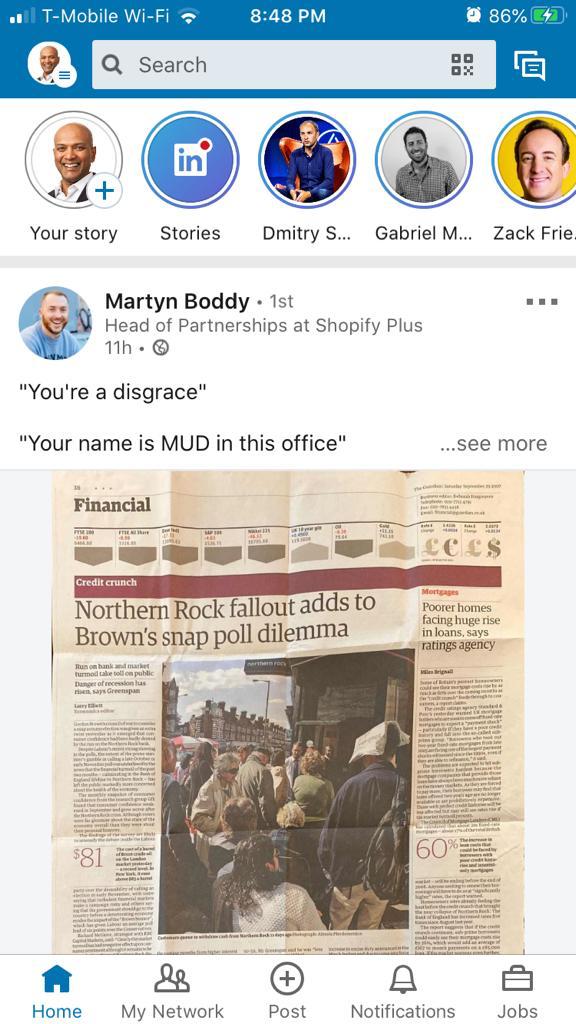
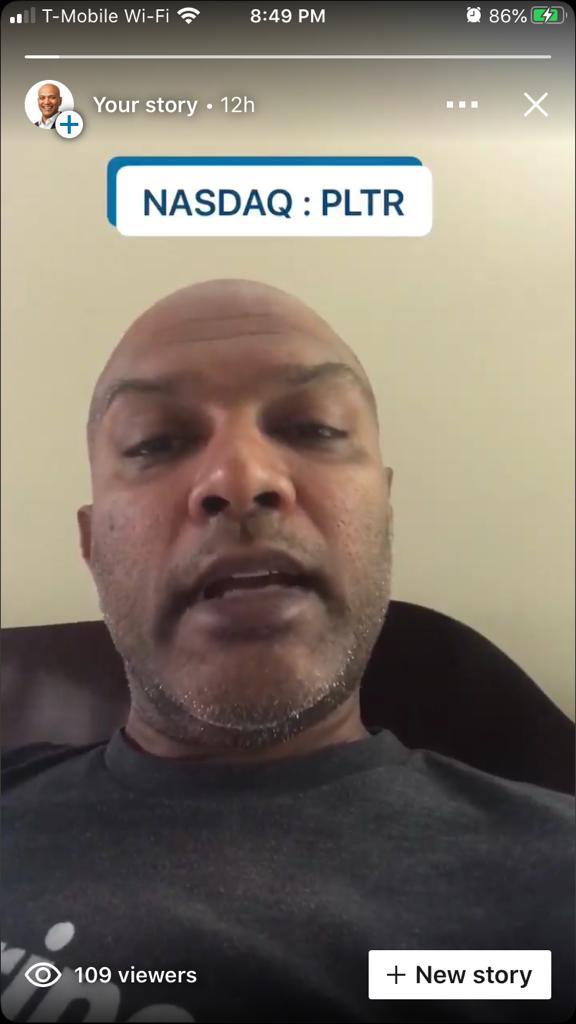
LinkedIn rolled out a new mobile feature to a limited number of users in certain countries called LinkedIn Stories.
If you are familiar with TikTok, Instagram , Facebook or Snapchat stories feature, it is fairly similar with a few differences.
There are very few “filters” for your story. You can make it look better, but the options are limited.
Second, they are ephemeral. I cannot confirm if LinkedIn is “saving” the stories someplace, but they are “gone” after 24 hours.
Third, they are very limited engagement options for users. Every comment comes to your LinkedIn inbox. So, no threaded conversations.
I have been using it for a week. I update daily with ONE stock tip or ETF that I am watching daily.
I like it so far. Each day I have been getting between 100 to 200 views.
Facebook stories has about 300 million users apparently, Instagram stories has 500 million daily active users (DAU), Snapchat stories has about 200 Million DAU, and TikTok has about 500 million.
Since LinkedIn has 400 Million users, the DAU is more limited and because stories has been rolled out to a very few number of people the feature is in its early stages.
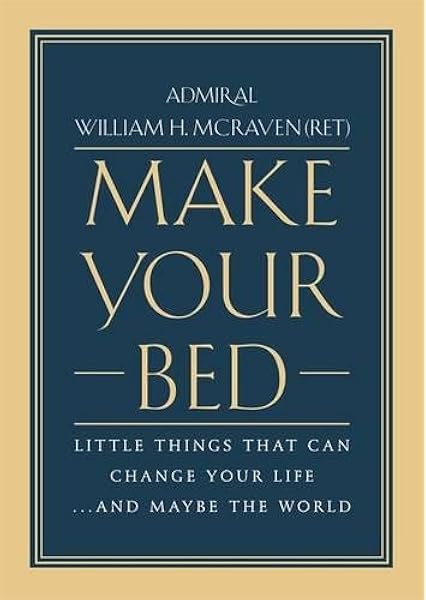
Make your bed – Book based on the commencement speech by Admiral William Mcraven
There are some books that are good reminders of the things that you should not forget. While the items themselves are not very illustrative or insightful, the stories that remind you of them are what make them memorable.
This is one such book. The very accomplished Admiral William Mcraven gave a speech at MIT. He is a retired U.S. Navy admiral who directed the raid that killed Osama bin Laden.
A former Navy SEAL himself, McRaven retired from the Navy in 2014. A year later he was hired as chancellor of the University of Texas system. He stepped down from the post in 2018 and is now a faculty member at the University of Texas at Austin.
You should read his entire speech (below), as well if you are keen. The book is an extended version of this speech.
There are 10 life lessons he reminds you in the book in 10 chapters.
Chapter One: Start Your Day with a Task Completed
Why is attention to detail important in your life and work?
Chapter Two: You Can’t Go It Alone Why is it important to have a strong network of people who support you? Why is it important to support others in general?
Chapter Three: Only the Size of Your Heart Matters Why is it important to not judge someone only by their appearance?
Chapter Four: Life’s Not Fair – Drive On! How do you deal with adversity?
Chapter Five: Failure Can Make you Stronger What adversity has made you stronger?
Chapter Six: You Must Dare Greatly How can you “be daring” and take these risks in your life?
Chapter Seven: Stand Up to the Bullies Sometimes doing what’s right means standing up for what you know is right.
Chapter Eight: Rise to the Occasion What dark times have you gone through in your life? How did you rise to the occasion?
Chapter Nine: Give People Hope How do you encourage people when things get rough?
Chapter Ten: Never, Ever Quit! Why is it important to never quit?
This photo provided by The University of Texas at Austin: Naval Adm. William H. McRaven
I have been reviewing Privacy Policies generators over the last few days. If you have a website or an app, I assume you are aware of GDPR and CCPA. These laws required you to be clear about a) what user data you collect from visitors, b) how you store and use that data, and c) who you share the data with.
What user data you collect: For most SaaS apps, you need name and email at the minimum. For some apps phone (for two factor authentication) may also be required. For paid SaaS apps, you might collect credit card, location, address, IP address, etc. Since all of the users data is considered private, your privacy policy needs to be clear that you are collecting all of this data.
How you store and use the data: SaaS apps use the data for email marketing, retargeting, notifications, etc. Your privacy policy needs to outline the uses of all types.
Who you share the data with: If you use 3rd party providers for email marketing, you need to be clear about those as well.
Fortunately most online privacy policy generators do a good job of asking simple questions (guided wizard) and then giving you a policy document that you can link to.
Many founders I know just go to another website and copy / paste their privacy policy and terms of service. While that seems quick and fast, the only time you need these policies to work is if a user litigates. Especially if you have a paid service, I would recommend using a customized privacy policy. Or you can request that you corporate lawyer provides you with a boilerplate template.
There are over 20 privacy policy generators, but for SaaS businesses, I would consider the following 3 for SaaS businesses. I have used Termly and TermsFeed.
TermsFeed: Provides multiple documents including Terms and Conditions and EULA. You can also get free templates for multiple types of legal documents that you can customize.
2. Iubenda: Provides cookie policy, terms and conditions as well. Best solution if most of your customers are from the EU.
3. Termly: Provides policies for multiple platforms, including phone based apps, website and provides automatic updates to policy on changes.
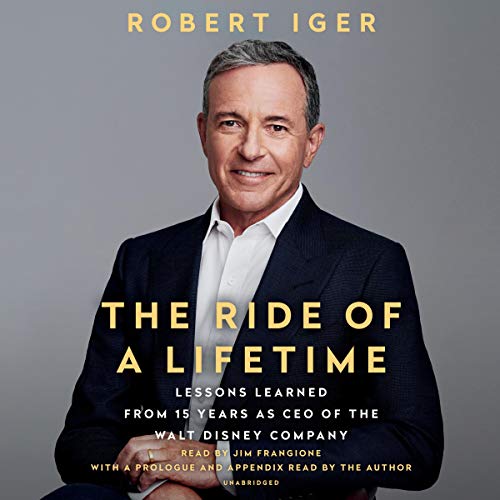
I am a fan of business autobiographies. I loved Howard Schultz’s Pour your heart into it (4/5), and Shoe Dog Phil Knight (4.5/5) the most of the 50+ books I have read so far. I would give his book 3.5/5.
Since Bill Gates himself recommended the book by Bob Iger, I thought I should read it.
The story itself is pretty compelling, with the first few chapters mostly about his youth and childhood. The story of how he joined ABC, followed by his vision for Disney when he was being considered for the CEO role are the best parts.
I do not want to give the entire book away, but I felt the book itself did not give me any more glimpse into Bob Iger than what I had read in the press before.
He does not address the #MeToo movement issues, the book is very well scripted and he chooses not to reveal anything about himself more than what he feels is necessary and skips all the parts about his relationship with the previous CEO.
The great parts that I loved were his discussion with Steve Jobs before the acquisition of Pixar, the discussion of how the changing media landscape is a catalyst for companies such as ABC, FOX, NBC and CBS.
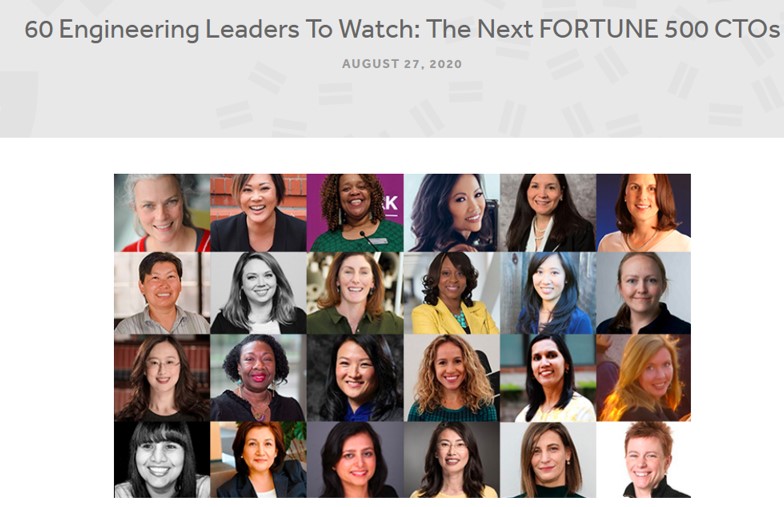
GirlGeek has a good piece on 60 women who are engineering and technical leaders. It is a very compiled list and I would recommend giving it a view.
GirlGeek Top 60 engineering leaders to watch
I like this list a lot. I would love to get some more up-and-coming names, however. Most of the women in this list seem like they have already made it.
Some quick observations:
90% of the women are in the bay area.
85% are from technology companies (which is to be expected).
Except 6 of them (10%) every one has an advanced degree in engineering.
Google and Salesforce top the list with the most # of women technical leaders at 5 a piece.
Average # of years of experiences among the list is over 13.
You are in a meeting with a few others. There is a presentation or document which has been provided to all of you in the meeting. After 20 minutes of the presenter talking and in slide #11, you get a question that pops in your head, about something that was presented.
You ask the question – “Why is it …”?
The presenter responds “Yeah, that’s a good question. I think …”.
A few minutes later in slide #17, another person asks what you think is the exact same question, but phrased differently.
Everyone in the room exclaims “Wow, that’s an insightful question”.
You wonder if it is because you were asking the question early, or because you are never able to get your point across easily, or because others don’t view you as “insightful”.
If you ever wanted to have a bigger impact on most situations, where people consider your point of view as impactful and insightful, then read on.
Over the last 3-4 weeks, I have been reading over 50+ articles, books and research on what Insight is. Here is a summary.
The capacity to gain an accurate and deep understanding of a person or thing
First, the definition and origins. The word Insight (noun) comes from Scandinavian origins (insikt) meaning inner sight or wisdom.
The capacity to gain an accurate and deep intuitive understanding of a person or thing.
Merriam Webster dictionary
John Kounios is the leading insight researcher in the world, and a professor of psychology at Drexel University. He has done extensive work on understanding how everyone can be insightful.
First, most people solve problems in 2 ways
Analytical reasoning or Insightfully
Analytical reasoning is logical and structured.
Insightful thinking is creative.
You dont get insightful just because you meditate
If think you can just meditate on a problem for long and come up with an insight you are probably right, but most of us dont have that luxury.
Insight is like a cat. You can’t order it to appear. You can coax it. But you can’t command it. Creativity and insight flows from a particular brain state. And if you can put yourself in this brain state, you will be more likely to have these creative insights.
John Kounios
You can coax an insight by looking at the problem more creatively.
According to his research, there are 3 things that are important to put your mind in a frame to generate insights.
Positive Mood: Creativity flows from a state of feeling safe or secure. When you feel safe or secure, you can take risks. And creativity is intellectually risky. When you come up with new ideas, they can be wrong. When you try to implement new ideas, you can meet resistance.
Large Spaces: If you’re in a large space – a big office, with high ceilings, or outside — your visual attention expands to fill the space, and your conceptual attention expands.
Take a break: When you take a break from a problem that you’re stuck on and do something completely different, you forget the bad idea that you were fixated on. It allows other ideas, better ideas, to bubble up to the surface.
The problem is these are not solutions that are useful if you are in a meeting room with others (say nothing if you are in a Zoom call).
What can you do to be more insightful then?
There are 5 things I have found, each of which I will expand on next week. They are :
Ask the question “For this to be true, what needs to be false”?
Look for exceptions in the data
Only look for the anomalies in the data, argument or thesis
Reframe the question by assuming you are the “customer”
Ask yourself “If <someone else who you admire> were to look at this problem, how would they frame it?
This research paper was published by the New York University professors Deepak Hegde and Justin Tumlinson. In this paper they posit that there are 2 theories, both of which are based on information asymmetries.
When information frictions cause firms to undervalue workers lacking traditional credentials, workers’ quest to maximize their private returns drives the most able into successful entrepreneurship
Information Frictions and Entrepreneurship
The researchers have built a mathematical model to view data on a) who becomes an entrepreneur vs working at a firm, b) what their earnings over time are and c) why do entrepreneurs choose to start a company.
Empirical analysis of longitudinal samples from the U.S. and the U.K. reveal the following patterns:
(i) entrepreneurs have higher cognitive ability than employees with comparable education,
(ii) employees have better education than equally able entrepreneurs, and
(iii) entrepreneurs’ earnings are higher and exhibit greater variance than employees with similar education.
What this means it that employers value people’s degree, credentials, etc. Most entrepreneurs believe they are as good (or better) than their peers who might have graduated with a degree from a better institution.
For example, potential employers commonly accept educational attainment and work history as signals of unobservable ability. However, the signals are imperfect if a worker believes his ability exceeds what potential employers can infer from his observable characteristics, then he chooses entrepreneurship and becomes residual claimant of his productivity, rather than join a firm in which he would be paid according to his observable signals.
I had a chance to read Essentialism – the disciplined pursuit of less this week. It was a quick read, with many stories and examples, and I would give it a 3/5. The big takeaway for me is to make conscious choices, say no to a lot of things and make routines that help you say no to trivial things more often. Here is a PDF copy of the book (Thanks to heram)
Essentialism: The disciplined pursuit of less
The basic value proposition of Essentialism: only once you give yourself permission to stop trying to do it all, to stop saying yes to everyone, can you make your highest contribution towards the things that really matter.
The way of the Essentialist is the relentless pursuit of less but better. It doesn’t mean occasionally giving a nod to the principle. It means pursuing it in a disciplined way.
Essentialism is not about how to get more things done; it’s about how to get the right things done.
If you don’t prioritize your life, someone else will.
ESSENCE: WHAT IS THE CORE MIND-SET OF AN ESSENTIALIST?
1. Individual choice: We can choose how to spend our energy and time. Without choice, there is no point in talking about trade-offs.
2. The prevalence of noise: Almost everything is noise, and a very few things are exceptionally valuable. This is the justification for taking time to figure out what is most important. Because some things are so much more important, the effort in finding those things is worth it.
3. The reality of trade-offs: We can’t have it all or do it all. If we could, there would be no reason to evaluate or eliminate options. Once we accept the reality of trade-offs we stop asking, “How can I make it all work?” and start asking the more honest question “Which problem do I want to solve?”
Not everything is essential
Steps to Essentialism
STEP 1. EXPLORE: DISCERNING THE TRIVIAL MANY FROM THE VITAL FEW. Essentialists systematically explore and evaluate a broad set of options before committing to any.
STEP 2. ELIMINATE: CUTTING OUT THE TRIVIAL MANY. To eliminate nonessentials means saying no to someone. Often.
STEP 3. EXECUTE: REMOVING OBSTACLES AND MAKING EXECUTION EFFORTLESS: Essentialists invest the time they have saved into creating a system for removing obstacles and making execution as easy as possible.
There are three deeply entrenched assumptions we must conquer to live the way of the Essentialist: “I have to,” “It’s all important,” and “I can do both.”
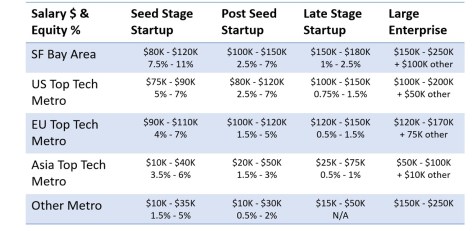
There are 5 variables to consider for the compensation, which might make it complicated, so I will try to simplify for 2 of the variables in this post – size of company and job location. I have collected data from 11 sources – PayScale, Glassdoor, LinkedIn, Salary.COM, Comparably and VC databases such as Pitchbook – sources below.
The variables are:
Size of the company: Impact of the role to the organization is a key determinant. Startups pay less than larger companies, but give more in stock. Seed stage startups will pay less than later stage, but give you more equity (in terms of % ownership).
Location of the role: Roles in the US pay the most, followed by Europe and then in other regions. Indian CTO roles do not pay as much for most startups. Self reported data from 594 CTOs place the salary at INR 2.5 Million to INR 5 Million (25 L to 50 Lakhs)
Industry segment and sector: CTO roles in technology pay a lot more than roles in non technology companies, but that is changing quickly.
Scope of the role: CTOs are expected to be technical leaders, but many organizations also expect them to play the role of VP of Engineering and CIO in certain cases.
Years of experience or CTO background: The rule of thumb is that more experience equals higher pay and equity. Similarly if you have experience building large scale systems at companies such as Amazon, Facebook, Google or Microsoft, you will get paid more than if you are not.
The numbers below assume you are hiring a CTO, as opposed to having a co-founder as a CTO.
The next question is how can I get on the more or show that I deserve more than the guideline range? That question is best answered situationally and if you want to setup time with me for some advice feel free to email me.
The data is above is very subjective and has many nuances. Obviously salaries are very personal and negotiations play a big part in the final salary you get.
There is a an old myth that 80% of the jobs are not advertised. Depending on who you talk to, you will get a variation of this number – from 40% to 80% of jobs are apparently filled without more than 2 people being interviewed. While that is not true in my experience for all jobs (it is closer to 20% or less), it is very high for senior roles. In this post I will give you a few actionable tips on how to make your name on the shortlist when founders, CIOs, CEOs and board members are looking to fill that crucial role of CTO for their organization.
The first thing to realize is that there are far fewer positions than there are # of qualified candidates and for roles in the C suite, the right fit is absolutely crucial. So, while you may be interviewed, it is also likely that in 70% of the cases an internal candidate is chosen. The reason I mention this is so you realize that in most cases, you should be looking internally within your organization to see if there is a need for a CTO position.
In this post my goal is to give you more “at bats” – or more chances of being interviewed for external positions.
The hiring executive for a CTO tends to be the CEO or founder in 34% of the cases (more for technology companies), the CIO (Chief Information Officer) in about 30% of the cases (especially larger companies) and CDO (Chief Digital Officer), CPO (Chief Product Officer) or board member in the remainder.
The CTO is hired by the CEO / Founder or CIO in over 65% of the cases. Data from CTO searches of executive search firm databases
If you were to leverage this data, then the strategy to get shortlisted for CTO positions becomes both easier and harder.
Easier because you know who are likely the key people to hire CTOs.
Harder because those people are very difficult to network with.
There are 5 primary strategies you can use to make sure you are “Top of mind” for these positions.
Make a short list of potential CEOs and CIOs in the companies you would like to work for (market segment, size) and find a way to add value to their work. I would recommend curating articles and content for them which helps them get a summary of key trends weekly.
Build and maintain relationships with colleagues at your current company who are thinking of starting their own venture
Build relationships with recruiters – there are specialty CTO hiring firms such as CIO Partners, YScouts and CTO Recruiter.
Build a comprehensive social profile so you get inbound requests for CTO positions – GitHub, LinkedIn, Twitter, Blog and speaking engagements
Contribute and work with a open source project which gives you an opportunity to work with the founder who could use help from you as a CTO
Now that you know ways to network your way into a job, what are the ways to find out about CTO jobs that are open?
There are 7 sources that have some listing of CTO positions. In no particular order, I would keep tabs on them every other week. The links below will only list the CTO open positions.

/arc-anglerfish-arc2-prod-mco.s3.amazonaws.com/public/YZPX42HZSZF67PM7NZY4PPA44Q.jpg)