Many of the entrepreneurs I know have created new innovative startups thanks to real constraints they had. For example, I was hearing AirBnB’s Brian Chesky, on the Corner Office podcast and he mentioned that when he and his cofounder were trying to get some money to get started and the only way to keep afloat was to “rent” their air bed they had in their room. That, then led to Air Bed and Breakfast, which is now AirBnB.
This was a real constraint they had – no money to “eat” so they had to make it happen somehow.
I have heard of many stories of innovation where in the protagonists had real constraints of either financial, technology, supply, demand, economic, social or any number of other characteristics.
The interesting story that I have also recently heard of how Facebook has “pivoted” from being a desktop offering to getting a significant part of their revenue from mobile is how they were given the arbitrary constraint of only accessing Facebook via the mobile phone.
So there are ways that you can create “artificial” constraints to force innovation to happen.
Most larger companies and some smaller ones as well, have to constantly find ways to create artificial constraints – to find a way to innovate and be more be a pioneer.
While some constraints are good – lack of funds at the early stage for example and lack of resources, there are entrepreneurs that are stymied by these constraints and those that will find a way to seek a path to go forward.
I think this is a great way for you to think about innovating in a new space. If you have constraints, find a way to use it to your advantage.
I got a question yesterday about how to expand into a new market (the question was specifically about expanding from India to the US or other markets) and the approach / strategy one could take to grow the business.
I have personally good knowledge only of the US, UK, German and Indian markets, since I have stayed at and sold in all these markets. I have also advised companies who have started in US and India and wanted to sell to the other country.
I am going to make some assumptions about the type of company and stage, to make things easier. First, I assume you are a startup with a B2B focus, not consumer or eCommerce. Second, I assume you have some initial customers in your own market who have validated that the need exists, and your solution provides some value. Third, I am going to assume that your product costs more than $10K, which means you will have to “meet and convince” your customers to buy your product, instead of asking them to self serve or buy online.
If you do not have some early customers, in your market that you currently operate in, I recommend you do that first. If your product costs < $10K annually, you should focus on making the process of acquiring, trying and using your product simple and seamless, so you can focus purely on self-service approaches to getting customers.
The best way to think about a new market or region is to assume you are starting a new venture all together. I would focus purely on getting the first few customers in a new market via referrals from either existing customers or from friends and colleagues.
Before you start to “scale” your marketing and sales efforts to acquire customers who have no background or experience working with you I’d recommend you get customers who you “know”. Focus on building your pipeline either by tapping into your own network, or if you don’t have a network, I’d suggest your attend a conference or two in your space and find a way to start (as an attendee) and build a relationship with 3-4 people who you could start to talk about your product with.
The first few customers are critical to helping you establish your credibility, so while there may be an “ideal” customer with a large budget, immediate need and willingness to take a risk with your company, I’d err on the side of someone who you can get instead of the ideal customer.
To find the early customers, I would also build an early target list that would focus on 4 characteristics – the industry (I prefer finance, technology and telecommunications since they tend to be early adopters), size of customer (mid-sized customers have budget and move quickly, whereas smaller customers don’t have budget and large enterprises move slowly), title of the buyer (marketing, sales and services move quicker than finance and HR) and location (US – coasts are better than Japan or Europe for example, since they are risk-friendly).
For B2B startups, one of the biggest challenges and costs is “sales”. Especially if the product costs greater than $10K annually. While many of the lower price point SaaS products might spend more money on marketing, the immediate costs of hiring, managing and growing a sales team is a big challenge for most entrepreneurs.
I hear from a lot of entrepreneurs who try to “develop” a channel, the frustrations of working with a large company’s sales force.
In the attempt to tap into their existing customer base, they end up educating the “channel” sales team on questions to ask prospects, how to qualify opportunities and how to handle objections and not getting enough from the process.
In still other cases, entrepreneurs try to work with partners in the ecosystem – system integrators for example or existing products in adjacent spaces and trying to engage with their sales and technical sales professionals to help position and sell new products to customers. They realize after many weeks or months that the teams are rarely given an incentive to do anything more than sell the company’s own products.
While I am a big fan of trying to drive indirect sales via partnerships and business development efforts, I also believe doing it too early sets the wrong precedent for startups.
The question is “When is too early to engage partners to sell”?
There are no actual numbers, but some rules of thumb that I follow.
First, if there is enough demand for your products that you are unable to return customer calls or you are unable to fulfill requests from customers for meetings, then you should engage partners. The best and easiest way to help build a loyal partner base is to drive the initial business to them.
Second, you should have enough case studies to cover at least 3 use case scenarios in your top industries as examples. What that means is that you should have 3 possible case studies of how your product helps drive initiatives in a specific industry that the partner operates in, where you are targeting to get customers.
Third, you sales cycle time should be reducing 10% per opportunity and your sales process must be defined enough so it is consistently predictable. For most companies, this does not happen until you are selling for a year and have about 30-50 customers already.
I usually get the question that if these were already in place, why would you need partners? The short answer is to scale.
Similar to funding from institutional investors, if you already have a business that’s doing well and growing, then funding and partnership sales helps you scale quickly not to generate the initial excitement.
In fact, my suggestion to enterprise B2B startups is to not consider channels and partnerships for selling until they have raised their series B funding from an institutional investor.
Channel sales for startups
Channels take time to develop and you have to invest a lot of money to gain the benefits over a long period of time.
I would highly recommend you be in control of your own destiny and push yourself to directly engage, generate and close your initial leads and customers.
If you have a profitable, but slow growing business, which complements another larger existing company in a relatively small market, you will have the opportunity to shop your company for sale.
Many founders who have organically (customer funded) or via outside investments (VC / Angel funded) grown their company, get the 7 year and 10 year itch to sell their company.
Whether you have decided to sell your company or just wanting to shop it to see the potential value, you will likely run into investment bankers who will offer their advisory services to help position, pitch and sell your company,
An investment banking firm is typically a partnership, (similar to a legal or accounting firm) with the founders having the capability to leverage their connections and expertise of certain markets, to create “synergies” for new companies.
Investment banking services
When an investment bank is hired by a company that wants to acquire other companies, they represent the “buy side” and if they are helping you sell your company to acquirers, they are known as representing the “sell side”.
If you engage with an investment bank to help shop your company to acquirers you are giving them a “mandate“. Most, (likely all) investment banks will expect an exclusive mandate, meaning, you cannot have anyone else shopping your company to potential acquirers. Even if you do have others and they end up selling the company, your investment bank will likely get a portion of the sale.
I was going to focus this post purely on sell side services of investment banks. The agreement letter or advisory letter or “letter of agreement” is a contract between the investment bank and your company.
Most entrepreneurs get hung up over just the commission or the “rake” the investment bankers take for the transaction – that’s only one part of the agreement – similar to your valution. Most bankers typically charge between 2% (highly unlikely, but possible if you are a hot company, with a high probability of sale at a large price) to 7% (smaller transaction, < $5 Million).
The analogy I hear from a lot of entrepreneurs is similar to a “HR consultant” or a recruiter, who works on a non-exclusive basis to fill a position. I do get questions as to why investment consultants demand exclusive rights. To which, I’d say that even the best HR consultants and those that work on executive positions work on a exclusive mandate.
There are 3 things that investment bankers like to call their “service value proposition” – their knowledge of the industry to help you navigate the buying landscape, their connections to potential buyers and their expertise in helping you structure and negotiate your final sale agreement.
Thee are 5 items you want to pay attention to in your advisory agreement:
Term of the agreement – Since most M&A transactions take 3-6 months, these agreements will last at least for that duration. Most agreements also specify that if your company gets sold for 6-12 months after the start of the engagement, the investment bank will likely get a portion of the sale, even if they did not make the introduction or help negotiate the final sale. While many will claim it is standard to have a 12 month clause, there is no “standard” – it is all negotiable.
The engagement fee or retainer: To help prepare your documents, pitch deck and start to position your company, the company will ask for a retainer fee between 10% and 20% of the expected final sale price (or about $25K to $100K) – whichever is lower. This fee is purely for them putting the time and energy to get your documents together and is independent of whether they final sale happens. If your company is “hot” many will waive this fee. If you are looking to sell, expect to pay this amount – 50% before they start and 50% after 3 months of the final completion of the agreement whichever is earlier.
List of preferred buyers or list of buyers already in agreement. In your agreement sometimes, you will have a list of companies you might suggest to the banker to not approach since you have already been taking to them or the opposite – you have a term sheet from one buyer which you are not 100% happy with, so you want to shop for more deals. In this case you might specifically ask for a certain company to be on this list to be shopped to.
Other considerations. If the buyer directly does not approach you, then in a lot of cases, you will find them to want some protection clauses, such as 3 year commitment for the founders to stay at the company etc. To ensure this happens, they will have an “earn out” amount associated with the sale. That is usually counted as part of the acquisition price, but is paid over time. An investment banker, typically will not have the patience to wait for that period of time or control over the longer term outcome, so they will want their “fee” to be paid in full for the net amount. That’ s something you can negotiate as well.
There are a few other negotiable clauses, but these are the main ones. At the end of the day, I would say that like most agreements, it depends on who needs who more. If you are eager to sell, expect to give in on certain parts of the agreement. If your banker, however needs you more, they will be willing to give you more leverage.
Finally in certain cases entrepreneurs use bankers to help raise their series B investment round, so most of these clauses hold good for that type of agreement as well.
Yesterday I crossed over 1000 blog posts. Sometime in the next month I will (hopefully) cross 100K subscribers. It has been a long journey and with many twists and turns. My original intention was to “become an expert” on online communities – hence the URL. Sometime over the next few years, my focus changed to be more about technology in general, building a thought leadership profile, talking about entrepreneurship and finally about investing and startups.
On a good day, my blog gets 24% open rate from my subscribers, and most days less. On average 40% of the subscribers are in India and 34% are from the US. I did some work with full contact API data and found that about 60% of subscribers have “founder” in their title on LinkedIn.
There have been many folks who have been inspiring and helped me along when I was not exactly sure why I was blogging or for whom. There have been a few role models who I consider the best in the business and are people I think have a day job, and still have built a strong brand around their work. They have been doing it consistently for years, so I dont consider them “flash in the pan” type overnight successes.
I wanted to call out 6 of them who I have been reading and trying to emulate, and if you are into blogs or reading online I think you might know them all. I dont tend to follow a lot of publications and media blogs like TechCrunch but individual bloggers.
Horace Dediu of Asymco: If there was one person who writes with more authority and is very data driven, I’d say its Horace. His graphs and charts are worth putting on a picture frame at times. I am a huge fan.
Ben Thompson of Stratechery. I have been following Ben only for the last year and he is very insightful, I wish I had the ability to see things around the corner like he did.
Jean-Louis Gassee of Monday Note. I first met Jean-Louis about 15 years ago, after he left Apple. He is possibly one of the most authoritative voices on Apple, more than any of the others who are “insiders” or into Mac media culture.
Neil Patel of Quick Sprout. Another long time writer and essayist, his posts are very actionable, which I admire. Few people can push you to do something immediately about something the way Neil’s writing can.
Mark Suster of Both Sides of the Table: Mark’s pretty authentic. There are 2-3 of his posts that I ready every month – Lines not dots, is still my most recommended piece to new entrepreneurs.
Tomasz Tunguz of Tom Tunguz. Relatively new on my radar, Tomasz writes very well researched pieces and is quite possibly an expert in the SaaS space by sheer ability to write so much after a lot of hard work researching the topic.
If you look at the highlighted / bold words – data driven, insightful, authoritative, actionable, authentic and well researched are what I aim for. I dont end up doing that with every post, but that’s my goal.
Even without meeting me, these folks have been mentoring me with their writing. This is my thanks to them.
If you have a few early customers for your SaaS application, the next question typically is to get to $1000, then $10K and then $100K in MRR (Monthly Recurring Revenue) – which most people will call serious traction.
The biggest criteria I have found in looking at the 3 SaaS companies I have invested in is price of the product determines the customer acquisition technique.
There are 3 bands of pricing for SaaS products. I am going to look at monthly prices for all the products.
The first band is if your product is an individual purchase on a person’s credit card. Typically most people get uncomfortable at more than $99 per month. The sales cycle could be anywhere from 2 to 6 weeks.
The second band is when a department purchases your product for use, or if your product is highly specialized for a role which makes it between $99 to $499 per month. The sales cycle is typically between 2 to 10 weeks is my experience.
Finally, the last band at $499 to $999, is when you typically need approval from your manager. In many cases a “corporate wide” approval may also be required at > $999 per month. In most cases the sales cycle is greater than 6 weeks and for products > $999 per month might take 3 months or more.
Marketing Techniques for SaaS companies
These are when you are selling to an enterprise B2B market. For those targeting SMB markets, the bar is lower for the amount of money, because you typically find the owner approving most purchases over $299.
If you have a few ( say 10) customers for your product and are making between $1000 (for $99/month product) to $5000 ($499/ month product) and are trying to get to traction – $10K and then $100K per month, there are only 2-3 techniques each that work.
For lower cost products, SEO and Search advertising are predominantly the only viable models.
For more expensive products, since the sales cycle is typically longer, you will need to “start” your customer acquisition with one technique (Content Marketing, with Social Engagement) and will probably “engage” the customer (cold emails, inside sales engagement after signup) via phone and likely have a face to face meeting for products that cost > $25K per year.
What does not work for early stage, pre-traction companies?
Events, especially those that feature a lot of companies and several large organizations in your space, dont work at all.
There are 2 techniques that many people claim work to your “brand” front and center with customers, but does not drive leads – blogging and podcasting.
While both are largely easy to do and require much less investment than other techniques, they might be used in conjunction with other mechanisms, but will not drive much in terms of signups, even if you have a “freemium” plan.
What I have also noticed is that engaging potential customers via webinar (where you get 20-30 participants) and they can ask questions and learn about the problems you solve work much better than even search marketing and touch-less signup.
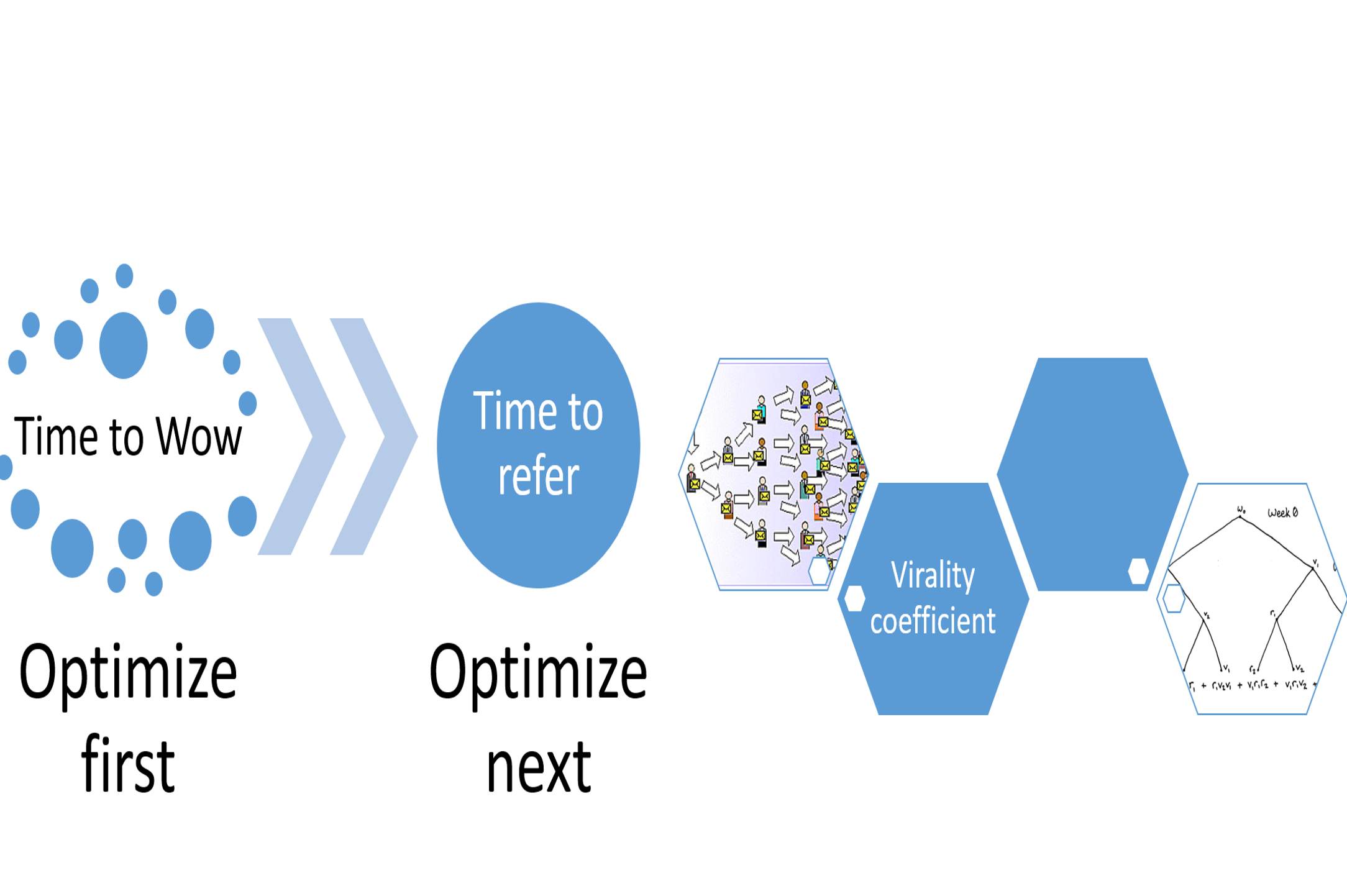
There are 3 numbers that determine if your mobile app has reached product market fit. The “Time to Wow”, “Time to Refer (TTR) and Viral Coefficient. Once you have achieved product market fit, your TTW should be short (preferably in minutes or hours), your TTR should be hours or days and your viral coefficient should be greater than 1.2 to 1.5.
Time to Wow
Most entrepreneurs start with their friends and family to be their first “beta” users for mobile apps. While that’s the best logical point to baseline your TTW, TTR And VC, you might not become “big” quickly enough to generate VC-level interest for your startup if that’s your goal.
There are multiple marketing methods available for startups. Many of the mobile app companies I know have tried Facebook Ads, Social Media Engagement, some have even tried SEO and still others have tried extensive PR and Blogging
The only thing that has worked very well for non-gaming productivity apps is influencer marketing.
Over the last 1 year, at Microsoft, there have been 3 acquisitions of top mobile productivity apps – Accompli (Email client), Sunrise (Calendar) and Wunderlist (Task Manager). I had a chance to talk to the folks who were at the companies during the early days.
The only thing that worked was “Word of mouth” for marketing. None of them spent money on advertising – they did market, but they did not advertise.
The only marketing technique they adopted was influencer marketing.
Influencer marketing is the approach to get influential early adopters to try the product, then tweak to get their feedback and have them spread the product via word-of-mouth.
It is important to realize that influencer marketing begins with identifying, engaging and building your influencers way before your product is ready or even before you have a beta product.
Emailing your influencer when you need to have them try the product will not suffice.
You have to engage with them, comment, work their egos and build your credibility with them long before you launch your product.
Influencer marketing helps your increase your viral coefficient, and it may increase your time to refer, but it does not help with your time to wow.
You will get a lot more people trying and using your product if influencers recommend it, but dont expect that to be the only technique you should adopt after your product has a viral coefficient greater than 1.5
You might want to then adopt partner app referrals (when another popular app suggests your app as an add-on).
The other technique that works later is bundling – this is when you are part of a “suite” of apps which act together as a bundle and perform complimentary tasks or have a similar goal, but aid in different parts of the goal.
I am not a fan of Donald Trump and dont agree with many of his positions, but he sure is entertaining to follow. I do actively follow politics, so I am keenly interested in campaign strategies, tactics and political news.
There’s a lot to learn from Donald Trump, in terms of startup strategy. There’s a great piece about him on Business Week, which is a good read.
Trump paraphernaliaTrump Mar A Lago Club (ht: Business Week)
Here’s the TLDR version – he inherited a lot of money from his dad, started building and did some real estate development, lost a lot of money, bankrupted his companies and then started fresh again. Instead of risking a lot with loans, he instead, created a “branding and merchandising” entity which lends the Trump name to real estate companies. This licensing is how he makes a lot of money – risk free.
The 3 most important lessons I learned from him so far are:
Disrupt the incumbents and “insiders” by creating a new set of rules to play by. Political campaigns, we are told are about issues, depth of knowledge and having strong positions on those issues. You need to be broad and deep on the issues – know who the president of Syria is, as well as the unemployment rate in rural Iowa and the daily working class problems of a single mom in Florida. Which realistically most candidates don’t have.
Trump, but no means is an expert (for most of the things that you need to be an expert on to be a President). In fact, he is the antitheses of an expert. He has forced all the other “institutional candidates” with pedigree and great backgrounds to make illegal immigration the #1 issue for the election. Which, in itself is surprising, given how little impact it has on the economy or social well being. It does though, have a huge cultural impact.
The incumbents, now have to play by his rules and are falling all over themselves, looking like fools, and giving answers that indicate that the solution to every problem is to build a wall.
2. Make your competitors biggest strength their biggest weakness. Most political campaigns are about fundraising. You have to bring enough via small donations, contributions from rich investors and retail money (think $1000 private dinners). Most of the competitors have been trying to do that, just like the establishment of the Republican party – which is confused as to how they can “checkmate” Trump. Well, their biggest strength (fund raising) is now inconsequential. Trump has spent no money (not really, but much less than his competitors) but has been constantly getting the attention and the coverage to be “in the news” all the time.
The rich Republican donors who want to stop him on his tracks are a loss to figure out how to do so, given that their money (with which I presume they can buy attack ads) is not going to buy them much at all.
3. Being an outsider in an industry helps frame everyone in that industry as “old school” and “dithering” to potential customers. Most customers like new approaches from other industries, even though they understand that 100% of them may not work . Trump’s solutions for building walls, making Iran “pay if they violate the contract”, etc. are unlikely to work in the political arena, which are purely business ideas, but he has framed them well enough for people to think there’s a shot it might work.
I actually am among the few people who think Trump will will the nomination of the Republican party, since the rest of the crowd (save Marco Rubio) are just not that exciting. If, he does that, then he has a great shot at being President.
Imagine that. That’s the startup equivalent of an Unicorn. Very little chance of happening when you started, but going against an existing set of players in a predefined market, making it easy pickings at times.
In talking to 4 new mobile (non gaming), mostly productivity , app developers, I understand now that there are 3 metrics the founders breathe, eat and sleep: Virality coefficient, Time to Wow (TOW) and Time to Refer (TTR).
A viral coefficient is a number which tells you how many customers each is your present customer bringing to you on an average.
Time to Wow is the amount of time from when a user downloads the app, uses it and gets enough value to get the “wow” effect.
Time to Refer is the amount of time it takes for a user from the time they use your app, get a wow effect and tell others about your app.
The first metric to optimize that is completely within your control is the “Time to Wow”. For most games, it has to be in minutes, but for productivity apps it can be a few hours or days. The longer the time to wow is, the less likely you will grow organically.
What can you do to reduce your time to wow?
First: Fit the product features to the user’s usage model as opposed to your initial definition of the problem. For example if your app is a calendar management automation AI product, the first time a user gets a WOW is when a calendar invite is sent to them and without their intervention it schedules it automatically. You could give them “examples” of calendar appointments on their calendar, but its not the same as their own use model.
Second, understand your users trigger points to Wow. Do they get a wow when they see an appointment scheduled, or when they get a notification? What triggers them to get immense value from your app.
The second metric to optimize is Time to Refer. This is a word of mouth metric, both offline and social. If a user has a wow effect with your product, they will likely tell others. How long does it take for them to tell people is important. If they tell people after a month of using your product, then you still have work to do. If they tell people only if prompted for a problem associated with the solution your product offers, then you will have a lot of work to do.
If however, they had a wow effect and immediately tell others about how this solved a problem for them, you have a low time to refer.
Time to Wow, Time to Refer and Viral Coefficient
Finally the viral coefficient. The reason why influencer marketing works as a seeding strategy, for mobile apps and consumer Internet apps is because the influences who use your product initially have a large network (or following). When they like something (have a wow effect) and tell others, more people listen and take a second look at your product.
If your product truly has a wow effect for the lay person, it does not matter, who your seeding users are. If, however your product is niche, then it is very important to get top influencers as your first few users of the app.
The viral coefficient is the number of people each user brings with them because of their network. How many people will they tell about your product (unaided and unprompted) and how many of them take the action to download and try your product are both key.
I have been clear in my preference for hacker / developer / engineer founded companies. I prefer developers since they can actually solve the problem using tools at their disposal without having to “hire” people they dont understand anything about.
The biggest challenge of backing hacker founders, though is that once every so often (more frequently than I’d like), I get an entrepreneur who falsely believes they have achieved “product market fit” and the problem they have is one of marketing.
This is especially true of consumer Internet companies and more so in mobile.
For some reason, hacker entrepreneurs believe the “problem” is solved when the product has been shipped to the App Store.
That’s usually when they start thinking about user acquisition.
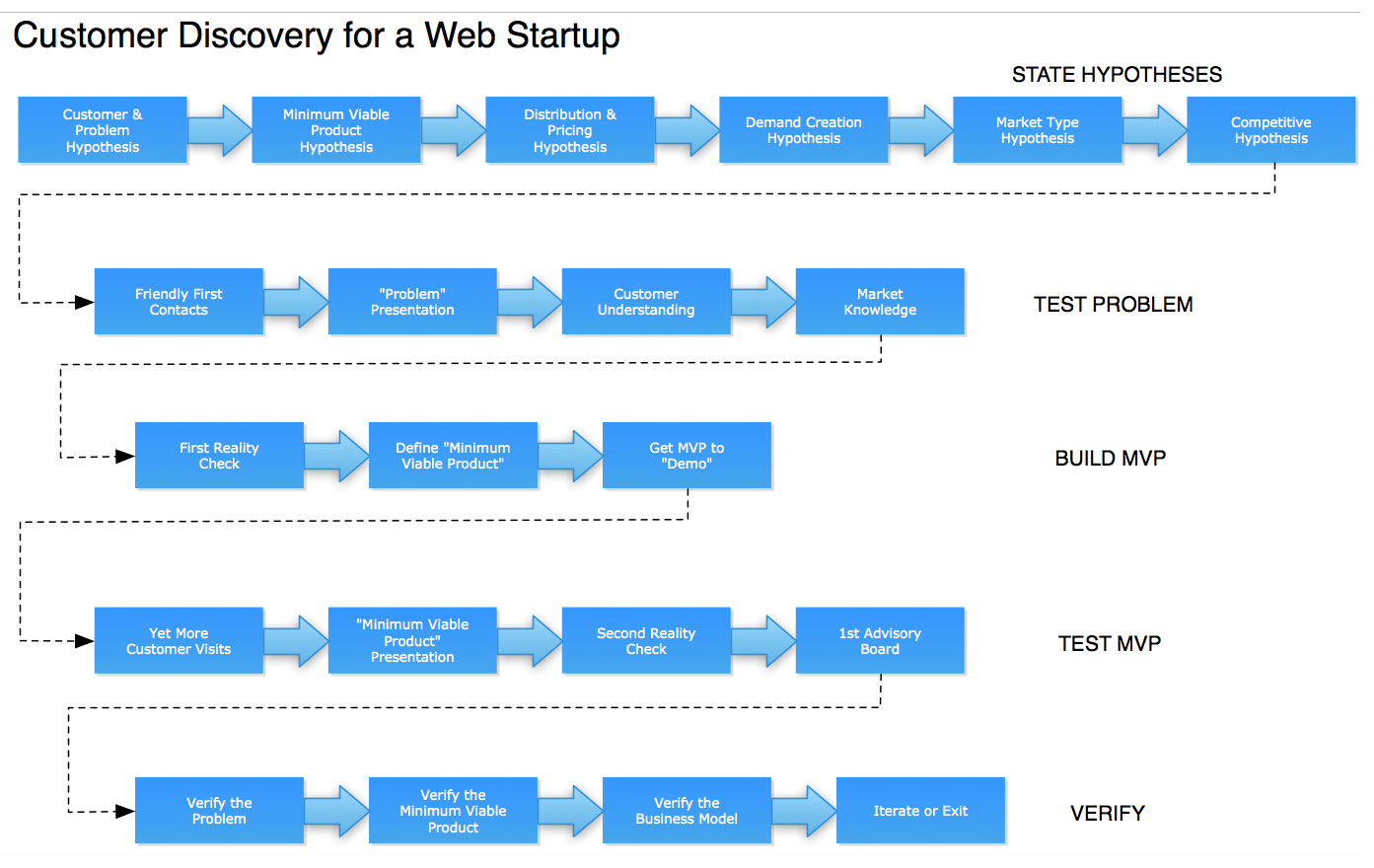
There is a big difference between customer discovery, customer validation and customer acquisition.
Customer Discovery
When you are talking to customers to understand their needs, and tweak the product to their needs or discover the real problem they have versus the problem you think they have, the stage you are at is customer discovery, development and validation.
When your product has completed its customer validation there’s one thing that you should know:
“What makes customers have a WOW experience with your product”?
If you do not know why a customer likes your product or when it triggers them to tell others, you have not yet achieved product market fit.
I do get a lot of engineer founders who will come to me after launching their product in the App Store. They are unable to get good traction for their product and they are stuck at 100-500 downloads per day and a total of 3K – 10K downloads. They then diagnose the problem to be a “marketing” problem and give me these possible reasons as to why they got limited traction:
They are not marketers and were unable to market the product.
They tried to hire 2-3 (pick a number) marketing people but they all were unable to get traction for the product, even though the product is “great”.
They have tried 5-7 different marketing tactics – SEO, Facebook ads, Social Media engagement, etc. and none of them is working.
It is usually at this point that I have the hard conversation with them about user / customer acquisition. Most times they are defensive and tell me they have been talking to customers “daily” and have been getting feedback and tweaking the product based on the customer’s needs.
They do however fail to understand that talking to customers during product development is “customer development” and not “customer acquisition”.
The easiest way to acquire customers is to have existing customers tell other customers.
So, then the only question you have answer is when and why will my existing customers tell other potential customers?
If you can answer that question, then the user acquisition is organic.
Else you have to use “marketing techniques” to acquire your initial users.
Marketing only adds fuel to an existing fire. It is not good at starting fires. Great product start fires. The fire spreads when a customer tells another person they trust about the product.
It is not a “marketing problem” you have. You have a customer acquisition problem, which you may classify as marketing, but really it is a product problem.