All posts by Mukund Mohan

My discipline will beat your intellect

If you are considering a startup blog, focus on “more” insights, not a “better” narrative

Over the last 4 months as many of you have noticed I have been writing a blog post daily. That’s resulted in 120+ blog posts and a few insights on what I learned by blogging daily.

There are many things I have learned about the writing process and very little about building a strong readership base. The number one thing that’s changed over the last few years is that most people seem to care about the number of unique new things (insights) they have access to and reducing the amount of time spent gaining those insights.

I guess that’s not “new” news or insightful, but it is the explanation for the success of tweetstorms.

Made popular by Marc Andreessen, who had a blog a few years ago and quite possibly figured out this inadvertently or by design.

Here is what I mean by concentrate on more but smaller pieces of insights vs. One big insight but with a great narrative.

Thanks to the mobile phone (largely screen size) and twitter, there is so little time for people to read long form articles that the number of long form pieces being read (and also the number of books) is reducing dramatically.

At the same time, people prefer to read 10 individual, standalone sentences that are 140 characters or less than read one big paragraph with 10 lines or 1400 characters.

Giving a lot of context, adding many superfluous words is what a lot of writers do. The readers, though seem to have no more time or patience for it.

The implications for those wanting to make money writing a book (non fiction) or a blog are pretty big.

Here are some examples of things that work.

1. Lists – take any article you are planning to write and make it a list with some visuals. That works.

2. Instead of long paragraphs, with 5-7 sentences and over 70-100 words, focus on writing 1 sentence.

3. Video or Podcast: Focus on getting your content in an audio or video format with a 5 min solution instead of writing. The time to read an entire 750 word blog post might be 5-6 minutes and it may be the same amount of time to read 20 tweets, but readers seem to prefer the latter.

The other thing that works is attention grabbing content shock.

The real disruption from the cloud is yet to come for Indian IT services companies

About 60% of revenue for software vendors (for businesses) is custom and 40% ($135 Billion, 2014) of it is packaged. Over the last 10 years, the trend has shifted from custom  to packaged (Saas). With the rise of cloud deployment the time to install, upgrade and customize software has reduced dramatically as well. Finally with cloud deployments, the number of people needed to manage servers, patch and upgrade systems has dramatically gone down.

These 3 main factors are the reasons why there is a lesser need for software developers, system administrators and systems integrators.

The WSJ has a piece on Indian Outsourcing firms changing direction thanks to cloud. The piece talks about how larger customers of Indian outsourcing firms are no longer signing up for large contracts to outsource their work.

The Indian outsourcing market has grown over the last 20 years from less than $1 Billion to over $120 Billion in 2014. There were 5 major drivers of this work as large IT organizations moved their back office work to India.

1. Support and maintenance of existing custom software. – 30% of revenues

2. Customization, deployment and installation of package software (SAP, Oracle, Siebel, etc.) – 25%

3. Remote managed services – managing, hosting, upgrading and patching systems – 20%

4. Business process outsourcing such as legal, administrative, and finance and accounting – 15%

5. Call center services and customer support – 10%.

In the next 10 years, there are expected to be over 10,000 SaaS companies catering to needs of most all sub segments of the market and niche user spaces.

Thanks to SaaS, the need for custom software is going down.

The rise of cloud-deployed SaaS also means fewer companies need as many people to upgrade or “deploy” packaged software. Customization is still needed, but much less so.

The rise of IaaS (Infrastructure as a Service) means the need for remote managed services is also reducing.

Many of the call center processes are being automated with machine learning, Artificial intelligence and data science. Which means that the need for call center services is reducing but that’s also because the customer experience was poor compared to having folks in the US support customers locally.

What does this mean for Indian IT outsourcing? Will they evolve or perish?

The large companies will try to morph and grow (many are struggling to do so), into full service providers with a focus on consulting (which needs fewer, but higher-end resources), data science and cloud managed hosting services.

Many of the resources will need to be retrained and redeployed.

The real disruption in IT outsourcing to India over the next 10 years is coming. The challenge that’s being faced by these companies is to figure out how to disrupt the larger systems integration firms that are migrating to consulting and complete IT outsourcing as opposed to software development, maintenance and monitoring.

5 strategic items to consider before you get acqui-hired #napkinStage

In the last 3 years at Microsoft Ventures, 7 teams have been “acqui-hired”. 2 were from India, 5 in the US. I had a chance to be up close and see the action, the challenges, the frustration, the joy and the sigh of relief that the entrepreneurs face with these deals.

Acqui-hires fall into 2 buckets – those that save face and those that are incrementally progressive.

While many of the acqui-hires seem like a face-saving opportunity for the founders, they are pretty traumatic for the employees and almost always a poor deal for the angel investors, with exceptions.

The incrementally-progressive ones land the early employees great jobs in the new entity, provide a small return for the investors and allow the founders to get a small win under their belt.

I think about acqui-hires with the focus on the 3 main constituents – the early employees, the advisers and investors and finally the founders.


Acquihire Model and Strategy

You could debate who comes first and who should be considered later, so this is only one model for thinking about this.

1. Return on Risk (ROR) for early employees. Most of your employees (if you hired great folks who were already in other great companies) have taken some form of risk to come and join your startup. Assuming that many left opportunities that were considered less risky than yours, I suspect they would expect a sufficient return on the risk taken. Most good employees, will get an offer from your acquirer, which, I think is the main reason why they are acquiring your company in the first place. The best way to give them a return on risk is to help them “true up” on their salaries they forwent.

2. Return on Time (ROT) for the first few hires. In most acqui-hires, I have seen that the acquiring company does not value the product / service that has been built, but instead likes the team. Building a new team who work well together takes time and energy, which is why they chose to acquire a team instead. A good way to help your early employees a return on their time spent (and you as well to hire, recruit and build the team) is typically via a “sign on bonus” for the entire team.

3. Return on Investment (ROI) for your early investors: If you take money, it should your responsibility to return it if you make some money. While many founders feel that angel investors fully know the risk they undertake when they invest in startups, the responsibility to return money does not go away when things dont work out. What I have found is that most founders will end up going back to being founders again and if you leave a trail of destruction or burn bridges when you do your first startup, it will get much harder to raise money for the next one. If you can help investors get as much money back or return their invested capital, then you will go a long way in terms of building credibility for your next venture.

4. Return on Equity (ROE) for advisers. Early advisers dont invest money, but typically their time. While you might feel less responsible towards them since “they did not lose money”, they did give you time, some connections, advice and mentorship, I think you should try and get some for of return for their Sweat Equity. I have seen one or two founders, taking a portion of their “earn out” to buy out the adviser shares that have been vested. You dont have to do this, but it does help.

5. Return on Opportunity (ROO) for founders. While most founders are relieved just with any exit (given that many acqui-hires were to save certain closure) I do think that founder return is important. If you do get an opportunity to get a good package of stock options and sign on bonus from your acquiring company, I’d highly recommend you negotiate for that.

I have found that in 4 of the 7 deals that happened, the acquiring company would have gladly paid an extra $100K – $250K just so the various parties involved would be “made whole”. In many cases the founders just did not ask since they were desperate to get the deal done.

My only suggestion to you as a founder is to ask if you can. If there is a good alignment with the acquiring company and they wish to keep all the employees for a longer time, they would gladly negotiate some more money to help make the deal more attractive to all parties.

The reason for the $100K to $250K number is simple. If your team is 3-5 people, the cost of hiring a team alone will be covered at those numbers. So, in most cases, it will be a win-win for the company.

#napkinStage customer service at startups is becoming the sales team

While sales people are becoming marketers at #napkinStage companies and marketers are becoming more data driven product managers, customer service managers are becoming the best sales people.

Changing Role of the SaaS Customer Service Professional

When you move from a market, sell, support model of software sales to a market, analyze and sell model of SaaS products, it becomes clear that the best things SaaS companies do is:

1. Build a good product segmented by users. (Product, Engineering)

2. Ensure that their target audience know about their products. (Marketing)

3. Educate potential customers about the product to help them “try” the product. (Sales)

4. Build conversion to paid customer within the product. (Product, Marketing)

5. Help increase engagement (more product usage) and reduce churn i.e. losing customers. (Customer Service)

The role of the customer service teams is increasingly becoming one of reducing churn, since that kills most SaaS business model’s financials.

It is so hard to acquire new customers at scale and cost, so when you have a good, paying customer the objective should be to help them use the product effectively and get the most value so they get the ROI and are extremely happy.

There are 3 important functions that belonged to sales – reducing customer churn, engaging users, and upselling, now belong to customer service.

Previously, about 10 years ago, most customer service professionals were measured by how quickly they resolved customer support calls, how few the escalations were and how long they were on the call.

These are now dramatically changed. Proactive customer outreach and predicting churn – to reach out to customers before they cancel is now the norm for most customer support teams.

Most SaaS products I know are also build an integration with other products such as #slack or other chat solutions to help customer service professionals resolve questions and support the customer within the product.

Many years ago I’d remember our customer service VP would measure and incent reps on how quickly they got customers off the phone.

No longer.

Now, the longer you keep the customer engaged and talking, the likely you are to uncover more opportunities to up sell and cross sell other products.

Customer service is more a sales function now, than a support function.

#NapingStage marketing people at startups are becoming more product managers than brand builders

Yesterday we talked about the changing nature of the sales person’s role at the #napkinStage of a startup. While many people still prefer the “closer” to the pipeline builder, I think if you have a great product that customers can try, use and then buy you dont need to “close”. Customers will “buy” or “close” themselves. Enterprise and SMB software use to be “sold” not “bought” – that’s now changed. Only if you have a poor quality product or an expensive one, do you need to “force” people to buy.

Today I am going to talk about the role of Marketing folks in the #NapkinStage of a startup. While many startups may not hire a marketing person early, I think the role of the “marketer” is being performed by someone who is responsible for “getting traction”.

10 years ago, the Marketing person at a startup was focused on building analyst relations, attending and participating at events and building a “brand”. They spent a lot of time with agencies building the right creatives, making sure they had good “brochures”, giveaways and promotional content.

Changing Role of the SaaS Marketing Professional

The marketing person’s role is now more like an early stage product manager – I call them opportunity managers than product managers actually.

If you have a good product, then it sells itself in a 15 min demo (or a 3 min video). Yesterday, one of our companies (Beagel) told me about how they have a 70% conversion to paid customers in less than 30 min, so this is not a rarity.

The role if marketing manager is now focused a lot more on metrics like Customer LifeTime Value (LTV), CAC (Customer Acquisition Costs) and CTR (Click Through Rate), then results of “Brand surveys”, or “generated leads” and analyst reviews. They are becoming more data driven.

Attending events, writing whitepapers and delivering webinars is being replaced by creative copy writing – SEO, engaging on social media (Twitter, etc.).

With this change it is becoming obvious that most marketing is now focused on measurable outcomes associated with revenues, business and product than purely brand.

Surprisingly, even at larger companies (such as Microsoft), I am finding that most Marketing folks are coming to learn about these techniques of “Lean marketing” from the startups at our accelerator.

Tomorrow I will talk about the changing role of the #NapkinStage development team and how they are becoming more Customer service organizations than product engineering.

Most early sales people at startups are becoming more marketers than closers

Over the last 6-7 months I have been helping #napkinStage companies hire their first few sales people to grow from the founders selling the product to growing a sustainable team to help sell.

The most important thing I have noticed is that most of the sales people are learning the science and art of marketing – building an email list, engaging on social media, writing short opinion pieces on trends, etc.

The primary reason is that most of the sales folks at startups have to build their funnel first, and most of them have few relationships or existing customers to get referral customers from.

10 years ago, or even 20 years ago, most of the techniques sales people used to fill their funnel was “cold calling” or “smile and dial”. There were few emails as well, but largely attending events to network and cold calling were the prevalent strategies.

Now targeted emails have replaced cold calling. Initial connection on social media – Twitter, LinkedIn have replaced connecting at an event. Writing a blog post or participating on a podcast have replaced sending PDF files of marketing collateral.

The role of the sales person as a closer is becoming less relevant now, and their role as a facilitator is becoming more important. The effective sales professionals I know are learning the art and science of coordinating a concerted campaign to get access to individuals within an account who can help become champions at a prospect.

Changing Role of the SaaS Sales Professional

Sales people are becoming more “industry experts” and learning about events prospects should be attending, having an opinion on current trends and curating content that they believe will be useful for their prospects.

That used to be the role of the marketing person.

In tomorrow’s post I will examine the changed role of the marketing person. Their roles are moving from more being more art and creative to science and data driven.

What Google and Microsoft found out about Smartphone hardware

May 2012 – Google bought Motorola for $13 Billion

Oct 2014 – Google sold Motorola to Lenovo for $3 Billion.

Sep 2013 – Microsoft bought Nokia for $7.2 Billion.

Jun 2015 – Microsoft wrote off the Nokia acquisition.

So both these companies spent a lot of money on buying “patents” or “trying to get into hardware”.

So, what did they find out about hardware?

1. Are they software companies that dont “get” hardware?

2. Is hardware really that hard?

3. Will applying software distribution techniques, margins and marketing work?

4. Is hardware best left to partners who are better at building devices?

5. Why is Apple better at hardware and software but poor at services (remember iTunes Ping)?

6. Will Amazon (which took a big haircut on their hardware as well last quarter) also “give up” on hardware?

7. Why are PC hardware makers – DELL, HP, Lenovo – giving up their leadership on the phone to – Samsung, Xiaomi and HTC?

8. Do you need to have only one hit hardware product (iPhone) and still survive a string of poor also-rans (iPads, Apple TV).

9. Were patents held by Nokia and Motorola worth it?

10. Most analysts and industry observers called this years ago, but why did the CEO’s not see this coming – were their hands truly tied?

Which type of pivot is the hardest for entrepreneurs?

If you have been working on your startup for any reasonable amount of time, you will learn quickly that the market and customer assumptions you make are quite different from reality in most cases. In some situations they might be relatively benign and still others they might take a complete change of focus and direction.

At the #napkinStage of the company, pivots are a lot easier to execute than at the later stages. Since the immediate impact is largely the time and effort spent on the idea, it tends to be easier to acknowledge, explain or work on.

In watching 14 entrepreneurs over the last 6 months, I have seen 5 companies pivot.

Types of Pivots
Types of Pivots

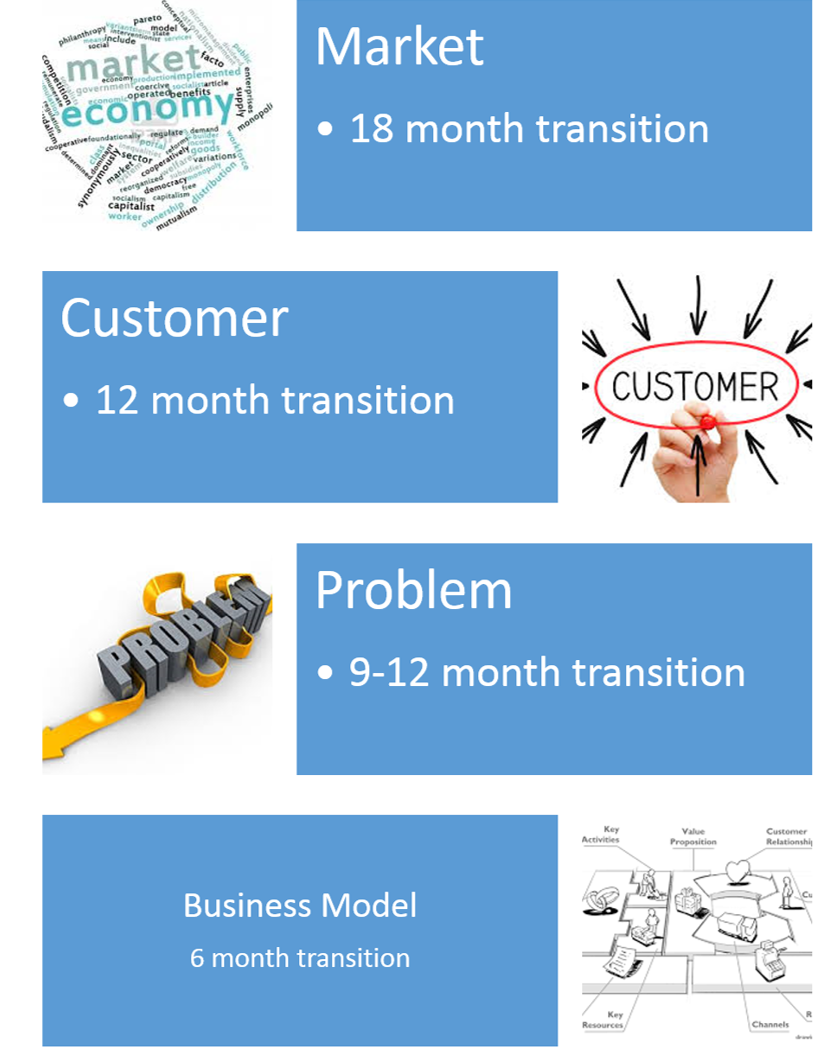
The hardest is the Market pivot – focusing on a completely different market than the one they focused on before – going from IoT startup to a data SaaS company. This type of pivot will take 18 or more months to execute. Learning about a new market is hard. Building relationships and understanding nuances of the landscape is even harder. It might seem easy since when you research on the Internet, but many markets are fairly opaque, till you spend more time learning about them.

The second hardest is the Customer type pivot – a company went from selling to consumers to selling to SMB with the same product. Changing the customer type or target customer is equally difficult. The hardest part is knowing and understanding the influence and decision making landscape if you are in B2B or to find the immediate value for the consumer if you are B2C.

The third hardest is the Customer problem pivot – one of the startups, realized, after talking to their target users that the problem more pressing was a different one and hence changed their product. If you already know your customer, but find out that the “latent” problem you perceived was different from the top 3 problems for your customer, then it is relatively less difficult to change course and pivot to the new problem. While communication with the internal team is still a challenge, these pivots tend to be able to execute faster.

The less harder pivot is the Business model pivot – a company went from charging on a SaaS monthly subscription model to a commission model on sales. By no means am I suggesting that a Business model pivot is easy. Having seen 2 companies of 14, just in the last 6 months, I think of all the other pivots, these are easier to execute and will likely take less time.

The first part of your problem is spotting the trend lines that help you understand when to pivot. The second (and likely more hard) part of your pivot is communicating – to your employees and founders, your customers, to potential and existing investors and to others who were involved – mentors, advisers, etc.

Lessons from the Greek debt crisis for entrepreneurs

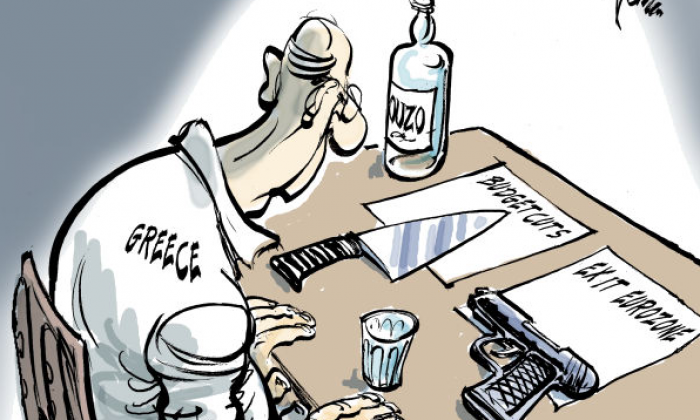
Here is a hypothetical “real” situation. Lets say you raise  some angel money from a few friends (IMF) and a few rich individuals (Germany and French banks). The money you raised is $250K, in a convertible note (loan).

The intention was to get product to market (stabilize your economy) with that money and hire 2 others besides pay for you and your cofounder. You detail that the money will last 5 months at $10K per month per person, plus expenses.

Greek Debt Crisis
Greek Debt Crisis

The angel investors are not happy that you and your cofounder are taking $10K in salary per month, which they feel is a lot (yes I know that it seems like a small amount in SF, or Bangalore as well), but really want in your deal (because they believe you will build a good business).

Then after 5 months, the product is not quite there and will likely take 5 months more to bring to market. You go back to your investors and let them know the situation. While not happy, they are still ready to back you and now are willing to put $25K for the next 6 months, and ask both you and your cofounder to forgo your salary (austerity) until product is shipped.

You and your cofounder realize there’s no choice but to accept the austerity measures and give in to better terms as well and think that the pain (no salary) will be short term so it would be worth it.

6 months pass and you need to raise more money. You have some early customers, the product is in the market. The money is needed to scale, grow and also to provide some relief to the founders in terms of getting paid.

The new investors though, are not giving you the valuation that will give you any relief and are not willing to pay for the “accrued” salaries of the founders. They also think that to grow the business, some of the loans from the angel investors needs to be “written off”. The previous investors will take a “haircut” on their debt.

Previous investors are unwilling to take the haircut, so your funding, goals and priorities are at am impasse. Neither side is willing to give up.

You now have 3 choices.

1. Exiting investors take a haircut on their debt, and their “investment” of $75K, is going to be valued at $25K instead, but they will be part of any growth going forward.

2. New investors are willing to value the previous investment at $100K (which includes the $25K in accrued salaries to founders for the last 6 months) and are willing to fund the company enough to pay salaries and support growth.

3. The founders are willing to take a haircut on their ownership (and give it to previous angel investors) and forgo their salary for the last 6 months as well.

That’s the Greek debt crisis and the options in a nutshell, with the players changed and the situation more complicated (Euro, Social programs, etc.)than I explained it.

The reality of the go-forward plan is that there will be compromises that need to be made all around. Founders, previous angel investors and likely the new investors will all have to find a solution to keep the company going.

Who’s the most vested – the founders (or Greeks) who have spent 12 months of their life trying to bring product and idea to market.

Who’s the least vested – the new investors, who are not going to invest unless they see upside.

Who’s taken a lot risk – the existing angel investors, who put money in expecting a return, but knew fully well that it was risky.

Asking the existing investors alone to take a haircut wont be right, neither will it be fair to have the founders take all the burden of the new investment.

Ideally if you can “carve” out a portion of the future potential for both founders and previous investors, it would be fair.

I have seen though too many cases where new investors “Cram Down” previous investors and in many cases dilute the founders way too much to have meaningful value going forward, which is why terms and provisions in the convertible notes are getting more difficult and involved.

What’s the best solution you think to the above problem? Who (all) gets the haircut?

Rate of customer validation is the best indicator of #napkinStage success

When you have an adviser or two on board, I would recommend a monthly check-in with your advisory deck to actually get advice. Since no amount of expertise and knowledge the adviser has will replace your daily “living” and “breathing” your startup, you will have to brief them on key accomplishments and a view of the “trees”. If you have chosen the right advisers, hopefully they will help you see the forest from the trees.

The biggest challenge is showing “early momentum” and traction. Most traction falls into 2 buckets – product or customers. Side note: When you are a larger company there would be many buckets that are news worthy – funding announcements, partners, awards, hiring, event attendance, etc. but, at the napkin stage, only product updates and customer updates are valuable.

In terms of product updates, changes, modifications and new features (including design updates) are worthy of putting on your monthly advisory update. The best updates I have seen as an adviser are those that are related to changes the product based on feedback from potential beta customers, especially if the feedback results in the customer willing to pay for the product.

The second set of updates are around customers. In this particular case, activity is an early indicator of traction, so I would try and focus more on trying to use as many referrals from people you meet to get introductions to other customers.

A trick that I have seen several people use effectively is to focus on getting 2 customer meetings or demos each day for the first 3-6 months during the customer validation phase.

The rate of early customer validation is the best indicator of early success is what I have found.

The rate of early customer validation is the total number of “prospects” or “Customers” you talk to in a given time period. So, the more customers you get a chance to talk to in 2 weeks, versus another competitor who talks to fewer customers in the same time period, the better are your chances of determining problem fit.