I had the opportunity to meet about 20+ entrepreneurs at the Plug and Play Tech Center, an accelerator and coworking space in Sunnyvale. This cohort was 2 sets of companies in the IoT (Internet of Things) space. Companies ranged from those in wearables, healthcare, connected car and home automation spaces. There were none in the industrial or commercial IoT area.
The startups were trying to get a sense for the changed funding landscape for startups and how to manage the new set of investors they had to deal with. Many in the connected car space were also talking to “strategic investors” such as the automakers themselves to get a sense for their interest to fund startups.
There was a question that one of the startups asked, which was they were adviced by a mentor who was a venture capitalist that “If we get funding from a strategic investor, then it will be viewed as toxic (sic) since we have to build to their needs”.
I am not sure of the context of that discussion, neither do I know about that investor’s background or intent, but this seems like poor advice at the outset. With more context and analysis I might learn more, but at the first glance, this is poorly construed.
I think the best way to deal with experts who provide advice professionally is to resist the temptation to dismiss it rightaway or the desire to take it at face value and implement it rightaway.
Surprisingly I have found that most entrepreneurs actually “forget” the advice and seek out to experiment and find their own answer. That’s goodness, but it begs the question, how do you remember to seek what you learned?
So the problem as most people realize is that (like with storing and sharing good things at home) the problem is not storing, it is retrieving.
How can you recall the right advice when you need it?
Some decisions we make are fairly quick and provide us with very little time to process. Most decisions we make as entrepreneurs take require a longer lead time than a day.
The best way I have found to recall information an advice is to ask it again in context, instead of trying to remember what was said before and assume no judgement or bias before asking for a framework to think about the decision.
That way it gives you the ability to recall in context.
This surprising tactic means you should ignore all the advice you get and filter most of it as entertainment.
Which, if you are an entrepreneur is a much needed distraction.
I am always wary of absolute statements such as “We only invest in entrepreneurs” or “The best way to hire is to have a strong culture” or “Raise money from top tier VC’s, else you will not have a Unicorn exit”.
Why? Primarily because there is no one right answer. The answer is always “It depends”, but “it depends” is a hollow and unsatisfying answer.
So I prefer frameworks.
A framework is a mechanism to think about your particular situation and unique constraints and apply the possible approaches to come up with a personalized strategy.
I was reminded of that by Dave McClure, who talks about portfolio size in his latest post on Venture Capitalists.
When VC’s tell me they want to be “stock pickers” not index fund managers, I tend to have a lot more questions.
A “stock picker” assumes they know something everyone else does not. They have a key market insights, some differentiated information that’s not available to anyone else or knowledge that most others are missing.
An “index fund” manager believes that they dont have that insight, but can make money nonetheless by tracking market returns.
Turns out in the VC world, most VC’s think of themselves as “Stock Pickers”. That is one strategy to win in Venture and generate outsized returns.
To call every other strategy not-workable, is incorrect. While many folks call the other approaches “spray and pray” or “finishing with a net”, the strategy might work.
A framework to think is probably a better approach. That framework has to put desired outcomes on one side, the constraints in the middle and the inputs on the other side.
Outcomes and Constraints
This framework visualization is not the only way to think about answering a question. There are many cases, when an “expert” might have learned something unique, analyzed the situation and provided the constraints in a more prioritized fashion. So, instead of looking at all the constraints, you can look at the 2-3 that matter.
Over the last 3-4 weeks, I have been putting together more frameworks to outline problems and questions I have encountered and worksheets or templates that work.
Going back to the VC conundrum, if an investor believes that there’s only one way to approach early stage investing, then they are possibly wrong.
The constraints I have heard from VC’s who follow the stock picker approach is that they dont want to sit on too many boards, dont have time to help more than 5-6 companies at the same time, or that they dont have time to find more than 10 companies are worth investing in.
If those are the constraints, then there are better and more different ways to solve for those constraints.
You can not sit on the board, and still have influence rights, you can hire people to help your portfolio and use technology to find more relevant companies and founders.
Most constraints can be solved, as long as you are clear about the outcomes you desire.
Some constraints you do not want to compromise on, and that is a constraint as well.
As an entrepreneur, though, if you are given only “one answer” or “one approach” or “one strategy” to be successful, you are talking to a fairly inexperienced person who you should probably not take advice from in the first place.
In 1995 when I reached Silicon Valley from Baltimore, HP was the company to poach talent from. Most startups and mid-sized companies during that period were keen to hire away from HP. It was known as the place that had a very refined “Management API”. Every executive and manager from HP was defined as having been through rigorous training, experiences and situations to help them navigate the complexity of running technology companies.
A few years later, the “it” company to hire from was Cisco and then Siebel was the target. Now it the “it” companies to poach talent from are Google and Facebook.
Surprisingly if you are a founder, and have an exit, you have lived through hell and back, but if you crave relevance and recognition, then you are better off being the 150th employee at an “it” company than the founder of the 150th exit.
In fact the most sought after founders are not serial entrepreneurs with a small exit, but an early to mid-stage employee at an “it” company.
That’s the Silicon Valley “meritocracy” in action. Working at “it” companies is regarded as a proxy for good pedigree. If you don’t have a Harvard or Stanford degree, but are working at an “it” company, you will be courted.
Yesterday, I had a chance to drive up to the airport with a good friend, who had a good exit (small, <$20 Million at an ad tech company in NYC). He had a very surprising observation to make. For all its “meritocracy” discussion, the only thing the valley values is pedigree. Which is not surprising. Which also means Silicon Valley is more similar to Hollywood than it is to any other place in the world.
Let’s say you are a successful entrepreneur (good, but small exit) and are looking for what’s next. You head over to the valley VC Mecca – Sand Hill road, thinking yeah, you have been successful, made money and have been thorough the grind and know how to exit and make money, so people should be interested in funding your opportunity – right?
Then you are in for a rude shock, because no one gives a damm. Most of the folks are chasing the ex-1200th employee at an “it” company, who worked on an arcane part of their advertising solution. That employee may have never actually built an entire product let alone a company, but they are “it” right now.
So, how do you break the mold? Only by showing success. It is the path that will be harder to take. It will be road with more obstacles.
You may hear stories of how an ex “it” company engineer raised $5 million on the back of a napkin over cocktails. That’s not going to happen to you.
You may hear that 2 engineers with a prototype got a series A term sheet, while you with a product and revenues, are still struggling to close your seed investors, even though you are in the valley as well.
That’s the nature of the valley, so don’t be disheartened. You too will shine and grow. Until then though, focus on building your business and keeping customers happy enough to tell others.
On your journey towards creating your startup and growing it, there will be multiple opportunities to quit. Startups are much harder than anything else you will do in your professional career, so you will have display enormous resilience to bounce back from “near death” experiences.
Over the last 3 years as I have watched multiple entrepreneurs from the sidelines, and about 20% of them have been “Plan B entrepreneurs”. These are folks that were thrust into entrepreneurship, not by choice or deep desire, but by circumstance. There is a story of a successful executive at a large SI who was laid off and found himself on the wrong side of the age equation, so he was “over skilled” for another position, and decided to be an entrepreneur instead. Another story, is that of a good friend, who graduated at the middle of her class and found no “jobs” for an entry-level developer, so she started a training school for average developers who can be placed at smaller companies.
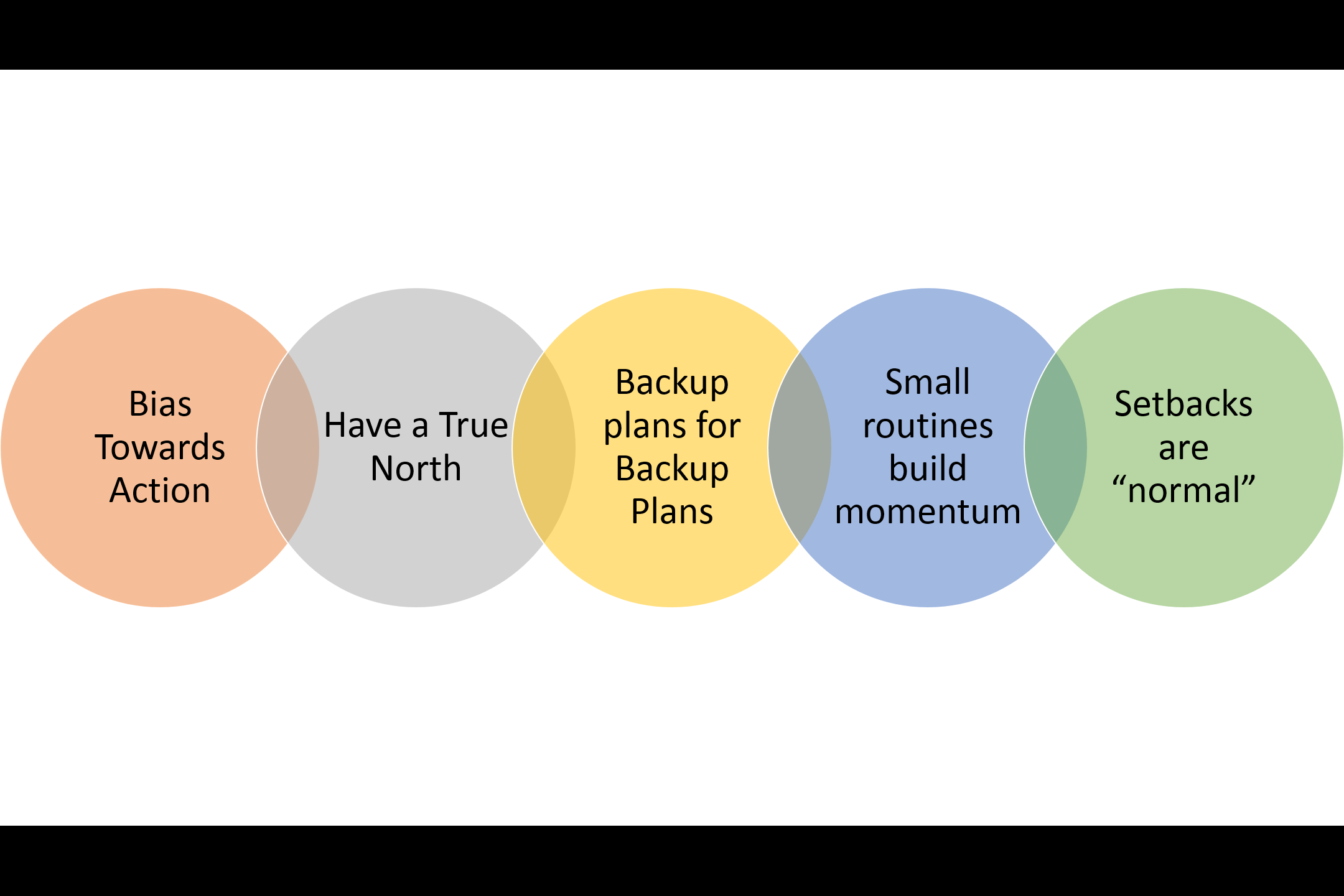
I have noticed that plan B entrepreneurs aremore resilient and they tend to display 5 primary characteristics.
How to be Resilient
The set of steps they might go through is denial, acknowledgement, acceptance, analysis and finally action, but the time spent on action tends to be the most.
Resilient people have a bias towards action and their action steps are immediate. Surprisingly the ones that I respect the most rarely “Sleep over it”. In fact, a mini-setback really spurs them towards exploration of multiple actions or options. That seemed counterintuitive to me at first, since the advice most people give is to “sleep over challenging situations”, but I guess different people are wired differently.
Second, they display the maturity to understand that setbacks are normal. They realize that the path to success is littered with multiple mini-setbacks. So each of these “mini-setbacks” only convinces them that setbacks are not failures, but successes posing as an obstacle.
Third, they have a “true north” that keeps them going. That true north is usually written down, not in “their head or their mind”. They tend to revisit the “true north” every so often, maybe a month, a week or every time they encounter a mini-celebratory moment or a mini-setback.
Fourth, they are always making a backup plan for the backup plan. It is almost as if they realize their first plan will never work out, so they always have a Plan B, or plan C. Their plan A, many have mentioned to me, almost never has materialized. They spend as much time coming up with plan B as they do plan A, which leads me to believe, that plan B’s are those that take more time, more effort, but are also responsible for progress.
Finally, they tend to be more disciplined and setup small routines to build momentum. Building momentum by identifying smaller steps that display progress tend to help them bounce back, is what I have heard. Some of them celebrate success so small, that they build a great culture in their teams of enjoying themselves a lot more together.
Related to this but on a more personal level, I read and re-read the touching note by Sheryl Sandberg yesterday on Dave Goldberg. It is an amazing read. I’d highly recommend it. Many things are worth highlighting, but the Option B part of the note is most relevant for entrepreneurs.
When I was a product manager, I tended to focus only on the product features, user experience, design and technology during my competitive analysis of a company.
That’s usually what most CEO’s do – after all product is the #1 thing that most customers see, touch and feel that matters to the most.
Turns out that’s an incomplete view of competition. I had a chance to see a complete view when we did a comprehensive audit of the top 2 competitors before we sold our company.
It is pretty obvious now, but you can get so much information from external sources such as social networks, email newsletters and blogs that to get a comprehensive 360 degree view of the competition, you can clearly understand where they came from, and where they are headed.
Comprehensive Competitor Analysis
I put a partial list of sources that you might want to consider to get competitive information from in the chart above.
Here are the top questions you might want to consider getting answers to understand your competitors strategy overall.
What events are they attending? Speaking? Presenting?
What are they announcing? Investors? Management? Customers?
What are their open job positions? Who have their hired?
What is the segment of customers they are going after?
Who have their hired? What’s their background likely to tell you about their plan?
How do they price? What are the tiers?
What have they learned about their customer needs?
What are they sharing about their company?
Where are they looking to start new offices?
Where are they looking for talent / customers?
Who reports to who? How many people in the company? Background?
Promotional Plans? Who is following them?
Who likes their page? Who are their customers?
What questions come up? What are customers complaining about?
What messages are they pushing?
What keywords do they rank for? What are they bidding for?
While these are tactical questions, the key parts of your competitors strategy you are trying to understand are:
1. Who are their customers – what segment of the market are they going after?
2. How are they targeting customers?
3. What is the problem for their customers they are solving?
4. How are they solving the problem? What features in the product support that?
5. How do they plan to scale and grow?
Typically after this detailed analysis you will get a clear idea of what your competitor is doing beyond their product to help differentiate from others.
Depending on the audience you will be asked to show a “competitive landscape chart” of your domain and the major players in the market. The main purpose of the competitive landscape chart is to position your company or product against others in the market. You need not to go into details, but, will be required to provide enough clarity for the audience to make out the differences between you and others in the market.
There are 2 important things you need to consider when putting together the competitive landscape analysis chart –
What you show (Features, Customer Segments, Market Requirements, etc.) and
How you show it (Visualizations such as Venn Diagrams, Harvey Ball Table, Process Map, etc.)
I follow a 3 step process to come up with the competitive analysis landscape:
Step 1: Identify: List all potential and possible competitors on a spreadsheet – one for each row
Step 2: Analyze (What you show): Start putting a list of features that you can claim you have they don’t, or segments of market which are market determined or a list of capabilities you intend to build which your customers care about or any other set of capabilities you can distinctly and objectively bucket each offering by.
Step 3: Visualize (How you show it): Look for patterns to showcase a small subset, (2-3) of the key dimensions you can differentiate and then choose the right visualization.
From the many hundreds of competitive analysis charts I have seen, here are the 7 most frequent.
Market Size – Dimensional Bubble
Market size analysis is typically good for early stage investors (institutional). The size of market tends to be a big determinant for many investors, so if you can show the potential size on a chart featuring bottoms up numbers in the X and Y axis and the cumulative size of the market as the size of the ball, you will end up giving them a sense for the potential of your company. In the example below I have shown the # of users and Price per user in the X and Y axis. The size of the bubble is (not to size) will then indicate size of the market.
A good way to differentiate if you don’t have a different product is to differentiate by segment of market. You can segment markets by any number of ways, and the type of company / user / customer you are going after is a good way to show your competitive landscape. Most consumer companies tend to do this. As an example, Twitter is good for 30-45 year old males, Pinterest is good for 25-40 year-old women, Snapchat is for 20-30 year olds, etc.
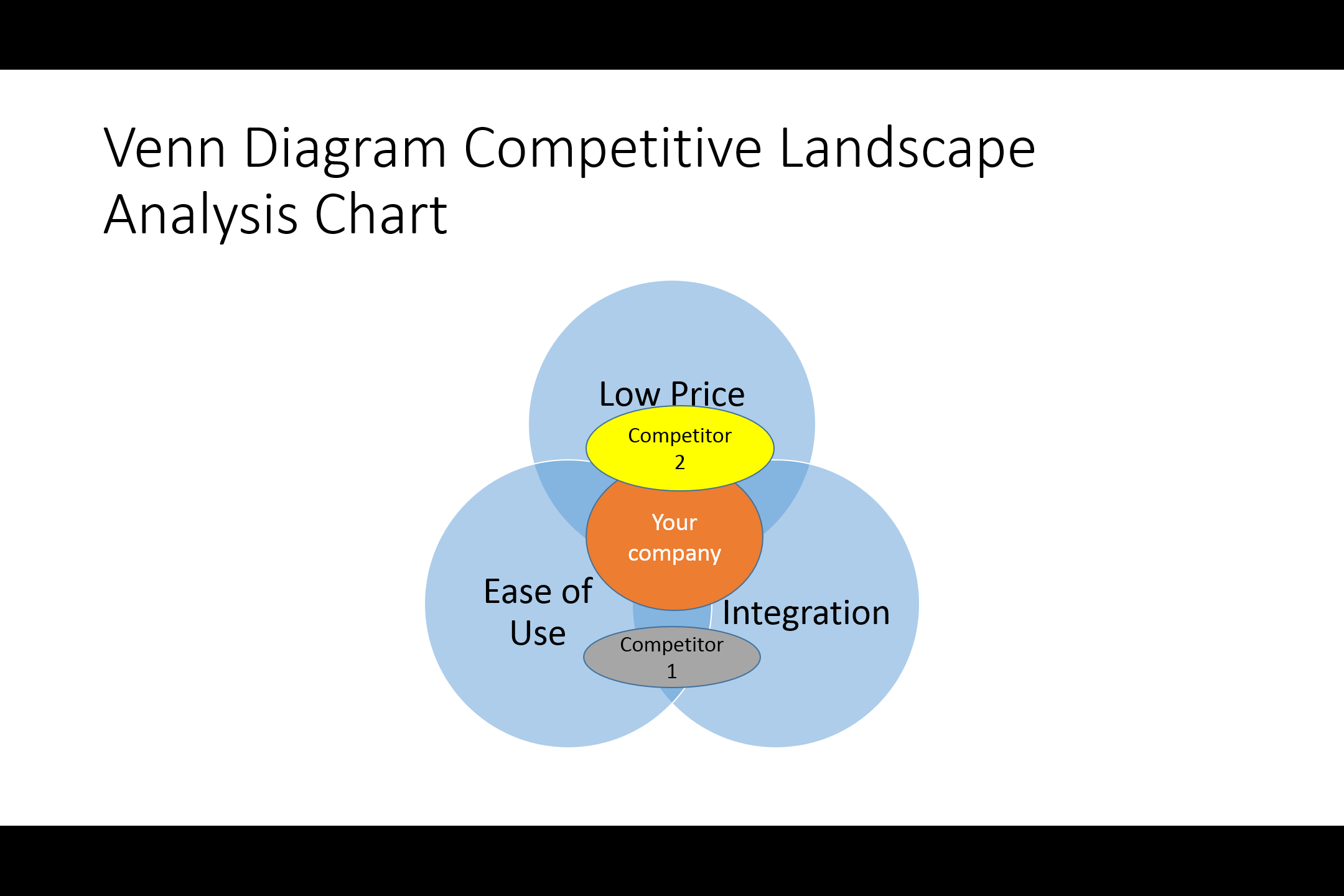
It is okay to have an overlap of companies across multiple segments and the other twist I have seen is to show the value proposition to your customer on the other axis. In this example the key 3 capabilities of Price, Ease of Use and Integration is what I have showcased.
Customer Segment Multi Axes Competitive Analysis Chart
Customers Process and Systems – Process Map
The Process map is best used when you have a lot of companies in the “space” but they all do different things for the customer in terms of their usage and solve different portions of the same larger problem. For example, when I was starting BuzzGain, the listening solutions were good to get an understanding of what was being talked about a brand on social media, but engagement products were used by customers to interact and respond and analysis solutions were used for market research.
This chart could be a double-edged sword. One on hand a customer or investor could see this as clear positioning of where you stand in the process map, but on the other hand they could see the other products wanting to build the different capabilities across the process, which leads to consolidation, which to them indicates, they should wait until the market settles, or buy from a “large vendor, who has a significant but not best of breed products across the spectrum of their process”.
Customer Process Competitive Analysis Chart
Feature Capability – Venn Diagram
Best used when you want to convey that customers need the best of 3 (or 2/4/5) different capabilities or features which all make the product unique. For example the fact that you have not he lowest price or the easiest to use product or integration alone will not rule your product out in the customers’ mind, but the fact that you have all 3 covered in the perfect blend makes it appealing to customers or investors.
The Venn diagram is best used when you can show that you have the capability to showcase you in the center and competitors on other intersections.
Venn Diagram Feature Competitive Analysis Chart
Key Features – Quadrant by axis
The simple McKinsey quadrant is actually the most used in investor presentations. This shows 2 axes with opposite ends of the axis values for e.g. simple vs. complex and fast vs. slow on the implementation speed.
You want your company to be on the top right ideally and others to be at the other quadrants. The way this sometimes backfires is that investors believe that the person in the center will win because they have the “perfect blend”.
Feature Quadrant Competitive Analysis Chart
Feature Spectrum – Silo Systems
Silos are best when you have a short list of 3-5 features alone to compare competitors with, and you have more than 3-5 competitors to show. That means a market where there are many competitors but few things to differentiate them by. Most used in rapidly growing markets, they tend to show why and how you can build a product or company quickly if you focus on a set of features that spans multiple silos.
Feature spectrum Silos are also very useful if you expect the number of competitors to increase. That way your investors don’t get alarmed when a new post shows up on a tech blog which has them sending you emails asking if we have a good plan “to compete against this new startup”.
Feature Spectrum Silos Competitive Analysis Chart
Feature details – Harvey Ball analysis
Customers prefer this landscape analysis best on the website. Sometimes if you are talking to corporate venture teams, they tend to like this level of detail as well. The Harvey balls indicate the “feature completeness” of each of your competitors versus your feature set. Typically you want to highlight features where you will be “complete” and those where others are “less complete”. I have found though, that if you do a more objective analysis and focus on which features your customers really want and show a ball or two where you are less complete than others, it will give you more credibility.
The other way to do Harvey Ball analysis is to provide a list of key scenarios where the customer has to choose one product vs. another. In this situation, you will find customers self-selecting one product because of their own situation.
The table format is the most detailed and most useful only if your audience is potential customers. Most investors prefer a high level analysis of direct competitors, potential threats and incumbents. Your customers are currently using some solution (even if it is manual) or an incumbent (old dinosaur company) as a solution possibly, but they are competitors as well, which you must acknowledge.
Short answer – there’s nothing much you can do, but a lot you need to think about – positioning, differentiation, pricing, advisors, funding, etc.
There are many times when you find a new idea and after a lot of customer validation framework for your ideas,you decide, “this is the idea to go with” and you decide to plunge and build.
Then a month (or a few weeks, or days) before your launch, a competitor launches. With the exact same features you expected to launch with, with the same problem statement, going after the same customers.
I put together a framework that I used with BuzzGain. A month before launch, Radian6 launched and a week after was the launch of Techrigy, and a few weeks later, Scout Labs launched as well.
While we were all launching “different products” at different price points, the market was the same was what investors told me. Well, they were wrong. Turns out we all got exits – Radian 6 raised the most money and was sold to Salesforce for > $200 Million, Techrigy and Scoutlabs sold as well, and I did exit as well.
Just do your startup already
Here are the 5 questions I asked myself when I saw the Radian 6 launch:
1. Was I still passionate about the idea? That was the first question I should have asked, but unfortunately it was not. So, in retrospect I am suggesting you do this instead. Think about if you still are curious – intellectually and enjoy learning about the market for a long time – 5-7 years at the minimum.
The answer to this question wont come to you in an hour, a day or a week, it might come to you after multiple discussions over a month or so.
If the answer is no, I’d recommend you go do something else.
2. Was the problem the customers I had been talking to real and a huge pain? I had shortlisted about 35 beta customers after talking to over 1000 potential targets over 6 months. What I realized later was that MOST of them knew about my competitors and were still willing to try my product because a) they knew me b) they thought I was solving a different problem for them than my competitors c) I had taken time to build a relationship with them.
If the answer to the question is that you have not done customer development yet, then I’d suggest you go and do that first, or do something else if you dont like the market.
3. Was the “market” large? Large is relative. Investors (who were largely clueless), thought this was going to be a small market for 1-3 “marketing automation” products and that HubSpot and others were going to come into the listening platform business. Turns out 10 years later, they still have not.
If you believe the market is large, it is not sufficient to internalize it. If you want to build a large company, you have to build a convincing case to help your investors understand that.
If the answer is the market is relatively small, you can still build a good business, but it wont attract investors given that one competitor was already in the market. The surprising thing is that sometimes (thanks to the herd mentality) many investors now will be interested if one company was funded in the space and they need to “check the box”.
4. Would I be able to differentiate my offering? If you were going to build a similar product aimed at the same market, then I’d advice you to rethink. If not, then spend time honing in on your differentiation.
BuzzGain was aimed at SMB, Radian6 started with agencies and others were focused on mid-market companies.
We focused on building tools that a marketing consultant could use for their clients, as opposed to agencies use for their larger clients.
In fact, you can see from my day-in-the-life analysis that we started out aiming a the same market – mid-sized agencies, but we changed based on Radian6’s launch.
Rule #1 – Dont care what they do. Rule #2 – There are no other rules. Rule #3 – What? Are you still looking for more rules? Go back and read Rule #1.
You will still have to do a comprehensive competitive landscape analysis (and then a competitor analysis, which is different), which I will cover the next 2 days.
Content Marketing is being touted as the way to educate your customers and create your brand. For both startups and individuals trying to build a personal brand, content marketing is always being pushed as a means to engage with your audience.
Even though blogging has been the staple of most content marketing efforts on the small startup side for the SMB prospect, and the whitepaper as the staple for the B2B marketer in the enterprise, the rules of the game have dramatically changed for “quality” of content. The bar is much higher given the amount of content and the need to fight through the clutter and noise.
The primary changes are thanks to the mobile phone and the reducing attention span that most folks have.
The things that I think are not going to work anymore:
1. 0-1000 word blog posts. Most folks dont have the time to read a lot of text. On the phone text is being swiped faster than photos.
2. Infographics – most infographics are pretty useless and the bar for what constitutes a good infographic is great analysis and visualization, not just a bunch of numbers.
3. Anything blog post hthat’s not topical, since the shelf life of any blog post is now heading to minutes, not hours. If your blog post is something you are looking to create a book (for personal branding) out of your blog post, you might want to rethink that strategy. Books are being read solely by older audiences now and video trumps reading thanks to shorter attention spans.
What works then to draw an audience and help build a brand?
Content Marketing that works
1. Blog posts that are data rich, visually attractive or long form – CB Insights, Crew and Buffer are proving that there’s still a place for great content in the traditional blog post. If you are into writing long form (1500+ words, choose to host and publish on medium instead of your own domain).
2. Video: Short, 3-5 min produced how to videos, interviews are still working well.
3. Podcasts: This has taken off more than most people anticipated. If you are starting a new company, I’d recommend you to go podcasting instead of text based blogs.
4. Slideshare presentations: Visually attractive, with high quality images, and tons of data in a simple PowerPoint slide is still drawing a lot of attention.
5. Great images and photos that can be shared on Instagram or Pinterest (even if you are a B2B company).
6. Real time video streaming – Periscope and Meerkat are two platforms you should consider.
7. Blog posts with very little text, but a lot of animated gifs: Thanks to BuzzFeed, these are extremely popular if your target audience is younger workers just joining the workforce.
One of the most important challenges that startups face is one of getting their users time or attention. For B2B startups besides the time,they also have to help save money or increase revenues, etc.
Time, for most people is rather hard to convince people to find. Even if you believe they do have it, users are unlikely to commit unless it entertains them (games, media) or it saves them more time (apps, eCommerce, etc).
The best way to understand how a product will add value to your users is to do a time and activity audit of your customers.
The output of your time and activity audit is to come up with your a) product value proposition, roadmap and be the north star for new features b) be the guide to help target your marketing efforts and c) help your sales persona mapping.
Day in the Life of a PR Associate
Here is the final output of the day in the life audit for BuzzGain, and the visualization I used to talk about the day in the life.
Day in the Life Audit Drives Product Direction
While the final output of the day in the life looks pretty, the process to gather the data and come up with the analysis is anything but.
There are 3 possible ways for you to collect and organize the day in the life data:
1. The increment method: In this approach, you have to “shadow” your users for a day and document every 15 / 30 minute increments. I used this for 3 users on 3 different days and did it in 30 minute increments. This was done so I could understand where they ate, who they worked with, when they had meetings, what “activity” they performed, etc. I would color code the activities into 3 (meetings, work and other – red, black and blue worked for me on a simple print out that I got from Outlook.
Daily Calendar
2. The mini-milestone method: In this approach, you are unable to shadow the customer, but you meet them 3 times – early before they start their day, afternoon at lunch and late afternoon before they leave for home. You are trying to get a highlight of the key time “blocks” and activities they spent time on. Do this with at least 5-7 users, instead of 3 if you are adopting the previous method, since users either forget or lie to make themselves sound more busy and important than they actually are.
3. The prioritized activity method: In this technique, you ask your users for their top goals, priorities or objectives for the period they are measure – monthly, quarterly or annually and the amount of time they have to spend to achieve those priorities. Then you can check in for 3-4 weeks, every week to see if the major “buckets of their time” are being spent towards achieving those priorities and what activities are contributing towards achieving those. This is typically done when your users are senior-level executives.
3 bonus tips for you during this process:
1. Your audit helps recruit your users as well (they can be beta customers later), so think of this process and the exercise as a value-added pursuit that you can offer for busy people to help them get control of their time.
2. Most “business” users spend a lot of time in meetings. In fact I wont be surprised if over 30% of folks tell you they go from meeting to meeting and only get work done late at night or early morning when “they have time for themselves”. Document the person(s) they meet with. It will help you with possibly “adjacent” markets later.
3. Documenting this helps your targeting and marketing efforts as well, so to ensure you can action it, document the “outside” the lines time-spent such as where they eat, when they take a break (to check FB, Twitter, etc.)
There are multiple methods to keep track of your projects and priorities. Here is one technique I used when trying to keep track of customer validation. This approach works best when teams are in one single location since it is visually appealing and easy to update.
It is called the Kanban method of Do, Doing and Done. A visual dashboard, which I used colored post it notes for, comprises of 3 buckets of work:
1. Do – has all the items that need to be still done.
2. Doing – what you are currently working on
3. Done – what’s finished
Typically we update and refresh the items each week – sometimes daily if there are enough changes, but a week is ideal.
Do Doing Done Kanban Method
Some folks have mentioned using Trello or Kanbanize. I have not, so I cant recommend them.
As I mentioned previously, the elapsed time for these 5 steps, in my experience lasts from a 4 weeks to 3 months on average.
The most important item to remember is that the method works best for discrete, defined tasks that take a short period of time. If your item takes many weeks or months, you have to break it down into simpler steps.Customer validation or pricing strategy cant be a step. Pricing strategy has to broken up into price tiers, price testing, pricing validation, pricing research etc.
When validating customer problems, you are trying to understand the following questions:
Is this a real problem? Is is a big enough problem for them to look for a solution?
What will it take for them to adopt a solution? Adopt my solution?
How much will they be willing to pay to adopt?
I have used post-it notes as a great way to segment the steps in the process and use colors to validate different items I need to:
In the customer validation I put forth a process comprised of 5 steps:
1. Secondary research
2. Primary research with insiders
3. Proxy market sizing
4. Online validation
5. Customer interviews
The best way to use color is to put these various “sources” into different colors. So, influencers may be blue, proxy sizing sources may be yellow, etc.
When you get to the customer interview step, you are likely finished with the previous steps, so you can color code segments of your customer with different colors.
So “Segment A” will be yellow and “Segment B” will be green and so on.
The reason for colors is then you can put them all into a board at the end and find a way to look for patterns that correlate.
The big advantage of the visible productivity map is that everyone is motivated to make changes to the charts so you can see progress daily. Try it and let me know if it works for you.