Category Archives: Entrepreneurship

Why are there so many more acquisitions than IPOS for Venture Funded Companies?

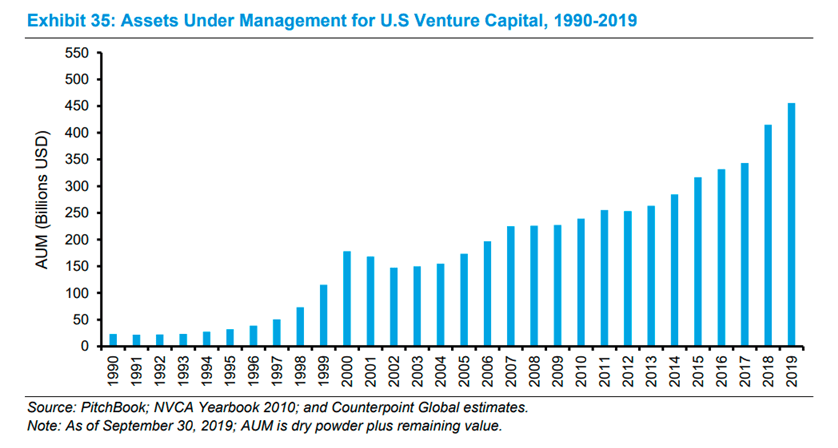
Assets under Venture management has been growing

In the early part of the 20th century, startups were funded largely by wealthy families and individuals. Today, we would call them “angel” investors. Examples include firms such as Pan American World Airways, Eastman Kodak, and Ford Motor Company.
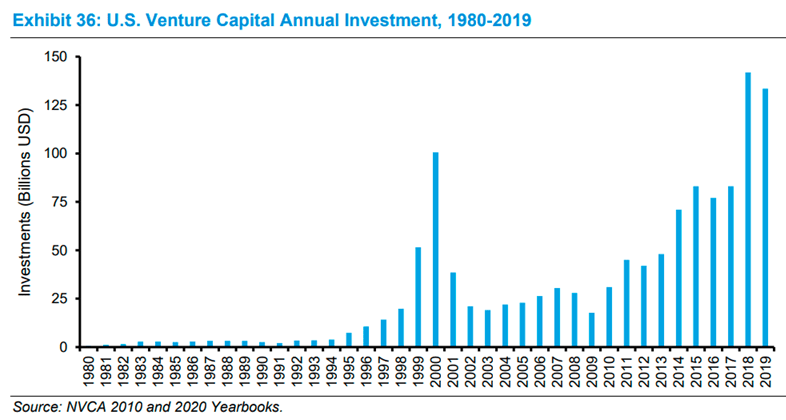
The formation of American Research and Development Corporation (ARD) is often associated with the birth of the venture capital industry as we know it today. Founded in Boston, Massachusets by prominent bankers, academics, and businessmen, ARD raised $3.5 million for a closed-end fund in the fall of 1946, with more than one-half coming from institutional investors.

One of the founders of ARD was General Georges Doriot, then a professor at Harvard Business School. He taught a course called manufacturing that was really “all about starting companies and technology.” A number of his students and disciples went on to be prominent venture capitalists, including Tom Perkins (Kleiner Perkins), Don Valentine (Sequoia), Bill Elfers (Greylock Partners), Arthur Rock and Dick Karmlich (Arthur Rock & Company), and Bill Draper and Pitch Johnson (Draper & Johnson Investment).

The venture capital industry then went through its greatest period ever starting in the mid-1990s. This was in part fueled by the adoption of the Internet, ushered in by the meteoric rise of Netscape, an Internet browser, following its IPO in August 1995.

The fee structure for venture capital funds is similar to that of buyouts. The management fee is typically 2 percent of the total amount raised by the fund, and the incentive fee is commonly 20 percent of profits. But venture capital and buyouts differ in their ability to scale. In buyouts, doing large deals is not materially different than small deals. As a result, buyout firms can grow their AUM with less degradation of expected returns than can venture firms.

Exits. The return for any fund is a function of the difference between the purchase and subsequent sale of investments. From the beginning of the venture industry through the mid-1990s, an IPO was the most common way to profitably exit a venture investment. In the late 1990s through 2000, both IPOs and a sale of the business were popular. But since 2000, IPOs have declined substantially, and a sale, either to a strategic buyer or a buyout fund, has become the preferred vehicle for exit.
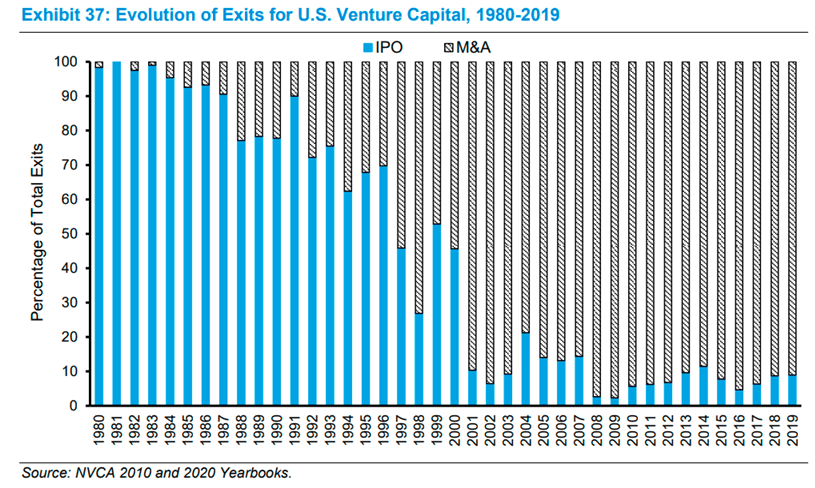
There are a number of drivers behind the trend of fewer exits through IPOs.

First, because the cost to list has risen in recent decades, only larger and typically older companies are in a position to list. The age of a company doing an IPO has risen as a result.

Second, the motivation to go public has shifted. Young companies today don’t need to raise capital from the public market because they are generally less capital intensive than their predecessors.

Third, even those companies that are in very competitive industries have been able to stay private because there is a huge amount of capital available via late-stage funds.

Finally, there are now ways for employees who are compensated in equity to sell shares. In some cases, funding rounds give employees a chance to cash out.
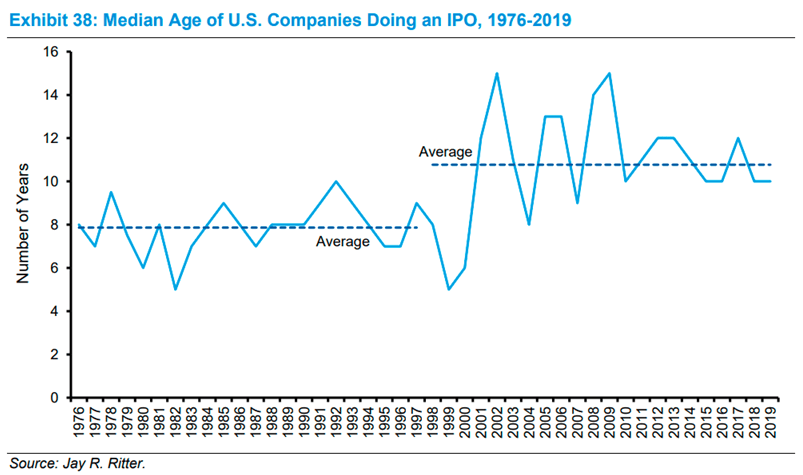
These drivers have important consequences for investors.

There is now a sizeable population of companies that are very valuable on paper. For example, CB Insights, a platform that tracks market intelligence in the technology industry, counts 225 “unicorns” in the U.S. worth a combined $662 billion as of July 2020.

Another consequence of staying private longer is that more wealth is created in the private market and less in the public market.

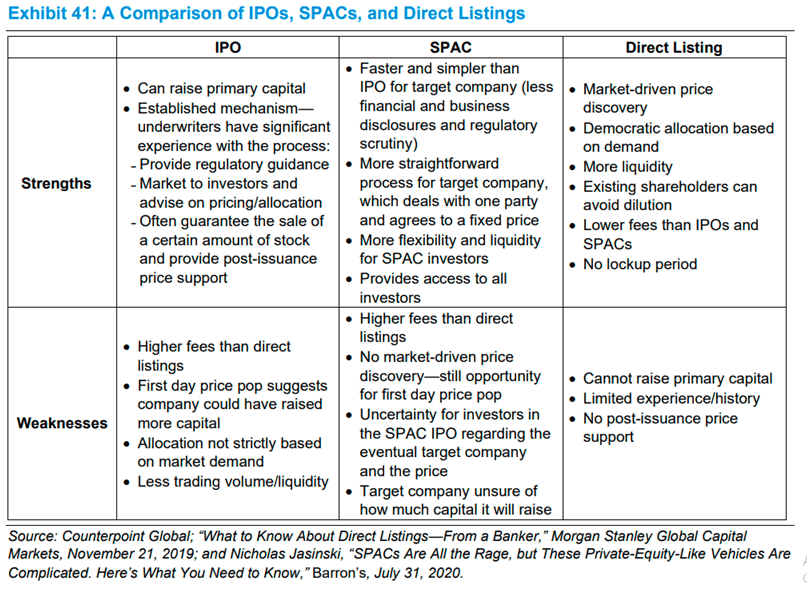
Despite the decline and delay of IPOs, many venture capitalists view an exit into the public market as attractive due to the accountability and transparency associated with being a listed company. At the same time, it has become more common for entrepreneurs and investors to consider a sale to a special purpose acquisition company (SPAC) or a direct listing as alternatives to a traditional IPO.

A SPAC is a company that goes public with the goal of using the offering proceeds to make an acquisition. In an IPO, a SPAC offers a unit that includes a common share at a set price and warrants. SPACs are sometimes referred to as “blank-check” companies and can provide public market investors access to private companies.

With a direct listing, a stock exchange builds an order book, whereby buyers and sellers express their interests in terms of price and volume. The exchanges do this every day for every stock. The opening price reflects the intersection of supply and demand. Buyers include any investor, and sellers include shareholders, such as employees and early-stage investors. Neither buyer nor seller has an obligation to transact.

A final consequence of staying private longer is that the combination of steady flows of capital into venture and later exits means a much larger share of the industry’s total investment is late-stage. For example, in 1980 around 10 percent of investments were late stage. By 2006, roughly 20 percent of dollars went to investments of $50 million or more, and that figure was closer to 60 percent in 2019.
Why are more firms going private than remaining public in the US?

In 40 years through 2019, the S&P 500 Index had a total return of 11.8 percent.

We now examine three considerations that are relevant for the multi-decade shift from public to private firms, as well as the composition of the firms that remain public.

The first is the rise of intangible assets. Paul Romer, an economist who won the Nobel Prize in Economics in 2018 for his work on endogenous growth theory, poses a basic question:

“How can it be that we’re wealthier today than people were 100 years ago?”

The underlying quantity of raw materials has not changed over time.

The answer is we can now arrange resources in ways that are more valuable than before.

Traditional models of economic growth are based on inputs of capital and labor and treat technology as exogenous. Robert Solow, also a Nobel Laureate, created a model that made technology endogenous. Romer’s contribution was to make technology “partially excludable,” or a private good.

This allows firms to benefit from their investments. Romer emphasizes the importance of intangible assets, including instructions, formulas, recipes, and methods of doing things. He argues that “growth takes place when companies and individuals discover and implement these formulas and recipes.”

What’s important is that these intangible assets have characteristics that are different from physical capital or labor. Economists call them “non-rival” goods, which means that more than one person can use the good at a time. A physical book is a rival good that only one person can read at a time. A digital book is a non-rival good that can be read by many simultaneously. Under certain conditions, intangible-based companies can defy the conventional economic concept of diminishing marginal returns and in fact realize increasing returns.

This shift has a few implications for our discussion. To begin, companies need less capital because they need fewer physical assets. For example, sales per employee for Facebook, Inc. were nearly double those of Ford Motor Company in 2019. From 1956 to 1976 the number of public companies grew fivefold, as many companies needed to finance “their mass production and mass distribution.”

Today, companies simply do not require as much capital as they once did. This, along with freer access to private capital, allows private companies to remain private longer.

Second, implication is that the rate of change, which we can measure by longevity, appears to be speeding up. The idea is that if longevity is decreasing, the rate of change is increasing. About 1,500 companies went public during the 1970s, 3,000 in the 1980s, 3,900 in the 1990s, and 2,100 in the 2000s. Companies that had listed before 1970 had a 92 percent probability of surviving the next five years, and those listed in the 2000s had a probability of only 63 percent. The chance of survival has dropped in each successive decade.

Third, the main reason companies delist is that they are acquired. This contributes to the last implication. In corporate America, the strong are getting stronger. This is giving rise to “superstar” firms.

For example, the gap in return on invested capital between a U.S. company in the top 10 percent and the median has risen sharply in recent decades.52 Consolidation explains a large part of this. Measures of concentration, such as the Herfindahl-Hirschman Index, have shown a substantial increase for many industries since the mid-1990s. These include industries that rely on tangible assets.

M&A is by far the leading explanation for delisting.

First, the companies that are public now are on average much larger and older than companies in the past. Vibrant M&A has led to more concentration in most industries, and a handful of very large technology companies have attained strong market positions. As a result of where they are in the industry lifecycle and the profitability they enjoy, listed companies also have a high proclivity to
pay out capital.

Following the introduction of a safe harbor provision for buying back stock in 1982, the preferred means to return capital to shareholders has shifted from dividends to share buybacks. Second, buyout and venture capital funds have not included many Main Street investors. This could change with the Department of Labor’s instruction letter, written in 2020, that may allow private equity as an option for defined contribution plans.

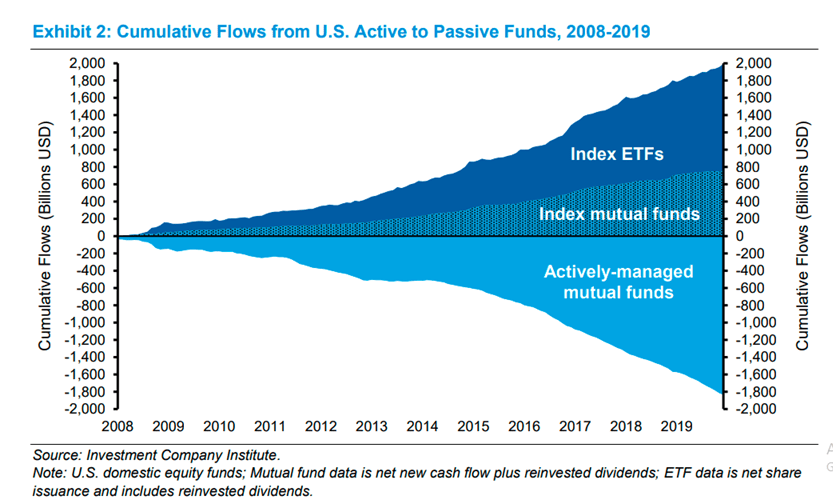
Finally, there has been a large shift away from actively-managed equity funds to funds that track indexes or are rules-based.

Why are there so few public companies in 2020 vs 1990

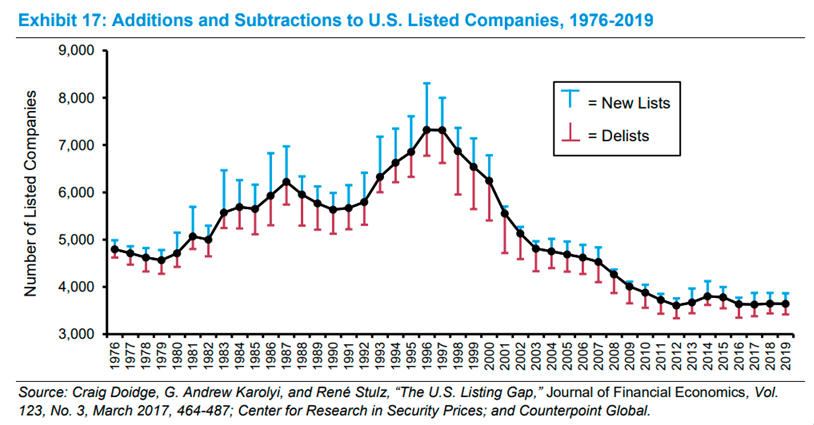
# of companies that are publicly held <via Morgan Stanley report 2020>

U.S. domestic equity mutual funds manage about $8.4 trillion, with active funds controlling $5.6 trillion and index funds $2.8 trillion at year-end 2019.

Overall US domestic market

Buyout funds in the U.S. have $1.4 trillion in assets under management (AUM), including $560 billion in “dry powder.”

Venture capital funds have AUM of approximately $455 billion, which includes dry powder of $120 billion.

The equity capitalization of the U.S stock market is roughly 27 times the size of AUM for buyout funds and more than 80 times the size of venture capital funds.

There are about 3,600 public companies in the U.S. today, about one-half as many as there were in 1996 and three-quarters as many as there were in 1976. The drop reflects active M&A activity and a low level of initial public offerings (IPOs). More than 90 percent of the stocks that have disappeared since 1996 were those of small- and micro-capitalization companies.

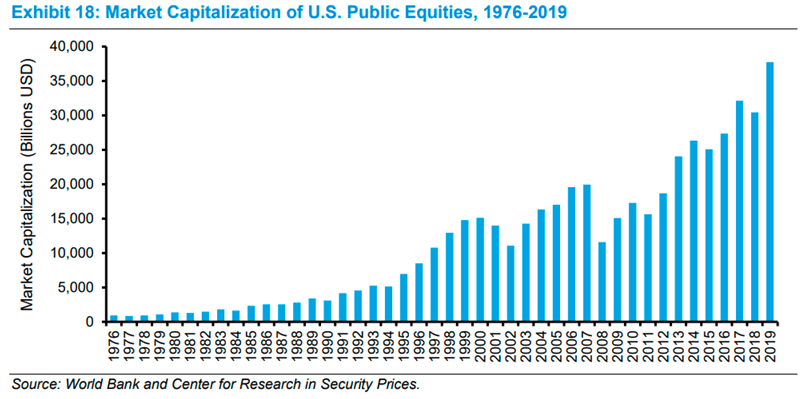
Market capitalization of public companies

Drivers

  1. Less need for money – fewer capital investments. As a consequence, companies need less capital to fund their operations and hence the demand to raise capital through public markets has diminished.
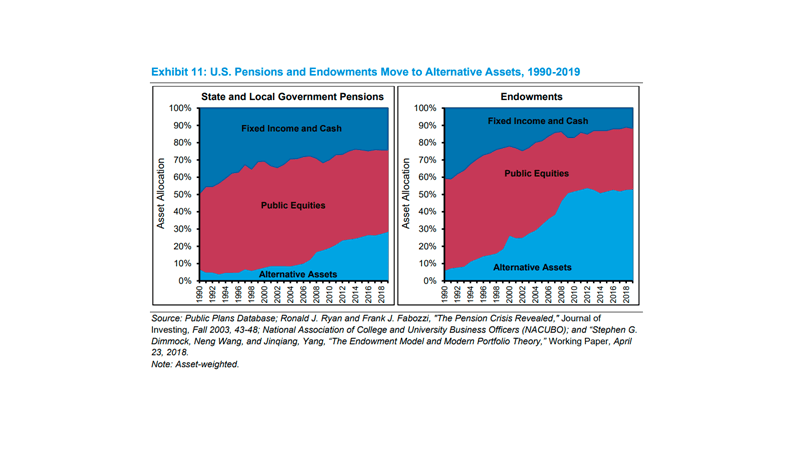
  2. Sophisticated investors, including pension funds and endowments, have moved their asset allocation toward private markets in search of higher returns.
Sophisticated investors have moved money to alternative assets
  1. Companies have raised more money in private markets than in public markets in each year since 2009. For example, companies raised $3.0 trillion in private markets and $1.5 trillion in public markets in 2017.
  2. Regulation and legislation have also played an important role in the evolution of capital markets. A company’s propensity to go public can be framed as a cost-benefit analysis, and the costs have risen since the 1990s.
  3. Finally, the tendency of executives to mindlessly imitate the behavior of their peers, no matter how foolish it may be to do so.”
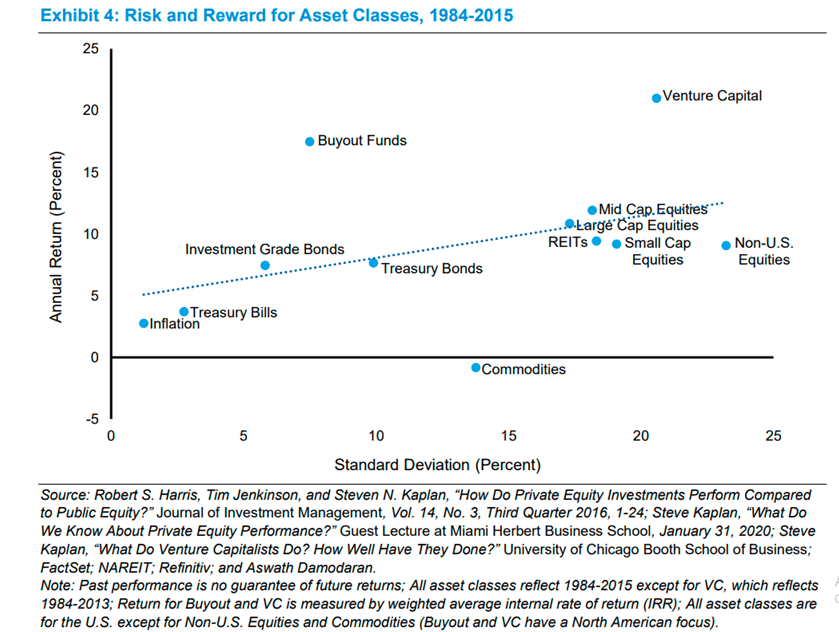
Returns in alternative asset classes have been better


As of year-end 2019, there were approximately 3,640 listed companies in the U.S. employing 42 million people, roughly 7,200 firms owned by private equity buyout funds employing 5.4 million, and 18,400 companies backed by venture capital firms employing 1.1 million. The average market capitalization for a public company today is roughly $10.4 billion, up from about $700 million in 1976, adjusted for inflation.

Investors have been taking money out of public equities in the U.S., with net outflows of about $500 billion from domestic equity mutual funds and ETFs over the past 5 years.

Investor commitments to U.S. buyout funds have increased steadily in recent years and in 2019 surpassed the peak preceding the financial crisis. Commitments to venture capital funds are also near record levels excluding the extraordinary inflow in 2000, which remains almost twice as large as any other year. Combined, the commitments to U.S. buyout and venture funds were about $315 billion in 2019.

What is the difference between a business and an entrepreneurial venture?

I have written before that the great Indian dream is to run a side business.

Entrepreneur or Businesswoman?

Yesterday I was reading (skimming) a book by Jim McKelvey called The Innovation Stack.

In an interview Jim was asked if he would start an entrepreneurial venture now and what his advice to a young entrepreneur would be.

Understand if you’re an entrepreneur or a business person. Business people are more likely to be successful and make money because they’re doing something that’s already been done before. So a business person would copy another successful business, and that’s how business is done and money is made. If you’re an entrepreneur, then you’re doing something that hasn’t been done and might not work. So it’s a lot riskier, and the rules almost totally change in that world. Understand which world you’re in.

Interview with Jim by Polina

Be an entrepreneurial business person

While I understand the sentiment, I would characterize it a little differently. Entrepreneurs are doing something new and exciting but they are also trying to build a business. No entrepreneur starts off thinking “This is a venture that I dont want to be successful or make money”.

In fact, I think most entrepreneurs are looking to innovate and make money. Business people on the other hand are arbitrageurs.

An arbitrageur attempts to profit from market inefficiencies.

Both entrepreneurs and business people are trying to solve a problem. While the entrepreneur might be looking to solve a problem with a new solution, the business person might look at solutions that exist already.

What do you think?

Top 10 Questions about Sleep: Why we sleep #Bookreview #insomnia #Health

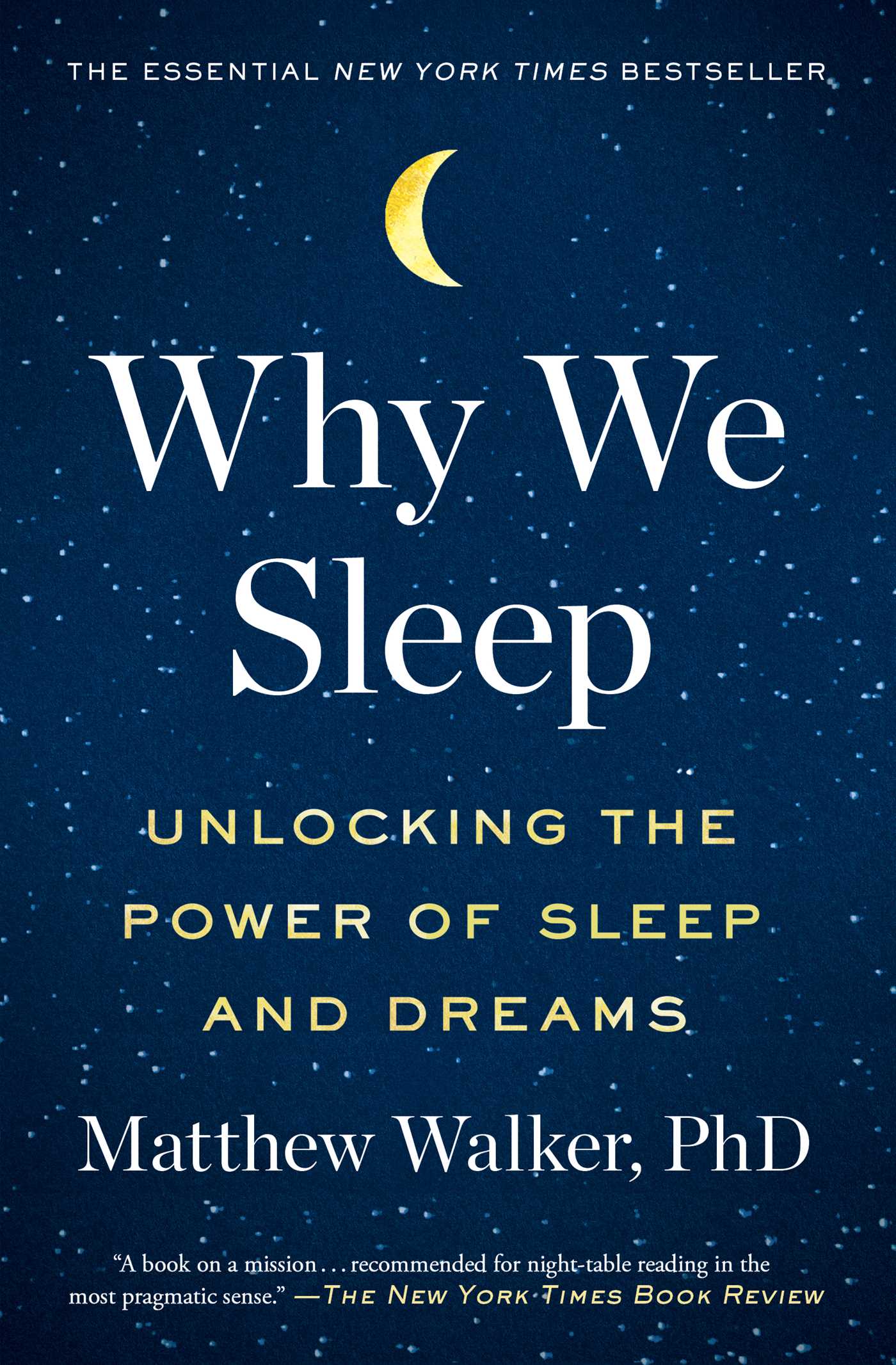
Why We Sleep | Book by Matthew Walker | Official Publisher Page | Simon &  Schuster
Why we sleep: Book by Matthew Walker

I got a chance to borrow Why we sleep from the library last week. There were multiple recommendations from others on a Telegram group I am a part of.

I would give this book a 4.5/5. Terrifically researched, well written and actionable. It does go into a lot of theory, so if you are the person looking for quick advice on how to sleep better, skip to the end of the book.

Why We Sleep by Matthew Walker Summary - StoryShots – Free Book Summaries
Credit: Get Story Shorts

The twelve tips for better sleep he recommends are:

Twelve Tips for Healthy Sleep

  1. Stick to a sleep schedule
  2. Exercise is great, but not too late in the day. Try to exercise at least thirty minutes on most days but not later than two to three hours before your bedtime.
  3. Avoid caffeine and nicotine.
  4. Avoid alcoholic drinks before bed.
  5. Avoid large meals and beverages late at night.
  6. If possible, avoid medicines that delay or disrupt your sleep.
  7. Don’t take naps after 3 p.m.
  8. Relax before bed. Don’t overschedule your day so that no time is left for unwinding. A relaxing activity, such as reading or listening to music, should be part of your bedtime ritual.
  9. Take a hot bath before bed.
  10. Dark bedroom, cool bedroom, gadget-free bedroom.
  11. Have the right sunlight exposure. Daylight is key to regulating daily sleep patterns. Try to get outside in natural sunlight for at least thirty minutes each day. If possible, wake up with the sun or use very bright lights in the morning.
  12. Don’t lie in bed awake.

‍The book itself is divided into 16 chapters focusing on defining sleep, naps, how should we sleep, why sleep is important, dreams and their significance, and finally the benefits of sleep.

Here are my top 10 questions and answers:

Why is sleep important?

Sleep is a memory aid, it helps to cement memories and prevent forgetting. It helps your brain as much as your body. It helps motor-skill enhancement and helps with physical recovery – muscle repair and cellular energy.

How much sleep is required?

The book suggests most adults need to sleep in a biphasic pattern (having two phases). One in the night for 6-8 hours and another nap in the afternoon for 30-60 minutes. Younger teenagers might need more sleep in the night.

How are some people able to get away with little (<6 hours) of sleep?

While it does not address this question, there has a gene that has been identified in people who can sleep less. The book says it is rare that people can function with less sleep.

True low-sleepers (chronically < 6 hours of sleep/night without impairment of function) are incredibly rare, less than 1% of the population. Everyone else is disguising their sleep deprivation with caffeine and sleeping pills.

When should I sleep?

Having a consistent sleep rhythm is important – sleep at about the same time daily is suggested by the book. The time itself is not given (so if you sleep at 10 pm daily or 1 am that’s your pattern).

Why do we sleep less as we age?

Older adults need as much sleep as younger. It is just that the sleep efficiency drops as you age. As you enter your fourth decade of life, there is a palpable reduction in the electrical quantity and quality of that deep NREM sleep. The second hallmark of altered sleep as we age, and one that older adults are more conscious of, is fragmentation. The older we get, the more frequently we wake up throughout the night.

Do naps help as a substitute?

No matter what you may have heard or read in the popular media, there is no scientific evidence we have suggesting that a drug, a device, or any amount of psychological willpower can replace sleep. Power naps may momentarily increase basic concentration under conditions of sleep deprivation, as can caffeine up to a certain dose. Neither naps nor caffeine can salvage more complex functions of the brain, including learning, memory, emotional stability, complex reasoning, or decision-making.

How and why do we dream?

Dreaming essentially is a time when we all become flagrantly psychotic. 

First you started to see things which were not there, so you were hallucinating.

Second, you believe things that couldn’t possibly be true, so you were delusional.

Third, you became confused about time, place, and person, so you’re suffering from disorientation.

Fourth, you had wildly fluctuating emotions like a pendulum, something that we call being affectively labile. And then, how wonderful?

You woke up this morning and you forgot most if not all of that dream experience, so you’re suffering from amnesia.

The second benefit of dream sleep is essentially a form of overnight therapy. It’s during dream sleep where we start to actually take the sting out of difficult, even traumatic, emotional experiences that we’ve been having. And sleep almost divorces that emotional, bitter rind from the memorable experiences that we’ve had during the day. And so that we wake up the next morning feeling better about those experiences. So you can think of dream sleep as emotional first aid and it sort of offers this nocturnal soothing balm that smoothes those painful stinging edges of difficult experiences. So it’s not time that heals all wounds, but it’s time during dream sleep that provides you with emotional convalescence.

Can you control your dreams?

Techniques to control, or at least influence, our dreams have been shown to work in sleep experiments. We can strategize to dream about a particular subject, solve a problem or end a recurring nightmare

What stops a person from sleeping?

Alcohol and caffeine are the two biggest contributors. Not surprisingly if you have a lot of activity to the brain (iPad, Phone), you might take longer to fall asleep.

Should one take sleep aids? E.g. sleeping pills, a hot shower or a “night cap”?

Hot showers help, but night cap (alcohol) and pills dont much.

 Alcohol is a class of drugs that we call, “the sedatives.” And what you’re doing is just knocking your brain out. You’re not putting it into natural sleep.

VC Scout programs – how to make a career in Venture Capital

How to get into Venture capital

One of my top 10 posts is one about how to get a job as a Venture Capitalist. It is worth a read, but much has changed since 2012.

What has changed?

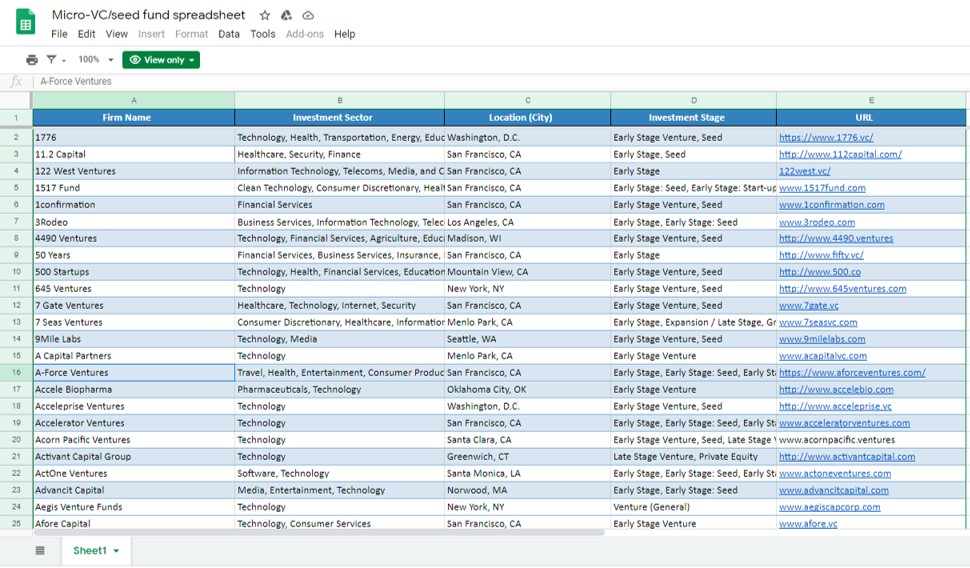
  1. There are a ton of micro funds (<$25 Million) now. In fact, 652 funds are now listed across US, Europe and Asia. There were < 1000 funds in 2012, so there has been at least a 60% increase in # of venture funds
652 Micro Venture Funds exist now (list was last updated in 2019)

2. There are now over 100 Venture funds with Scout programs. What is a Scout program? Scouts are individuals who are empowered to invest small check sizes ($25K – $50K) in very early stage companies. They are funded by the venture fund. There are in fact over 50 Scout programs specifically aimed at college students.

3. There are so many angels and angel groups. In 2012 there were 30K worldwide. Now China alone has 25K active angels who have invested in the last year.

If you are interested in getting a job as a Venture investor, then there are 5 paths now compared to 2-3.

  1. Bring your own money (assuming you have money to invest on your own).
  2. Start an early stage micro fund focused on a niche.
  3. Be a VC Scout (there are a lot of resources on how this works).
  4. Start an angel group or fund with others
  5. Join a VC program as an analyst

If you look at the profile of venture capitalists across the world now, the Silicon Valley used to be where 65% of investors were in 2010.

Now in 2020, there are more funds outside the US, although the funded $ are still more in the US.

Lets look at each of these paths in detail:

  1. Bring your own money. Most investors who go this route have 3 paths – a) They have family money – inherited, b) They have worked at an early stage startup or struck it rich early (many crypto currency investors are now VCs), or c) They have worked at Google, Facebook, etc., and decided after X years to invest in early stage startups.
  2. Start a Micro fund. Most investors who go this route, have 3 paths as well. a) they were at a large VC fund and decided to strike it on their own, b) they were keen to start a fund and have friends and family who are willing to invest, or c) they started small, had 1-2 great investments early and grew from there.
  3. Be a VC Scout. Investors who were scouts and then became a VC are few, but most are interested in learning and sharing more than making money.
  4. Angel groups: Investors who started an angel group are typically helping their friends or alumni raise money and then they start to get some deal flow. Others get their colleagues from work to invest in a startup as a first step.
  5. The VC Analyst program. These tend to be the most sought after, but far and few between in terms of opportunities. Many have terrific backgrounds from the top schools or had some success at a VC funded startup.
Starting a VC fund is hard

LinkedIn Stories – first thoughts #stories

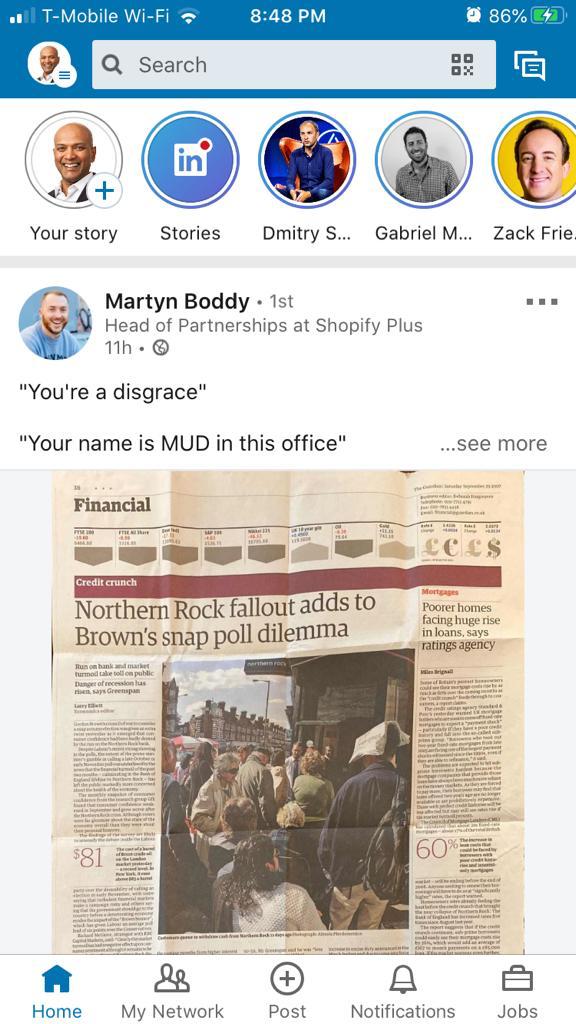
LinkedIn rolled out a new mobile feature to a limited number of users in certain countries called LinkedIn Stories.

If you are familiar with TikTok, Instagram , Facebook or Snapchat stories feature, it is fairly similar with a few differences.

There are very few “filters” for your story. You can make it look better, but the options are limited.

Second, they are ephemeral. I cannot confirm if LinkedIn is “saving” the stories someplace, but they are “gone” after 24 hours.

Third, they are very limited engagement options for users. Every comment comes to your LinkedIn inbox. So, no threaded conversations.

I have been using it for a week. I update daily with ONE stock tip or ETF that I am watching daily.

I like it so far. Each day I have been getting between 100 to 200 views.

Facebook stories has about 300 million users apparently, Instagram stories has 500 million daily active users (DAU), Snapchat stories has about 200 Million DAU, and TikTok has about 500 million.

Since LinkedIn has 400 Million users, the DAU is more limited and because stories has been rolled out to a very few number of people the feature is in its early stages.

Make your Bed: Book review Admiral William Mcraven

Make Your Bed: Little Things That Can Change Your Life...And Maybe the  World: McRaven, Admiral William H.: 9781455570249: Amazon.com: Books
Make your bed – Book based on the commencement speech by Admiral William Mcraven

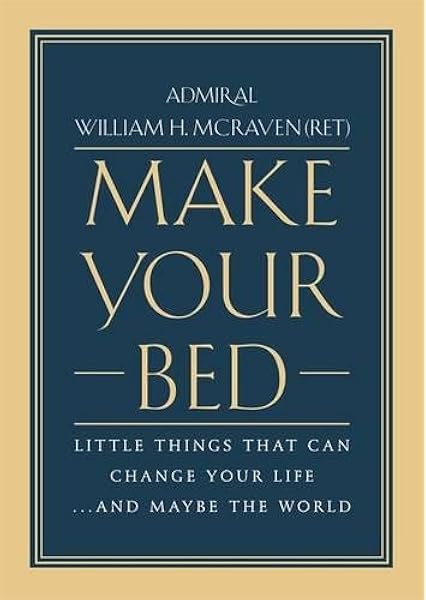
There are some books that are good reminders of the things that you should not forget. While the items themselves are not very illustrative or insightful, the stories that remind you of them are what make them memorable.

This is one such book. The very accomplished Admiral William Mcraven gave a speech at MIT. He is a retired U.S. Navy admiral who directed the raid that killed Osama bin Laden.

A former Navy SEAL himself, McRaven retired from the Navy in 2014. A year later he was hired as chancellor of the University of Texas system. He stepped down from the post in 2018 and is now a faculty member at the University of Texas at Austin.

You should read his entire speech (below), as well if you are keen. The book is an extended version of this speech.

There are 10 life lessons he reminds you in the book in 10 chapters.

Chapter One: Start Your Day with a Task Completed

Why is attention to detail important in your life and work?

Chapter Two: You Can’t Go It Alone
Why is it important to have a strong network of people who support you? Why is it important to support others in general?

Chapter Three: Only the Size of Your Heart Matters
Why is it important to not judge someone only by their appearance?

Chapter Four: Life’s Not Fair – Drive On!
How do you deal with adversity?

Chapter Five: Failure Can Make you Stronger
What adversity has made you stronger?

Chapter Six: You Must Dare Greatly
How can you “be daring” and take these risks in your life?

Chapter Seven: Stand Up to the Bullies
Sometimes doing what’s right means standing up for what you know is right.

Chapter Eight: Rise to the Occasion
What dark times have you gone through in your life? How did you rise to the occasion?

Chapter Nine: Give People Hope
How do you encourage people when things get rough?

Chapter Ten: Never, Ever Quit!
Why is it important to never quit?

This photo provided by The University of Texas at Austin: Naval Adm. William H. McRaven

The best privacy policy generator for SaaS businesses #GDPR #PRIVACYPOLICY

Privacy policy for SaaS

I have been reviewing Privacy Policies generators over the last few days. If you have a website or an app, I assume you are aware of GDPR and CCPA. These laws required you to be clear about a) what user data you collect from visitors, b) how you store and use that data, and c) who you share the data with.

  1. What user data you collect: For most SaaS apps, you need name and email at the minimum. For some apps phone (for two factor authentication) may also be required. For paid SaaS apps, you might collect credit card, location, address, IP address, etc. Since all of the users data is considered private, your privacy policy needs to be clear that you are collecting all of this data.
  2. How you store and use the data: SaaS apps use the data for email marketing, retargeting, notifications, etc. Your privacy policy needs to outline the uses of all types.
  3. Who you share the data with: If you use 3rd party providers for email marketing, you need to be clear about those as well.

Fortunately most online privacy policy generators do a good job of asking simple questions (guided wizard) and then giving you a policy document that you can link to.

Many founders I know just go to another website and copy / paste their privacy policy and terms of service. While that seems quick and fast, the only time you need these policies to work is if a user litigates. Especially if you have a paid service, I would recommend using a customized privacy policy. Or you can request that you corporate lawyer provides you with a boilerplate template.

There are over 20 privacy policy generators, but for SaaS businesses, I would consider the following 3 for SaaS businesses. I have used Termly and TermsFeed.

  1. TermsFeed: Provides multiple documents including Terms and Conditions and EULA. You can also get free templates for multiple types of legal documents that you can customize.

2. Iubenda: Provides cookie policy, terms and conditions as well. Best solution if most of your customers are from the EU.

3. Termly: Provides policies for multiple platforms, including phone based apps, website and provides automatic updates to policy on changes.

The Ride Of a Lifetime: Book Review- Bob Iger

Amazon.com: The Ride of a Lifetime: Lessons Learned from 15 Years as CEO of  the Walt Disney Company (Audible Audio Edition): Robert Iger, Jim  Frangione, Robert Iger, Random House Audio: Audible Audiobooks

Bob Iger Ride of a lifetime

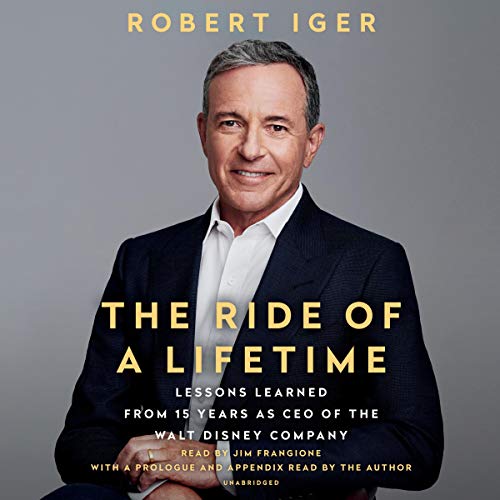
I am a fan of business autobiographies. I loved Howard Schultz’s Pour your heart into it (4/5), and Shoe Dog Phil Knight (4.5/5) the most of the 50+ books I have read so far. I would give his book 3.5/5.

Since Bill Gates himself recommended the book by Bob Iger, I thought I should read it.

The story itself is pretty compelling, with the first few chapters mostly about his youth and childhood. The story of how he joined ABC, followed by his vision for Disney when he was being considered for the CEO role are the best parts.

I do not want to give the entire book away, but I felt the book itself did not give me any more glimpse into Bob Iger than what I had read in the press before.

He does not address the #MeToo movement issues, the book is very well scripted and he chooses not to reveal anything about himself more than what he feels is necessary and skips all the parts about his relationship with the previous CEO.

The great parts that I loved were his discussion with Steve Jobs before the acquisition of Pixar, the discussion of how the changing media landscape is a catalyst for companies such as ABC, FOX, NBC and CBS.