Category Archives: Entrepreneurship

Divisional ascendancy applied to Facebook – how to disrupt the social network

Divisional ascendancy is the official term (more polished) for “divide and conquer”. In politics, sociology and economics, this term applies to breaking up larger concentrations of power into little pieces and tackling them individually.

When a startup is trying to “disrupt” a large market or has a big competitor, the best approach is to break up that larger company’s products, strategy, marketing muscle or sales approach down into its component parts.

Then you want to either:

a) pick on the part that the larger company is the weakest at or

b) pick the part that the larger company is ignoring or

c) pick the part that has the most margins (profit) or

d) pick the part that the larger company thinks is “safe” from threats.

Of course, it goes without saying that if you do this only in the context of the competition (the larger company) and not your customers (or the market in general) – you will fail.

Most larger companies are really a bunch of smaller organizations. That’s the first observation. Very rarely is the culture of larger companies so strong, coherent and consistent that it permeates everything they do and every organization that exists – which is why you see most of the “old guard” in technology unable to innovate, dominate and tackle new markets.

As an example, take a company with multiple products, and multiple channels.

While channel conflict is obvious -when the “partner” team wants to get business to the channel vs. the direct sales team wants to take that business for themselves, product conflict is less so.

Product conflict is when the company plays both the coach (platform) and the player (application) roles.

Take the example of Facebook – they’d like to be a platform, so the developer evangelism team goes out to recruit partners to build apps. Some of those apps become so big and large that they can become bigger than the company itself. When the platform teams notice that, they understand they are “leaving money on the table” for others to monetize.

Strategic or otherwise, they will end up building the app to compete with the partners.

This is a crucial point, that startups can exploit.

Sometimes (when the culture of the company is fairly weak) the two sides (platform and apps) tend to disagree and if there is no strong alignment, or clear answer if it is better to be either, then things go on for a while without clarity from the company. Which allows startups to pick up mindshare and hopefully market share.

In a particular observation about Facebook, I notice how on my mobile it has become an “Instagram” – very heavy on pictures / photo / video heavy and very text / links light.

They are ignoring text in favor of images is my guess, which makes sense for them. If you were to build a pure text, link sharing app for mobile among “friends”, which they are ignoring, I suspect you can disrupt their mojo.

The channel conflict happens more often. In many cases the Business Development team ends up helping partners to sell and fulfill on their “platform”. Left unchecked, they might end up undermining the direct sales team from winning deals directly.

This is quite possibly the best way to disrupt a large B2B company.

Historically, divisionally ascendancy has been the downfall of a few larger software companies – more companies die because of either losing focus on their customer or changing technology under pining or market demand.

The way startups can use this is to convert the battle against a larger company into smaller pieces.

The thing I have noticed, in B2B software companies among the ones I have seen, is that the easiest is to pick the areas the companies are weakest at (which makes sense) and hardest to pick are the areas where the larger company makes the most margin – hence has the most incentive to protect.

The most counterintuitive thing I have noticed is that where companies make the most margin is also where they tend to be the weakest.

The way it works is that your product is so disruptive that they will do anything to protect that margin, including giving away a part of their product free for a certain period – to prevent you from gaining any market share.

So, pick the one they are ignoring and then work your way from there. To do this, you will need to figure out a way to monetize the “ignored” part – where in lies the challenge.

Agree? Or Disagree? The best predictor of future achievement is past achievement.

I mentor 2-3 high school students each year who want to get into a great college and want to understand how to navigate the complexity of admissions, test preparation, extra curricular activities and high school academics.

As part of this process, I end up learning two important areas that I really need to know about, selfishly because I have 4 kids.

First, I end up learning about the selection process at the top schools. What it takes, who is involved, how they make their decisions and what they value. Which helps tremendously in picking companies to back as an investor.

Second, knowing more about the common admission test for the US – the SAT. It is no surprise to many that know me, that I like to take the test and keep myself updated.

The important element of the first I have learned about the first, is that the “selection” committee’s that ends up picking the right students for any school is pretty diverse, but driven by a common goal –

How do we get the “best” students to our college?

As you can imagine, the word best in this question is the most controversial, subjective and arbitrary in this question.

From what I have known, read and heard, the one thing that the committee for admissions feels the responsibility for is charting the course of thousands of young kids worldwide.

On average 25K – 40K students apply to each of the top colleges each year to the top 25 schools and roughly an average of 7%-10% get selected in each college.

While you can claim that the top colleges are fairly diverse in their focus, what they look for and the students they want to attract, they are fairly similar in their desire to attract the “best” for themselves.

What strikes me the most about the process of selection is the criteria that goes into the best.

Lets say you are a committee member at a top US school.

You get an average of 25K applications.

The students who apply, submit their a) high school grade reports b) SAT scores c) personal essays d) recommendation letters and e) accomplishments outside their school – extra curricular activities. You only have these 5 criteria to judge whether they will be “great”.

Now, you have to quickly segment these 25K applicants into 3 categories.

1. Exceptional – the “best” based on the 5 criteria listed above.

2. Passable – the applicants who can be easily passed based on the 5 criteria listed above.

3. Maybe – these are the toughest, because, they have shown some promise, but are not in the “exceptional” category yet.

What is exceptional?

You can see these applicants are going to be great. How? Based on the 5 criteria of course. They have taken harder courses than others, they have better test scores, have excellent recommendation letters and essays and finally have done one thing very well.

They are likely to succeed, regardless of where they get in or what they do. What I am learning is that < 0.5% of applicants fit into this bucket at every school – so in our 25K applicant pool, that’s about 100 applicants or less.

What is passable? You can see these applicants are going to coast. How? Again, based on the 5 criteria, they took easier courses, have average test scores, good recommendations and an ok essay but have been a Jack of all trades, master of none.

These folks are not likely to fail, but they are going to be average. Which is the opposite of great, which is not a bad place to be, but again, every school is looking for people who are going to be “great” and help the school shine. What I am learning is that > 75% of applicants fall into this segment – so about 19K applicants.

The “Maybe” is not that obvious. They have done well in 3 or 4 of the 5 criteria. They may be great, but you can’t say for sure. This applicant pool has tried, maybe succeed in some, maybe failed in some of their attempts, but are some sign of progress.

They could be exceptional, if they are given the right opportunity, but it is not clear. The remainder of the applicant pool or about 6000+ fall into this segment.

The problem is the school can only accept a third of them.

This is the problem that faces every investor as well.

Over 90% of requests for funding I get are “un-investable” by return, investment focus, stage or market.

9.5% are “maybe”.

0.5% are a “yes” to a second meeting, not an immediate investment.

The biggest problem is that the ONLY way to determine “If” someone is going to be successful is based on their past achievements – Just like in the school selection criteria.

This puts many “late bloomers” and “hidden talent” at a distinct disadvantage.

Which is one of the most interesting and challenging parts of the role.

So, why do investors focus so much on the past history of the entrepreneur, their background and “pedigree”?

That’s because they did not have anything else to go by.

Now, that’s changing.

What else can you use as “criteria” or should you take the same criteria and “weigh” them somewhat differently?

The criteria we can use for new startups is a) Entrepreneur and team background b) Market c) Traction and Momentum d) Uniqueness and e) Defensible position.

Until recently, the #1 criteria was always the “Entrepreneur and the team” – which you will still hear from most investors.

Sequoia Capital, though, arguably one of the best investors has gone against the grain and says Market.

The seed stage investors have started to go against the grain and say the #1 criteria is “Traction and Momentum”.

Which is great, but comes with its own set of challenges.

That’s the BIG change that’s happening in the ecosystem.

More people are re-ordering the criteria, weighing the differently and also changing what’s within those criteria.

The thing that’s not changing is that they can only predict the future on anything but past success.

Which is why entrepreneur from “great” colleges, “exceptional” companies and “rock star” backgrounds have an unfavorable advantage.

You can change that with “great” traction”, “exceptional” momentum and “rock star” velocity of your business.

Or continue to do what you are doing and bootstrap yourself and build it on your own terms.

I learned something new yesterday – How to measure Technical Debt?

Yesterday I had a chance to meet an entrepreneur, Brian York. He is the non-technical founder of Bliss.ai, a startup that measures software quality.

More specifically it measures Technical Debt.

I had heard the term before and knew what it meant in theory, and tried to understand it in practice as well, but it always fell in the “nice to know” not a must know bucket.

After meeting with Brian, I don’t think I have changed my mind, but at least I know how to measure it now.

In simple terms, technical debt is when you have to code fast and quick to deliver some capability and you take a few shortcuts – for e.g. you don’t document, you end up writing the same functions again, as opposed to searching for it and calling a library function, don’t ahere to coding standards, etc.

These shortcuts add up over time and ultimately you have to set aside time to “clean up” or pay down the debt.

Like financial debt, not all debt is 100% bad. Sometimes to deliver the functionality (features) on time, you have to ship fast and it ends up being “quick and dirty”.

Which comes back to bite you later – either by crashing, not scaling or just not working at all.

The problem is when it gets out of control and you have to pay “interest” by taking time to re-architect, re-platform or build new from scratch again in a few weeks / months or years.

What I did hear from 2 other engineers who I talked to yesterday was it is interesting but not all that important to track. It is but one measure or “metric” to measure developer effectiveness.

Bliss though, has many paying customers, who give them $60 / month, on average to track their software. They integrate with GitHub, BitBucket, etc. which are code repositories and tell you how well your teams and developers are doing based on running your code through well known static assessment frameworks.

The time you take out of the schedule to pay down technical debts, typically doesn’t result in anything the customers or users will see. This can sometimes be hard to justify.

Here is a framework to think about it from AEquilibrium.

Technical Debt Explanation by AEquilibrium

Technical debt is the invisible parts of your code that adds negative value to your system.

How do you measure it? And why is it somewhat important?

Measurement is done largely by using static analyzers right now, as I mentioned, and you can quickly get a sense for which developers are doing commits, how many lines of code were checked in and “how much debt was incurred” relative to the lines of code and commits.

The part that’s interesting is the number of companies I know which are doing “hackathons” each quarter (over the weekend) to pare down technical debt.

Which is interesting, but if I were a developer, and I was asked to come and participate at a hackathon to do “work” over a weekend which I was going to do slowly anyway over the week, I am not sure how I’d feel about those extra 30-50 hours per quarter.

Either ways, I thought it was interesting enough to learn about and share – not the debt part, but the measurement part.

Do you measure technical debt in your company yet? And do you track and reward engineers based on that measure?

As measurement and rewards systems get more sophisticated over time, and all our jobs become more outcome based, I can easily see ways to quantify “the 10X developer” myth or the fact.

All measurement is possibly good, but measuring things that are irrelevant creates “metrics debt” in the short term.

Is the opposite of winning and success, learning and not losing or failure?

I was reminded of this yesterday when a friend, Rajesh Setty eloquently put it in an email signature to me.

The opposite of winning is learning.

Which should technically mean that the opposite of learning is winning, but that’s not true. You do learn when you win, The mystery of success and the articulation of failure is a big problem overall.

I have found that when you dont know what made you successful, you make new mistakes.

So my question is, f you keep having multiple “failures” and end up learning a lot, how can you incorporate learning into your learning. Meta Cognition is an important field of science I am paying some attention to.

Metacognition refers to higher order thinking which involves active control over the cognitive processes engaged in learning. Activities such as planning how to approach a given learning task, monitoring comprehension, and evaluating progress toward the completion of a task are metacognitive in nature.

Simply put, learning how you learn is an important skill for most people.

Self awareness, (not nirvana or even self realization, in a spiritual sense) or understanding what makes you as an individual tick is important for entrepreneurs.

That’s another skill I seek to understand about entrepreneurs.

How do they learn? Do they know how they learn? This is less about how coach-able they are, but more about how they go about learning things they dont know much about.

When you get started, there are many things you dont know about the market, customers, adoption, sales, etc.

How you go about prioritizing what’s important to learn and how you learn them is critical to what is called “Execution”.

The ability to understand that is driven, I believe by 3 questions:

  1. How do you learn best? – By reading, but observing, by being tutored, by seeking advice, by doing it yourself, etc.
  2. How quickly can you incorporate the learning into your plans and execute them?
  3. How do you monitor and observe what the results were so you can continue to learn?

So, back to the question – Is the opposite of winning – learning?

And not losing? Similarly

Is the opposite of success, learning as well and not failure?

How SaaS entrepreneurs are looking to grow their business #PacificCrestSurvey

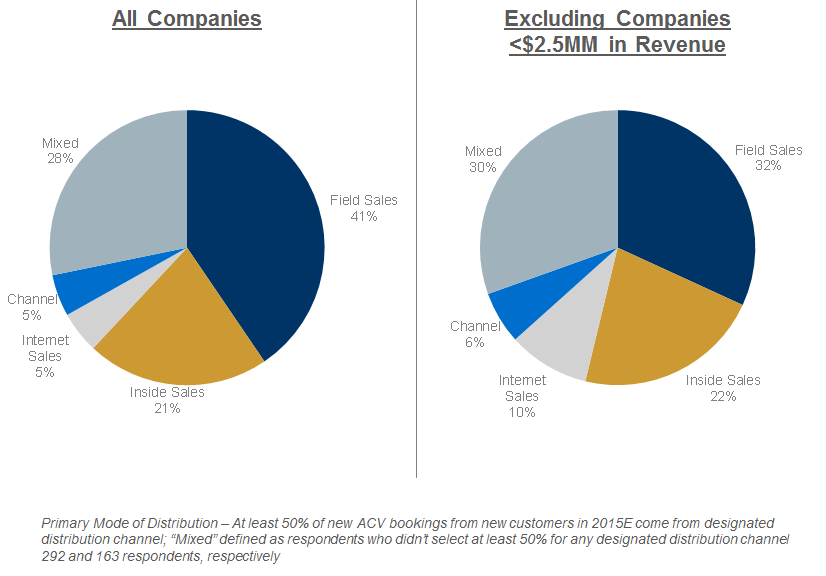
The annual Pacific Crest survey of SaaS companies is ready and published. It is an amazing piece of work. Comprehensive, actionable and very insightful, it is a must read for any SaaS entrepreneur. I highly recommend you take the 30 minutes to read it if you are in the business. Even if you are not and are interested in learning about how our personal and work lives will change with the new models of consumption and delivery of software, this is a good read.

A total of 300 companies participated, so this is a good sample size of the estimated 7000+ SaaS companies in the world.

Some highlights that I think you should definitely not miss if you are not going to read it.

  1. If you are in the US and fewer than 50 people or < $4 Million in annual recurring revenue, you are below average – so this report is skewed towards growing companies, not idea or prototype stage.
  2. If your company is growing revenues < 45% annually you are below average as well.
  3. If you expect to grow <36% next year, well, that’s below average
  4. If you are only hiring your own sales people and not using a marketplace such as Salesforce AppExchange or others, then you will grow significantly slower.
  5. If you are < $2.5 M in revenue, 63% of revenues are likely coming from other Very Small Businesses on average.
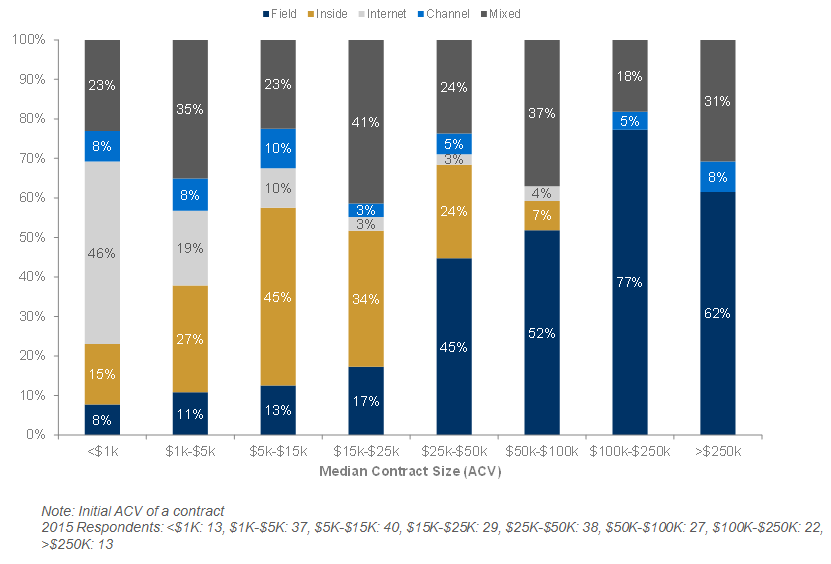
Pacific Crest SaaS survey channel usage by company size

As your company “matures” in Average Contract Value (ACV) expect to have a mixture of “inside” – telesales and “outside” – field sales. The magic number seems to be $25K/year or $2K per month. Beyond that, it seems you will need a field channel.

More than $1K per year in ACV and “Internet” self-service sales, or friction free sales is rather over – or it drops from almost 50% to < 20%. You can still use the Internet for lead generation, but the viral – try, buy and grow is pretty much only try and use after $10K per month.

3 things I have learned about being a public person with strong perspectives

There are many things you learn if you write and blog often. One is your vocabulary gets better. Second, you tend to think through things quicker and can crystallize thoughts into basic and fundamental arguments and finally, you get used to listening and appreciating counter points for things you don’t assume are up for debate.

The more meaningful observations I have are the following.

  • Attitude determines everything.

If you are going to have a perspective, be prepared to defend it, have it shredded by others with opinions, anecdotes and innuendoes. Even if your facts and data back you up, there’s nothing stopping people with opinions that are different from yours claiming you are wrong and they are right. Take it in your stride.

A colleague told me this – be prepared to disagree but don’t be disagreeable.

  • You are never as good as people say you are and not as bad as they say either.

Most of the people who will interact with you will form opinions on some 2 minutes of interaction, some in a 30 minute meeting, others, via a Facebook link you shared, another person’s single interaction with you once, maybe your comment or lack of that on Twitter, or the headline of a blog post. Some want to look for any fodder to defend their existing opinions (both positive and negative) of you.

A colleague told me this – if you judge a person based on their best interaction with you or their worst interaction, you are immature.

  • If you build your reputation over many years it will take many years and many mistakes to bring it down.

The corollary is if your reputation is built overnight, it soils overnight as well.

One hit wonders or over-night famous in 15 minutes are like a helium ballon, they soar quickly and burst just as fast. However, it takes years of neglect and poor maintenance for a defective part to cause a car to stall. I used to believe that you have to build your reputation over years, and it can be shredded overnight by one single mistake. Not so. Most people (there are many exceptions) are more even keeled than that.

A friend mentioned this to me – a house built of brick and stone, however poorly built, still withstands many years of the storm.

The mental and psychological benefits of having side projects

I am a firm believer that one should focus intensely on the one thing at hand to get something meaningful accomplished. I do also have one side project (it changes based on my availability, learning objective, etc) that I am always tinkering with all the time though – these are experiments that help me learn, build or experiment.

There are many documented benefits of side projects, as long as they dont take up too much of your mind space. Some of the most creative products in the world were born from side projects (although they are the ones we talk about the most – #slack, #twitter, etc.).

The benefits I have found are many fold, I thought I’d list them to encourage entrepreneurs to influence their employees to try stuff out. Why?

1. When you do a side project, you learn something new – always. I have found that even if it is an idea that I know a lot about or a problem that I am critically aware of, I end up learning a nuance or two about the problem, positioning, distribution, human behavior. For example with a project we did on monitoring the media for elections, I found that most news media properties were woefully staffed to do data driven projects.

2. It helps you tide rough times during your primary job. Every job has its “days” and some down periods – not down time where it is “waiting for someone to do something”, but time when you don’t see things going your way and need a break, so you can come back to the primary job with a fresh perspective and new set of eyes. For entrepreneurs, I would say this should reduce your overall attrition, since people realize that most side projects go “nowhere”, but once in a while the side project will take over an employee’s life and likely cause you heartburn. It is still worth the effort.

3. It helps you create and get a productivity rush, which gives you more dopamine, less adrenalin. Both are useful, but for most of us, who are in largely desk-bound jobs, the need for a “feeling” of doing something that you don’t have to do is wonderful and fulfilling. For entrepreneurs, the employees that have positive attitude (which dopamine causes) is awesome to have around.

4. It helps your brain be sharp. Yesterday, I was listening to a podcast that talked about brain amnesia. Basically most people remember numbers and artifacts from many years ago, but cannot remember a single important number from the last 2-3 years. The smartphone has taken away the need to remember these mundane things was the conclusion of the reporter and you have “amnesia” since your short term memory remembers fewer and fewer things. With the increase in online distractions at work, including social networks, videos, news, etc. the best way to keep your mind occupied with “junk food” for the brain is to have a good side project.

5. It helps you get out of “boring routines”, prevent doing the same things over and over again, expecting different results. After a while at anything you will get proficient at it enough to not only go past the “productive” phase but then get into the plateau phase. The plateau is when you “settle down”.

Settling down is for ground coffee. You ask hyperactive kids, who have had a candy binge to, “settle down”.

I think for entrepreneurs who are hesitant to encourage their employees to do side projects, personally, the benefits far outweigh the downsides. I have heard of projects taking up too much time, intellectual property being infringed up on, and a few other stories, which are all likely true and a cause of problems.

Still the best framework to think about side projects is – will you learn something new? Is it going to help you explore a new area? Will it help you grow as an individual?

If the answer is yes, please by all means, do it.

Having a side project when you are already doing side projects, though is just a big waste of time, is what I have found.

Things to watch for the future: Epidermal Electronics

From time to time I meet a company that blows my mind and I have to pinch myself to think that they reached out to me seeking investment.

Epidermal electronics are a class of electronic systems that achieve thicknesses, effective elastic moduli, bending stiffnesses, and areal mass densities matched to the epidermis (your outer layer or skin). This has been reported in the National Institute of health. There’s been a lot written about this apparently, but I was ignorant.

Unlike traditional wafer-based technologies, laminating such devices onto the skin leads to conformal contact and adequate adhesion, in a manner that is mechanically invisible to the user. A few companies have been trying this technology for purposes of sports measurement and concussion detection.

These systems incorporate electrophysiological (measuring heart rhythm) , temperature, and strain sensors, as well as transistors, light-emitting diodes, photodetectors, radio frequency inductors, capacitors, oscillators, and rectifying diodes.

Solar cells and wireless coils provide options for power supply. This type of technology is used to measure electrical activity produced by the heart, brain, and skeletal muscles and show that the resulting data contain sufficient information for an unusual type of computer game controller.

The applications are few right now, since the company I spoke with only focused on temperature sensors for patients (older) who need constant monitoring, but they can do things beyond temperature.

The picture the entrepreneur painted for me is what I was most excited about. There are a class of health monitoring devices that are purely temporary. You will need them for a bit of time, when you are unwell, but you need them constantly during that period and then you dont need them (hopefully) at all after that, until your next time.

Epidermal Electronics

The entrepreneur I spoke with mentioned that this area is still in the “Research” and “Exploratory” phases of development and the FDA approvals would take years, but there are companies that are starting to do this.

Imagine an imprinted tattoo on your skin that is temporary that measures some key indicators constantly and keeps sending you signals (or your doctor) on your progress. The tattoo is personal (lesser chance of infection), it is designed to be multi-functional (can be used to measure skin response for multiple measurements) and can also be removed after the period of detection is completed.

The implications for managed health are enormous. Currently the market for medical devices for personal monitoring alone is about $15 Billion.

Twilight Zone startups – not so small to be bootstrapped, not so big for VC funding

I had a chance to meet 4 startups at the LunchBox event this week, at Startup Hall. There were 4 startups that were vying for $10K in prizes. Each startup was given 5 minutes to pitch with 4 judges and 5 min for Q&A. Lisa from Frog Design, Todd Paris and Krish Gopalan and me were the judges.

The 4 startups that presented were, FasterBids.com, which brings catalogs and pricing information from home improvement product manufacturers online, Siren.mobi, a dating site for women, Crelate, a CRM for recruiters to help manage interviews and Camp Native a campsite booking eCommerce site.

All of the presenters stayed under their 5 min pitches, were crisp, very focused on what their traction, team and unique value proposition was. I was really impressed to see the up-leveling of the presentations, even though many had not been through an accelerator program where you practice your pitch till you perfect it.

Most of them were looking to raise some money – between $500K to $750K and some were close to finishing their round with angel investors.

The thing that struck me was how many of them were solving a good problem, had great traction and some were even solving a meaningful problem that exists in a mid-sized, but very competitive market. I think most of them will raise some angel investment, which is pretty good, but getting to their series A and later will be a challenge for all of them.

When you did the bottom’s up back-of-the-envelope calculation for most of their markets, they were largely mid-sized – $500M to about a $1B. In these Unicorn chasing days of VC-land, most of them will end up raising multiple seed, post seed and bridge rounds before they get to a series A from an institutional VC.

Which means if they are very capital efficient and smart about their growth, they will be a good business, but will unlikely excite a VC unless they change their pitch to talk about much larger market sizes.

The 3 key parts of the market – size (is it big enough), growth (will it grow fast) and scale (can you grow it in a capital efficient fashion) are no for less than 1% of the companies who want venture capital. Which is why less than 1% of companies that start get any form of VC funding, but nearly 3%-5% of companies (or more ) get angel funded. Since it costs lower to get companies started, the money required might be much less to get a sizable exit (greater than $50 Million), so that’s the opportunity really for Micro VC funds and angel syndicates.

For entrepreneurs, though, the road to getting some angel investment and then executing well enough towards a larger market potential might be the sure way to a “Unicorn” – after all, most Unicorns probably did not know they were going to be one, were they?

On the other hand, just raising enough to get a good exit might be the best option for others.

Either ways, the fork in the road is post your seed round, but having a sense of the map so you have a good framework for that decision is a good thing to think about.

The frustration that entrepreneurs working on “meaningful” problems face with fundraising

Yesterday I met with two really young and intelligent entrepreneurs. One of them is a clinical diagnostics technician and another is a software developer. I have know the software developer for over a year. He is someone I would consider on the top end of the spectrum for programming skills.

His brother (the clinician) has been facing this problem for consolidated radiology and EMR management daily. So, he wants to fix the problem. One of the biggest challenges in this space is FDA approval (yes, you need approval for certain type of software) and HIPPA compliance. Which, in itself is not a deterrent, because it is a process that all companies in the space go through, so it is an even playing field for healthcare software companies.

Not so for social networks, on-demand food delivery, consumer Internet and SaaS software companies.

I met them over lunch yesterday to understand what they were doing. To be honest, I did not understand it. Not even close. The value proposition was clear – saving money and time for nurses, doctors, clinicians and patients, but dig one level deeper and unless you are an “insider” you will get lost.

I did not attempt to understand, because, the number one thing with these folks,  on my mind was, if I fund this company, will they be able to get more funding again, later to grow, and scale?

That’s sad. Very sad.

Are they solving a big problem? Possibly, again i don’t know.

Do I like the entrepreneurs and do I think they are a great team? Yes.

Do I like the market? No

Do I think I can add value? Not in the areas they will need help.

Do I think I will make money on this opportunity? Likely not. More on this later.

Do I think this has the opportunity to scale? Likely not.

Will it change the world? Most likely, but only at scale.

So, in a 2 min window I went from I really like the entrepreneur to I still like him, but the opportunity is not where I will make money.

The problem is now with my fund, I have a conflict of interest if I invest personally. I have to get approval for deals that I think are not a fit for the fund, but are good for a personal investment.

For a small fund, like ours, every deal matters. I cant take even one deal that may not return the fund and grow “large’ to return the $10 Million.

Which means many “meaningful” opportunities that will do well and make some money, but may not actually grow big fast, will be passed on.

That’s unfortunate for me and for the entrepreneurs who are doing something meaningful but things that dont scale.

What’s the point of that? Make yet another social network app that optimizes ad inventory?

Going against the grain is tough, but I think I might have to do just that to get outsized returns.

Which was the point of the fund. The only problem is this is my first fund, so I am treading carefully to ensure I don’t make too many rookie mistakes.

Maybe that’s the biggest mistake – being too cautious and only focusing on the “proven” way to fund large hits.