
Category Archives: Entrepreneurship

The power of the “to dont” list and why you should keep one

I tend to get distracted easily. I have the shiny new object syndrome disease. I tend to take time to understand what made me master a task or a skill and so I tend to make a lot of mistakes.

Which is why I have a tool in my box called the “To Dont” list. It is not my idea or a new one, but I have benefited from it a lot.

It is a list I keep of things I am not going to do.

I have a list of 3 things I want to do each week and 1 thing I want to get done daily.

I have close to 45 items on my To Dont list. Examples – writing a book, learning Mandarin, learning awesome photography skills.

Every startup CEO and entrepreneur needs a To Dont list actually. Why?

1. Limited resources. When you are small you dont have an army of direct reports who can each own an initiative and “run with it”. If you, as the CEO, are not spending time managing projects and helping remove obstacles for people, you are not getting further ahead. I know a CEO who keeps blaming all the people she hired on her team for “not stepping up” to take responsibility for the top 3 items that the company must achieve. All along while she is working on priorities outside the core priorities she identified for the team.

2. Limited energy. If you are not spending time on your top 3 priorities for the day / week / month / quarter, and dreaming, eating, sleeping, brainstorming and executing those priorities, then your energy and brain power is being consumed by 100 other “shiny” non priorities. It tends to be the “death by a thousand cuts” problem where 7 to 9 things take up your time, and before you know it, it has been over 4-8 weeks and you have not made any progress towards the top 3 things you need to achieve as a company to get to the next milestone.

3. Limited time. If you work 10 hours a day, god bless you. If you work 15 hours a day, you are fooling yourself into believing that you are “working and productive”. I dont know the exact capacity and stamina that different people have for work, but everyone needs some time to rest their brain, their body and their mind. If, for example, you believe you should spend 8 hours on your top 3 priorities and only 2 hours a day on your bottom 7 priorities, I still would question your ability to focus.

The main reason is that it is not time alone that you are spending – you are spending your energy, which is another thing you have in limited supply.

I know that Google has said you have the 20% time where you can work on things that you enjoy doing, outside your core priorities, but you are not Google.

You are a startup, with very limited resources and time.

If you want to work for 12 hours, daily, by all means do so.

Just make sure that your top 3 priorities get the all of your attention – until they are completed.

There are some tasks that you might believe “you cant make progress” on, until there’s something else that happens outside your control.

Bring more things back into your control by spending time and energy on alternative paths.

For example, if you believe the “customer” will take 1 month to get approvals in place for you to get the POC ready, try to get another customer on board, or work the org chart of the customer to get other approvals in place. Dont spend time trying to talk to a new integration partner since that’s not on your priority list.

That should belong on your to-dont list, until it is important enough to belong on your To Do list.

The To dont list should be as sacred as your to do list. Put everything in there that catches your attention until it is worthy enough to make it to your to do list.
The one mistake most entrepreneurs make when they are at an accelerator

I have noticed that the biggest mistake most startups make when they are at an accelerator is that they focus on

“Increasing their total surface area” instead of “accelerating their business”.

This results in the “tail wagging the dog”, where the accelerator schedule, mentors and connections determine what the entrepreneur and the startup does each day. It is important to ensure that you get enough value from the accelerator program, but I would recommend entrepreneurs optimize for acceleration.

If you dont have a clear idea on what to expect from an accelerator, you should spend time with alumni of the program to understand the value their provide first.

It is almost as if after the startup got into the accelerator, the entrepreneurs believe they have a new boss – those who run the accelerator. That could not be farther from the truth.

If you get into an accelerator program, the #1, #2 and #3 thing you should be focused on is validating key assumptions, building product and customer development. Most everything else at the accelerator stage of your company is a waste of time, including attending knowledge information sessions on term sheets, understanding the “local” investor scene or going to “startup events” – unless startups are your target market.

There are 3 important things that most accelerators promise:

1. Learning from mentors, other members in your cohort and industry experts.

2. Connections to investors, potential customers and influential early users.

3. Infrastructure, office space, and a little sustenance money to get your team and product ready for seed investment.

If you look at these 3 items in isolation, there are many other entities that do a much better job individually, but a good accelerator “bundles” these items together so you can have a great experience.

Let me explain with 3 specific examples of what increasing your total surface area is versus accelerating your startup.

a) The best learning is via practice and teaching. So if you spend as little time as possible understanding the contours of the topic you want to learn, you can spend more time practicing and refining your learning. 

Instead, I find most startups attending every learning workshop including “how to sell your company” or “the legal ramifications of your series A investments”. While <10% of the startups in any cohort will really be ready for a series A, 100% of them actually “try to increase the surface area” of their learning by attending sessions that they dont need given the stage of their company.

Instead, I would spend more time accelerating the learning of specific topics from your customers – what real problems they face outside of the pain point your company addresses, etc.

b) The best connections are those that are mutually beneficial. So, if you can help your mentor or adviser learn about your business, the market or new updated techniques of engineering, marketing, sales, etc. they can help you learn more about the nuances based on their experiences. If they are unwilling to learn or are not interested, they are not the right mentor.

Increasing the total surface area is trying to network with every mentor from the accelerator and networking with every potential investor, even if they have not invested in any company in your market or domain.

Instead, accelerating your startup is focusing on specific investors by domain, check size, background, connections, and other criteria you need to help your company grow.

c) While the infrastructure is available to have meetings, get the team together and learn from other entrepreneurs in your cohort, increasing your total surface area is trying to spend every evening with other startup entrepreneurs, networking over beer or having a lot of meetings at the space with other startup influencers from the community.

Accelerating your startup, instead is spending enough time with your own team, learning about the challenges they are facing and understanding how to remove the roadblocks. Or, spending time outside the building, trying to meet potential users and customers to refine and validate your assumptions.

If the accelerator focuses you on increasing your total surface area, they are wasting your time.

How to write the script for your #startup overview video (with examples)

Before you produce the overview video for your startup, you will need to understand what its purpose is and that will dictate the type of video you will create.

When I produced the 2 min video for BuzzGain, the first thing that surprised me the most was how quickly 2 minutes flies by.

There are 3 important things I learned during the process of creating the video, which will help you put together the outline of your video before you actually produce it. I still cringe at my first video produced and made so many mistakes (voice clarity, etc), which I wish I knew before.

1. The outline needs to be clear about the only ONE outcome you can achieve – e.g.to get people to understand what your product does or to show them your demo, and ONE call to action – signup for your service, signup for a newsletter, subscribe to your blog, etc.

Most entrepreneurs forget this important item. There’s only ONE thing you can achieve. You might as well figure out what it is and focus on that alone.

2. For a 2 minute video the maximum number of sentences you can comfortably speak and have people understand is less than 40. This should force you to choose your words carefully and ensure that you dont over engineer the demo video. Dont try to cram too many ideas, concepts or topics in your overview video.

Speaking faster than normal does not count, and it makes the video difficult to watch.

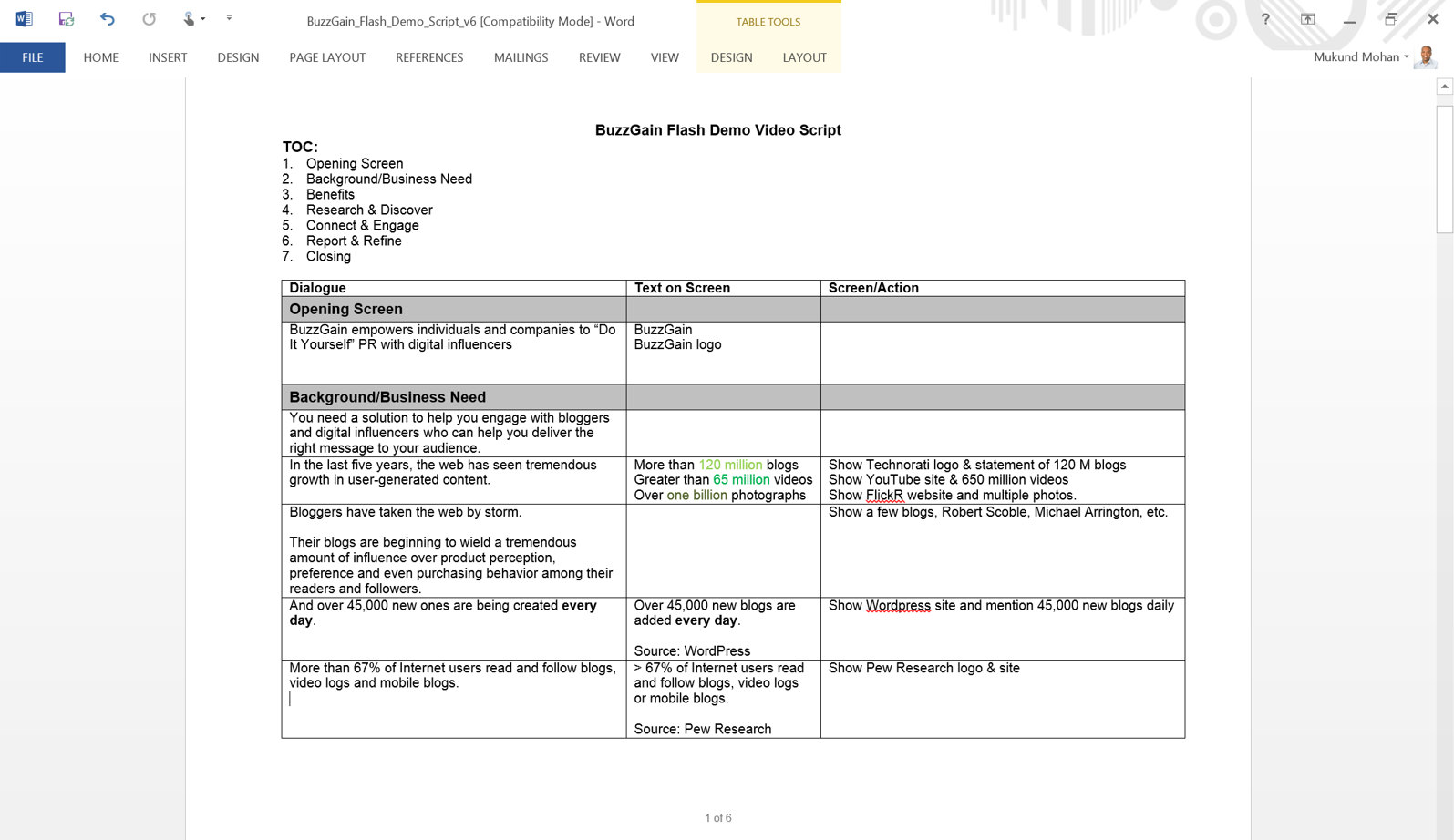
3. The best way to put an outline is to follow the Say this, Show this approach. In this approach, you have a 2 column word document where you will write exactly what you will say (audio) and on the right column what will be shown (visual) on the screen.

Overview Video Script

The alternative scrip format that I followed above uses a 3 column format with the optional 3rd column to show the text on the screen to go with the visual.

Here is the set of steps I took to write and produce the video:

1. Writing the goal: Time taken 15 minutes to write and 3 days to refine. I had to test the goal and understand who the real audience was for the video. There were 5 things I had to be absolutely clear about:

  • Who was the right audience for this overview video? – was it the PR Associate, the PR manager, the owner of the PR firm, or the communications manager at the large company?
  • What was the goal of this video? – to tell them about our product, to give them an overview so they know what it does
  • What was the desired outcome and my call to action? Did I want to have them sign up for BuzzGain? Did I want them to subscribe to the blog – since the production of the video happened before the product was ready or did I want them to take the next step – which was to view the next video on BuzzGain’s technology and how it worked.
  • What was the desired flow? What problem did I have to surface (based on my audience)? What pain point did I have to mention? How did I have to show the solution? Did I have to show the differentiation?
  • What were the assets I had to produce to make the video happen? Besides the flow what were the screen shots, the text, the logos, etc. that I needed to have ready?

Here is the original BuzzGain_Flash_Demo_Script_v6.

You will notice, that it has the 3 column format and actual screen shots.

2. Practicing the story telling (audio) and ensuring I hit the key points before the visuals

  • Speak into a microphone and record the entire script 3-4 times before you go and produce it with the video.
  • Play that to 10 people (without the visuals) to get feedback on the script and the voice, tone, key points etc.

The key reason for this step is to ensure that your story can be told even without the visuals. That way you can use the same script when you meet folks at networking events and dont have the visuals to go with it.

3. Going to the studio to actually record the audio in production quality.

4. Putting together the screen shots or PowerPoint slides that go along with the video.

5. Producing the video by mixing the audio and visuals. During that time (2009) I had Camtasia Studio and Jing project as tools to help produce this. I loved Jing project, but migrated to Studio since I found it more feature rich. There are many other tools you can use as well.

6. Uploading the video on YouTube after refining it multiple times and producing 7 useless videos which I did not like. Today I’d use a high quality HD video hosting site like Vimeo.

7. Embedding the video on our front page of the website using YouTube embed.

What I learned from looking at 30 startup videos of the recent YC batch

Video is the fastest growing medium on the mobile web. Turns out even if you are a B2B company these days, the word-of-mouth affiliation you need is often easier to achieve if you have a video more than text, audio or images. Of the 114 companies in the lastest YC cohort I looked at, most had a video on their website. I focused on the ones that had done a good job of explaining their overview using video.

Not surprisingly even CIO’s and traditional B2B buyers also prefer to view videos to reading whitepapers these days.

As a startup, if you are in the consumer space, I’d wager that you want to get your overview video faster than your “text website” which might be SEO friendly. Why?

Most of the early influencers and younger audiences are using YouTube as their search engine more than Google.

So, having reviewed 30+ videos from startups that graduated from YC last cohort, what did I learn about the types and kinds of videos you need for your startup?

I am going to assume that you are just launching your app / service or about to launch it soon. What you are trying to do in less than 2 min is give potential customers and prospects a chance to understand the problem you solve, how you solve it uniquely and how they benefit from the problem solved. I have noticed these 5 types of videos that startups have used so far.

Types of Overview Videos

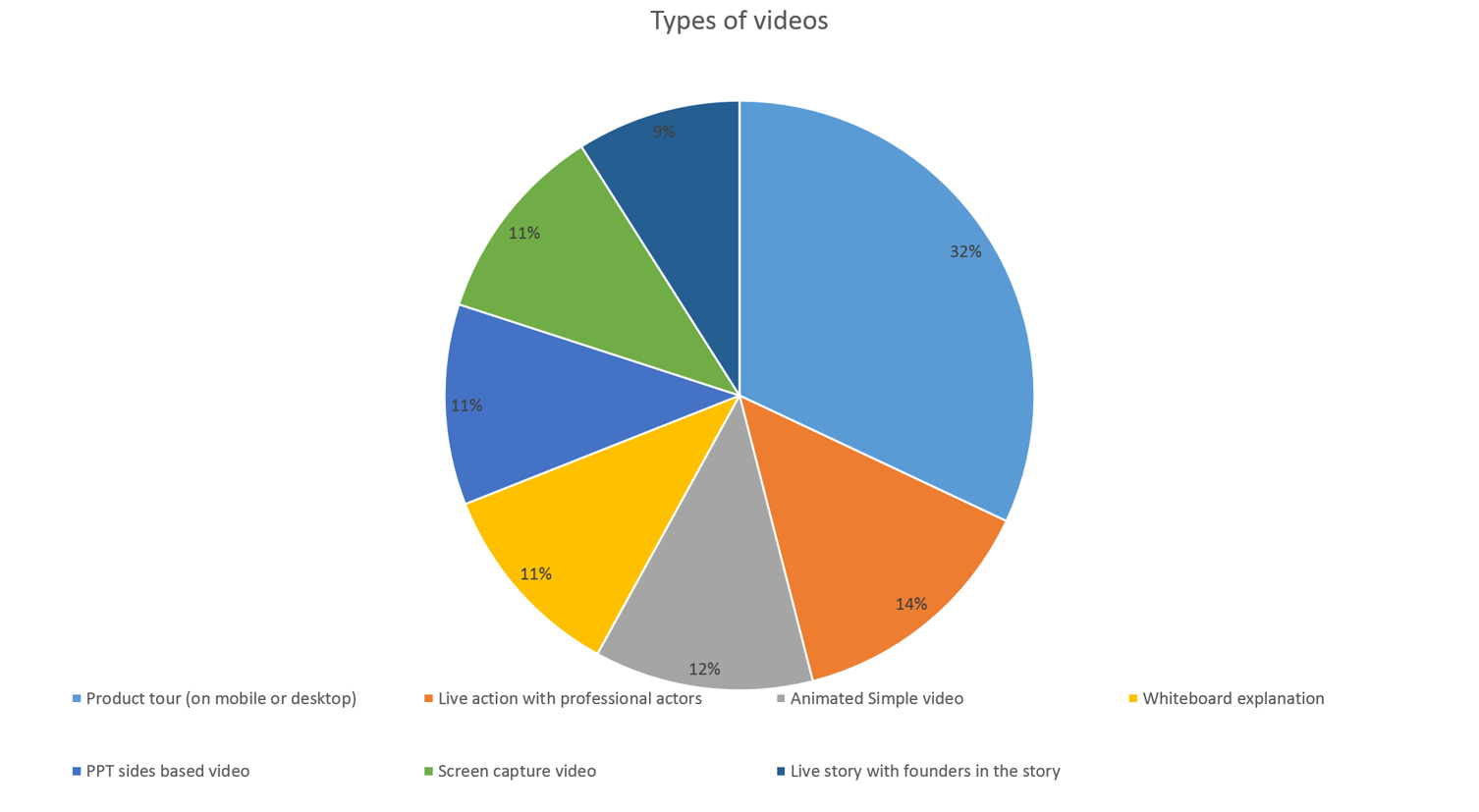
In most cases the “goldilocks” overview is less than 2 minutes and there are 7 popular formats for these videos:

1. Product tour on mobile or web: In this type of video, there is a person “showing” the app on their mobile with some upbeat background music. In many ways it is more a demo than necessarily a overview, but it serves the purpose well to get people to understand “what the product or company does”. It was hard to figure out which of these were actually using the product live versus screen captures, but slick production was the key.

2. Live action video with professional actors: As it suggest these are much more produced and directed, and will cost your more, but they tend to show “real” product users in “real” scenarios. I think these are pretty expensive if you are bootstrapped, costing upwards of $10K in most cases, but among consumer Internet (eCommerce especially) startups they seem to be pretty popular.


3. Animated Simple video: In this type of video, there are props used with simple cutouts and voice over. In most of these videos, I found that the startups used animation to to explain abstract complex, or non-intuitive problems, largely in B2B scenarios.


4. Whiteboard explanation: Fairly common as well, is two or sometimes just one person going to the whiteboard explaining what is it the startup does. In many cases, these are fairly technical products and companies, so Open Source product companies tend to use them the most.

5. PPT based slide videos. Used when the founders are not technical, bootstrapped and have strong B2B backgrounds in sales or operations. Since they are unable to put a professional looking video, these are used by folks who dont have a shipping product yet. They are not very effective, but I think they are better than text based pages.

6. Screen capture: Typical to the #2 type, these “show” product, but the screen capture videos are less professionally done. Authentic to a fault, they tend to be quickly done, rather poorly produced, but effective to “demo” the product more than give an overview.

7. Live story with founders: Rarely used, but common in Kickstarter campaigns, these are when the founder (s) are a key part of the sales pitch.


Over the next few days I will showcase a series of posts on the use of video, the types of video and some techniques I use to produce better startup showcase videos.

How to build a wide and deep network of relationships as an entrepreneur?

Initially when you are looking to hire a person in your company, you will hire “from your network”. The challenge is to have a good network that’s diverse and varied to help you bring those critical “early believers” on board.

One of the most difficult hires for most developer / technical people is hiring that first sales person.

There are many types of sales people entrepreneurs can hire – you can make out the different types of sales people by their reviewing their resume first.

There are 3 types of sales people a startup needs initially and maybe a 4th type later when they get bigger.

Startup sales people are not responsible for revenue but for payroll, so you should hire someone with the mindset that they are doing something very important and not just “sales”.

The hustler will get you any deal and will focus on getting you in the door quickly to open opportunities.

The relationship sales person will open doors to the few, but you will need to supplement her with other technical and sales resources.

The process or consultative sales person is good when you have a clearly defined sales process you need to scale.

The account manager is great when you have to expand your footprint within your existing customers.

The four types of sales people are best segmented by the depth and breadth of their relationship building efforts.

Types of Sales People

In the chart above I have tried to segment them based on my experience of working with these kinds of sales people. I dont think it is perfect, but it gives you a framework to think.

This could be a framework you use for your personal entrepreneurial journey as well, as you build your own network.

The best entrepreneurs have a broad (wide) and deep network.

They use the network to hire, recruit customers and attract partners. You know these folks who can not only help you get to the 2-3 people you need to talk to quickly to validate something but also help you canvas the 20-30 folks you need to get feedback from.

Building such a network is hard and takes time. Most people have 3-5 good friends and colleagues who they hang out with often and maybe 10-20 folks they work with on and off. Others have 500+ LinkedIn connections, but wont know more than 5 of them very well.

To build a wide network you need to have the mindset to seek out new people each time you have a question or run into a challenge. That’s not normal behavior for most people.

To build a deep network you need to invest time with a few folks and really get to know them, not only by working together but also personally.

The best way I have found to build a deep network is to find projects that mutually benefit others based on common interests.

The best way to build a wide network is to find a way to help as many people as possible for any type of request.

All this takes time, which is why you have to prioritize your relationships. In the early stages of your entrepreneurial journey, depth of relationships beats breadth, so make sure that you have the 3-5 people who you can count on, and then look to build adjacent relationships to grow your network.

Awesome quote modified: Whether you are big or small you better be innovating

“Every morning in Africa, a gazelle wakes up, it knows it must outrun the fastest lion or it will be killed. Every morning in Africa, a lion wakes up. It knows it must run faster than the slowest gazelle, or it will starve. It doesn’t matter whether you’re the lion or a gazelle-when the sun comes up, you’d better be running.”

― Christopher McDougall, Born to Run: A Hidden Tribe, Superathletes, and the Greatest Race the World Has Never Seen

The most important skill #entrepreneurs will need is to manage investors and navigate #funding landscape

There are many skills we ask of entrepreneurs – sales, hiring, marketing, product management etc. Of them fund raising is probably the most detested among technology entrepreneurs and the most desired among investors. If there are 3 things most seasoned entrepreneurs will tell you that you need to focus on as the CEO is to set the vision and product direction, hire great people and make sure there’s enough money in the bank.

The fund raising landscape, though has dramatically changed over the last 7-10 years for technology startups.

Used to be that most startups went from bootstrapped (for 6 months or less) to friends and family round (for the next 6 months) to an angel round (lasting 12 months) and then, if successful to a institutional venture capitalist (lasting 18-24 months).

It is not unusual to hear of 7 or more funding rounds BEFORE the institutional venture funding round these days for the 80% of the startups that dont have “unicorn type” growth. This crushes previous investors and makes the entrepreneurs more vulnerable to the situation when there is an exit at the company and the entrepreneurs make literally no money at all.

What are the sources of capital now available to entrepreneurs and when should you chose them?

That’s largely a “it depends” type of question, but here are your options.

1. Most entrepreneurs start with a bootstrapped model. It used to be that you had to keep 6 months of capital for yourself to sustain before you started, and now that has remained 6 months or become closer to 12-18 months. If you show quick traction, expect external investment soon, else expect to be in for the long haul.

2. Friends and family are typically still a good option, but increasingly I am noticing ex colleagues who have worked at startups or large companies who trust you and have experience in the market or customer problem you are trying to solve are a good option.

3. Crowd funding sites like Kickstarter, Indegogo, Fundable and Funding Circle are a relatively recent option for hardware startups, but are increasingly becoming a good option for “validating” true customer need and initial funding for many startups as well.

4. Angel investors are still a viable option, but increasingly angel groups are becoming a better source of the next stage of capital. They provide not only the ability to get money quicker than venture investors but also provide valuable expertise, advice and connections to help rookie entrepreneurs along the process.

5. Accelerators are relatively new source of funding, advice, network and mentorship as well. From fewer than 10 that existed 7 years ago, there are over 500 of them across the world, with many focused on specific verticals and industries that have domain expertise to help you further than a generic seed fund.

6. Micro Venture Capitalists (Micro VC) or Super Angels or Seed Funds are a relatively new phenomenon as well. From fewer than 10 Micro VC’s 7 years ago, there are over 250 of these small check-size, quicker to move investment options.

7. Angel List Syndicates are the latest option available to entrepreneurs now in the US and India (via Lets Venture). These syndicates allow any investor who has expertise in an area to help syndicate their “deal” with other interested High net worth individuals. They are usually led by an experienced and very well regarded entrepreneur and the value to this individual (besides the carry, a small portion of the investment in ownership or future exit option) is the reputation it builds for that individual.

Most of these new options come with their own pros and cons, but they are relatively recent phenomenon. If you are an entrepreneur I’d highly recommend you spend time reading up on all these options before you embark on your funding path. The best sources are usually blogs written by experienced entrepreneurs who have recently gone through the process and have the knowledge and desire to share.

The rise of technology Mergers and Acquisitions in India, in 2015

Between 2010-2014 there were 150+ acquisitions (about 30 per year) reported in the technology sector in India. Of these, 100+ were acquirers from India, and 40+ were from abroad. Most of the acquisitions were in the Internet space (outside of eCommerce).

Fast forward to 2015 and there have been 21 reported acquisitions already, and it is only April. In fact one of the investors, Blume Ventures has had 3 in 3 months. When I spoke with Sanat Rao of Ispirt M&A advisory connect, they are expecting an acquisition to be announced every week for the next 2 years. That’s a 100% increase over the last 5 years.

What’s driving this is a question that often comes up.

The first is the build up of the investor ecosystem over the last few years. From 2008 to 2010, IVCA reports that close to $5 Billion have been invested in Indian technology companies. Compare that to $1 Billion from 2000 to 2008. That’s a 5 fold rise in 1/4th the time. While investment alone is no indicator of M&A, many of the venture investors have built good relationships with M&A teams to help companies further their cause to “find a home” if needed.

The second, is the growth of new age acquirers – FlipKart, Snapdeal, Komli Media, PayTM InMobi, Naspers and MakeMyTrip, are now the leading acquirers in India with 15 deals in the last 18 months. Flipkart has acquired LetsBuy, Chakpak, NgPay and Myntra, PayTm acquired PlusTxt and Snapdeal has acquired FreeCharge, while Naspers acquired RedBus. Some of them have stated publicly that they will spend close to a $1 Billion to acquire more companies in India.

Third, older more established companies are finally getting into the act as well, with Havells acquiring Promptech most recently. The primary motivation for them is their strong cash positions are now being put to use to move into newer markets quicker.

Fourth, raising follow on capital has become easier for the larger companies, (series D,E) from external investors such as Tiger Global, which gives them a war chest to be more aggressive and take some risky bets.

Fifth, many early stage companies are getting acquired by US companies keen to expand into the Indian market – e.g. Twitter acquired ZipDial to expand in India. Now that there’s a huge critical mass of Indian Internet users (on mobile), this makes a lot more sense for these large US companies.

Sixth, acqui-hires are becoming more attractive to US companies since they are looking for smart talent and it is easier for them to acquire a team in India and move them to the US than hire a team locally. For example Facebook acquired Little Eye Labs and Yahoo acquired BookPad.

Many may argue that we still dont have the “big” acquirers from the US that are significantly buying Indian startups yet, but given the maturity of the ecosystem, comparing India to Israel is going to be hard.

I think this is among the best times to be an Indian entrepreneur, since India is now the #3 in terms of total technology investments,

How to present your differentiation slide on your #startup overview deck to investors?

This is a series of posts with a focus on your overview deck to investors, presenting your market opportunity, the team , problem you are trying to solve and traction your startup has had so far.

The differentiation slide in your overview deck needs to answer the question:

“Why is what you do important enough for customers to choose you over you competitors”?

Most startups can differentiate either by going after a different customer or by building a different product or solving a different problem.

Your differentiation will stem from the insights you gathered about the problem or the customer which you uniquely believe no one else has. The problem you are trying to solve (for e.g. search on the Internet sucked 15 years ago) leads to an insight (for e.g. Larry Page believed that # of links from other pages results in a higher authority page than others), which will help you create that differentiation.

If you have no better insight than others and merely are trying to execute better, it will result in a tremendous amount of capital consumption.

Here are 5 important questions investors are thinking about when it comes to differentiation on hearing your pitch:

1. Can someone other bigger company or competitor adopt the differentiation quickly and eat your lunch?

2. Is the customer segment differentiated enough? Is there a real pain?

3. Is the product differentiated enough to have a 6-12 month lead over others?

4. Is the framing of the problem different enough to make this a large opportunity?

5. What is the one insight they have gathered that’s differentiated enough that no one else knows about?

Which is why many entrepreneurs believe patent pending algorithms are the best differentiation. That’s defensible, but not differentiated for most parts.

Unlike customers, for whom the differentiated features in your product along with customer service, support or community is what helps them make the decision, investors are looking for differentiation to fend off competitors.

How you differentiate (to your customers) may be not the same as how you communicate differentiation to your investors. In reality, offering better customer service, creating a community and positioning your product differently will all be ways to differentiate, but the communication of differentiation to your investors will have to be around the large moat you can create around your company so you can fend competition.

The best ways I have often seen differentiation presented is by creating network effects in your business (eBay, Facebook, Twitter, etc.) or by proprietary algorithms (Google, VMWare) or being a first mover (Uber, AirBnB, etc.)

If you can articulate 2 of these 3 clearly – being a fist mover and having network effects or having proprietary algorithms and having network effects, then your investors will believe you can have a sustainable business.

10 things I have learned from running 10 demo days about #startup pitches

Ahh, the demo day. The arbitrary day the accelerator decides it is time to throw its babies to the world of investors. The number of accelerator directors I have asked the question “why is your program 3 or 4 months” is probably in the 50’s and the number of times I have not heard a thoughtful response is 100%. It is almost as if “that’s what everyone else does”.

This post though is not about being cynical, but more about what I have learned over the years and on what entrepreneurs can gain from my experiences of managing and running 12 demo days and helping close to 150 companies pitch, position and excite audiences.

First, it is important to set context. I am assuming you have a mix of investors and some non investors as well at your demo day. You have been through a 3-4 month program and have been practicing your “pitch” for a few months once or twice a month at least. I am also assuming that your pitch is about 3-5 minutes and your goal is to get investors interested enough to setup a follow on meeting to understand your company in more detail to express interest in investing.

I know that YC demo days have people in a frenzy with some investors texting they are “in” a round, even before the entrepreneur finishes their pitch, but for most parts I am going to assume that’s a rarity. For the rest of us, mere mortals, the pitch is an opportunity to prevent the audience from going to their smartphones distracted or otherwise bored by listening to pitch after pitch.

Here are the 10 things I have learned, in no particular order.

1. Show energy and passion – always be selling

You are in the spotlight, so if you dont wear your passion on your sleeve, you will likely get no attention. Even if you are a mellow person and tend not get excited much, find a way to show as much excitement you can about your company, the market and the opportunity. Investors are judging you and if “you dont seem excited about the opportunity”, they dont believe they should be either. You have been given an opportunity to sell your vision and this is one of the biggest opportunities you can get.
2. Visuals are only a prop – You should be able to tell your story without slides as well

Things have gone wrong with the deck or the projector only 2 times during the entire demo day for the 10 times we have done them, but those 2 times resulted in a meltdown for our founders. They were among the best in the cohort, but they forgot their pitch, got distracted and flustered when their slides went “blank”. Investors went believing that if they were to react this way if their pitch went dark, how would they react when sh*t hits the fan at their startup. Be cool. Use the Pitch deck as a prop alone.
3. Your goal is to a) get people’s interest to have a follow on discussion and b) to prevent them from getting distracted by their smart phones and c) ensure you are memorable enough for them to “tweet” about it, or make a note to email you for a follow up meeting

Dont imagine that someone will walk up after the pitch and give you a check. That would set you up for a high bar in terms of goal for your demo day pitch. You only goal should be to be memorable enough to get a follow on meeting.

4. Show traction – quickly after the problem and solution

Traction trumps all evils in a startup. Not a complete team, but have great traction – the investors think they can help you build the management team. Market sizing is still relatively small – the investors will try and help you expand to adjacent markets. But no traction? You cannot manufacture that.

5. Be specific about the total market, and addressable market

Most entrepreneurs have the time to only show the largest number possible and hope investors bite. Be more thoughtful than that. Over 60% of the folks that “went one level deeper” about addressable market, I have found, got a follow on meeting. The ones that showed a large gazillion dollar market, found investors ignored that number largely.

6. Tell stories that your day in the life has shown you, avoiding using phrases like – big problem, painful, etc.

If you generically use statements like “the problem is massive” for our customers, without being specific about the pain points, you are likely going to be dismissed. I’d highly recommend you use your “day in the life” scenarios to showcase what your user actually goes through as problems and how they are handling this right now.

7. Answer the question – why are you the best team to execute this problem

Many investors will tell you they invested only because they felt this was a great team and nothing else. That’s a lie. A big lie, but nonetheless, the team is one of the most critical aspects of any software opportunity. Just telling the audience who is in your team and letting them make the inferences as to why the team is uniquely suited to execute this problem is poor judgement on your part. Ensure that you let them know about your experiences, the fact that you have worked together, or that you have each unique learning that together helps build a great company.

8. Be clear about why and how you are different

In the absence of having something different to say, most customers (and investors) assume you dont have anything different, so you will compete on price. Competing on price is okay, but that usually signals a race to the bottom. The important thing I have learned about differentiation is that you have do something different in all aspects of your pitch – why is your team different, why is your product different, why is the market you are targeting different, why is your go-to-market different etc.

9. Your positioning forces people to figure out quickly if they are interested – get it right.

The first single line positioning is the thing almost everyone will listen to, which should be 5-15 seconds, when they are deciding if your pitch is worth listening to. Get it right and do it by A/B testing your startup’s positioning over time. Tweet-ready positioning is the best way to get some attention from the audience online.
10. Work your audience – Focus, 10 sec pause, Connect, Sweep 2 sec, Repeat. Make eye contact with as many people as possible. Engage your audience with a rhetorical question if you can.

These are tips for the folks that want to be a better public speaker. If your accelerator offers an opportunity to avail the services of a pitch coach, use it. As often as you can. While it wont make or break your company, the best public speakers generate more interest (not necessarily better, but more) for their companies than the ones who “show up and throw up”.