
Category Archives: Entrepreneurship

Do you really need a “board of directors” when your company is 6-12 months old?

I had a few questions on “Board of directors” at a startup from Manish Taneja. This it a post on the first question – Do you really need a “Board of directors” when your company is 6-12 months old?

You always need a board of directors, even if its just one person. A board primarily is responsible to the shareholders and looks out for their interests.It also advises the management (mostly the CEO) on company direction.

A board of directors (BoD) is not the same as an advisory board. The BoD has a fiduciary responsibility, whereas the advisory board has none.

Obviously when you are single founder, you will be “the board”. Since you are the only shareholder. There are a few procedural (statutory?) items that need to be completed (annually or more frequently) which are performed by the board.

Now on to the larger question: When and how should you expand the Board to a larger set of people?

The simple answer is when you believe your company needs Operational discipline, Financial discipline and “Discipline in your strategy“.

That could happen in 3 months, 6 or even later.

The most important thing I have personally experienced with board meetings is the need for reporting & tracking your company’s key metrics. Hence the discipline that sets in.

The company’s key metrics may not be revenue, customers or any other metric in the first few months. It could be as simple as status of the product development effort, customer development status, etc.

What I have found is the simple act of having to report that on a frequent basis is a bias for action and progress.

This is the biggest advantage of having a board of directors (especially for those entrepreneurs who tend to be “loosey-goosey” about most things.

Initially it might be okay to add one more person to the BoD, who you trust, can bounce ideas off and someone who will give you honest feedback to help keep things on track.

Most institutional investors (VC’s and some advanced angels) will however request a board seat to protect their (as a shareholder’s) interests.

In the next set of posts, I will detail – how many board members should you have, how often should they meet, what are board committees, how to manage your board and other board questions. If you have a specific question about the board,, feel free to email me or leave a comment.
A sample of the “values and culture” of leading technology companies

As part of the culture and values post I looked at what were the values & culture statements of the top technology companies. From Amazon to Zynga, the key things that they believe makes their company unique and successful. Some observations:

1. The older the company is the more “traditional” its values are, like integrity, customer focus, etc.

2. If you had to allocate a % to the categories of values, hiring people features in almost all of them.

3. Customer (or User) features next in 70% of them.

4. Innovation (or the commitment to it) features in less than 50%.

5. Interestingly only Apple talks about products.

  1. Google

1)       Focus on the user and all else will follow.

2)       It’s best to do one thing really, really well.

3)       Fast is better than slow.

4)       Democracy on the web works.

5)       You don’t need to be at your desk to need an answer.

6)       You can make money without doing evil.

7)       There’s always more information out there

8)       The need for information crosses all borders

9)       You can be serious without a suit

10)   Great just isn’t good enough.

  1. Apple

1)       We believe that we’re on the face of the Earth to make great products.

2)       We believe in the simple, not the complex.

3)       We believe that we need to own and control the primary technologies behind the products we make.

4)       We participate only in markets where we can make a significant contribution.

5)       We believe in saying no to thousands of projects so that we can really focus on the few that are truly important and meaningful to us.

6)       We believe in deep collaboration and cross-pollination of our groups, which allow us to innovate in a way that others cannot.

7)     We don’t settle for anything less than excellence in every group in the company, and we have the self-honesty to admit when we’re wrong and the courage to change.

  1. Facebook

1)       Focus on Impact

2)       Move Fast

3)       Be Bold

4)       Be Open

5)       Build Social Value

  1. Zynga

1)       Love to play

2)       Level Up (Meritocracy)

3)       Be CEO

4)       Zynga Speed

5)       Zynga first

6)       Innovate

  1. Salesforce.COM

1)    Get Your Aspirations Right

2)    Field Your Best Possible Team

3)    Focus on Your Best Customer Segments

4)    Create Your Competitive Advantage

5)    Build Your Sales and Marketing Factory

  1. Amazon

1)       Customer Obsession

2)       Ownership

3)       Invent and Simplify

4)       Are Right, A Lot

5)       Hire and Develop the Best

6)       Insist on the Highest Standards

7)       Think Big

8)       Bias for Action

9)       Frugality

10)   Vocally Self Critical

11)   Earn Trust of Others

12)   Dive Deep

13)   Have Backbone; Disagree and Commit

14)   Deliver Results

  1. Microsoft

1)    Integrity

2)    Honesty

3)    Openness

4)    Personal excellence

5)    Constructive self-criticism

6)    Continual self-improvement

7)    Mutual respect

  1. IBM

1)       Dedication to every client’s success

2)       Innovation that matters, for our company and for the world

3)    Trust and personal responsibility in all relationships

  1. Netflix

1)       Judgment

2)       Communication

3)       Impact

4)       Curiosity

5)       Innovation

6)       Courage

7)       Passion

8)       Honesty

9)       Selflessness

  1. HP

1)       Passion for customers

2)       Trust and respect for individuals

3)       Achievement and contribution

4)       Results through teamwork

5)       Speed and agility

6)       Meaningful innovation

7)       Uncompromising integrity

  1. Zappos

1)       Deliver WOW Through Service

2)       Embrace and Drive Change

3)       Create Fun and A Little Weirdness

4)       Be Adventurous, Creative, and Open-Minded

5)       Pursue Growth and Learning

6)       Build Open and Honest Relationships With Communication

7)       Build a Positive Team and Family Spirit

8)       Do More With Less

9)       Be Passionate and Determined

10)   Be Humble

  1. Twitter

1)       Grow our business in a way that makes us proud.

2)       Recognize that passion and personality matter.

3)       Communicate fearlessly to build trust.

4)       Defend and respect the user’s voice.

5)       Reach every person on the planet.

6)       Innovate through experimentation.

7)       Seek diverse perspectives.

8)       Be rigorous. Get it right.

9)       Simplify.

10)    ___ it.

  1. LinkedIn

1)       Demand excellence

2)       Take intelligent risks

3)      Act like an owner

  1. SAS

1)       Passion for excellence

2)       Enthusiasm and initiative

3)       Responsibility

4)       Focus on customer

5)       Emphasis on Competence building

6)       Cost consciousness

7)       Team work

8)       Integrity and loyalty

9)       Organizational pride

10)   Knowledge sharing

  1. Cisco

1)       Customer focus

2)       Corporate citizenship

The frustration of “lack of progress” with your product

On the outside looking in, its extremely frustrating to hear of product teams shipping product multiple times a day.

I tend to often question: “What in devil’s name am I doing wrong”?

  • Is it that I have not defined the product requirements right?
  • Have we hired the wrong people? Does our team not have enough experience?
  • Is our culture not supportive of mistakes?
  • Are we not focusing on the right things?
  • Do we not have the capability to get stuff done quickly?

Experience with multiple startups has taught me that its ignorant to compare your company with others (who might have stated at the same time) who have more “visible progress” than yours does.

But I hate that experience.

Its hard not to compare and question why is someone else doing so well with a smaller team than you have.

Experience has also taught me that startups for most parts (like kids) have a step function in progress. Its rarely a smooth “up and to the right”.

I hate that experience as well.

Should all that experience not make the next go around a lot smoother?

So the question – “What the value of all that experience”?

There’s only one answer – Its overvalued.

There’s one solution to most of these questions and although it is a cliche and often repeated, the answer is “Hire right” – whether its consultants or contractors or full-time employees, you need to constantly evaluate and hire the right people.

So, how do you hire right? And how do you define “right”?

So lets start with not the job description, but with your culture and values. Hire the right person that fits your culture and can align with your values.

If you culture is defined by moving fast, hire and attract people that can do that.

How do you determine if someone “fits” your culture if all you can do is interview them for 1 hour or so?

Write down questions to situations where you feel your culture will make them act one way versus the other. Ask those questions during the interview.

Depending on the answer to those questions you can determine if they can align.

What I have learned is people rarely change. So its hopeless to expect someone who is not a good cultural fit, to come in and get “religion”.

Comment from Rohit, converted into a post

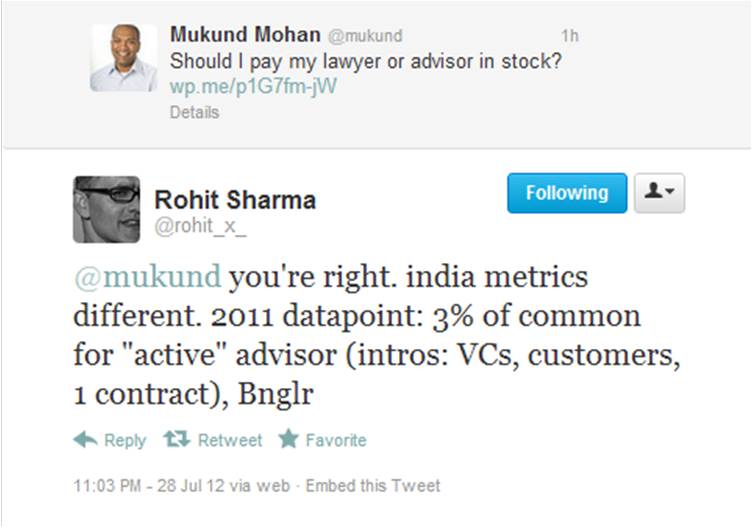
Rohit Sharma, angel investor and technology maven, left a very relevant comment that gives more color to the post on Should I pay my lawyer or advisor in stock?

I thought it was relevant enough to post it as a complete post by itself. The comment.

Here you go.

Despite equity being seen as the ‘right’ reward, my experience has been that the startups i know in india had a very hard time (compared to silicon valley) attracting people to the mission+equity at 25% or more cut from market salary. In the valley, it is common to see early core employees work at 50% of market even. If you can get the *right* employee in india for mostly equity – great but be prepared to fish with cash. This is not inherently an attribute of us Indians – I dont think India has seen many (any?) virtuous venture cycles where an independent founder raises seed or bootstraps, then raises A/B/C/.. grows + returns money to common + preferred in a profitable and large exit. Once several of these cycles complete, there would be ‘existence proof’ of common equity == much higher value than cash.

Also, “quality” advisors are rare in India at this point – there are several that promise “intros” to VCs or customers. Carefully evaluate their resume + past successes + references *before* you sign up any advisors. If they claim they connected XYZ company to potential customers, call them and confirm – not just the top level details but some working level truth to the claim.

If you find the right person for your startup – sign them up and just like signing up early stage core employees, do not optimize for lower-dilution – offer what you have to. A thinner slice of a bigger pie goes the thinking vs. hoarding a whole lotta equity for nothing.

Carefully consider the ‘term’ of the relationship. Does the advisor want the equity to vest immediately? Or over 1 year? or over 2/3 years? In the valley, common to have 1 year terms and equity vests monthly. Remember it would be hard (impossible?) for you to gracefully fire your advisor in the event things are not what they were promised to be. So 1 year terms may be best.

And just like hiring a key employee, try before you buy – spend as much time as possible *prior* to committing to figure out if this is someone who will be genuinely helpful. Establish some bounds – # of hours per week/month + get in to detail of the promised “intro”. i.e. will it be an email ? a phone number? an in-person meeting with advisor present? if things dont move forward (to a POC/trial/contract) with the customer in question, would the advisor try and open alternative channels for you? How well do they know their contacts – do they just know them (socially – weak for business) or did they work together (strong / trusted axis) or did business together (separate companies – may or may not be strong). The more specifics you can get out of them, the more ‘data’ you will have to back up your instincts.

No lawyer I know in India (From Amarchand to local firms) has taken equity as compensation. Vague claims of “not being allowed” by firm etc abound. Not sure where the truth lies. If you succeed in getting good legal work for equity – let me know ! In the valley, good lawyers will often defer fees till financing (very common), or give you an implicit discount (vs. hourly billing) and would often offer to invest to get some preferred as well as take some common. All equity goes in to an arms length Partners Fund for most law firms. Individuals are known to work for common just like advisors.

Should I pay my lawyer or advisor in stock?

I had 3 founders who had questions about compensation in Indian startups last week. One founder is building a mobile application for social TV, another a SaaS marketing application and the third a retail loyalty program using mobile phones.

They had multiple variants to the same question:

1. One was trying to figure out what percentage of stock to give an “active” advisor who was promising connections and a deal with a top customer.

2. Another was trying to see if she should pay for legal fees with stock (this is a US entrepreneur). Indian lawyers rarely accept stock as payment.

3. The third had a MySQL consultant who wanted to be paid only in cash.
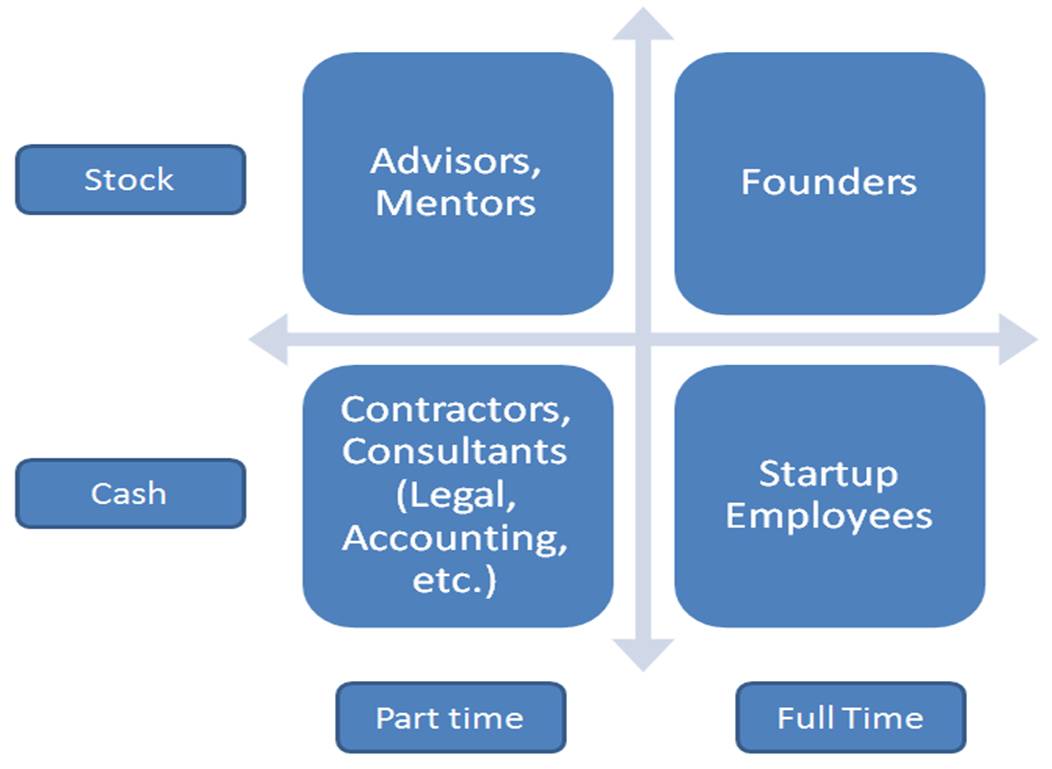
Startup Compensation FrameworkTo address these questions and more I am sharing a “compensation framework”, that I have used consistently for figuring out “how do I pay” for startups.

On the x-axis I put part-time and full time commitment. On the y-axis I put the payment methods – stock and cash.

For most parts, before getting funded, founders of the company get “paid” only in stock. So if your company is not making money or is making “not sufficient” money to pay the founders full salaries, then stock is the only compensation for founders. Usually most founders will get their stock vested over 4 years, or they may own  the company outright. On funding (institutional or seed), most founders still tend to take a small amount of money (not full opportunity cost salary) since their motivation should be to grow the company and use the investment towards growing the company’s value instead of growing their own bank accounts.

Full time employees get paid mostly in cash (and some stock). The Silicon Valley model is to pay 20-25% less than market rate for key full time hires, and “make them whole” with stock options which will have more value than current cash, if there was an exit in 2-5 years. Most Indian employees however do not like stock options and view them as “gravy”. I agree with their view for most parts, since exits are far and few between in Indian startups. Since key engineers, marketing professionals in India expect full pay or close-to-full-pay (some actually expect a pay hike with a startup because of the perceived risk), I am of the opinion that you dont give everyone stock options until you have proven that the company has market momentum. You can always accelerate their vesting pro-rata based on their tenure with the company when you believe there’s a strong potential for an exit for the company (i.e after 2-3 years).

Consultants of every kind (sales, lawyers, accountants, UI experts, marketing consultants) who work part-time should get paid only in cash is my perspective. They dont add long term value to any startup and while they are valuable in the short-to-medium term, their commitments are rarely with the startup alone. If you cant afford to pay the consultant market rate, I would offer the deferred compensation, or “true up” compensation on growth, but not stock.

Finally advisors and mentors, should only be paid in stock. How much equity you pay the advisor in a startup depends on a) the quality and market-worthiness of the advisors b) the amount of time they spend with the company and c) the expected objective you get them on board as advisors. E.g. If you are getting a mentor to open doors to potential customers, they would be given stock corresponding to the type and number of doors they open for your or the number of customers you close because of their help. Usually advisory positions are awarded stock vesting over a 18 or 24 month period (tenure of their position with the company). I know most entrepreneurs in India use US metrics (0.25-1% of stock in the seed stage, less in follow on stages) for percentage of stock to give advisors, but that’s not going to get you quality advisors in India. Since exits are fairly rare, you have to double the US (Valley) advisor stock options percentages and motivate good, high quality advisors to help you get achieve your goals.

Love to hear if you guys think differently.

P.S. Friend and investor Rohit has some datapoints around active angel investors data points.


Advisor stock compensation


The most constructive way to give feedback

I had an extremely smart manager at Mercury / HP who could hold his own on both the strategic side with the CEO and also on technical topics with engineers. Robin was one of the earliest to help me get a polished side (I am not saying I’ve mastered it, he just put me on a path to “try” to be more diplomatic and refined) to  my brash and in-yer-face “talk to the hand, cos the face ain’t listening” approach. I had been known to give the Heisman (see the image on wikipedia to understand why) to many of my colleagues and while that was fine with the Israeli culture, there was a lot to be desired with most other folks.

He ordered a book for me that I’d highly recommend called “Crucial conversations” (link) to all entrepreneurs.

The book helps in dealing with confrontations at home, at work, and even with friends.How to Notice When Safety Is at Risk, How to Speak Persuasively Not Abrasively, How to Turn Crucial Conversations, and How to Stay Focused on What You Really Want.

There one really neat trick I picked up, which was worth the cost of the book.

Every time you want to argue or have a debate about a point, or provide (negative) feedback but do it in a nice way, turn your statement into a question.

For example, if you want to tell the designer that the UI he built does not help conversion and its actually more work for users to scroll down, your normal approach would be to show him the analytics and tell her that she’d designed it poorly. That’s when you realize the designer gets defensive and she’d take the extreme position because she gets a sense you are “attacking” her knowledge or turf.

Instead ask the question “What would help us get more conversions?”. Then try to have everyone come up with an answer together.

For example, if you want to talk to your engineers and you know using AWS is better than maybe hosting your own server, your approach might be to show him multiple blog posts and other articles about why his position is wrong. Again, you’d get a engineer who’s being challenged and now believes its best to defend his position regardless of how wrong he might have been. Rare is the person that would easily take this feedback and admit they were wrong.

Instead present your hypothesis as a question. “What if …”? “What would”, “How can we”?, etc.

Then focus everyone on helping answer that question, making them part of the decision instead of being the ones to only implement it.

Try it tomorrow and the day after and let me know if you notice a difference.

Always ask questions instead of making statements of fact (even if you believe you are right).

It makes you come off as humble and truth seeking not the “know-it-all”. It also helps you focus on what you want as the end goal, instead of the minutiae.

In India, a customer does not buy a product, they buy a phone number

There are over 800 products listed in the productsmade.in database (out of 2149) that cater to the SMB market in India. Many of them sell only to the Indian market, and a few also try to target International markets.

The amazing part of selling in India is the ease of access to founders (promoters, they are called here) and Managing directors (CEO). Most have their cell phones listed on their website and many may have it listed on their ads.

Throughout the last few years when I ran relatively small (<20) person sales team, targeting companies with less than $2 Million revenue we found that getting appointments with CEO’s at small companies was extremely easy. A conversion rate of 50% from cold call to face-to-face appointment was not unheard of.

At a price-point which was less than a full-time resource to manage marketing, they found our solution relatively easy to adopt, but they were focused on quick ROI – meaning if they put $1 now, they expected $5 within the first month and an increase every month.

During the first few months, we spent an inordinate amount of time trying to simplify our product. We realized most decision makers & users at these companies were the CEO’s so we wanted to make sure they found our product easy to use. We did 4 sets of focus groups and removed a lot of features from the product, making it so that just one of two options were provided on each page. Navigation was made simple as well, with large buttons and primary colors.

After 2 months, we had an interesting problem. None of the CEO’s actually used the product. Every time they wanted data from our system, they’d just call the sales rep and ask him for information. We showed them how easy it was for them to look up the information on their cell phone, but they’d still call and “chat up” the rep, share more information about their business, their issues, etc.

We then provided a customer service team who would answer these questions so our sales person would be more productive. The sales person still got calls. One sales person left to join an MBA program. Even a year after he’d left, the CEO’s he sold to would call him to ask him for information.

That’s when we realized that Indian customers dont buy a product or a service. They just buy a phone number – a person’s mobile phone which is their user interface to the product.

Then I got to know about a central number system. Basically its a number that you can give and you can change it to any set of numbers by “routing” the call based on the number. We did not implement it fully, but the first few weeks of using it were a lifesaver for our sales productivity.

Startup Idea: Shopify for SaaS companies

There are over 20,000 SaaS companies in the world and growing (source). They are the new “software ISV” of the 1990’s. Growing like weeds. Getting users, building niche applications and growing revenue.

Every SaaS company builds a “specific application” for a “specific user”. They are the domain experts on that application.

Every SaaS company development team though, needs to pay a 15-25% tax upfront. Sometimes more.

Every one of them has to develop a sign up process, a user cancellation process, a payment process, a refund process, a login process, a password retrieval process, etc.

Trust me, we are going through this and its an absolute PAIN. It gets in the way of building useful benefits and capabilities for the user.

Its plumbing and it should be standard and out of the box for 90% of startups.

What if you provided a “Shopify” like sandbox for SaaS companies? Provide all these capabilities out of the box. Let SaaS developers focus on building their app. Not do plumbing.

Please dont tell me AWS is one, they are an infrastructure provider. You will still have to code a bunch of processes on top of AWS.

Requirements:

1. This platform has to be “developer friendly” – but not like Magento. That’s too steep a learning curve. Think like Mixpanel or Stripe “developer friendly”.

2. It has to provide simple API (hooks) to the developer’s own application.

3. It has to (obviously) be hosted.

Is it a billion dollar opportunity?

I dont know.But I will put my money where my mouth is. Show me a good team, and show me how you will do this and I will put angel money into this.

This is Heroku 2.0 (they got bought for $212 million). Go beyond platform and infrastructure and actually build application plumbing.

No one is doing it.

Who are the “early adopter” Venture Capitalists in India

Like you, I assumed that all VC’s are risk takers. I mean as an asset class if you have to provide the highest returns over the long term, I would suspect you have to take big risks to get big returns. The average Indian bank has been giving around 8% annual returns on FD (source), real estate returns about 13%, and gold loan providers will give you close to 15% I am told. So, VC as an investment class should offer higher returns given how ill-liquid they are and how risky they tend to be.

So, how do you really measure if a VC is an early adopter versus a late adopter? (lets keep it simple and only put them into 2 categories).

My thinking is the only way you can do that is to look at their investments (portfolio companies) and find out the categories of companies they invested in. Then find out if any other VC’s invested in another company in that category after the “first” VC did. There are other ways to do that, like ask entrepreneurs who responded the fastest when they were looking for funds, but those dont evaluate who puts their money where their mouth is.

Why is this question useful to answer?

For entrepreneurs who are innovating in a new area, this list of early adopters will help you determine who you should go to first versus who should you expect will fund a possible competitor.

Lets define our methodology and assumptions:

1. We will look at all their websites and make a list of the Indian VC portfolio. Fortunately we have that list of over 50 VC’s in India.

Flaw: Many dont update their website as frequently so there may be a 20% (or higher) error, but I have tried to be comprehensive.

2. We will then categorize their investment into 5 buckets – Media and content, eCommerce, Business to Business, Mobile and other (Education, Healthcare, etc). This is important so we know not only which VC’s are early adopters but we can also try to find that out by sector.

3. Then we will look at the announcement dates of their funded companies from press releases, Unpluggd, YourStory, ET and VCCircle. We will give them 2 points for every investment done in a sector before any other VC did.

Flaw: Most (I suspect over 50%) of companies report their funding 3-6 months after they have raised the money, so this will be a large flaw, but lets do the analysis anyway.

4. Finally look at stage of investment. If a VC puts money in the series A, I would give them two points in the early adopter bucket. If, however they participated in series B or later, they get one point in the late adopter bucket.

First let me give you the results (not in any order other than early adopters vs. late adopters).

Early adopters VC’s.

  • Accel (eCommerce, B2B) – 78 points
  • Indo US Venture Partners (B2B) – 56 points
  • Saif partners (Mobile, eCommerce), but they are late adopters in B2B – 49 points
  • Venture East (B2B) – 45 points
  • Sequoia (Media) – 46 points
  • Seedfund (Scored enough, but dont have a clear winning category) 42 points

In the middle

  • Blume ventures – 40 points
  • Nexus Venture partners – 36 points
  • Helion – 36 points
  • Ojas ventures – 34 points

Later adopter VC’s – all scored less than 30

  • Bessemer Venture Partners
  • DFJ
  • Cannan partners
  • India Innovation fund
  • Inventus Capital
  • Footprint ventures
  • IDG ventures
  • India Internet Fund
  • Lightspeed partners (but have done well in Education)
  • Norwest
  • Sherpalo

What I hope this list will do?

1. Make Indian VC’s think about being innovation catalysts rather than ambulance chasers. I understand you have a responsibility to provide returns, but you also have a responsibility to grow the Indian startup ecosystem. Might I suggest a 5-10% of your portfolio towards risky, “first time this is going to happen” investments?

2. Make Indian company founders announce their funding. Unlike the US, here entrepreneurs are loathe to do so. I can understand the competitive pressures, but not doing any announcement is just lame.

3. Educate Indian entrepreneurs on their target VC list. Depending on the opportunity you are trying to pursue, please target the right VC firm. The only thing you have (and dont have) on your side is time. Use it judiciously.

P.S. I have confidence in the methodology but I would be the first to admit its neither comprehensive nor scientific. If you are an eager MBA / Engineer / analyst and would like to help make this methodology and analysis more robust, I’d love your help. You can take all the credit. In fact, I can convince many publications to give you credit for the work if you desire and if you keep it updated every 3-6 months.

P.P.S. If you are a VC and not in the early adopter list, or you are not happy with the analysis I’d also welcome your associate’s help in making this analysis robust.

How to get a job as a Venture capitalist

I get an email or two a week from folks wanting to be a Venture Capitalist. Usually its to ask for introductions to a VC firm or to forward their resume. Most of these folks have a technical background and some have an MBA. Since most people sending the email dont ask me how they could really get a job at a VC firm, I thought I’d outline that for them.

There are broadly 3 operating roles in a VC firm – General Partner (GP), Associate / Principal (AP) and Operating partner (OP). There are other roles such as Venture partner, but those are fairly rare. Limited Partners LP’s) are not part of a VC’s fund’s operating roles, they are investors in a VC fund.

Most VC firms have between 2-5 GP’s, and 2-5 AP’s and 1-2 OP’s. (source: PDF)

GP’s take the most risk, since they raise the fund from institutional investors so they tend to get the highest salaries and profits the firm makes from the investments. To be a GP you should have enough capability to raise funds (the most important aspect) and deploy those funds to provide a better return (which is: invest in startups and ensure they have great exit). Most GP’s (over 60%) I know have a degree from a top notch school (think Harvard MBA, Stanford MBA or in India IIT and IIM). Please see list of VC firms (below) in India. My analysis of GP’s in those firms indicates unless you have been an entrepreneur before with a successful exit OR from a IIT / IIM, with over 10+ years of experience OR you can raise money from other investors, your chances of being a GP are very low (less than 10%). Unless you can raise money to be a fund on your own, you will have to spend 10+ years being an AP and then graduate to being a GP.

AP’s are usually junior folks, and of the ~120+ AP’s in the list of firms below, more than 69, (> 50%) are from IIT, IIM, McKinsey backgrounds. So if you are a fresh grad or someone with 2-5 years of experience, and not from a top school, your chances of getting into a VC firm as an AP are not high. Its not impossible, but there are only 400+ firms in India and so a max of about 1500 AP positions, which means a best case of about 700 (<50%) positions. The good news is over the last 5-10 years the % of IIT, IIM grads as AP’s has dropped from over 80% to less than 60%.

Operating partners are usually CFO’s or Legal advisors, so your technology background wont qualify you for a role there. More likely a legal degree or a CPA / CA certification is required.

So how do you get a job as a VC if you are not from a top school or you dont have ability to raise money?

1. Be an entrepreneur first: Most VC’s who are not from top schools end up being one because they made money for the VC firm that invested in them. If you are an entrepreneur and you raise money from a VC firm, and then have a successful exit, the chances of you becoming a VC improve dramatically. Surprisingly, even if you dont have a successful exit, your chances of getting into a VC firm improve many fold. If you had a successful exit however, you can possibly raise your own fund, and write your own ticket.

2. Help rich investors make money: As I point out before a key part of being a VC is the ability to raise money. Most folks who I get emails from are like me (15 years ago). I did not have the network to raise funds at that time and neither did I have a lot of money myself to start a VC fund. Raising money from other rich people involves them trusting and knowing you (they are friends, family, etc.) OR you having made money for them before. I suspect like me, most of the folks emailing me dont have very rich uncles and aunts, so the best strategy is to help rich folks get richer. This might include introducing them to startups which need investment and then exit to make your investors a profit, or making money for them via the stock market and generating enough returns to both satisfy them and to make a tidy sum for yourself.

3. Work yourself into that role: VC’s dont recruit by going to campus interviews or by posting on job boards. If they do, be vary, and run away. Most good VC’s I know only hire from their network or trust a executive search firm to help them get the right AP candidates. Get to know and help executive search (Kornferry or Stanton Chase) recruiters get other candidates (for other roles) and keep your name on their radar. They might come to you when a VC job comes up.

The other approach is to network with VC’s so they will let you know when their firm has an opening for an AP. To be on their radar, help them source and talk to great entrepreneurs and send them good quality companies to invest in. Alternately if you have an uncle or aunt at a VC firm, you can get that AP role fairly easily.

Of course the easiest way to be a VC is to bankroll the fund with your own money, if you have that much money, then this post is largely useless for you.

List of VC firms (sorted by no particular order), where I have a connection, so if you want an intro, I can help you.

DFJ http://www.dfj.com/cgi-bin/cgi-networkportfolio/search.cgi
IUVP http://www.iuvp.com/portfolio.htm
Bessemer Venture Partners http://www.bvp.com/Portfolio/Default.aspx
Saif Partners http://www.saifpartners.com/portfolio
Cannan Partners http://www.canaan.com/home/companies/india/
Venture East http://www.ventureast.net/Portfolio.html
India Innovation Fund http://www.nasscom.in/Nasscom/templates/NormalPage.aspx?id=53252
Nexus Venture Partners http://www.nexusvp.com/companies.asp
Inventus Capital http://www.inventuscap.com/portfolio.html
Helion http://www.helionvc.com/portfolio.htm
Footprint Ventures http://www.footprintventures.com/portfolio.htm
IDG ventures http://www.idgvcindia.com/global_portfolio.htm
Ojas Ventures http://www.ojasventures.com/portfolio.html
Naukri InfoEdge http://www.infoedge.in/ir-financial-fys.asp
Accel http://accel.com/company/sector.php?sector_view=122100
Nirvana Ventures http://www.nirvanaventureadvisors.com/
Everstone Capital http://www.everstonecapital.com/
Epiphany Ventures http://epiphanyventures.in/team.asp
Seed Fund http://seedfund.in/investees/
Silicon Valley Bank http://www.svb.com/india/
India Internet Fund http://www.indiainternetfund.com
New Silk Route http://nsrpartners.com/portfolio/sector
Sequoia http://www.sequoiacap.com/india/early
Lightspeed Partners http://www.lightspeedvp.com/Portfolio/Default.aspx?i=1&t=0
Greylock http://www.greylock.com/portfolio/portfolio/
Benchmark http://www.benchmark.com/companies/
KPCB http://www.kpcb.com/portfolio/portfolio.php?communication
General Atlantic http://www.generalatlantic.com/en/companies/region/4
Ascent Capital http://www.ascentcapital.in/
Reliance Venture Asset Management http://www.relianceventure.com/portfolio.html
Intel Capital http://www.intel.com/about/companyinfo/capital/portfolio/index.htm?country=india
IFCI VC Funds http://www.ifciventure.com/Success%20Stories
Matrix Partners India http://www.matrixpartners.in/portfolio.php?category_id=8
Kitven http://www.kitven.com/port.htm
Rajasthan Venture Fund http://www.rvcf.org/portfolio.html
Norwest Venture Partners http://www.nvp.com/NVP%20India.aspx
Clearstone Venture Partners http://www.clearstone.in/content/html/portfolio-location.htm
ePlanet Capital http://www.eplanetventures.com/team
Artiman Ventures http://www.artimanventures.com/team.html
Indavest http://www.indavest.com/portfolio.html
Sherpalo http://www.sherpalo.com/portfolio/index.php
Catamaran Ventures http://www.catamaranventures.com/
Battery Ventures http://www.battery.com/portfolio/international.html
Qualcomm http://www.qualcommventures.com/team
Blume Ventures http://blumeventures.com/
Mayfield Fund http://www.mayfield.com/
Andreessen Horowitz http://a16z.com/
First Round Capital http://www.firstround.com/
Union Square ventures http://www.usv.com/
Khosla Ventures http://www.khoslaventures.com/khosla/default.html