Category Archives: India

What I learned in my first month of running a startup accelerator

I have been the CEO of the Microsoft Accelerator for the past month. There are 11 companies as part of the batch and it has been an exciting ride. One of the things I focused on is trying to make the program a lot more structured than YCombinator and modeled it around a finishing school that I always wanted. Here are the top things I learned.

1. Dont try to change an entrepreneur’s idea. They have to come up with something they like themselves. This seems fairly trivial. There are many incubators and seed funds that believe if you dont have an idea, but are great entrepreneur material, they will “give you ideas”. That rarely works. Entrepreneurs have ownership and pride only for things they believe “they came up with on their own”. Anything borrowed (even if its a clone or knock-off idea from a US startup) is theirs. They will put more wood behind their idea than anything you ever propose.

2. Indian entrepreneurs have varied expectations from accelerators. One entrepreneur wanted “execution” help in actually doing the design (preferably a full time designer and user experience person for a few weeks to do it) and another wanted better quality food at the cafeteria. Some think the biggest value proposition of an accelerator is the “quality of the space” (i.e the physical location), while another thought the value was the other startups who would egg them to get better.

3. Regardless of what you offer, there’s always someone offering more or better, which I think is the “grass is greener on the other side syndrome”. If I had a penny for every time someone said “I have heard YCombinator founders get XYZ” or “500 startups gives more ABC”, I’d have enough money to fund all the startups for a year.

4. Indian companies need a lot more user experience and design help than any US company. I have invested in over 20+ companies in the US and about 11 here in India. Its extremely hard to find good user experience talent in India. This is a different person from someone that just does Photoshop and illustration. We interviewed 23 “highly recommended” designers and user experience professionals in India. Most were average and were still charging rates from $20 / hour to $100 / hour. No negotiation.

5. The Go-to-market challenge is largely under-appreciated in India among founders. Many need more help here than any other area, but tend to relegate the problem to “lets hire someone to do that”. Unless one founder is deeply involved in the customer development process, we largely build technology for the sake of it.

Startups and mentors: How to look for a great marketing mentor? & A list of top marketing mentors in India

After the first post on technology mentors in India, the next person who can help the most as a mentor to startups < 2 years old is someone that can help with product & customer knowledge (or understanding user / customer behavior if its a consumer startup).

There are 3 primary categories of “marketing” mentors I’d recommend you think about. You dont need them all, just be clear who you need for what kind of mentorship.

Product mentors are people who can distill what customers would need and say into what you need to build in your product. There’s a big difference between a product manager and a business analyst. The latter, typically found in many Indian services companies, tries to give the customer exactly what they want, and end up building largely a custom piece of work for that client. Product experts on the other hand, observe customers, ask them tough questions and direct the technology team to build what the customer really wants.

Sales mentors are people carrying a quota (target). They are pounding the street or directing teams that are selling every day. They understand targets, compensation, lead nurturing, managing deals and sales opportunities. There are many types of sales people but largely they are either “farmers” or “hunters”. Farmers end up expanding your current opportunity and Hunters get new business from new clients. They both have their place. Mostly, I have found sales people dont make very good mentors because they are largely unavailable, but there are a few good guys around. Ideally they would help you understand and grow your sales team from “CEO is the sales guy” to building a repeatable, growth-oriented team.

Marketing mentors would help you with positioning, building awareness, lead generation and digital marketing. They can typically help you at the stage when you need to launch (largely after product-market-fit). Most marketing people tend to talk lots and do little, so if you get someone that can give you practical tips on how to build your funnel and grow your customer base by spending as little money as possible, then you have the right person.

The question usually is why do you need so many mentors. The answer is you dont. It all depends on the team you have and if they need advice, help and mentorship. I have seen startups with 5 mentors and many with none. Most have 2-3 mentors to complement the team. You can get as much value from mentors as much time you put into the relationship. I typically recommend most entrepreneurs to setup 1 hour every other week during the initial days (<6 months) and then 1 hour every month and finally 1-2 hours every other month.

Some recommended Product mentors:

1. Amit Somani (Make my trip)

2.  Varun Shoor (Kayako)

3. Vijay Anand (The Startup Center)

4. Girish Mathrubootham (Fresh Desk)

5. Sridhar Ranganathan (InMobi)

6. Amit Gupta (InMobi)

8. Preetham VV (InMobi)

9. Dhimant Parekh (Hoopos)

Some recommended Sales mentors:

1. Madhu Lakshmanan (ex Photon)

2. Abhay Singhal (Inmobi)

Some recommended Marketing / Online customer acquisition mentors:

1. Pankaj Jain (Startup Weekend)

2. Ravi Vora (Flipkart)

3. Karthik Srinivasan (Flipkart)

4. Sanjeev Gadre (Consultant)

Early access: Quick review of BoxTV.COM

A good friend Abhishek from Tlabs gave me a preview access 2 weeks ago to BoxTv.com. Its dubbed as “Hulu for India”.

I am not a big TV or movie watcher (We dont have a TV at home, have not had it for many years now), so take this review with a grain (or more) of salt. I have only watched 1-2 partial movies. They dont have any TV shows yet.

The top things I liked:

1. Content selection (especially Hindi and English) is excellent. There are hundreds of movies that I have not seen at all (again that’s not saying much). The old hindi movie selection is particularly good.

2. Streaming is instantaneous and quick. The overall experience was pretty good and there were no glitches. I did have a problem the first time I logged in, post which there have been no bumps.

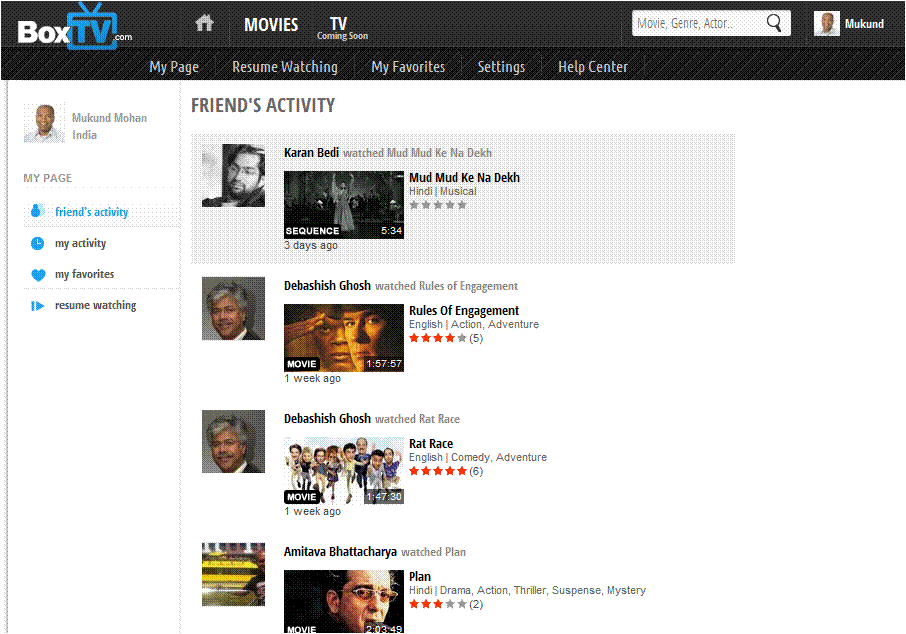
3. Connecting with facebook allows me to see other movies my friends watch, which was interesting, but not very useful. I realize I dont watch enough movies and TV to even know which of my friends have similar likes and interests.

4. Very easy to skip to certain parts of the movie quickly. Yes, I only watch the songs and skip most of the movie (grin)

5. Below each movie page there are important clips (between 2 and 3 min each) which are like the highlights reel. Loved that feature the most.

BoxTV.com
BoxTV.com

Things I did not like:

1. No support for mobile phone. Most of my work is now on my phone. Its a fairly large screen device, so I am not using my notebook for much. Since BoxTV is based on flash, support for mobile phones is non existent.

2. No sports and limited content for kids. If there was ever a reason to watch TV I’d buy it for NFL, tennis and cricket. Everything else is a waste of time at our home. Kids love many of the cartoon shows, and there were very few of them on BoxTV.

3. The filters dont work too well. If all I wanted to see was the list of latest movies, it shows me a bunch of clips (scenes) instead. What I thought it would show me is a list of the top recent movies.

4. Not enough integration with movie reviews. I’d love to find out from IMDB or rottentomatoes, which movies I should watch based on the popular list.

5. Not easy to search by actor / actress, etc. I tend to watch primarily by who’s in the movie, so this was still “in the works”.

Have you used Boxtv? What did you think?

What should a series A funding process look like? Step 5: due diligence and transfer of money to the bank

Please read series A funding plan and strategy, the first step of the process – the introduction to an investor, the 2nd step – first meeting and follow up, step 3 – present to the partnership, step 4 – Negotiations and Legal Discussion and now the final step: the due diligence and money transfer.

After the investor offers your a term sheet, they will mention that the final money transfer is subject to clearing their “due diligence”. Anecdotal evidence from 4 people in my VC network suggests nearly 10%-15% of companies which get a term sheet do not clear the due diligence. That’s a very high number.

What is a due diligence?

Its examination of the facts stated by you to ascertain if they were true.

The due diligence checklist (sample: pdf file), typically consists of anywhere from 10-15 (short) list of items to 10-20 pages of items. The items include your incorporation paperwork, tax and regulatory compliance, IP rights ascertainment, contracts signed, customer verification, and a host of other items.

Everything you mentioned in your presentations before (including customers you signed, revenue you currently are booking, etc.) will have to be verified.

Typically if you are a small startup doing little revenue, this might take 2-3 weeks, but if you are a larger entity it might take a month or more. Usually it is done in parallel with the term sheet negotiation, and will take up (in India) 1/2 time for that period of any individual. It consists of bringing together multiple documents and paperwork that you may have missed, filed or recorded.

This is one of the main reasons why fund raising becomes a full time job for one of the cofounders. I would also recommend you giving a heads-up to your Chartered Accountant or your lawyer so they can help you with these, but realize you (or someone you assign) will have to project manage this entire task.

Most investors (both in the US and India) prefer to transfer money in full to your account once the paperwork has been signed. Sometimes as part of the negotiation, you might get specific milestones that you might have to hit for more money to come to your bank. That’s typically called investing in installments or “tranche“.

Within 1-2 weeks of your final negotiation, you will be expected to put a “90 day” and a full year financial model and plan. You will be expected to hit these metrics (preferably go above and beyond). You should also expect a monthly (at the minimum) review of the key metrics (revenue, customers, hiring, etc.).

What might go wrong and how to fix it?

1. Your are missing certain items in your due diligence list. The key is to warn early. Tell your investors you are either missing or have lost or dont have a few items. You will be given time to get those fixed or in some cases they might waive it – it depends on the nature of that item.

2. There are some discrepancies between what you mentioned during your initial presentations and the documents you submit. That happens more often that most investors like and is probably the cause of most of the term sheets being rescinded. My personal suggestion is to be totally transparent and upfront with your investors before the due diligence so you can avoid this situation.

3. Some of the items in the due diligence dont apply to you, or they dont make sense or you dont like to share them. If they dont apply, ignore them and communicate. If they dont make sense, learn. You dont have a choice but to share everything with the investor.

If you like this post, please consider submitting to Hacker News.

What should a series A funding process look like? Step 3: presenting to the partnership

You have a series A funding plan and strategy, the first step of the process, the introduction to an investor, the second step the first meeting and follow up, now its step 3 is to present to the partnership.

Most times this step is hard to get to. Getting to this step means the key partner who is “sponsoring your startup” believes in it enough to get your company in front of the other partners. Most investor firms have 3-5 partners who (should) have the same # of companies they fund and same amount of funds to deploy. So if the fund is $500 Million and has 5 partners, then each person has to deploy $100 Million to get best returns. The partner sponsoring your company has to convince other partners why he’e excited about investing in your company.

In the US I have been asked to present to the entire partnership 2 times (they will then discuss it between closed doors among themselves), but in India, the way it works is that the partner presents your case to her partnership. So, instead of you telling the story about your company, you have to arm the partner with the best story so she can convince others in the partnership. Other partners can say no, but that’s rare is my experience. Usually your champion has been sharing details about your company with others early in the cycle so they are typically aware of the company, and now are trying to look at the deal in its entirety and look for any last minute reasons to say no.

To get to this point, though, is a series of multiple steps, follow-ups and constant progress updates. There is no “one thing” that you can do to get here. After your first meeting with the investor, follow up on the action items they suggest and ask the right questions of them so you can do the due diligence on them as well.

One of the most important parts (besides following up and providing frequent progress udpdates – weekly) of the process is the type and kind of questions you ask of the investor.

Smart questions and they realize you are trying to evaluate them as much as they are you. No questions and they will think you are a novice.

Here are a few questions to consider, which you can tailor to your situation:

1. How much time do you spend with portfolio companies and how often? Will give you a sense of their involvement. Some investors like to invest and only attend board meetings, whereas others will also provide valuable advice and connections.

2. What are the biggest challenges to scaling our company that you foresee? Will let you know their thinking around amount of money they think you will need eventually.

3. Which of your portfolio company CEO’s can I talk to, so I can learn from their experience? Make sure you also speak to other portfolio companies who they dont mention, so you get a well rounded perspective.

4. Will you be able to lead our round, or will you expect me to find a lead investor? Most firms will lead your round if they are excited, but some seem to prefer to co-invest and let others take the lead. If the firm you are talking to does not lead, then you will have to spend a lot of time trying to get another lead investor.

5. How long will it take from the time your partnership says yes to the time of finishing the paperwork and completing the money transfer? They will mention “on average it take X weeks / months” which will give you a sense of the negotiation process you have to endure.

Typically the partner meetings are on Monday, so if you hear back on Monday or Tuesday all’s good. Later than that means, there are typically more questions that came up, so you things might go sideways for some time.

What might go wrong and how to fix it?

1. Your investors “goes cold” on you after they present to the partnership (happens more often that I’d like). Remember that admin you started building a relationship with in step 1? Leverage her to find a time to speak to your investor – either when she’s on the way to the airport someday or in between meetings.

2. Your investor “needs more time” since they have some concerns. Get the list of specific concerns. Not generic stuff like “we dont like the market”, since nothing’s changed in the market since they started talking to you (assuming its not long). Try and see if those concerns are valid and addressable. If they are not, cut your losses, move on. Keep them informed or progress via a monthly email update, but realize trying to engage again is going to suck up a lot of your time for an unknown outcome.

3. Investor needs “more data“. Understand what data they need and which parts of it falls into the “due diligence” and which parts of it are truly needed to make a decision to offer a term sheet.

4. Investor does not say a firm yes or firm no. This is the biggest problem. Most Indian investors are fairly straightforward and will give you a quick 2 week (from start to finish) no. But the yes might take longer. The trouble is the quicker you push, the more likely you’ll get a no. US investors for most part (institutional) have a hard time saying no. Usually their “yes, but” means not yet. My suggestion is to focus on building your product during this time and get enough other work going on to ensure you dont keep waiting for the phone call from the investor.

If you like this post, please consider submitting to Hacker News.

What does a series A funding strategy and plan look like?

This post is the first in a series that I am planning to do on fund raising. I have successfully raised money 3 times (to a total of $29 Million – series A, B and C) and failed twice (once trying to raise $2 Million series A and second time $3-$5 Million series B).

As a background please read Elizabeth’s great post on “Behind the scenes of a seed round”.

Fund raising is one of the most difficult parts of a founder’s job. Getting money from investors of any type is hard. Dont be fooled by stories of entrepreneurs talking to investors and getting checks in 10 minutes. Those are truly black swan events.

The first thing you have to realize is that you need to develop an comprehensive plan and strategy to raise your series A. Think of it as an effort that’s similar to the launch your product. For purposes of this discussion lets call series A, as your first institutional round. I am also making the assumption that you have a working product, paying customers and are targeting a very large market (>$1 B for US, >$250M in India). If any of those criteria are not met, dont bother trying to raise money in this environment.

What are the 3 most important elements of your funding plan?

1. The pitch deck – a 15 slide PowerPoint presentation which summarizes the market, problem, traction and investment requirements. This is needed only for the face-to-face meetings.

2. The target list of potential investors – a Excel spreadsheet which has investor’s firm, name of partner, list of 2-3 recent investments (in the same general space as yours), email addresses, phone numbers, admin assistant’s name & email address, investor connection (people who can give you warm introductions to the investors), status and notes fields. You could use a CRM tool like Zoho if you like, but its overkill for this purpose is what my experience tells me.

3. An email introduction (40 – 100 words) and a one page summary. A simple text file with no images or graphs (something that the investor can read on their mobile phone (most have blackberry, although that’s changing). This can be sent to your connections to introduce you to investors or directly to known investors.

What should your strategy be?

1. Who should you target by role?: Investment firms have partners (decision makers) and associate / principals (decision enablers). Partners make decisions so if you can, get a introduction to a partner. If you cant, its not all doom and gloom, since many partners rely on their associates and principals to source deals for them.

2. Who should you target by investment thesis: Every investment firm has an investment thesis (how they will deploy funds to get best returns for their investors). This should guide you as to whether you’d be a good fit for the firm. Example: An investment firm might say we believe India’s broadband access and huge number of consumers with high disposable incomes is a great target for Indian eCommerce companies. So, they will deploy a certain % of their funds in eCommerce companies. Similar theses exists for big data, SaaS, etc.

Example: if you are an education startup focusing on India, Lightspeed (thanks to their success with TutorVista) should be on the top of your list. If you are a SaaS firm targeting US, Accel (thanks to Freshdesk) should be on your list. If you are a travel technology startup, Helion & Saif (thanks to Make My Trip) should be obvious targets.

A word of caution: If a firm has invested in a company in your sector, they will very likely ask you to speak to the CEO of their portfolio company to perform cursory due diligence. You may decide that company might be competitive and likely to execute your idea better since they have more resources. So proceed with caution and dont reveal any thing during your due diligence that might hurt you later.

Many investors invest in a sector because they “need one of those in their portfolio”. Example: Every firm has a baby products eCommerce company. So, I also recommend the “herd rule”. Which means, you should talk to other investors if your competitor has been funded by your first choice investor.

3. Who should you target by investment stage: Although every Indian investor claims to be sector agnostic and stage agnostic, there are a few early adopter VC’s. If you are the “first” in a new space, then consider an early adopter investor, else any investor who has not made an investment in the sector will suffice.

In a next post I will outline what the series A funding process should look like. This post will include information about whether you should follow a “back-to-back” process, or do a “listen and tweak” process.

If you like this post, please consider submitting to Hacker News.
Solve meaningful problems as a startup

Back in the 90’s and better part of last decade, most of the smartest folks from the top colleges would go and work at Wall Street. Lured by high salaries and fat bonus checks, they used their wizardry to create CDO’s, asset backed securities and derivatives to create billions for hedge funds, investment banks and trading desks of large financial organizations.

We all know where that ended up – the subprime mortgage crisis.

We thought there was a turn of events when one of them started to build a meaningful startup.

That prompted Bill Gates to say

“I’d say we’ve moved about 160 IQ points from the hedge fund category to the teaching-many-people-in-a-leveraged-way category. It was a good day his wife let him quit his job”

I get a sense that, “founding an Internet startup” is the new “joining a hedge fund” in the 90’s.

We are getting an amazing number of very smart people who are joining these startups in droves and applying for incubators, accelerators, hackathons and startup weekends.

There is a massive movement of high level IQ points from old-school consulting and “IT services backend for a large Indian outsourcer” to startups. That’s awesome news.

I have attended and judged 3 startup hackathons and prototype creation sessions over the last 1 month. I am absolutely thrilled that there are so many people turning out for these events in India. Over 650 attended the Yahoo Open Hack day. It was amazing to see such a diverse group of young talented developers and programmers solve some very interesting problems.

The part we have to work on is why the brightest minds are solving the most trivial of problems.

Startup IQ
Startup IQ

I think the problem with Indian startups is they think we are in the US.

There are rich people problems (The pictures from my mobile phone dont look good, can we build a “pimp my photo” app”) and there are real world problems (how can I make sure new grads from college learn to develope real apps, so they can get a job and reduce the jobless rate).

My humble request to Indian entrepreneurs is ‘Please dont build any more “I’m bored” apps’.

I am not trivializing the need for “fun” apps.

All I am requesting is that the highest IQ folks should be working on the highest impact problem areas to aid most humankind.

The frustration of “lack of progress” with your product

On the outside looking in, its extremely frustrating to hear of product teams shipping product multiple times a day.

I tend to often question: “What in devil’s name am I doing wrong”?

  • Is it that I have not defined the product requirements right?
  • Have we hired the wrong people? Does our team not have enough experience?
  • Is our culture not supportive of mistakes?
  • Are we not focusing on the right things?
  • Do we not have the capability to get stuff done quickly?

Experience with multiple startups has taught me that its ignorant to compare your company with others (who might have stated at the same time) who have more “visible progress” than yours does.

But I hate that experience.

Its hard not to compare and question why is someone else doing so well with a smaller team than you have.

Experience has also taught me that startups for most parts (like kids) have a step function in progress. Its rarely a smooth “up and to the right”.

I hate that experience as well.

Should all that experience not make the next go around a lot smoother?

So the question – “What the value of all that experience”?

There’s only one answer – Its overvalued.

There’s one solution to most of these questions and although it is a cliche and often repeated, the answer is “Hire right” – whether its consultants or contractors or full-time employees, you need to constantly evaluate and hire the right people.

So, how do you hire right? And how do you define “right”?

So lets start with not the job description, but with your culture and values. Hire the right person that fits your culture and can align with your values.

If you culture is defined by moving fast, hire and attract people that can do that.

How do you determine if someone “fits” your culture if all you can do is interview them for 1 hour or so?

Write down questions to situations where you feel your culture will make them act one way versus the other. Ask those questions during the interview.

Depending on the answer to those questions you can determine if they can align.

What I have learned is people rarely change. So its hopeless to expect someone who is not a good cultural fit, to come in and get “religion”.

Should I pay my lawyer or advisor in stock?

I had 3 founders who had questions about compensation in Indian startups last week. One founder is building a mobile application for social TV, another a SaaS marketing application and the third a retail loyalty program using mobile phones.

They had multiple variants to the same question:

1. One was trying to figure out what percentage of stock to give an “active” advisor who was promising connections and a deal with a top customer.

2. Another was trying to see if she should pay for legal fees with stock (this is a US entrepreneur). Indian lawyers rarely accept stock as payment.

3. The third had a MySQL consultant who wanted to be paid only in cash.
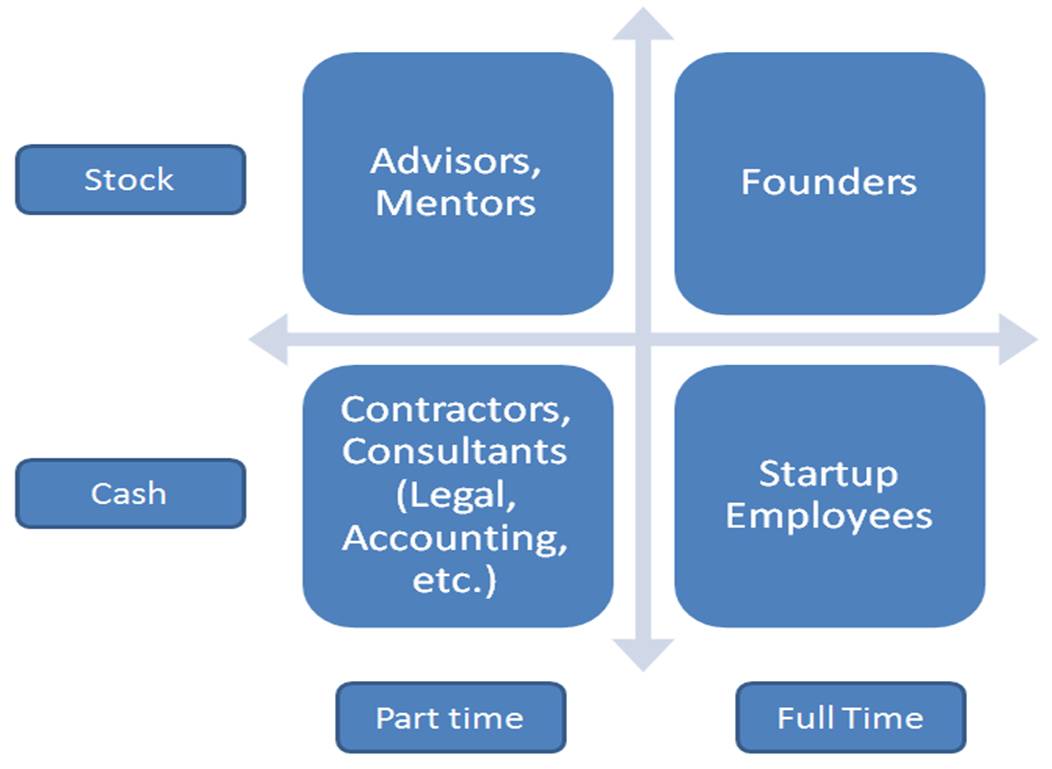
Startup Compensation FrameworkTo address these questions and more I am sharing a “compensation framework”, that I have used consistently for figuring out “how do I pay” for startups.

On the x-axis I put part-time and full time commitment. On the y-axis I put the payment methods – stock and cash.

For most parts, before getting funded, founders of the company get “paid” only in stock. So if your company is not making money or is making “not sufficient” money to pay the founders full salaries, then stock is the only compensation for founders. Usually most founders will get their stock vested over 4 years, or they may own  the company outright. On funding (institutional or seed), most founders still tend to take a small amount of money (not full opportunity cost salary) since their motivation should be to grow the company and use the investment towards growing the company’s value instead of growing their own bank accounts.

Full time employees get paid mostly in cash (and some stock). The Silicon Valley model is to pay 20-25% less than market rate for key full time hires, and “make them whole” with stock options which will have more value than current cash, if there was an exit in 2-5 years. Most Indian employees however do not like stock options and view them as “gravy”. I agree with their view for most parts, since exits are far and few between in Indian startups. Since key engineers, marketing professionals in India expect full pay or close-to-full-pay (some actually expect a pay hike with a startup because of the perceived risk), I am of the opinion that you dont give everyone stock options until you have proven that the company has market momentum. You can always accelerate their vesting pro-rata based on their tenure with the company when you believe there’s a strong potential for an exit for the company (i.e after 2-3 years).

Consultants of every kind (sales, lawyers, accountants, UI experts, marketing consultants) who work part-time should get paid only in cash is my perspective. They dont add long term value to any startup and while they are valuable in the short-to-medium term, their commitments are rarely with the startup alone. If you cant afford to pay the consultant market rate, I would offer the deferred compensation, or “true up” compensation on growth, but not stock.

Finally advisors and mentors, should only be paid in stock. How much equity you pay the advisor in a startup depends on a) the quality and market-worthiness of the advisors b) the amount of time they spend with the company and c) the expected objective you get them on board as advisors. E.g. If you are getting a mentor to open doors to potential customers, they would be given stock corresponding to the type and number of doors they open for your or the number of customers you close because of their help. Usually advisory positions are awarded stock vesting over a 18 or 24 month period (tenure of their position with the company). I know most entrepreneurs in India use US metrics (0.25-1% of stock in the seed stage, less in follow on stages) for percentage of stock to give advisors, but that’s not going to get you quality advisors in India. Since exits are fairly rare, you have to double the US (Valley) advisor stock options percentages and motivate good, high quality advisors to help you get achieve your goals.

Love to hear if you guys think differently.

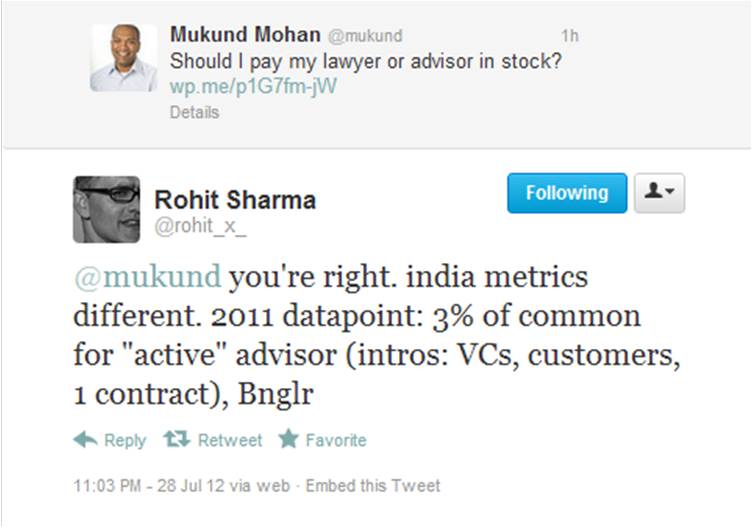
P.S. Friend and investor Rohit has some datapoints around active angel investors data points.


Advisor stock compensation


In India, a customer does not buy a product, they buy a phone number

There are over 800 products listed in the productsmade.in database (out of 2149) that cater to the SMB market in India. Many of them sell only to the Indian market, and a few also try to target International markets.

The amazing part of selling in India is the ease of access to founders (promoters, they are called here) and Managing directors (CEO). Most have their cell phones listed on their website and many may have it listed on their ads.

Throughout the last few years when I ran relatively small (<20) person sales team, targeting companies with less than $2 Million revenue we found that getting appointments with CEO’s at small companies was extremely easy. A conversion rate of 50% from cold call to face-to-face appointment was not unheard of.

At a price-point which was less than a full-time resource to manage marketing, they found our solution relatively easy to adopt, but they were focused on quick ROI – meaning if they put $1 now, they expected $5 within the first month and an increase every month.

During the first few months, we spent an inordinate amount of time trying to simplify our product. We realized most decision makers & users at these companies were the CEO’s so we wanted to make sure they found our product easy to use. We did 4 sets of focus groups and removed a lot of features from the product, making it so that just one of two options were provided on each page. Navigation was made simple as well, with large buttons and primary colors.

After 2 months, we had an interesting problem. None of the CEO’s actually used the product. Every time they wanted data from our system, they’d just call the sales rep and ask him for information. We showed them how easy it was for them to look up the information on their cell phone, but they’d still call and “chat up” the rep, share more information about their business, their issues, etc.

We then provided a customer service team who would answer these questions so our sales person would be more productive. The sales person still got calls. One sales person left to join an MBA program. Even a year after he’d left, the CEO’s he sold to would call him to ask him for information.

That’s when we realized that Indian customers dont buy a product or a service. They just buy a phone number – a person’s mobile phone which is their user interface to the product.

Then I got to know about a central number system. Basically its a number that you can give and you can change it to any set of numbers by “routing” the call based on the number. We did not implement it fully, but the first few weeks of using it were a lifesaver for our sales productivity.