Category Archives: Learning

Problem Development Learning: Dont explain what your startup does to a “layperson”

Most entrepreneurs following the Lean Startup Methodology or the Customer development methodology will tell you that it never really works in a linear, sequential fashion, neither does it follow the prescribed set of steps.

The primary reasons are either because you end up getting some feedback or learning during the entire process that changes your perspective quickly or get distracted.

I had a chance to talk to 3 entrepreneurs last week, who had all shut down their startups. One of them got a job at Facebook, after raising money from VC’s (tier 1 VC’s at that), another has started on a new venture and the third is going back to his previous role at a large company.

All 3 of them had spent upwards of 6 months and the most was 18 months in their startup. Surprisingly, none of them mentioned “lack of ability to raise more cash” as their reason for failure.

They all mentioned the challenges of “customer development”.
Stair Step Growth
Stair Step Growth

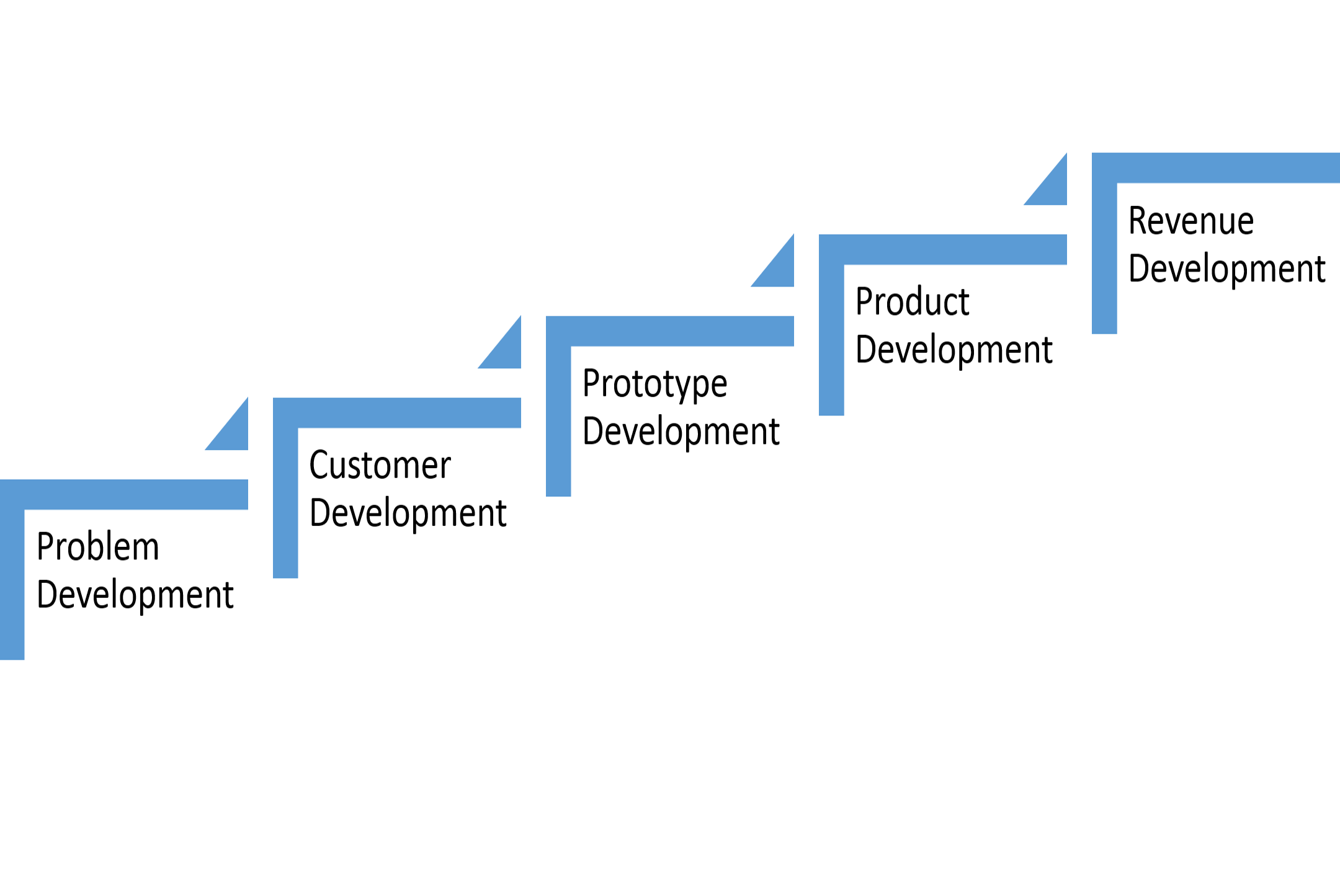
The startup development process comprises of 5 steps – problem development, customer development, prototype development, product development and revenue development.

I am showing these in a stair step approach, which suggests a sequential method, but I fully understand it is rarely so.

Problem development is a relatively new phenomenon, and your goal is to do a good enough job, fine tuning and understanding the customer problem in detail.

What I have found that in the quest to explain “what is your story” to a layperson, most entrepreneurs end up explaining the problem their solution solves, not the customers real pain point.

The biggest challenge for you the entrepreneur is to have the problem statement nailed in as great detail as possible when explaining it to your product and development teams. Else the “high level” problem statements, which you will use with customers or investors will result in poorly thought out solutions.

There are choices that you will have to make daily and hourly about product, experiences, features and direction of your product. In the absence of having a detailed set of problem statements – which constitutes the problem development step, most of these choices will be sub optimal.

Focus on problem development in conjunction with customer development for best results.

5 strategic items to consider before you get acqui-hired #napkinStage

In the last 3 years at Microsoft Ventures, 7 teams have been “acqui-hired”. 2 were from India, 5 in the US. I had a chance to be up close and see the action, the challenges, the frustration, the joy and the sigh of relief that the entrepreneurs face with these deals.

Acqui-hires fall into 2 buckets – those that save face and those that are incrementally progressive.

While many of the acqui-hires seem like a face-saving opportunity for the founders, they are pretty traumatic for the employees and almost always a poor deal for the angel investors, with exceptions.

The incrementally-progressive ones land the early employees great jobs in the new entity, provide a small return for the investors and allow the founders to get a small win under their belt.

I think about acqui-hires with the focus on the 3 main constituents – the early employees, the advisers and investors and finally the founders.


Acquihire Model and Strategy

You could debate who comes first and who should be considered later, so this is only one model for thinking about this.

1. Return on Risk (ROR) for early employees. Most of your employees (if you hired great folks who were already in other great companies) have taken some form of risk to come and join your startup. Assuming that many left opportunities that were considered less risky than yours, I suspect they would expect a sufficient return on the risk taken. Most good employees, will get an offer from your acquirer, which, I think is the main reason why they are acquiring your company in the first place. The best way to give them a return on risk is to help them “true up” on their salaries they forwent.

2. Return on Time (ROT) for the first few hires. In most acqui-hires, I have seen that the acquiring company does not value the product / service that has been built, but instead likes the team. Building a new team who work well together takes time and energy, which is why they chose to acquire a team instead. A good way to help your early employees a return on their time spent (and you as well to hire, recruit and build the team) is typically via a “sign on bonus” for the entire team.

3. Return on Investment (ROI) for your early investors: If you take money, it should your responsibility to return it if you make some money. While many founders feel that angel investors fully know the risk they undertake when they invest in startups, the responsibility to return money does not go away when things dont work out. What I have found is that most founders will end up going back to being founders again and if you leave a trail of destruction or burn bridges when you do your first startup, it will get much harder to raise money for the next one. If you can help investors get as much money back or return their invested capital, then you will go a long way in terms of building credibility for your next venture.

4. Return on Equity (ROE) for advisers. Early advisers dont invest money, but typically their time. While you might feel less responsible towards them since “they did not lose money”, they did give you time, some connections, advice and mentorship, I think you should try and get some for of return for their Sweat Equity. I have seen one or two founders, taking a portion of their “earn out” to buy out the adviser shares that have been vested. You dont have to do this, but it does help.

5. Return on Opportunity (ROO) for founders. While most founders are relieved just with any exit (given that many acqui-hires were to save certain closure) I do think that founder return is important. If you do get an opportunity to get a good package of stock options and sign on bonus from your acquiring company, I’d highly recommend you negotiate for that.

I have found that in 4 of the 7 deals that happened, the acquiring company would have gladly paid an extra $100K – $250K just so the various parties involved would be “made whole”. In many cases the founders just did not ask since they were desperate to get the deal done.

My only suggestion to you as a founder is to ask if you can. If there is a good alignment with the acquiring company and they wish to keep all the employees for a longer time, they would gladly negotiate some more money to help make the deal more attractive to all parties.

The reason for the $100K to $250K number is simple. If your team is 3-5 people, the cost of hiring a team alone will be covered at those numbers. So, in most cases, it will be a win-win for the company.

#napkinStage customer service at startups is becoming the sales team

While sales people are becoming marketers at #napkinStage companies and marketers are becoming more data driven product managers, customer service managers are becoming the best sales people.

Changing Role of the SaaS Customer Service Professional

When you move from a market, sell, support model of software sales to a market, analyze and sell model of SaaS products, it becomes clear that the best things SaaS companies do is:

1. Build a good product segmented by users. (Product, Engineering)

2. Ensure that their target audience know about their products. (Marketing)

3. Educate potential customers about the product to help them “try” the product. (Sales)

4. Build conversion to paid customer within the product. (Product, Marketing)

5. Help increase engagement (more product usage) and reduce churn i.e. losing customers. (Customer Service)

The role of the customer service teams is increasingly becoming one of reducing churn, since that kills most SaaS business model’s financials.

It is so hard to acquire new customers at scale and cost, so when you have a good, paying customer the objective should be to help them use the product effectively and get the most value so they get the ROI and are extremely happy.

There are 3 important functions that belonged to sales – reducing customer churn, engaging users, and upselling, now belong to customer service.

Previously, about 10 years ago, most customer service professionals were measured by how quickly they resolved customer support calls, how few the escalations were and how long they were on the call.

These are now dramatically changed. Proactive customer outreach and predicting churn – to reach out to customers before they cancel is now the norm for most customer support teams.

Most SaaS products I know are also build an integration with other products such as #slack or other chat solutions to help customer service professionals resolve questions and support the customer within the product.

Many years ago I’d remember our customer service VP would measure and incent reps on how quickly they got customers off the phone.

No longer.

Now, the longer you keep the customer engaged and talking, the likely you are to uncover more opportunities to up sell and cross sell other products.

Customer service is more a sales function now, than a support function.

#NapingStage marketing people at startups are becoming more product managers than brand builders

Yesterday we talked about the changing nature of the sales person’s role at the #napkinStage of a startup. While many people still prefer the “closer” to the pipeline builder, I think if you have a great product that customers can try, use and then buy you dont need to “close”. Customers will “buy” or “close” themselves. Enterprise and SMB software use to be “sold” not “bought” – that’s now changed. Only if you have a poor quality product or an expensive one, do you need to “force” people to buy.

Today I am going to talk about the role of Marketing folks in the #NapkinStage of a startup. While many startups may not hire a marketing person early, I think the role of the “marketer” is being performed by someone who is responsible for “getting traction”.

10 years ago, the Marketing person at a startup was focused on building analyst relations, attending and participating at events and building a “brand”. They spent a lot of time with agencies building the right creatives, making sure they had good “brochures”, giveaways and promotional content.

Changing Role of the SaaS Marketing Professional

The marketing person’s role is now more like an early stage product manager – I call them opportunity managers than product managers actually.

If you have a good product, then it sells itself in a 15 min demo (or a 3 min video). Yesterday, one of our companies (Beagel) told me about how they have a 70% conversion to paid customers in less than 30 min, so this is not a rarity.

The role if marketing manager is now focused a lot more on metrics like Customer LifeTime Value (LTV), CAC (Customer Acquisition Costs) and CTR (Click Through Rate), then results of “Brand surveys”, or “generated leads” and analyst reviews. They are becoming more data driven.

Attending events, writing whitepapers and delivering webinars is being replaced by creative copy writing – SEO, engaging on social media (Twitter, etc.).

With this change it is becoming obvious that most marketing is now focused on measurable outcomes associated with revenues, business and product than purely brand.

Surprisingly, even at larger companies (such as Microsoft), I am finding that most Marketing folks are coming to learn about these techniques of “Lean marketing” from the startups at our accelerator.

Tomorrow I will talk about the changing role of the #NapkinStage development team and how they are becoming more Customer service organizations than product engineering.

Which type of pivot is the hardest for entrepreneurs?

If you have been working on your startup for any reasonable amount of time, you will learn quickly that the market and customer assumptions you make are quite different from reality in most cases. In some situations they might be relatively benign and still others they might take a complete change of focus and direction.

At the #napkinStage of the company, pivots are a lot easier to execute than at the later stages. Since the immediate impact is largely the time and effort spent on the idea, it tends to be easier to acknowledge, explain or work on.

In watching 14 entrepreneurs over the last 6 months, I have seen 5 companies pivot.

Types of Pivots
Types of Pivots

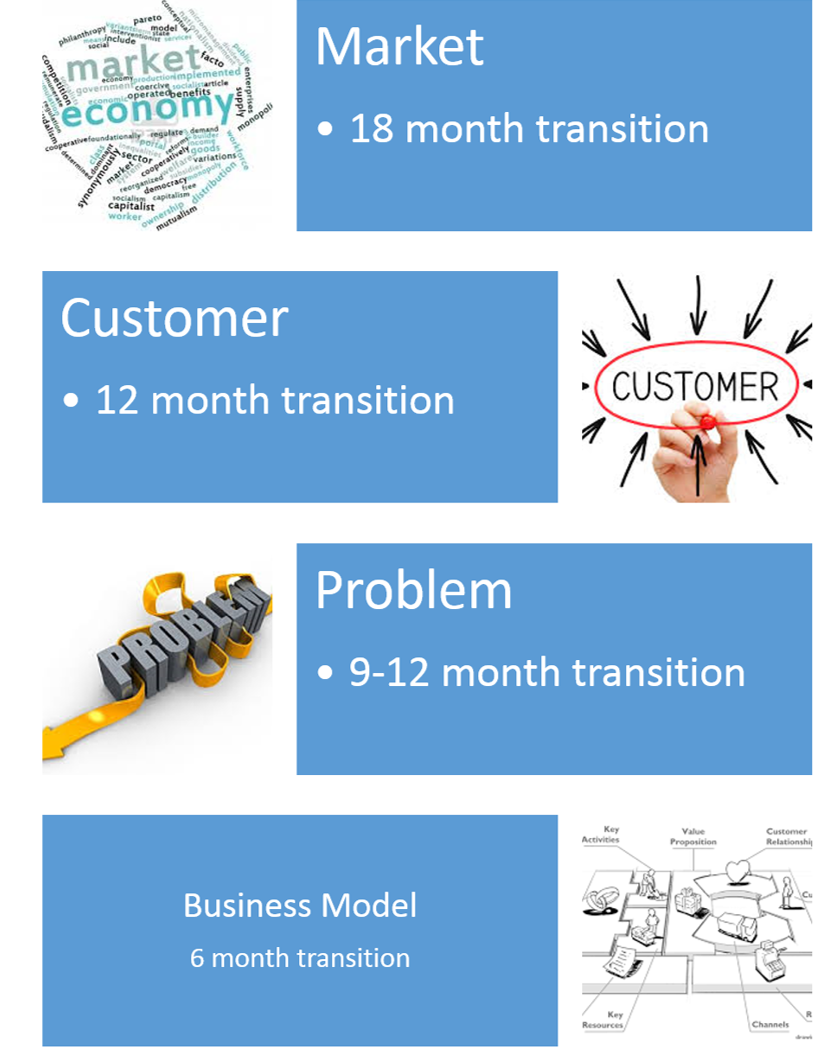
The hardest is the Market pivot – focusing on a completely different market than the one they focused on before – going from IoT startup to a data SaaS company. This type of pivot will take 18 or more months to execute. Learning about a new market is hard. Building relationships and understanding nuances of the landscape is even harder. It might seem easy since when you research on the Internet, but many markets are fairly opaque, till you spend more time learning about them.

The second hardest is the Customer type pivot – a company went from selling to consumers to selling to SMB with the same product. Changing the customer type or target customer is equally difficult. The hardest part is knowing and understanding the influence and decision making landscape if you are in B2B or to find the immediate value for the consumer if you are B2C.

The third hardest is the Customer problem pivot – one of the startups, realized, after talking to their target users that the problem more pressing was a different one and hence changed their product. If you already know your customer, but find out that the “latent” problem you perceived was different from the top 3 problems for your customer, then it is relatively less difficult to change course and pivot to the new problem. While communication with the internal team is still a challenge, these pivots tend to be able to execute faster.

The less harder pivot is the Business model pivot – a company went from charging on a SaaS monthly subscription model to a commission model on sales. By no means am I suggesting that a Business model pivot is easy. Having seen 2 companies of 14, just in the last 6 months, I think of all the other pivots, these are easier to execute and will likely take less time.

The first part of your problem is spotting the trend lines that help you understand when to pivot. The second (and likely more hard) part of your pivot is communicating – to your employees and founders, your customers, to potential and existing investors and to others who were involved – mentors, advisers, etc.

The first step to disciplined experimentation is to capture all possible ideas

When you have a great startup culture and hire awesome people at your startup, you will attract a talent pool that has tons of ideas all the time. Many of those ideas may not be relevant to your startup, but I firmly believe that it is not only the product managers, engineers or marketing folks that can have ideas that have an impact on your startup.

If you create an environment that encourages active listening, experimentation and risk taking, you will have a good mix of innovation all around at your startup.

One of the most effective ways to encourage is the impromptu “Lets just chat” weekly sessions that I see at many new startups. These are not larger company-wide all hands sessions, but smaller sessions usually hosted by a very junior, but engaged individual at your startup.

Most times they are held with 5-7 people at your kitchen or during lunch or casual drinks in the evening. The ideal size of the team is less than 10 is what I have found.

Ideas pop into people’s heads at all times. I tend to get most of my ideas when I run. Many people get them when they are stressed, others during vacation, and still others in the shower.

Ideas require a stimulant, and while I have not read the research yet, I believe one of the key ways to stimulate ideas is to exercise or rest your mind.

Capturing these ideas to whoever it occurs is possibly the best start you can have. Many people use idea management software like User Voice or Brain Storm.

I think more people are starting to use Slack for idea capture at their startup. I have seen it with 3 different startups and it is starting to become a thing.

Slack for Ideas
Slack for Ideas

The challenges with Slack are that idea rating, idea management, voting, tracking deployments are pretty challenging.

I would highly recommend you use the one app / messaging platform that EVERYONE in the company uses (possibly email, and if you have Gmail, then use plugins to manage emails to ideas) and put them into a single place.

The best way to review the ones that will have impact is to understand the value of that idea in the context of your key milestones. Some of them will impact your milestones immediately, others will improve aspects of your stated goals. Still others may do neither.

The most important framework I have used is to understand the effort and impact.

Impact versus Effort Matrix

I think putting the ideas generated into the matrix and focusing on the ones with most impact and low effort (has to be delegated) tends to give you the ability to have good value.

A framework to think about experiments for your startup

Experimenting is at the core of building and tying new ideas. A opposed to having a clear problem to solve, experiments are designed to “try” out ideas that you have and yet know if they will work or not.

At most startups, I notice two primary “ends of the pendulum” issues. Most (over 90% of startups) dont run enough experiments. The rest (< 10%) run too many experiments in parallel.

If you fall into the first category, then my only suggestion is to think about experimenting and commit to doing one. The AirBnB blog is a great place to start, in terms of understanding the user experiments they run. They actually have a experiment reporting framework, which shows how evolved their thinking is in terms of this facet of work.

I also am a fan of the “test and learn” mindset. Since I believe that working on your startup is more a journey in self realization than of markets, problems and customers, it is important to keep learning. I do also believe the best way to learn is to try and do small experiments which you can scale.

I have been a fan of disciplined experimentation.

This post is about the < 10% who run too many experiments in parallel. That’s the biggest challenge I see with startups that hire amazingly entrepreneurial talent for their first few hires.

Since each of the first 5-10 employees are entrepreneurs themselves, they all tend to run multiple experiments, either with product, marketing, customer acquisition, sales, etc.

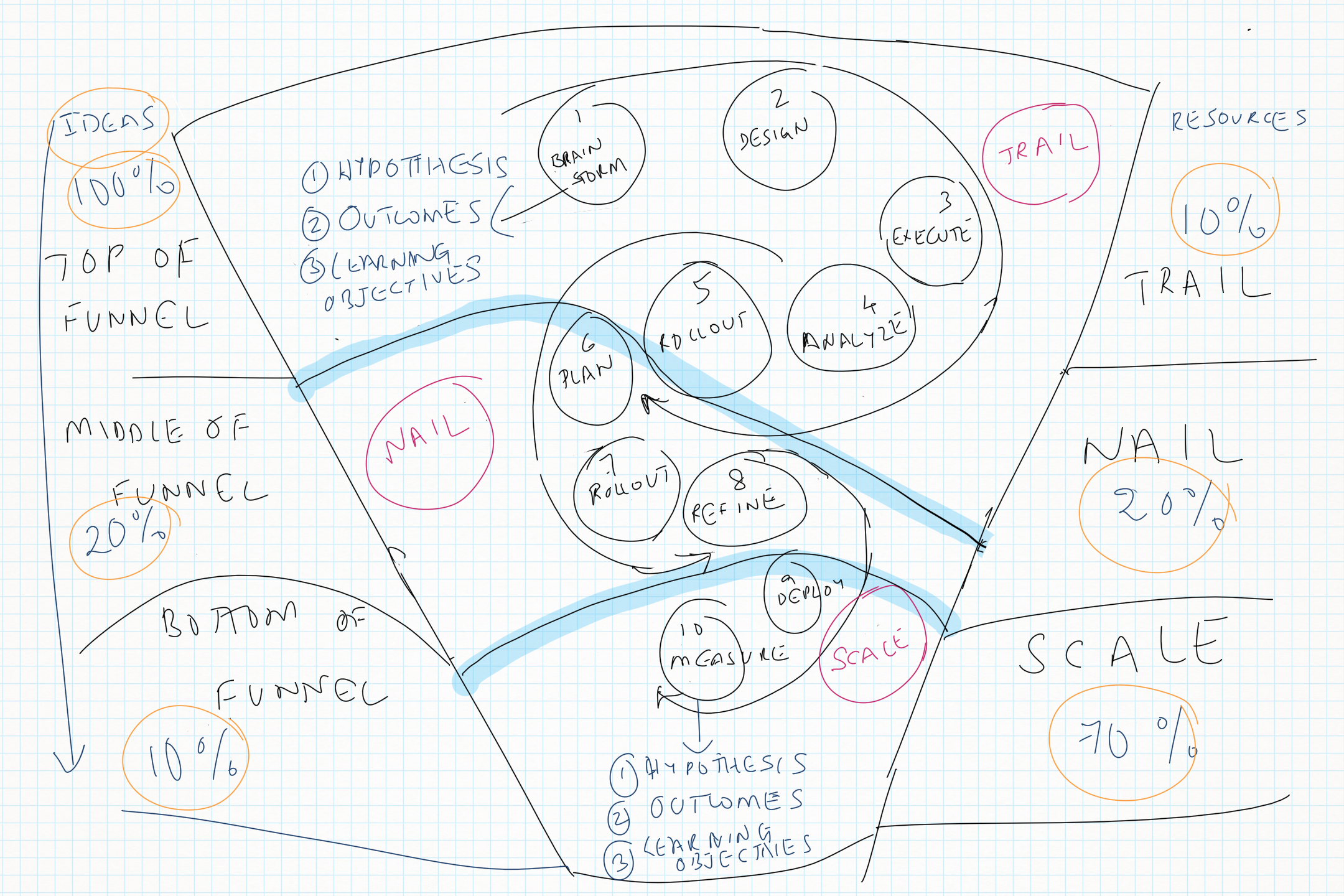
The framework I have for thinking involves 3 “sets of steps”. I call it “Trail, Nail, Scale”.

The “Trail” comprises of 5 steps, the “Nail” comprises of 3 steps and the “Scale” comprises of 2 steps.

Here is a visual to think about it.

Trail Nail Scale Disciplined Experimentation

Obviously this is very early thinking, but I’d love your feedback.

The way to think about experiments is you to pass through gates and assign the appropriate resources at each stage and have a “rough sense” of what you are trying to achieve. If you know exactly what you want to get out of your experiments, you are not “experimenting”.

What I have noticed is that the 3 stages end up being a funnel. There are many experiments you run, a few of them you will nail and a fewer of them you will scale.

If you have 100% of your “experiments” when you start, (on the left of the graphic), then 20% (or less) will be nailed and 10% you will scale.

In terms of allocating time and resources (if you dont have a large team as a startup, allocate your time), 10% is spent on “Trailing”, then twice that time or 20% on nailing and 70% on scaling.

There are many questions that this throws up, which I want to address over the next few days.

1. How many experiments should you run at the same time?

2. How do you define the success of an experiment?

3. How do you internalize and document the learning from your experiment?

4. How much “money” should I spend on trailing? How about in nailing?

5. How do I leverage lean principles into this thinking of Disciplined Experimentation?

Anyway, I’d love your feedback on this framework. As I share more of my work, which I am interviewing people in larger (Unicorn) startups at, I will also give you some case studies to see what they learned.

The first 5 steps to building your own SaaS application

This post is for non developer founders who want to build a SaaS application.

Software as a Service (SaaS) is a relatively small market – at $19 Billion in total revenues, it seems large, but compared to $250 Billion of the overall software market it seems minuscule. It has grown from nothing to this large number in the last 10 years. Similar to the eCommerce market, which seems large but is less than 15% of overall retail, the opportunities will start to be in the niches is my prediction.

The big question is when and how will it grow and where are the opportunities. While there are many specialist firms focusing on SaaS alone, the incumbent software companies (the largest of who are Microsoft, SAP, Oracle, etc.) are also making their own investments to move their businesses from selling licensed software to services.

One of the key opportunities I see is that ability for smaller, niche markets to be targeted using SaaS. Since the deployment model, time to value and cost are so much lower now than 10 years ago,  it is easy to build a niche product that can gain rapid fan following among the target customers and *if that customer base* does grow and end up having more budget it can be a lucrative market.

I do get the question often about the steps to build a SaaS business. Even if you dont intend to build a Venture funded business, the economics of SaaS are determined by cost of customer acquisition (CAC) and cost of servicing the customer (developing, operating and maintaining the software).

What I am increasingly starting to see is that most prototypes are either built by a developer founder, or outsourced (by a non technical founder) to “prove that the market exists“.

1. The first step I’d recommend before you start development, is to sign up 15-20 beta customers. Target people you know well who will stick through your crappy alpha, beta and version 1, so you can convince them that the value does exist when you iterate quickly.

For early beta customers, there are many techniques you can use including: a) setting up a launch page and promoting that launch page on social media b) setting up a launch page and buying Google adwords to drive signups and following up with signups via email c) blogging about the topic to share what you know about that market d) interviewing influential users before you launch or e) setup an email newsletter of great content for that industry and have many potential users subscribe to that newsletter.

2. The next step is to create an activity model and user flows.

User flow Diagram
User flow Diagram

This step is to ensure that you can know exactly what are the top 3 features you need to implement first which will make your product “must have” to solve the problem for your users.

In fact if you can identify the top feature (just one) that people will come back and use everyday, you should be good to go to the next step. Validate the top feature with your beta customer list, so you are building what they will use.

3. The next step is to create a mockup using wireframes. These are typically good to show the screens your user will go through and the experience as well. I would get a lot of feedback on the list of steps and screens before I build the prototype.

Iphone Wireframe
Iphone Wireframe

Typically in your first pass stick to under 7 screens would be my suggestion. That’s enough for a 45 second to 1 min “demo” and should give your users a feel for what the app will do. If they ask you for “one” feature that matters more to them than the ones you have, dont mock it up yet, but put it on your list until you have enough users interested.

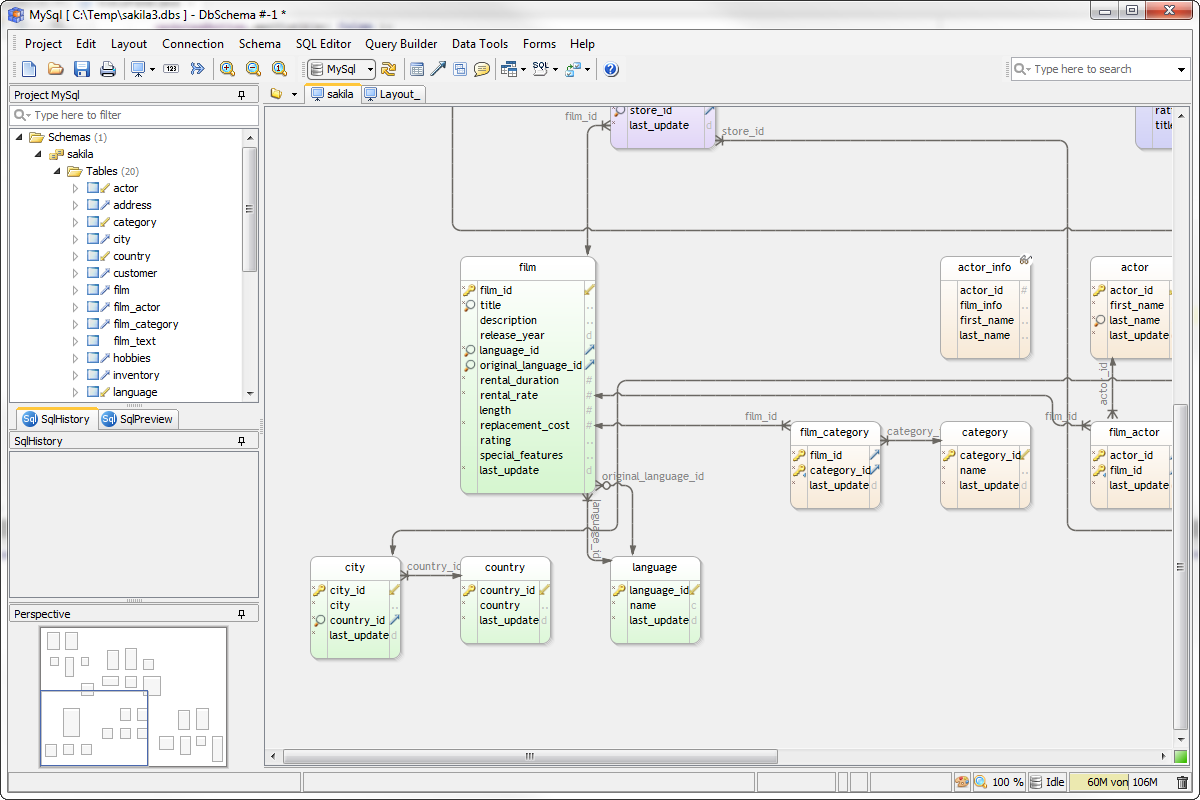
4. Design your database schema. A database schema is good to share with your developers entities that exist in your application and what their relationship are. I tend to use DB Schema or just Freemind to show to fields without the datatypes.

DB Schema
DB Schema

5. Understand and select your “stack”. Even if you want to outsource your application development I’d recommend you talk to a few developer friends who can educate you on the stacks they use – what the front end languages and libraries would be, what the back end language would be and the database options. You will be more confident when you talk to your outsourcing company and also be able to help make tradeoffs when you need them.

A day in the life of a Micro VC – @jeff of @softtechvc tells me where he spends his time

Jeff Clavier
Jeff Clavier of SoftTech Venture Capital

At the 500 startups LP meeting and dinner last night, I had a chance to meet with Jeff Clavier. He is one of the first Micro VC funds (before they were a thing in valley). Their latest fund (Softech IV) is a $85 million fund. Jeff and I have known each other for years now, since 2005, when I first met him at a TIE conference and he’s still the same very approachable, friendly and simple guy – surprising given that he’s French – (sorry, Jeff, could not resist taking a dig).

A Micro VC fund has a much smaller team, is the first thing you notice. While larger funds like A16Z have over 100 people and even a a large fund such as Menlo might have over 20-30 people, a $50-$100 million fund, cannot afford more than 5-7 folks. Typically there might be 2-3 partners, and 2-3 associates or Vice presidents.

Which means you are pressed for time. Jeff, mentioned that he’d ideally like his time spent in thirds.

1/3rd of his time spent on sourcing new deals and working to build a pipeline of opportunities, by meeting new entrepreneurs and trying to help them even if he wont invest.

1/3rd of his time portfolio management, which includes spending time helping them with execution and operations, thinking about fund raising and helping make key connections and finally helping open doors to potential hires or prospective customers.

Finally a third of his time is spent managing the team, investor communications and networking with other investors at events, judging startup hackathons, and learning about new areas to invest in.

Each of the 3 partners at Softech VC does 5 deals a year, so they do 15 deals in the 3 years of investing in the fund. To do 5 deals a year, they end up meeting about 250-300 entrepreneurs he said, and roughly 2 times that many introductions are made to him from others.

Digging deeper, the first 1/3 of the time sourcing new deals begins largely by getting warm introductions, which were built by the years of working with other investors, and helping other entrepreneurs who have been the best source of his deals.

The 2nd third of his time is disproportionately taken up by warm email introductions and strategy discussions with his existing portfolio on fund raising. Typically Jeff stays on the board for 2 years, ensures that they company has a very good series A investor and then hands the board seat to them, keeping in touch with the entrepreneurs if they need his help. Which, according to him makes it all the more important to ensure that you think about later stage investors

Finally, the last third of time time is for “everything else” – which includes fund communication, meeting with new potential Limited partners, attending startup events, connecting with other entrepreneurs, discussions with potential M&A targets for teams and mentoring his own team, to discuss opportunities.

The first thing that strikes you is that this is a full time job. Many who claim that the the life of a General partner is mostly golfing, 2 hour lunches, 3 hour dinners, attending events, spouting knowledge about unknown markets and “networking”, dont appreciate the amount of time that it takes to source, manage and attract high quality partners who can help you connect with great entrepreneurs.

Second, unless you spend time (and lots of it) building good relationships with good potential downstream (assume that a series A investor is downstream from a seed investor) Venture capitalists, then you will have a hard time helping your companies raise more money and feel confident that your invested dollars are in safe hands with folks looking for the best interests of the company.

Tomorrow, I will touch on a topic that he and I talked about – how many “warm introductions” to potential investors, does it take to get a funding round done for an early stage startup.

How the 6 digit Apple passcode requirement wastes $6.551 Billion annually

Apple this week announced that they are going to require 6 digit passcodes instead of 4 digit passcodes for the lock screen.

Newer ipads and iphones will require the 6 digit passcodes. That’s apparently more secure than 4 digit passcodes.

The only reason to go to 6 digits is when your phone gets stolen by someone who can brute force 10,000 codes (with 4 digits). Well, apparently, most people use pretty common passwords, so if you only try 27 known passcodes (such as 1111) then your chances of unlocking the phone are at 67%. That means only a third of the people actually use complicated passcodes that will take more than 15 minutes to crack.

If however, you have 6 digits, then the combinations are a million (versus 10,000+) so, it should take longer and more effort to crack your password.

I doubt that. 90% of people will go with 111111 instead of 1111 is my guess, or 123456 instead of 1234. Now, your stolen phone will take 22 minutes to be unlocked instead of 15. Yay!

Apple has sold 512 Iphones to date and about 200 million iPads. Of those, about 75% or 534 Million devices are still in active use. 83% of them run the latest version of iOS.

I am going to assume that most people will upgrade to the new OS version so about 500 million (534 million to be exact) iOS devices will be upgraded to 6 digit passcodes.

The median salary in the US is about $42,000 and the median iPhone users salary worldwide is higher – $53,000.

90% of the iPhone users move to 6 digit passcodes and each user actually unlocks their phone 50 times a day (given that most users glance or unlock their phone 150 – 500 times a day, it is a reasonable assumption).

The extra two digits will cause 1 second more to unlock is also a fair assumption to make.

This equates to $6,551,388,888.89 in productivity loss every year.

iPhone 6 digit passcode Migration Wasted Productivity

With no discernible added security. All for a feature going from 4 digit passcodes to 6 digits.

There were 1.6 Million phones stolen in 2014. The average price of the stolen iPhone was $250, equating to a $400 Million market.

End note: I know the value of a stolen iPhone to a user (especially if there is a loss of life tragically in some cases) is much more than $250, but a 6 digit passcode is not going to change that for the better.