I had the opportunity to meet about 20+ entrepreneurs at the Plug and Play Tech Center, an accelerator and coworking space in Sunnyvale. This cohort was 2 sets of companies in the IoT (Internet of Things) space. Companies ranged from those in wearables, healthcare, connected car and home automation spaces. There were none in the industrial or commercial IoT area.
The startups were trying to get a sense for the changed funding landscape for startups and how to manage the new set of investors they had to deal with. Many in the connected car space were also talking to “strategic investors” such as the automakers themselves to get a sense for their interest to fund startups.
There was a question that one of the startups asked, which was they were adviced by a mentor who was a venture capitalist that “If we get funding from a strategic investor, then it will be viewed as toxic (sic) since we have to build to their needs”.
I am not sure of the context of that discussion, neither do I know about that investor’s background or intent, but this seems like poor advice at the outset. With more context and analysis I might learn more, but at the first glance, this is poorly construed.
I think the best way to deal with experts who provide advice professionally is to resist the temptation to dismiss it rightaway or the desire to take it at face value and implement it rightaway.
Surprisingly I have found that most entrepreneurs actually “forget” the advice and seek out to experiment and find their own answer. That’s goodness, but it begs the question, how do you remember to seek what you learned?
So the problem as most people realize is that (like with storing and sharing good things at home) the problem is not storing, it is retrieving.
How can you recall the right advice when you need it?
Some decisions we make are fairly quick and provide us with very little time to process. Most decisions we make as entrepreneurs take require a longer lead time than a day.
The best way I have found to recall information an advice is to ask it again in context, instead of trying to remember what was said before and assume no judgement or bias before asking for a framework to think about the decision.
That way it gives you the ability to recall in context.
This surprising tactic means you should ignore all the advice you get and filter most of it as entertainment.
Which, if you are an entrepreneur is a much needed distraction.
Depending on the audience you will be asked to show a “competitive landscape chart” of your domain and the major players in the market. The main purpose of the competitive landscape chart is to position your company or product against others in the market. You need not to go into details, but, will be required to provide enough clarity for the audience to make out the differences between you and others in the market.
There are 2 important things you need to consider when putting together the competitive landscape analysis chart –
What you show (Features, Customer Segments, Market Requirements, etc.) and
How you show it (Visualizations such as Venn Diagrams, Harvey Ball Table, Process Map, etc.)
I follow a 3 step process to come up with the competitive analysis landscape:
Step 1: Identify: List all potential and possible competitors on a spreadsheet – one for each row
Step 2: Analyze (What you show): Start putting a list of features that you can claim you have they don’t, or segments of market which are market determined or a list of capabilities you intend to build which your customers care about or any other set of capabilities you can distinctly and objectively bucket each offering by.
Step 3: Visualize (How you show it): Look for patterns to showcase a small subset, (2-3) of the key dimensions you can differentiate and then choose the right visualization.
From the many hundreds of competitive analysis charts I have seen, here are the 7 most frequent.
Market Size – Dimensional Bubble
Market size analysis is typically good for early stage investors (institutional). The size of market tends to be a big determinant for many investors, so if you can show the potential size on a chart featuring bottoms up numbers in the X and Y axis and the cumulative size of the market as the size of the ball, you will end up giving them a sense for the potential of your company. In the example below I have shown the # of users and Price per user in the X and Y axis. The size of the bubble is (not to size) will then indicate size of the market.
A good way to differentiate if you don’t have a different product is to differentiate by segment of market. You can segment markets by any number of ways, and the type of company / user / customer you are going after is a good way to show your competitive landscape. Most consumer companies tend to do this. As an example, Twitter is good for 30-45 year old males, Pinterest is good for 25-40 year-old women, Snapchat is for 20-30 year olds, etc.
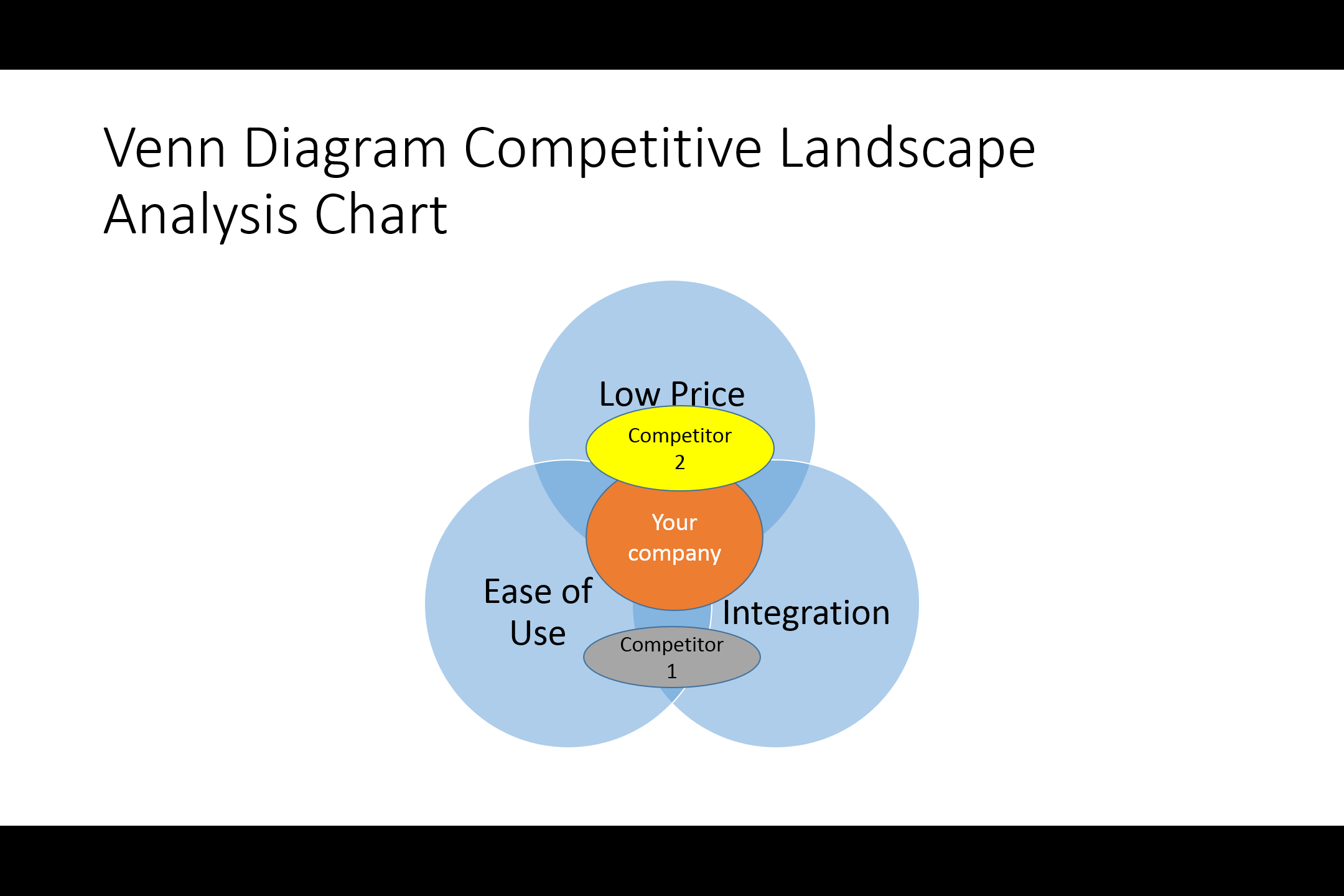
It is okay to have an overlap of companies across multiple segments and the other twist I have seen is to show the value proposition to your customer on the other axis. In this example the key 3 capabilities of Price, Ease of Use and Integration is what I have showcased.
Customer Segment Multi Axes Competitive Analysis Chart
Customers Process and Systems – Process Map
The Process map is best used when you have a lot of companies in the “space” but they all do different things for the customer in terms of their usage and solve different portions of the same larger problem. For example, when I was starting BuzzGain, the listening solutions were good to get an understanding of what was being talked about a brand on social media, but engagement products were used by customers to interact and respond and analysis solutions were used for market research.
This chart could be a double-edged sword. One on hand a customer or investor could see this as clear positioning of where you stand in the process map, but on the other hand they could see the other products wanting to build the different capabilities across the process, which leads to consolidation, which to them indicates, they should wait until the market settles, or buy from a “large vendor, who has a significant but not best of breed products across the spectrum of their process”.
Customer Process Competitive Analysis Chart
Feature Capability – Venn Diagram
Best used when you want to convey that customers need the best of 3 (or 2/4/5) different capabilities or features which all make the product unique. For example the fact that you have not he lowest price or the easiest to use product or integration alone will not rule your product out in the customers’ mind, but the fact that you have all 3 covered in the perfect blend makes it appealing to customers or investors.
The Venn diagram is best used when you can show that you have the capability to showcase you in the center and competitors on other intersections.
Venn Diagram Feature Competitive Analysis Chart
Key Features – Quadrant by axis
The simple McKinsey quadrant is actually the most used in investor presentations. This shows 2 axes with opposite ends of the axis values for e.g. simple vs. complex and fast vs. slow on the implementation speed.
You want your company to be on the top right ideally and others to be at the other quadrants. The way this sometimes backfires is that investors believe that the person in the center will win because they have the “perfect blend”.
Feature Quadrant Competitive Analysis Chart
Feature Spectrum – Silo Systems
Silos are best when you have a short list of 3-5 features alone to compare competitors with, and you have more than 3-5 competitors to show. That means a market where there are many competitors but few things to differentiate them by. Most used in rapidly growing markets, they tend to show why and how you can build a product or company quickly if you focus on a set of features that spans multiple silos.
Feature spectrum Silos are also very useful if you expect the number of competitors to increase. That way your investors don’t get alarmed when a new post shows up on a tech blog which has them sending you emails asking if we have a good plan “to compete against this new startup”.
Feature Spectrum Silos Competitive Analysis Chart
Feature details – Harvey Ball analysis
Customers prefer this landscape analysis best on the website. Sometimes if you are talking to corporate venture teams, they tend to like this level of detail as well. The Harvey balls indicate the “feature completeness” of each of your competitors versus your feature set. Typically you want to highlight features where you will be “complete” and those where others are “less complete”. I have found though, that if you do a more objective analysis and focus on which features your customers really want and show a ball or two where you are less complete than others, it will give you more credibility.
The other way to do Harvey Ball analysis is to provide a list of key scenarios where the customer has to choose one product vs. another. In this situation, you will find customers self-selecting one product because of their own situation.
The table format is the most detailed and most useful only if your audience is potential customers. Most investors prefer a high level analysis of direct competitors, potential threats and incumbents. Your customers are currently using some solution (even if it is manual) or an incumbent (old dinosaur company) as a solution possibly, but they are competitors as well, which you must acknowledge.
Like most people, some days I have a hundred ideas and other times I go for 100 days without a single idea that I think is worth spending time on.
The difficult part of these ideas is that many most of them are practically useless. They are not grounded in real problems, and are likely a means for the mind to play some games where it feels good to have some exercise for that moment.
Over the years, I have put together many frameworks for thinking about problems and ideas and categorizing them –
a) throw it away (meaning dont think about it any more),
b) file for later (meaning document it on my notepad, to review in a few years or so),
c) do some research (document the market findings) or
d) pursue it for validation (talk to people).
There are 5 steps that I take to understand whether the idea is worth pursuing.
The elapsed time for these 5 steps, in my experience lasts from a 4 weeks to 3 months on average.
Customer validation framework and process
1. The first step almost always is doing secondary research on the web using available resources. I have found that it is fairly easy to get a ton of “expensive paid research reports” by just typing the name of the market, followed by keywords like market, landscape, overview and then filetype:pdf in Google.
There seems to be someone always who has uploaded a recent report from a key investment bank or a analyst report that’s available for free.
During this step I try to document with the intent to publish my learning as a blog post. That’s key, I have found, to ensure that I do as comprehensive a job as possible. It also helps you in steps 2 and 3, as I will share later.
The best way to document is to be honest and write down a bunch of questions you might have about the market, problem etc. Summarize as much as you can, in your own words, instead of cutting and pasting.
2. The second step is actually having a discussion with at least 10+ “industry insiders” to help understand the questions where the data is inconsistent. It is important to have insider discussion before customers only because they will tend to see and know “trends”, whereas customers tend to give you their current problem or their sense of the workarounds, which they seem to think work “fairly well”.
To get to talk to 10+ insiders, you will need to offer them something in exchange for their time. Most insiders are fairly busy and tend to not want to help teach a new person the in’s and out’s of a new market. Here is where you assessment of the market and the 4-5 reports come useful from step 1.
I am consistently surprised at how many insiders have not read (they have head of it, but wont have read) a recent industry report on the space. The fact that I read them in entirety and can provide a Cliff notes summary is very valuable to them.
3. The third step is to get a good sense of the market size. Since most of the research reports will give you a total market estimate, top down, as opposed to an addressable market, bottoms up, number, I find it valuable to do some empirical evidence gathering for the bottoms up analysis.
The best ways I have tried to do this is getting proxies for the market size – Google search volume is a good indicator for certain types of markets, or in other cases, create a series of blog post on LinkedIn and see the traffic volume, try segmentation numbers with Facebook ads etc.
If you are up to spending some money to recruit potential customers and get some email conversations, I’d recommend Google Ads as well.
4. The fourth step in my process is to clarify and crystallize the problem and solution and get primary feedback online – I have found Launch rock for consumer applications work well for this. Create a simple page and drive traffic – either with ads or social and get a sense for interest.
For B2B, just offering your summary of the research on the market as an eBook (from step 1) will suffice to get emails of potential prospects. This also helps you build a target list of customers.
5. The step five is actual customer interviews. This is the most time consuming step and takes a lot of effort, which is why I end up doing it last. I would recommend doing it earlier, if you want to get a quick sense of the market, and maybe you might end up doing it all along, but this is a very intensive process, so I end up breaking it up into chunks and doing it all along while I am going over the steps 1 through 4.
For customer interviews, I try to address the problem question and the adoption question.
Is this a real problem? Is is a big enough problem for them to look for a solution?
What will it take for them to adopt a solution? Adopt my solution?
How much will they be willing to pay to adopt?
These questions help me address both the solution and the go to market problems of marketing and pricing.
There are some caveats to my process and methodology:
1. This does not have to be a waterfall approach. The agile version will ask you to keep doing these 5 steps in parallel and keep doing them consistently. Just because you are following an agile process though, does not mean you dont have a list of steps to follow.
2. These steps work very well for software. What I found for IoT hardware is that a Kickstarter campaign works betterfor a hardware idea to supplement step 4.
3. For consumer facing applications and eCommerce companies, there is no substitute for putting a framework page and putting a buy button (instead of LaunchRock, use Shopify – free version).
4. Document, document, document.The more you write the more your thoughts get clarified and you have new insights. Only listening to customers and insiders is useless. Thoughts come, you process them, and you forget more than 50% of the insights.
5. Be very cautious and deliberate when you go from one step to the next.90% of ideas and problems are really not worth pursuing, unfortunately. You are better off discarding your half baked, insolvent ideas, instead of wasting 6-12 months pursing it, only to realize you dont quite have a real market need.
Short answer – it does a lot, but not as much as you think it does.
There is a never ending debate about how much do ideas matter when you are starting. There are arguments on both sides of this thesis. There are folks that believe ideas are dime a dozen and execution is everything and others who believe that ideas are what differentiate the great entrepreneurs from the mediocre ones.
So this makes me believe the answer is somewhere in the middle. A good idea executed well is obviously better than a good idea executed poorly. Similarly a bad idea executed well is marginally better than a bad idea executed poorly. Either way, execution does matter as does the idea.
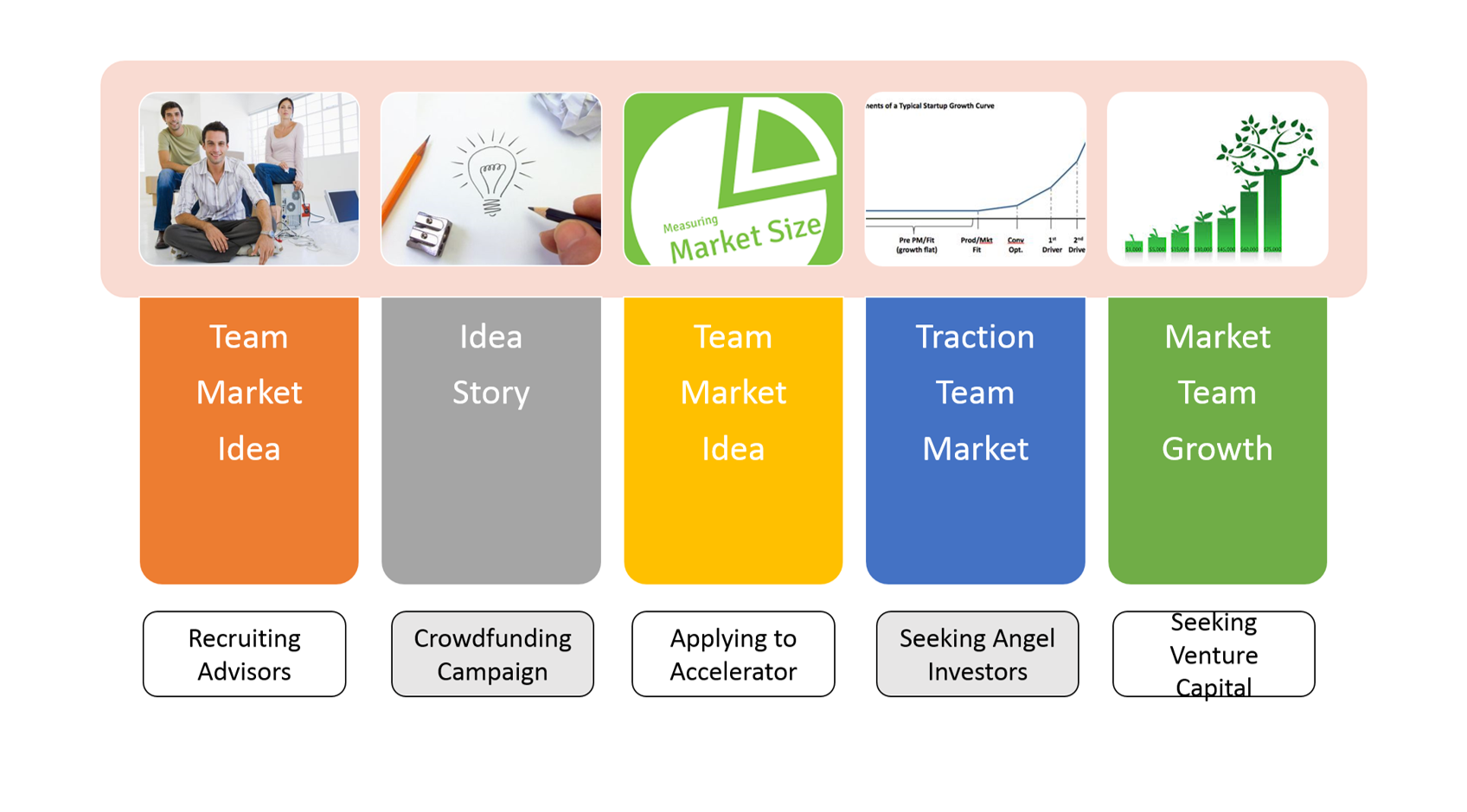
I put a chart together based on my experience of the top 1-3 things that different folks care about the most when you are progressing along stages of your startup.
The first thing to keep in mind is that the idea matters most to your potential customers.
Which is why it matters so much.
Your customers may care about the team, the problem you are trying to solve (it better be important to them) but they certainly dont care as much about your market or your growth.
What Matters When At A Startup
At the napkin stage when you are trying to recruit advisers, and early folks; your team and market matter to them the most, then possibly the idea.
The next stage (if you are going that route) at the crowdfunding stage, the idea and your story matter the most. The market maybe somewhat matters, but the team does not seem to matter as much since they are largely the “people” behind the video.
The stage beyond that (again if it applies), which is the accelerator stage, the team and market matter the most. The assessment of whether the team can pivot plays a lot into this stage.
At angel investor stage the traction seems to matter most, followed by team. Enlightened angel investors care more about the team and the market, but accelerators have trained the startups and angels to write checks based on “traction”.
Finally when you are ready for the venture capital round, lots of things matter, but most VC’s will tell you that the market you operate in and the team matter the most, followed by growth in metrics.
If you look at the chart above, the obvious conclusion you will come to is that idea does not seem to matter to most people.
If, however you expand the “crowdfunding” stage to “recruiting customers“, then at that, stage ideas matters more than everything else.
So the idea does matter, it matters a lot and it matters to a key (if not the most important) constituent of your startup – the customer.
Does it matter as much as you think though?
That answer is also no, because, the other “constituents” including potential employees, care about working on a great problem, getting paid well and being challenged (in that order hopefully).
So, when any of your investors or potential advisors or an accelerator tells you “Ideas dont matter” – you know they are wrong, but not as much wrong as you really think they are.
Put those two numbers together and you it will be likely that you will be introduced to an investor you want to pitch over email, and they will (hopefully) hear about you from someone they know (or trust as well).
The first thing people do when they get an introduction via email is check the person’s LinkedIn profile.
According to the LinkedIn heatmap profile the first thing people look for the photograph followed by the most recent status update – even on LinkedIn.
LinkedIn Heatmap
The next few things people look for are your most recent role, followed by your educational qualifications.
Only after that do people check out your website or mobile app.
I have seen many cases where the investor will push the meeting to later if the LinkedIn profile is “incomplete” or “not very appealing”.
While your app or website might be professionally designed and be very appealing if your LinkedIn profile is not, you will likely not get to the next step very quickly.
Most investors will Google search you as well and click on the first three links – For most people the first two links are LinkedIn profile, AngelList profile (if that exists), followed by the website bio.
So, that makes it all the more important to get your LinkedIn profile more appealing than your website.
I wanted to showcase today the biggest transition pricing plan pages will have over the next decade.
The move primarily affects B2B companies, but is being driven by consumer Internet companies currently such as Uber with their surge pricing.
There are 3 steps towards the maturity of the pricing model that I foresee.
The first step is the transition from perpetual pricing or “pay unfront” pricing to subscription billing or “pay as you go“.
The second step is the transition from subscription billing and “pay as you go” models to utility billing or “pay for usage“.
The third step is the transition from utility billing or “pay for usage” to outcome billing or “pay for performance“.
Why was perpetual pricing or “pay upfront” popular?
Perpetual pricing was easy to understand, for most accounting and finance teams.
Paying for software and amortizing it over a period of time was easy to register on the financial records. The initial assumption was most of this software was going to be in “perpetuity” or forever. It was over 20 years from 1980 to 2000 that most folks realized this was not true. Software changed constantly, had to be upgraded and the 20% annual maintenance did not pay for the new versions.
Why did we transition to pay as you go?
When finance and accounting teams realized that only a fraction of the software that was purchased, is going to be used, and much of it was “shelfware“, they were loathe to pay for “things that were not being used”.
The second problem was the high cost. Perpetual pricing assumes a 4 year fee for the software would be paid “upfront” and so the cost of that software was pretty high. Which meant, most smaller and mid-sized customers were unable to afford it.
Finally, once the sale was done, there was no “skin in the game” for the software provider. The success or lack of the deployment or usage of the software was upto the customer. Obtaining value from the software was also something the customer was on the hook for, not the provider.
Why is there going to be a transition to pay for performance?
While the problems of lack of usage, high upfront cost, and the “skin in the game” can be solved by Software as a Service (SaaS) models, which ensures payment to the software partner once the software is being used and only for the amount it is being used, the problem of “obtaining value from the software” still exists.
The problems with SaaS pricing (usage) are 3 fold:
1. Inability to predict the “constant amount” each month – since it is be based on usage, instead of a fixed amount each month.
2. The need to focus on “success” instead of “best effort” for customers. Instead of the provider saying “this is what we will provide” the provider and consumer jointly will have to agree on the “desired outcomes” and the share of value they will each obtain from the transaction.
3. The need for providers to capture more of the “value” associated with the pricinginstead of the “cost plus profit” model.
Which is why the next transition will be towards subscription billing or variable pricing not on usage but on “outcomes“.
What are outcomes?
Here is an example that most folks can relate to:
Imagine if you had to go from location A to B for a meeting by 6 pm. You are late and leave at 530, and expect it to take you 45 minutes to get there, but you’d really like to get there by 6 pm. You are willing to “pay extra” to get there on time.
Instead of charging you for the distance, which is what the taxi charges you, the cab instead charges you more for the “desired outcome“, being there on time. That means, for someone who left at 5 pm the cost would be less than for you, even though both of you went the same distance.
Here is another example.
If the desired outcome from a startup joining an accelerator is to A) Get a follow on round of funding and B) get some early customers instead of paying (a percentage of your startup, not an actual amount) a fixed %, startups will transition to paying for those outcomes or not paying at all. Or associating a variable payment based on the level of achievement of that outcome.
I believe the biggest transition that pricing pages will have to reflect over the next decade will be the move from “usage based pricing” to “outcome based pricing”.
Any early indicator to better conversion from viewing the pricing page to signing up for a plan was time spent on the pricing page.
If customers spent very little time (less than any other page) on your pricing page, then they would either not sign up or sign up for the “free plan”.
If customers spent too much time (more than any other page) then they would not sign up at all.
If customers spent time in the “middle zone” of your other pages, they conversion rate to a paid plan was most likely.
This was even if you had a free option prominently featured on your pricing page.
So how do you figure that out. I am assuming most people start out using Google analytics.
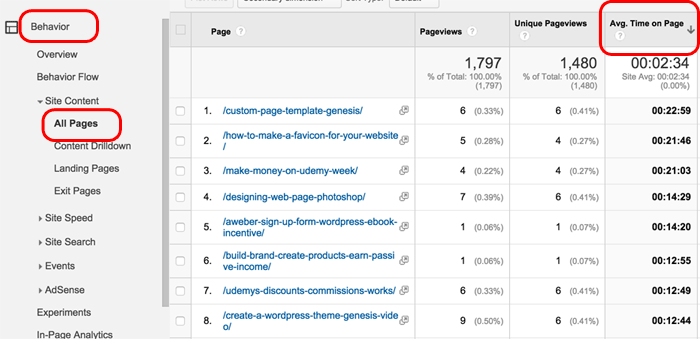
Google analytics: Time spent on pages
On your Google analytics page you can navigate to All pages and look at the average time spent on page. (see below).
Navigating to Time spent on page in Google Analytics
So why is this the case? There are 3 major reasons I learned:
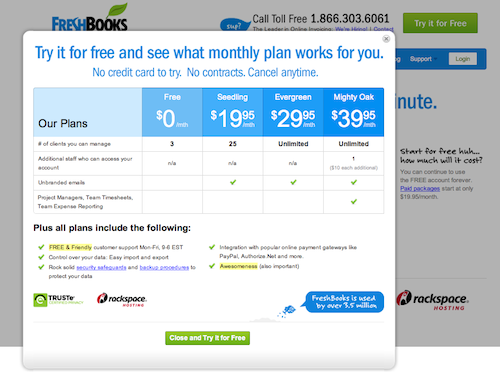
1. More time spent usually meant more options and more confusion for customers. When customers were given 3 pricing options (one of them being free) the conversions were higher, than when there were 5 pricing options. Not surprisingly even when the “free plan” was displayed “under the fold”, the conversions were the same. See below for what “Below the Fold” means.
Free plan as an optionFree plan below the fold as an option
2. More time spent on the page also indicated customers were reviewing other competitive options on other tabs. While less time meant customers had already made up their mind, so they were more likely to just “sign up and try”, it also meant the customer liked the options enough to try.
3. If the pricing option was the place where customers spent the least amount of time, than other pages, that was an indication that the customers were not ready to sign up and were “window shopping” alone. Either they did not have the pain point that your product addressed, or they were not in as much pain to even try the solution.
There were 2 exceptions that I found consistently among all the marketers I spoke with.
Not surprisingly, if the “referral source” of the customer was a search marketing campaign, and the time spent was the least, then the conversion rates were much higher than the referral sources.
If the referral source, was social and the time spent was more than other pages, then the conversion rates were much higher as well.
You can find referral source on Google analytics and correlate that to the time spent on pages.
The 3 most important factors that should go into the decision making process for taking advice is a) Who should you take advice from b) What advice should you take and c) When should you seek that advice.
There are 2 kinds of people you take advice from – those you consider as “experts” in the field and those who have “experience” with the specific problem you set are seeking the advice from. Everyone else is rather a big waste of time. So, if you are an entrepreneur and seek advice from someone at a much larger company on what you should do with your product direction, when they are not an expert in the field, then be prepared to be given useless advice. Well, you asked for it so there.
Expertise is easy to ascertain since, it has a factual basis. If someone is a certified legal professional, then they know the aspect of law they practice. They won’t necessarily be the best at litigation or immigration if they are a corporate attorney, but they would be the best at company legalese.
Experience is best couched with situational awareness. If the person giving the advice is smart, they will tell you the specific conditions, background and environment that the course of action worked. From that, you can at least determine if it might work for you in your specific situation.
The worst people to take advice from are those that pattern match. In my experience, most investors, general practitioners and enthusiasts understand a situation by talking to many people and offering their generic opinion couched as “experience”.
If you seek advice from those whose experiences don’t match your current situation, then you will get suboptimal advice. People who are confident may tell you they don’t know, but it is more likely you will get opinions from 3rd party reading couched as experience.
You need actually both expertise and experiential advice for most situations, which is why understanding the contours of the problem will help you explain it to the person you are seeking advice from.
What you need advice on falls into 2 buckets as well. Easy questions and hard questions. Easyquestions have a binary outcome. These are fairly rare. Most difficult questions tend to have a range of answers, with complicated if-then-else statements around the answer.
Easy questions are those that can be answered by experts alone. Can you hire someone from your ex-employer is fairly easy to answer if you look at your exit interview or contract and have a legal person review it.
Hard questions typically will give you multiple choices, not just two. Should I raise money is an easy question to answer if you are running out of cash, but the harder question of who to raise money from and how much to raise are harder questions that can run the gamut based on your situation.
Finally, when you seek advice is also fairly binary. You can either seek advice when you need it, or way before you encounter your specific situation. Seeking it after is just a waste of time – it reaffirms your position and makes your feel nice, or it will make you regret the decision since the advice you get is contrary to the decision you already took.
If you seek advice just when you need it, prepare to be rushed and expect to miss out on key details that tend to be nuances and shades of grey. For example, trying to decide what type of company (C corp or S corp) you should incorporate is best done when you don’t need it done yesterday. It will give you time to think about the options if you learn about the options way before you need them and keep the notes handy.
Seeking advice way before you need it is useful in situations when the impact is longer term. When the decision to be made cannot be reversed very easily (for example who you want as a cofounder), you are better off getting advice on the type of cofounder you need.
The biggest challenge is always the conflicting nature of the advice. What do you do when two people, both of who you trust, offer very different advice or in fact the exact opposite advice.
The relative scale of their expertise and experience does not count, so most people go with what they feel “more comfortable” with. Or they get more opinions and do a “vote count”. Either way it tends to be sub-optimal only in hindsight.
Most founders will come up with following variations of milestones when they get started with their company.
1. Ship beta version of the product by Dec
2. Raise $XXXK in funding
3. Get to $YY in revenue.
Unless there is a team that’s large enough to have each person take on ownership for each of the milestones, the founders are the ones that are responsible for them.
This means that there is little else you can do other than focus on these milestones.
Lets assume you have a cofounder and you split the roles into technical and business.
The technical person takes responsibility for the beta version and the business person for the funding and revenues.
Now a few months in, a new set of responsibilities come forward including managing your board, your mentors, talking to potential partners and others.
Your team has not expanded to take on the executive level challenges, so you still have the 2 cofounders taking on more.
Some of these new tasks are enjoyable – having conversations with partners or mentors for example, so you get “distracted” and the top 3 goals no longer get enough time. That’s when you realize you need a to-dont list.
A few weeks go by and you hopefully realize you are behind and try to catch up, this time removing the new tasks on your list and replacing them with items on the top 3 milestones.
The problem is getting to the new items is tough until you have enough folks on the team who can take on the high level, cross functional priorities.
Here are the top 5 tips I have learned to come up with milestones that you can manage. You may have heard about SMART goals, so I am going to skip that portion and assume you already do that.
1.One person per milestone. You cannot have joint owners for a milestone. Even if you and your co founder are “two peas in a pod” and “complete each others sentences”, have only one person assigned to each milestone. You will achieve greater accountability that way.
2. One milestone per person. If you have more than one milestone assigned to a person, reduce the number of milestones. Obviously if you are a solo founder, that means work on one thing at a time until you have a management team to help you take tasks off the plate.
3. Milestones cannot be overloaded. Milestones need to be specific enough for one area of work. If your milestone reads “raise a seed round and ship version 1 of the product”, that’s 2 different milestones with responsibilities for 2 different people.
4. Milestones need to have a specific date, and be reviewed weekly. To track your progress, I have found that a weekly review works better than daily or monthly. During the weekly review, you need to understand the tasks and projects that make up the milestone and understand where the blockers are with an “plan B” for any blocker.
5. The owner of the milestone needs to have cross-functional authority. You may have silo functional ownership of roles but most milestones, if they are important have cross- functional impact. So if you need to ship a beta version of the product, the owner of the milestone may need to get customer access from another person and market data from a 3rd person. Even if they are peer’s for the success of the milestone, the owner needs to have full authority to help get the resources to get the milestone done on time. This ensures that even if you have to transition from a role of control to a role of influence, you still have the ability to execute on the milestone.
Which is why I have a tool in my box called the “To Dont” list. It is not my idea or a new one, but I have benefited from it a lot.
It is a list I keep of things I am not going to do.
I have a list of 3 things I want to do each week and 1 thing I want to get done daily.
I have close to 45 items on my To Dont list. Examples – writing a book, learning Mandarin, learning awesome photography skills.
Every startup CEO and entrepreneur needs a To Dont list actually. Why?
1. Limited resources. When you are small you dont have an army of direct reports who can each own an initiative and “run with it”. If you, as the CEO, are not spending time managing projects and helping remove obstacles for people, you are not getting further ahead. I know a CEO who keeps blaming all the people she hired on her team for “not stepping up” to take responsibility for the top 3 items that the company must achieve. All along while she is working on priorities outside the core priorities she identified for the team.
2. Limited energy. If you are not spending time on your top 3 priorities for the day / week / month / quarter, and dreaming, eating, sleeping, brainstorming and executing those priorities, then your energy and brain power is being consumed by 100 other “shiny” non priorities. It tends to be the “death by a thousand cuts” problem where 7 to 9 things take up your time, and before you know it, it has been over 4-8 weeks and you have not made any progress towards the top 3 things you need to achieve as a company to get to the next milestone.
3. Limited time. If you work 10 hours a day, god bless you. If you work 15 hours a day, you are fooling yourself into believing that you are “working and productive”. I dont know the exact capacity and stamina that different people have for work, but everyone needs some time to rest their brain, their body and their mind. If, for example, you believe you should spend 8 hours on your top 3 priorities and only 2 hours a day on your bottom 7 priorities, I still would question your ability to focus.
The main reason is that it is not time alone that you are spending – you are spending your energy, which is another thing you have in limited supply.
I know that Google has said you have the 20% time where you can work on things that you enjoy doing, outside your core priorities, but you are not Google.
You are a startup, with very limited resources and time.
If you want to work for 12 hours, daily, by all means do so.
Just make sure that your top 3 priorities get the all of your attention – until they are completed.
There are some tasks that you might believe “you cant make progress” on, until there’s something else that happens outside your control.
Bring more things back into your control by spending time and energy on alternative paths.
For example, if you believe the “customer” will take 1 month to get approvals in place for you to get the POC ready, try to get another customer on board, or work the org chart of the customer to get other approvals in place. Dont spend time trying to talk to a new integration partner since that’s not on your priority list.
That should belong on your to-dont list, until it is important enough to belong on your To Do list.
The To dont list should be as sacred as your to do list. Put everything in there that catches your attention until it is worthy enough to make it to your to do list.