
Category Archives: Learning

The top 5 tips to making a successful customer testimonial video

With the rise of video, many entrepreneurs are looking to find a new way to bring social proof to their apps and websites.

While the overview video is the best way to introduce your company or product, and there are various types of introduction videos you could use to showcase your startup, the customer testimonial needs to do three things:

1. Give prospects confidence that there are real people using the product, who are similar to themselves.

2. Help potential customers understand if this might “work in their environment”.

3. Outline to prospects what pain points your product may help solve in their own words and using their language.

It is important to script the customer testimonial video as well, and ensure that it looks and feels very professionally done.

Here are the top 5 tips I have learned by doing customer testimonial videos:

1. Use “users” in your videos and have them explain their day in the life pain that your product solves, instead of the decision maker taking in abstract terms of how your product helps the company.

2. Have more than one person from your customer be a part of the video. Or have 2-3 different customers be part of the same video. I have found that in 2 occasions, the “customer” who I featured in my video left the company and I had to remove the video (the customer requested it, since they did not want mis-representation) which cost us much angst.

3. To avoid the problem of having to remove the video completely because your “user” or customer leaves the company, shoot each segment of the video separately and ensure you will have the segments “individually produced”. That way if you have to produce the video by editing out a segment (because people leave or have new people appear) you can still do that.

4. Show your product being used by the customer in their office in your video. This ensures that people believe they are not paid actors, and instead are actually using the product for their daily business. I prefer to use 2-3 quick shots (pan and zoom) of the person in front of the computer or mobile phone clicking on certain sections of your product. When you use users in video, show their company’s logo or workspace to ensure the video is realistic.

5. Breakup your video into 5 segments – with each section being able to stand on its own. That way if you need multiple “cuts” – e.g. 30 second, 1 min, 1.5 min or 2 min you can do “stitch” them together easily.

Here are the 5 sections I recommend:

a) the pain point – preferably 3 thing they do in their day in the life, which hassles them. E.g. “It would take me 5 hours to generate the influencer list and I had to go to the search engine, then pull reports into Excel”.

b) their current solution or what they did before your product. E.g. “Our current solution was a client server product which did not allow our management team to view the reports on their mobile phone”.

c) their use of your solution – how are the using it daily, or how does it fit into their work processes. e.g. “With BuzzGain, we can put in 3-5 keywords, then understand who the right influencers are and quickly in a matter of minutes obtain the list of key outlets and publications. This helps us respond to client briefs quicker.”

d) how your product has solved the problem – the benefits they have obtained, preferably quantified in ROI terms – for example “after using BuzzGain our time spent on building reports reduced by 5 hours a week”, or “after using ABC product our sales increased by 2%”.

e) why do they like the solution OR why would they recommend your solution. E.g. “I would highly recommend BuzzGain because it helps me in my role daily and saves us time, which helps me focus on building client relationships instead of collating reports”.

Bonus tip: Ensure that you have the full title and correct spelling of your customers in your video at the bottom each time you introduce them on the video for 3-5 seconds. Most people do it only once at the beginning, but I have found, that many people do not watch video intently enough to remember to focus on the name and title. It is always better to show the name and tile of the customer at the bottom of your screen for 2-3 times during your video.

Here is a great example from GoodData of a customer testimonial video I like.
How much does it cost to get an overview video done? By type of video

When creating startup overview videos, “begin with an end in mind” is more true than anything else. I have noticed by reviewing over 30 company videos from the latest YC cohort, that the length of the videos is directly proportional to the level of commitment required for the call to action. If the level of commitment requires you to sign up for a 30 min demo, the video was longer (3 min) or if it required you to sign up for the laundry service (3.5 min) versus it required you to download a free app (2 min).

The call to action (what you expect your visitors to do next) determines the length of your overview video.

While we talked about format of videos yesterday, today I want to focus on the categories of videos.

There are 5 types of videos, with different goals and slightly different calls to action.

The overview video is an introduction to the company, the demo video would like you to sign up for a free trial, the tutorial video helps you get further along on the onboarding process, while the testimonial video is social proof, requesting you to explore pricing and finally the storytelling video urges you to get on a waiting list.

Most, if not all of the videos ask you to give them something in return for watching the video – that’s typically an email address.

1. Overview: Typically this video is the first a company creates because they have “finally” nailed what they do, for who and why it matters. This type of video might involve professional cameraman, producer and multiple shots and actors at times.

Cost – $5000 and above.

2. Demo: In this type of video there are 2 formats – one that’s professionally done and one that’s done by the founders. In the professional done video, the voice over is usually an actor and the script is written by them after input from the founders.

Cost – $0 (DIY – your time is precious though) to $3000

3. Tutorial: Most tutorial videos are made by the team – either a marketing person in your company or by the founders themselves. Since many tutorials are typically made for different aspects of the product, these tend to be self made and cost much less to produce and deliver.

Cost – $500 to $3000 – depending on the amount of time to produce. Expect every minute of video to take 1 to 2 hours of production.

4. Testimonial

5. Storytelling: These  are typically the most expensive videos to make, most being professionally produced, longer format and have actors or hired artists as well. They tell a story in the day in the life of a typical user.

Cost: From $5000 to $15000 depending on the number of hired artists, production quality and required animation.

Take a look at this storytelling video as well for a professionally done example. (Sorry Embeds were not permitted).

What I learned from looking at 30 startup videos of the recent YC batch

Video is the fastest growing medium on the mobile web. Turns out even if you are a B2B company these days, the word-of-mouth affiliation you need is often easier to achieve if you have a video more than text, audio or images. Of the 114 companies in the lastest YC cohort I looked at, most had a video on their website. I focused on the ones that had done a good job of explaining their overview using video.

Not surprisingly even CIO’s and traditional B2B buyers also prefer to view videos to reading whitepapers these days.

As a startup, if you are in the consumer space, I’d wager that you want to get your overview video faster than your “text website” which might be SEO friendly. Why?

Most of the early influencers and younger audiences are using YouTube as their search engine more than Google.

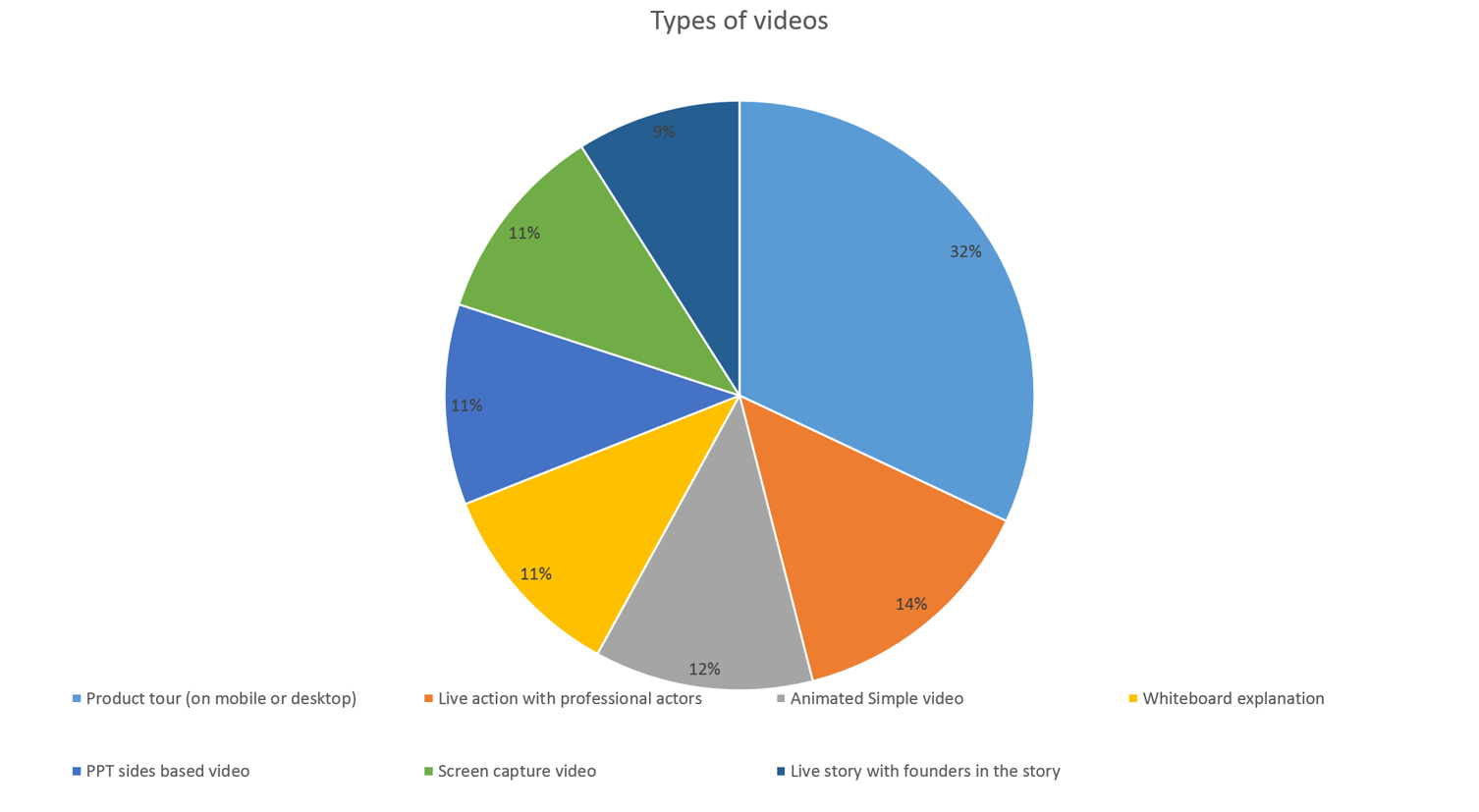
So, having reviewed 30+ videos from startups that graduated from YC last cohort, what did I learn about the types and kinds of videos you need for your startup?

I am going to assume that you are just launching your app / service or about to launch it soon. What you are trying to do in less than 2 min is give potential customers and prospects a chance to understand the problem you solve, how you solve it uniquely and how they benefit from the problem solved. I have noticed these 5 types of videos that startups have used so far.

Types of Overview Videos

In most cases the “goldilocks” overview is less than 2 minutes and there are 7 popular formats for these videos:

1. Product tour on mobile or web: In this type of video, there is a person “showing” the app on their mobile with some upbeat background music. In many ways it is more a demo than necessarily a overview, but it serves the purpose well to get people to understand “what the product or company does”. It was hard to figure out which of these were actually using the product live versus screen captures, but slick production was the key.

2. Live action video with professional actors: As it suggest these are much more produced and directed, and will cost your more, but they tend to show “real” product users in “real” scenarios. I think these are pretty expensive if you are bootstrapped, costing upwards of $10K in most cases, but among consumer Internet (eCommerce especially) startups they seem to be pretty popular.


3. Animated Simple video: In this type of video, there are props used with simple cutouts and voice over. In most of these videos, I found that the startups used animation to to explain abstract complex, or non-intuitive problems, largely in B2B scenarios.


4. Whiteboard explanation: Fairly common as well, is two or sometimes just one person going to the whiteboard explaining what is it the startup does. In many cases, these are fairly technical products and companies, so Open Source product companies tend to use them the most.

5. PPT based slide videos. Used when the founders are not technical, bootstrapped and have strong B2B backgrounds in sales or operations. Since they are unable to put a professional looking video, these are used by folks who dont have a shipping product yet. They are not very effective, but I think they are better than text based pages.

6. Screen capture: Typical to the #2 type, these “show” product, but the screen capture videos are less professionally done. Authentic to a fault, they tend to be quickly done, rather poorly produced, but effective to “demo” the product more than give an overview.

7. Live story with founders: Rarely used, but common in Kickstarter campaigns, these are when the founder (s) are a key part of the sales pitch.


Over the next few days I will showcase a series of posts on the use of video, the types of video and some techniques I use to produce better startup showcase videos.

Why your #startup #fundraising process should be very similar to your college application process?

There are over 4000 universities and colleges offering 4 year degree program for students graduating from high school. Of the 20+ million students that apply, 13 million get into the college undergraduate programs. Of the 13 million students enter 4 year under graduate programs each year and only 2 million graduate from the programs.

So, it is pretty obvious that while the acceptance rate of students into college is fairly high, the graduation rate from undergraduate programs is fairly low.

The graduation rate from the “top and elite” 100 colleges is much higher than the rate from the bottom 3500 colleges. So it make sense to get into a top college if you want to ensure you successfully graduate.

There are 800+ venture investors that fund companies each year in the US. Of the 30K+ companies that are looking for VC funding, about 3900 get funded. Of the 3900 companies that get funded each year, only 1200 actually have exits.

The % of companies that get funded is fairly low, while the “success rate” is reasonably decent,

The similarity of the college application process and get institutional or angel funding process is striking if you consider top entrepreneurs and top investors.

The top investors are most coveted and so are the top entrepreneurs. They are the ones with the most offers and have “competing” term sheets or startups looking to seek their attention.

Most college applications are coached by career counselors to apply to about 8-10 colleges, with a 3 level system – 3 of them are safeties, 4 are good matches and 3 are reaches.

Having been a fund raising advisor to over 102 startups over the last 3 years, I’d highly recommend you follow a similar process with different numbers to raise funds at any stage of your startup.

To raise funds for your startup use a fishing pole not a fishing net.

Here are some assumptions I make. 1) Smart money is better than just money – all things being equal you are better off raising money from an investor who can help advice you and connect you 2) Fund raising is important, but not the goal. The goal is building a great company.

That’s the best advice I can give entrepreneurs. Let us assume you are in the SaaS space and are looking to raise $1 million for your post accelerator round. There are less than 50 angel investors and micro VC fund who might be the best fit for you. There are exceptions, and you *might* get a good VC firm interested, but that’s a crap shoot.

I would recommend you start your fund raising process by building a list of the 50 VC’s.

Then put them into buckets of safeties, good matches and reaches.

Try your pitch first (email connections and warm introductions help) with the safeties, then try the good matches and finally go with the reaches.

That way you can tweak your pitch and model consistently and keep getting feedback as you learn more about what investors like and have problems with your company.

The most important skill #entrepreneurs will need is to manage investors and navigate #funding landscape

There are many skills we ask of entrepreneurs – sales, hiring, marketing, product management etc. Of them fund raising is probably the most detested among technology entrepreneurs and the most desired among investors. If there are 3 things most seasoned entrepreneurs will tell you that you need to focus on as the CEO is to set the vision and product direction, hire great people and make sure there’s enough money in the bank.

The fund raising landscape, though has dramatically changed over the last 7-10 years for technology startups.

Used to be that most startups went from bootstrapped (for 6 months or less) to friends and family round (for the next 6 months) to an angel round (lasting 12 months) and then, if successful to a institutional venture capitalist (lasting 18-24 months).

It is not unusual to hear of 7 or more funding rounds BEFORE the institutional venture funding round these days for the 80% of the startups that dont have “unicorn type” growth. This crushes previous investors and makes the entrepreneurs more vulnerable to the situation when there is an exit at the company and the entrepreneurs make literally no money at all.

What are the sources of capital now available to entrepreneurs and when should you chose them?

That’s largely a “it depends” type of question, but here are your options.

1. Most entrepreneurs start with a bootstrapped model. It used to be that you had to keep 6 months of capital for yourself to sustain before you started, and now that has remained 6 months or become closer to 12-18 months. If you show quick traction, expect external investment soon, else expect to be in for the long haul.

2. Friends and family are typically still a good option, but increasingly I am noticing ex colleagues who have worked at startups or large companies who trust you and have experience in the market or customer problem you are trying to solve are a good option.

3. Crowd funding sites like Kickstarter, Indegogo, Fundable and Funding Circle are a relatively recent option for hardware startups, but are increasingly becoming a good option for “validating” true customer need and initial funding for many startups as well.

4. Angel investors are still a viable option, but increasingly angel groups are becoming a better source of the next stage of capital. They provide not only the ability to get money quicker than venture investors but also provide valuable expertise, advice and connections to help rookie entrepreneurs along the process.

5. Accelerators are relatively new source of funding, advice, network and mentorship as well. From fewer than 10 that existed 7 years ago, there are over 500 of them across the world, with many focused on specific verticals and industries that have domain expertise to help you further than a generic seed fund.

6. Micro Venture Capitalists (Micro VC) or Super Angels or Seed Funds are a relatively new phenomenon as well. From fewer than 10 Micro VC’s 7 years ago, there are over 250 of these small check-size, quicker to move investment options.

7. Angel List Syndicates are the latest option available to entrepreneurs now in the US and India (via Lets Venture). These syndicates allow any investor who has expertise in an area to help syndicate their “deal” with other interested High net worth individuals. They are usually led by an experienced and very well regarded entrepreneur and the value to this individual (besides the carry, a small portion of the investment in ownership or future exit option) is the reputation it builds for that individual.

Most of these new options come with their own pros and cons, but they are relatively recent phenomenon. If you are an entrepreneur I’d highly recommend you spend time reading up on all these options before you embark on your funding path. The best sources are usually blogs written by experienced entrepreneurs who have recently gone through the process and have the knowledge and desire to share.

10 things I have learned from running 10 demo days about #startup pitches

Ahh, the demo day. The arbitrary day the accelerator decides it is time to throw its babies to the world of investors. The number of accelerator directors I have asked the question “why is your program 3 or 4 months” is probably in the 50’s and the number of times I have not heard a thoughtful response is 100%. It is almost as if “that’s what everyone else does”.

This post though is not about being cynical, but more about what I have learned over the years and on what entrepreneurs can gain from my experiences of managing and running 12 demo days and helping close to 150 companies pitch, position and excite audiences.

First, it is important to set context. I am assuming you have a mix of investors and some non investors as well at your demo day. You have been through a 3-4 month program and have been practicing your “pitch” for a few months once or twice a month at least. I am also assuming that your pitch is about 3-5 minutes and your goal is to get investors interested enough to setup a follow on meeting to understand your company in more detail to express interest in investing.

I know that YC demo days have people in a frenzy with some investors texting they are “in” a round, even before the entrepreneur finishes their pitch, but for most parts I am going to assume that’s a rarity. For the rest of us, mere mortals, the pitch is an opportunity to prevent the audience from going to their smartphones distracted or otherwise bored by listening to pitch after pitch.

Here are the 10 things I have learned, in no particular order.

1. Show energy and passion – always be selling

You are in the spotlight, so if you dont wear your passion on your sleeve, you will likely get no attention. Even if you are a mellow person and tend not get excited much, find a way to show as much excitement you can about your company, the market and the opportunity. Investors are judging you and if “you dont seem excited about the opportunity”, they dont believe they should be either. You have been given an opportunity to sell your vision and this is one of the biggest opportunities you can get.
2. Visuals are only a prop – You should be able to tell your story without slides as well

Things have gone wrong with the deck or the projector only 2 times during the entire demo day for the 10 times we have done them, but those 2 times resulted in a meltdown for our founders. They were among the best in the cohort, but they forgot their pitch, got distracted and flustered when their slides went “blank”. Investors went believing that if they were to react this way if their pitch went dark, how would they react when sh*t hits the fan at their startup. Be cool. Use the Pitch deck as a prop alone.
3. Your goal is to a) get people’s interest to have a follow on discussion and b) to prevent them from getting distracted by their smart phones and c) ensure you are memorable enough for them to “tweet” about it, or make a note to email you for a follow up meeting

Dont imagine that someone will walk up after the pitch and give you a check. That would set you up for a high bar in terms of goal for your demo day pitch. You only goal should be to be memorable enough to get a follow on meeting.

4. Show traction – quickly after the problem and solution

Traction trumps all evils in a startup. Not a complete team, but have great traction – the investors think they can help you build the management team. Market sizing is still relatively small – the investors will try and help you expand to adjacent markets. But no traction? You cannot manufacture that.

5. Be specific about the total market, and addressable market

Most entrepreneurs have the time to only show the largest number possible and hope investors bite. Be more thoughtful than that. Over 60% of the folks that “went one level deeper” about addressable market, I have found, got a follow on meeting. The ones that showed a large gazillion dollar market, found investors ignored that number largely.

6. Tell stories that your day in the life has shown you, avoiding using phrases like – big problem, painful, etc.

If you generically use statements like “the problem is massive” for our customers, without being specific about the pain points, you are likely going to be dismissed. I’d highly recommend you use your “day in the life” scenarios to showcase what your user actually goes through as problems and how they are handling this right now.

7. Answer the question – why are you the best team to execute this problem

Many investors will tell you they invested only because they felt this was a great team and nothing else. That’s a lie. A big lie, but nonetheless, the team is one of the most critical aspects of any software opportunity. Just telling the audience who is in your team and letting them make the inferences as to why the team is uniquely suited to execute this problem is poor judgement on your part. Ensure that you let them know about your experiences, the fact that you have worked together, or that you have each unique learning that together helps build a great company.

8. Be clear about why and how you are different

In the absence of having something different to say, most customers (and investors) assume you dont have anything different, so you will compete on price. Competing on price is okay, but that usually signals a race to the bottom. The important thing I have learned about differentiation is that you have do something different in all aspects of your pitch – why is your team different, why is your product different, why is the market you are targeting different, why is your go-to-market different etc.

9. Your positioning forces people to figure out quickly if they are interested – get it right.

The first single line positioning is the thing almost everyone will listen to, which should be 5-15 seconds, when they are deciding if your pitch is worth listening to. Get it right and do it by A/B testing your startup’s positioning over time. Tweet-ready positioning is the best way to get some attention from the audience online.
10. Work your audience – Focus, 10 sec pause, Connect, Sweep 2 sec, Repeat. Make eye contact with as many people as possible. Engage your audience with a rhetorical question if you can.

These are tips for the folks that want to be a better public speaker. If your accelerator offers an opportunity to avail the services of a pitch coach, use it. As often as you can. While it wont make or break your company, the best public speakers generate more interest (not necessarily better, but more) for their companies than the ones who “show up and throw up”.

How to showcase the “problem you are trying to solve” in your overview deck #startups

This is a series of posts with a focus on your overview deck to investors, presenting your market opportunity, the team and traction your startup has had so far.

Customers, investors and partners want different levels of depth from your problem statement.

Investors want to understand the fundamental underlying trends of the market in the context of the problem you are trying to solve.

Customers want to understand the “day in the life” pain points that you help address.

Partners want to understand the contours of the problem in terms of the challenges that customers face.

You have to articulate the problem extremely well to get a buy in from all of the above audiences. Doing that solves more than 1/2 the challenges you have with getting buy in. The reason is because all of them believe that the person who articulates the problem best is the one who has likely the best solution.

Since you know the problem so well, you have thought about the solution as much is the assumption they make.

The best way to showcase the problem slide is to outline the trend that you are seeing in the industry first.

For e.g. Cloud computing is rapidly taking over enterprise deployments of new applications. Or, there is a dramatic rise in number of developers also performing the role of operations and this trend will continue until 2020. Or, there is a new role in companies which are progressively seeking to differentiate with great customer insight and the person in charge of it is called the Customer Experience Officer.

Now, it is important that you dont show that in the slide, but also provide your view of the impact that the trend has on your problem.

The reason this is important is that most every investor, and many early adopter customers will have access to these trends and will likely know about these trends already. For many of your late adopters, this might be news, but investors tend to be on top of trends for most parts, with some exceptions, especially if the are not deep in a specific category or industry.

So rather than say the generic statement, cloud is changing everything I’d offer a view on the way it is changing that affects the portion of the problem you are solving.

For e.g. Cloud deployments are increasing by 150% every year and that rise has caused a 220% increase in number of new Developer Operations roles, and these roles dont have the tools to be successful since the developer tools are available only to debug code issues, and the operations tools are focused on monitoring production instead of trouble shooting.

There are 3 tips I have learned to use when you share the overall trend part of your problem.

a) The trend needs to be something most people can relate to easily

b) the trend is best explained by using percentage numbers to showcase the growth (trend is your friend) and

c) the trend needs to have a disruptive nature to it, if you are playing in market with large incumbents.

The pain point part (2nd slide likely) is best explained when you have a day in the life of the person who is the user. What do they go through on a daily basis which causes them angst. What do they have to go though, which prevents them from being successful or causes them to waste time, or causes them to be inefficient in their job, or costs them more money than doing it with your proposed solution.

Any or all of these day in the life scenarios is usually explained best when you showcase what your user has to endure and how with your solution these go away. So in some ways, your user pain point should directly correlate to the solution you are trying offer that will solve these problems.

For example, the PR associate at a mid to small agency spends 3-5 hours going over google news and putting news articles into word, curating the influencers into an Excel spreadsheet and finally putting a report together that will share the key media coverage in a PowerPoint slide. This associate spends 3-4 hours every week doing this and we can do these things for them in less than 15 min.

There are 3 important tips I have see that work best to showcase your user pain:

1. The persona of your user and the “day in their life” has to focus on the top 3 pain points they have, daily. If your pain points are not the things that are high on their priority list, they will likely dismiss your solution as “nice to have”.

2. The best pain points expressed are in 3 specific things, not more. If you have one, then you will find your presentations to customers to be hit or miss, so you are better off, having 3 so the total surface area of the customer’s pain points are well covered.

3. The more “real” your pain point and the more they go through it daily, the better are your chances of getting customers to buy into the fact that you can empathize with them. The best way to test this is to ask questions of them to seek engagement. For e.g. “Raise your hand if you find yourself struggling to quickly understand which emails are important and which ones are not, after a quick 15 second glance on your email client”.

Let me know if these tips work.

How to be a more innovative startup by changing just 2 words in your meetings daily

Most every startup wants to be innovative. That’s the essence of being in a startup. To be innovative, most entrepreneurs realize they have to get their culture right. An innovative culture fosters and innovative workplace which builds an innovative company.

So, now the question is how do you build an innovative culture?

To build an innovative culture, I believe you have to encourage experimentation. Lots of it. Most people learn only by experimenting, not by sitting in classrooms and being taught. While it is important to sit and learn the first principles, most everything else needs to be learned by doing. You will have to let people try lots of things and learn what works for your company, your industry, your market and your customers.

The trouble with experimentation is that it breeds failure. Lots of failure. If everyone of your experiments were successful, then you are not taking enough risk, which means the company wont be as innovative. In fact, the leading indicator for innovation in most companies is the number of failures they have. Which means they are taking more, but managed risk. A good metric to measure, is the # of experiments your startup conducts in a unit of time and what the failure rate is.

The best way to do this is to practice the art of disciplined experimentation. Which is why I am a fan of the phrase “My discipline will beat your intellect“.

So, if you do conduct a lot of experiments, you will fail. How do you understand, organize and learn from your failure?

Most companies conduct an audit of their experiments, the hypothesis, the initial learning and the final results. That’s where the the biggest problem is to be found.

Most managers and executives are trained to ask the question –

“Who to blame”?

That’s the question that most meetings post experiments start with? What happened? Why did it happen? Who is to blame?

I propose a small change instead, which will get your people less defensive, more open to taking risks and experimenting.

The right question to ask is –

“What to blame”?

Focusing on the process, steps, methodology and systems brings out the best answers to the question “how do we get better”?

Surprisingly you learn more about people, their strengths, limitations, weaknesses and biases if you focus on the process that was broken instead of assuming that the people messed it up.

For most founding entrepreneur CEO’s this is one approach that works best to foster a culture of innovation and risk taking.

Do you have a manager who has followed this principle? I’d love to understand what you have learned from them. Drop me a note on Twitter. (I do respond to all @ replies BTW).

How to A/B test your startup’s positioning statement

I had a chance to talk to 2 of our startups at the accelerator yesterday and we discussed positioning. One of the first things that we focus on is to ensure you position your company and product well. That may seem like “fluff” and “soft” to many folks, but we find that to be critical to ensure that people who you interact with – customers, partners, potential recruits, investors, etc., get it quickly and accurately.

What I have found is that depending on the background of the entrepreneur, the positioning statements tend to be very long, mostly filled with buzzwords – (no, really 99% of the people in this world dont know ARM, resin-conductors or DevOps, and most likely 90% of your target audience does not either) or overly complicated.

The positioning statement should at its simplest help explain who you are at your core.

Most folks will try to explain their positioning by using the framework below.

For (specific customer description):

Who (has the following problem):

Our product (describe the solution):

That provides (the following difference):

Unlike (your competition):

Now, for most parts this was 15 years ago. This is still a valid exercise for you to come up with your positioning, but most of this may be not as effective in our Twitter driven world.

There are 3 more manifestations I have seen for this statement:

1. Position your company / product in less than 8 worlds so that someone coming to your website can get it in less than 5 seconds

2. Positioning by successful similarity – We are XYX (an awesome product, e.g. Uber) for ABC (a very large market, e.g. school kids needing rides)

3. Retweet ready positioning – A positioning statement that is retweet worthy, so it should be less than 100 characters – so you can still provide a link to your website

The important thing to note is that your website should reflect positioning for your biggest audience – target users or customers, not potential investors or employees.

I am also not a fan of using multiple positioning statements by audience – so you should avoid telling investors you are a disruptive solution for ABC market, and tell potential employees you are X for Y.

It never adds up and wont scale.

Instead, I’d recommend you start with first making a list of segments of your customers. Preferably you are able to segment a small niche customer segment to start.

Then write down the list of problems your customers have. For example. a) the existing products are too hard to use b) the existing solution is too expensive c) the existing solution is to do something manual d) potential customers are unable to be successful since no solution exists to help them with this pain, etc.

Then you have to document the features of your product that correspond to solving the problems you listed above in the problem statement. For example: a) Our export to excel feature allows customers to get the data via API’s b) our API based mechanism lowers cost of delivery. etc. This is also sometimes the “how you do it”.

Then you have to record the differentiation associated with the features. How do you do something different to enable that feature(s). For example: our algorithm for ranking generates a proprietary score for each customer segment.

The next step (which you may not need for the positioning, but will later on) is to document the benefits of the feature / differentiation. Benefits are fairly easy to document based on cost savings, revenue generation, etc. and are based on the feature list. For example, if you have X feature and Y differentiation, that results in a reduced cost compared to existing competitive solutions for customers,.

This should suffice for you to start A/B testing. Now, use these in your web copy, presentations and when you are describing your company to others at events, meetups, etc.

Keep a log of the first 100 people (or some good enough sample size) of people you to talk to, and get a sense for which statements resonate.

Test different positioning statements until you get to the minimal set that gets people exited enough to ask you to tell them more.

Until that point, keep testing.

Before you know it, your startup is now a “big” bureaucracy with “approvals” for everything

Often when I meet wannabe entrepreneurs at events, I ask the question, why they are willing to give up their relatively easy job, with good pay to take up the roller coaster world of starting their own company. About 20% or so of the folks I meet at these events work at another startup (typically < 3 years old, about 20-50 people). I think of most of these companies as startups as well, so I am curious as to why, after seeing all that happens in an early stage startup, they want to start their own company.

Sometimes it is because they want to be their own boss, or they see the success of the founders, who they claim have little intelligence, but still managed to start their own company and be moderately successful. At other times, I hear the burning itch to start and solve a problem or other times it is because they always wanted to start one, but were not able to because of other constraints.

Every so often I will get a person who was the 1st or among the first 10 employees of a startup. They will reminisce about the “early” days of the startup they are working at and talk about how everything was simple and easy during those days and how bureaucratic their 50-100+ person startup had become.

When I press further about the “bureaucracy” and what makes things slow and inefficient, the word that always comes up is “approvals”.

“Approvals” are the tool misguided managers use to make themselves feel important.

If you are a person that needs to feel important so you can “approve” things, you dont have enough work to do.

Approvals are used by big companies to kill any ounce of individual responsibility and trust. They also kill the very initial set of values and culture that you might set out to build your company’s foundations on.

Approvals send one of many messages:

1. I did not hire the right person so I have to ensure they “stick” to the rules of the company that HR has arbitrarily come up with.

2. We have hired way too many people who dont have enough work to do, so they have to be around to “approve” things.

3. We need policies and procedures for everything since we dont trust the folks we hired to use their judgement.

Notice that the common word in these (and most other) examples is “hiring”.

Approvals are the child of poor hiring and recruitment.

You can cop out and say it is a HR problem. It is not actually.

As a founder, it is your responsibility to ensure that the vision and culture of the company are consistent with the ethos you started it out with.

The first 10 employees are indicative of the zeal you brought to the table, which convinced them to join a high risk startup at such an early stage.

If these first 10 and many other employees feel that the company is “approval” heavy and requires big company (productivity killing and sans accountability) procedures, then you have something wrong with your hiring, not with your HR policies.

Remember this, if a manager in your company feels so important to want to “approve” everything anyone does in his organization, he has practically no work and likely a heightened sense of importance.