Yesterday I had the chance to talk to 2 startups. One has been around for 2 years and has raised $2 Million in seed funding and is in the B2B SaaS (Marketing) space. The other is older, has raised a series B and has over 47 people in their company.
Neither of them have a single person in “IT”. They both have over 40+ applications they use and everyone of their employees is using notebooks, phones, etc., but they dont have a central IT team.
I asked the CEO’s at what point do they see themselves getting an IT team and the answer from both of them was “Why do we need an IT team”?
That reminded me of Nichoas Carr’s piece, 12 years ago, in which he claims IT does not matter. He was subjected to a lot of ridicule many year’s ago, but he’s proving to be right.
I started to read about what all IT does actually in any company. You can break it down into 5 main priorities.
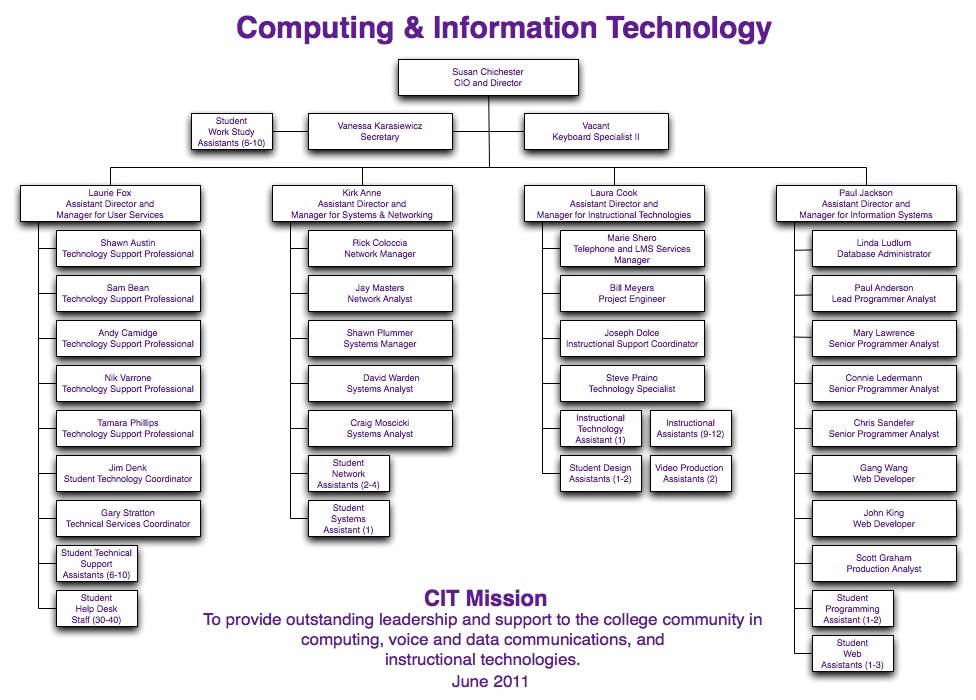
IT Org Chart
Support the business with computing – notebooks, devices, etc. Turns out most new startups, (which will grow into larger ones later), have mostly a BYOD policy or let their employees choose their own machines, which focuses on the support, maintenance and upgrade of the machines to the employee. So, that’s mostly not needed.
Provide the business teams with internal applications (Build, Buy or Outsource)- Email, Collaboration, HR systems, ERP, etc. Most new companies are buying SaaS products and are letting the business teams (HR, Sales, Engineering, etc.) make their own decisions on which applications to buy.
Build, buy or outsource external customer / partner facing applications – These are also being moved from IT to the business teams. They directly engage with partners, agencies or buy off the shelf SaaS applications, bypassing IT to directly buy to their requirements. In fact over the last 10 years, according to Gartner, 50% of IT spend on applications is being managed directly by the business teams, bypassing IT. That’s in the large companies. In the small companies, it is 100%.
Supporting, managing and assisting internal users via a help desk on problems they have with IT systems. Most users are bringing their own devices and building their own applications, so the help desk is largely eliminated.
Operationally support the applications built with DBA’s, system administrators, operations managers, etc. With the rise of DevOps and the cloud, all of these external facing, customer applications, which are developed internally are being deployed, managed and supported by the developers who built the applications in the first place.
The only remaining portions are vendor management (if there are many suppliers to IT) or outsource partner management, which is starting to get managed by the business teams.
While, many of these startups are saying they dont have an IT team, what’s really going on is that many of the functional elements that IT did before are being given back to the business teams.
The two entrepreneurs who I spoke with foresee a day when they might need a person to help them with integrating their different “apps” which the teams bought, but that’s much later, and a highly specialized role.
Maybe in 20 years only 10% of large companies will have an IT org, and that’s when they have multiple locations, need to make sure all the offices have connectivity to their VPN and need an intranet (which can also #SaaS), but that’s going to be rare.
I get an email or 2 every week from employees at large companies who have interviewed at a startup wondering if “startup X” is good, will do well, or “is a good bet”. Most of the time I dont know about the startup or the founders, so I tend to focus mostly on the market trends and the problem the startup is trying to solve.
Occasionally I will also get folks sharing their salary and ownership details with me (mostly junior folks) who would like some advice on how to negotiate a better salary or more stock options.
I used to be rather dismissive of the negotiators and ask them to focus on the learning and experiences, but that turns off most people I think. They wanted advice on how to negotiate better and here I was telling them what they were getting was good enough.
Instead, I decided to develop a framework to think about the opportunity and the startup role.
The first thing you want to ask yourself is why you want to work at a startup. Or leave your current job and join another startup. If you are at a big company (and have been there for a while) and have made a good salary and are looking for a “big retirement win from 3-4 years of work” at a startup that’s going to go public, then it is very hard to choose the right startup.
If you are however at a big company and looking to learn more and get a different set of experiences, you will likely have expectations that can be met.
Predicting which startups will do well is hard. In fact, over the last 10 years, given that most companies are raising a lot of money in private markets, it is harder to “get an exit” and make it big (financially speaking) in a short period of time.
Lets start with your objective.
If you are looking to make “risk free money in a short period of time” with your talent, you will get a small reward. A role that similar to your big company role and with a pay package that fairly consistent.
If you are seeking to learn how to be an entrepreneur and master how to start a company, you are better off joining an earlier stage startup than one that’s “sure to go public in a year or two”.
If you are looking to make more money than your current role offers and advance your career, it is best you join a later stage startup that’s looking to scale.
Startups that are less than 2 years young are the riskiest, will offer the most in stock and less in pay. Especially if they have only raised a series A.
Startups that are 2-5 years young and have done one or two rounds of institutional funding will likely offer good pay and decent benefits but limited upside in stock options.
Finally, “unicorns” which are over a billion dollars in capitalization will offer compensation that’s commensurate with your current pay and benefits and even more limited upside in terms of stock options.
If you are looking for the “perfect role” with the “most awesome pay”, that’s equivalent to your current pay and “huge upside” in stock options with guaranteed returns, that does not exist.
So, my recommendation is to decide what’s important to you – steady pay with strong benefits, but learning a new technology or being part of a new culture – then join a later stage startup.
If you decide that being a part of a fast growing startup which has some traction but still has potential to scale, where you will learn and grow with the company, is important to you, then join a venture which has been around for about 3-5 years.
Finally if you wish to learn how to start your own company after this one’s done and want to learn the fundraising elements of the startup, understand how to market and scale the business, then join a much earlier stage startup.
The discipline of finding the factors that differentiate one set of your potential customers from another based on a set of characteristics is customer segmentation.
Most entrepreneurs, at the napkinStage end up getting customers who they know, but sometimes may not have the pain point as much. Else they end up getting customers who have the pain or are unwilling to try anything “not proven”.
When you have been out trying to get early paying customers, you will realize quickly that customers have one of several reasons for not buying or wanting to try your solution.
1. They are risk averse, and not early adopters, so while they have the pain, they use their existing manual or alternative techniques to solve the problem.
2. They are able to deal with the pain, since they get a sense of job security knowing that they know how to solve the problem, and no product, machine or algorithm can replace them.
3. They believe the ROI from solving the pain will be negligible and their time and money is better spent elsewhere.
4. They want more mature solutions so they can handle their “special situation”, which is unique enough that no early product can customize it and be less expensive at the same time.
5. They believe the solution will weaken their position since it will solve the problem that exposes their “value-add” to the company.
6. They are not emotionally vested in either you or your startup, so they are not willing to take the leap of faith to try an early version of the product.
7. They actually dont believe your solution will solve the problem and are willing to wait and see some more proof until a point that it does.
These and many other excuses / reasons are the ones I have heard of consistently when I have been trying to get early customers for most of my startups.
If your potential customers sees a big benefit to:
a) their personal agenda (promotion, makes them look good, etc)
b) their position in the company and finally
c) their company’s standing in the market.
Picking your early customers though, is almost always a combination of personal relationships, built over time and solving a problem they have that is so intense that they are willing to try anything to get rid of it.
Lets say you left the job you did for 2-3 years, i.e.the co-founder of a startup. You were fired, “let go”, decided to leave or “step down”. Either ways, you are doing something different than what you started.
Then time passes and you are asked to step-in again – for the same role, but a different job than before. Same role since you were the founder and CEO, but different job since the company is bigger (or smaller) now, and has a different set of challenges than you left before.
This is not a hypothetical situation – this happens not only at bigger companies – Zynga, Yahoo, Twitter, but at most startups after a significant round of financing as well.
You will now have to “interview” for the role again.
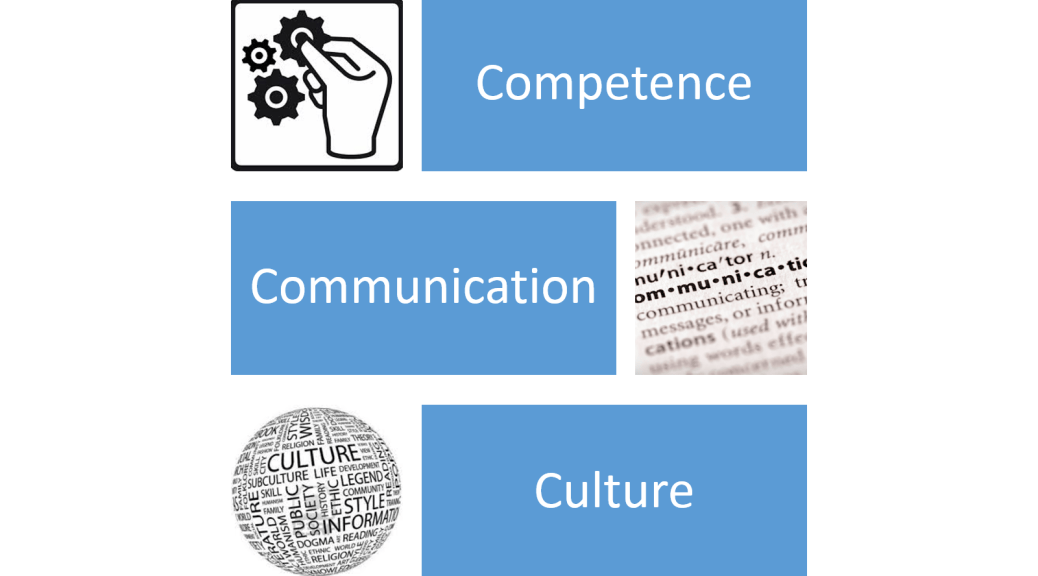
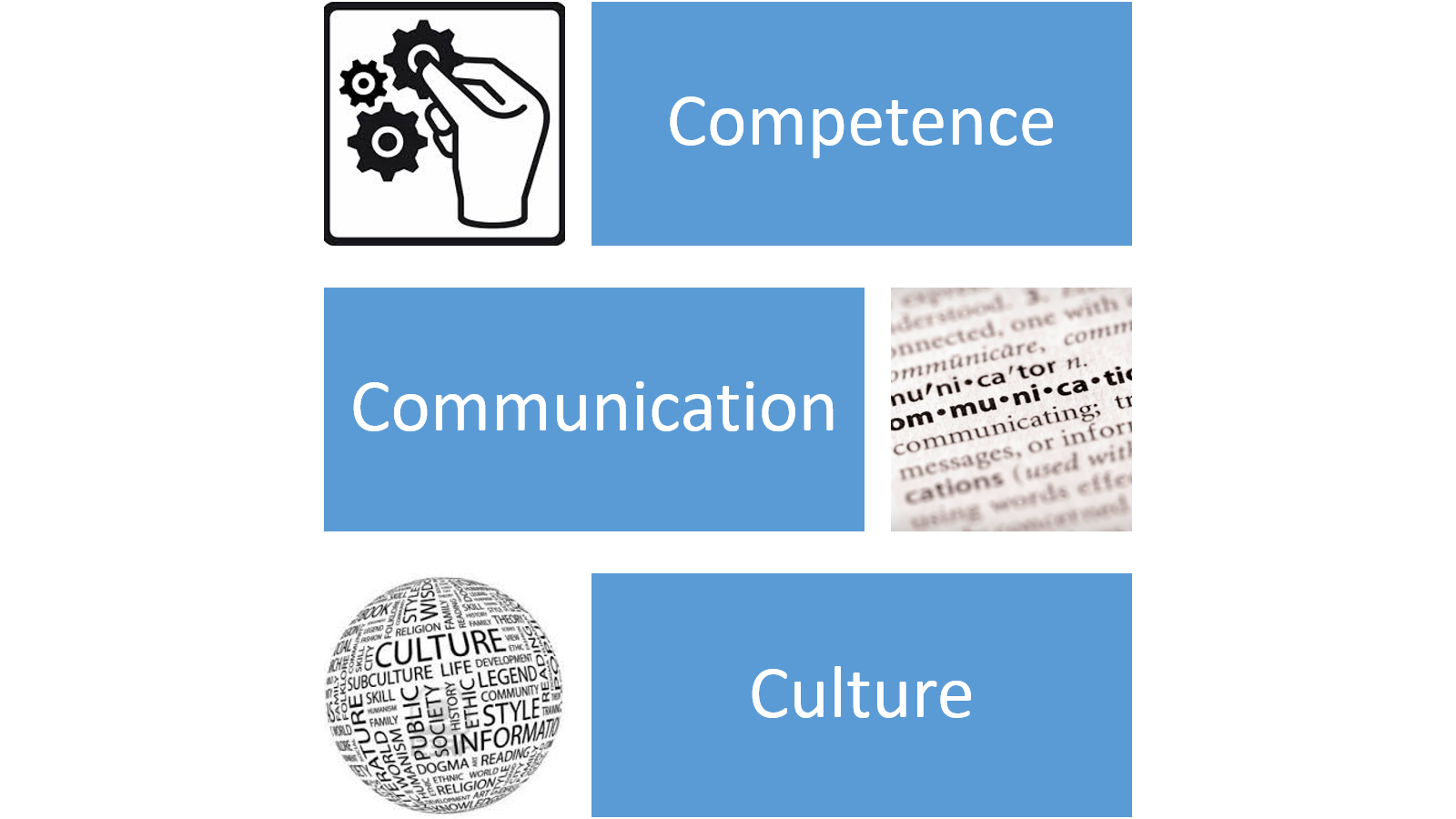
3 C’s for getting hired again
For any CEO / founder role, the board will be involved, and probably initiate the search, but also get inputs from the current management team and the “interim CEO”.
The new team will have to determine if you are the right candidate for the role, given many criteria, but we can boil it down to the top 3 that matter.
1. Competence: For any role, not just the CEO, “can the person get it done?”, is the first question most of us ask – skills, expertise, knowledge and capability to execute among other things are a must have. These are what we call table stakes.
2. Communication: A key skill and capability that sits head and shoulder above all others is the ability to communicate – written, spoken, one-one and one-many. We also put ability to motivate people to take action into this bucket.
So the million dollar question to ask yourself as a founder is:
If I were to interview for my role as an outsider, will I get this job?
I know a founder, who goes through a formal interview process EVERY YEAR with 2 of his board members, 3 of his direct reports (different ones each year) and one outside executive recruiter.
His rationale for this is simple – it keeps him honest and gives him a clear picture on things he needs to do for the next year in 3,6, 12 month time horizons.
It is a great trick in your book to have. Try it.
Tell me if it helps you.
Interviewing for a job you already have. Will you make the cut?
Changing Role of the SaaS Customer Service Professional
When you move from a market, sell, support model of software sales to a market, analyze and sell model of SaaS products, it becomes clear that the best things SaaS companies do is:
1. Build a good product segmented by users. (Product, Engineering)
2. Ensure that their target audience know about their products. (Marketing)
3. Educate potential customers about the product to help them “try” the product. (Sales)
4. Build conversion to paid customer within the product. (Product, Marketing)
5. Help increase engagement (more product usage) and reduce churn i.e. losing customers. (Customer Service)
The role of the customer service teams is increasingly becoming one of reducing churn, since that kills most SaaS business model’s financials.
It is so hard to acquire new customers at scale and cost, so when you have a good, paying customer the objective should be to help them use the product effectively and get the most value so they get the ROI and are extremely happy.
There are 3 important functions that belonged to sales – reducing customer churn, engaging users, and upselling, now belong to customer service.
Previously, about 10 years ago, most customer service professionals were measured by how quickly they resolved customer support calls, how few the escalations were and how long they were on the call.
These are now dramatically changed. Proactive customer outreach and predicting churn – to reach out to customers before they cancel is now the norm for most customer support teams.
Most SaaS products I know are also build an integration with other products such as #slack or other chat solutions to help customer service professionals resolve questions and support the customer within the product.
Many years ago I’d remember our customer service VP would measure and incent reps on how quickly they got customers off the phone.
No longer.
Now, the longer you keep the customer engaged and talking, the likely you are to uncover more opportunities to up sell and cross sell other products.
Customer service is more a sales function now, than a support function.
I am on the advisory board of 2 companies and on the board of directors of 1. One way to think of startups as going through the “forever school of learning”.
Before MVP you have 4 seasons or primary school, then after MVP, before Product Market Fit, 4 seasons of middle school, then after raise your series A or 3 quarters of consistent revenue growth, 4 seasons of high school and finally after series B and beyond, 4 years of graduate school.
As you’d expect, the challenges (or courses) get more difficult as you progress. The early challenges are largely speaking to enough customers to get feedback and nailing the specifics of the problem you are working on with product updates and later on they tend to be about metrics, strategy and managing cash.
Monthly Advisor Update
Here is a template document I have used with my monthly advisor updates. Most of the startup CEO’s create this template on Google Docs. The other advisors update the doc with their comments and since we are all at different locations (and continents) it is easy to review the combined feedback.
There are 5 sections as you can see above. The section I value the most are the what they learned and what they accomplished.
Usually what I have found is that the CEO updates 3 sections – accomplishments, key metrics and areas they need help and the co founder or product person updates the remainder.
Most of the advisor meetings are about an hour a month with many shorter updates and conference calls in between.
Board meeting packages on the other hand tend to be more metrics focused. Here is a sample board deck that I have suggested be used (from IA Ventures) to my startups.
The key part of the advisory monthly update document is that it needs to give your team accountability and ensure the advisor has visibility into the progress so they can help.
Experimenting is at the core of building and tying new ideas. A opposed to having a clear problem to solve, experiments are designed to “try” out ideas that you have and yet know if they will work or not.
At most startups, I notice two primary “ends of the pendulum” issues. Most (over 90% of startups) dont run enough experiments. The rest (< 10%) run too many experiments in parallel.
If you fall into the first category, then my only suggestion is to think about experimenting and commit to doing one. The AirBnB blog is a great place to start, in terms of understanding the user experiments they run. They actually have a experiment reporting framework, which shows how evolved their thinking is in terms of this facet of work.
This post is about the < 10% who run too many experiments in parallel. That’s the biggest challenge I see with startups that hire amazingly entrepreneurial talent for their first few hires.
Since each of the first 5-10 employees are entrepreneurs themselves, they all tend to run multiple experiments, either with product, marketing, customer acquisition, sales, etc.
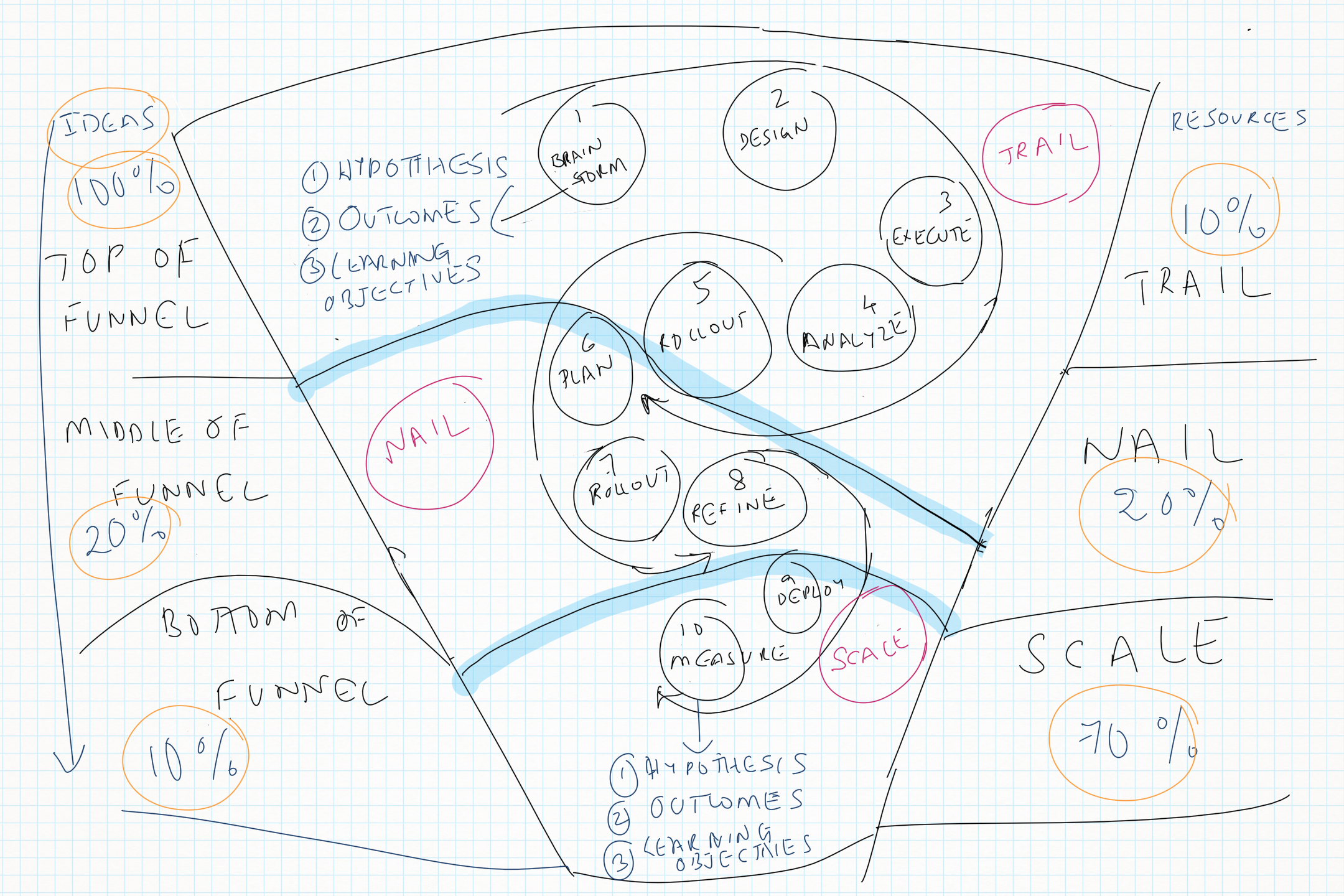
The framework I have for thinking involves 3 “sets of steps”. I call it “Trail, Nail, Scale”.
The “Trail” comprises of 5 steps, the “Nail” comprises of 3 steps and the “Scale” comprises of 2 steps.
Here is a visual to think about it.
Trail Nail Scale Disciplined Experimentation
Obviously this is very early thinking, but I’d love your feedback.
The way to think about experiments is you to pass through gates and assign the appropriate resources at each stage and have a “rough sense” of what you are trying to achieve. If you know exactly what you want to get out of your experiments, you are not “experimenting”.
What I have noticed is that the 3 stages end up being a funnel. There are many experiments you run, a few of them you will nail and a fewer of them you will scale.
If you have 100% of your “experiments” when you start, (on the left of the graphic), then 20% (or less) will be nailed and 10% you will scale.
In terms of allocating time and resources (if you dont have a large team as a startup, allocate your time), 10% is spent on “Trailing”, then twice that time or 20% on nailing and 70% on scaling.
There are many questions that this throws up, which I want to address over the next few days.
1. How many experiments should you run at the same time?
2. How do you define the success of an experiment?
3. How do you internalize and document the learning from your experiment?
4. How much “money” should I spend on trailing? How about in nailing?
5. How do I leverage lean principles into this thinking of Disciplined Experimentation?
Anyway, I’d love your feedback on this framework. As I share more of my work, which I am interviewing people in larger (Unicorn) startups at, I will also give you some case studies to see what they learned.
The interesting thing I learned last week from a founder of a small startup last week, was they have weekly celebrations. The reason was it forces the team to think about what they should be doing to celebrate in a few days. Every Thursday, their team would get catered lunch, and a cake, providing the opportunity for one person to be the MVP for that week.
When he was presenting this to us at the advisory board meeting last week, I thought it was pretty cool. I loved the culture they are building of celebrating smalls wins.
Another member of the board, who was an angel investor, nodded his head, and moved on to the next item, which was a milestone he really cared about – $10K in monthly revenue, which the entrepreneur had committed to last quarter. The progress was slower, and so it was likely they were not going to hit that number in the quarter, but he was confident they would in 2 months.
I gathered later (post the board meeting) that they were unable to hire a “Growth Hacker” to their team, since they had interviewed 3 great candidates, but they all picked up offers at other companies.
I asked him what the issue with hiring was. He mentioned that the companies they lost the candidates to were smaller, earlier and were wooing the candidate with a different culture (free food, benefits, pay were all table stakes) of work from anywhere and 2 weeks paid work from a place of their choice (think Hawaii or Bulgaria or anyplace you choose).
That’s when it struck me. You will always have investors who have been through the startup experience and those that have not. Those that have not, will not understand the nuances of what it takes to actually be an entrepreneur, so they are less appreciative of the “many little things” that go towards making the big things happen.
What this entrepreneur was planning to do was to have candidates attend their final interview (if they went to that stage) on a Thursday, so they got to see the culture in action.
In this particular case, the outcome that the investor cared about was revenue. To achieve that though, the #1 thing they needed to do was to hire a good marketing person (Growth hacker) and the #2 and #3 things were to build a good pipeline of opportunities for their newly hired sales people and tweak the on-boarding experience for new customers.
Unfortunately the entrepreneur had failed to explicitly communicate this to the other investors, who were not entrepreneurs before.
If you do not have investors and advisors who are entrepreneurs, make sure that you are clear about the “little” things that need to happen to make the outcomes happen.
Depending on the audience you will be asked to show a “competitive landscape chart” of your domain and the major players in the market. The main purpose of the competitive landscape chart is to position your company or product against others in the market. You need not to go into details, but, will be required to provide enough clarity for the audience to make out the differences between you and others in the market.
There are 2 important things you need to consider when putting together the competitive landscape analysis chart –
What you show (Features, Customer Segments, Market Requirements, etc.) and
How you show it (Visualizations such as Venn Diagrams, Harvey Ball Table, Process Map, etc.)
I follow a 3 step process to come up with the competitive analysis landscape:
Step 1: Identify: List all potential and possible competitors on a spreadsheet – one for each row
Step 2: Analyze (What you show): Start putting a list of features that you can claim you have they don’t, or segments of market which are market determined or a list of capabilities you intend to build which your customers care about or any other set of capabilities you can distinctly and objectively bucket each offering by.
Step 3: Visualize (How you show it): Look for patterns to showcase a small subset, (2-3) of the key dimensions you can differentiate and then choose the right visualization.
From the many hundreds of competitive analysis charts I have seen, here are the 7 most frequent.
Market Size – Dimensional Bubble
Market size analysis is typically good for early stage investors (institutional). The size of market tends to be a big determinant for many investors, so if you can show the potential size on a chart featuring bottoms up numbers in the X and Y axis and the cumulative size of the market as the size of the ball, you will end up giving them a sense for the potential of your company. In the example below I have shown the # of users and Price per user in the X and Y axis. The size of the bubble is (not to size) will then indicate size of the market.
A good way to differentiate if you don’t have a different product is to differentiate by segment of market. You can segment markets by any number of ways, and the type of company / user / customer you are going after is a good way to show your competitive landscape. Most consumer companies tend to do this. As an example, Twitter is good for 30-45 year old males, Pinterest is good for 25-40 year-old women, Snapchat is for 20-30 year olds, etc.
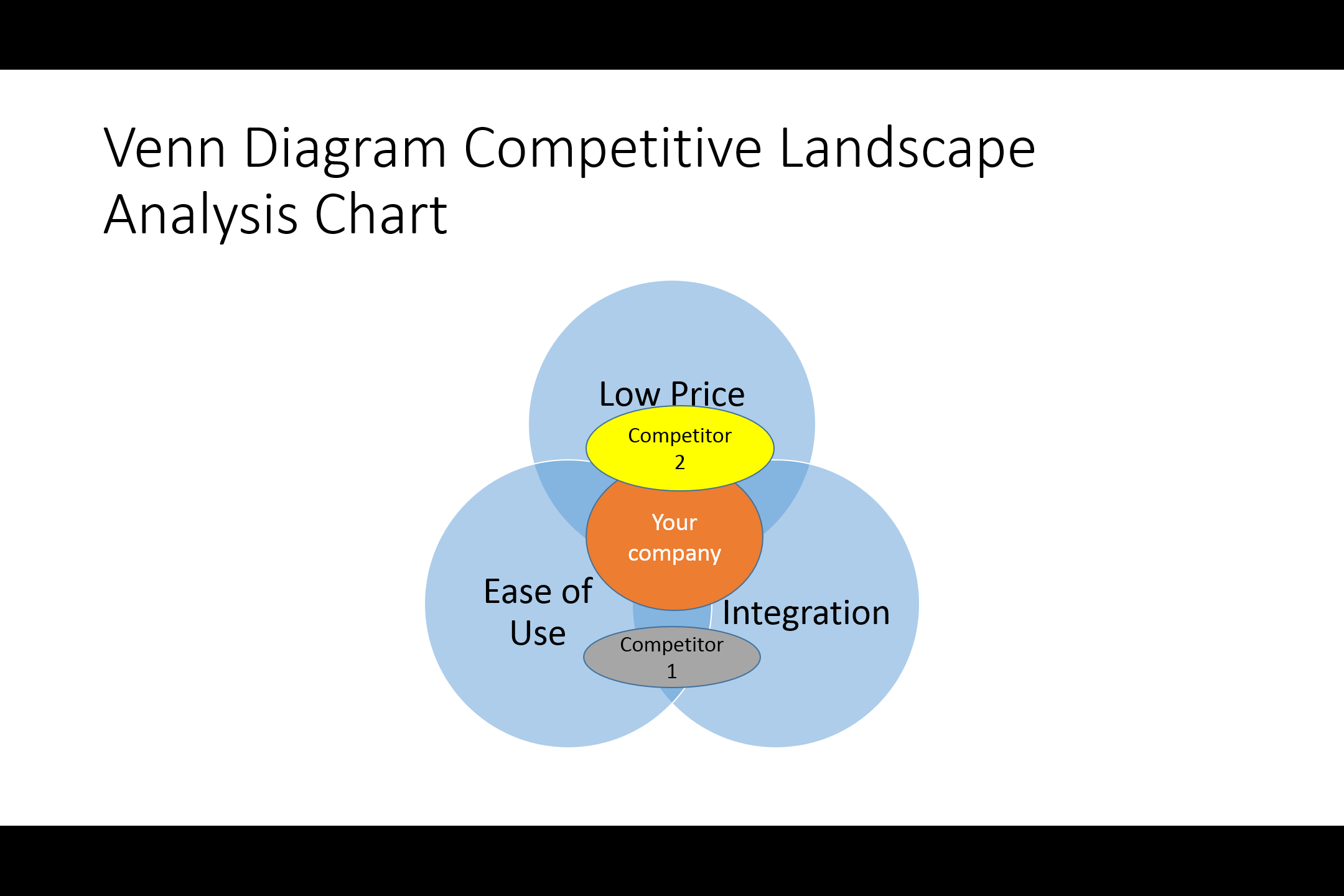
It is okay to have an overlap of companies across multiple segments and the other twist I have seen is to show the value proposition to your customer on the other axis. In this example the key 3 capabilities of Price, Ease of Use and Integration is what I have showcased.
Customer Segment Multi Axes Competitive Analysis Chart
Customers Process and Systems – Process Map
The Process map is best used when you have a lot of companies in the “space” but they all do different things for the customer in terms of their usage and solve different portions of the same larger problem. For example, when I was starting BuzzGain, the listening solutions were good to get an understanding of what was being talked about a brand on social media, but engagement products were used by customers to interact and respond and analysis solutions were used for market research.
This chart could be a double-edged sword. One on hand a customer or investor could see this as clear positioning of where you stand in the process map, but on the other hand they could see the other products wanting to build the different capabilities across the process, which leads to consolidation, which to them indicates, they should wait until the market settles, or buy from a “large vendor, who has a significant but not best of breed products across the spectrum of their process”.
Customer Process Competitive Analysis Chart
Feature Capability – Venn Diagram
Best used when you want to convey that customers need the best of 3 (or 2/4/5) different capabilities or features which all make the product unique. For example the fact that you have not he lowest price or the easiest to use product or integration alone will not rule your product out in the customers’ mind, but the fact that you have all 3 covered in the perfect blend makes it appealing to customers or investors.
The Venn diagram is best used when you can show that you have the capability to showcase you in the center and competitors on other intersections.
Venn Diagram Feature Competitive Analysis Chart
Key Features – Quadrant by axis
The simple McKinsey quadrant is actually the most used in investor presentations. This shows 2 axes with opposite ends of the axis values for e.g. simple vs. complex and fast vs. slow on the implementation speed.
You want your company to be on the top right ideally and others to be at the other quadrants. The way this sometimes backfires is that investors believe that the person in the center will win because they have the “perfect blend”.
Feature Quadrant Competitive Analysis Chart
Feature Spectrum – Silo Systems
Silos are best when you have a short list of 3-5 features alone to compare competitors with, and you have more than 3-5 competitors to show. That means a market where there are many competitors but few things to differentiate them by. Most used in rapidly growing markets, they tend to show why and how you can build a product or company quickly if you focus on a set of features that spans multiple silos.
Feature spectrum Silos are also very useful if you expect the number of competitors to increase. That way your investors don’t get alarmed when a new post shows up on a tech blog which has them sending you emails asking if we have a good plan “to compete against this new startup”.
Feature Spectrum Silos Competitive Analysis Chart
Feature details – Harvey Ball analysis
Customers prefer this landscape analysis best on the website. Sometimes if you are talking to corporate venture teams, they tend to like this level of detail as well. The Harvey balls indicate the “feature completeness” of each of your competitors versus your feature set. Typically you want to highlight features where you will be “complete” and those where others are “less complete”. I have found though, that if you do a more objective analysis and focus on which features your customers really want and show a ball or two where you are less complete than others, it will give you more credibility.
The other way to do Harvey Ball analysis is to provide a list of key scenarios where the customer has to choose one product vs. another. In this situation, you will find customers self-selecting one product because of their own situation.
The table format is the most detailed and most useful only if your audience is potential customers. Most investors prefer a high level analysis of direct competitors, potential threats and incumbents. Your customers are currently using some solution (even if it is manual) or an incumbent (old dinosaur company) as a solution possibly, but they are competitors as well, which you must acknowledge.
There are multiple methods to keep track of your projects and priorities. Here is one technique I used when trying to keep track of customer validation. This approach works best when teams are in one single location since it is visually appealing and easy to update.
It is called the Kanban method of Do, Doing and Done. A visual dashboard, which I used colored post it notes for, comprises of 3 buckets of work:
1. Do – has all the items that need to be still done.
2. Doing – what you are currently working on
3. Done – what’s finished
Typically we update and refresh the items each week – sometimes daily if there are enough changes, but a week is ideal.
Do Doing Done Kanban Method
Some folks have mentioned using Trello or Kanbanize. I have not, so I cant recommend them.
As I mentioned previously, the elapsed time for these 5 steps, in my experience lasts from a 4 weeks to 3 months on average.
The most important item to remember is that the method works best for discrete, defined tasks that take a short period of time. If your item takes many weeks or months, you have to break it down into simpler steps.Customer validation or pricing strategy cant be a step. Pricing strategy has to broken up into price tiers, price testing, pricing validation, pricing research etc.
When validating customer problems, you are trying to understand the following questions:
Is this a real problem? Is is a big enough problem for them to look for a solution?
What will it take for them to adopt a solution? Adopt my solution?
How much will they be willing to pay to adopt?
I have used post-it notes as a great way to segment the steps in the process and use colors to validate different items I need to:
In the customer validation I put forth a process comprised of 5 steps:
1. Secondary research
2. Primary research with insiders
3. Proxy market sizing
4. Online validation
5. Customer interviews
The best way to use color is to put these various “sources” into different colors. So, influencers may be blue, proxy sizing sources may be yellow, etc.
When you get to the customer interview step, you are likely finished with the previous steps, so you can color code segments of your customer with different colors.
So “Segment A” will be yellow and “Segment B” will be green and so on.
The reason for colors is then you can put them all into a board at the end and find a way to look for patterns that correlate.
The big advantage of the visible productivity map is that everyone is motivated to make changes to the charts so you can see progress daily. Try it and let me know if it works for you.