
Category Archives: Management

The 3 most important questions you will need to answer about customer segmentation

Customer segmentation for entrepreneurs is a tool to reduce distractions, focus your product roadmap towards your Minimum Viable product and create personas that can help your marketing, sales and development efforts.

I am often asked 3 questions associated with customer segments, which I thought I’d address in this post. I am going to use an example of a company building a new age mobile Patient Records Management solution (or EMR – Electronic Medical Records) for the tablet as an example.

1. What are the steps to a good segmentation strategy?

The first thing you need to do to ensure a good segmentation approach is to write down your ideal customer attributes. You dont need any framework to do this, just a list of attributes will suffice. Your attributes need to be specific, numerical and descriptive.

(I) Specific means, you will have to outline their environment. What are they using currently? How specific is their problem? Do they have alternatives? If your target is doctors in our above example,. that’s too large a segment. Instead there are different types of doctors:

a) Those that practice independently vs. those that are attached to a hospital

b) Those that are general physicians vs. those that are specialists.

c) Those that see < 10 patients a day vs. those that see more, etc.

(II) Numerical means there has to be a set number of customers that fall into this segment. It has to be a number much less than your entire target market, and not more than 2.5% of 2.5% of your target market. Why 2.5% of 2.5%? That’s usually the second question.

(III) Descriptive means, you have to outline their current day-in-the-life scenario without your product. Explain how they are currently solving the problem (if it does exist) and how they are solving it without your product. It cannot be that they are not solving it. They may be used pen and paper to keep medical records, but a system does exist.

2. How many customers is enough to build a segment for? Is there a minimum number?

Innovators - theory of diffusion
Innovators – theory of diffusion

According to the theory of diffusion, we have 2.5% of customers who are innovators. These are your earliest of early customers and your initial targets. What I have found with most of the startups I am helping is that 2.5% of those innovators are truly the engaged, early influencers who will be willing to have the discretionary time and budget to try truly innovative products and then be willing to evangelize them to the rest of the innovators.

To be clear, you dont need all of the 312 to be your early customers. These are your early segment of potential customers. Typically 10% of them being early customers tends to show “traction” for an investor.

Lets say the total number of doctors in the US is 500K. Then your Innovators are 12.5K. Of them, 2.5% should be the first segment, which is about  312. That’s the ideal target for you to have as a start.

3. What if most of the target customers dont have the pain point or dont want the product? Does that mean the segment is incorrect or there is no market need for this segment?

If you have targeted 312 doctors who are primary physicians (segment by practice type), in the Texas area (segment by location) who work in a multi-use work location (segment by work area) and are currently using paper based medical records (segment by current product usage) theny you now have a segment of customers who you want to go after.
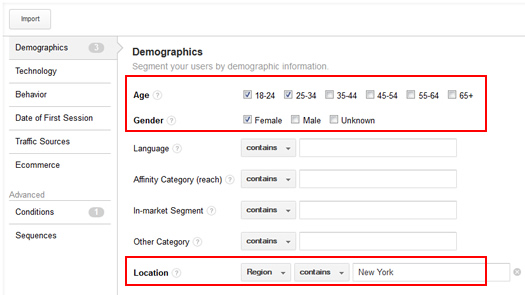
Google Adwords Segments

A trick that I have seen most people use is to segment based on Google Adwords segments (see diagram above) or segment by Facebook targeting options.

Facebook Targeting Options

Once you have your segment at 2.5% of 2.5%, then you are doing a combination of ads, conversions, focus groups and interviews to understand if they have the pain point.

If you end up finding out that customers dont have the pain point or the conversion rates on your ads is low it is indicative of either poor targeting, poor messaging (your message did not resonate), incorrect framing of the problem or lack of the problem in the first place.

What I have found in my experience with over 300 startups is that the number one problem is poor targeting, followed by lack of the problem existing for the prospect in the first place.

What is customer segmentation and why is it important for the #startup #entrepreneur?

One of the first things you will realize as an entrepreneur is that you will need to be absolutely clear about your customer’s problems and envision your product solving their most important pain point. This realization results in an appreciation for the “micro” problem for a “small set of customers” to begin with.

That in essence is customer segmentation.

The discipline of finding the factors that differentiate one set of your potential customers from another based on a set of characteristics.

First, segmentation is a discipline.

The output of that discipline is a) a way to make it easier to identify your customers via a known name or persona b) a means to target them more effectively and c) a language to explain their problems / pain points and d) an ontology to express your solution to help them solve the problem.

Second, you will have to find factors that help you differentiate customers.

The idea behind the factors it to help you focus on those customers who have the highest pain, and hence the most propensity to buy, or the most desire to solve the pain and eliminate (during that period) than those that dont have the need immediately.

Third is to identify and document the characteristics that help you find the patterns or a set of questions to help guide your segmentation.

The best way I have found you can document the characteristics is to write down a set of interview questions that can help you during a discussion with potential customers. Others have used the buyer persona canvas or a simple tool to document thinking, feeling, seeing into maps.

Buyer Persona Canvas
Persona Map VP Sales
Persona Map VP Sales]

The empathy map is more relevant for design, but it can be made very relevant for you to leverage as a founder to understand the sales cycle, buying process, marketing criteria or service design.

Lets take an example. Assume that you are building a CRM system for SMB, to help them track their sales and allow sales reps to directly provide a quote and contract using just their mobile phone.

Most entrepreneur’s state that all SMB are their customers. This is usually done to prove that the market is very large and hence deserves attention.

The goal of the segmentation exercise is to make the market extremely small (a set of customer you can get in front of, collect feedback and test your hypothesis in as short a time as possible).

In most B2B scenarios there are 3 major and many minor characteristics that define segments of customers.

1. Size of the customer: Some people define size by revenues, others by # of employees, still others by # of sales people within the organization, still others by # of quotes the company delivers in a year, etc.

2. Industry vertical: In industries where speed to quoting and contract delivery makes a difference in the sales process, your solution might be more valuable, (e.g. some insurance verticals) than others were the contract process involves multiple rounds of competitive bids.

3. Title of the buyer: Titles (VP of Sales, Director of sales, Sales Manager, etc.) are usually an indicator of spending authority. In our case the VP of sales at a small company in the insurance brokerage is likely to have the ability to try and purchase the solution to help his sales professionals be more productive, than a Sales manager, who, is likely going to focus on trying the solution to offer feedback, but may not have the authority to buy. They will end up being a user, but not the economic buyer.

It used to be that location was the 4th characteristic, but with the Internet, is highly possible that your customers are in a different location (physically) than you are.

For B2C companies, most segmentation is done by demographics or psychographics. The 3 most frequently used characteristics are age, gender and income. There are many others as well, but these are the primary. I will share the B2C example in the next post.

Top 5 tips on how to come up with milestones that are measurable for your startup

Most founders will come up with following variations of milestones when they get started with their company.

1. Ship beta version of the product by Dec

2. Raise $XXXK in funding

3. Get to $YY in revenue.

Unless there is a team that’s large enough to have each person take on ownership for each of the milestones, the founders are the ones that are responsible for them.

This means that there is little else you can do other than focus on these milestones.

Lets assume you have a cofounder and you split the roles into technical and business.

The technical person takes responsibility for the beta version and the business person for the funding and revenues.

Now a few months in, a new set of responsibilities come forward including managing your board, your mentors, talking to potential partners and others.

Your team has not expanded to take on the executive level challenges, so you still have the 2 cofounders taking on more.

Some of these new tasks are enjoyable – having conversations with partners or mentors for example, so you get “distracted” and the top 3 goals no longer get enough time. That’s when you realize you need a to-dont list.

A few weeks go by and you hopefully realize you are behind and try to catch up, this time removing the new tasks on your list and replacing them with items on the top 3 milestones.

The problem is getting to the new items is tough until you have enough folks on the team who can take on the high level, cross functional priorities.

Here are the top 5 tips I have learned to come up with milestones that you can manage. You may have heard about SMART goals, so I am going to skip that portion and assume you already do that.

1.One person per milestone. You cannot have joint owners for a milestone. Even if you and your co founder are “two peas in a pod” and “complete each others sentences”, have only one person assigned to each milestone. You will achieve greater accountability that way.

2. One milestone per person. If you have more than one milestone assigned to a person, reduce the number of milestones. Obviously if you are a solo founder, that means work on one thing at a time until you have a management team to help you take tasks off the plate.

3.  Milestones cannot be overloaded. Milestones need to be specific enough for one area of work. If your milestone reads “raise a seed round and ship version 1 of the product”, that’s 2 different milestones with responsibilities for 2 different people.

4. Milestones need to have a specific date, and be reviewed weekly. To track your progress, I have found that a weekly review works better than daily or monthly. During the weekly review, you need to understand the tasks and projects that make up the milestone and understand where the blockers are with an “plan B” for any blocker.

5. The owner of the milestone needs to have cross-functional authority. You may have silo functional ownership of roles but most milestones, if they are important have cross- functional impact. So if you need to ship a beta version of the product, the owner of the milestone may need to get customer access from another person and market data from a 3rd person. Even if they are peer’s for the success of the milestone, the owner needs to have full authority to help get the resources to get the milestone done on time. This ensures that even if you have to transition from a role of control to a role of influence, you still have the ability to execute on the milestone.

The power of the “to dont” list and why you should keep one

I tend to get distracted easily. I have the shiny new object syndrome disease. I tend to take time to understand what made me master a task or a skill and so I tend to make a lot of mistakes.

Which is why I have a tool in my box called the “To Dont” list. It is not my idea or a new one, but I have benefited from it a lot.

It is a list I keep of things I am not going to do.

I have a list of 3 things I want to do each week and 1 thing I want to get done daily.

I have close to 45 items on my To Dont list. Examples – writing a book, learning Mandarin, learning awesome photography skills.

Every startup CEO and entrepreneur needs a To Dont list actually. Why?

1. Limited resources. When you are small you dont have an army of direct reports who can each own an initiative and “run with it”. If you, as the CEO, are not spending time managing projects and helping remove obstacles for people, you are not getting further ahead. I know a CEO who keeps blaming all the people she hired on her team for “not stepping up” to take responsibility for the top 3 items that the company must achieve. All along while she is working on priorities outside the core priorities she identified for the team.

2. Limited energy. If you are not spending time on your top 3 priorities for the day / week / month / quarter, and dreaming, eating, sleeping, brainstorming and executing those priorities, then your energy and brain power is being consumed by 100 other “shiny” non priorities. It tends to be the “death by a thousand cuts” problem where 7 to 9 things take up your time, and before you know it, it has been over 4-8 weeks and you have not made any progress towards the top 3 things you need to achieve as a company to get to the next milestone.

3. Limited time. If you work 10 hours a day, god bless you. If you work 15 hours a day, you are fooling yourself into believing that you are “working and productive”. I dont know the exact capacity and stamina that different people have for work, but everyone needs some time to rest their brain, their body and their mind. If, for example, you believe you should spend 8 hours on your top 3 priorities and only 2 hours a day on your bottom 7 priorities, I still would question your ability to focus.

The main reason is that it is not time alone that you are spending – you are spending your energy, which is another thing you have in limited supply.

I know that Google has said you have the 20% time where you can work on things that you enjoy doing, outside your core priorities, but you are not Google.

You are a startup, with very limited resources and time.

If you want to work for 12 hours, daily, by all means do so.

Just make sure that your top 3 priorities get the all of your attention – until they are completed.

There are some tasks that you might believe “you cant make progress” on, until there’s something else that happens outside your control.

Bring more things back into your control by spending time and energy on alternative paths.

For example, if you believe the “customer” will take 1 month to get approvals in place for you to get the POC ready, try to get another customer on board, or work the org chart of the customer to get other approvals in place. Dont spend time trying to talk to a new integration partner since that’s not on your priority list.

That should belong on your to-dont list, until it is important enough to belong on your To Do list.

The To dont list should be as sacred as your to do list. Put everything in there that catches your attention until it is worthy enough to make it to your to do list.

The one mistake most entrepreneurs make when they are at an accelerator

I have noticed that the biggest mistake most startups make when they are at an accelerator is that they focus on

“Increasing their total surface area” instead of “accelerating their business”.

This results in the “tail wagging the dog”, where the accelerator schedule, mentors and connections determine what the entrepreneur and the startup does each day. It is important to ensure that you get enough value from the accelerator program, but I would recommend entrepreneurs optimize for acceleration.

If you dont have a clear idea on what to expect from an accelerator, you should spend time with alumni of the program to understand the value their provide first.

It is almost as if after the startup got into the accelerator, the entrepreneurs believe they have a new boss – those who run the accelerator. That could not be farther from the truth.

If you get into an accelerator program, the #1, #2 and #3 thing you should be focused on is validating key assumptions, building product and customer development. Most everything else at the accelerator stage of your company is a waste of time, including attending knowledge information sessions on term sheets, understanding the “local” investor scene or going to “startup events” – unless startups are your target market.

There are 3 important things that most accelerators promise:

1. Learning from mentors, other members in your cohort and industry experts.

2. Connections to investors, potential customers and influential early users.

3. Infrastructure, office space, and a little sustenance money to get your team and product ready for seed investment.

If you look at these 3 items in isolation, there are many other entities that do a much better job individually, but a good accelerator “bundles” these items together so you can have a great experience.

Let me explain with 3 specific examples of what increasing your total surface area is versus accelerating your startup.

a) The best learning is via practice and teaching. So if you spend as little time as possible understanding the contours of the topic you want to learn, you can spend more time practicing and refining your learning. 

Instead, I find most startups attending every learning workshop including “how to sell your company” or “the legal ramifications of your series A investments”. While <10% of the startups in any cohort will really be ready for a series A, 100% of them actually “try to increase the surface area” of their learning by attending sessions that they dont need given the stage of their company.

Instead, I would spend more time accelerating the learning of specific topics from your customers – what real problems they face outside of the pain point your company addresses, etc.

b) The best connections are those that are mutually beneficial. So, if you can help your mentor or adviser learn about your business, the market or new updated techniques of engineering, marketing, sales, etc. they can help you learn more about the nuances based on their experiences. If they are unwilling to learn or are not interested, they are not the right mentor.

Increasing the total surface area is trying to network with every mentor from the accelerator and networking with every potential investor, even if they have not invested in any company in your market or domain.

Instead, accelerating your startup is focusing on specific investors by domain, check size, background, connections, and other criteria you need to help your company grow.

c) While the infrastructure is available to have meetings, get the team together and learn from other entrepreneurs in your cohort, increasing your total surface area is trying to spend every evening with other startup entrepreneurs, networking over beer or having a lot of meetings at the space with other startup influencers from the community.

Accelerating your startup, instead is spending enough time with your own team, learning about the challenges they are facing and understanding how to remove the roadblocks. Or, spending time outside the building, trying to meet potential users and customers to refine and validate your assumptions.

If the accelerator focuses you on increasing your total surface area, they are wasting your time.

The one question you need to ask VC’s in #India to understand how quickly they will move to fund your #startup?

I was in Bangalore for 3 days, meeting about 30 entrepreneurs on day 2 and about 50 earlier stage in-the-process-of-starting-a-company entrepreneurs. The first thing that strikes you is how amazingly vibrant the ecosystem in Bangalore is. I met with over 100 investors (angel as well as a few VC’s) as well at the Lets Venture event and they while many were complaining that “valuations are higher” and “entrepreneurs are pushing them to make decisions quicker”, they were very upbeat about the opportunity in the Bangalore ecosystem.

The entrepreneurs are also much more savvy than folks were even about a year ago (I know that I spoke with a curated list, but previous curated lists were provided as well and this cohort of entrepreneurs were far ahead of those a few years ago).

The most interesting part that I noticed was that there was a bigger focus on “traction“.

I can confidently say that having been to 23 cities in the last 6 months including New York, Beijing, San Francisco and other cities in the US, Bangalore has a clear shot at being in the elite “top 5” entrepreneur ecosystems (Of course it will be Silicon Valley (Snow White) which will be #1 by a wide margin, but the other cities (the 7 dwarfs) are doing well relatively. I look at ecosystems for entrepreneurs around cities more than countries.

That optimism also bears itself out in the numbers. From look at IVCA funding and other locations, Bangalore is trending stronger than other cities such as Seattle, New York or Austin.

There were many observations I had in my 3-5 indepth discussions with Venture Capital investors in India. One of them was their necessity to now “compete” to get entrepreneurs’s attention.

Which in itself indicates a strong and vibrant startup funding ecosystem.

The most important takeaway for you as an entrepreneur, that I have learned is this –

If a venture firm has spent any time forming an “investment thesis” in a particular market or segment, then they will move much quicker than other firms who have not.

So that’s the million dollar question you can ask to determine if a VC will move quickly in India. I know this is the case in other locations as well, but the funding frenzy has been more acute in Bangalore than I have seen before.

I would ask a variation of the question – “What is your investment thesis in XYZ market”? Or “Do you have an investment thesis on “my XYZ” market”?

if they do, then your job is only to convince them that you are the best team, company and startup with the right traction to invest in.

If not, they will take weeks to understand the lay of the land, look at competitors and then form an opinion on your market.

Let me know if this works.

How to be a more innovative startup by changing just 2 words in your meetings daily

Most every startup wants to be innovative. That’s the essence of being in a startup. To be innovative, most entrepreneurs realize they have to get their culture right. An innovative culture fosters and innovative workplace which builds an innovative company.

So, now the question is how do you build an innovative culture?

To build an innovative culture, I believe you have to encourage experimentation. Lots of it. Most people learn only by experimenting, not by sitting in classrooms and being taught. While it is important to sit and learn the first principles, most everything else needs to be learned by doing. You will have to let people try lots of things and learn what works for your company, your industry, your market and your customers.

The trouble with experimentation is that it breeds failure. Lots of failure. If everyone of your experiments were successful, then you are not taking enough risk, which means the company wont be as innovative. In fact, the leading indicator for innovation in most companies is the number of failures they have. Which means they are taking more, but managed risk. A good metric to measure, is the # of experiments your startup conducts in a unit of time and what the failure rate is.

The best way to do this is to practice the art of disciplined experimentation. Which is why I am a fan of the phrase “My discipline will beat your intellect“.

So, if you do conduct a lot of experiments, you will fail. How do you understand, organize and learn from your failure?

Most companies conduct an audit of their experiments, the hypothesis, the initial learning and the final results. That’s where the the biggest problem is to be found.

Most managers and executives are trained to ask the question –

“Who to blame”?

That’s the question that most meetings post experiments start with? What happened? Why did it happen? Who is to blame?

I propose a small change instead, which will get your people less defensive, more open to taking risks and experimenting.

The right question to ask is –

“What to blame”?

Focusing on the process, steps, methodology and systems brings out the best answers to the question “how do we get better”?

Surprisingly you learn more about people, their strengths, limitations, weaknesses and biases if you focus on the process that was broken instead of assuming that the people messed it up.

For most founding entrepreneur CEO’s this is one approach that works best to foster a culture of innovation and risk taking.

Do you have a manager who has followed this principle? I’d love to understand what you have learned from them. Drop me a note on Twitter. (I do respond to all @ replies BTW).

Communicating stretch goals internally versus milestones externally

I got an interesting question from Brian of Slope the other day on the process of communicating internal stretch goals (which should be much higher than the external milestones) to your board or investors.

If you have bought into the discipline of setting milestones and measuring the right metrics to support them, then you will realize quickly that you will need to push yourself and your team harder to set goals that will require you all to persist even against difficult circumstances.

The first step to come up with milestones is when you and your management team (or you and your co-founder, when you are small) meet together to understand where you want to be and when. That usually tends to happen at your kickoff meeting or your offsite or when you decide you want to plan and execute against your goals.

Lets say for example, in 12 months, we should have 15 paying enterprise customers, or 10,000 daily active users or 500 transactions on our eCommerce platform. The metric and the milestone would be something you have derived from various discussions including what your think you are capable of doing, where your competitors are, what the market adoption rate will be etc.

Then the next step is to understand the list of items that need to be done , their dependencies and synchronized in order for that to happen. For example, your product needs to have a set of features, or your need to demo your product 30 times to specific titles and roles in your target prospect, or you will need to hire these profiles in your company, or if you need to help obtain the initial set of users via word of mouth.

Now, before you and the team decide whether the goals are achievable I’d advice you work on the process bottoms up. What that means is what you think you can do as opposed to what you should be doing.

Lets say again for example that you can realistically process successfully 100 orders per day, but you believe that without you doing 250, you wont be the market leader, or you wont get the valuation you’d like, then I’d still document the bottoms up number first.

Typically the top-down number for your metric will be something the market dictates. That’s not very much in your control. In any event, I’d ignore all competitor information until you know how you can do better yourself.

Once you have decided that metric and the goal achievement number, you should run it by your 1-2 top trusted advisors before your communicate it more broadly.

The next step is to communicate that to your board (if you have one), or to your advisors (if you dont have an advisory board, I’d recommend you do that first) or to your existing investors. Most entrepreneurs ask me what the difference should be between the externally communicated goal versus the internal stretch goal you set for the team.

I dont think there’s a formula, but typically I have seen on the boards I advice a 15-20% difference, on average.

That means if your goal internally is to hit 100 orders/day, I’d commit to 85 / day to the board.

The final step in the process is to communicate to your entire team again, typically in an all hands meeting. I’d do this even if your team gets larger. That also gives your entire team a chance to ask questions and see the same information that has been committed to the board.

Why you need to do user development before customer development

When working on customer development, many B2B startups quickly realize that their user is different from their customer. This usually happens because the price of the product is more than what the user can pay for on their credit card, or if the user wants to use the product for “work” and needs to have it approved by their manager (the economic buyer or the customer).

When I ask the question “Who is your customer”? to a startup, the answers range from a) Size of the company (Enterprise, SMB or Mid-Sized) to organizations within the company (Marketing teams, Engineering teams or Sales teams) to titles within an organization (Event planner, Release manager, etc).

When you are initially doing customer development, the user pain and problem matters more than the customer value proposition. If you do not solve a problem for a person (s), you dont have a product at all, even if your value proposition is useful to a larger organization.

The best way to do the initial user development is to practice ethnography. Spending as much time with users is key. Watching and learning from users is more important than interviewing them is what most entrepreneurs learn quickly.

The next step in your user development process is to document your “day in the life of your user”. This is the process of understanding what you user goes through on a “typical day”. I would highly recommend “chunking” the day into 15 min increments from 8 to 6, instead of 1 hour or 30 minute increments. You should get 40 segments in the users day. Put these segments in your first column. Then have 3 columns together – one for what the user “does” during those 15 min, a second column for categorizing the work into buckets that are relevant for your startup versus not relevant and third for priority of that task to the user.

Typically you will need to watch and observe about 15-20 users before you detect patterns. What most entrepreneurs realize quickly is that if the startups is not tacking the most high priority problems for the user, and instead is only # 5 or lower on the users priority list of pain points, then getting “traction” is slow and long. Growth is stunted.

The second observation I have is that the categories that the user prioritizes over what the startup prioritizes are indicative of the lack of empathy that the entrepreneur has for the users job. The best case situation is if you have been in that role – so you can scratch your own itch, but if not, what I have seen is that there is a cognitive dissonance between what the users categorizes as things for a project versus things for building network, versus meetings for example.

Finally, if you can map the users day in the life, and even if you dont tackle the top 3 problems for the user, you will find that the top 3 offer you opportunities to market to the user by helping address their biggest other pain points – this is typically done by content, tools and other products that will help you establish credibility with your user. Which gives you an opportunity to build a longer term relationship with the user.

The analogies and words people use in your startup meetings define your culture

As a founder, it is important to define and constantly manage / prune your company culture. Why? It defines your growth, who you hire and how you respond to situations.

Most founders don’t understand, though, what the company’s culture really is. When you have more than a few dozen people, things change dramatically if you are not constantly pruning and hiring the right folks. Even the best leaders have a little more than 50% batting average when it comes to hiring stars, so it is no surprise that culture changes at a startup quickly if it is not nurtured.

What is then the best way to understand what your company’s culture is and how it manifests itself in your interactions?

The best way I have found you can understand your company’s culture is attend a critical kickoff meeting for a key project for every team, every so often.

Not as a contributor or a participant, but as an observer.

Sometimes folks in the room will be cautious about having the founder attend their meetings and be likely guarded in that meeting, so I’d recommend you ask to be on the conference call, not in person. Most people tend to forget folks on the conference call, and tend to be their natural self.

Then look for key words that people use to describe actions, situations, responses and milestones.

For example, at Microsoft teams use the words rhythm, cadence, muscle memory and “landing things” a lot on the sales side of the house. On the engineering side it tends to be “shipping bits”, agile, “landing things” and cadence a lot.

It is very useful to understand where those words come from and what people believe in when they are confronted with situations. They also though, define the culture of the organization.

As instrumental as these words are in understanding what people value, it is also indicative of what gets ignored.

The best way to have an understanding of the culture is to ask questions about quality, deadlines and budget.

These items will give you the best response into the psyche of the organization.

Another thing to look for is the analogies that people use to describe situations.

Most sales teams will use sports analogies (for example you will hear at Microsoft about “hail Mary” effort to secure a difficult customer effort by end of the quarter). Engineering teams tend to (at Microsoft at least) use science analogies – (for example you will hear frequency and amplitude of releases, and the signal to noise ratio of feature requests).

Some of these analogies are truly regional and defined by background, but once in a while, when you have a new leader who wants to redefine the culture they start to use different and new analogies, which stay for much longer than their tenure.

As a founder the best way to have these “grapevine” stories stick is to use analogies that folks will adopt because it creates a sense of “insider knowledge” or “tribal power”. It is also the best way to ensure that your culture has a cult following.