They’re statistical compression of everything that already exists.
They don’t invent—they average. Their job is literally:
“Given all the design patterns in the world, what’s the most probable next pixel, word, or layout?”
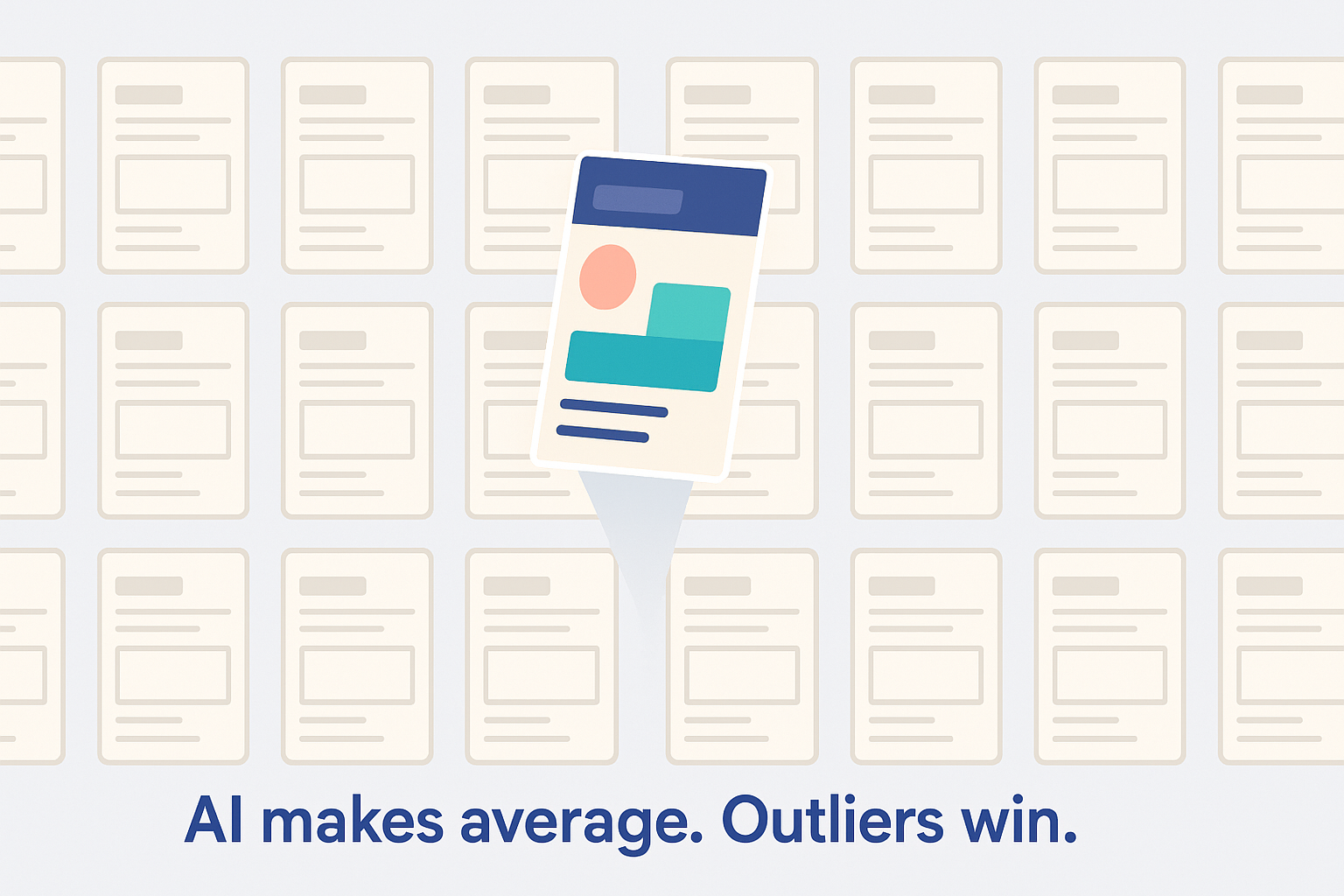
That means AI is gravitationally pulled toward the center of the bell curve. It is designed to be safe.
And safe is the enemy of great.
What AI naturally produces:
Layouts that look familiar. Color palettes that “work” Components that follow convention. Slightly-above-average Dribbble-style UIs. Translation: Pleasant, polished, predictable. Good enough to impress non-designers. Not good enough to move culture.
What AI instinctively avoids (because the data rarely contains it):
Bold new patterns nobody has tried
Weird layouts that break grids
Pixel-perfect craft (it blurs details)
High information density (it simplifies)
High constraint problems (logos, complex UI)
Subtle brand identity
Clever metaphor or symbolism
Risky opinions
Why? Because the median is safe. And the median dominates the training data.
AI = Safe.
Great Design = Opinionated. Great design is not the “average of what’s been done.” Great design is a decision, a stance, a refusal to blend in. AI is optimized to remove risk. Humans are valuable because we’re willing to take it.
Design is about taste—and taste can’t be averaged.
AI finds the midpoint. Taste lives at the edges. Taste says:
“Everyone is doing X… so I’ll do Y.”
Taste is judgment under constraints—not pattern recall.
The Beige Flood is Coming.
As AI becomes more accessible:
Every founder can generate “good-looking” screens.
Every template will feel AI-polished.
Every landing page will look interchangeable.
We will drown in pleasant, soulless UI. Everything will look… fine. And fine is the new ugly.
In that world, human taste becomes a luxury good.
When everything is mass-produced and “pretty,” What stands out? Not polish. Personality. Not symmetry. Story. Not correctness. Character. In a sea of AI beige, the rare work with soul, sharpness, or a strong opinion will feel electric. People will pay for it. Brands will compete for it. Users will crave it.
AI will dominate production. Humans will dominate direction.
AI can generate infinite “good.” But only humans can define what “great” even is. The winners aren’t the ones who prompt the fastest. They’re the ones who see what AI cannot see. The edge. The vibe. The future.
Conclusion:
AI is the new baseline.
Outliers are the new competitive advantage.
If you’re just “good,” AI will replace you. If you’re bold, specific, opinionated, weird, wildly human? AI can’t follow you there.That’s where the future is.
So I just listened to this super insightful conversation with Anne, the CMO at Sierra Ventures, and let me tell you — if you’re in marketing, freelancing, or running an agency right now, this is your moment. Seriously. It’s not doom-and-gloom like some people say AI is coming for all the jobs. Nope. Anne’s take? This is probably the best time ever to be running a small agency or be a consultant. Here’s why.
Anne’s journey is already wild — she started in Hollywood at Paramount Pictures, went up to the Bay Area, worked at Sony PlayStation, then jumped into the startup world, and eventually built her own agency before landing in venture capital. She’s now helping portfolio companies scale their go-to-market (GTM) strategies and digging into deal flow as part of Sierra’s investment team.
But the real heart of the convo was about what she’s seeing right now in the world of GTM and marketing, especially with AI taking over.
Let’s rewind for a second. Remember how we used to think agencies were on their way out because of AI? That’s what a lot of VCs were buzzing about. But Anne flipped the script.
Her LinkedIn post that kicked off this whole discussion made a big, bold point: agencies are not dying — they’re evolving, and fast.
Why? Because the tech is finally working for the agencies.
AI tools have leveled the playing field. A small shop can now spin up content, videos, and even podcasts at lightning speed, and often better than a bloated team. And here’s the kicker — many agencies are still charging the same prices they did pre-AI, while doing the work in a fraction of the time.
Anne said it best: “These tools only work as well as you know how to make them work.” That’s the sweet spot where agencies and freelancers are thriving — becoming true experts in tools like video editing, podcast production, AI writing assistants, and platforms like Clay (which is powerful but not exactly beginner-friendly).
One of the cooler metaphors that came up was the idea of the “full-stack agency.” Back in the day, a marketing agency might have had one SEO person, one video person, one designer, and so on. Today? You’ve got folks who are full-stack in their specialty. Like: “I do video, and I do it all — record, edit, optimize, publish.” Same with podcasts, same with content. Fewer handoffs. Less friction. More speed. And much higher margins.
The conversation also veered into why so many AI platforms are now offering “Do It For Me” or “Concierge” services, even though their tools are supposed to be self-serve. Isn’t that kind of ironic?
Anne explained this perfectly: Even if the tools are powerful, people — especially in startups and enterprises — don’t have the time to learn 10 new things while putting out a million fires. Startups are already running on overdrive quarter after quarter. So they need help. Not just software — implementation, guidance, and actual execution.
Enter the freelancers and micro-agencies. These folks are not just service providers anymore — they’re becoming educators and implementers. Some consultants are making a killing just teaching teams how to use tools like Clay effectively. That’s not going away anytime soon.
Another interesting thread: impact. The days of “I’ll make content and check the MQL box” are over. Brands want to see revenue. If your agency or tool isn’t tied to business outcomes — not just leads, but dollars — you’re going to get passed over. AI may automate execution, but strategy, impact, and real performance still need smart humans in the loop.
Anne even mentioned some cost-saving hacks on the CRM side — one of the podcast hosts built his own internal CRM using a $20 tool instead of paying $400 a month to HubSpot. That’s wild — and again, speaks to how agile and efficient marketing ops have become if you’re tech-savvy and AI-literate.
And honestly? This is just the beginning.
We’re still early. The models and tools we’re using now? They’re the worst we’ll ever use, Anne said — everything’s only going to get faster, smarter, and more intuitive. But right now, there’s this golden window of opportunity for agencies and freelancers to learn the tools, stack their skills, and lead the charge before everything becomes “click-and-done.”
So if you’re in the agency game, thinking of starting a consultancy, or even just freelancing on the side — this episode was your pep talk. You’re not being replaced by AI. You’re being amplified by it.
As SaaS and AI-native companies evolve, so do their monetization needs.
Gone are the days when simple subscription billing could handle the complexities of a modern B2B company. Today’s growth-stage businesses demand flexible usage-based billing, automated revenue workflows, and AI-enhanced pricing logic to remain competitive. A wave of startups—and some mature players—are rising to meet this demand, redefining the core of how software companies generate and optimize revenue.
In this post, we break down the emerging landscape of modern revenue infrastructure by analyzing 9 standout companies: Metronome, Orb, Maxio, Paid.ai, Solvimon, Zenskar, PostHog, Sequence, and Paddle.
The Shift from Legacy Billing to Composable Monetization
Traditional billing platforms like Zuora or Chargebee were built in the era of flat subscriptions and manual workflows. But the modern SaaS business is:
Product-led (PLG), requiring granular metering of user behavior
Global, with currency, tax, and compliance complexity
AI-driven, where dynamic pricing and renewals must be handled in real-time
Enter the new monetization stack—an ecosystem of tools built API-first, designed for developers and RevOps teams alike.
Segmenting the Landscape: Four Clusters
To make sense of this rapidly growing market, we segmented the companies into four distinct clusters:
1. Usage-Based Billing Platforms
These tools provide powerful metering, real-time billing, and pricing flexibility:
Metronome: Built for scale, Metronome is known for its developer-friendly APIs and real-time metering. Used by fast-growing SaaS businesses embracing usage-based pricing.
Orb: A strong choice for AI-native companies needing composable pricing logic and deep integrations.
Zenskar: Focuses on quote-to-cash and supporting hybrid pricing models.
Solvimon: Based in Europe, it supports sophisticated pricing rules for fintech and B2B software businesses.
Sequence: Positioned as a CPQ+Billing hybrid, with strong RevOps and approval workflows.
These platforms are ideal for high-growth SaaS teams that need precise control over how they bill based on real usage.
2. RevOps / FinOps Infrastructure
These platforms extend billing into revenue recognition, SaaS metrics, and compliance:
Maxio: A well-established name for financial operations, including deferred revenue and subscription analytics.
Paddle: Operates as a Merchant of Record, handling tax, fraud, payments, and compliance globally.
They’re especially suited for finance teams looking to unify monetization with compliance and reporting.
3. AI-Native Billing
This emerging category blends dynamic logic with automation:
Paid.ai: A newer player that acts as the brain of the revenue engine—handling renewals, pricing decisions, and billing using AI agents.
Perfect for experimental teams looking to future-proof their revenue stack.
4. Product Analytics Adjacent
These aren’t billing tools per se—but they inform monetization strategy:
PostHog: An open-source product analytics suite that helps companies understand usage patterns, retention, and conversion—crucial for pricing and packaging decisions.
Visualizing the Landscape
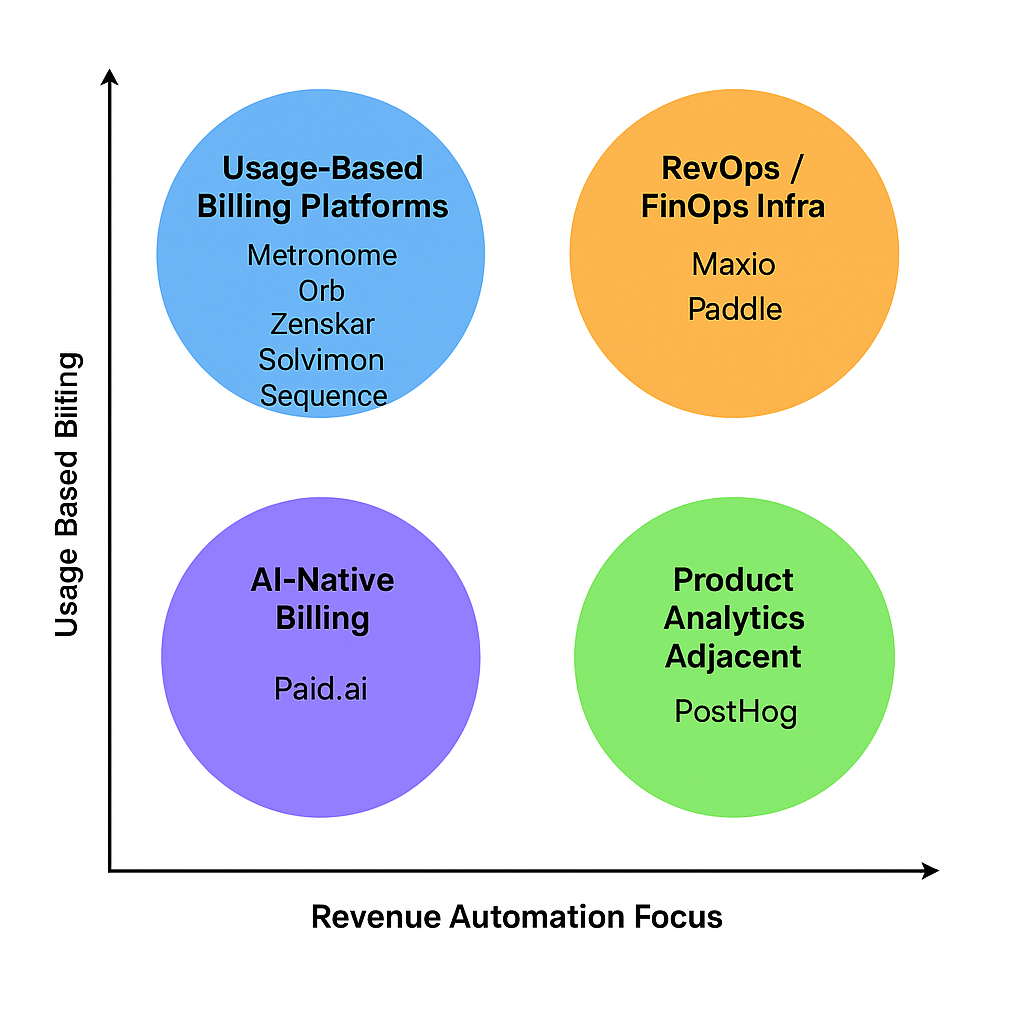
In our quadrant view, we plotted these companies along two axes:
X-axis: Revenue Automation Focus (manual vs automated workflows)
Y-axis: Usage-Based Billing Sophistication (flat rate vs dynamic pricing)
Each cluster reflects a different strategy for monetizing software:
Usage-billing companies dominate the top-left, prioritizing granular metering.
RevOps tools cluster top-right, integrating compliance and finance.
AI-native and analytics platforms fill in the bottom quadrants, each pushing innovation.
Who Should Use What?
Company Profile
Ideal Cluster
Early-stage PLG SaaS
PostHog, Metronome
Scaling SaaS with hybrid pricing
Orb, Zenskar, Sequence
Global SaaS needing tax/compliance
Paddle, Maxio
AI-native or dynamic pricing
Paid.ai
Looking Ahead
The lines between billing, finance, and product analytics are blurring. As GTM teams embrace more complex monetization strategies, the most successful platforms will be:
Composable: Integrating across CRM, data warehouse, and product systems
Real-time: Offering instant billing, pricing, and reporting
AI-native: Making predictive decisions on renewals, discounts, and pricing
These 9 companies are at the forefront of this transition. As the market matures, expect convergence—and consolidation—as businesses look for unified monetization platforms.
As B2B software moves from seat based or usage based pricing to outcome based pricing these companies are the new backbone behind many of the new AI startups.
They specialize in recurring revenue models, usage-based billing, or quote-to-cash processes. Their products go beyond billing to include features like revenue recognition, analytics, forecasting, and reporting.
Most platforms provide robust APIs or developer-centric tooling to integrate into existing SaaS stacks. They focus on infrastructure needed after a sale: invoicing, tax compliance, dunning, renewals, etc. These companies are part of an emerging wave disrupting legacy billing systems like Zuora, Aria, or Chargebee.
Company Name
Founding Year
Number of Employees
Key Products
Metronome
2019
130
Usage-based billing platform for SaaS companies.
Orb
2021
72
Modern billing infrastructure for AI and software companies.
Maxio
2009
235
Billing and financial operations platform for B2B SaaS, including subscription management and revenue recognition.
Paid.ai
2024
9
Business engine for AI agents handling pricing, subscriptions, margins, billing, and renewals.
Solvimon
2022
18
Monetization and billing automation platform for global fintech and B2B software businesses.
Zenskar
2022
64
Quote-to-cash platform automating complex subscription and usage-based billing with analytics.
PostHog
2020
85
Open-source product analytics and data toolkit used by over 70,000 teams.
Sequence
2021
30
Modern billing, CPQ, and revenue recognition platform for error-free revenue workflows.
Paddle
2012
360
Merchant of record solution for SaaS businesses, handling payments, tax, and subscription management.
While specialized tools for each job are important, most people have a Swiss army knife with them. That’s for 80% of the job for most people.
ChatGPT is the Swiss Army Knife
Last week over 100 Generative tools were released – from resume builders to Bloomberg Finance GPT.
List from Generative AI page on LinkedIn
While most people I believe will still use ChatGPT, each role (engineers will still subscribe to CoPilot from GitHub, and marketers will likely subscribe to ChatSpot from HubSpot) will have their special tools.
I liken this to the similar explosion of eCommerce and B2B sites in 1997 – 2000.
Amazon would help you buy everything, but collectors loved eBay, and overstock still exists as does Zappos for shoes and Zulily for fashion.
Frequently Asked Questions
Why can’t Google do better than ChatGPT? They have better resources, lots of talent and money.
Google can do better, will do it and is already doing this. The same can be said about when Google first came and Microsoft had more money, resources and talent but still got upended by Google in search. ChatGPT has distribution quickly (over 100 Million users). While another AI chatbot is a click away, so is Google search. Still, billions of people use Google over Bing because it is better.
2. Do you need more than one chatbot? Is there room for Bard and ChatGPT?
Most people will use one or two chatbots (or more) depending on their need. Most people like to have a second opinion, especially when it comes to non factual questions. Meaning, when questions are subjective in nature, you need to get another opinion.
Many datasets (such as LinkedIn or Facebook) will not share their data with either Google or OpenAI. They might roll out their own chatbot. The folks that need it will use them.
When Netflix first came, most people did not think they needed more than one streaming service. Now we have 10+ in the US alone with over 10 Million users and the average user has 3 accounts or more.
If you have a few early customers for your SaaS application, the next question typically is to get to $1000, then $10K and then $100K in MRR (Monthly Recurring Revenue) – which most people will call serious traction.
The biggest criteria I have found in looking at the 3 SaaS companies I have invested in is price of the product determines the customer acquisition technique.
There are 3 bands of pricing for SaaS products. I am going to look at monthly prices for all the products.
The first band is if your product is an individual purchase on a person’s credit card. Typically most people get uncomfortable at more than $99 per month. The sales cycle could be anywhere from 2 to 6 weeks.
The second band is when a department purchases your product for use, or if your product is highly specialized for a role which makes it between $99 to $499 per month. The sales cycle is typically between 2 to 10 weeks is my experience.
Finally, the last band at $499 to $999, is when you typically need approval from your manager. In many cases a “corporate wide” approval may also be required at > $999 per month. In most cases the sales cycle is greater than 6 weeks and for products > $999 per month might take 3 months or more.
Marketing Techniques for SaaS companies
These are when you are selling to an enterprise B2B market. For those targeting SMB markets, the bar is lower for the amount of money, because you typically find the owner approving most purchases over $299.
If you have a few ( say 10) customers for your product and are making between $1000 (for $99/month product) to $5000 ($499/ month product) and are trying to get to traction – $10K and then $100K per month, there are only 2-3 techniques each that work.
For lower cost products, SEO and Search advertising are predominantly the only viable models.
For more expensive products, since the sales cycle is typically longer, you will need to “start” your customer acquisition with one technique (Content Marketing, with Social Engagement) and will probably “engage” the customer (cold emails, inside sales engagement after signup) via phone and likely have a face to face meeting for products that cost > $25K per year.
What does not work for early stage, pre-traction companies?
Events, especially those that feature a lot of companies and several large organizations in your space, dont work at all.
There are 2 techniques that many people claim work to your “brand” front and center with customers, but does not drive leads – blogging and podcasting.
While both are largely easy to do and require much less investment than other techniques, they might be used in conjunction with other mechanisms, but will not drive much in terms of signups, even if you have a “freemium” plan.
What I have also noticed is that engaging potential customers via webinar (where you get 20-30 participants) and they can ask questions and learn about the problems you solve work much better than even search marketing and touch-less signup.
One of the things I forgot to mention was why you should take MLO seriously. I will outline that in this post.
The market for SaaS applications will be about $130 – $150 Billion by 2020 according to IDC. That compares to $5 Billion for IaaS (AWS, Azure – compute, networking, storage, etc.) and $12 Billion for PaaS (Meteor, Angular, etc.)
The second way to segment this is by size of company purchasing SaaS solutions. Enterprises greater than 1000 people will account for 48% of this spend, Mid-sized companies 100 to 999 people will account for 28% of this and 24% by companies with 1 to 99 people.
Another way to segment this is by type of SaaS application. Customer facing applications (eCommerce websites, etc.) will account for 59% of this spend and 41% towards internal, employee facing applications (ERP, etc.)
Yet another way to segment this spend is by location. The US is expected to be 37% of the spend, Europe about 29% and the rest of the world about 34%.
Finally if you segment by the “cost” of the application purchased by user per month, then SaaS offerings that cost < $25 / mo / user will account for 61%, $26 – $100 will account for 31% and > $101 per user, per month will be about 8%.
So, any way you cut it, SaaS is a large market, with global purchase capability focused on your clients customer, and for smaller $ per user per month.
One segmentation that none of the analysts cover is the segmentation for the SaaS provider by channel of opportunity. What I mean by that is what % of that spend will be direct, versus through a channel.
If you look at the top 100 software companies overall, in the B2B space, 64% of their revenues come from direct customers and 36% from channels (VAR’s, resellers, SI Partners, etc.)
In SaaS currently, that’s the other way around. Thanks to SEO, Google based search results, direct marketing and online digital marketing, 70%+ of the purchases are direct to customer. VAR’s, channel partners and others have yet to figure out how to sell and partner in this new era.
That will change though. There is a new class of larger partners (Salesforce for example) who have a large base of installed customers and can help SaaS and other companies sell “through” them.
The value add to the customer (buyer) is obvious – they get to buy from a trusted brand (Telstra, Microsoft etc.) and they have an existing relationship with the partner.
The value add to the SaaS provider (seller) is also obvious – instead of having to go through a lengthy process of getting on the vendor list and get empanelled, etc. they can sell using the existing relationship the brokerage or large company has with the buyer.
This is what many of the analysts predict will happen by 2020.
So the Direct vs. Indirect business will again get to 70-30 mix.
Which means if you the SaaS company has a good relationship with the brokerage or listing provider, you can expect 30-40% of your revenues to come from that instead of direct.
This will lower your cost of sales, support and service.
Which will help you grow faster and bigger with lesser capital raised, and hence more profitable.
The most frequent question I get asked about SaaS companies is how to think about pricing for the product. Here are some constructs to think about and 7 questions to ask before you come up with a pricing model or a price for your product.
1. Understanding your customers current solution and options and their “cost per unit of activity” is the most important thing you should do first. For e.g. if you sell a Sales force automation solution, the customer might be using an Excel spreadsheet to track their sales because they dont have too many opportunities. So in their minds the “cost per unit” is zero, since they have already “paid” for Excel.
2. SaaS pricing is a marketing function not finance or operations. If the team that determines the value of your offering to the customer is another them, then it is their responsibility. The reason for this is that value of your product determines how much you can charge, not what customers are willing to pay. Value cannot be determined as a absolute, only relative. Which is why you have to compare it to their current solution.
3. At the early stages (less than 50-100 customers) optimize for more customers and quicker sales cycles not for profit. To get data and buying patterns you need enough data and a meaningful sample size. When you go beyond the early customers, it is time to optimize for LTV and CAC.
Here are the top 7 questions to ask before you come up with a pricing model for your SaaS product.
1. What are the current options for your customer?
Find out how are they solving the problem your product addresses currently and how much does it cost them to do that.
2. What are the different segments of your customers?
Find out if there are different problems your product can solve and the value associated with those problems. That would be the best indicator of
3. What is your goal from your pricing?
It is not always obvious to say that your goal is to get the “most money” or to be the most expensive product. Some companies want to be the 80% functionality at 20% of the cost option. Determine your pricing goal – profitability (after customer acquisition costs), value creation, marketshare, etc.
4. What is your cost of customer acquisition?
For most parts, your cost of development tends to be fixed (if you hire 3 people, you have to pay their salaries regardless of how many features the ship), but the cost of customer acquisition tends to be a variable. So if your costs dont take CAC into account, you will have a model that wont be profitable.
5. What is your sales model?
Linking Sales and Pricing for SaaS
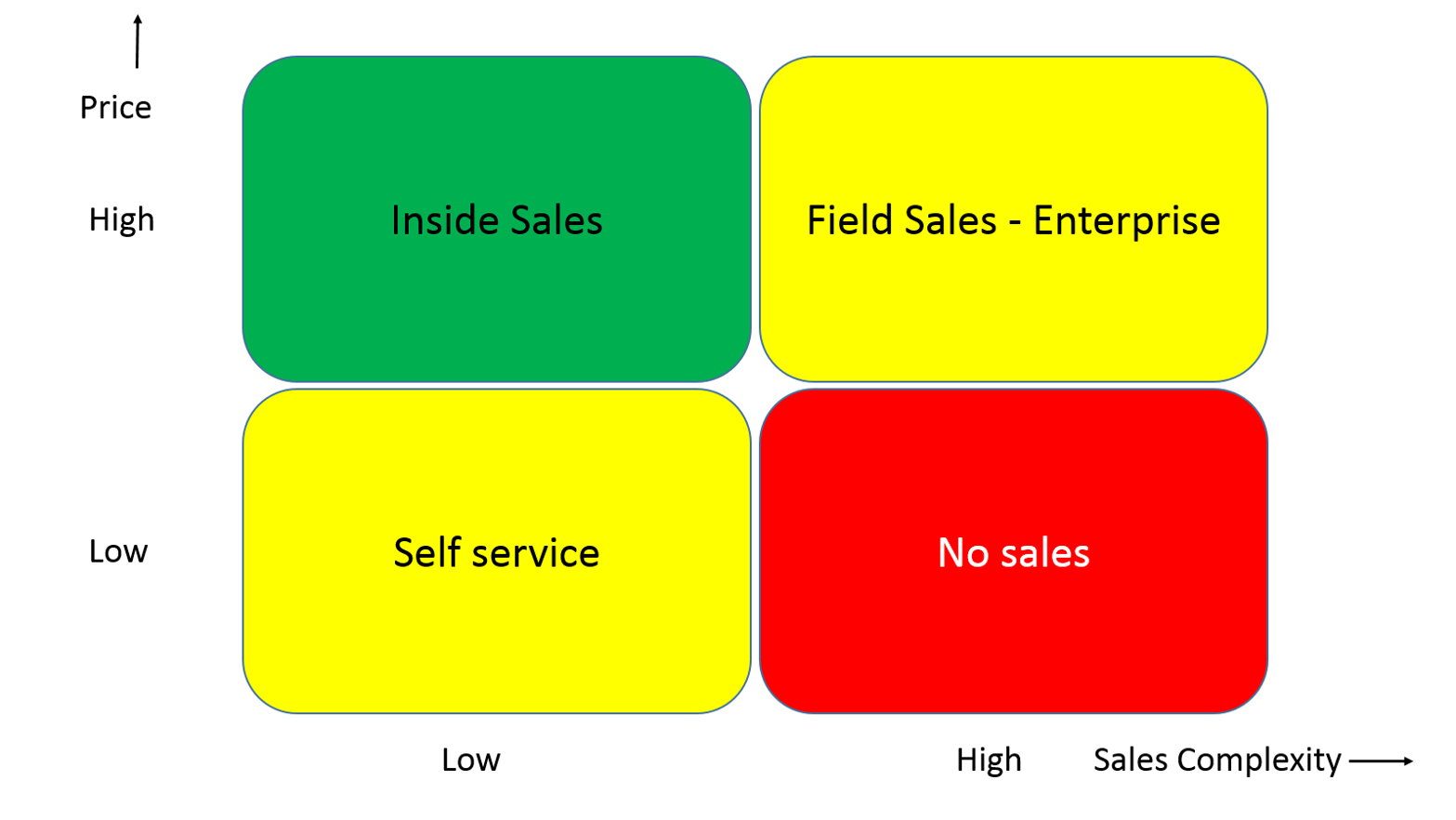
I usually use the price and complexity of sales / marketing on two axes to understand the sales strategy for a SaaS company.
If you are a company with a lower price point and low complexity of sales, you will have to rely on customers to try and buy (freemium) the product on their own and work on obtaining customers at a low cost.
If you are a very complex product or have a complex sales process and your product costs a lot, you will have to hire a field sales team to help you sell.
If however, your product is priced high and your complexity is low then you will build an inside (phone) sales team.
If you have a high complexity product and sales model and low price, your company will die.
Use this model to determine where you want to be and price the product appropriately.
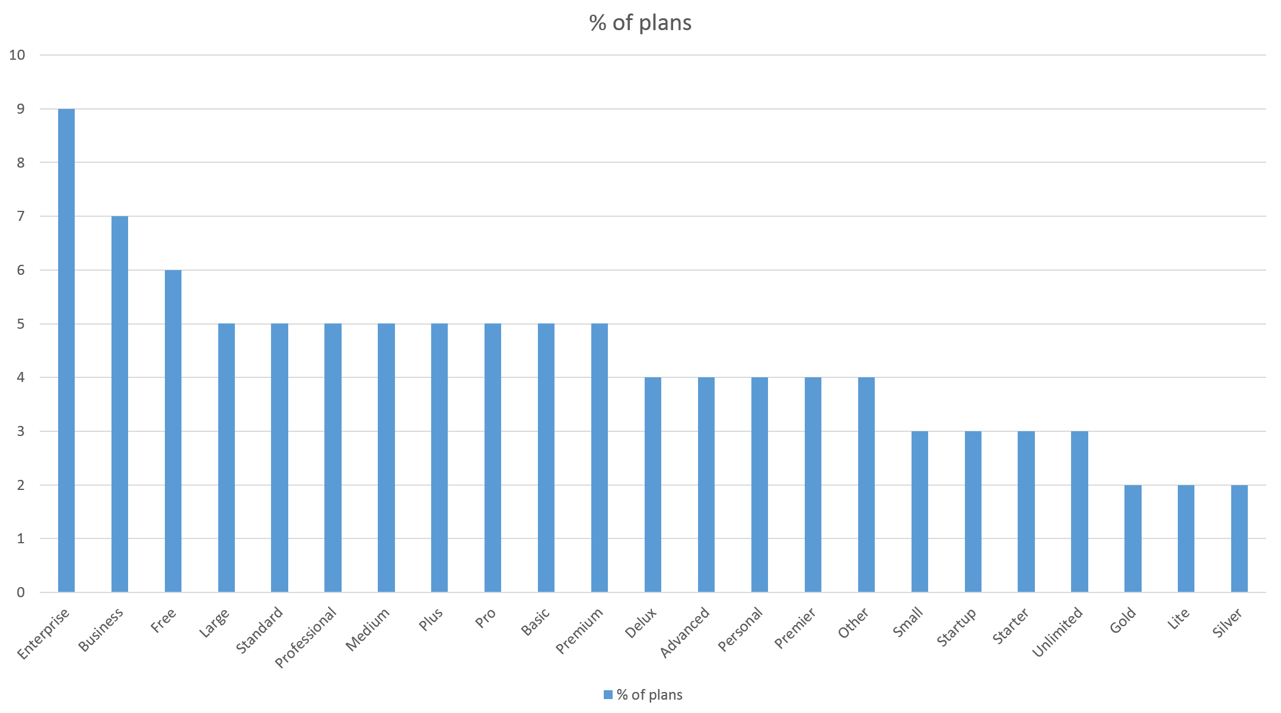
I did notice that of the 89 companies, 82 of them gave their pricing plans “names”. Each plan had a name so their customers could associate the name with the plan. Most (over 80%) used standard and conventional names but it was interesting to see the spread. Here is the data from 89 companies and 251 plans.
Names of SaaS Pricing Plans
The most important points you want to take away are the following:
1. Even though SMB and SOHO (Small Office, Home Office) users are the first few to sign up for a SaaS service, 3 of the top 5 names were named Enterprise and Business and Large. I would imagine this has to do more with the inside out naming (the plan is large or enterprise, not the company buying it).
2. The plans named “Small or equivalent” were largely in the bottom quartile of the distribution. Even though over 70% of companies had 3 plans, only 35% of them named the smallest plan as “Startup”, “Starter” or “Lite”. The most common starting plan was named “Standard”.
3. Of the 20% of companies that used “custom” names like Boutique, Tyrannosaurs, or Garden named all their plans uniquely. The surprising element of the companies that used custom names was that most of them had images to convey the “size” of the plan.
There were some other surprising things I learned as well in my discussions.
1. In naming plans, understanding the end customer’s billing and invoicing was key. Most customers got an email invoice (a few sent PDF invoices) and they would either file them or expense those invoices (if < $50) or would send the invoices to an accounting team.
Ensuring that the “accounting” team did not ask any questions was the consistent mention among 3 of the startups with custom names for plans.
2. Naming the plans to support your payment gateway is also critical. Getting too cute with names means the payment gateway will support a higher refund request that were marginal.
3. Many of the companies had to setup standard names so their marketing and product management teams could do better analytics and research on the backend, consistent with their reporting. Surprisingly, if the names were “standard” the companies found it easier to have a conversation to understand conversion rates, pricing options and changes with their finance teams, design teams and other outsourced companies as well.
1. Speak to as many customers as possible to understand “Why did they buy”? Ask the founders to help connect you to existing customers before you join so you can clearly understand why customers are buying. Is it because of the relationship the founder has (most likely at early stage startups), or are they solving a real pain point? Is it obvious there is a pain? Will there be budget allocated for this pain? Help the founders document the set of steps in the sales process during this phase as well.
2. Find out what your disciplined schedule will be for the first 30 to 90 days. Besides building your pipeline of business, there should be nothing else you should be working on. Whether it is researching 20 prospects, cold-emailing 20 potential targets or engaging with 20 candidate customers on LinkedIn, figure out the basic unit of activity and the way to measure it consistently.
E.g. Your basic unit of activity might be to spend 5 min researching a prospect on LinkedIn and understanding what your subject line should be to them and 5 min to craft an email that will help you send a response, followed by reviewing all the people in your suspect list from the previous day. Follow the disciple consistently.
3. Write down 10-20A/B test headings, subject lines and messages that you will test during your pipeline development phase. You will need to test your Subject lines, the time you email prospects, the call to action, the collateral you will use to incent prospects to engage with you. The founders may already have a message they use, but dont take that at its face value. You will need to find the top 3-5 things your prospects will care about and the top 3-5 things they are willing to do as a next step or the 3-5 things they need to be educated about during the sales process. You job is to try and have enough permutations and combinations of these pain points, calls to actions and collateral till you hit the top 3 combinations.
E.g. Try the 3 top industry news items as headlines rotating and also your top 3 benefits, then the top 3 pain points or the top 3 questions on their mind as your subject lines.
4. Align on a system (Excel works just as well, if you dont like CRM systems) you will use to track your activity with your founders. Initially you will not have an immediate term wins, so in the absence of sales, activity will have to be measured as a proxy for outcomes. Whether it is # of sales calls per day or the # of demos per week or the # of responses to emails and phone calls that you will have to track, find a way to measure it, and track it diligently.
E.g. Put a simple spreadsheet with names of companies, target people, status (1st email sent, No response, Not interested, Call back in 3 months, No budget, etc.) and use a color-coded system for follow ups.
5. Network religiously to find a way to help potential partners who will help you after you help them. Many of the folks in your existing network may be able to help, and they may have an inclination to do so since you are now at a “startup”. Use the fact that you are at one to your advantage. Most people I know love helping and engaging with entrepreneurial-minded people and want to help early stage risk-takers. Even if you dont have a prospect in your network, it does not hurt to ask.
E.g. Last week, many of the participants at our customer day, at the accelerator were not prime targets for one of our companies in the Health care segment, but many had “friends” or “ex colleagues” who were now in hospitals and they were willing to help.
In the initial days of your SaaS startup, when you are doing user development, you may find that your product will help both SMB (Small Medium Business) users as well at Enterprise users.
There’s a tendency to then focus more on the “customer” development than the user. Assuming you have spent enough time on the user, there is a serious possibility of getting distracted from your mission by doing “both” at the same time.
Here is a dichotomy for entrepreneurs – Knowing that the milestone of Monthly Recurring Revenue (sans Churn) is the most important metric for SaaS companies, many entrepreneurs try to take the “relatively” easy route to try and get more larger enterprise deals for their product, if that’s what they know.
I have found that most entrepreneurs with an enterprise background end up finding 5-10 early customers who are willing to pay for a good product, but in the bargain they end up flexing their enterprise sales” muscle instead of building the “SMB marketing” muscle.
There is nothing wrong with choosing either market, but there is a big enough difference between both.
The enterprise SaaS market will end up with longer sales cycles (even if you know the decision makers), larger deals and request for integration with many existing tools and processes.
The SMB SaaS market will end up with smaller individual sales, an inbound marketing driven “self service” approach to vending and a extreme focus on seamless “on boarding” of users (sans training).
Many entrepreneurs also convince themselves that they can do both at the same time.
Which cannot be farther from the truth.
So, the question I usually get asked is “Which one do investors prefer“?
The answer is either one, since investors care about quality and quantity of revenue, but above all they also care about empirical evidence that they money they invest in will generate the consistency in the business for the chosen model.
Inconsistencies kill fund raising cycles.
So, if you chose to say you will build an enterprise sales model, you need to show your financial, product, hiring and operational model to support that type of business.
If, however you say your company will build a try and buy model for SMB sales online, with minimal or zero human touch from your side, driven by digital marketing, you need to show evidence that you can do that over a 3-6 month (or more) period.
I have seen many entrepreneurs confuse any revenue with good revenue. Consistency matters.
You have to show investors that you have done what you want to do.
Empirical evidence trumps theories.
So, my suggestion is to pick a model, stick to it for some time, before you decide to pivot if that does not work for you. Before you raise money, showing that the model you are choosing is one you have relevant expertise and knowledge in running is going to be critical.