The Ultrasound market stock recommendation: Longview Acquisition corp (Butterfly Network) $LGVW – $BFLY

Summary

The Ultrasound market is a ~$7B global medical systems opportunity in 2020, growing to over $10B by 2025. The market has been long dominated by expensive cart systems from GE, Siemens and Phillips at expensive price points (>$50K). However newer disruptors in the segment of handheld systems, such as Butterfly Network are using AI and inexpensive handheld hardware ($2K + $500 annual fee) to “democratize” the use of Ultrasound for many new applications and types of users. This segment of handheld is the fastest growing at 25% CAGR.

This creates an opportunity to expand the market and fundamentally changes the landscape for Ultrasound. This is similar to how Southwest Airlines created low cost point-to-point flying, reducing costs, by doing away with many frills, thereby expanding the market and increasing the number of flyers. Or how Uber “expanded” the rides market by taking on incumbents in the taxi and limo markets by creating a market of supply by making “anyone with a car, a driver”.

Butterfly Network was founded in 2011, by Jonathan Rothberg, an industry veteran and luminary. The company has raised over $350M from multiple investors including the Bill and Melinda Gates foundation. The company has 3 unique differentiators: a) handheld hardware (ultrasound SoC – System on Chip) with patented capability to provide 3D imaging on depth, b) strong use of Artificial intelligence for imaging analysis and c) a network of experts with content – which can now create less expensive “doctor’s aides” into ultrasound technicians.

Butterfly Network has chosen to go public on Nov 25th via a SPAC with Longview Capital ($LGVW) providing it with $584 million in cash, and valuing the company at $2B (post money). It currently trades (12/29/20) at $20.5, valuing the company at $4.17B.

This represents a 94X multiple on 2020 LTM revenue ($44M), 53X NTM revenue ($78M) and, 30X 2020 revenue ($137M). While rich, the reason could be attributed to the expected 70% revenue growth rates for 4 years (2021-2024), strong management team, unique technology, seasoned backers and disruptive market approach which could dramatically increase revenues and growth to over 100% annually for many years.

My recommendation is to initiate a long term position, with an expectation to hold for 4 years, when it will be at $235M in revenue and likely at $10B in market capitalization (42X Revenue), representing a ~139% upside in 4 years (~31% CAGR).

In 2021 I expect it to consolidate and have put a price target of $24.5 by Dec 2021, representing a 29% upside from its current price. It is likely that momentum investors will ignore the stock by Q1 / Q2 when the acquisition is complete and the stock lists as $BFLY, at which point I expect the stock to drop to between $15 – $17 per share. My recommendation is to dollar cost average (DCA) in with 25% sizing initiation by quarter or 10% every 2 weeks.

If the company delivers higher revenues that projected in its first two quarters of being public – expectations are $18 to $20M in Q1 and Q2 2021, then I would expect the stock to further gain in price to be at $30.

The biggest risks for Butterfly Network stock include a) lack of revenue growth due to insufficient trained technicians, b) an incredibly competitive landscape with over 80 other companies in the space (many with larger distribution), c) likelihood of Apple ($APPL) to enter the space with a software solution to partner with any ultrasound hardware (low likelihood), d) the very high valuation getting a significant haircut post the merger due to momentum investors moving to other pastures and e) lack of long public company operating experience making internal controls for finance, reporting and operations a material weakness.

What is Ultrasound?

Diagnostic ultrasound, also called sonography or diagnostic medical sonography, is an imaging method that uses high-frequency sound waves to produce images of structures within your body. The images can provide valuable information for diagnosing and treating a variety of diseases and conditions.

Diagnostic ultrasound is a safe procedure that uses low-power sound waves. Unlike X-Ray which might cause some radiation, Ultrasound is safe.

Ultrasound is used for many reasons, including:

View the uterus and ovaries during pregnancy and monitor the developing baby’s health, Diagnose gallbladder disease, Evaluate blood flow, etc.

How does Ultrasound work?

High-frequency sound waves travel from the probe through the gel into the body. The probe collects the sounds that bounce back. A computer uses those sound waves to create an image. Ultrasound exams do not use radiation (as used in x-rays). Because images are captured in real-time, they can show the structure and movement of the body’s internal organs. They can also show blood flowing through blood vessels.

Conventional ultrasound displays the images in thin, flat sections of the body. Advancements in ultrasound technology include three-dimensional (3-D) ultrasound (Butterfly’s market) that formats the sound wave data into 3-D images.

Ultrasound scanners consist of a computer console, video display screen and an attached transducer. The transducer is a small hand-held device that resembles a microphone. Some exams may use different transducers (with different capabilities) during a single exam. The transducer sends out inaudible, high-frequency sound waves into the body and then listens for the returning echoes.
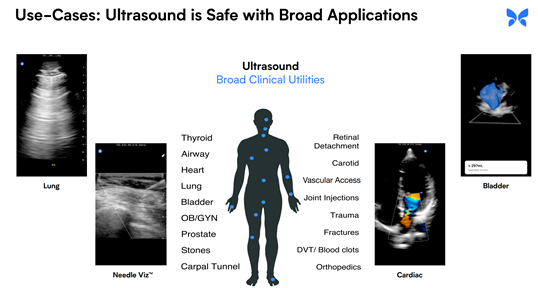
Ultrasound is safe for many types of imaging

How big is the Ultrasound market?

Ultrasound market is expected to be over $10B by 2025.

The Ultrasound market is expected to grow to over $10B by 2025.

Global ultrasound unit shipments grew 9% from 2016 to 2017 and totaled 218,767 in 2017. Traditional ultrasound unit shipments totaled 149,013 and accounted for 68% of the total ultrasound market in 2017. Segment growth was driven by strong demand for traditional equipment in China.

Point-of-care ultrasound (Butterfly’s market), which consists of anesthesia, critical care, emergency medicine, musculoskeletal, and primary care applications, was the smallest ultrasound segment in unit shipment terms in 2017. However, point-of-care unit shipments grew 14% from 2016 to 2017— the highest year-over-year growth rate of all three ultrasound segments.
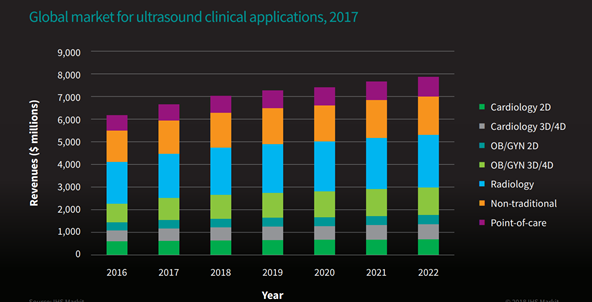
Point of care (Butterfly’s market) is small but the fastest growing

What is handheld Ultrasound?

Sales of handheld ultrasound accounted for less than 2% of the $6.9B global markets for ultrasound equipment. The relatively high cost and limited performance of early generation handhelds were limiting factors. Steady product improvements over the years, coupled with fresh innovation from new market entrants (Butterfly), are beginning to unlock the full value of handheld ultrasound, both for experienced and new users alike.

Credentialing, data security and quality assurance (both for image capture and interpretation) can be challenging. While handheld ultrasound devices may be ready for mainstream adoption, many institutions lack the IT infrastructure required to provide seamless patient care between the office and hospital settings.

Primary care remains a largely untapped market for handheld ultrasound, and is potentially the largest opportunity, with more than 250,000 primary care physicians in the US alone.

The handheld ultrasound market is growing rapidly, as the latest generation of ultra-portable devices gains acceptance among a diverse range of customer groups, from emergency medicine physicians and internists and office-based specialists, and looking forward, primary care physicians.  The expanding customer base, coupled with the increased availability of affordable handheld scanners, is forecast to boost global sales of handheld ultrasound by over 50% in 2019. By 2023, the global market for handheld ultrasound is forecast to exceed $400 million.
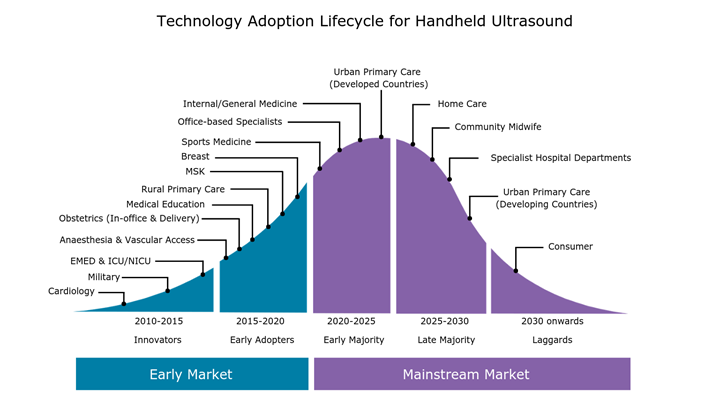
Handheld Ultrasound will go from niche to mainstream in the next decade

Who are the key players?

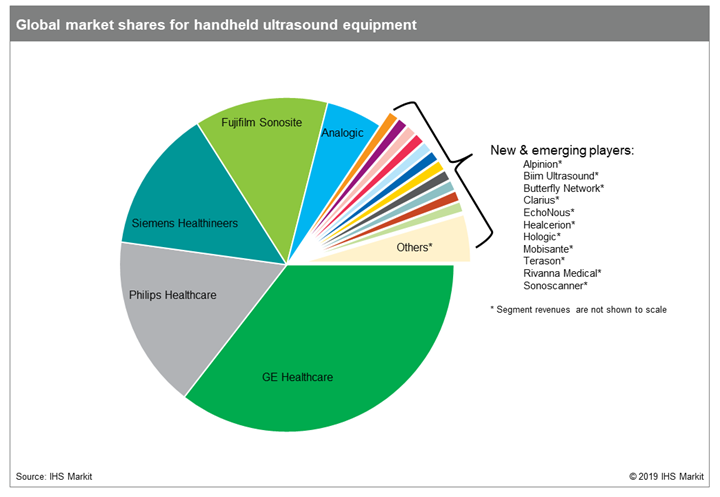
While traditional players such as GE Healthcare, Siemens and Phillips matter, over 50 new companies have been funded in the last 12 years.

Butterfly Network began shipping its Butterfly iQ scanner towards the end of 2018 at the headline price of $1,999 (plus annual subscription of $420). In response, GE Healthcare cut the price of the basic version of Vscan Extend to $2,995 (currently US only).

While the price is becoming less of an issue, many primary care physicians lack formal ultrasound training and reimbursement is not widely available.

To address the lack of skills issue, vendors of handheld scanners are striving to simplify ease-of-use, both in terms of the device itself and integrated tele-ultrasound services that connect novice users with experts at separate locations over two-way audio and video calls.

The latest generation of handheld scanners feature numerous presets for common exam types and artificial intelligence (AI) is being applied to enable physicians with no prior scanning experience to capture high-quality images. AI-guided ultrasound will help users to identify body parts and correctly position the transducer to maximize the image quality for a given exam. Moving forward, AI will also play an increasingly important role in image interpretation, providing physicians with automated measurements, anomaly detection, and diagnostic decision support.
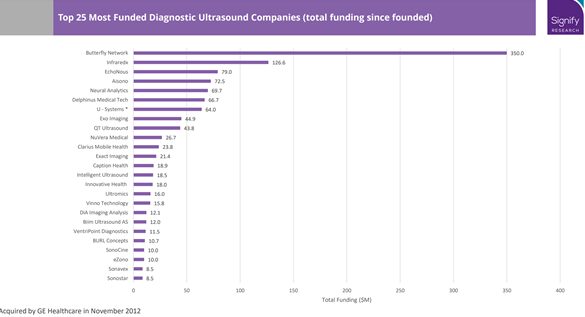
This is not a winner take all market by any means

What is the customer problem?

For patients who do not want exposure to radiation (X-ray) and need a quick convenient way to view internal organs for issues, Ultrasound is the best solution.

For example, ultrasound is playing an increasingly important role as a screening tool for women with dense breast tissue.  In acute care, ultrasound is increasing being used for lung imaging to diagnose conditions such as pleural effusion, pulmonary oedema and pneumothorax. In another example, the use of shear wave elastography is expanding beyond hepatology (e.g. liver fibrosis) to other body areas, including breast, prostate, thyroid and spleen. Musculoskeletal is another relatively untapped market for ultrasound, including orthopedics, rheumatology and sport’s medicine.

Who is Butterfly?

Butterfly Network, Inc. (“Butterfly”) is the inventor / pioneer in semiconductor-based point-of-care ultrasound (“POCUS”) devices

Founded in 2011 by visionary innovator Jonathan Rothberg. Dr. Jonathan Rothberg PhD, Founder and Chairman, has dedicated his career to enabling breakthrough technologies to revolutionize healthcare. He was given several awards including from President Obama to further the cause of better healthcare.

Total investment of over $400 million with first product introduced in 2018, 700+ patents and 2020E revenue of $44 million, projected to grow to $138 million in 2022E.

Longview Acquisition Corp. (“Longview”) is a Special Purpose Acquisition Corporation (“SPAC”). Initially capitalized with $414 million in cash in May 2020.

Butterfly develops a sensor and software to enable handheld Ultrasounds.

400-member team.
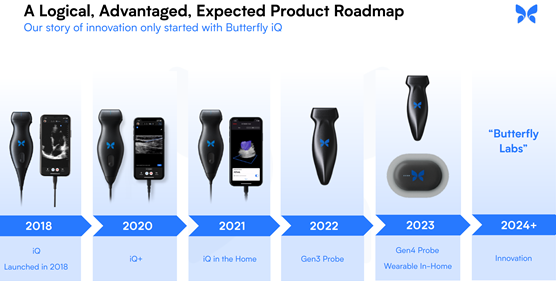
What is unique about Butterfly? What is their moat?

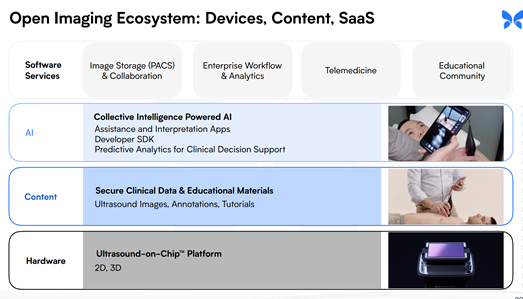
There are 3 parts to Butterfly:

  1. A 3D patent pending rendering sensor with System on Chip
  2. AI and software to make it easier for diagnosis without significant training.
  3. Strong content and delivery network to train new specialists and “less expensive” technicians.
Who are the competitors?

As mentioned over 100 companies old and new startups exist in the space. Butterfly is the most funded, the earliest and has the most patents among the smaller upstarts.

Why will Butterfly win over others?

  1. Funding: Better funded ($400M to date, plus $453M from the SPAC IPO)
  2. Sensor technology: Proprietary SoC with hundreds of patents on the sensor
  3. Distribution: Strong distribution framework for new applications
  4. Software and AI: AI and machine learning software to make it easier for technicians to diagnose problems
  5. Support: Strong training and support network
  6. Competitive Price: Superior price point (under $2000) plus annual fees (subscription)
  7. Talented management team: with CEO who has experience in managing fast growing companies.

Artificial intelligence (AI) will have a transformative impact on the market as it addresses some of the key limitations associated with ultrasound; namely, the shortage of trained sonographers and the relatively steep learning curve, high operator dependency both during image acquisition and interpretation, poor image quality for certain exam types and the relatively lengthy exam time compared with other modalities.

The first wave of ultrasound AI applications are entering the market and are mainly for image optimization (noise reduction) and automation of time consuming and repetitive tasks, such as anomaly detection, image labelling, feature quantification and classification.

However, the greatest impact of AI will be guided ultrasound (ultrasound navigation), which will provide real-time support during image acquisition (i.e. probe placement and anatomy detection). This is what Butterfly does best.

What are the financial projections?
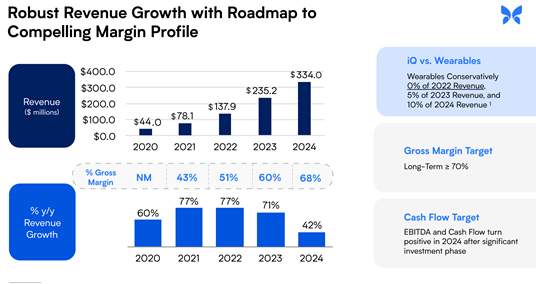
Butterfly is expected to grow at over 60% in 2020 from 2019 and over 77% for the next 2 years to reach $138M in 2022.

Why is the valuation of Butterfly so rich?

Given the rich background, the lack of multiple companies that are public in the space and execution record, Butterfly is very highly priced. It does have strong projections of growth in revenue to back the valuation.

References

https://www.mayoclinic.org/tests-procedures/ultrasound/about/pac-20395177

https://www.radiologyinfo.org/en/info.cfm?pg=genus

https://www.rootsanalysis.com/reports/view_document/handheld-imaging-devices/319.html

https://equityzen.com/company/butterflynetwork/

https://www.fiercebiotech.com/medtech/handheld-ultrasound-developer-butterfly-network-to-go-public-through-1-5b-acquisition-deal

AEVA (NASDAQ $IPV, $AEVA) Spac merger – LIDAR company recommendation

Please read an overview of LIDAR before you view this stock recommendation.

A quick background on AEVA

Aeva was founded by former Apple Inc. engineers Soroush Dardashti and Mina Rezk. In 2018, the company raised $45 million in a series A funding round co-led by Lux Capital Management and Canaan Partners.

Rezk, who previously designed optical hardware for Nikon and worked alongside Salehian at Apple’s Special Projects Group.

They employ about 100 people in Mountain View, California.

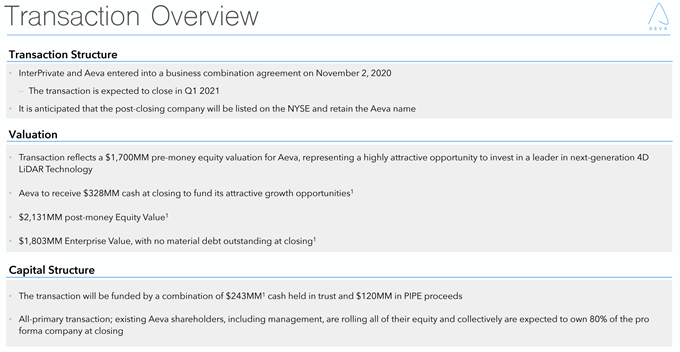
Aeva is planning to merge with a special purpose acquisition company called InterPrivate Acquisition Corp.

AEVA-NYSE-SPAC
AEVA founders

What does AEVA do?

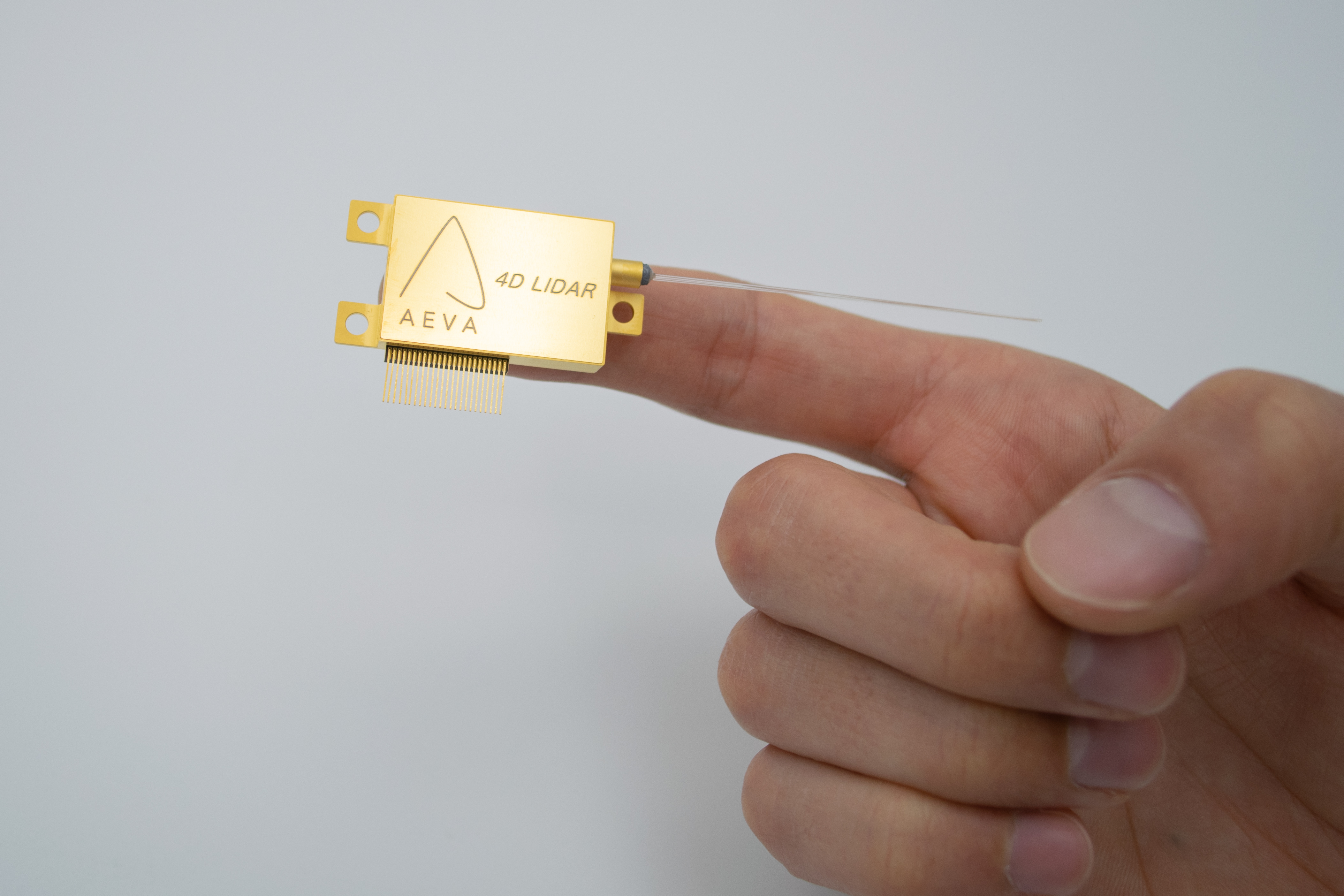
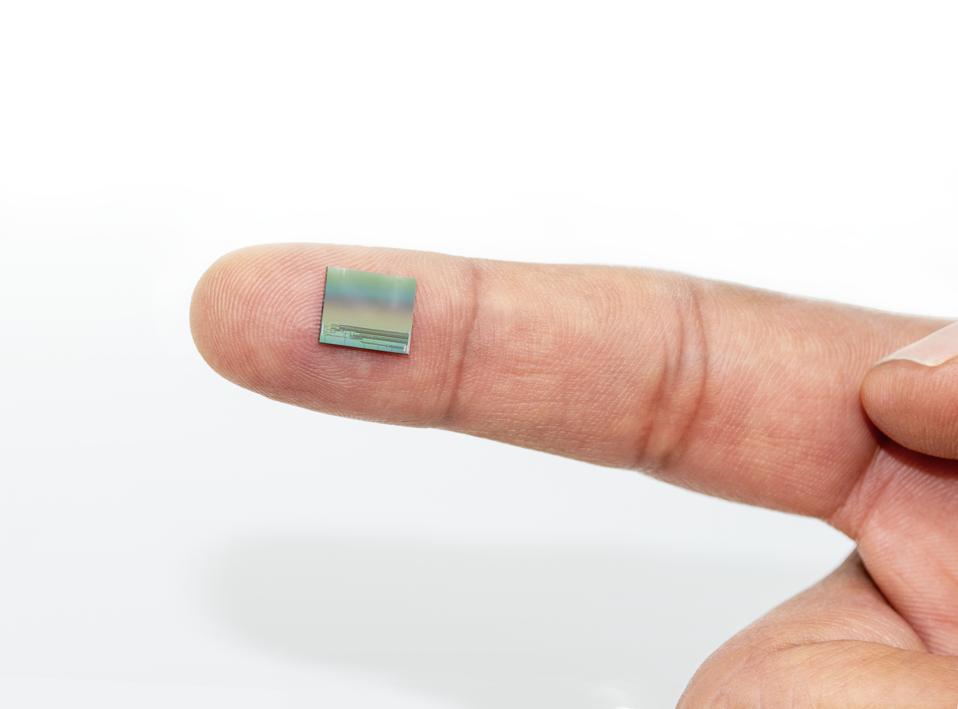
Aeva has created a miniaturized solid-state photonics chip, called Aeries, that reduces the size and power requirements of typical LIDAR systems. It will cost less than $500 at scale, compared to tens of thousands of dollars.

Instead of pulsing a laser beam that bounces off of objects in a vehicle’s path to determine distance and depth, Aeva’s system emits a continuous, low-power laser beam that measures changes in the frequency of waves reflected off of objects.

LIDAR on a chip

What is the unique technology that AEVA has developed?

Aeva’s technology is unique as it has a 4D map. AEVA can measure distance as well as instant velocity without losing range all while preventing interference from the sun or other sensors.

Its technology is also said to use less power which allows it to integrate better with perception software. Its technology is primarily meant for autonomous cars but it is also being leveraged for ADAS systems.

Aeva says its sensor does not rely on powerful lasers or exotic materials, which has helped it to shrink the cost and size of the device.

Aeva’s 4D LIDAR-on-chip uses a continuous laser beam to measure the change in frequency of the waveform as it reflects off of an object. This allows it to detect an object’s range and instant velocity simultaneously beyond 300 meters at high accuracy. Aeva’s 4D LiDAR is free of interference from other sensors or sunlight and it operates at fractions of the optical power typically required to achieve long range performance. 

AEVA-NYSE-SPAC-Listing
Small, with constant pulse and low power requirements

A key differentiator is breaking the dependency between maximum range and points density, which has been a barrier for time-of-flight and FMCW LiDARs so far.

AEVA LiDAR integrates multiple beams on a chip, each beam uniquely capable of measuring more than 2 million points per second at distances beyond 300m.

All lasers, detectors, circuitry, are integrated on a chip at the wafer level, and it’s in production for volumes already targeting use in major OEMs. It will be in cars in the 2022 to 2023 timeline.

AEVA’s sensing system is capable of completely shutting out interference from other, similar sensors — including those from other companies — and operating in all weather conditions and in the dark, thanks to a reflectivity sensor.

Sensing depth and velocity

Why is AEVA better than Velodyne or Luminar?

It has high resolution, long range, additionally it gives velocity. It’s scalable because it’s all on a photonics chip–a very small package with low power consumption.

A few other LIDAR startups also rely on a version of frequency modulation. But Aeva’s system uses a continuous beam, rather than a pulsed beam. 

Who is AEVA partnering with?

Aeva and ZF, a top global automotive Tier-1 supplier, are partnering to bring the world’s first Frequency Modulated Continuous Wave (FMCW) LiDAR to the automotive market. 

The company has signed a sensor-system deal with an Audi-owned unit that is working on self-driving technology for Volkswagen Group and is working with German automotive supplier ZF Friedrichshafen to have its sensors in mass production by 2024.

Aeva and ZF partner for production of first automotive grade FMCW LiDAR for automated driving. (Photo: Business Wire)
Partnership with Porsche supplier ZF

Are there other use cases for AEVA?

It has also attracted consumer electronics companies likely phone manufacturers who want to get into smart glasses and augment their smartphone camera systems with LIDARs for better portrait photography, autofocus, low-light performance and augmented reality. 

An increasing number of devices, such as Apple’s new iPad Pro and iPhone 12 Pro models, include lidar sensors that help with applications such as augmented reality, in which digital content is overlaid on the real world.

Who is InterPrivate Group?

InterPrivate is a SPAC led by private equity investor Ahmed Fattouh. It raised $210 million in an initial public offering in February. InterPrivate Acquisition Corp valued AEVA at $2.1 billion. InterPrivate is lead by private equity investor Ahmed Fattouh expects the deal to be closed by early 2021.

When will we see this in cars?

Aeva’s lidar has been on test vehicles for some time, including an experimental version of Audi’s E-Tron. The first commercial application may come in lightly automated, or Level 2, vehicles, but right now, all VW will say is that it plans to put Aeva’s lidar on the ID Buzz AV. That’s a more completely automated, or Level 4, minibus; it’s scheduled to launch in 2022/2023.

VW  ID Buzz AV
VW ID Buzz AV

What is the valuation for AEVA?

Aeva was last valued at $460M in 08/19, and its public valuation on the merger date 11/20 was $2.1B. Today (12/29/20) it is valued at over 3.2B (8X valuation gain in 1 year).

Investors include Porche, Audi, Canaan Partners, Lux Capital, Volkswagen Group.

The deal will provide up to $343 million of gross proceeds to AEVA.

AEVA will be richly valued at over $4B (Dec 29, 2020)

Who are the competitors?

AEVA competes with 70+ other LIDAR companies including Waymo (Google), Velodyne, Luminar, Ouster, Quanergy systems and Innoviz.

What is the financial model?

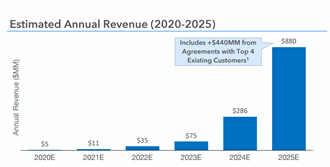
Aeva financial projections

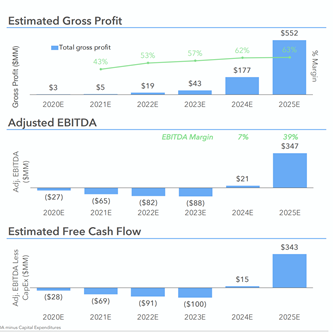
Aeva is expecting meaningful revenues only by 2024. As you can see from their projections, it goes from $11M for next year 2021 to $236M in 2024 and $880M by 2025.

If those projections work out, then given their long term expectation of 62% gross margins, this could end up at nearly $350M in adjusted EBITDA by 2025.

Margin and EBITDA projections

Should you buy the stock?

IPV is a NASDAQ listed SPAC and trades today (12/29/20) at $15.12. That implies a valuation for AEVA at over $4B, twice the proposed valuation at time of acquisition announcement.

With no significant revenues until 2022 or later, this is a purely speculative play. I would recommend a small position close to $13 – $14 and patience for 2+ years.

References

https://www.theinformation.com/briefings/47501e

https://www.spglobal.com/marketintelligence/en/news-insights/trending/jXfoX9Zj_yxBpz_TYCcVlw2

https://www.carandbike.com/news/lidar-maker-aeva-going-public-with-spac-valued-at-2-1-billion-2319981

https://www.canaan.com/companies/aeva

https://financialpost.com/pmn/business-pmn/lidar-firm-aeva-led-by-apple-veterans-agrees-deal-to-go-public

Partner presentation

https://tdameritradenetwork.com/video/rB4AoXX6EseBdfujU-IAQw

https://www.crunchbase.com/organization/aeva

https://www.forbes.com/sites/alanohnsman/2020/11/02/laser-sensor-startup-aeva-may-see-2-billion-valuation-from-nyse-listing/

https://www.reuters.com/article/us-interprivate-acq-m-a-aeva/lidar-firm-aeva-led-by-apple-veterans-agrees-deal-to-go-public-idUSKBN27I1QB

https://www.autonews.com/mobility-report/lidar-maker-aeva-go-public-merger

https://siliconangle.com/2020/11/02/aeva-makes-lidar-sensors-autonomous-cars-plans-go-public-via-spac-merger/

https://www.businesswire.com/news/home/20191211005284/en/Aeva-Reveals-First-4D-LiDAR-on-Chip-for-Autonomous-Driving-and-Vote-of-Confidence-from-VW-Group-with-Porsche-SE-Investment

ttps://luxcapital.com/companies/aeva/

https://www.bizjournals.com/sanjose/news/2020/11/02/aeva-going-public-via-spac-at-21b-valuation.html

https://m.futurecar.com/4236/Silicon-Valley-Lidar-Startup-Aeva-Inc–Agrees-to-go-Public-in-a-SPAC-Deal-That-Will-Value-the-Company-at-$2-1-Billion

https://www.dnb.com/business-directory/company-profiles.aeva_inc.9c256cf10f994244eb55e3b7272dbf75.html

https://www.theverge.com/2018/10/1/17915276/aeva-4d-lidar-technology-next-gen-self-driving-car-sensor-system

https://craft.co/aeva

https://www.ft.com/content/d1cdcf10-1c14-11ea-97df-cc63de1d73f4

An overview of LIDAR and its use cases in Autonomous Cars

As 6 LIDAR companies have gone public, either via SPACs or have been public for a while, I thought I would dig deeper into LIDAR and answer a few questions as I formulate my thesis on LIDAR. There have been over 80 companies funded in the LIDAR space and over $3.5 Billion in investments that have been made over the last 7 years.

The public companies are: Velodyne Lidar (VLDR), Luminar (LAZR), Aeva (IPV / AEVA), Innoviz (CGRO / INNV), Ouster (CLA / OUST) and Microvision (MVIS). This write up is going to focus on LIDAR overall, while the next few days I will focus on each of the companies.

Velodyne is an early leader in both the market and revenues, while the others are expecting to ramp up production of products and revenue by 2025.

I have taken a Frequently Asked Questions approach to this write up, focusing on questions I would have as a beginner in this market.

What is LIDAR? (LiDAR)

LIDAR (or LiDAR) stands for Light Detection and Ranging, the use of laser pulses to build a 3D model of environment around objets.

Just like SONAR (which uses sound) and RADAR (which uses radio waves), LIDAR uses pulsed laser to measure distances and map objects.

Why is LIDAR suddenly important?

LIDAR has been around since 1950s and has been used by ecological organizations to track tree growth in forests and other sprawling ecosystems. Airplanes equipped with LIDAR soar overhead, and – even when travelling at cruising speed – can catalogue individual leaves and branches by the billions in a single sweep.

Filmmakers have incorporated this technology to chart rare environments or objects that cannot be used in production – like consecrated ruins and fragile artifacts – to recreate them in CGI

In the automotive industry, radar has long been utilized to automatically control speed, braking, and safety systems in response to sudden changes in traffic conditions.

The move towards autonomous cars (level 5) requires multiple sensors on cars – cameras, radar sensors, etc.

Whereas vision and RADAR-based sensors can provide a high level of automation to vehicles, the conception of a fully automated self-driving vehicle requires LIDAR-based sensors.

Self-driving cars equipped with LIDAR sensors offer complete automation under all driving modes. LIDAR-based ADAS systems along with vision and RADAR-based sensors take complete control over the vehicle, managing the speed and steering control, thereby providing a remarkably safe driving experience.

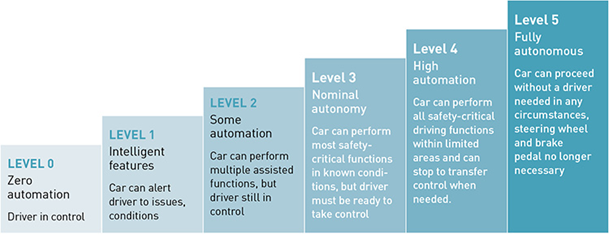
What is Level 5 autonomous driving?

The 6 levels of autonomous vehicles

Level 5 vehicles do not require human attention―the “dynamic driving task” is eliminated. Level 5 cars won’t even have steering wheels or acceleration/braking pedals. They will be free from geofencing, able to go anywhere and do anything that an experienced human driver can do. Fully autonomous cars are undergoing testing in several pockets of the world, but none are yet available to the general public. 

What types of sensors are needed for autonomous cars?

Automobiles need radars, cameras and ultra sound sensors for different purposes. Some for assisted parking, staying in lane, “sensing other cars ahead”, and viewing potential obstacles.

How does LIDAR work?

  1. Lidar systems emit a constant stream of laser pulses in every direction.

2. Laser pulses travel outward until contacting an object.

3. Upon contact the pulses reflect to the LIDAR system.

4. Lidar system received and registers the echo pulse.

5. The system calculates the distances of the object, based on the laser pulse’s travel time to and from it.

Lidar systems emit and receive hundreds of thousands of laser pulses every second.

A LIDAR system consists of four key components: a transmitter to emit laser pulses, a receiver to intercept pulse echoes, an optical analyzing system to process input data, and a powerful computer to visualize a live, three-dimensional image of the system’s surroundings.

How did LIDAR become important for autonomous cars?

LIDAR allows you to generate huge 3D maps, which you can then navigate the car or robot predictably within. By using a LIDAR to map and navigate an environment, you can know ahead of time the bounds of a lane, or that there is a stop sign or traffic light 500m ahead. This kind of predictability is exactly what a technology like self-driving cars requires and has been a big reason for the progress over the last 5 years.

How big is the market?

The LIDAR industry is projected to be worth $1.8 billion in three years and over $8B by 2025. The market for LIDAR sensors in light-duty vehicles could reach $46 billion in sales by 2030, with much of that going to enable partial autonomy.

LiDAR industry: high expectations for autonomous driving - System Plus  Consulting

Is LIDAR really needed? Can you do the same with cameras and software?

Critics of LIDAR including Tesla CEO Elon Musk believe the high cost of LIDAR (early units were > $75K), makes then untenable for autonomous cars. Musk has said that AI + cameras would suffice for autonomous cars.

LIDAR has the potential to make autonomous systems safer, If there’s bright sunlight or if it’s really dark at night, camera-based features are not reliable and not available all the time.

Advanced driver assistance systems (ADAS) are becoming more commonplace in mass-market vehicles. These systems rely on cameras and radar to power features like automatic emergency braking, blind spot detection, and lane-keep assistance.

For inclusive vehicle safety solutions, ADAS systems cannot be dependent on just vision and RADAR based systems; they require more efficient systems capable of providing highly accurate data for improved driver assistance.

Whereas vision and RADAR-based sensors can provide a high level of automation to vehicles, the conception of a fully automated self-driving vehicle is impossible without LIDAR-based sensors.

Self-driving cars equipped with LIDAR sensors offer complete automation under all driving modes. LIDAR-based ADAS systems along with vision and RADAR-based sensors take complete control over the vehicle, managing the speed and steering control, thereby providing a remarkably safe driving experience.

What are the types of LIDARs?

1. Electro-Mechanical LIDAR

Electromechanical LIDARs are traditional LIDAR systems, which can be considered as first generation LIDAR sensors for automotive applications. These mechanical spinning LIDAR system sensors are assembled from multiple moving parts, which are arranged to produce and emit an array of laser beams towards the targeted area. Electromechanical LIDARs are quite bulky, very expensive and prone to wear and tear in tough terrain. They are installed on the top of the vehicle and continuously rotate to scan the surroundings of the vehicle and typically cover a long range.

How does Google's Waymo self-driving car work: GRAPHIC - Business Insider
The Waymo Google Lidar is a bulky electro mechanical system

2. Solid State LIDAR

Unlike traditional electro-mechanical LIDARs, solid state LIDARs are built entirely on a single chip (e.g. AEVA or Luminar). All the components of the LIDAR systems like emitter, receiver and processors are integrated on the single chip of the solid-state LIDAR. Being on microchips, solid state LIDARs are compact in size. Also, they are not visible upon installation, light in weight and cost efficient. Since there are no moving parts in these LIDAR systems, they are fixed in rear, front and sides of the vehicle.

Solid state LIDARs have optical emitters, which send a burst of laser photons without having to adjust the direction of the transmitters. The light, emitted in specific patterns, collides with the objects in the way and bounces back to the system’s receiver. The processor in the LIDAR system fetches this data constantly and produces a real time 3D map of the vehicle’s surroundings.

Solid state LIDAR is the future of LIDAR based ADAS systems as it is exceptionally durable, reliable, affordable and commercially viable.

LeddarTech Releases 3D Solid State LiDAR System-on-Chips to Automotive  Partners - News
Cross Sectional view of LeddarTech solid state LIDAR

What are the alternatives?

Tesla is pushing the idea of pseudo-LIDAR based on innovations in cameras, AI and computing, and the fact that they have access to rich driving data from ~1M cars in varied traffic and weather conditions. 

Daimler has research activity, aimed at exploiting gated imaging and machine learning to replace LiDAR. GM Cruise stated in a recent interview that they had replaced one of the sensors in the sensor pod of their newly launched purpose-built ride hailing AV, the Origin, most likely implying that LiDAR will be replaced by thermal cameras.

Other methods to extract 3D information using stereo vision cameras have also been proposed.

What is the future of LIDAR?

The industry is marching ahead with a real focus on cost decrease and resolution and range increase.

Solid-state LIDAR opens the potential of sub-$1k powerful LIDAR units, which today can cost as much as $80k a unit. The huge jump in the number of applications for LIDAR has brought with it a flood of talented founders and teams starting companies in the space. Higher resolution output and increased tracking range (200m in some cases) will provide better object recognition and tracking and are one of the key differentiators in sensors from startups like Luminar.

References

https://www.theverge.com/2020/1/7/21055011/lidar-sensor-self-driving-mainstream-mass-market-velodyne-ces-2020

LiDARs for self-driving vehicles: a technological arms race

https://www.forbes.com/sites/sabbirrangwala/2020/04/30/do-autonomous-vehicles-need-lidar/

https://www.forbes.com/sites/sabbirrangwala/2020/04/12/there-must-be-860-ways-to-build-an-av-lidarpart-1/#56ad2f25545c

https://www.ff.com/us/futuresight/what-is-lidar/

https://arxiv.org/abs/2004.08467

https://news.voyage.auto/an-introduction-to-lidar-the-key-self-driving-car-sensor-a7e405590cff

https://www.osa-opn.org/home/articles/volume_29/january_2018/features/lidar_for_self-driving_cars/

https://www.einfochips.com/blog/how-lidar-based-adas-work-for-autonomous-vehicles/

https://www.mdpi.com/2076-3417/9/19/4093/htm

https://www.ti.com/lit/wp/slyy150a/slyy150a.pdf?ts=1609138611013

https://www.ttnews.com/articles/fully-autonomous-driving-distant-lidar-finds-its-place

https://www.wired.com/story/lidar-self-driving-cars-luminar-video/

US Pet industry Overview and list of stocks to watch and track

What is the market size?

The US Pet care industry is about $77B – $90B, growing at 2.5% annually. It is expected to grow rapidly, reaching over $100B – $120B by 2025.

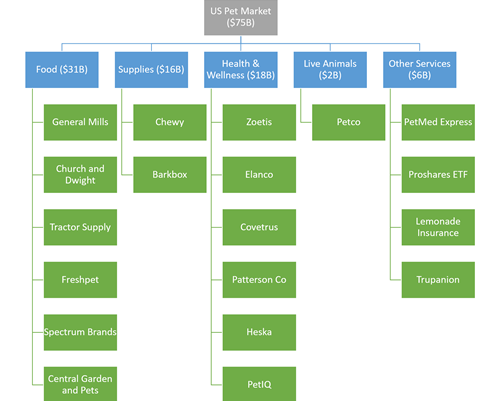
There are 17 companies in this industry that are public (or about to go public). There may be a few more, but these companies make more than 70% of their revenues from selling to pet parents or pet owners.

How has the industry performed as a segment in 2020?

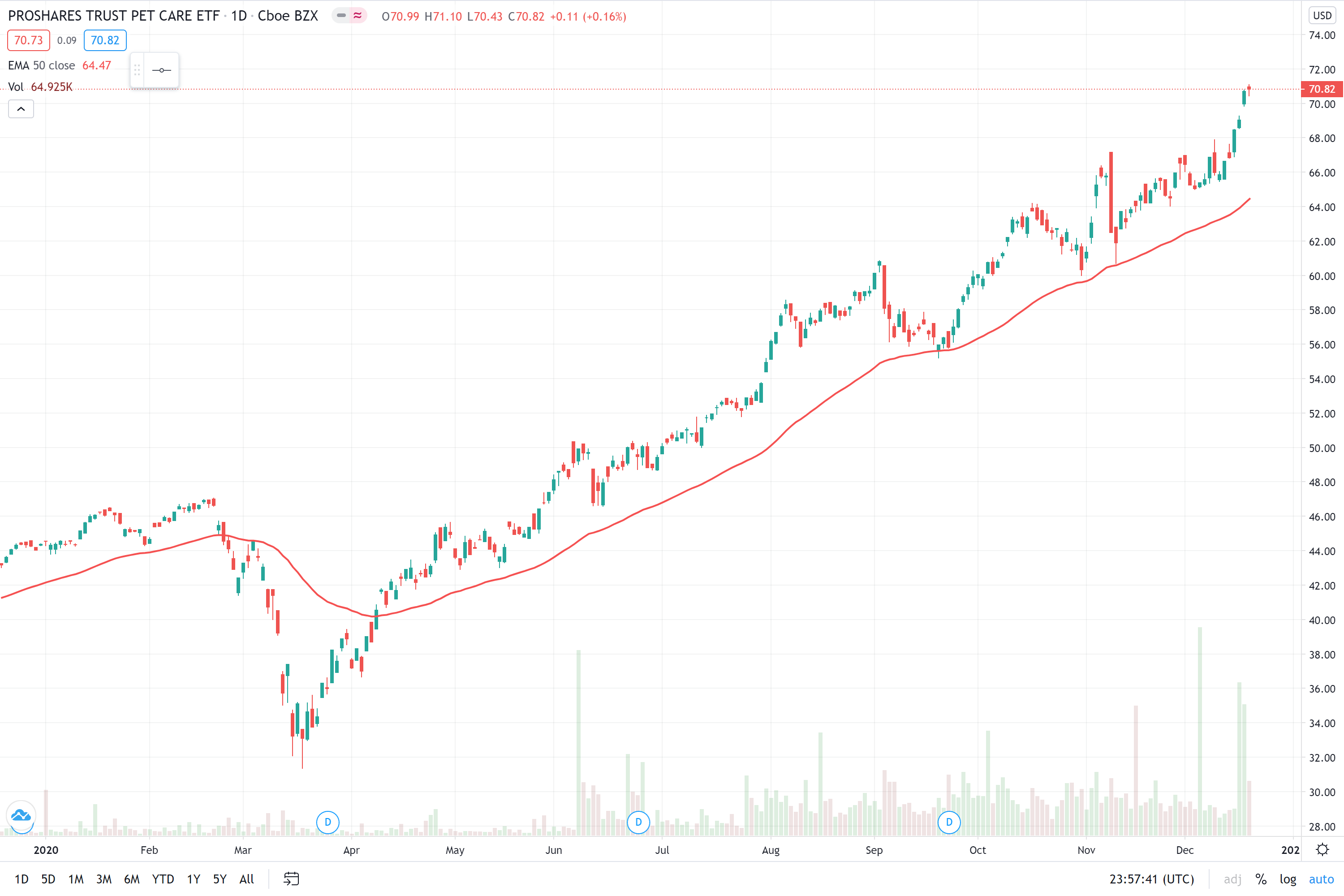
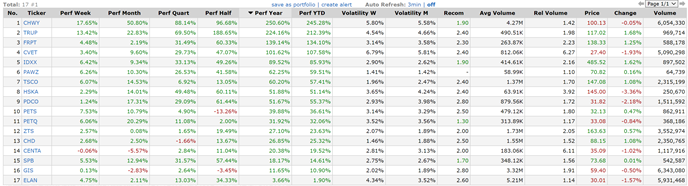
The industry ETF (Invesco PAWS) is in the 97th percentile of performing funds, returning over 60% for the year.

PAWS has returned over 60% on the back of Trupanion, Chewy, Freshpet, Zoetis and PetIQ
PANW is #70 out of 1967 funds, putting it in the 97the percentile.

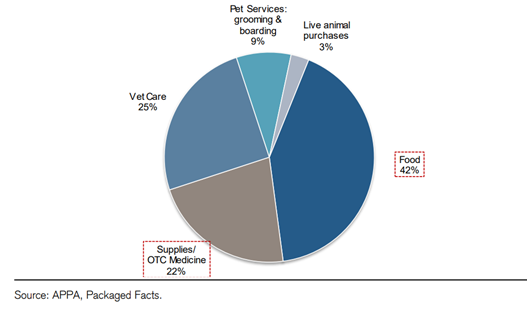
What are the segments within this industry?

The 17 stocks (and more in the < $500M stock Market Cap), are in 5 segments:

1. Food (consumables, treats, cat litter, etc.). This segment covers a wide range of products such as dry and wet food for dogs and cats, bird feed, crickets and worms for reptiles and other treats and supplements.

2. Supplies (OTC medicine, toys, etc.). Products in this segment include over-the-counter medicines, food bowls, collars and leashes, pet clothing, brushes and combs, shovels and scoopers, cat litter, cages birds and reptiles, travel carriers and other various accessories for pets.

3. Health (prescriptions, vet care).

4. Live animals (birds, mice) and

5. Other services (Rover for dog walking, Grooming, pet insurance, etc.). Pet services were the fastest-growing product segment for the industry over the past five years, reaching an estimated 7.7% of total industry revenue in 2020. Pet services include full-service grooming, haircuts, baths, toenail trimming and tooth brushing. This segment excludes veterinary services.

There are 17 stocks I track in the Pet care industry in the various segments

The sub segments that are growing the fastest are Other services (7%) and Supplies 6%.

How have individual stocks performed within this industry?

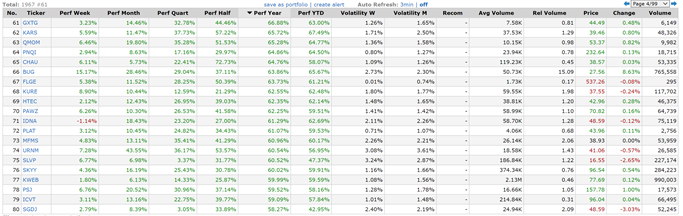
The top 10 stocks in the list I track have all beaten the S&P 500 (+13.5%) and NASDAQ (+40%) this year.

The top 10 stocks in this industry have outperformed both NASDAQ and S&P 500

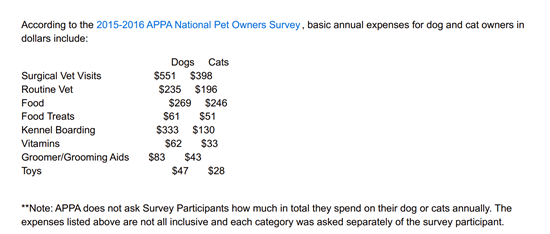
The average dog owner for example spends over $2000 annually on their pets with the most being spent on Surgical visits, Vet services, Food, Kennel services & grooming.

Will the industry keep growing?

Pet owners spend over $2000 annually on their pets

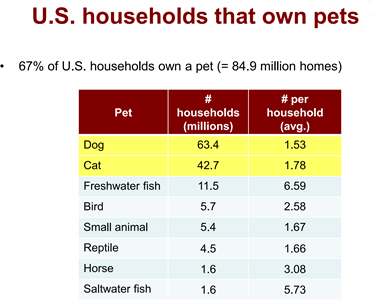
Over 67% of US households own pets with most homes owing a dogs and cats.

Data: APPA

What does the industry value chain look like?

While retail (Petco, Petsmart, Chewy, Barkbox) margins are in the 20-40%, manufacturer (Freshpet, Zoetis) are closer to 40-50% and services (Trupanion) are in the 50%+.

US Pet retail is $20B, with 1.7% CAGR 2015-2020 but growing at 2.3% 2020-2025

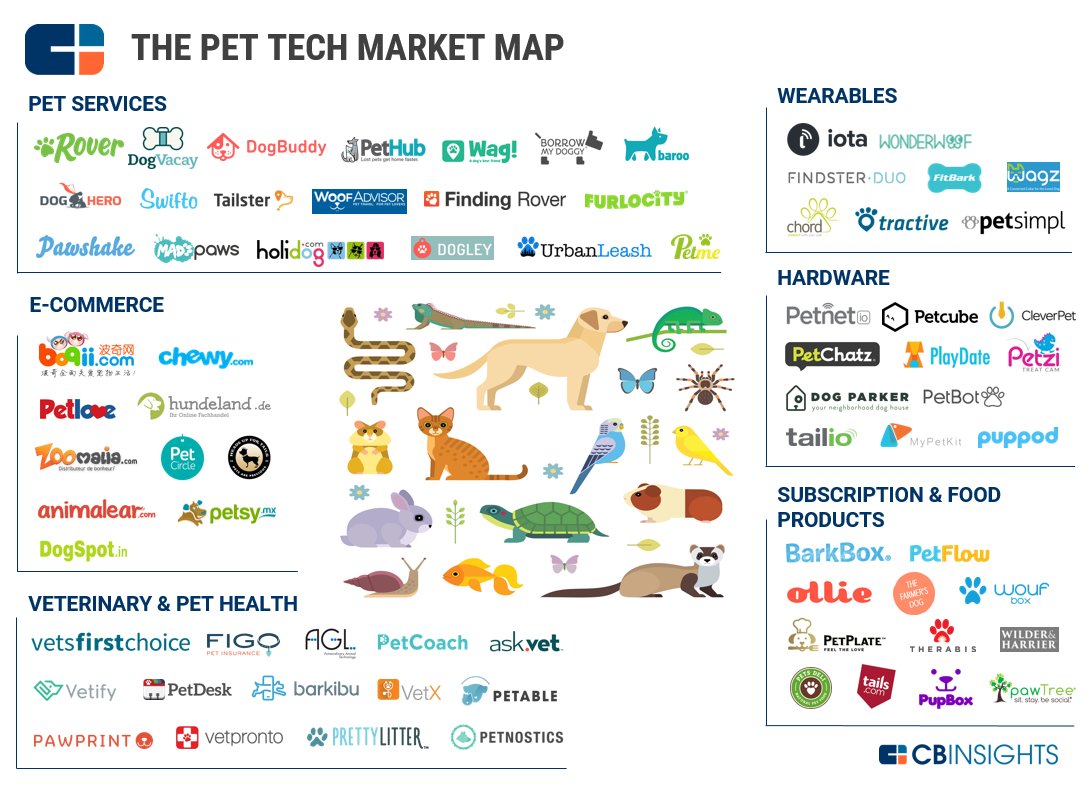
The pet technology market map from CB insights further tracks the technology companies innovating in the space from Chewy and Barkbox to Rover and Wagz (werables)

ALL IN 💪🏼🚀🌎 on Twitter: ".@CBinsights' pet tech market map features  pioneering startups in the pet industry including portfolio co @petsymx  #ALLIN since 2013 https://t.co/Us6zTJyEvh… https://t.co/aoZkdbrTuk"
CB Insights tracks over 100 startups in the pet tech market

What are the key industry trends for 2021?

In 2020 with Covid the number of pet owners has increased over 2019. Millennials and younger adults have been the primary driver of growth. The long term secular trends include:

  1. Pet grooming and boarding – including a luxury hotel for pets – Jet Pet Resort
  2. Organic, allergy-free and fresh food for pets, instead dry or canned.
  3. Pet care and sitting – paying professional dog walkers and pet sitters.
  4. Pet insurance – the fastest growing segment within Pet care $TRUP
  5. Move to online (ecommerce) ordering, subscription purchases, thanks to Covid and store closures – $CHWY, $BARK

Which are the best bets in Pet care market?

I will write a long piece on each of these stocks, but the 3 companies for me to invest in are

Growth stocks for 2020

a) Trupanion (TRUP)

b) Chewy (CHWY)

Speculative stock for 2020

a) Barkbox (SPAC acquisition by Northern Star Acquisitions Corp (STIC.U) , will list in Q1 or Q2 2020)

If there was only one company I could invest in, I would invest in Chewy. I already have a position and have consistently been buying it from $64. It is currently over $100.

Links

  1. https://www.ibisworld.com/resources/documents/45391-Pet-Stores-in-the-US-Industry-Sample-Report.pdf
  2. https://www.fool.com/investing/2020/03/22/3-pet-economy-stocks-with-fetching-futures.aspx
  3. https://www.nasdaq.com/articles/7-pet-stocks-to-adopt-today-2020-10-13
  4. https://www.barrons.com/articles/pet-stocks-investing-51559266662

Audioeye (NASDAQ:AEYE): Stock Analysis and Recommendation

AudioEye Eradicates Barriers to Digital Accessibility with Launch of  Machine Learning-Powered AudioEye Digital Marketplace and Team AudioEye

Audioeye (AE) is a Software-as-a-Service (SaaS) company founded in 2005 by Sean Bradley and his brother in in Phoenix. The company helps businesses (SMB, Enterprises and Government organizations) make their websites, PDF files (new in 2020) and mobile websites accessible to individuals with disabilities. There are about 40M people with disabilities of some form in the US alone.

Audioeye claims to provide 3 capabilities to solve the problem of poor accessibility:

a) testing of your website to look for accessibility problems,

b) remediation (how to automatically fix the problems it found) and

c) monitoring (ensure that those problems were fixed) for your website.

The company listed in the NASDAQ stock market on August 26, 2020. Before that they were on the OTC. It is priced at $24.96 (12/18/2020) and the market cap is $231M.

In Q3 2020, the company reported $5.3M in revenue (+92%) with MRR (Monthly Recurring Revenue) of $1.7M (+67%). It has a Gross Margin of 71% and a net loss of $1.1M ($0.12 per share). They have $10+M in cash and have 25K customers, with a 90% renewal rate (Q3 2020 conference call transcript).

They pre released earnings for Q4 on Dec 16th 2002, and guided up Q4 revenue to $5.4 – $5.6M, full year 2020 revenue at $20.3M – $20.5M and expect to have 32K customers .

For 2021, the company guided revenue in the range of $30 million to $32 million (+56%)and reiterates its expectation to grow MRR and become cash flow positive.

The company was ranked 122 on Deliotte 500’s fastest growing companies in 2019, growing at over 983% YoY.

What is the customer problem?

There are over 1.4 websites with over 1000 visitors / day worldwide. Companies building websites have to conform to Web Content Accessibility Guidelines (WCAG) to make their content easy to consume by individuals with disabilities (e.g. blind – support for read aloud, deaf – video content needs to have captions, color blind – dark contrast, primary colors, etc.).

Most companies dont do this. When mid-sized, large companies and government organizations do not make their website accessible to the disabled they get sued.

In February 2006, a student at the University of California-Berkeley sued Target because its website was inaccessible to the blind. Target settled for $6 million with Bruce Sexton Jr., the student at UC Berkeley, and the National Federation of the Blind, which filed the lawsuit jointly with Sexton.

In 2019, there were 11K lawsuits and average cost of litigation was $50K – $100K. Below are some common accessibility errors. Images may not have ALT-text, color contrast may not be sufficient.

There are several regulations (ADA compliance) that you need to adhere to as a large company (e.g. Target) so this is a big driver for customers. A customer sales presentation from AE shows all accessibility problems they solve.

How big is the market?

The market for accessibility software currently is about $350M – $450M growing at 4% and AE revenue is $20M annual. This is not a very large market, but AE can see a path to $50 – $100M in revenue (2021E is $30-$32M) and take advantage of adjacent markets (TAM over $1B) for mobile apps accessibility, etc.

They could also make the market larger <if> governments decide this is important for their disabled citizens.

Most companies a) use consultants to find and fix accessibility issues manually, b) outsource the accessibility issues to external contractors or c) ignore the problem.

The biggest direct competition for AE is a company called AccessiBe, but the real competitors are many small companies that provide accessibility testing solution (over 20) or manual outsourced consultants.

What technology does AE have and what are their differentiators?

Audioeye has 8 patents they have applied for and some have been granted, in the area of assessment and remediation. I have reviewed the patents, and they are valid submissions but only partially relevant to the remediation problem. You can view the patents and understand their technology moat. The patents are in the areas of Modular systems and methods for selectively enabling cloud-based assistive technologies, with patent numbers 10867120, 10866691, 10860173, 10845946 and few others. I read one of the patent documents – it is interesting but not earth shattering, which tells me the patents are there purely to claim they have patents. 4 have been granted and 4 have been filed in Aug 2020.

What is the customer experience?

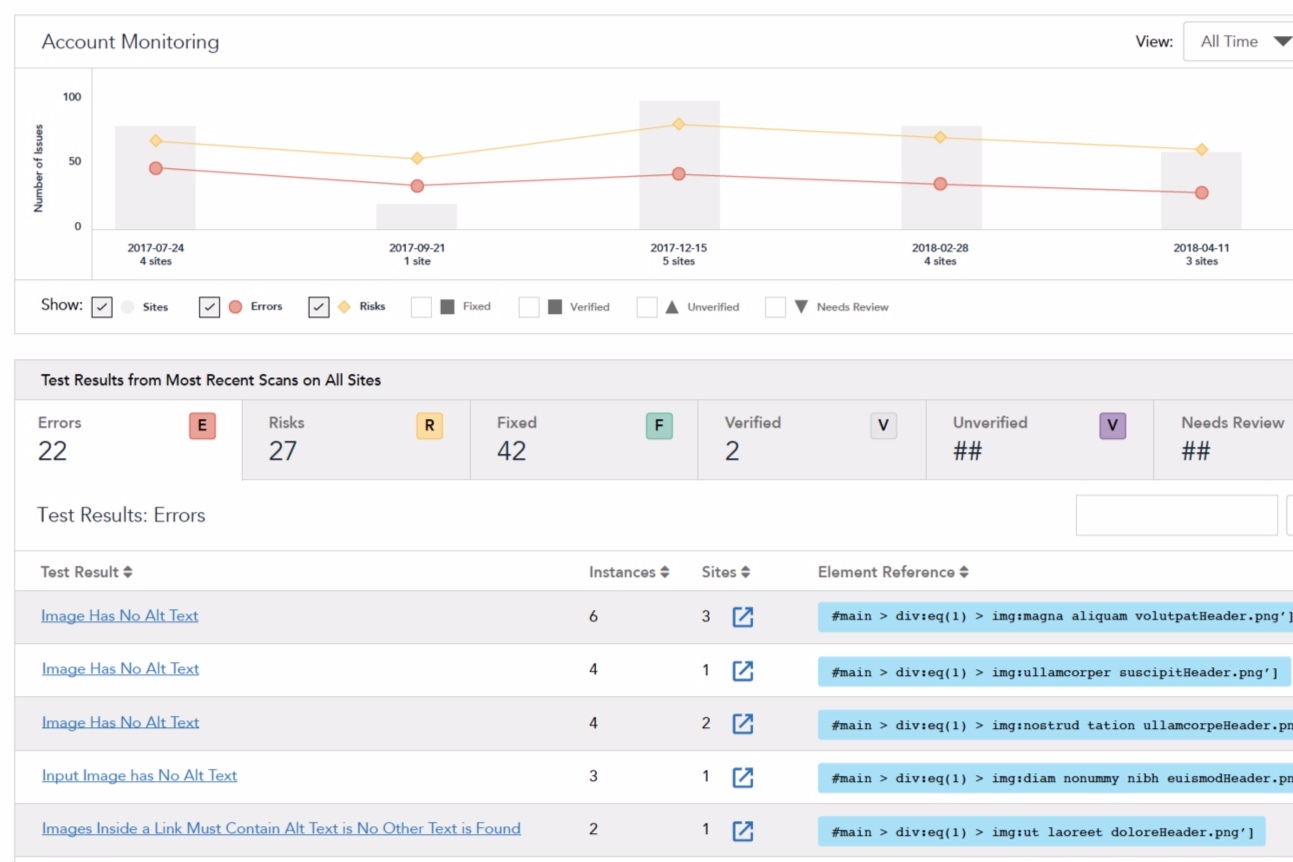
When a customer signs up for AE they need to add a few lines of JavaScript code to their website. That enables AE to track visitors to the website and provide them a dashboard to view website errors and a dashboard with recommendations / remediation’s to fix and monitor. See dashboard example below.

When a user comes to the customers website, a small AE icon shows up on the bottom right corner of the website allowing visitors to view accessibility options. See below for examples.

product+dashboard
AE claims Machine learning based remediation, but I dont see that in any website

Does it really automate and solve the problem of accessibility remediation?

Having been a CTO before I dont think you can remediate in an automated fashion. 20-25% of the accessibility issues can be identified and < 5% can be automatically remediated.

The best option is for developers and Product managers to build accessibility into their plans upfront, but that is the last thing on their mind and it delays website launch if they choose to do that.

When companies get sued, they look for a quick fix and while none really exists, the low hanging fruit from simple fixes (putting a Javascript from AE) is what they end up doing.

There are some customers I visited (example Mohawk below – visit their website to experience for yourself and notice a small icon on the bottom right) which provide a simple way for accessibility to be solved for < 10% of the disabled audience.

See the right navigation for controls in screenshot 2

See bottom navigation for audio in screenshot 3

AE tools
See right navigation for controls
See bottom for audio controls

What is their moat?

There are 3 moats that they are building, and need to continue to build.

  1. Proprietary algorithms for remediation – <if> this works, it can be a game changer. Customer growth is strong for just the simple testing product. Remediation is the “cure cancer” offering, as opposed to testing which is “diagnose that this is cancer”.
  2. Partnership channels are going to drive growth – they target WordPress (content websites), Shopify (eCommerce websites) and media sites using partners. No partner likes to sign up with multiple providers.
  3. Customer retention with monitoring: While AE is easy to replace <1 line of Javascript code is not hard to remove and replace from a website), when developers get use to the reports and monitoring they dont want to learn a new tool.

What is the go to market model for Audioeye?

AE has a sales team for enterprise customers (20+ sales and partner reps) and a partnership model with channel partners who sell AE as a bundled solution. Companies get to know about AE through Google SEO, search ads or partner promotions.

AE offers a freemium SaaS model – meaning customers can sign up for free to find problems in their website and they offer some paid plans.

A $39/mo plan allows them basic remediation, $99/mo plan allows for advanced and if you are an enterprise that wants a “managed” i.e. outsourced solution they offer that as well.

AE does not disclose # of customers by plan.

Quarter# customersQoQ Growth
Q1 202011K48%
Q2 202016K45%
Q3 202022K38%
Q4 202032K45%
Customer growth has been strong

Are their customers real? What about Mariner research’s claim that the product does not have any AI/ML?

The report by Mariner on Seeking Alpha made me dig deeper into their customers and I visited 20+ customer websites to confirm that they actually have them on.

BuiltWith (see below) confirms that there are over 28K websites with the AE Javascript. That does not tell you how many are paying customers. They should more data on cohort analysis or metrics on DBNER.

I also confirmed by checking the Javascript code on a few websites. At the very least – even if AE does not provide “remediation” – which is the holy grail, it does provide accessibility options, which solves a part of the problem.

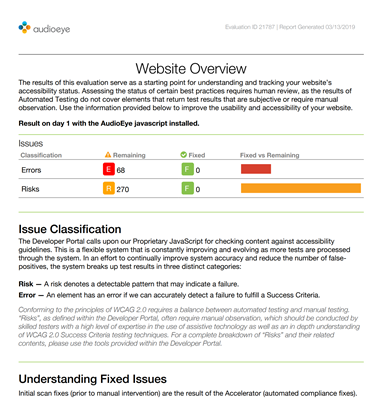
You can also see a sample of a website accessibility testing report from AE with a snapshot below.

BuiltWith confirms 28K installs of AE javascript
An actual website accessibility report from AE
Maricopa County website with AE
AE Javascript on Audiobooks.com as an example
With 28K customers, and no reviews on G2 something is amiss

Builtwith also confirms that the usage of their script is growing. They had a big drop in 2018, but after that they have been getting installed at a rapid clip. It does show that over 95% of their customers are in the United States.

AudioEye script install growth shows websites using them increased

How is employee morale given all these management changes?

AE has 100+ employees in Atlanta, Phoenix and Portland. Reviews of CEO (100%) 7 reviews and Company (75% positive) are good, but the sample size is too small. It is hard to say.

The numbers seem to indicate the sales and marketing teams are getting the job done. The product will likely go through several “build for scale” changes, but I dont see too many concerns.

When you have a mission such as AE’s I think it attracts a certain kind of individual (who wants to make the world better).

How good is the management team?

This is one of the biggest issues I have with AE. There has been constant management change. The current website lists some strong names, and I am reaching out to them on LinkedIn to confirm.

  1. CEO David is interim – full time investor at Sero Capital. The previous CEO left after 8 months on board in Aug 2020.
  2. CFO Sach joined 18 months ago from D&B.
  3. President & CTO Dominic has been on board for 7 months from a consulting position before.
  4. CPO Joel is part-time AE and is 1 year into the job
  5. CMO Bryan has been there for 3 months and was at Tile before
  6. CRO Russell was at Shipstation and BigCommerce before and has been at AE for 2 months
  7. CBO Rob was at Pinterest and FB as a mid level manager and has been at AE for 1 month

What are the risks?

  1. There have been constant management changes with3 CEO’s in 3 years. They have an interim CEO now (who was their board member) after their CEO hired in March 2020 stepped down. They named a new CMO, CRO in Feb 2020 and replaced them both again in Dec 2020. Risk – management continuity does not exist.
  2. They have moved their technical development team to Portland from Atlanta and hired a new President there who will build a new technical team there – Risk have to rebuild their tech stack / architecture which could distract from customer growth
  3. Lawsuits – they have filed a lawsuit against their #1 competitor – AccessiBe for patent infringement on Sep 2020 and that is still being litigated. AccessiBe has raised $10M+ in funding, so this will be a long battle
  4. They dont have great reviews on many review sites, but customer growth is increasing dramatically and churn is moderate (90% retention – which is poor given most good SaaS companies have negative churn
  5. They don’t report traditional SaaS company metrics such as CAC, DBNER, etc. which gives no visibility into their revenue quality
  6. The company has amended and reclassified historical financials (and at one point restated 97% of its revenue) likely enabled or caused by material weaknesses in internal controls. A long piece by research firm Mariner (link below) says their accounting is suspect, product does not actually work and AI/ML is just marketing.

So what is Mariner missing?

At the core of Mariner’s research is 5 issues:

  1. Lack of investment in R&D: Agree. Their R&D spend has been minimal, but as a technical person with sufficient knowledge of systems, I can tell you that this product does NOT require deep technical depth. The biggest issue is AE has “marketed” a simple web accessibility toolbar as a machine learning / AI tool and made multiple claims to be making 1 Billion+ remediation’s daily. That is overreach and (probably) false, but this does solve a part of the accessibility problem. When AE says they power 1 billion remediation visits daily that is the sum total of all the page views their customers serve daily thanks to the Javascript that shows the AE icon on the bottom right. I say (probably) false because they could argue it is remediation – but that is like calling a cat, tiger. Yes they are feline, but there’s a big difference.
  2. Poor internal financial controls: Agree: AE reporting is so poor and has only 1 analyst covering them (who is from their banker B Riley) that this needs to be viewed more closely because they have reinstated revenue and earnings before. I also learned from others that this is “turnaround play” – they should be even more clear with investors and transparent.
  3. CEO connections to “Pharma bro Martin S”: Not material but agree: Being “connected” to Martin and making them guilty by association is bad form from Mariner.
  4. The founder’s other companies are suspect or have been barred from NASDAQ. Not material but agree: They have since left the company or have been relegated to lower positions for continuity.
  5. No real technology to claim their remediation with ML/AI: Partially Agree: This is a simple JavaScript add-on to the website that allows for certain accessibility capabilities to be turned on. Marketing this as AI/ML based remediation is overreach. But, it does the basic job of accessibility testing and reporting.

Even though I agree all of their points are “valid”, however, the product does some basic things. It is usual in the software world and in Silicon Valley in particular to “pitch the vision” and deliver” the current version”.

If the company is given AI/ML valuations, (which everyone wants) that is a valuation problem and poor communication from AE.

That’s what the company is doing, I believe, but I would like verification of the SaaS metrics reported by other companies to confirm.

Would I recommend this stock?

I was introduced to this stock by my friends on Twitter, and while there is a lot to not like – it is risky, it has many challenges and the marketing seems off – I believe those are the main reasons they have brought on fresh talent.

The quarterly numbers are amazing (given their growth) because they are starting from a small base. I would be willing to give them a quarter or two of runway to clean up the issues mentioned an move forward. During this time I want more reporting on standard SaaS metrics, such as DBNER, churn, CAC, etc. I also think they should ask their new President to outline their product strategy and execution plan.

Since this is a very risky play I would time the entry (I am not a stock chart price-action expert), keep a short stop loss (and keep a stop loss in permanent, instead of just for the day), and put <2% or a small amount of portfolio to see the performance for 1-2 quarters.

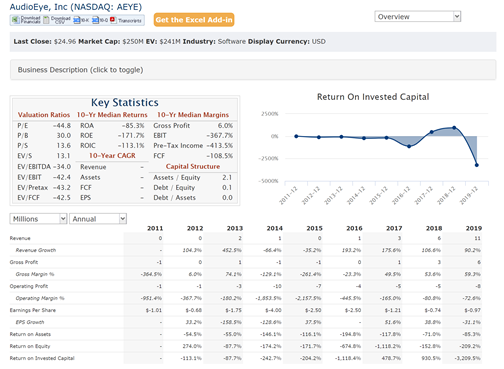
Audioeye financial metrics

Links for more reading

  1. https://cdn2.hubspot.net/hubfs/158743/CivicPlus/Accessibility/AudioEye%20Web%20Essentials.pdf
  2. https://www.forbes.com/sites/danieldambrosio/2019/12/26/can-blind-people-use-your-website-find-out-with-audioeye/
  3. https://www2.deloitte.com/content/dam/Deloitte/us/Documents/technology-media-telecommunications/us-tmt-fast-500-2020-winners-list.pdf
  4. https://www.lflegal.com/2020/09/audioeye-vs-accessibe/
  5. https://www.accessibilityassociation.org/files/Deque_Company_Overview_9_15_a.pdf
  6. https://www.researchreportsworld.com/global-website-accessibility-software-market-15561626
  7. http://www.taylorbodnardesign.com/audioeye
  8. https://www.audioeye.com/about-us
  9. https://www.business2community.com/web-design/10-website-accessibility-software-solutions-that-help-you-achieve-ada-compliance-02323106
  10. https://marinerresearchgroup.com/2020/09/14/more-than-meets-the-audioeye-we-see-50-downside/
  11. https://www.audioeye.com/fq1-2020-earnings-call-transcripts
  12. https://www.yahoo.com/now/edited-transcript-aeye-oq-earnings-061500215.html
  13. https://sec.report/Document/0001104659-20-124715/Interactive-1
  14. https://seekingalpha.com/news/3608186-audioeyes-interim-ceo-david-moradi-agrees-to-receive-1-in-annual-salary
  15. https://www.prnewswire.com/news-releases/audioeye-appoints-todd-bankofier-as-chief-revenue-officer-300922129.html
  16. https://www.audioeye.com/post/audioeye-appoints-heath-thompson-as-chief-executive-officer#:~:text=TUCSON%2C%20Ariz.,%2C%20effective%20March%2023%2C%202020.
  17. https://www.zoominfo.com/c/audioeye-inc/10196181
  18. https://www.g2.com/products/audioeye/competitors/alternatives
  19. https://techstartups.com/2020/05/13/web-accessibility-solution-accessibe-clinches-12-million-funding-k1-capital/
  20. https://www.prnewswire.com/news-releases/audioeye-inc-completes-15-million-equity-financing-300253546.html
  21. https://www.prnewswire.com/news-releases/audioeye-announces-closing-of-6-5-million-growth-equity-financing-300692787.html
  22. https://www.lflegal.com/2020/09/audioeye-vs-accessibe/
  23. https://www.prnewswire.com/news-releases/digital-accessibility-provider-audioeye-in-the-top-100-of-the-fastest-growing-companies-in-north-america-on-deloittes-2019-technology-fast-500-300959662.html
  24. https://assets.simpleviewinc.com/simpleview/image/upload/v1/clients/denver/Denver_AudioEye_Pro_Introduction_Education_6cbbef16-32c0-432a-952b-c41a32f71a04.pdf
  25. https://www.civiccms-demo.com/sites/g/files/vyhlif2716/f/agendas/chesilhurst_borough_-_accessibility_scan.pdf
  26. https://www.streetinsider.com/Corporate+News/Audioeye+%28AEYE%29+Announces+Customer+Update+and+Preliminary+Outlook+for+Q4+and+FY21+Revenue+Outlook/17725162.html

Errors and Omissions

Please do not take this as investment advice.

As I notice errors and issues, I will update this document and also highlight the errors in this section. Please check this area frequently

What is iBuying? Which is the stock to buy for the next 10 years?

What is iBuying?

An iBuyer is a company that buys your existing home and then (usually) resells it on the open market.

iBuying (instant Buying) companies such as Opendoor, Offerpad, Zillow Offers, RedfinNow, Knock, eXPI and over 20 others use online technology to estimate a home’s value and make an offer in one to two days. If the offer is accepted and the sales transaction closes, the iBuyer assumes the burden of owning, marketing, and reselling the home.
Opendoor provides a simple app to get estimates

Who is the customer?

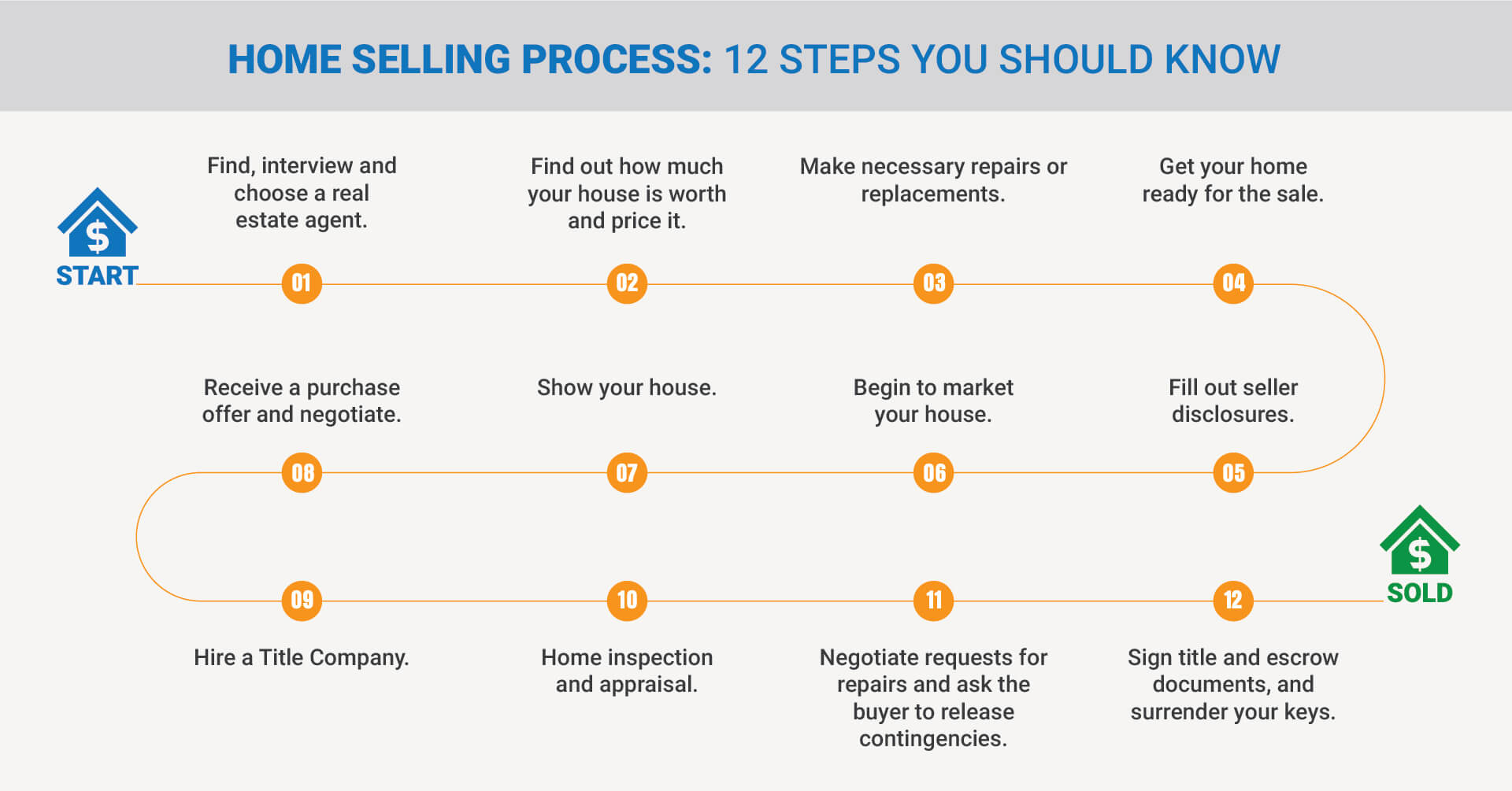
The process of buying or selling a home takes 6-8 weeks from finding an agent, listing the property, preparing the home for sale, inspections, “showing” the home, confirming mortgage, getting escrow and finally closing.

The customer for iBuying is a home seller, frustrated with this lengthy process and would like to sell their home in less than a week or less, and get a good price for their home, quickly. This is so they can then buy another home that they may have already selected or just keep the cash.

Similarly the buyer of the home has to go through a lengthy process of selecting a broker, viewing homes, getting mortgage pre-approval, selecting a home, getting inspections done, and finally closing on a home (escrow, title, etc.)

Home Selling Process: 12 Steps You Should Know | HOMEiA
The home selling (and buying) process is long and cumbersome

What is the customer problem?

In an iBuying transaction, there is no need for the homeowner to hold open houses, consider multiple bids, or wait for a buyer to work out financing.

Simply sign up on any one of their websites/mobile app and you can get a cash offer. Sometimes you can expect that offer within 1-24 hours.

iBuyers make cash offers on “livable” houses That are supposedly close to the actual market value of the house.

The owner selects the closing date, which can be as soon as a week after signing the iBuyer contract. It also offers advantages to consumers who want to sell their existing home and purchase a newly built one in a single transaction and wait to move out until their new home is completed.

How big is the market?

In the US there are 5.3 Million (new and existing) homes sold and bought each year. That represents a $1.4 Trillion market. The commissions paid to realtors alone is $150 Billion. The closing and escrow is another $30 Billion market. The US mortgage (refinancing included) is a $4.5 Trillion market.

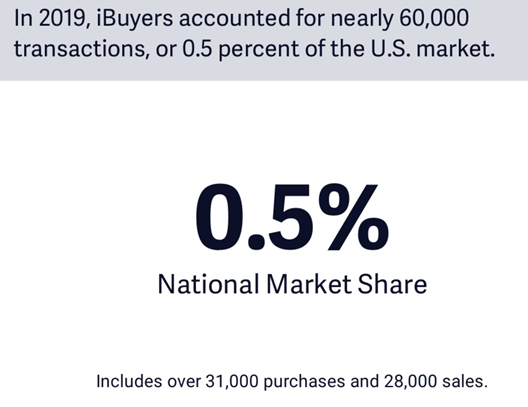
iBuyers represent a small part of the market in 2019 and 2020

What are the pros and cons of iBuying?

Pros of Selling to an iBuyer

Quick close on a day of your choosing – instead of waiting for many weeks.

No showings (except inspectors) – saves time and hassle.

Buy your next home without a contingency – this means you can buy another home without having to wait to sell your current home.

Better than selling to a flipper – Flippers tend to undervalue the price of a home, “fix” it and “flip” it for a large profit.

Cons of Selling to an iBuyer

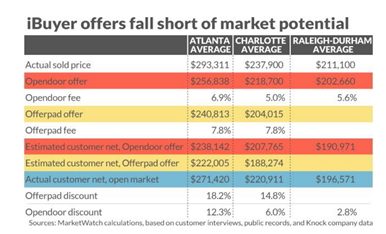
Less than full fair market value – iBuying can pay you less than if you use a realtor.

High fees – Realtor commissions and closing costs tend to be 6% whereas iBuying charges 8-10%.

Not so “guaranteed” offer – some offers are withdrawn if the iBuying firm finds the home to be in less than acceptable condition.

Few homes/markets qualify – Of the homes in the US the estimate is < 15% qualify for iBuying

How do iBuying companies make money?

iBuying is a low margin, high volume business. The companies make money in 2 ways:

  1. Service fees
  2. Price appreciation of the home
iBuyers make money with fees and home price appreciation because of the fixes they peform

E.g. If a home is priced at $250,000, the iBuying company charges $25K (10%) as their service fee (for the entire process, cleaning, title, escrow) and then will “upgrade” your home by making cosmetic changes and sell it for $260,000.

In this example they make $25K in fees and $10K in appreciation.

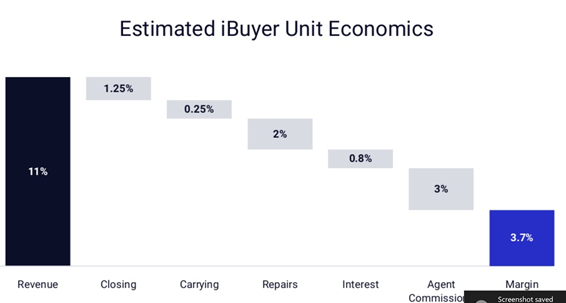
If you look at this unit economics for e.g. (below) and assume an average 11% just in service fees, their margin is about 4%.

If you look at “agent commission” – that is the area to improve for iBuyers. Margin can get to 6-7%

Who are the key companies in this iBuying space?

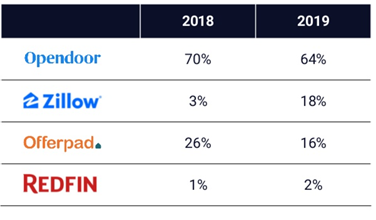
There are over 20 companies in various markets, but the leader is Opendoor, followed by Zillow Offers and Offerpad.

Opendoor is the leader, but Zillow is catching up fast

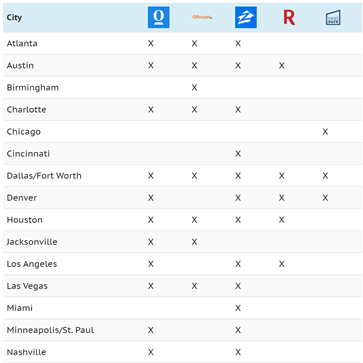
Is iBuying available everywhere?

No, Opendoor is in 21 “markets” or cities, Zillow in 25. Redfin in 5, eXPI in 7 and Offerpad in 5. Rest are in under 5 markets.

The market needs to have enough inventory, sufficient transactions and resonsably priced homes
iBuying will likely remain a US phenomenon for decades

Will every home be sold with iBuyers in 20-30 years? Is this a long term trend?

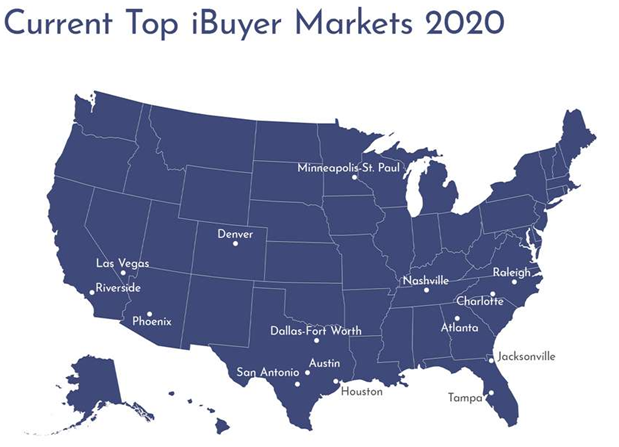
Currently the iBuyers are in the top 25-50 markets as the chart shows below. There are a total of 250+ markets in the US. So the penetration by the iBuyers is relatively small.

The sweet spot for iBuyers seems to be the $250K (+/- 20%) price point for the home, which is the median US home price, representing about 42% of all US homes. This means iBuyers will likely only be (for the next decade) in the top 50-60 markets.

Markets where iBuyers operate

Open door intends to operate in 50 markets by 2025.

The 50 markets where Opendoor intends to operate

Who is iBuying disrupting? Is the real estate agent in trouble?

In 2020 and for the next few years the easy 25K “home flippers”, in the US, i.e. people who buy a home, do minor fixes (paint, clean, etc.) and then flip (sell it) are the ones that are feeling the pressure from iBuyers. The heavy-lifting flippers (who buy run down properties and rebuild) are not going to care about the iBuyers since those run-down homes are not the target for iBuyers.

There are between 1.5 to 2 Million registered real estate brokers in the US. Of those < 200K do more than 2 transactions a year. The others are “casual realtors”.

How Many Real Estate Agents Are There Globally? - FBW
In 2020 there were over 1.4 Million real estate brokers in the US

Over time, with volume, iBuying will disrupt the long tail of realtors, and also reduce the fees for real estate brokers.

What about regulation?

The existing real estate brokerages (there are over 104K in the US) and many real estate brokers are threatened by the iBuying phenomenon. This is because it cuts into their commissions (which have been 6% of the home price forever) and know that iBuying companies might eventually cut them out of the transaction.

Sellers beware - Why America's real-estate brokers are such a rip-off | United  States | The Economist
Real Estate Broker commissions across the world

In terms of regulation, there are no proposed laws against iBuyers in any states yet.

Many brokers, mortgage companies and escrow firms think iBuying will continue to be a small part of the business overall. For e.g. after 25 years of ecommerce, it is still < 10% of all retail in the US. However, ecommerce has disrupted many brick and mortar retail companies.

It is very likely that iBuying will do the same to traditional real estate brokerages.

Do iBuyers offer the best price? If not, why are people still choosing iBuyers?

Not always. If a buyer values time over the best price they will choose iBuying. If not, the traditional process might yield a better price.

An analysis of 1000 iBuying transactions showed that that iBuyers offer between 90% – 95% of the current value of the home.

How big is iBuying now? How big will it get?

iBuying is very small as a segment (< 2% of homes sold in the US are bought / sold by iBuyers), but it is growing fast.

iBuying is expected to have large growth

The market slowed in 2020 (thanks to Covid) but with a) millennials looking to buy homes in the suburbs, b) remote working being acceptable now, and c) low interest rates, iBuying will see dramatic growth from 2020 – 2030.

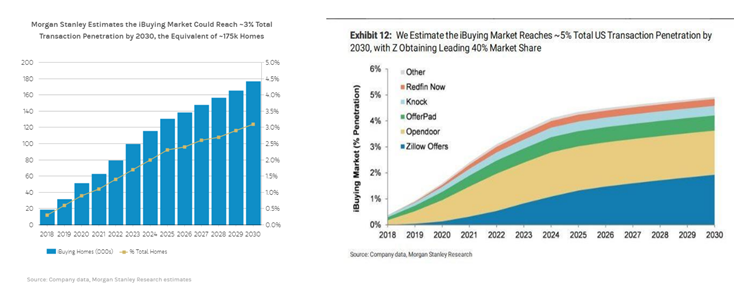
It is anticipated that iBuying will be 3%-5% (currently < 2%) of all homes bought and sold by 2025 and 5% – 10% by 2030.

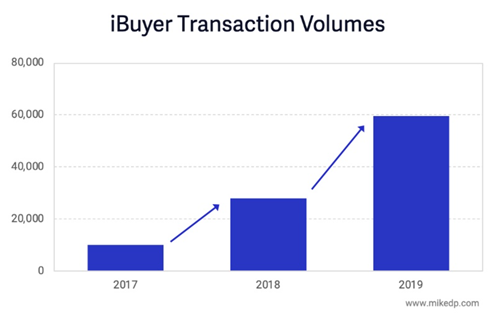
At 5% in 2025, the total transactions (homes bought) by iBuyers will be 265,000 homes (60K in 2019) in the US and the transaction volume will be $66B (4.4X 2020 of $15B). The implied revenue to iBuyers is $8B – $10B.

Transaction volumes have increased exponentially over the last few years

In some of the mature markets (e.g. Phoenix), iBuying is already over 15% of transactions.

What is a “Market” according to the iBuying companies?

According to the National Association of Realtors, each MSA (Metropolitan Statistical Area) or County in the US is a market. There are 256 markets in the US.

You might hear realtors refer to “buyers market”, “sellers market” or “balanced market”. The term market in iBuying is a location (city, county, MSA) where there is enough inventory of homes to buy and sell.

Top iBuying markets of 2020

How do iBuying companies finance their home purchases?

All companies have lines of credit, or have raised billions in debt. In 2018 alone Opendoor raised $1.3 Billion and have over $3B in 2020.

This chart is as of 2018

What is the competitive differentiation between these companies?

The differentiation comes from having more data about the market, buying homes at the “right price”, selling them “quickly” and automating the operations to reduce unnecessary costs.

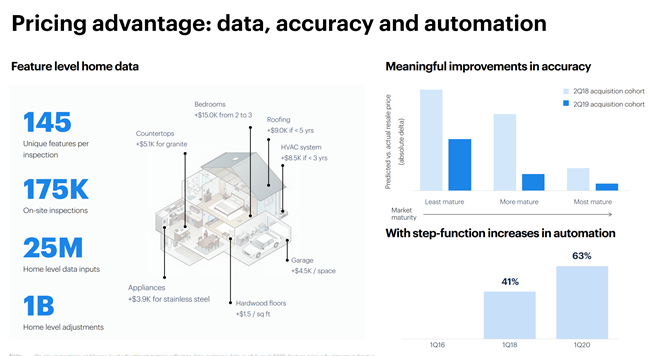
Opendoor is the pioneer in the space and has done the most transactions. So they have a lot of data about the home and use ML/AI to price homes based on multiple photos and images of the home.

Zillow is the leader in real estate technology and has data for pricing on over 100 Million units in the US.

Redfin has the most “in house agents” to get potential customers interested so they are using that to their advantage.

Which stock should I buy?

Ticker2020 Rev (TTM)2020 iBuying Tx*Mcap# MarketsExpected Rev (2025) from iBuying
OPEN~$3B – $4B~20K – $22K$4.8B*15$50B
ZG$4B~6K – 7K$30B22$40B
RDFN$900M~ 1.5K – 2K$7B7$15B
EXPI$1.5B< 500$4.6B5$10B
OPEN will list by Dec 2020 or Jan 2021. This is the expected valuation

The 2020 iBuying Transactions (# of homes) is obtained from their projections, so subject to changes.

The 2025 expected revenue is disclosed in their conference calls with analysts and is a “likely number”.

Who is Opendoor? Why are they going public?

Opendoor was founded by Eric Wu (ex Trulia – sold to Zillow), Keith Rabois and JD Ross in 2014. After multiple rounds of funding from Softbank and General Atlantic, it last raised $300M in 2019 valuing the company at $3.8B.

In Sep 2020, Opendoor announced it would go public by merging with Social Capital Hedosophia Holdings Co (IPOB), a company launched by Chamath P of Facebook.

The deal valued Opendoor at $4.8B.

Opendoor has strong history and metrics in the space to be a leader

What is Opendoor’s moat or unique value proposition?

Given that the business is simple to understand but difficult to execute, any company that has to succeed will have to get these 3 important things right:

  1. Buy at the right price. Not too low that the homeowner would prefer to sell it via a real estate agent and not too high that that cant make an appreciation, given that fees are difficult to raise.
  2. Assess the conditions of the market and neighborhood well to ensure they dont “buy and hold” properties that required a lot of upgrades or markets where inventory moves slowly.
  3. Optimize operations to reduce the costs – the big cost is realtor fees at 3%.
Algorithms and large data sets (with network effects) power Opendoor

Opendoor collects a lot of data about a company by doing “feature inspection and data recording. This in turn generates better estimates and better data to price intelligently. The new data in a market helps make the next purchase better.

Zillow has more data on US homes than any of these companies, so I would be very bullish in their ability to leverage their proprietary data and be the #1 or #2 in this market quickly

Given that Redfin chose to partner with Opendoor, I see this as a 2 horse race – Zillow (which might acquire others in specific markets) vs. Opendoor + Redfin combined.

What is vertical integration in real estate? Why is that important?

If you look at the process of buying and selling homes, there are multiple steps. iBuyers eventually want to own the entire process end-to-end. This is called vertical integration. It gives the iBuying companies bigger markets to grow into.

For example iBuyers can:

  1. Help you select a home from their inventory – eliminating broker fees
  2. Provide inspections and get pre approval – lower inspection fees
  3. Obtain mortgage – make money on mortgage referrals
  4. Provide escrow and closing – lower escrow fees
  5. Help with upgrades, repair and maintenance – increase revenue potential
The Home Buying Process - Atlanta Ben
Home buying process for vertical integration

The reason this is important is because each of the markets in the process is large.

  1. Real estate commissions $150B market
  2. US residential real estate mortgages: $4.5 Trillion
  3. Escrow and closing: $25B
  4. Home setup, showing and preparation $10B
  5. Home insurance, title insurance, etc. $25B

Resources and Links for more reading

  1. https://www.theceshop.com/sites/default/files/block_image/eBooks/iBuying-Ebook.pdf
  2. https://www.nar.realtor/sites/default/files/documents/BE-Pinehurst-iBuyers-The-Good-The-Bad-The-Ugly-BLublin.pdf
  3. https://www2.deloitte.com/content/dam/Deloitte/us/Documents/finance/us-in-focus-usell-ibuy.pdf
  4. http://floridarealtors.geniecast.com/wp-content/uploads/sites/7/2020/08/Lublin-Bill-CE-Class-Text-iBuyers-The-Good-The-Bad-And-The-Ugly.pdf
  5. https://dynamix-cdn.s3.amazonaws.com/metrobrokerscom/metrobrokerscom_194552090.pdf
  6. https://www.collateralanalytics.com/wp-content/uploads/2019/08/CA-RESEARCH-iBuyers-A-new-choice-for-home-sellers-but-at-what-cost.pdf
  7. http://reia.asn.au/wp-content/uploads/2019/05/22-May-2019-iBuying-is-coming-to-real-estate-but-not-through-REA-Group-or-Domain.pdf
  8. https://assets.empirefinancialresearch.com/uploads/2019/05/Zillow-slide-presentation-Edion-Hysi-4-22-19-1.pdf
  9. https://1zubki95x8hev77r4cdd9314-wpengine.netdna-ssl.com/wp-content/uploads/2020/08/edge082420.pdf
  10. https://www.opendoor.com/w/wp-content/uploads/2020/09/Opendoor-Overview_vPDF_02.pdf
  11. https://cdn.expworldholdings.com/wp-content/uploads/sites/2257/2020/12/Investor-Deck-Dec-2-Edit-Uploaded-to-Site-4pm-PT.pdf
  12. https://www.slideshare.net/MikeDelPrete/the-2020-ibuyer-report-preview

The Four Horsemen theory of investing

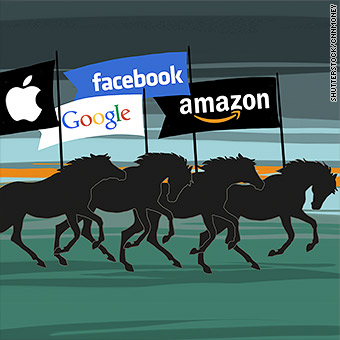
In early 1995, when I first started investing and I was working at Cisco, the company was called one of the four horsemen of the Internet.

The four were Microsoft, Intel, Cisco and DELL (+1 Oracle). Nothing could stop them at that time. (DIMCO)

Meet the new 'four horsemen' of tech: Sorry, Microsoft, Dell, Cisco and  Intel - GeekWire
Four horsemen of 1990’s

The four horsemen of 2000’s were ignored because they were in China (BATS) – Baidu, Alibaba, Tencent and Sina (+1 – JD.com)

The State of Chinese Social Media in 2016: What You Need to Know Five  Trends in China's Fast-Moving Social Landscape – Chinese Tourist

For the next decade the four horsemen (+1) were FAANG (Facebook. Apple, Amazon, Netflix, Google)

Why you need to own the Four Horsemen of Tech
Four horsemen of 2010s

The four horsemen (+1) of Covid without doubt have been: Tesla, Zoom, Peloton, Docusign and Shopify.

The new horsemen (+1) of 2020 – 2030 are being formed right now. There are a few candidates.

Nvidia (AI and Chips)

Tesla (Electric cars)

Shopify (eCommerce)

Peloton (Connected fitness)

SEA Limited (Singapore)

Mercado Libre (Argentina)

Are there others you can think of? Message me on Twitter – @mukund

100 Baggers: Book review and Summary

100 Baggers: Stocks That Return 100-to-1 and How To Find Them: Mayer,  Christopher W: 9781621291657: Amazon.com: Books
100 Baggers: a Book on Investments by Chris Mayer

100 Baggers is a book on finding and keeping stocks that increase 100X their value after purchase. The book was published in 2015 and has 220+ pages. the book details 365 companies that have returned 100X their value.

Book notes and summary

“Every human problem is an investment opportunity if you can anticipate the solution”. Except for thieves, who would buy locks?

Phelps figured out a few things about investing. He conducted a fascinating study on stocks that returned $100 for every $1 invested. Yes, 100 to 1. Phelps found hundreds of such stocks, bunches available in any single year, that you could have bought and enjoyed a 100-to-1 return on—if you had just held on. His basic conclusion can be summed up in the phrase “buy right and hold on.” Investors need to distinguish between activity and results.

What investors should do is focus on the business, not on market prices.

“Bear market smoke gets in one’s eyes,” and it blinds us to buying opportunities if we are too intent on market timing. The greatest fortunes come from gritting your teeth and holding on.

“There is a Wall Street saying that a situation is better than a statistic,” Phelps said. Relying only on published growth trends, profit margins and price-earnings ratios is not as important as understanding how a company could create value in the years ahead.

Don’t sell just because the price moved up or down, or because you need to realize a capital gain to offset a loss. You should sell rarely, and only when it is clear you made an error. One can argue every sale is a confession of error, and the shorter the time you’ve held the stock, the greater the error in buying it.

There are lots of ways to make money in markets, just as there are many ways to make a good pizza. Nonetheless, there is something to be said for a good pizza that almost anyone can make with the right ingredients.

We’re looking for insights and wisdom, not hard laws, and proofs. Investors have been conditioned to measure stock price performance based on quarterly or annual earnings but not on business performance.

# of years a company is in the S&P 500

The Biggest Hurdle to Making 100 Times Your Money

The biggest hurdle to making 100 times your money in a stock—or even just tripling it—may be the ability to stomach the ups and downs and hold on.

Analysis of 100 Baggers:

• The most powerful stock moves tended to be during extended periods of growing earnings accompanied by an expansion of the P/E ratio.

• These periods of P/E expansion often seem to coincide with periods of accelerating earnings growth.

• Some of the most attractive opportunities occur in beaten down, forgotten stocks, which perhaps after years of losses are returning to profitability.

• During such periods of rapid share price appreciation, stock prices can reach lofty P/E ratios. This shouldn’t necessarily deter one from continuing to hold the stock.

The key to 100-baggers

Many 100-baggers enjoyed high ROEs, 15 percent or better in most years. It’s important to have a company that can reinvest its profits at a high rate (20 percent or better). ROE is a good starting point and decent proxy. I wouldn’t be a slave to it or any number, but the concept is important.

Owner Operators: Skin in the Game

Keep the list of names relatively short. And focus on the best ideas. When you hit that 100-bagger, you want it to matter.

100-baggers distilled: essential principles

  1. You Have to Look for Them: “When looking for the biggest game, be not tempted to shoot at anything small.” You only have so much time and so many resources to devote to stock research. Focus your efforts on the big game: The elephants. The 100-baggers.
  2. Growth, Growth and More Growth: You want to focus on growth in sales and earnings per share.
  3. Lower Multiples Preferred: Great stocks have a ready fan club, and many will spend most of their time near their 52-week highs, as you’d expect. It is rare to get a great business at dirt-cheap prices. If you spend your time trolling stocks with price–earnings ratios of five or trading at deep discounts to book value or the like, you’re hunting in the wrong fields— at least as far as 100-baggers go. You may get lucky there, of course, but the targets are richer in less austere settings.
  4. Economic Moats Are a Necessity: A 100-bagger requires a high return on capital for a long time. A moat, by definition, is what allows a company to get that return.
  5. Smaller Companies Preferred: Start with acorns, wind up with oak trees. The median sales figure of the 365 names in the study was about $170 million.
  6. Owner-Operators Preferred: Having a great owner-operator also adds to your conviction. I find it easier to hold onto a stock through the rough patches knowing I have a talented owner-operator with skin in the game at the helm.
  7. You Need Time: Use the Coffee-Can Approach as a Crutch: Once you do all this work to find a stock that could become a 100-bagger, you need to give it time. Even the fastest 100-baggers in our study needed about five years to get there. A more likely journey will take 20–25 years.
  8. You Need a Really Good Filter: Don’t fret so much with guesses as to where the stock market might go. Keep looking for great ideas. If history is any guide, they are always out there.
  9. Luck Helps: Just as in life, so in the pursuit of 100-baggers. Good luck helps.
  10. You Should Be a Reluctant Seller: If the job has been correctly done when a common stock is purchased, the time to sell it is—almost never. Sell if: You’ve made a mistake—that is, “the factual background of the particular company is less favorable than originally believed.”  The stock no longer meets your investment criteria. You want to switch into something better—although an investor should be careful here and only switch if “very sure of his ground.”

What is an Investing EDGE?

The Importance of Finding Your Trading "Edge"

An investing edge is a technique, observation or approach that creates a cash advantage over other market players.

Said another way – what do you know better than others?

E.g. You are a developer and know companies that provide software / frameworks for developer before others do. E.g. OKTA, Splunk. Amazon AWS, etc.

What are the characteristics of an edge?

The edge has to be repeatable.

You need to be able to use the same process (your knowledge of developer stack for e.g.) to find new investments consistently. Using your process you may only get 1 investment a year or 1 a month or 1 a day (wow), but it has to be a process that keeps repeating using a set of rules you adopt consistently.

The edge has to result in better than 50-50 odds

Let me give you an example to prove this point. Lets say you and I chose a stock ABC. You know nothing about ABC and I don’t either. The odds of the stock going up or down are – 50% – a coin toss. That’s gambling. When you gamble, the house always wins in the end (regardless of the market).

Now lets say ABC is a developer focused technology company. You know more about whether it will do well or not than I do. You now have an edge.

For me it is still a coin toss. For you, however, the odds are in your favor since you know more.

It has to be validated before and be proven (Back testing)

Back testing is a fancy insider term for “prove to me that your hypothesis will work with data from previous time periods.

Back to our example, if you have an edge, as a software developer, what questions (metrics) will you ask to find the companies you would have invested in the last 10 years?

Doordash (NYSE:DASH): The most Comprehensive IPO review

DoorDash IPO filing shows huge growth and lots of risk - CNET
Doordash (NYSE:DASH) filed for an initial public offering.

Doordash, the food delivery company, founded in 2013, by  Andy Fang, Evan Moore, Stanley Tang, Tony Xu, filed for an initial public offering.

The company is expected list on the NYSE and is being underwritten by Goldman Sachs and J P Morgan.

The company is expected to seek a valuation of about $25 Billion and it is still not clear how much it plans to raise (the placeholder value is $100M, but the final amount depends on the interest from large investors). Ed: I expect it to raise about $800M – $1B.

The company’s most recent price of shares were $45.9 (Series H, June 2020), when it was valued at $16B, raising $400M. This means the price at IPO will likely be $80 – $100.

The company has grown quickly and has recorded $1.9B (+237% growth) in revenue in 2020 (9 months, ending Sep), losing $149M in the process. During this period the Gross Order Value (Amount of food purchased & sold through the system was $8.1B – giving it a rough take rate (commissions) of 11%.

That compares to $587M in revenue for all of 2019 with a loss of $533M.

Assessment

Ed: I think this stock will head lower after the IPO if it prices at $80 – $100, unless Uber and Lyft start to trend upwards. This is based primarily on the valuation expected.

The questions around delivery and consumer growth need to be answered only by 2021 and until then I think this business will grow very quickly.

Given that the key story for DASH is that the pandemic has kicked its business into orbit, the key questions will be:

  1. Can the the growth in consumers and consumption be sustained?
  2. Are there good competitive moats vs. Uber, Just Eat (Grub Hub) and Instacart?
  3. Are the take rates sustainable in the future?
  4. What is the autonomous delivery story?
  5. What about the poor economics of delivery businesses outside the major metros?

You should buy this IPO only if you believe the future of restaurants depends at least on 25%-30% of their business coming from delivery (compared to < 12% currently), as opposed to people going back to dining in after 2021 (Post Covid).

Market

The market for “local” business delivery – starting with restaurants (which is where Doordash initially operates) is large. There are over 660K restaurants and over 38K grocery stores in the US alone. Of those 390K are customers of Doordash (Monthly active). Doordash is active in Australia (3 cities), Canada (80 cities) and United States (4000 cities).

Doordash claims to be a “merchant first” business. There are 3 participants in the business.

  1. Merchants: These are local businesses that want to deliver products to consumers, without the overhead of delivery or the cost of owning a fleet of trucks. 390K active merchants use Doordash.
  2. Consumers: Businesses (before Covid) who need catering for their office and homeowners who like food delivered at home from their local restaurant are the main buyers. 18 Million consumers use Doordash.
  3. Delivery personnel (Dashers): These are the on-demand workers who deliver the food (similar to Uber or Lyft and get paid in tips and delivery fees for their work. There are 1 Million Dashers on the platform.
Expected Online penetration of Delivery (Credit: Uber acquisition of Postmates presentation)

Customer Segments

Consumer

1 People cannot cook due to lack of time.

2. Professionals who can’t go out during lunch because time is the constraint.

3. Students who don’t have a kitchen facility.

4. People who don’t know how to cook.

Merchants

1 Food joints that have no delivery service.

2 Restaurants with poor seating arrangements.

3 New restaurants that need a huge customer base.

4 Eateries looking for advertising and marketing.

Dashers

1 People looking for part time or full-time work.

2 People looking for good income via salary and tips.

Product and Value Proposition

There are 3 apps Doordash provides: a) for merchants, b) for consumers and c) for Dashers.

Merchant Value Proposition

  1. Demand aggregation: Provide them orders from customers who want local delivery.
  2. Merchant services: White label logistics service (Doordash drive) allowing merchants to generate demand by themselves & Doordash Work for catering orders

Consumer Value Proposition

  1. Convenience: Stay at home and order food
  2. Wide selection: Food and groceries from 1000s of local food places
  3. Value: flat delivery fee or monthly subscription

Dasher Value Proposition

1. Flexible opportunity to earn

Business Model

Doordash makes money by

a) charging businesses a percentage of their sales. That commission ranges from 10% to over 30% in some cases. Consumers pay a delivery charge and tips to the dashers. As of Sep 2020, over 5 M consumers pay a monthly subscription fee ($9.99) to Doordash for unlimited local food deliveries.

b) advertisement: Any restaurant that wishes to advertise themselves on the DoorDash app has to pay in order to be ranked in one of the top places. This is done to increase the visibility of the restaurants and earn more customers

c) delivery fee: the delivery fee is another source of income for Doordash. The amount is decided during the payment process depending on the distance from the pickup to the delivery point. Usually, the delivery fee ranges from $5 to $8.

Pricing

Doordash charges consumers $5 – $8 as a delivery fee. Consumers can subscribe to a $9.99 Doordash pass which gives them unlimited orders per month.

Doordash charges 20% – 30% commissions from merchants.

The advertisements fee is between $50 – $100 per month on average.

Doordash pays Dashers per delivery ($10 – $25).

Financials

There are many questions about the viability of the model from multiple players, (see footnotes), but Doordash seems to have executed the Covid plan well. They have grown over 200% YoY and are

201820192020
GOV (Gross Order Value)$2.8B$8B$16.4B
Revenue$291M$885M$1.91B (9 mo)
Take rate % of GOV10.39%11.05%11.64%
Profit (Loss)($204M)($667M)($147M)
Doordash quick financials

Growth

Growth for Doordash will come from more merchants (expanding beyond restaurants to other local services), followed by more consumers buying more often (increasing transactions and GOV).

  1. More merchants
  2. More merchant services
  3. More consumers
  4. More consumer engagement
  5. International expansion (beyond .AU and .CA)

Funding

They raised a small round from YCombinator ($120K) in 2013, followed by $2.4 M round from Khosla Ventures. Since that point they have raised over $2 B from over 50 investors. The biggest investors are Softbank (25%+) and Sequoia Capital (20+%), followed by GIC Singapore (9.5%).

RoundDate$ raisedValuationLead
Pre SeedMar 11, 2013120K$2.5MY Combinator
SeedSep 30, 2013$2.4M$17.5MKhosla
Series AMay 22, 2014$17.3M$73.5MSequoia
Series BMar 26, 2015$40M$173MKleiner Perkins
Series CMar 22, 2016$127M$600MSequoia
Series DMar 1, 2018$535M$1.4BSoftbank
Series EAug 16, 2018$250M$4.1BCoatue
Series FFeb 21, 2019$400M$7.1BDragoneer
Series GMay 24, 2019$600M$13BDarsana
Series GNov 13, 2019$100M$13BT Rowe Price
Series HJun 18, 2020$400M$16BDurable
Doordash Funding rounds since 2013

Comparable Valuations

CompanyValuation2020 Rev (E)2020 Growth (E)2020 EPS
$UBER$86B $12 B-15%-$3.4
$LYFT$12.6B$2.4B-30%?
$ABNB$30B (E)$3.7B-12%?
$GRUB$6.6 (A)$1.4B25%-$1.2
$DASH$25B (E)$2.5B212%?
Given the range of valuation I expect $DASH to trade lower after IPO

(A) Acquired, (E) Estimate

Uber, Lyft and GrubHub stock performance

Competitors

The local food delivery space has multiple competitors including Uber Eats, Grubhub (acquired by Just Eat for $7.3B), doing $1.2B in 2019 revenue, Postmates (acquired by Uber for $2.7B), doing $107M in Q1 2020. In addition, Instacart, which does grocery delivery is expected to file for an IPO in 2021.

Doordash has over 50% marketshare in the US (for restaurants), followed by 26% for Uber eats and 16% for Grubhub.

The biggest competition is consumers walking up to a restaurant (dining in), followed by restaurant owned delivery (e.g. Dominos).

Finally, as Doordash expands its addressable market need, it might run into competitors such as Instacart as well. Lyft (in the US) has still not made its plans known for delivery.

Acquisitions

Doordash has made 4 acquisitions to date, including Caviar (competitor) and is likely going to keep acquiring companies in Canada and Australia to expand their footprint.

DateCompany acquired
Aug 21, 2019Scotty Labs
Aug 1, 2019Caviar
Apr 1, 2019Ivi5
Sep 14, 2017Rickshaw
Doordash acquisitions

History

The company was founded in 2013 by the 3 founders as Palo Alto Delivery.

Tony Xu owns 5.2% of the company, while co-founders Andy Fang and Stanley Tang each own 4.7%. The fourth co founder no longer is with the company (Evan Moore).

On January 12th 2013, Palo Alto Delivery was born.

Footnotes

  1. https://medium.com/@DoorDash/the-doordash-story-b370c2bb1e5f#:~:text=DoorDash%20began%20with%20a%20simple,an%20app%20we’d%20built.
  2. https://www.cnbc.com/2020/11/13/doordash-releases-s-1-for-ipo.html
  3. https://www.axios.com/doordash-ipo-filing-32608a73-38c4-4ede-8345-85b7bd3d515f.html
  4. https://techcrunch.com/2020/11/14/doordash-ipo-bets-that-the-pandemic-has-accelerated-change/
  5. https://www.salon.com/2020/01/19/doordash-drivers-make-an-average-of-145-an-hour-analysis-finds/
  6. DoorDash average order size was $37.28, only 20 percent spent more than $50
  7. DoorDash average delivery time was 37 minutes in 2019
  8. The company employs over 7000 people
  9. https://www.restaurantbusinessonline.com/technology/postmates-doubles-revenue-q2-ahead-uber-eats-deal

The personal blog of Mukund Mohan