Why you should consider buying New York Times Stock (NYSE:NYT)

There is a terrific (long) presentation about the New York Times business (disclosure, I am planning to buy the stock, small position, < 5% of my portfolio).

Here is the bull case in 5 sentences and visuals (there are 167 slides in the presentation). I have summarized, them to the 5 that I think tell the story well.

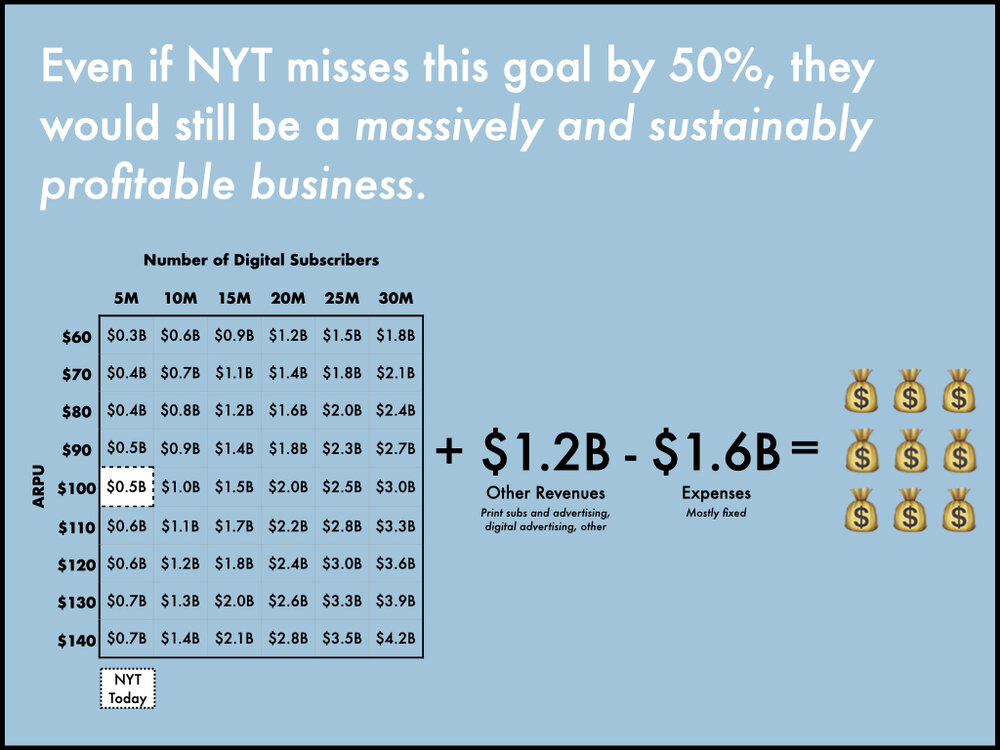
  1. The New York Times market (# of subscribers) can be about 30 million globally (they are currently at 6.5 Million subscribers). Even if they get to 50% of that number, they will be a ~$3 B annual business.
NYT Deck Images.161.jpeg

2. NYT has a much lower cost structure than Netflix or Spotify, resulting in a more profitable business, since they own their content.

NYT Deck Images.144.jpeg

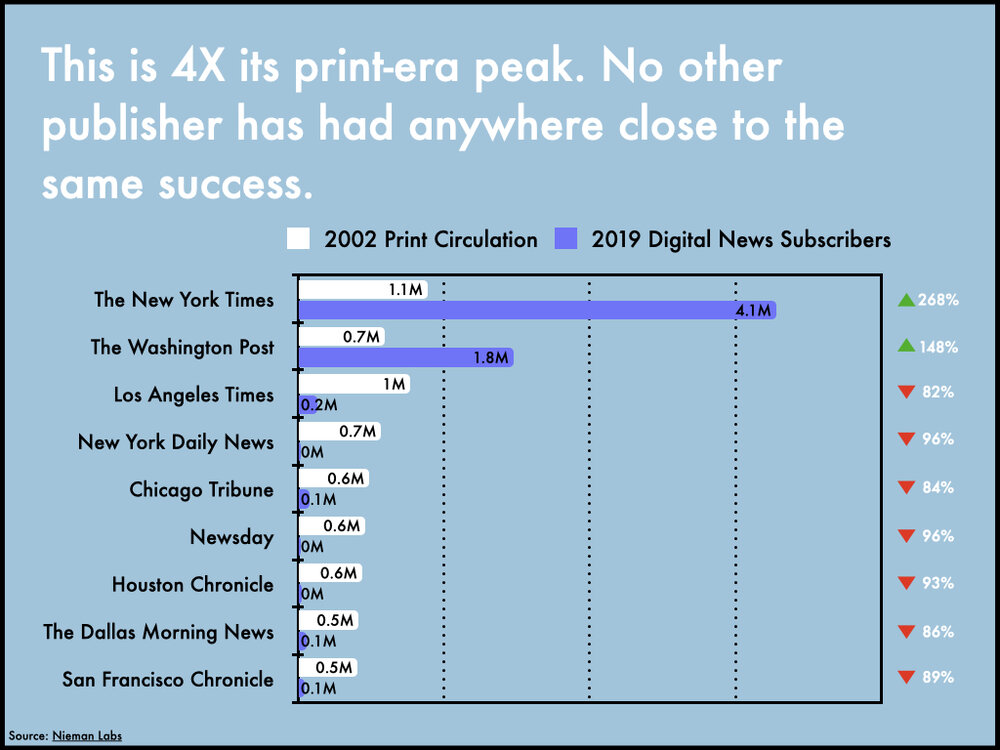
3. They have very few competitors that matter, compared to other online content businesses. In fact they have more subscribers than the next 100 competitors combined.

NYT Deck Images.107.jpeg

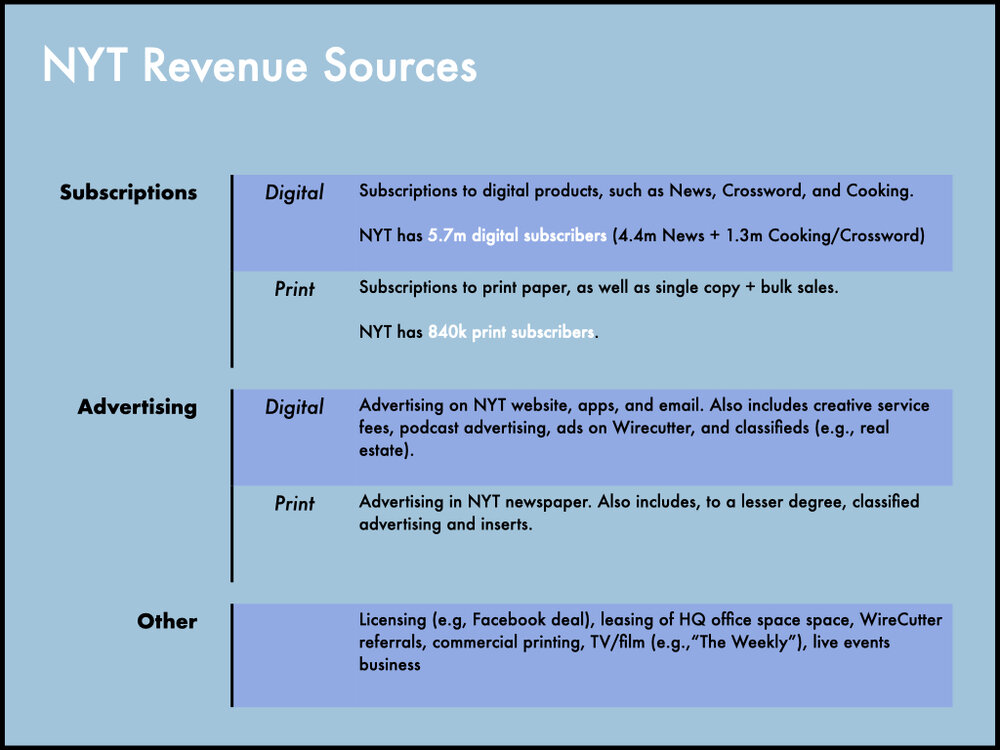
4. They have well diversified revenue streams, from digital, print and other sources, they are all growing and are profitable.

NYT Deck Images.123.jpeg

5. They have terrifically strong financials to survive the downturn, Covid and beyond.

NYT Deck Images.023.jpeg

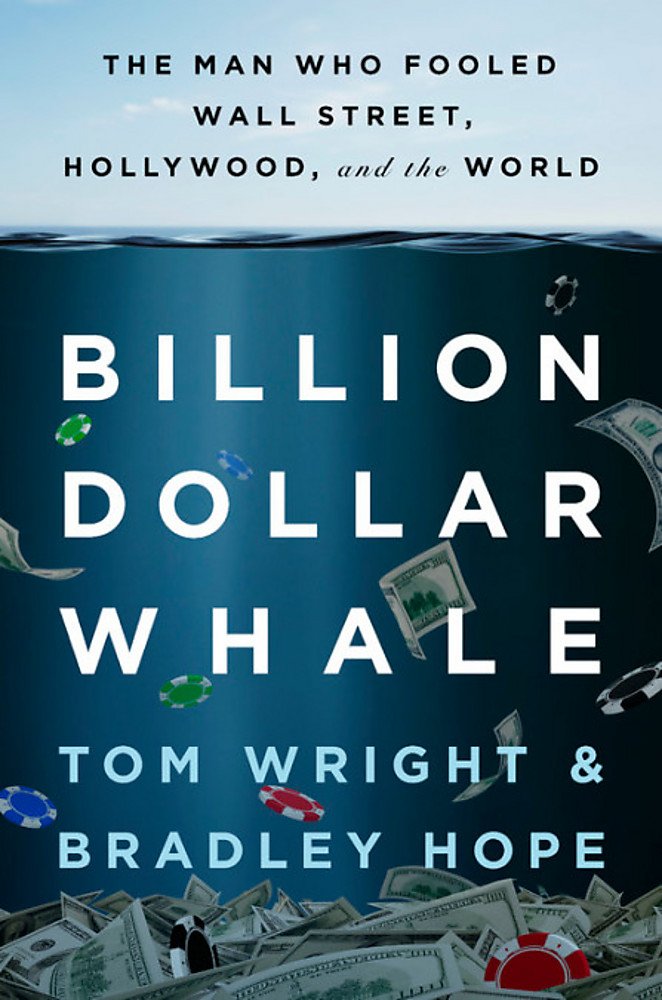
Billion Dollar Whale: Book Review – the Story of 1MDB and Jho Low

Amazon.com: Billion Dollar Whale: The Man Who Fooled Wall Street,  Hollywood, and the World (9780316436502): Wright, Tom, Hope, Bradley: Books
Billion Dollar Whale – the story of 1MDB and Jho Low

I was not too keen to read this book until I saw it was recommended by Bill Gates. The book was launched on Sep 2018, and is about 405 pages.

If you like crime thrillers (similar to Wolf of Wall Street) and financial crime books in particular (there are very few books in this genre), then this book is a must read.

I would give it 4/5 for story, eye for detail and pace. I suspect you can skip this book and expect to see the movie in the next year or so (because of Covid, it might launch later).

The book is the story of a young Malaysian called Jho Low, who came to study in the US (Wharton) after finishing school at Harrow in London.

Harrow schoolboy Jho Low is a real Wolf of Wall Street | Daily Mail Online
Jho Low at Wharton

After he graduated from Wharton in 2009, where he met many heirs of billionaires and other people from “old” money, he devised a scheme to raise a sovereign wealth fund for Malaysia. He did this by having the government (Prime Minister of Malaysia – Najib Razak was involved) sell bonds (loans) underwritten by Goldman Sachs and backed by from the Middle East.

Over the next 7 years, he controlled over $5 Billion in money and spent it on bribes, payoffs, kickbacks, parties (there is extensive description of the parties), art, music labels, movies (Wolf of Wall Street was financed by Jho Low), and debuachery.

He paid all the people involved by means of multiple numbered accounts in Cayman islands, Switzerland, Mauritius and controlled over 20 entities which moved billions of dollars globally.

The book itself has over 50 different characters, so it might be hard to keep up with the story. The 5 central characters are Jho Low, Najib Razak (the PM of Malaysia), his wife (Rosmah) – who had a penchant for luxury good and jewelry, the financer at Goldman Sachs (Tim Leissner) and the ambassador of UAE to the United States (Yousel Otiba).

Celebrities from Paris Hilton, Miranda Kerr, Leonardo di Caprio, Jamie Foxx and a host of others were all involved in some way as well, partying hard with Jho who had a very lavish lifestyle.

I suspect that the movie will be much better than the book, given the nature of this story.

Here are some Frequently Asked Questions.

How did he not get caught doing all this?

That puzzled me the most, but when you read the book, you realize he paid each and every person (bribes, kickbacks) he was involved with. Every one made money, so everyone partied. Even those in the Malaysian government connected to the Prime Minister benefitted. Goldman Sachs alone made over $500 Million dollars from raising money for 1MBD.

What happens to the loans?

Depending on which version of the story you read, there are over $11 Billion in loans outstanding. Most of that will have to be repaid by the Malaysian government, but others including UAE. Goldman Sachs paid the Malaysian government $2.5 Billion in exchange for the government dropping criminal charges against them. The assets purchased by Jho Low and Rosmah (wife of PM, Najib) have fetched over $1 Billion (including a yacht and over $300 Million of jewelry).

What are the consequences?

There are over 25 criminal and civil cases pending in the US, Singapore, Switzerland, Malaysia and UAE. They involve many Goldman Sachs employees, Jho Low and others. Najib and his wife are both in custody. Jho Low has not been apprehended yet and is purported to be hiding in China.

Here is a quick 10 minute video on 1MBD and the scandal.

What can we learn from Uber, Theranos, Zenefits, WeWork, Away, Thinx, Bouxtie, Luckin Coffee and Wirecard?

Silicon Valley: The home of 100’s of Unicorns

In the last 3 years there have been a raft of new startups that are privately held and valued at over $1 Billion. They are referred to as Unicorns. Many have gone public as well – some are expected to be Winged Unicorns.

First, some context. There are over 434 Unicorns, which has increased from 85 in 2015. Of these about 50 have gone public (or merged, acquired) already leaving about 380+ still privately held.

Of these, about 15 have been “bad eggs”, or about 3%.

These include: a) Uber, b) Theranos, c) Zenefits, d) Away, e) WeWork, f) Thinx, g) Bouxtie, h) Luckin Coffee, i) Wirecard and others in the bitcoin realm.

Even if you assume there are others (not publicized) and that number is twice the known ones, there are 30 “challenged” companies in a list of 450, or roughly 6%. I will let you make the judgement on if that is too few or too many.

I started to look at the key issues that came consistently among all the companies and their founders via books written about these companies – Bad Blood, Super Pumped, Hatching Twitter and Cult of We. There are no public stories about Luckin Coffee yet and the Wirecard issue is still new. The book on WeWork – Billion dollar loser is going to be released on Oct 20, 2020.

Five themes emerge:

  1. Founders motivated to make “a billion dollars” than “right a wrong” or “solve a problem”. Travis, Adam (founder of WeWork) and Elizabeth have been profiled from when they were young to be driven by money alone. In fact, when she was 5 years old, Elizabeth said “I want to have a billion dollars” when I grow up. She did not care how she got the billion dollars.
  2. Being young is an advantage, but lack of balance or wisdom is a huge detriment. Except in one case, the founders were young, between 20 and 30 years of age. While they were incredibly motivated, they also seem very one dimensional, i.e. focused only on what they cared about most at the cost of all else.
  3. Founder worship is a pendulum that has swung too far in one direction. The press and media (investors, entrepreneurs and the general public), have gone from being cheerleaders of successful entrepreneurs to devotees of the founders. Nothing that the founder can do seems to be wrong. These founders themselves were using Steve Jobs (for Elizabeth at Theraons) and Jeff Bezos (for Travis at Uber) as their role models. From the books it was clear that they took it too far, not understanding the person behind the person, instead only looking at other reported news or images and videos.
  4. Growth at all costs is a huge red herring. In all these cases, when growth (either in revenues, customer acquisitions, user adoption, etc.) stalled, growth hacking techniques were adopted, and some proverbial lines were crossed. When they could not show real growth, fake orders, revenues and customers (Luckin) were portrayed.
  5. Investors have a big part to play in this game as well. Unrealistic projections are “normal”. If you don’t have “hockey stick” growth or “eye popping numbers”, founders are pushed to get there. This is winner take all gone bad.
red and yellow heart sticker on black wooden door
Founders are expected to be Super human

The next question is what can we do about this in the near term?

First, being a good sounding board as a partner, member of advisors or mentor will help. Providing guidance to founders on ethical and moral issues to ensure they dont “flip the switch” will help. The guidance is to help balance the founder(s).

Second, most people working with startups understand there are many ups and downs. If there is an expectation that every quarter or month has to be “up and to the right”, then that creates unnecessary and artificial constraints that cause the most stress. Growth is important, but “at all costs” – is not.

Third, as an investor (or advisor, mentor) being a cheerleader on Twitter, LinkedIn is important, but it is also critical to be constructively critical about areas that need development – for the founder on a personal basis.

I am sure there are other many more actionable ideas on this topic, and a few “blots” on an otherwise clean and positive development (Growth of Unicorns) are bound to be around.

Book review: Bad Blood – The Theranos Story

Johnson Book Club - "Bad Blood" Pre-Book Discussion - Cornell

Bad Blood – the story of Theranos

I am a little late to this book. It was a best seller released in 2018 and is about 350 pages. Some (most, all) of you may have already read the story of Theranos in the press. I would give the book a 4/5.

The short version is that a young entrepreneur (Elizabeth Holmes) dropped out of Stanford University to start a company that would perform 100’s of blood tests (compared to tens) with drops of blood (compared to a syringe full) without costly and bulky equipment at a very low cost.

The book is about how she and her COO (Sunny Balwani) deceived investors, harassed employees, cheated partners (Safeway, Walgreens) and hoodwinked their board.

The book itself spans the 13 years (from its founding in 2003) to 2016 when WSJ exposed the company’s challenges.

The problem she was trying to solve is extremely hard. While she was a visionary, the number of challenges to overcome (mechanical, biological, chemical, mathematical, etc.) are at least 4-5 orders of magnitude more challenging than building an app for the IPhone or a SaaS product.

The big takeaways for me were a) fake it till you make is really bad advice, b) large companies like Walgreens and Safeway were worried about competitors, they had FOMO (Fear of Missing Out) and so they were wishing for this to work, giving up on good due diligence and c) the obsession that Elizabeth had for Steve Jobs borders neuroticism.

  1. The Silicon valley advice for most entrepreneurs is to “fake it till you make it”. An easy way to understand is is to pitch customers on a “product” that is ready when it is actually being developed, or to tell potential investors there are “many” customers in the pipeline. I fell for this line as well and took it to the extreme. My advice – never fake it. For whatever reason. Be authentic to yourself. If investors and customers dont want to buy your authentic self, then wait to make progress until they do.
  2. FOMO is real. In the book there are several times executives at Safeway and Walgreens (besides the executive champions at those companies) questioned the progress and the value of Theranos. They were always greeted by the executive champions with – “Yeah, maybe but what if it is true and the competitor launches this in a few months”? Startups can use this to their advantage in most cases. Find the thing that drives the executive champion and position towards that.
  3. Just like Uber founder Travis Kalanick (read the Super Pumped book review) was obsessed with Jeff Bezos, Elizabeth (founder of Theranos) was obsessed with Steve Jobs. While Travis was emulating Bezos’ business acumen, Elizabeth is portrayed at a neurotic person, modeling her dressing, voice, pitch and meeting schedule to mimic Steve Jobs.
Theranos and Elizabeth Holmes: What to Read, Watch and Listen To - The New  York Times

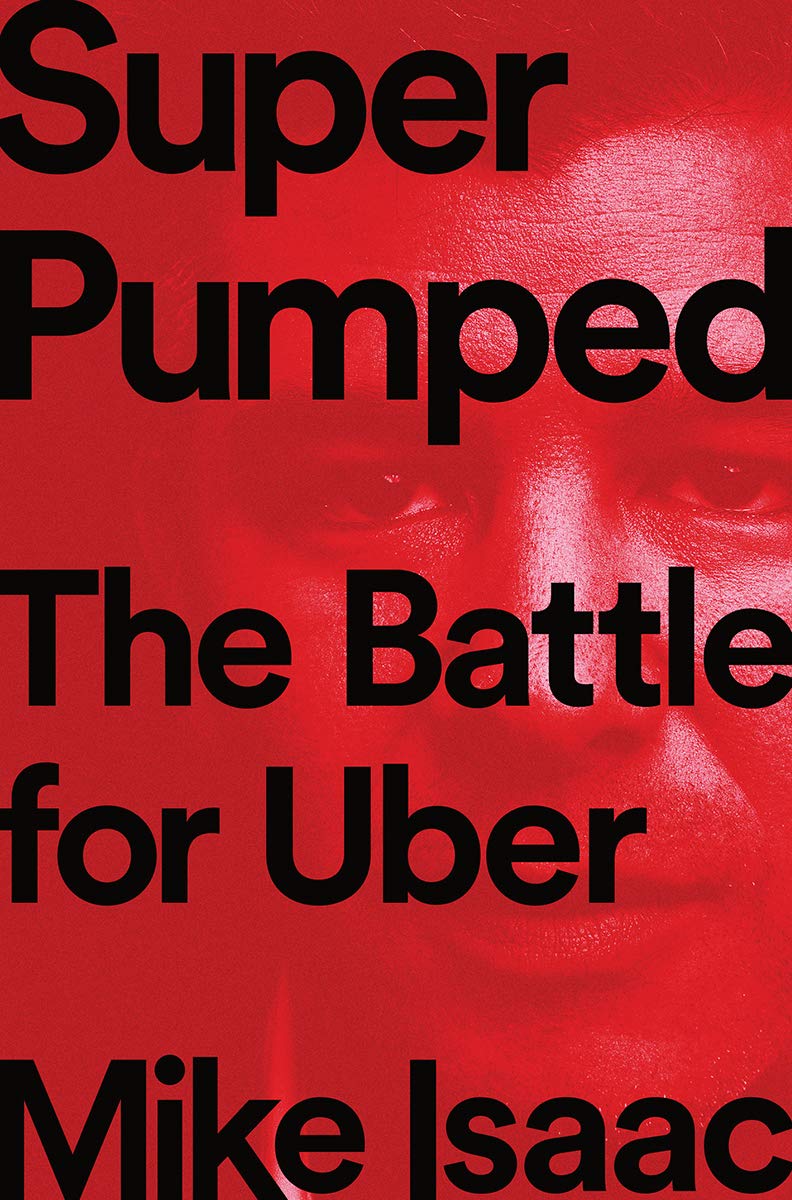
Super Pumped Book review: The Story of Uber and Frequently Asked Questions about Uber founding

Super Pumped: The Battle for Uber: Isaac, Mike: 9780393652246: Amazon.com:  Books
Super Pumped. The battle for Uber

It took me 2 days of fast paced reading (skimming) to complete the book that is about of the founding of Uber. The book by Mike Isaac felt more like a fiction drama than a book about a technology startup. The book was released in Aug 2019 and is about 400 pages. I would give it a 3.5/5. Fast paced, many twists and is a good read.

That is if you have not read any of the previously published stories and followed Uber at all. Most (of the passages and stories I highlighted – nearly 80%) had made it to the press way before 2019.

The book itself starts with the story centered around the founder, Travis Kalanick. Uber itself started in 2009, but the story of Travis and his previous startups were a precursor to his behavior. He had moderate success as an entrepreneur, but Uber was a very different league obviously.

There are about 10 main stories that I recall, but the main theme I took away was how focused on growth over all else Uber was – which was an extension of Travis’s personality.

While reading Bad Blood (a story about Theranos) it was clear to see that Elizabeth Holmes idolized Steve Jobs. Travis had that kind of an obsession with Jeff Bezos.

The difference here is that Uber was a wildly successful and entirely real company. Like Holmes, Kalanick was slowly found out, leading to Uber’s disastrous 2017, but still a great outcome for him (he is now a billionaire several times over).

He carefully studied the 14 leadership principles of Amazon and mirrored them at Uber with a twist of words on the same.

The list read like Amazon’s corporate values run through a bro-speak translation engine”

Mike Isaac

There is misogynic behavior, reckless law breaking, drugs, alcohol, surveillance of government officials, lack of privacy policies, blatant disregard for laws, in this startup story.

Super Pumped: The Battle for Uber

Travis was let go from Uber in 2017 after a coup by the board, but not after he had built a culture that was toxic at best.

Many of Uber’s employees seemed to share that value system. It was an environment where the risk prevention team might voluntarily figure out how to break Apple’s rules for the App Store or the fifth floor of Uber’s downtown headquarters may erupt in a round of cheers when someone who was sexually assaulted in an Uber “decided not to pursue litigation or if the evidence in a police report was not conclusive enough to prosecute”.

The question of potential consequences for any of the misdeeds detailed in the book is still up in the air. The trial of Anthony Levandowski (prison term) and review of other growth-at-all-costs tactics are still ongoing. 

There are many sub plots – #MeToo, #DeleteUber, the parties, rape trial in India, that I found it hard to see how Uber did not end up as a bigger disaster.

Travis viewed Uber as a crusader “battling the under-handed, street-fighting entrenched interests … who were colluding to keep taxi service bad and overpriced.” He would launch Uber into city after city without going through the usual regulatory channels, such as paying medallion fees required of cab drivers.

There is an entire section and set of pages devoted to how they tried to go around Apple’s privacy rules by “geo fencing” the app when used by the Apple store reviewers. On reading that I was shocked Apple allowed them to continue on the app store.

Super Pumped does a terrific job, however, of untangling the ethical and personality shortcomings of Uber’s early executives (which were many) with the broader meaning of Uber’s impact on transportation and employment.

Author: Mike Isaac

Was Uber Travis’s idea?

Garrett Camp, a successful entrepreneur, was annoyed that he couldn’t catch a cab quickly in San Francisco (SF). He sold StumbleUpon to eBay for $75 million. He tried several hacks to solve the “dial a cab” problem, but then finally settled on the app on the IPhone strategy.

Garrett became obsessed with the idea of Uber, a black car service that would be a market leader in private transportation. He shared it everywhere he went, even replacing the word “great” with “Uber” in his vocabulary. It took more than one conversation with Kalanick to convince him that Uber was a good idea.

Travis had a home in SF, he called the “Jam Pad”. It was there that he would jam on business ideas with friends. Camp happened to be one of those friends, and after some convincing, Camp persuaded Kalanick to join him as CEO of UberCab.

Were the investors complicit in this behavior?

First Round Capital, Lowercase Capital (Chris Sacca), Benchmark Capital (Bill Gurley), Saudi Arabia Public Investment Fund, Google, TPG capital were all the early (Series A, B, and C) investors in Uber. Only Bill Gurley and David Bonderman were on the board, besides Travis, Garret Camp and Ryan Graves (early CEO).

The investors however were happy to see the growth of the company and although they complained when Travis let go of the CFO, they did not do much. The book talks more about the board’s issues with not having a CFO and reckless spending of their invested dollars on pursuing the China market than the issues around the culture or the legal frameworks Uber was circumventing.

It was not until much later (2016 / 2017) when they were worried that their investment might amount to nothing that they took action.

What were the things that were most egregious?

  1. Uber built a system to evade authorities called “Greyball”.
  2. Uber evaded Apple’s app store privacy policies by tracking users even after they left the app.
  3. Uber turned a blind eye to employees and managers who were accused of sexual misconduct.
  4. Uber had a security breach of nearly 50K driver’s information and they never reported it.
  5. More than 16 drivers were murdered in Brazil before they improved the identity verification process and security in the app.
  6. Uber booked over 5000 fake rides on Lyft to prevent them from growing. They would book Lyft rides and cancel them, resulting in non-availability of Lyft rides for customers.
  7. Uber “hell” was a secret program to track drivers who drove for Lyft and Uber to entice them to drive exclusively for Uber.
  8. Godview or “heaven” was another program that tracked users extensively without their approval or permission.

Overall, I’d recommend a quick skim if you are into reading non fiction that reads like fiction – in the genre of “The Social Network”, ‘Bad Blood”, and “Hatching Twitter”.

Detailed Notes: Maria Shriver on I’ve been thinking book review

I wrote a review of Maria Shriver’s book I’ve been thinking. Here are my detailed notes on the book. These are her final thoughts.

There is nothing about life that’s predictable, so stop trying to predict it. Find every excuse you can to celebrate it.

Stop wishing you were a different age. Love the age you are.

Stop worrying about what others think. It’s a huge waste of your time.

Stop wondering if God is listening. Just have faith he is.

Be grateful to anyone who has ever loved you or tried to love you.

Know that bad stuff happens in life. You think you won’t be able to withstand it, but you can, and you will. Just as you have before.

Be kind to your body because it will be with you for life.

Trust me when I tell you this: Diets are a waste of time. I’ve tried them all.

Don’t believe people who tell you they can eat anything and still be that skinny. They’re lying!

Moderation in everything but laughter.

Don’t be scared to be a parent.

Trust your heart.

Make friends with your children’s friends. They’ll make you laugh and give you valuable intel.

Keep a pair of clothes from high school. Not to check if you can still fit in them, but for the memories they hold.

Hold your children over and over again, and then let someone hold you.

Get smart about money as early as possible.

Save something from every paycheck.

Buy comfortable sheets because you’ll spend a lot of time on them.

Know that no matter how smart you are, you can’t change someone else.

Stay out of other people’s business. Dealing with your own is a full-time job.

Be kind because everyone else is struggling, too.

Don’t engage in gossip. It always comes back and bites you in the butt.

Don’t mistake gifts for love.

Stay connected with your childhood friends and introduce them to your grown-up friends.

Make yours a generous tribe that’s connected not only to you, but to one another.

Spend time alone when you’re young, so being alone won’t scare you when you’re older.

Write thank-you notes to people for their time and their wisdom.

Regard both of those as gifts they’ve given you.

Look people in the eye when you talk to them.

And at least once, look into someone’s eyes for five minutes straight. You’ll learn something.

Sit down to family dinner every night. If you can’t do it every night, pick a night and make that a can’t-miss-it Family Night.

Play games with your kids. (My favorites are Capture the Flag and Uno.)

Give your children a Get-Out-of-School Pass to use for a special day with you.

Keep an open table and an open mind.

Be of service.

Travel with your kids. It will broaden their horizons and strengthen your bonds.

Don’t assume anyone is better than you or you are better than anyone else.

Don’t ever sit out an election. Living in a country where every vote counts is a gift. Use yours.

Stay connected to your siblings, and don’t come between them and their partners.

My four brothers are my past, my present, and my future—and I love their wives.

It’s a privilege to take care of your parents when they’re aging and ailing.

Learn how to turn off the critical voice in your head as early and often as possible.

Every year write down your regrets, then burn them and leave the ashes where they belong: in the garbage.

Listen to your gut. It knows more than anyone you’re asking for advice.

Practice prayer and meditation.

It will keep you in contact with yourself.

Never think your work life is more important than your family.

Don’t think bad stuff won’t happen to you. Learn how to push through.

Head up, shoulders back, keep on trudging.

Don’t allow anyone to shame you. If you don’t let them, they can’t.

Get good at forgiveness. You’ll need to practice it throughout your life.

Know that forgiving doesn’t mean going back to what was. It means going forward with love.

You get to decide what that looks like.

If you want forgiveness, ask for it.

Get good at letting go.

Don’t expect people to be perfect. Just as you aren’t, neither are they.

Learn how to communicate in your own home. If you can’t find your voice, get help. And don’t think that reaching out for help (see number 50) is a sign of weakness. It’s a sign of strength.

Therapy isn’t a waste of time. It can save a friendship, a marriage, your life.

If you marry and it comes to an end, don’t let anyone tell you that you’ve failed—and don’t tell that to yourself, either.

Be grateful for the love you had, the memories you made, the lessons you learned.

If you do have a self-pity party, make it short, and then move on.

Don’t see yourself as a victim. See yourself as brave.

Be brave enough to write your own story—and then rewrite it.

Be brave enough to try love after your heart has been broken.

Spend time in nature. It calms the mind.

Spend time with people who see you, celebrate you, and want the best for you.

Have faith that your best days are ahead of you, that your next frontier will be the most fulfilling time of your life, and that you deserve to be seen as good enough just the way you are—including by yourself.

Detailed notes, How to Fail at everything and still win: Book review

I write down detailed notes on each book, and in this case a friend who knows this, asked me to share my notes. Here it is. If you dont want to read this, then the short summary book review of How to fail at everything and still win big is available as well.

Highlights:

You need to be selfish, but not too selfish, to get what you want from life.
Maintaining a positive attitude despite the setbacks is key.
The only way you can secure your future fortune is by creating a system.

His formula for priorities is also very simple and easy to follow.

  1. Look after yourself first. This involves eating right, exercising, avoiding unnecessary stress and getting enough sleep.
  2. Look after your economics. That includes your job, your investments, and even your house.
  3. Look after all the other things. Your family, community, country and the world.

Build your life around systems, not goals

Adams first learned about systems from a man he sat next to on a flight. The man said systems had helped him go from employee to CEO, one in particular: going from job to job, always trying to find something better. It was simple enough and the more Adams thought about it, the more he preferred systems over goals in general. He says goals have two problems:

They’re in the future. To get an outcome on an unknown day far out, you have to put in work today. That’s depressing.


They’re specific. Unless you get exactly what you set out to get, you’ll be disappointed, even if you end up with something that’s pretty close or even better.

For example, if Scott had focused on trying to publish 365 comics in a year, each day would have been a potential failure until he had actually drawn something and no individual day would really have felt like a win, because it’s just 1/365th of the mission.

Systems, however, leave room to adjust your plans and make timing irrelevant. When you just focus on, say, publishing a blog post each day, every day when you do it feels like a win, the others are just rest days. And even if it takes 500 days until your work takes off, that won’t matter, because you never set a deadline.

Goofs use goals, winners use systems.

“If you want success, figure out the price, then pay it. It sounds trivial and obvious, but if you unpack the idea it has extraordinary power.”

Scott Adams

“Successful people don’t wish for success; they decide to pursue it. And to pursue it effectively, they need a system. Success always has a price, but the reality is that the price is negotiable. If you pick the right system, the price will be a lot nearer to what you’re willing to pay.”

“I make choices that maximize my personal energy because that makes it easier to manage all of the other priorities. Maximizing my personal energy means eating right, exercising, avoiding unnecessary stress, getting enough sleep, and all of the obvious steps. But it also means having something in my life that makes me excited to wake up.”

Do Creative Work First

In the morning, he is a creator, in the afternoon he’s a copier. Mindless tasks go later in the day. This is the single biggest change you can make to improve your odds of success.

Use space and time to manage your energy

Adams doesn’t believe in finding your passion. He believes in finding your energy. It makes sense. As long as you stay energetic and motivated, it doesn’t matter how many iterations of failure you have to go through until you figure out what works, because you’ll enjoy life along the way.

Scott suggests three specific angles, from which you can look at your energy levels:

Activities. What’s exciting and what’s draining? I, like Adams, hate shopping, for example, but love listening to music.
Space. I need to go to an office in the morning, whether it’s a coffee shop or a library. To me, home is relaxing. When you’re used to doing certain things in distinct places, don’t mix them with others.
Time. Some people are early risers, like me, others like sleeping in and kick into gear late in the day. The more you can adjust your work day to your internal clock, the better.

Don’t worry if you can’t switch to your perfect schedule right away. It takes some time to find and even more to implement, especially if you find you’ll need a different or no regular job to make it happen. But that doesn’t mean it’s not worth trying.

If you can manage your energy well for long enough, you can fail at almost everything and still win big.

Passion is bullshit

Most people think passion causes success, it’s usually the other way round.

Goals vs Systems

Goals are specific objectives while systems are to be followed on a regular basis. “Losing 10 pounds” is a goal, “eating healthier” is a system. Focus on better systems rather than goals. Systems-oriented people feel good every time they follow the system, goals-oriented are always busy chasing their goals and once they have attained it feel miserable (and start looking for another one). There are too many options (distractions) irrespective of the plan, the focus is important.

Deciding vs wanting

A lot of people want something, successful ones decide that they are going to pursue it and are willing to pay the price for the same.

Being selfish is important

Focus on self (be it food, exercise or career), once a reasonable level of success has been attained, you will automatically develop the feeling to start distributing its fruits.

Maximize personal energy
Always try to optimize personal energy (Something which you a positive mental or physical lift), some people enjoy solace, some crowded places, decide what maximizes your personal energy and do those activities in spare time. Maximizing personal energy is selfish but has the best impact on the person and his/her contribution to society in the long run.
Between optimization (doing many things optimally) and simplification (doing just a few things), pursue simplification in the long run since it maximizes personal energy.


Priorities (highest to lower)
Self > Personal finance > family > community > country > world.
Attitude


A positive attitude is not optional. Daydreaming, positive forms of entertainment, smiling, success (from anything spills into success in other fields), perceptions (even incorrect ones) – all contribute to the positive attitude.

Who you know is important
You don’t need CEOs and billionaires, just knowing friends who know different things than you are sometimes sufficient.

Recognizing your talents and knowing when to quit

Childhood obsessions and tolerance for risk are rough guides are talents.

Deciding when to fight against an obstacle and when to quit is difficult, things which someday work out well, start out well (albeit small success), things which start bad usually never become successful.

Repetition vs Novelty based jobs
Some jobs require a lot of practice (eg. sports), some require a lot of disciplined study and novelty (eg. software engineer, entrepreneur), decide which one suits your nature and choose a career path which is in line with your nature.

Managing your Odds of Success
Every new skill you acquire doubles your odds of success.
It’s better to be good at two complementary skills than excellent at one.
The more you learn, the easier it becomes to learn even more.
Read news about topics which interests you and which are positive in nature (avoid reading a lot about tragic events).

The Math of Success
Some skills increase odds of success – public speaking (Dale Carnegie’s course), psychology (List of biases), business writing(eg, using active over passive), accounting, design(basics – the L-shape), conversation, overcoming shyness, second language, golf, proper grammar, persuasion (being decisive, using write responses), technology and proper voice (pitch).

Pattern Recognition
Learn to recognize patterns in life.
Certain patterns are direct predictor of success.
As per the author, lack of fear of embarrassment, education, exercise and looking at success as learnable skill are major patterns for successful people.

Humor
It’s not just a form of entertainment, it helps in developing more social connections as well as boosts personal energy.

Affirmations
Repeat to yourself what you want to achieve while imagining the outcome you want. It improves the odds of success.
The author is careful at pointing out that there might a coincidence or his selection bias in play here.

Timing is luck too
Don’t ignore the importance of timing in success.
The world is like a slot machine where one has to put time, focus and energy and occasional rare payoffs can be big.

Experts
Experts are 98% right on easy cases but only 50% on unusually complicated cases.
If your intuition disagrees with experts, go with intuition, it could be an indicator of some pattern recognition which you can’t yet verbalize.

Association Programming
Humans are social animals, we are influenced by people near us.
Spend time with people who most represent what you would like to become. Their good habits and energy will rub off on you.

Happiness
Happiness has more to do with self than with the situation.
Happiness has more to do with direction than the current situation (when things are going in the right direction, we are happy).
In a career, improvement of skills makes a person feel happy. So, focus on a career where you can improve over time.

The imagination of a brighter future makes a person happy.
Exercise, diet (eat right) and sleeping enough strongly influence happiness.

Routines make us happy since they reduce the number of choices we have at any time (more choice makes us unhappy). Reduce daily decisions for routines.

Help others (after helping yourself).

Diet
Food impacts a person’s mood. Pay attention to energy level after eating certain foods.

All humans are different, find patterns in food, which food makes you feel better, which ones make you feel sleepy.
Remove unhealthy energy draining food from home and stock convenient healthy food instead.
Get enough sleep, tiredness causes the illusion of hunger.
Willpower is a limited resource, using that to fight against cravings is a bad idea instead author suggests an alternative, make a list of healthy food items and decide that “you will eat as much of healthy food items as you can”.

Over time, you will stop eating unhealthy food, in the long run, the habits of eating healthy food in limited quantities will become the norm.

Getting recommended dietary allowance with just food is impossible.
If eating for social reasons, choose the lowest calorie options.
Author’s diet consists primarily of complex carbs (like nuts), protein bar, fruits, and fish.
Don’t make healthy food bland by avoiding butter and salt, it’s better to eat healthy food with butter and salt than an unhealthy one.
The author recommends a vegetarian or near-vegetarian diet.
Coffee has higher highs and lower lows which aligns with creative workers, while it does make a person addicted, the trade-off is worth it.

Fitness
Be active every day – don’t use willpower to decide workout and don’t do things you don’t like. Do anything which feels pleasant, walking is fine too.
Always exercise at the same time (routine).
Try Exercising with the spouse if married.

Don’t burn yourself out so that, the next day you won’t be able to do it.
Reward yourself after workout eg. relaxed reading for a while after a workout.

Failures
Failures will happen from time to time, learn from them and come forward because of that learning.

Scott Adams How to fail at almost everything and still win big? Book review and FAQ

How to Fail at Almost Everything and Still Win Big: Kind of the Story of My Life by [Scott Adams]

How to fail at almost everything and still win big – Scott Adams

This book was recommended by Tim Ferris in his book Tools of Titans. Scott Adams is the creator of Dilbert and a successful writer, cartoonist and philosopher (as well) now. The book was published in 2013 and is 247 pages.

There are 5 major concepts in this book that I have summarized – they are a) improve your personal energy, b) improve your luck by learning multiple skills, c) focus on systems not goals, d) develop a habit of simplifying not optimizing and e) affirmations work.

There are multiple book reviews of this book since it has been published 7 years ago, so I am going to only focus on the ONE takeaway that I am implementing starting today. I will give you multiple examples of how this has affected my life so far and how I think it will improve it going forward.

Focus on systems not goals

In 2013 I was about 175 Lbs (80 Kgs). I was not overweight but I was heavy. I went for my annual checkup when I learned that I would be a higher risk for diabetes with my weight. So I set myself a goal to be 150 pounds in 3 months. I was exercising daily, sleeping well, but I have a fondness for chocolate and snacking.

In 3 months I hit my goal and then some, I was 146 pounds. Thrilled.

3 months after hitting my goal I was at 155 pounds. Not bad, but not great either.

6 months after hitting my goal I was at 160 pounds.

I set myself a new goal – 140 pounds in 3 months. You know the drill.

I hit the goals I hit consistently, only to not be able to keep up after.

Why Do Dogs Chase Cars? | SlimDoggy
The perennial dog chasing the car

In hindsight it was the classic dog chasing a car. Once I got to the goal, I did not know what was next. I could put a new goal – e.g. Maintain the weight at 145 lbs, but was not as motivating.

The answer according to Scott is to build a system – e.g. change behavior with small habits that is repetable everyday.

This actually makes sense in the context of the weight loss. By limiting what I eat daily to a few set of thing that I can repeat, I create a mechanism to see the long term rewards of my system.

Now that does not meant you dont have goals. I read this as have a goal, but put a system in place to support long term changes and goals.

If you focus on a repeatable system you will likely hit the goal.

Now for the frequently asked questions.

Does this apply to work (as opposed to personal goals)?

I think it does apply to everything. Goals are important, but if you can create a repeatable system (mechanism in Amazon’s vocabulary) you are more likely to see the long term effects of your habit change.

Do systems help with short term or long term progress?

It is easy to say they help with both, but in my experience systems help more with long term changes you want to make.

Should I give up setting annual goals then?

A SMART goal is very useful and important. It helps you focus on achievement. Without goals you are not sure what you want to achieve. How you can sustain that achievement is by putting a system in place.

What role do systems play in motivating you to achieve the goal?

Systems replace motivations with a routine or process. Once you set a goal and hit it, you are likely to focus on the next thing. Sometimes you up your goal. E.g. after my weight reached 145 Lbs I thought the next goal should be to maintain it, but the motivation to stay at that weight was not as high.

It is easy to measure progress toward a goal. How to you measure systems?

Lets take the example above.

The goal: Lose 25 lbs in 12 weeks. Roughly 2 lbs a week. A goal is easy to measure. So I will eat less every day (lets say 1000 calories) to make sure I am making progress towards losing weight. The metric I track is my weight. If it goes up or down a day I will have to adjust my eating the next day accordingly.

Lets say I wanted that goal, but I now put a system in place to eat 1000 calories a day instead of my usual 1200. The metrics I track the # of days I am sticking to that system, instead of tracking the weight. That way the system helps me in the long run by tracking the # of days I stick to 1000 calorie diet.

Top 10 Frequently Asked Questions about SPACs (Special Purpose Acquisition Company)

SPAC IPO Listings on Nasdaq | Nasdaq
Hat tip: NASDAQ blog

1. What is a SPAC?

A SPAC is a Special Purpose Acquisition Company, also called blank check companies. These companies raise money in the public markets without having operations. They raise money so they can acquire a company. The company has an “IPO – Initial Public Offering”, only to raise money from external investors.

In simple terms think of them as getting a mortgage “pre-approved” before you buy a home. It is not exactly the same, but close.

SPACs look for companies that are private, which they can acquire and take public.

SPACs are usually run by experienced management teams who understand a market or industry well and want to buy a company (or a few) and take them public.

2. How many SPACs are there?

According to SPAC databases, in the last 11 years (2009 – 2020) there have been over 380 companies that have raised money in a SPAC vehicle. In 2020 alone, over 130 companies have raised money using SPACs. The most famous SPACs have acquired Virgin Galactic, Nikola, Draft Kings and Pershing Square Tontine Holdings.

3. How do SPACs work?

Similar to an IPO, the management team registers with the SEC, does a roadshow (presentations to potential investors such as pension funds, mutual funds, hedge fund managers) and requests commitments for capital.

Lets say SPAC-You wants to raise $200 Million. They might get commitments from 50 investors to raise that capital. They go public and the stock now lists at $10 per share to start. The money raised is held in a trust until a target company is identified, e.g. MyTechCo.

MyTechCo will now be acquired by SPAC-You, which puts the $200 Million into that investment. MyTechCo is free to raise more money as well, but it reduces the time and effort to go public and the cost as well.

In the old IPO method, 3% – 7% of the money raised goes to the bankers. Typically SPACs only charge 2% of capital raised.

4. Who invests in a SPAC?

Institutional investors such as Mutual Funds, Family offices, Pension Funds, Hedge Funds, Corporate funds, Endowment funds, Private Equity funds and Insurance companies invest in SPACs.

Retail investors (you and I) can also buy shares in a SPAC. They tend to be VERY long term investments. It would take at least 2+ years to see any movement in the stock price.

Stages in the life of SPAC | Download Scientific Diagram

5. How have SPACs performed?

Of the 380+ SPACs there have been about 10 that have outpaced the market, 20 that have performed below par and about 200+ that have still not made any acquisitions.

6. Why is there such a big interest in SPACs?

The main reasons are the cost of going public has been high and there are over 400+Unicorns (private companies with over $1 Billion in market capitalization). Over the last 2 decades the # of public companies has halved in the US. There are more companies going private than going public, and more companies getting acquired.

SPACs give companies capital without a short term quarterly focus on earnings (for a limited time) and have more patient investors.

7. Which are the most successful SPACs?

The most successful (in terms of money raised) have been

Pershing (PSTH.U),

Churchill Capital (CCIV.U),

Flying Eagle (FEAC.U),

Dragoneer Growth (DGNR.U) and

Red Ball Acquisition (RBAC.U).

8. How many businesses can a SPAC acquire?

A SPAC usually merges with one privately held company.

9. How do I go about starting a SPAC myself?

Going public
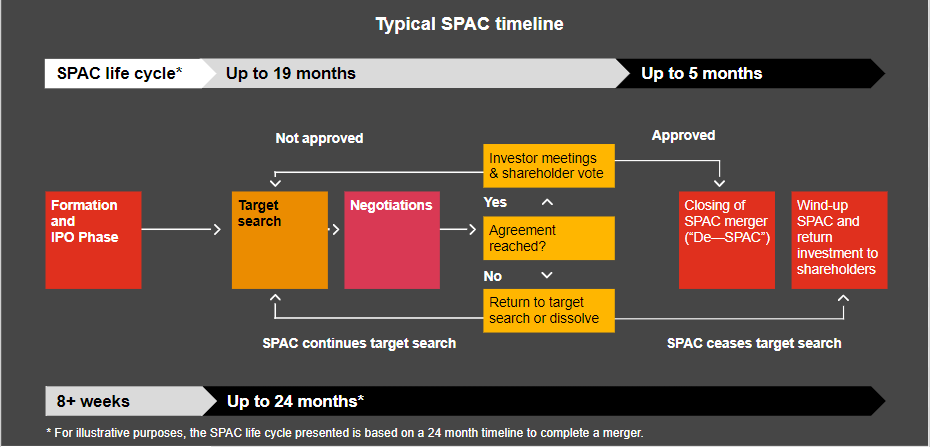
HBS report on SPAC time line

With a good management team, a banker to help you raise (or put together your own roadshow), you can raise a SPAC with all the legal paperwork to help you register with the SEC and launch one in 2-3 months.

10. What happens to the money in a SPAC?

The money raised by a SPAC is initially held in a trust until there is a target acquisition company.

Bonus Q: Should I invest in SPACs?

Since there is very little information available about SPAC (they have no operations) the founders and the team sponsoring the SPAC is crucial. Research the team well before you invest. You should have a 2-5 year horizon for the funds to generate value (if at all).

Book review and top FAQ: Maria Shriver – I’ve Been Thinking

I'VE BEEN THINKING... | Kirkus Reviews
Maria Shriver I’ve Been Thinking

This book was recommended as a top 100 spiritual books of 2020. It was published in 2018 and is about 240 pages.

Maria Shriver is a well known writer, philanthropist and former first lady of California. She is also part of the Kennedy family – John F Kennedy’s niece. This book is a collection of her top 20 or so prayers, meditations and thoughts to live by.

It was breezy read and took me under 2 hours. I did not “reflect” as much, since most of the key takeaways from this book have been mentioned in multiple books I have read recently. I would give it a 3/5. If you have not read other books in the spiritual genre then this is a good read. The Power of Now by Eckhart Tolle is a much better read.

What is the top takeaway from this book?

To lead a life of purpose, you need to a) live in the present, b) be grateful, c) think positively, d) develop inner strength (intestinal fortitude and e) be empathetic.

What is different about this book than others?

While the pithy’ s are the same 10-12 things (5 of which I have already mentioned), the difference in this book versus others is the prayers that are included. These tend to be 5-10 lines each.

For e.g. in the chapter on “The Power of Letting Go”. instead of a personal story, the prayer is

“Some people believe holding on and hanging in there are signs of strength. However, there are times when it takes much more strength to know when to get go and then do it.”

Ann Landers

What are the key often repeated statements to find purpose?

  1. I am who I choose to become (believe in yourself.
  2. Work on intestinal fortitude. Be strong of mind
  3. Life is yours to create – you control your destiny
  4. Power of peace starts from within – look to change yourself
  5. Power of Gratitude – be thankful for what you have
  6. Power of the mind – train your brain
  7. Power of pause – slow down
  8. Power of Listening
  9. Power of Empathy
  10. Power of Letting go – dont have regrets
  11. Power of thank you
  12. Power of laughter
  13. Power of faith
  14. Power of prayer and meditation
  15. Power of forgiveness
  16. Power of your story
  17. Chasing the illusion of perfection
  18. Acceptance is the path to finding peace
  19. Courage to care – for others
  20. When life throws you a curveball – walk into the woods – find a mentor
  21. It is okay to grieve
  22. Give up on complaining
  23. Stop trying to go it alone
  24. Looking for a light in the cracks – silver lining
  25. Why we need time to think and reflect

The personal blog of Mukund Mohan