How do I become a CTO?

CHIEF TECHNOLOGY OFFICER: A ROLE GUIDE

A frequent question I get that I want to help answer in the next few blog posts is “How do I become a CTO? or Chief Technology Officer.

I used to give a few simple answers before: a) Focus on building a great technology profile -e.g. GitHub profile, speaking engagements, etc., b) Network as much as you can with potential founders and c) Learn as much as you can about the business elements of your industry, especially customer trends.

I realized these were good enough for a 30 minute career counseling call, but not very valuable for people who want to plan their career for the long term.

Now that I have more time, I thought I would take a data driven approach to answering this question.

There are great articles on what a CTO does, so I am not going to answer that question.

Instead lets focus only on what it takes to become a CTO.

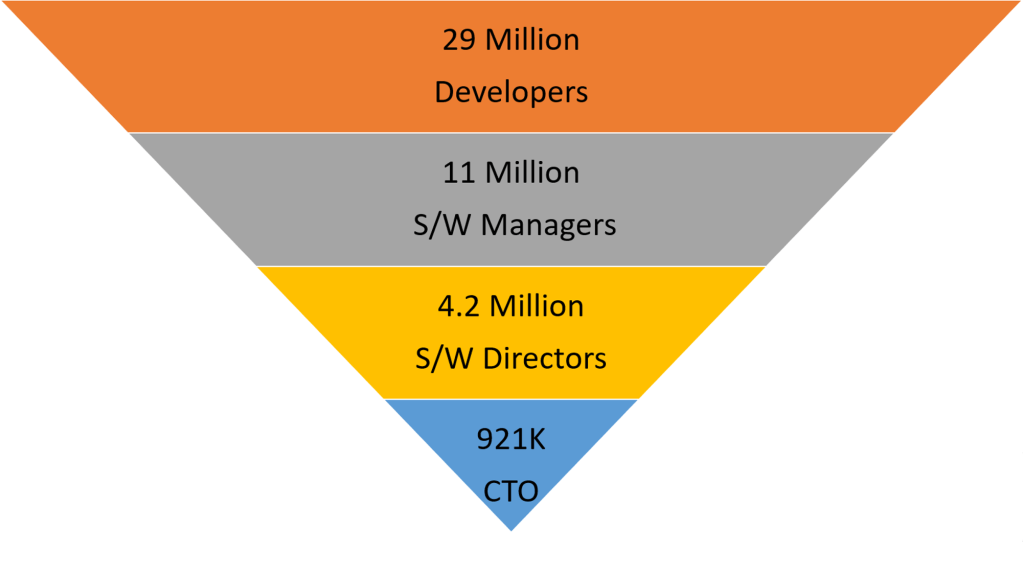
There are about 780K people with the title “CTO” on LinkedIn and roughly 159K with the title “Chief Technology Officer”.

Filtering them by size of company, indicates 11% are in large organizations (> 10K employees), and over 75% are in small (<100 employees). Many of the large organizations have multiple CTOs (e.g. Microsoft has 38 people in my network alone with a CTO title). Many of them are CTO of a specific business unit, or industry vertical function.

Segmenting by location, 38% of CTOs are in the USA, 27% in Europe and the rest in other locations.

There are 29 Million software developers in the world.

So roughly 1 in 30 software developers could become a CTO.

In my LinkedIn network, I have 1st degree connections with 541 colleagues with the title of either CTO or Chief Technology Officer.

I spend a few hours learning to deploy a LinkedIn scraper. It took me a lot longer than I thought it would, but that’s another story.

I scraped my network for 7 parameters:

  1. Name: E.g. Mukund Mohan
  2. Title: E.g. Chief Technology Officer
  3. Location: E.g. Greater Seattle Area
  4. Company / Organization: BuildDirect
  5. All organizations they worked at before, title and tenure in each organization. E.g. Director of Engineering, Microsoft, 5 years
  6. Education: E.g. Bachelor of Engineering and years at school (If available)
  7. Skills: e.g. product management, startups, etc.

I put this data into an CSV file just to view it in an easy way for me to visually review it.

Three patterns (or archetypes) emerge:

The career technologist (52% of my network)

This individual has over 16.5 years of average experience after graduating, working at 4.6 organizations with an average tenure of 6 years in each.

This indicates that the most frequent way to become a CTO is to have tenure as a developer and grow in organization(s) over time. There were CTOs with over 27 years of experience in my network, and the lowest in this segment had 14 years of experience as a technical leader.

Some examples: Kamal Hathi, Joseph Sirosh and Marianna Tessel.

The startup technologist (35% of my network)

This individual has about 10.2 years of experience after graduating, working at 3.1 organizations with an average tenure of 3 years in each.

This indicates the 2nd most likely way you can become a CTO is to start your own company (likely with a co founder). I tend to have more startup CTOs in my network than others do, so this may be due to my background and experience.

Some examples: Tom Harel, Aravind Bala and Farah Ali.

The fast break upstart (6% of my network)

This individual has 8.7 years of experience after graduating, working at 2.3 organizations with an average tenure of 4.6 years.

This archetype is unique and hard to find because they were at the right place at the right time. They joined a fast growing company (Google, Facebook, etc.) at the early stage and grew with the organization quickly enough to then get a role elsewhere as a CTO.

Some examples: Gaurav Oberoi, Palak Dalal

The rest (7% of my network)

The rest are a motley crew of technologists with long tenure, but I am not able to put them into a specific bucket. They have done several roles, including software development, product management, etc.

In the next few posts I will address questions such as

How do I direct my career to become one of the 30 people who can become a CTO?

How can I put a plan together to achieve my goal to become a CTO?

Where do I look for CTO positions?

What compensation and equity should a CTO at a startup expect?

How to bring the X-Factor in your role

I am going to start writing again. This is for myself. I don’t expect anyone to read this. I am trying to rebuild my confidence after having lost and still not regained it, the best way for me to do that is to journal.

I met a banker a few months ago. He was the CEO of a small bank and very engaging.

I expected him to be a banker and meet my perception of bankers – conservative, risk-averse, do-it-by-the-book type of people.

He was all that. What surprised me was he had one other thing.

He was willing to be creative.

His follow up was excellent and he was engaging (asking a lot of questions about my ideas and business, as opposed to only questions related to finance and accounting).

He was an unexpected swan in a river of ducks.

Which is why I enjoyed working with him and respect him a lot.

Which brings me to the point about the X-Factor.

Most people expect you to play a role and fit their “stereotype” when they interact with you.

For e.g. Sales people are “expected” to be outgoing and gregarious. Engineers are “expected” to be introverted and detail-oriented.

What if your X-Factor is that besides having the expectations of the role or title that’s expected, you also have another trait or characteristic that is unexpected?

Like in the banker’s case the ability to think creatively.

Those are the folks who are highly valued, I think.

Screwing up

I did screw up. Cant’ say no. I hurt people who trusted me, believed in me, and now are besides themselves. Unfortunately I cannot talk about the details given the legal circumstances, but I truly apologize.

I am sure most people cannot forgive me. Unfortunately throughout my career, I hurt many people either because I was blunt or because I was mean spirited.

I own my mistake, and now I have to course correct. Seeking help is what I am doing. I think the road ahead, though, will be very long.

If you have been trying to reach me, I apologize for not returning your email or WhatsApp note, text or LinkedIn message. I just don’t know yet how I can face or talk to anyone. Most days are filled with tears, reflection and a series of questions about “Why” or “What prompted this”?

Until I can answer those questions, I will have to keep to myself.

I am truly sorry. I don’t ever expect things will be back to “normal” again for most / all of you. I don’t blame you for it at all. I am not taking the high road. I know it is very hard to recover from breaking trust.

I have to now over correct to the other side and fix myself for the sake of others who I have to help.

What matters? SKILL OR LUCK – a thesis paper summarized

In 2013, I read a paper by Credit Suisse – Alpha and the paradox of Skill. In the podcast “How I built this” – the host Guy Raz interviews successful entrepreneurs and ends with the question “Do you believe your success was luck or skill and hard work”? If you look at summary of answers to that question, successful people attribute 60% to luck and 40% to skill – on average.

Back to the paper on paradox of Skill. The summary of the paper in one quote:

In investing, as in many other activities, the skill of investors is improving on an absolute basis but shrinking on a relative basis. As a consequence, the variance of excess returns has declined over time and luck has become more important than ever.

Credit Suisse, 2013

To be clear there are opportunities for skill to shine. Those are opportunities where “game” is played by people with lesser skill.

The main lessons are that sometimes it’s more important to worry about the game you’re in than the skill you bring.

Summary of the REMITTANCES market Worldwide and key players

The WSJ has a piece today about the worldwide remittances market. It is roughly $554 Billion worldwide with the top recipient countries (no particular order)

  1. India $46B (from US, Dubai and Saudi Arabia), 3% of GDP
  2. Mexico $38B (from US primarily), making up 3% of GDP
  3. China $24B (<1% of GDP)
  4. Pakistan $11B (8% of GDP)
  5. Philippines $20B (10% of GDP)
  6. Guatemala $10B
  7. Vietnam $12B
  8. Bangladesh $15B
  9. Ukraine $11B
  10. Egypt $9B
  11. Nigeria $8B

The market was largely owned by Western Union, but now a host of startups are in the space including:

  1. Transfer Wise
  2. Xoom
  3. Remitly
  4. Money Gram
  5. Ria

What is force Majeure and why is it trending on google search?

The impact of Covid19 on several businesses is catastrophic. Many businesses entered into contracts with vendors, suppliers and partners for their business.

In legal terms, “Force Majeure” means a clause that has an “out”, caused by an event or effect that can be neither anticipated nor controlled. You may no longer meet the obligations of the contract since the events (e.g. Covid were beyond any parties control.

A force majeure clause in a contract would typically include an exhaustive list of events such as acts of God. War, terrorism, earthquakes, hurricanes, acts of government, explosions, fire, plagues or epidemics or a non- exhaustive list of events wherein the parties narrate what constitutes these events and thereafter add “and such other acts or events that are beyond the control of parties”.

Can Covid19 be a reason for Force Majeure?

You most certainly should consult your lawyer, but there are multiple startups I know that are reducing their ongoing costs of systems and technologies, by invoking this clause.

So how do we get back to the “new Normal”? #AFterCovid

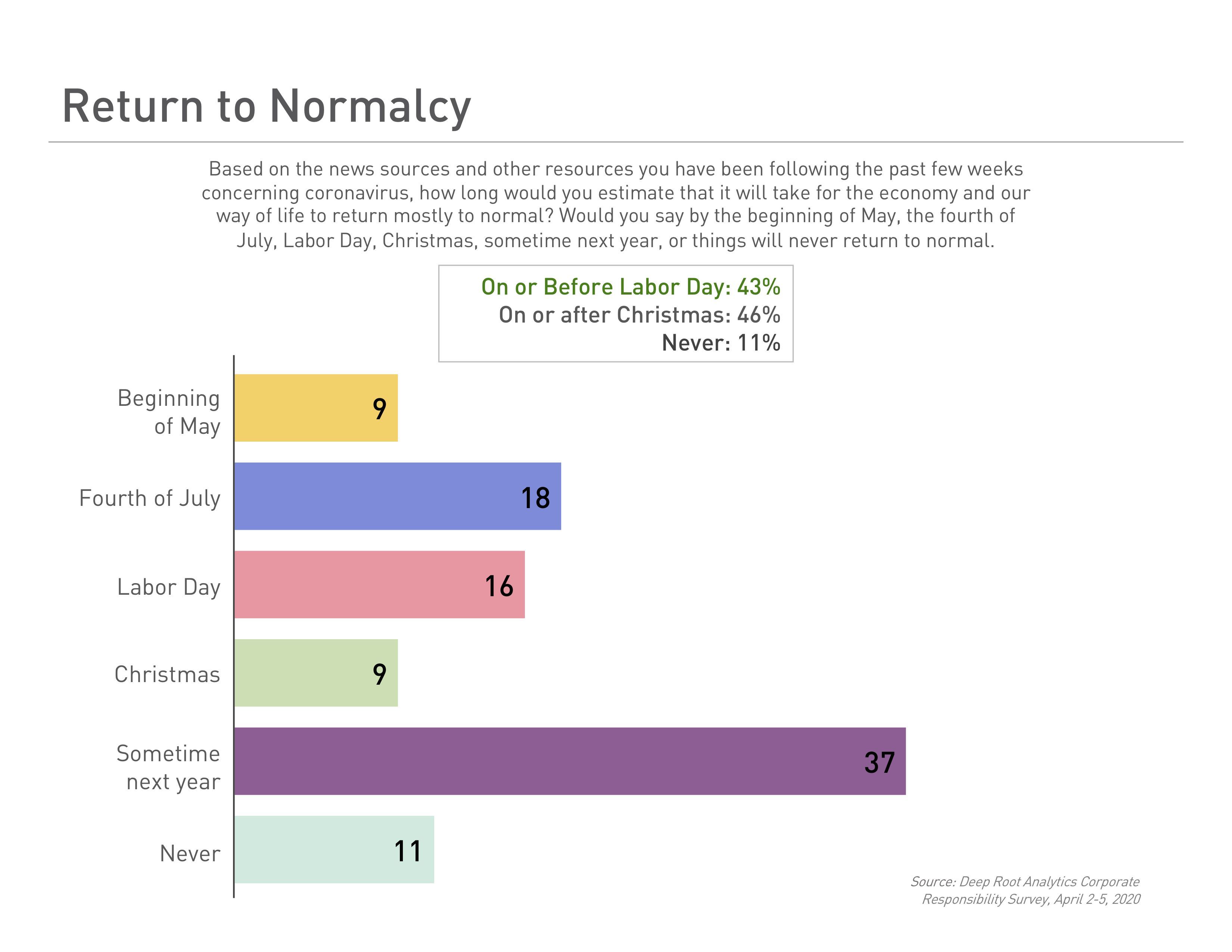
1 in 10 Americans believe economy will never return to normal from ...

The biggest bottleneck with Covid19 right now is rapid testing and centralized reporting. If we can fix that then we can start to reopen “parts of the quarantine”.

Most data points to the fact that people who are suffering or dying from Covid19 are those who have preexisting medical conditions or poor immunity (old, infirm, etc.).

That is likely between 5% to about 15% of the population. (source)

The rest of the people would likely suffer mild to no symptoms from CoVid.

Instead of allowing them to go about their lives, everyone’s life is being disrupted to ensure the 5-10% dont die.

In no way am I implying that the 5-10% be dammed. In fact we should take more precautions to ensure they are safe. Quarantine them, provide extra medical attention, support and safety.

If we had a quick (say < 15 minutes) way to test Covid and an easy way to aggregate the data and report it to local, regional or central authorities, then those who dont test positive could be allowed to go on with their lives.

So how does this play out?

Imagine 5-10 startups that are all innovating on “rapid test” with reagents from your home. They send you a kit (pack of 12 test kits), you take the test and test results are uploaded to a service via your phone. If the test is positive, you have to quarantine. If the test is negative, you can go to “work” or elsewhere. Assume the tests will be valid for some short period – maybe a day if you are in a high exposure role (e.g. nurse) or once a week if less so (e.g. software developer). This sounds simpler than it is, but bear with me for the sake of argument.

Each kit comes with its own app to upload results, and they are all reporting their aggregate and specific data to local government.

Now public health and other officials know who is and who is not infected and can provide “discerning guidance”, instead of a diktat for the entire population.

Now to the next question: How do we ensure that those that don’t test positive infect those who are old / infirm / or with poor immunity?

More than ever we need the strong and able bodied to help those who are unable.

So the precautions that are recommended by physicians and medical professionals apply more to those that are infirm that those for who this is “like a flu”.

Wash your hands, use masks are all good recommendations regardless of whether you test positive or not. Everyone should take those recommendations.

Having everyone have their lives upended is hard for 85% – 90% of the population.

Only rapid testing can solve that for now.

Thanks to Bal for helping me think through this.

The Great Mobile App Migration of March 2020

Over the last few weeks as many in the world have been in lockdown, there has been a temporary “mobile app migration” happening. There are new apps downloaded and they replaced existing apps on the “home screen”.

While some of these apps are likely temporary use, for e.g. I have 6 “conferencing apps” – Zoom, Uber Conference, Webex, Google Hangouts, Blue Jeans and Goto Meeting. That is because of the many people I have conference calls with – each company seems to have chosen a different web conference solution.

Other apps seem like they will have staying power – Houseparty, for e.g. which has games, networking and video conferencing all built into one app to keep in touch with friends and relatives.

Houseparty

The apps that have moved away from my “home” screen, which I expect will come back once the crisis will be behind us include – Uber, Lyft and all the airline apps from Delta, Alaska and United.

What is Flexfacturing: Response to covid19 from Manufacturers

Over the last 2 weeks multiple companies in many regions have started to re-purpose their manufacturing to support new requests due to COVID19.

Flexfacturing is “flexible manufacturing” – the ability to use a production facility and assembly to “easily” move to manufacture another product based on demand.

Here are some examples:

  1. A textile manufacturer has started making masks in Gastonia, NC.
  2. Anheuser-Busch, a maker of beer will start to make and distribute hand sanitizer – the same for LVMH & Zara
  3. Distilleries in New York are making hand wash soap and anti-bacterial detergent

This is the transformers meets manufacturing. Companies finding out (for altruistic reasons or otherwise) that what they are building has low demand, and something else has high demand.

I believe this trend will continue to happen after Covid19. More manufacturing facilities will be spawned in multiple locations that are built from the ground up to be flexible.

That is Flexfacturing.

15 things that Can change because of the coronavirus in the next 5 years

Here are a list of 15 initial things that will change I believe because of the coronavirus (#covid19) in the next few years.

  1. First meetings go virtual. I get about 3-5 requests on LinkedIn with people wanting to meet for coffee to network. I don’t drink coffee but I like to network. Instead of asking “where / when should we meet”, it will get to be “when can we meet virtually”. This is not going back.
  2. More people get employed by the government globally. Until now, the western countries have largely had the military and certain government functions federally employed and many teachers, firefighters and police employed by local government. To guard against more future outbreaks, more medical professionals (not specialist doctors, but nurses, etc.) will come under government employment.
  3. Just like the “strategic oil reserve” in the US, or the “pork reserve” in China, more countries will start to have strategic “medical reserves”.
  4. Significant number of older (greater than 70 years old) people will start to take supplements, exercise more frequently and take care of their health a lot more.
  5. WFH will become the norm for many more roles, resulting in more office buildings (commercial real estate spaces) being converted to residential apartments in downtown locations.
  6. More tracking, monitoring and surveillance (much more than currently being done)of individuals with automatic sensors for many types of illnesses being automatically detected by sensors in many buildings, groceries, etc.
  7. We will all realize that grocery stores can be open only from 7 am to 11 pm and that works for 90% of the people and have more sane hours in the US for workers.
  8. Support for paid medical leave will increase from hardly there to workers minimum rights, and have up to 21 days of sick leave for all.
  9. Increase in usage of tele-medicine, tele-counselling, and internet everything.
  10. Most kids (K-12) will start to have only 4 day school week and likely move to studying from home 1 day a week.
  11. College students will find that most of them can study from home very well, resulting in at least 10% of students opting for remote education, saving on dorm, meal plans and binge-everything
  12. More “minimum manufacturing, and production facilities in each country will force China to no longer be the “manufacturing powerhouse of the world. More countries will start to require vertical integration manufacturing to have at least X% (10% – 50%) of all their needs locally manufactured / produced.
  13. Voting (elections) will go digital in a big way with a lot of requirements on security and emphasis on making every vote count.
  14. Many more countries will start to accept “universal basic income” for the lowest 10% – 20% of their economically poor.
  15. Cash will go in many countries from being the primary currency of exchange to secondary – mobile payments, credit cards and micro-credit will start to take over.

What do you think changes?

The personal blog of Mukund Mohan