Tag Archives: development

Why few developers will make multi-millions but most will see their salaries flatten

This week on the app Blind there were several discussions about salaries. Specifically if technology engineer salaries have peaked.

Blind App

Google, Meta and Microsoft in particular, and some other companies in the valley, were known to pay over $1 Million for senior developers. In 2019, Google had 21 engineers making over a million and that number has most certainly gone up since. Similarly Facebook was known to have over 25 engineers making salaries over a million dollars (outside of stock RSUs and options).

To be fair, in the valley, a million dollars is a lot, but not unusual.

The discussion on Blind, the anonymous networking app, was if mid-level and senior engineers will no longer see $500K – $1M salaries without becoming Directors or VPs.

There are 3 trends to consider before I came to the conclusion that software development salaries will become more like Hollywood or professional sports salaries.

Few people at the top make a lot of money, while most B list actors make decent, but not more than the median income.

  1. With the flattening of the organization, Meta & others are seeking to be more like Amazon where there are certain metrics on span of control and ownership – minimum 6 people reporting to a manager and Directors should have at least 6-8 managers, which means their organization would be 50 – 100 people minimum. This means more developers per manager, and with AI, this will likely go higher, not lower (the number of developers reporting to an engineering manager will increase is my point).

2. The use of Artificial intelligence tools such as CoPilot and Tabnine will reduce the number of developers needed, as AI increasingly does a lot of the basic code output. This means a 10X developer will have to make 10X more than the average. If the average developer makes $150K, it makes sense for the 10X developer to make more than a million dollars.

3. 90% of the skills developers possess will become worth a tenth (e.g. actual writing of code that is reusable), but 10% of their skills (e.g. communicating with users and rapid iteration) will become more 10X more valuable.

Given these 3 trends, I predict that most developers will see their salaries remain same ($150K or so in the US as the median), but there will be far fewer developers in each team & organization.

At the same time a 1or 2 developers in each team or organization will make $1 million or more, even though they are not the manager.

Poll by Zigantic

In the poll yesterday by Zigantic, over 40% of developer (n=1362) expected their salaries to go dramatically lower. Which I dont think will happen.

While I understand the fear developers have, that’s not what I think is the way CEO’s and managers think. To prevent loss of morale, they will just hire fewer developers and make the current developers do more with AI.

Problem Development – 3 approaches to find good problems to solve

Yesterday when I wrote about problem development, I assumed that there would be a lot of information written about it. Turns out I was wrong. A simple Google search on “problem development” returns my blog post that I wrote yesterday in the top 10 results. I also got 2 emails from entrepreneurs yesterday asking me to share some more resources on problem development. I did not have as many, so I thought I’d write a few posts on what I have learned on problem development.

Most entrepreneurs are told to “scratch their own itch”, or solve a problem that they have themselves. It is good advice, but only one of many methods to find problems.

Most B2B companies tend not to either use their product or have the problems for the type and kind of users they are trying to solve problems for.

There are 3 ways I have seen people find problems to solve.

Problem Development Approaches

1. Follow the money: The founders of Ariba, where I worked, were not OSM (Operations Spend Management) experts by any means. They did not “have the problem” of non-production, non-manufacturing spend. The way the 2 founders came up with the problem was to look at spending patterns of large companies using classical analysis of expense statements. They spent time looking at where companies were spending money, where they are making money and finally figured out that non-plan, non production spend on “pens and paper clips” was a fairly large part of most businesses.

2. Domain expertise: In starting Infosys, the founders were not having the problems of Y2K, but they knew enough customers, who had the problem. The main reason was that they spent enough time building, supporting and managing COBOL based systems for large companies. They did not have the problem of managing the systems themselves, but their customers did.

3. Scratch your own itch: If you have neither deep domain expertise or ability to analyze the market in a financial manner, you can solve problems you have. What I have seen from my own experience is that while, we hear about the successes (Facebook, Microsoft, etc.), most of the not-so-successful founder-led-problems are no so frequently mentioned. Many suffer from “Clustering Illusion” bias, or the tendency to erroneously consider the inevitable “streaks” or “clusters” arising in small samples from random distributions to be statistically significant.

Problem Development Learning: Dont explain what your startup does to a “layperson”

Most entrepreneurs following the Lean Startup Methodology or the Customer development methodology will tell you that it never really works in a linear, sequential fashion, neither does it follow the prescribed set of steps.

The primary reasons are either because you end up getting some feedback or learning during the entire process that changes your perspective quickly or get distracted.

I had a chance to talk to 3 entrepreneurs last week, who had all shut down their startups. One of them got a job at Facebook, after raising money from VC’s (tier 1 VC’s at that), another has started on a new venture and the third is going back to his previous role at a large company.

All 3 of them had spent upwards of 6 months and the most was 18 months in their startup. Surprisingly, none of them mentioned “lack of ability to raise more cash” as their reason for failure.

They all mentioned the challenges of “customer development”.

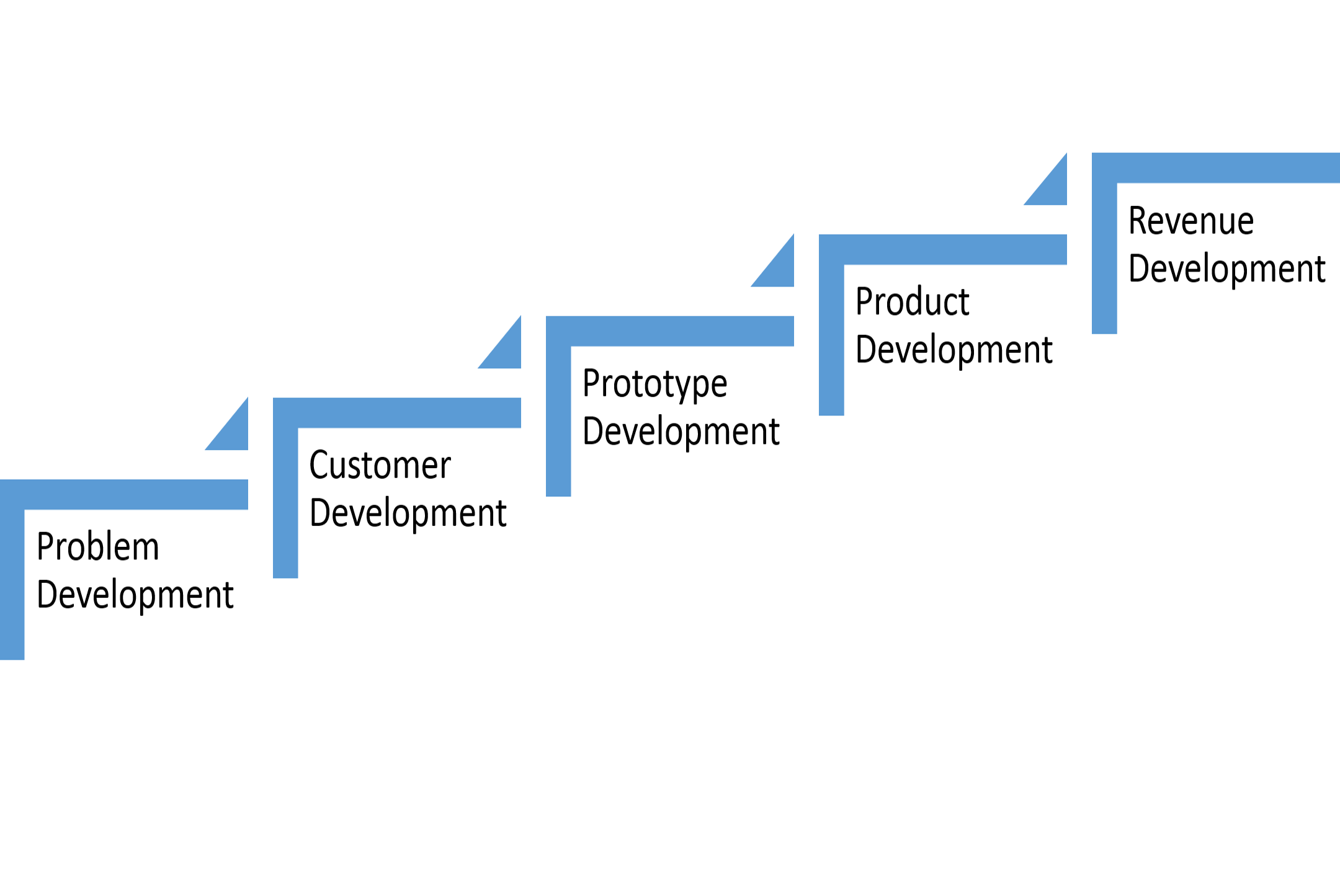
Stair Step Growth
Stair Step Growth

The startup development process comprises of 5 steps – problem development, customer development, prototype development, product development and revenue development.

I am showing these in a stair step approach, which suggests a sequential method, but I fully understand it is rarely so.

Problem development is a relatively new phenomenon, and your goal is to do a good enough job, fine tuning and understanding the customer problem in detail.

What I have found that in the quest to explain “what is your story” to a layperson, most entrepreneurs end up explaining the problem their solution solves, not the customers real pain point.

The biggest challenge for you the entrepreneur is to have the problem statement nailed in as great detail as possible when explaining it to your product and development teams. Else the “high level” problem statements, which you will use with customers or investors will result in poorly thought out solutions.

There are choices that you will have to make daily and hourly about product, experiences, features and direction of your product. In the absence of having a detailed set of problem statements – which constitutes the problem development step, most of these choices will be sub optimal.

Focus on problem development in conjunction with customer development for best results.