Tag Archives: startup

Why few developers will make multi-millions but most will see their salaries flatten

This week on the app Blind there were several discussions about salaries. Specifically if technology engineer salaries have peaked.

Blind App

Google, Meta and Microsoft in particular, and some other companies in the valley, were known to pay over $1 Million for senior developers. In 2019, Google had 21 engineers making over a million and that number has most certainly gone up since. Similarly Facebook was known to have over 25 engineers making salaries over a million dollars (outside of stock RSUs and options).

To be fair, in the valley, a million dollars is a lot, but not unusual.

The discussion on Blind, the anonymous networking app, was if mid-level and senior engineers will no longer see $500K – $1M salaries without becoming Directors or VPs.

There are 3 trends to consider before I came to the conclusion that software development salaries will become more like Hollywood or professional sports salaries.

Few people at the top make a lot of money, while most B list actors make decent, but not more than the median income.

  1. With the flattening of the organization, Meta & others are seeking to be more like Amazon where there are certain metrics on span of control and ownership – minimum 6 people reporting to a manager and Directors should have at least 6-8 managers, which means their organization would be 50 – 100 people minimum. This means more developers per manager, and with AI, this will likely go higher, not lower (the number of developers reporting to an engineering manager will increase is my point).

2. The use of Artificial intelligence tools such as CoPilot and Tabnine will reduce the number of developers needed, as AI increasingly does a lot of the basic code output. This means a 10X developer will have to make 10X more than the average. If the average developer makes $150K, it makes sense for the 10X developer to make more than a million dollars.

3. 90% of the skills developers possess will become worth a tenth (e.g. actual writing of code that is reusable), but 10% of their skills (e.g. communicating with users and rapid iteration) will become more 10X more valuable.

Given these 3 trends, I predict that most developers will see their salaries remain same ($150K or so in the US as the median), but there will be far fewer developers in each team & organization.

At the same time a 1or 2 developers in each team or organization will make $1 million or more, even though they are not the manager.

Poll by Zigantic

In the poll yesterday by Zigantic, over 40% of developer (n=1362) expected their salaries to go dramatically lower. Which I dont think will happen.

While I understand the fear developers have, that’s not what I think is the way CEO’s and managers think. To prevent loss of morale, they will just hire fewer developers and make the current developers do more with AI.
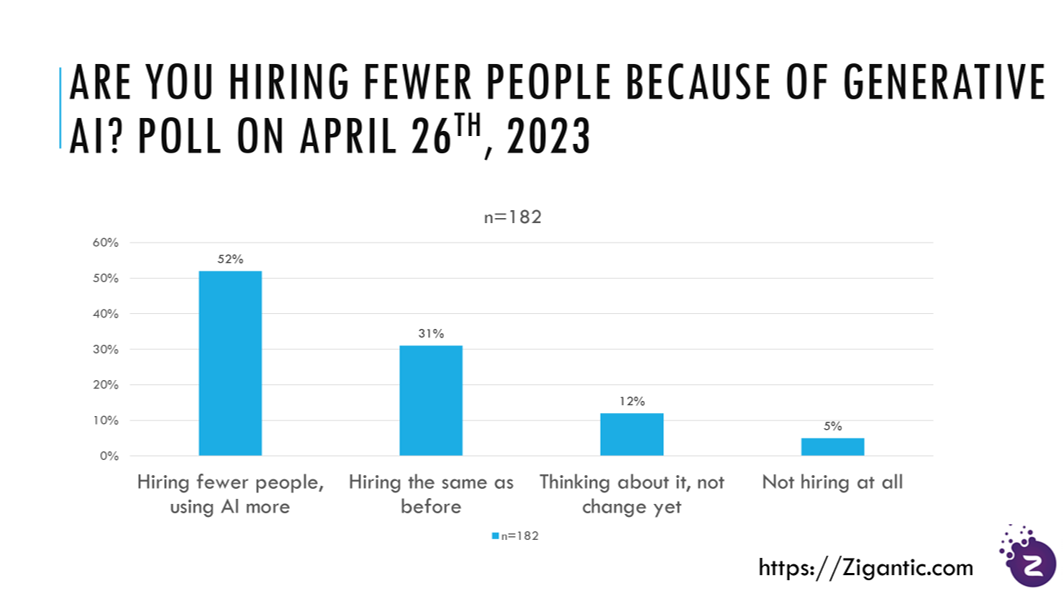
AI is already reducing the number of software developers needed

I have a network of about a thousand entrepreneurs, founders, and small business owners who read my blog posts daily of the 114K subscribers to this blog. I get a chance to ask them questions and poll them once a month or sometimes more often.

Over the last few months as part of a project, I have been polling them frequently and asking them about AI and the impact at work. Most of these are software entrepreneurs (a smaller number are eCommerce founders).

The poll I conducted yesterday was:

“Are you reducing the number of people you hire because of ChatGPT, generative AI and other LLM – Large Language Models”?

– generated many emails and a few phone conversations.

One particular example was telling which a friend related to me yesterday.

The company has 10 people, 8 of them are developers. The CEO of the company provided subscriptions to ChatGPT ($20 / month) and GitHub Copilot ($19 / month) to all the developers and mentioned that he won’t hire for another year and instead the developers could use the AI tools to do their job.

  1. The CEO is happy since he hired one fewer person
  2. The employees were happy since they are getting a chance to use new tools (AI prompt engineering looks good on the resume now).
  3. The HR person is happy since they don’t have to hire and train, onboard, and recruit a new person

All around goodness.

AI is already starting to reduce the number of jobs. It is just doing it a little slowly.

Software entrepreneur prompt NightCafe AI generated

The top 12 books about startups, funding, building lasting companies by sales

There are 100’s of books written by Silicon valley founders and leaders on the topic of funding, starting companies and building organizations to last. The top 10 in terms of number of copies of books sold are

  1. The Lean Startup by Eric Ries (2 million copies sold)
  2. The Hard Thing About Hard Things by Ben Horowitz (1 million copies sold)
  3. Zero to One by Peter Thiel (1 million copies sold)
  4. The Innovator’s Dilemma by Clayton M. Christensen (800,000 copies sold)
  5. The Startup Owner’s Manual by Steve Blank (700,000 copies sold)
  6. The Art of StartUp by Guy Kawasaki (600,000 copies sold)
  7. Crossing the Chasm by Geoffrey A. Moore (500,000 copies sold)
  8. The Startup of You by Reid Hoffman and Ben Casnocha (400,000 copies sold)
  9. The Lean Product Playbook by Dan Olsen (300,000 copies sold)
  10. The Startup Owner’s Finance Book by Steve Blank and Bob Dorf (200,000 copies sold)
  11. Venture Deals by Brad Feld and Jason Mendelson (150,000 copies sold)
  12. The Angel Investor’s Handbook by David S. Rose (100,000 copies sold)

Here is a one sentence summary on each of these books

  • The Lean Startup by Eric Ries: Build a minimum viable product (MVP) and test it with customers as soon as possible.
  • The Hard Thing About Hard Things by Ben Horowitz: Be prepared to make tough decisions, and don’t be afraid to fail.
  • Zero to One by Peter Thiel: Focus on creating new markets, not competing in existing ones.
  • The Innovator’s Dilemma by Clayton M. Christensen: Incumbent companies often fail to innovate because they are too focused on their current customers.
  • The Startup Owner’s Manual by Steve Blank: The four steps to starting a successful business are customer discovery, customer validation, customer creation, and customer scaling.
  • The Art of StartUp by Guy Kawasaki: Build a strong brand, tell a compelling story, and create a passionate community around your product.
  • Crossing the Chasm by Geoffrey A. Moore: When you’re launching a new product, you need to first focus on early adopters, then move on to the early majority.
  • The Startup of You by Reid Hoffman and Ben Casnocha: Your career is like a startup, and you need to be constantly learning and growing.
  • The Lean Product Playbook by Dan Olsen: Use a lean approach to product development to reduce risk and increase your chances of success.
  • The Startup Owner’s Finance Book by Steve Blank and Bob Dorf: Understand the financial side of your business so you can make informed decisions.
  • Venture Deals by Brad Feld and Jason Mendelson: Learn how to negotiate venture capital deals so you can get the best possible terms.
  • The Angel Investor’s Handbook by David S. Rose: Learn how to become an angel investor and help early-stage startups succeed.

Book review: Zero to One – Peter Thiel

“Zero to One” is a book that challenges entrepreneurs to think beyond incremental progress and instead aim to create something new and valuable, to go from “zero to one.”

Written by Peter Thiel, a Silicon Valley entrepreneur and venture capitalist who co-founded PayPal and was an early investor in Facebook, the book presents a contrarian view of business and innovation.

Zero to One Book

Thiel argues that competition is overrated and that startups should aim to create monopolies, as they provide the most value to both the company and society.

He also stresses the importance of having a clear vision for the future and the ability to execute on that vision, as well as the need for a strong team.

Created with Nighcafe AI

He argues that startups should focus on creating something new and unique, rather than simply competing in existing markets.

The Hollywood script summary!

If I were younger, created by Dall-E

FADE IN:

We open on PETER THIEL, a brilliant and eccentric entrepreneur, sitting in his office in Silicon Valley. He’s deep in thought, staring at a whiteboard covered in equations and diagrams.

PETER THIEL (V.O.) The world is changing faster than ever, but progress seems to have slowed down. We need to find a new path to innovation.

We see a montage of Silicon Valley tech companies, all working on incremental improvements to existing products. PETER THIEL shakes his head in disappointment.

PETER THIEL (V.O.) We’re stuck in a world of competition, where everyone is fighting over a slice of the same pie. What we need is a new philosophy of innovation. We need to go from zero to one.

PETER THIEL starts writing furiously on a notepad, scribbling down his ideas. We see glimpses of his past – co-founding PayPal, investing in Facebook – as he talks about the importance of building something new and revolutionary.

PETER THIEL (V.O.) We can’t just copy what’s already been done. We need to create something that’s never existed before.

We see PETER THIEL giving a lecture to a group of young entrepreneurs, urging them to take risks and think big. He talks about the power of monopoly, and how creating a unique product or service is the key to success.

PETER THIEL Competition is for losers. If you want to create something truly great, you need to find a way to be the only one doing it.

We see PETER THIEL mentoring a young startup founder, pushing her to think beyond the bounds of what’s possible. We see the company grow and succeed, thanks to PETER THIEL’s guidance.

PETER THIEL (V.O.) The world needs more innovation, more creativity, more boldness. It’s time to go from zero to one.

FADE OUT.

ChatGPT is the Swiss-army knife for your creative work

While specialized tools for each job are important, most people have a Swiss army knife with them. That’s for 80% of the job for most people.

ChatGPT is the Swiss Army Knife

Last week over 100 Generative tools were released – from resume builders to Bloomberg Finance GPT.

List from Generative AI page on LinkedIn

While most people I believe will still use ChatGPT, each role (engineers will still subscribe to CoPilot from GitHub, and marketers will likely subscribe to ChatSpot from HubSpot) will have their special tools.

I liken this to the similar explosion of eCommerce and B2B sites in 1997 – 2000.

Amazon would help you buy everything, but collectors loved eBay, and overstock still exists as does Zappos for shoes and Zulily for fashion.

Frequently Asked Questions

  1. Why can’t Google do better than ChatGPT? They have better resources, lots of talent and money.

Google can do better, will do it and is already doing this. The same can be said about when Google first came and Microsoft had more money, resources and talent but still got upended by Google in search. ChatGPT has distribution quickly (over 100 Million users). While another AI chatbot is a click away, so is Google search. Still, billions of people use Google over Bing because it is better.

2. Do you need more than one chatbot? Is there room for Bard and ChatGPT?

Most people will use one or two chatbots (or more) depending on their need. Most people like to have a second opinion, especially when it comes to non factual questions. Meaning, when questions are subjective in nature, you need to get another opinion.

Many datasets (such as LinkedIn or Facebook) will not share their data with either Google or OpenAI. They might roll out their own chatbot. The folks that need it will use them.

When Netflix first came, most people did not think they needed more than one streaming service. Now we have 10+ in the US alone with over 10 Million users and the average user has 3 accounts or more.

How can you spot trends before they become “mainstream”?

While the best approach to be ahead of the curve is to invent a trend, many people dont have the luxury of time from their day job to invent or keep on top of trends within their industry or overall.

While many people are good at observing and keeping their eyes wide open, most people would like “another pair of eyes”.

I interviewed 5 people who spot trends within B2B, Marketing, eCommerce and consumer internet to understand their process. 4 of them now pay for a trend spotting SaaS product.

My initial thesis was that Venture Capitalists and seed investors are more likely to spot trends because they get so much inbound interest.

Turns out, most VC friends were asking me for trends in Platform Engineering, SaaS Control plane and headless eCommerce engines.

If you have the time, the process for following trends is simple:

a) Follow influencers & analysts in the space you are interested in,

b) track Google Trends, Trendsmap (Twitter Trends), Join many Facebook groups, etc. and

c)Subscribe to newsletters, blogs and YouTube content creators.

Unfortunately that takes time as well.

In the last 3-4 years several Trend spotting SaaS websites have started as well.

I wanted to share the 5 most useful trend websites, since each of them focus on specific niches and have their own pros and cons.

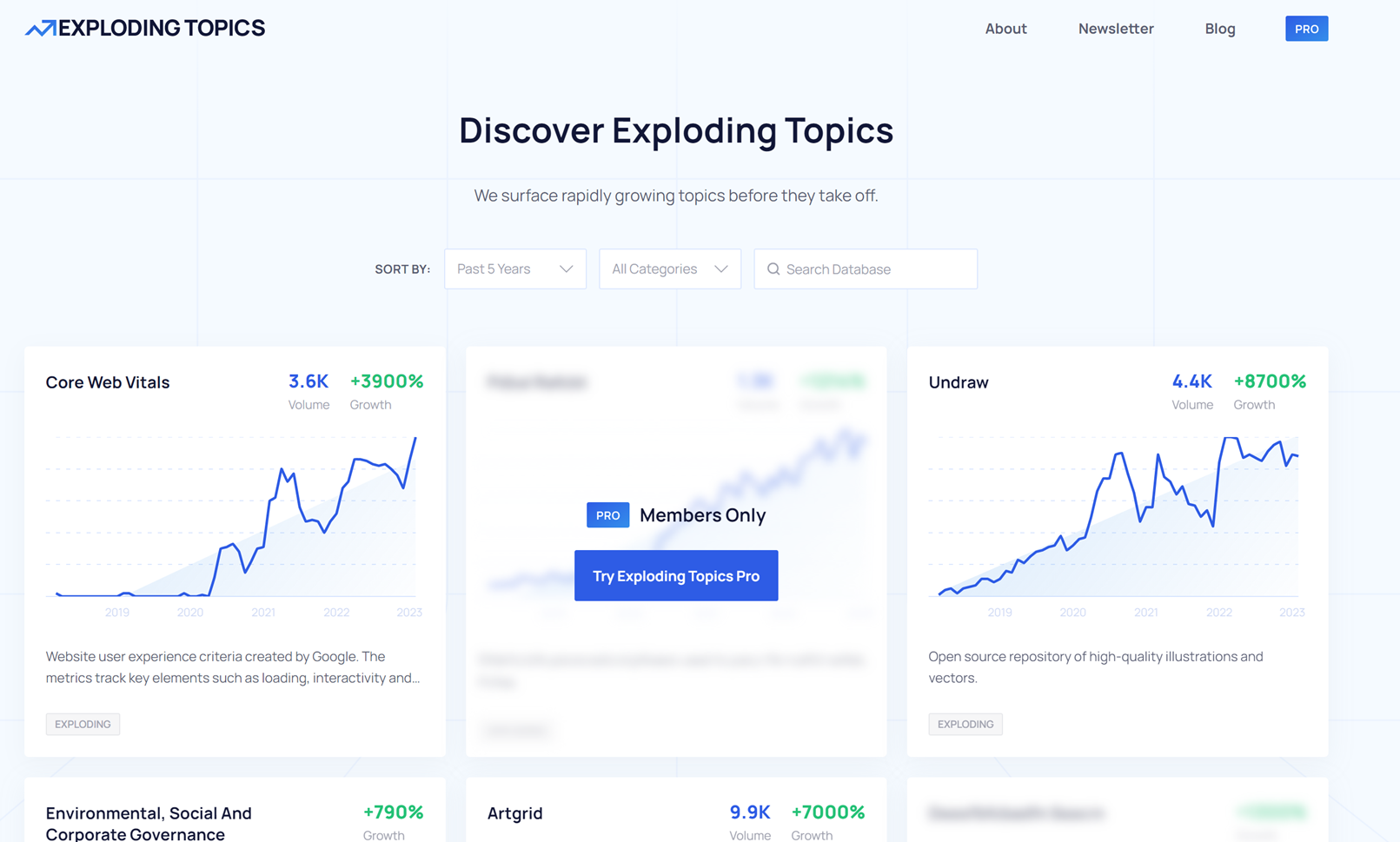
  1. Exploding Topics: The site has over 15K topics and trends. They do have a few newsletter for 1-3 trends and charge $39 to $299 per month for their Pro Version.

2. Trends.vc: Is a curated newsletter with top topics within a specific niche but is also a community of people (1000+) interested in trends. You can join the community ($299 annual or $99/month).

3. Treendly is similar to Exploding topics, and bills itself as Google trends “on steroids. Pricing starts at $99 per year, but the free version is a good place to start.

4. Trend Hunter is focused on ideas, trends and captures early kickstarter campaigns as well. Pricing starts at $24K per year, so this is focused on the enterprise segment.

5. Trend Watching has a self service tool, called Trend platform, that costs $900+ per month, so it is aimed at the corporate market as well.

Of the 5, I personally like Exploding topics the most. For personal use to track specific topics and areas for our business, the tool does a good job and has sufficient coverage in technology and developer trends.

Controversial: “Many entrepreneurs take plenty of risks—but those are generally the failed entrepreneurs, not the success stories.”

I am reading a book Originals – How non conformists move the world. It is about folks that challenge the norm. In it, the author quotes from Malcolm Gladwell

“Many entrepreneurs take plenty of risks—but those are generally the failed entrepreneurs, not the success stories.”

This is not new and very controversial at the same time. He mentions multiple examples of highly successful entrepreneurs from the founders of Warby Parker to Bill Gates, as folks who had a side-gig in their venture before they plunged into something.

On the other hand, my experience has always been that when you commit to anything full-time you get a lot more success, as I have seen in my own case.

I am curious, how many of you are doing a side-gig or a project that you hope someday turns into a full-time opportunity or startup?

I’d love to also hear if you think that committing full-time versus doing it on the side will get you to your goal.

As an investor I never invest in any entrepreneur that’s seeking investment for an opportunity they are doing part-time. Should I be changing that perspective?

The toughest fork in the road – from high growth startup to lifestyle business

One of the toughest pieces of advice I usually give to the founders I have invested in is to understand when and how they have to make the transition from a high-growth-chasing startup to a lifestyle business.

Entrepreneurs feel like they “gave up”. Many actually prefer to shutdown their companies and decide to either get another job or start something fresh, instead of spending more time learning which of their assumptions were incorrect.

In this blog post I am going to try and make the case for why you should transition to a lifestyle startup instead of giving up and going to another “idea” or solve “another problem”.

If you decide to join a big company or to get another job, if you startup does not pan out, I understand that. I dont think you will enjoy the transition, but a less stressful, more defined and predictable life is something people crave for after the roller-coaster ride that’s in a startup.

If, on the other hand you choose to start a new company in a new space, with a new idea, I think that will be a bigger waste of time than pursuing the “customer development” efforts in a given space.

Excellence as a Habit

From my experience I can tell you that it takes between 2 to 3 years on average to learn the contours of any given industry, its players, the mechanics of how it works and the entire value chain. I call this the “happy learning phase“.

Usually at this phase the growth on what you learn is typically 10% day-on-day.

During this period, while you are trying to build an early version of the product, get a few customers and iterate on the “actual problem” that you have to solve. Even when you believe that you have a problem and some form of product-market fit, you will need time to find the early adopters, or to weed out the naysayers and to find your early wins.

Most entrepreneurs set up early goals for their startup which have certain milestones, one of which is fund raising. Associated with the fundraising metric are business metrics as well – # of customers, revenue, # of employees hired etc.

Contemporary wisdom puts a number around your growth: measured month-on-month – typically at 10% or 20% (as opposed to Conventional wisdom, which used to be focused on growth with unit economic profitability). Most entrepreneurs feel if they dont hit those growth metrics, then their startup is doomed for failure, even though most realize that not all startups can be unicorns.

If, however after a few months of less than your stated growth, you are inclined to throw in the towel and pivot away, the clock on the “happy learning phase” resets.

Which means you have to start on a new set of learning and the phase begins again. This usually means that you have to understand the market again, figure out the new landscape and finally make new connections.

When you are at the fork in the road when you have to decide between continuing at the startup, versus pivoting to a new idea, I’d highly recommend you turn the company into a life-style (consulting, teaching, training, etc.) business and spend time in the making-money-phase based on the happy-learning you did before.

How to decide which startup to join if you are considering switching jobs

I get an email or 2 every week from employees at large companies who have interviewed at a startup wondering if “startup X” is good, will do well, or “is a good bet”. Most of the time I dont know about the startup or the founders, so I tend to focus mostly on the market trends and the problem the startup is trying to solve.

Occasionally I will also get folks sharing their salary and ownership details with me (mostly junior folks) who would like some advice on how to negotiate a better salary or more stock options.

I used to be rather dismissive of the negotiators and ask them to focus on the learning and experiences, but that turns off most people I think. They wanted advice on how to negotiate better and here I was telling them what they were getting was good enough.

Instead, I decided to develop a framework to think about the opportunity and the startup role.

The first thing you want to ask yourself is why you want to work at a startup. Or leave your current job and join another startup. If you are at a big company (and have been there for a while) and have made a good salary and are looking for a “big retirement win from 3-4 years of work” at a startup that’s going to go public, then it is very hard to choose the right startup.

If you are however at a big company and looking to learn more and get a different set of experiences, you will likely have expectations that can be met.

Predicting which startups will do well is hard. In fact, over the last 10 years, given that most companies are raising a lot of money in private markets, it is harder to “get an exit” and make it big (financially speaking) in a short period of time.

Lets start with your objective.

If you are looking to make “risk free money in a short period of time” with your talent, you will get a small reward. A role that similar to your big company role and with a pay package that fairly consistent.

If you are seeking to learn how to be an entrepreneur and master how to start a company, you are better off joining an earlier stage startup than one that’s “sure to go public in a year or two”.

If you are looking to make more money than your current role offers and advance your career, it is best you join a later stage startup that’s looking to scale.

Startups that are less than 2 years young are the riskiest, will offer the most in stock and less in pay. Especially if they have only raised a series A.

Startups that are 2-5 years young and have done one or two rounds of institutional funding will likely offer good pay and decent benefits but limited upside in stock options.

Finally, “unicorns” which are over a billion dollars in capitalization will offer compensation that’s commensurate with your current pay and benefits and even more limited upside in terms of stock options.

If you are looking for the “perfect role” with the “most awesome pay”, that’s equivalent to your current pay and “huge upside” in stock options with guaranteed returns, that does not exist.

So, my recommendation is to decide what’s important to you – steady pay with strong benefits, but learning a new technology or being part of a new culture – then join a later stage startup.

If you decide that being a part of a fast growing startup which has some traction but still has potential to scale, where you will learn and grow with the company, is important to you, then join a venture which has been around for about 3-5 years.

Finally if you wish to learn how to start your own company after this one’s done and want to learn the fundraising elements of the startup, understand how to market and scale the business, then join a much earlier stage startup.

How to pick and choose early users / customer for your #napkinStage startup?

The first few customers (or users) usually set the tone for your startup. They are the ones with either acute pain or the burning problem, and the earliest of early adopters. Usually, I have found that most entrepreneurs get their early customers because of the relationship they have with them OR they solve a really pressing problem for their customers.

When I talk to most entrepreneurs, one of the first things I recommend to them is to segment their potential customers.

The discipline of finding the factors that differentiate one set of your potential customers from another based on a set of characteristics is customer segmentation.

There are 3 important questions you will need to answer about your customer segmentation strategy before you recruit potential customers.

Most entrepreneurs, at the napkinStage end up getting customers who they know, but sometimes may not have the pain point as much. Else they end up getting customers who have the pain or are unwilling to try anything “not proven”.

When you have been out trying to get early paying customers, you will realize quickly that customers have one of several reasons for not buying or wanting to try your solution.

1. They are risk averse, and not early adopters, so while they have the pain, they use their existing  manual or alternative techniques to solve the problem.

2. They are able to deal with the pain, since they get a sense of job security knowing that they know how to solve the problem, and no product, machine or algorithm can replace them.

3. They believe the ROI from solving the pain will be negligible and their time and money is better spent elsewhere.

4. They want more mature solutions so they can handle their “special situation”, which is unique enough that no early product can customize it and be less expensive at the same time.

5. They believe the solution will weaken their position since it will solve the problem that exposes their “value-add” to the company.

6. They are not emotionally vested in either you or your startup, so they are not willing to take the leap of faith to try an early version of the product.

7. They actually dont believe your solution will solve the problem and are willing to wait and see some more proof until a point that it does.

These and many other excuses / reasons are the ones I have heard of consistently when I have been trying to get early customers for most of my startups.

If your potential customers sees a big benefit to:

a) their personal agenda (promotion, makes them look good, etc)

b) their position in the company and finally

c) their company’s standing in the market.

Picking your early customers though, is almost always a combination of personal relationships, built over time and solving a problem they have that is so intense that they are willing to try anything to get rid of it.