Tag Archives: startup

When do you know that it is time to fold your #startup?

Honestly you never will know. There is always a “what if”.

There are many times during your startup journey, when you get a sense that things are not worth it. When your cofounder leaves. When your customer bails. When you cannot articulate success.

The simplest situation is when you run out of money.

The biggest challenge is knowing when way before your run out of money if something’s not working out quite right.

You get a nagging feeling that the same time and energy you have can be spent on other things to get a better return – whether it is on the next startup or another job.

The constraints that most entrepreneurs face tend to be masked by their bravado.

I hypothesize that the only time you know when it is time to shutdown and move on is when you no longer have a desire for the end state.

When you lose your passion.

That’s it.

If you still have the desire for the space you are in, and the problem you have chosen to solve, then overcoming all other odds is easier, because you still believe there is a wrong to be righted.

Most founders, though dont realize they have lost the desire for the space or the problem until much later. They are taught that persistence is the key to success, so the slog through the early warning signals.

How do you find out if you have lost passion for the space, earlier?

“Going through the motions” is one way to find out.

“Not getting excited to get up and go at it” is another way.

“Inability to acknowledge the small wins” is a third.

I can list many more.

The next part of the question is how do you know if this is “temporary loss of passion” or “permanent lack of desire” for your startup.

It is a permanent problem when your opportunity cost of doing something else is more than your current situation.

How to get channel sales or indirect sales going for your startup?

When I talk to entrepreneurs who are developers and they don’t have a hustler (sales person) on board, they ask me if they should outsource their sales function. I usually advice them never to outsource startup sales efforts. They then look to find partners who they can work with. The main reason they want to do this is because they find the entire process of hiring, managing and growing their sales team revolting.

Some of them talk about possible “channel” sales efforts via partners or larger companies in their domain who can help, who they would like to approach.

When I tell them about the potential costs, commissions and the customer relationship efforts that are involved, they take a second look at their direct sales efforts. I thought I’d document that for many of the other entrepreneurs who have the same question.

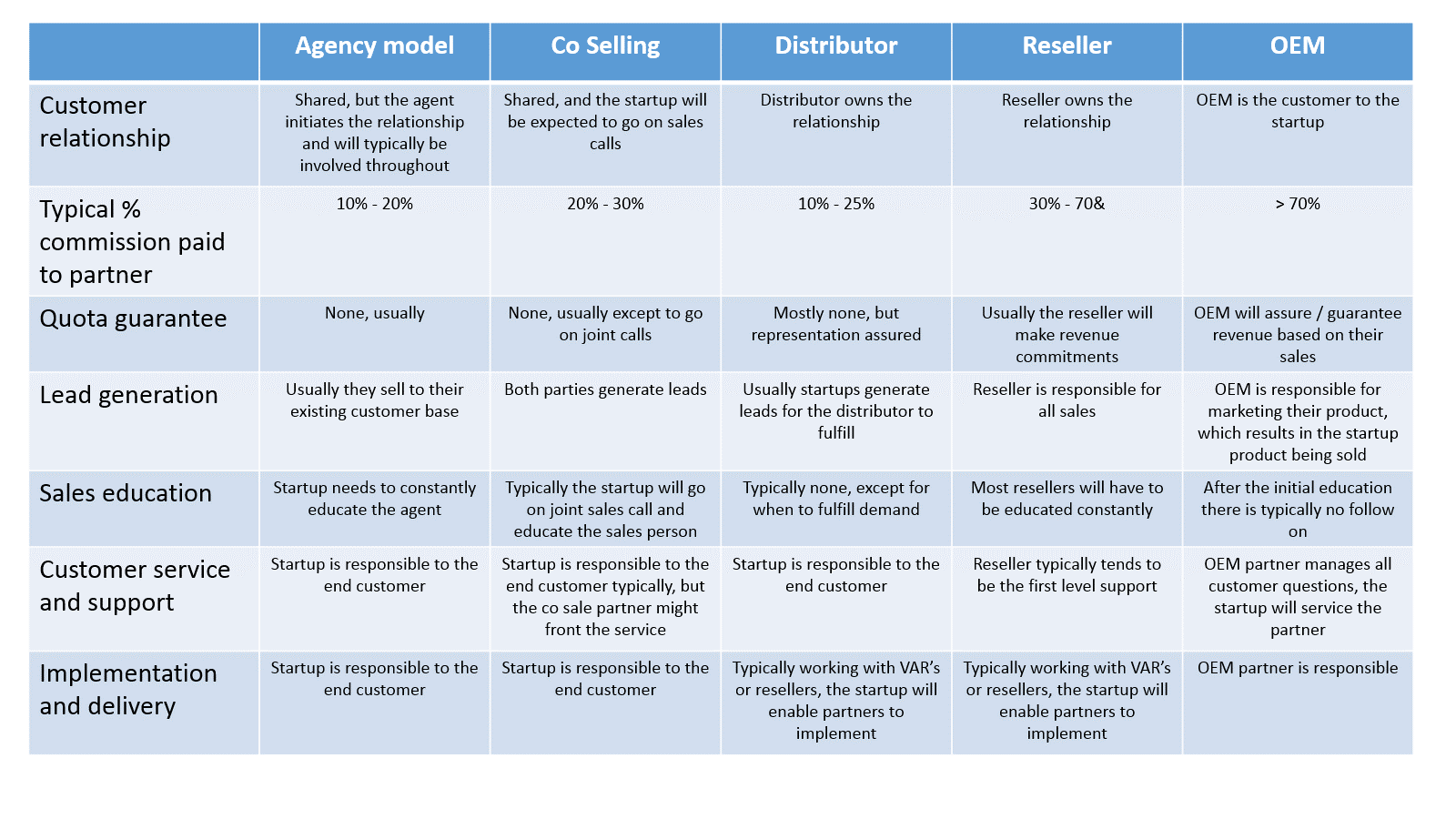
There are 5 models of partnerships I have encountered so far in my career. I will outline these models and list their pros and cons. While I cant say which model will work for you, and there may be other models as well, I think understanding the landscape will help you figure out which one makes sense in your situation.

First off, most channel or indirect sales models assume that the partner has an existing relationship with the startup’s customer. After all you are trying to shorten your sales cycle by using the partner’s strength.

Lets now look at these different models.

1. Co selling partnerships: These agreements tend to have a low to medium level of commitment from both the partner and the startup. If a sales person from the partner is going to meet the client, and are in active discussions on a deal and they feel like bringing your solution will help them win the opportunity, they will look at trying to position your product as well. In this case, you will have to go on the sales call with the sales person at the partner. The advantage of this partnership is that you typically dont have to do the initial “opening of the doors”. The “paper” or contract is typically separate as well. This means there will be 2 separate agreements for the customer to sign.

Pros: Since there is no commitment (most times) from both parties towards a quota or target, the discount you offer to the partner is low (typically starts at 20% and can go up to 30%). Also, since you can have a direct relationship with the customer, you can control the relationship going forward. Be sure to ensure that there are lower levels of “pass through” revenue you have to pay to the partner after year one.

Cons: There is no commitment to sell by the partner so you cant quite depend on this channel to deliver consistently. The customer also tends to get confused about the single person who will responsible for their success (the bad term usually used is one throat to choke).

2. Reseller agreements (sometimes called VAR or Value Added Resellers) : This partnership is medium to higher level of commitment. The partner will either resell your product on their paper or include your “quote” in their contract. You will hence have to train and manage their sales professionals.

Pros: There is a quota commitment in most cases, so you can be sure that sales people are motivated to sell, but you want to be sure that there are some downsides if they dont hit the commitments, else all this is a co selling agreement structured on the partner’s paper.

Cons: Since there are commitments, you will pay a much higher commission % – typically 40 – 60% are standard. Some partners may ask you for more. You will still have to train and do the lead generation to bring their sales folks into deals. Typically when you sign an agreement, even if you bring the partner into a new customer, they might ask you for the commission that they technically dont deserve.

3. OEM associations: When your product (or module) becomes part of another product and is integrated in such a way as to cause sales of your product each time the other product is sold, have an OEM (Original Equipment Manufacturer) association. These are typically for run time modules of developer products or a contact management product within a CRM system as an example.

Pros: Since your product is part of another product, you will typically be sold each time the other product is sold. In most cases this guarantees revenues and commits the partner to certain revenue goals.

Cons: Since your product is part of a module, you dont have the end customer relationship. Most OEM products also tend to generate smaller % of sales. Don’t be surprised if the final product is sold by the partner for a significantly more cost that what they pay you. Typically I have seen 10% of the final cost of the product paid out to the module.

There are 2 other models that I dont have much experience with, so I will let you give you an overview and try and address them in a future post.

4. Certified agent alliances: These are loose agency models (typical in affiliate sales) where the solo sales person who maybe has a few clients will try and sell for you. Since you have to recruit and manage each sales person yourself, these will be hard to scale. The only advantage is that the sales person is not an employees, so their base salary costs dont hit your books. This also means they are less committed to your product.

5. Distributor agreements: When your product is sold in a different geography where you need a local partner to stock (for hardware) or help educate local re-sellers, then distributors can help you with education, local tax and integration and identifying resellers. They can help you navigate a local market, but since they stock and manage multiple products for that region, getting their attention to focus on your product tends to be rather hard.

Startup Channel Sales
Channel partnership Framework

If you liked this post, please follow me on Twitter and say hi. I will follow folks who comment or tweet back usually.

Don’t apologize if you are building a life style business or a slow growth one

I had a friend come over to meet local investors and members this week to talk about his startup. It is a good company with very early traction. They are clearly not going to be a Unicorn in anytime soon.

The amazing part was he was not even looking for investment or money. He was seeking support and had a very nebulous but simple ask – get one person to lead the Seattle chapter of his startup and be the local champion to host events and hackathons.

Naturally, to an audience of seasoned investors and entrepreneurs, this seemed to be a small ask. There were a barrage of questions about “Why not do a bigger thing?”, “What is the market size?”, etc. Not withstanding the fact that his startup was already “in the market” with some meaningful traction. The entrepreneur was not looking to “Go Big or Go Home”, but really make a difference and also make some money.

In this market, where most everyone wants to invest in social networking applications that share real time video or a social network for dog lovers, he was building a different kind of company.

It was clear that he was not being able to tell his story and the impact his organization was making, since he was unable to convince most folks that what he was doing was material.

It would be a collective insult to the intellect of the room, if we did not support his cause actually or come up with ideas to help the entrepreneur.

When he was asked these important, but tangential questions, he chose to apologize. Many of his answers were “Yeah, we dont have that”, or “We only do this one small part” or “We have not had that level of impact yet”.

Surprisingly he had more impact on young kids and women in other regions, than I suspect 97% of the people in the room.

Yet, he was the one who was apologizing.

As an entrepreneur, you set out with a vision to change the world, however small. Sometimes you just have a small problem you want to solve. You wont even understand in most cases, the unintended consequences of your product or startup.

Never mind.

Just dont apologize to any self-righteous, unicorn chasing investor.

Tell your story, stick to your convictions and be humble, but stand up to criticism about the market you chose, or the growth you have had. Even if they chose not invest, remember that it is easier to throw rocks than to collect them and build a house.

Keep collecting all the rocks thrown at you. You will need them to build your house made of solid rock.

Until then, please dont apologize.

Vision, Execution and Communication, what makes entrepreneurial founders, great CEO’s

It is often said that the most important things a startup founder and CEO needs to focus on is setting the vision and communicating it effectively, hiring the right people and making sure there’s enough money in the bank.

In the early stages though, the vision is less clear for a company for many founders. What’s more clear (to most entrepreneurs) I assume is the problem they are trying to solve. Or, in many cases the solution they are trying to build.

If you over index on good or excellent execution but have not a clear, well thought out vision, the market, investors and employees will give you time and room to develop. Case in point, it was not always clear what Twitter’s vision was to most people (and probably is still not clear).

So, if you have a great, compelling vision for the future of how the industry (like Marc Benioff did with Salesforce.com), then it does make it easier to grow, fund and scale the company, but if you dont, I wont sweat it.

There are many forms of communication, but the 3 I am focusing on are public speaking, written communication and articulation in a personal setting.

Not surprisingly, if you are afraid of public speaking (which apparently is the 2nd most feared thing for most people after death), the market does give you some leeway. There are many entrepreneurs and senior executives who I know, personally, who are poor public speakers and are not at all charismatic. That usually does not seem to stunt their progress though.

If you are not great at written communication, (which can easily be fixed BTW, with practice), the world is not going to end. It does help, but you only have to keep in mind that over 80% of successful founders in the unicorn list have trouble writing something meaningful even with the 140 character limit that Twitter proposes.

If however you can’t articulate the problem you are trying to solve in 1-1 situations or answer the difficult questions about why your company exists, what it does and how it will solve a problem, then potential co-founders, employees, investors and customers will not give you much leeway.

There are certain situations when even poor articulation (which I have seen multiple times when folks come to pitch their product to us) is something we accept and assume we can help with.

That situation is when someone has executed very well. Whether it is building a compelling product, getting early customers, growing user base or raising funding rounds, doing beats telling 95% of the time.

From time to time, we (potential employees, customers or investors) get enamored by a good story, articulated by a charismatic, passionate and visionary founder, and it may happen more than in exceptions than the rule.

The thing is though, you can’t argue with execution at the partner meeting or at the customer review or when you are talking to your friends about a company you want to join.

Either they did what they did or did not – either they got users and growth or not. They have customers or they dont. They have a product that users like or they dont.

They executed or they did not.

Which is why, even if you being told you dont have a great vision or that you are poor at telling your story or you have bad communication skills, take heart.

If you out-execute and show the proof in the pudding, by numbers, metrics and growth, the market and the participants will let you get away with your “weaknesses” or perceived faults in vision or communication.

Before you know it, your startup is now a “big” bureaucracy with “approvals” for everything

Often when I meet wannabe entrepreneurs at events, I ask the question, why they are willing to give up their relatively easy job, with good pay to take up the roller coaster world of starting their own company. About 20% or so of the folks I meet at these events work at another startup (typically < 3 years old, about 20-50 people). I think of most of these companies as startups as well, so I am curious as to why, after seeing all that happens in an early stage startup, they want to start their own company.

Sometimes it is because they want to be their own boss, or they see the success of the founders, who they claim have little intelligence, but still managed to start their own company and be moderately successful. At other times, I hear the burning itch to start and solve a problem or other times it is because they always wanted to start one, but were not able to because of other constraints.

Every so often I will get a person who was the 1st or among the first 10 employees of a startup. They will reminisce about the “early” days of the startup they are working at and talk about how everything was simple and easy during those days and how bureaucratic their 50-100+ person startup had become.

When I press further about the “bureaucracy” and what makes things slow and inefficient, the word that always comes up is “approvals”.

“Approvals” are the tool misguided managers use to make themselves feel important.

If you are a person that needs to feel important so you can “approve” things, you dont have enough work to do.

Approvals are used by big companies to kill any ounce of individual responsibility and trust. They also kill the very initial set of values and culture that you might set out to build your company’s foundations on.

Approvals send one of many messages:

1. I did not hire the right person so I have to ensure they “stick” to the rules of the company that HR has arbitrarily come up with.

2. We have hired way too many people who dont have enough work to do, so they have to be around to “approve” things.

3. We need policies and procedures for everything since we dont trust the folks we hired to use their judgement.

Notice that the common word in these (and most other) examples is “hiring”.

Approvals are the child of poor hiring and recruitment.

You can cop out and say it is a HR problem. It is not actually.

As a founder, it is your responsibility to ensure that the vision and culture of the company are consistent with the ethos you started it out with.

The first 10 employees are indicative of the zeal you brought to the table, which convinced them to join a high risk startup at such an early stage.

If these first 10 and many other employees feel that the company is “approval” heavy and requires big company (productivity killing and sans accountability) procedures, then you have something wrong with your hiring, not with your HR policies.

Remember this, if a manager in your company feels so important to want to “approve” everything anyone does in his organization, he has practically no work and likely a heightened sense of importance.

A #contrarian’s field guide to New Year Resolutions

TLDR; This field guide helps you set new year resolutions and help you achieve them by using both a top-down and bottom-up approach towards managing your energy and hence managing your time better.

To achieve you new year’s resolutions, I propose 3 steps:

1. Top down prioritization.

2. Bottoms-up audit.

3. Planning and scheduling your energy.

You have to both do a top-down prioritization and a bottoms-up audit towards goal setting, because the top-down alone will tell you what you want to do, and the bottoms-up will tell you what you are doing right now. The planning will help you then figure out where you are wasting your time and energy and where you need to focus it instead.

Lets do the top-down first.

There are 9 categories of goals people have as individuals according to me.

1. Relationships: The need and desire to be connected as humans with friends, family and other people at large. Examples include, getting married, making new friends, or spending more time with your siblings for example.

2. Career and Work: When you are a student it will be around “what you want to be when you grow up”, but it is pretty much the same as an adult. Work goals include promotions, improving communication – public speaking for e.g. etc. Starting a new business falls into this bucket.

3. Intellectual: These are for you to learn. Many people like to learn new languages, read books and expand their mind as part of this category.

4. Health: Keeping your body fit enough and in shape to be able to achieve what you think you can. Losing weight is the most common goal in this category followed by promising to quit smoking.

5. Financial: Making enough wealth to be able to afford the things you’d like to have as part of your life. You might have other goals in this

6. Spiritual: The quest to find your inner self, and the meaning of life, the universe, god, etc. The most frequent goal in this category is to find your inner peace.

7. Interests & Hobbies: Travel, learning a musical instrument etc. fall into this category. Going to an exotic place for vacation is the most frequent goal in this category followed by learning a new musical instrument.

8. Giving back and Social Goodness: These are for individuals who want to give back and help the less privileged. Most people volunteer at charities or non-profits / NGO’s to help them in any way possible.

9. Self improvement: These are to better yourself as an individual, making time to grow as a person (not intellectually, but emotionally). E.g. I will not get angry with my kids, or will not blame someone else for my problems. The quest to be a better person drives this category of resolutions OR the willingness to correct a character flaw.

Now that we have a comprehensive category list, I suspect you can add your own resolution – such as “I will be a nicer person” or “I will meditate more”, which will fall into one of these buckets.

After you put your resolution into the bucket, write it down – both the resolution and your category.

P.S. here’s a contrarian tip – NEVER have more than one goal. More on that later.

The reason I think you should start with categories, is that it will help you focus on managing your energy not your time.

Then the second task is for you to do a time audit for a week. This is the bottom up approach. The best way to do this is to create a spreadsheet with 1/2 hour slots from the time you wake up to the time you sleep.

Then put what you are doing in that 1/2 hour slot for 1 week. This includes time to bathe, eat, work, etc.

The next step is to categorize the time audit items into your categories above as well.

It is okay to put sleeping into health category. If you listen to podcast or listen to music during your commute then put it in the health or interests or hobbies category.

Then take the categories you have and add up the time per category.

Plot the category and time spent on a pie chart.

Most people are absolutely shocked when they do this exercise at this point. They find that 25-35% of their time is truly “wasted” – they dont do anything else when the sleep – which is why many successful people apparently sleep less – god bless them, but I cant. Or they are spending time bathing or eating, etc.

So you have a top down priority and a bottom up use of your time.

Step 3, is planning and scheduling: The planning should help you find a way now to schedule time on your calendar for the one new year’s resolution or goal you set.

You can do the scheduling on your calendar by alternative or better time management.

If something is a priority for you, then you better spend more time on it than anything else.

My rule of thumb is that you need to spend at least 35% of your time on the one New Year’s resolution you set for yourself. If you are unable to do that, then prepare to fail.

If you find many other things taking up your time, deprioritize them and manage your calendar like a manic and NEVER let other things “creep” in.

Please let me know if this works for you, but remember you have to do the top-down and bottoms-up part (which might take you a week if you dont know your calendar yet.