Tag Archives: startups

2014 is the year when India became #3 worldwide in tech #startup funding

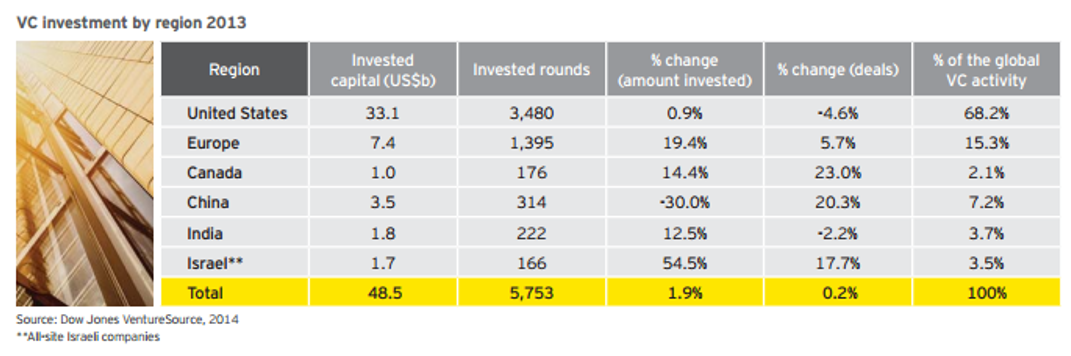
I am finally going through all the reports from PwC MoneyTree, E&Y reports and Venturesource data to determine how the tech startup ecosystem did in terms of funding and growth of VC investments. Here is a snapshot from 2013, the report is available for download.

Worldwide Venture Capital Investments 2013

If you look at 2013, US dominated with ~3500 funded startups by VC’s and that represented ~70% of all tech startups funded. There were a total of 5700 companies that got funded by VC’s alone, worldwide.

In 2014, the number (have to get permission to post since it is behind a paid wall) of VC funded startups rose to ~6500. Depending on which number you seek some say it is 7200.

The US was number 1 with 65% of startups, Europe (primarily UK, Germany and France) #2 with 1500, China #3 with 451 and India #4 with 312.

If you treat UK, Germany and France as separate countries (which they really are and I am not sure why E&Y and PwC group them together as Europe for the purposes of the report), then none of them made it to the top 5.

Looking at countries alone: 1) US, 2) China, 3) India, 4) Canada, 5) Israel, then UK, Germany and finally France.

In terms of invested dollars as well, the numbers are the same:

1. US $38 B – $45 B

2. China $4.5 B – $5.2 B

3. India $2.4B – $2.9B

4. Canada $1.7 B – $1.8 B

5. Israel $1.65B – $1.75B

A data driven approach to dispelling the myth that planning for #entrepreneurs is “old” school

There is an ongoing meme that keeps popping up ever so often among tech entrepreneurs and gurus. That the “business plan” is dead and there is actually no sense in planning at all.

After all they say “Hands-on Entrepreneurial Action is all that is required to create a Business”.

I have enough curiosity to keep finding out which of these truisms are valid and which are not. Fortunately I also have a position that allows me to try these experiments given that I run an accelerator program.

TLDR: This is absolutely false. Poor or any planning is better than no plan at all for over 80% of startups. In fact, the earlier the stage of the startup, the more is the value of that planning.

Here is the data:

Over the last 3 years, I had the opportunity to identify, select, coach and help 87 entrepreneurs for over 4 months each. I spent about 1.3 hours per week with each entrepreneurial team. In the last 3 years, and in 6 cohorts, there have been a total of 4834 applications we have received and reviewed. Of these my team and I have talked to about 450+ (about 10%) and have met with (for atleast 15-30 min) about 250 of these entrepreneurial teams. A total of 87 of them made it into our accelerator and that’s the sample size. Of these, 89% were from India, and 11% from the US.

There are between 10-12 sprints we run at each of our 4 month acceleration programs. Customer development, technology, product management, design, go-to-market, sales, partnerships, and others. One of the sprints we also run is called the “Operating plan” sprint. I instituted this after the first cohort, when I learned that most investors did not care so much about the “demo day pitch” as much as what the company was going to do with their investment for the next 12-18 months.

So, I put together an operating plan template. Think of this as your blueprint for execution. It would spell out what you were going to do to hire, sell, develop, fund and grow your startup. I put together a template as well to help the companies think through the plan.

It stems from your top level goal first, which depending on your stage could be – get product shipped, get customers to use it, increase usage, drive sales, increase revenue, etc. The only constraint I put was to ensure that you had one goal only. Not 3 or 5, just one.

Then you want to tie in various parts of your company to achieve that one goal.

If you had to hire engineers to build product, then that needed to be spelled out. If that then requires funding, you need to spell that out as well and so on.

So each operating plan will end up having 7-9 sub “plans” for product, development, hiring, sales, marketing, funding, etc.

This planning cycle begins in the 3rd month of our program and lasts 2-3 weeks for the entrepreneurs. During this time, many entrepreneurs are busy trying to get funding and meet investors, which means they tend to have little time for “all this other planning stuff”.

Which makes for a perfect experiment with a control group and a treatment group.

In the last 5 cohorts, I have asked and then politely urged all the entrepreneurs to participate actively in the operating plan sprint. But 50% of the cohort would get another 30 min pep talk from me on its importance.

I’d urge them over a lunch or coffee the importance of doing the plan.

I would not discourage the others from doing it, but the other group I did not spend the 30 minutes with on taking the operating plan seriously. Some of them took it seriously without my urging and cajoling and most ignored it.

Now that I have the data for 3 years, I can confidently tell you that just the act of putting together an operating plan – however poor it is, increases your chances of funding and raises valuation.

I went back to the data to look for my own biases and see if the ones that I urged were “somehow better suited to raise funding and be successful regardless of my urging” anyway, and I think I have no way to really check that at all, but I am confident that the sampling error, if any, was minimal.

Of the companies that I did the extra selling to, 69% of them raised funding within 6 months of the accelerator, compared to 31% who did not.

Even the companies that took the operating plan seriously and put what I consider a poor plan, beat the ones that did not take the operating plan seriously at all by a margin of 20 basis points.

I totally understand that funding is a weak (and only one) measure of achievement (and not of success), but I also realize that it is the metric most entrepreneurs judge an accelerator by.

So, the bottom-line is this.

If you want to achieve any form of success, creating an operating (or business) plan, even if it is poor, is better than not having one at all.

Should you go for high quality or high quantity of users before your seed round?

I get this question fairly frequently from folks applying to the accelerator. Usually this comes from a team of 2-3 developers who have built an app and are looking to either a) raise a seed round or b) apply to an accelerator.

The question is a very difficult one to answer and requires a lot of context and specific knowledge about the problem the company is trying to solve.

Lets take an example. You have built a consumer mobile application, and have had the app out for about 1-3 months, and have “organically” grown your user base, with word-of-mouth or referrals. The question is what are “investors” looking for in terms of traction? Lots of users – meaning thousands of downloads and many active users? Or engagement – meaning a high rate of your “atomic unit” usage?

Or in other words should you spend your effort, trying to get more users or to get your current users to use the product more?

A similar example is one around many free users for a SaaS service vs. few paying users but relatively high usage.

The easiest answer is both. The best products and startups get many users and lots of usage.

The more nuanced answer is that it is dependent on what is tougher. Investors (Accelerators in this case, I assume, are investors as well), look for one very tough problem that has been solved by you as a metric for your future success.

That means, if they believe it will be harder for you to scale up the number of users (based on your app) then they would want empirical data to prove that you have cracked that problem. If, however, they believe that your solution has a harder “retention” rate, like a Twitter – (where signup is easy, but getting users to understand and use the product is harder), then they’d expect you to have solved that problem.

Either ways, they are looking for you to have a good answer and some initial experiments on how you will solve the other part of the problem you have not been able to crack.

So, leaves us with the question – What should you do about it? Lets say you have runway for about 3-6 months before you have to raise a round of funding. What should you prioritize between now and than time when you run out of funds?

How do you determine which problem is tougher? Getting lots of users or getting more usage?

This answer depends on your (eventual) monetization technique.

At steady state, you will make money from having lots of users doing the “atomic unit” action more often.

For the initial stage, though, investors (and you) should be looking for the easiest route to monetization and how you can scale that route faster.

So, if you will make more money from lots of users (e.g. social network) then that is tougher. If however, you will make more money by getting few users to use it more (e.g. in-app purchases), then that is tougher.

#Biotech park in Bangalore

Quick note. I was invited to the Biotech park launch in Bangalore yesterday. This is a 56 acre piece of land to help Biotech startups in Bangalore. There is significant money being spent by both the state and central governments (approx $8 Million) to help startups in Bangalore.

The talent pool from BioGen, NCBS, Instem and others in Bangalore is large enough to support 20-30 startups each year is the thinking in Bangalore.

The space walk through was a 3D video. It was really cool. Loved it. Photos coming soon.

How the risk appetite of entrepreneurs affects their exits in Silicon Valley, India and Africa

I run this fun experiment each time at most events I speak at. I ran is again yesterday at the CII event yesterday in Bangalore. The experiment is to gauge the risk appetite among entrepreneurs. It is not scientific nor is it structured. It has though, given me a sense for the risk appetite among the entrepreneurial class.

I have run this experiment now over 30 times and have had fairly consistent results. If there are over 100 people in the audience, I ask folks three questions and request a show of hands.

Q1. If I gave you a 10% chance of making $2 Million from your startup, how many of you will take that outcome? I get a show of hands at this point.

Q2. If I gave you a 1% chance of making $20 Million from your startup, how many of you will take that outcome? Show of hands again.

Q3. If I gave you a 0.001% of making $1 Billion from your startup, how many of you will take that outcome? Final show of hands.

Over the last 3 months, I have spoken at 2 conferences in the US, 1 in Zurich, 1 in Africa, Singapore and over 5 in India.

The results give me a quick sense for the hypothetical risk appetite for entrepreneurs in that community.

In the US at both the conferences, the distribution was 30%, 10% and 60%. In Zurich it was 60%, 30% and 10%. Africa was very close to the US surprisingly, at 35%, 15% and 50%. It is almost as if Africans have nothing to lose and Americans don’t care for small outcomes, but both end up at the same place.

In all the conferences in India, it has been 70%, 25% and 5% (and that’s being generous in 2 conferences including yesterday, where 2 out of 150 people opted for the 3rd choice).

Rather than draw quick conclusions about the risk appetite, I thought I’d think about it more and understand why Indians are happy with smaller outcomes.

Given that the effort over several years to create a $10 Million outcome at your startup is the same as one that has a $1 Billion outcome, why dont we focus on the large opportunities?

  • Is it fear of failure?
  • Is it that we are “happy” and content with even the small things?
  • Is it that $2 million is such a large change in our lives that the $1 Billion does not seem worth it?
  • Is it that we really don’t aim big? Notice I did not say think big, I said aim big? Nuance, but a big difference
  • Is it lack of exposure to large markets?
  • Is it that we are not hungry enough?
  • Or is it something else?

I don’t quite have an answer. When I mentioned that I dont have an answer to the moderator Mohan Reddy yesterday, he expressed dismay. He was looking for an answer – was it our cultural background, our education system, our values, our government – someone or something had to be blamed.

I dont know the answer, but have a deep desire to find out.

Why?

As we start to invest in the early stage startup ecosystem in India, it is important to calibrate the possible returns and allocate funds associated with the returns. If most entrepreneurs in India are okay with smaller returns, it makes sense for us to allocate fewer fund here than China, Israel or Africa.

From our experience at the accelerator, where, over the last year we have “invested” our time, resources and energy in 23 startups, we know that the risk appetite is much lower among startup founders in India, compared to those in Israel for example.

We have already had 2 small “exits” and 3 closures in India. Israeli companies are still out there, fighting for their series A and beyond, while 1 company had pivoted dramatically in Israel, only to start again.

Is the reason something completely different? Is it that we are realists and don’t think the billion dollar outcome is even possible?

As Henry Ford said:

“If you think you can do a thing or think you can’t do a thing, you’re right.”

Where is analytics headed in 2020? An insight gathered from 25 top #startups

The most amazing part of my job is that I get to learn from the smartest entrepreneurs in the world. I cant think of too many people who get a chance to talk to 3 entrepreneurs via video conference in California at 8 am, 2 startup founders from Singapore at 1030, have lunch with 4 amazing big data analytics company promoters in Bangalore and then wrap up the night with a conference call at 830 pm featuring a recently funded analytics company in Boston.

Most VC’s get a local perspective, Silicon Valley, Tel Aviv, Bangalore, or Beijing. I get pitched from all over the world. Most investors in the valley will tell you the best and brightest come to the valley, but I believe there’s a big shift happening. More on that later.

I wanted to share one very insightful thing I learned after 25+ detailed (over 1-2 hour) briefings with entrepreneurs who are all innovating in the analytics space.

The future of analytics is in offerings based on derived insights.

I just gathered this insight, so let me explain.

Historically the analytics space was filled with services companies. In fact  consultants would take loads of data and gather insights to help their clients with their business objectives. The best known analytics companies that dont call themselves analytics companies are Mckinsey, Bain and other management consultants. Then companies like MuSigma and others decided to “offshore” this insights service. The problem with this type of offshore services business is obvious – low margins (net of 20% and since they are people intensive, they dont scale as fast).

The purveyors of the software model of analytics are those that provided a SaaS product – names such as Cognos, Business Objects etc. Companies like Kaggle crowdsourced your analytics and there are hundreds of companies providing SaaS analytics, such as GoodData, Insights Squared, etc. The problem with this type of business is that most of these software products are “generic” hyper cubes and data warehouse / data mart models. Their margins are better than services, but still nowhere near the 80% gross margins that some industries command.

Since we all know that software is eating the world, many companies in industries such insurance, banking, finance, manufacturing are all facing a threat from new age software companies, who are re-imaging the businesses.

The next generation of analytics companies are those that take the insights gathered and create an offering in that specific area so they can benefit from the insights, instead of providing those insights to others in the industry who make more money from it.

Let me take a simple example. Global Analytics just raised $30 Million. They are an analytics company. They used to provide their insights to financial institutions by way of giving them “leads”. These leads were those customers who were worth extending credit to. An average lead in this case cost their client $30 – $100 (depending on quality).

While that in itself was a big and large market, the larger market is to extend the banking facility themselves, which means with their analytics and insights can directly offer short term cash loans to those that their analytics deems are the best. The average customer in this case will make them $500 – $5000 (depending on the size of the loan). They did this via their own offering Zebit.

Now, most founders with a background in software will say “Wait a second. what business are we in? Software or Financial Services”? That’s a good valid question.

But when you get into the “Financial Services” business there’s loads of things you can re-imagine and redo the right way with a “software frame of mind” as opposed to being a “financial services insider”.

Huge difference in revenue and margins.

That’s the future of analytics.

Using the insight gathered from the analytics to offer a product / service direct to customers and not selling the insight or analysis to existing players.

Let me give you some more examples.

Lets say you are foursquare. You have analytics and insights into where people check in, where they go, what their patterns are with respect to travel.

Would you rather sell this treasure trove of data to marketers (and face a bunch of privacy issues) or would you create an offering based on those insights yourself?

The value to a museum of information that a potential customer is near their location is possibly $2.5  (that’s quite high I imagine if the tickets are $25).

Instead if foursquare offered a virtual museum tour or a personal crowdsourced guide to the museum, then they could sell that for $10 and have 40% margin on that offering.

Imagine if you had driving habits data about car owners – how they drove, what time, how fast, how safe, etc.

Instead of selling the “best driver” data as a lead to the insurance companies, who might pay you $100 – $200 per lead, you could create your own insurance offering based on miles traveled, safety of the drive etc., changing the long standing model of one-size-fits-all car insurance.

There are lots of examples that entrepreneurs are dreaming up these days and the most audacious ones I am talking to want to upend large established industries. It is both exciting and scary at the same time.

That’s exciting. Software will truly eat the world.

The reason why #startups fail in India is different from why they fail in #silicon valley

I read the interview with Steve Hogan yesterday about the reason for failed startups. Take a look at the #1 reason why startups fail according to him.

Hogan says, is that they’re sole founders without a partner. “That is the single biggest indicator of why they got in trouble,” he says, adding that it’s especially common for sole first-time founders to fail.

Sole founders.

#2 was lack of customer validation and #3 was “company ran out of time” – or money.

From our India data, I can tell you that among technology startups, solo founders make up less than 35% of the companies. We track now in our database about 15,000+ entities.

If you look at the reported closure rate, they are not significantly different from entities with multiple founders.

In fact in my own personal experience with 33 startups that I have closely observed in the last 12 months at the accelerator, the #1 reason for startups to close in India has been mis-alignment of founders.

Let me give you some examples that I am not sure are uniquely Indian, but occur in India a lot more than in the valley.

First was a team of founders working on a B2B marketplace.

Two founders we interviewed and accepted were related, but chose not to let us know about it. In the first 2 weeks at the accelerator, in multiple meetings they would often contradict each other’s views of their target customer’s pain point. One founder was a self-appointed “domain expert” and another was the “technical founder”.

The domain expert was an expert primarily because of the fact that she was not technical. She did not really have a background in the field, and neither was she all that experienced dealing with the potential customers. They had both stumbled into the problem while they were working in their previous jobs that were not related to their startup. After the first few weeks of multiple disagreements on the direction of the product, they chose to “keep their relationship intact” than to work on their startup.

Second is a team of strong technical founders.

Both these founders were among the smartest hackers I have met in India. Pound for pound they would be among the best developer teams you have ever worked with. They had worked with each other for over 5 years at a large MNC and came highly recommended. Their pedigree was excellent as well.

The problem they were addressing was real and fairly technical, and you were compelled to go with the team just given their background and the problem they were solving. The trouble was their answer to every customer problem was build more code. They were loathe to talk to real customers and after multiple fits and starts decided to split a few months ago. They still remain friends, but chose not to work on their startup.

Third was a strong team of founders, who had worked together for a year at another project.

They were also folks with excellent backgrounds, great Ivy league college degrees and were solving a real problem that many consumers had in India.

After a year of working together, building what I considered a good team of 5-10 folks and an alpha, then beta product, they chose to go separate ways. In discussions with both founders after the split, each blamed the other for not “delivering”. One person was the designated CTO and the other was CEO and chief sales guy. They did close a round of funding, but the product went through multiple fits and starts. The problem they were solving was real and even I was an early user of the product.

In all three cases, I found that having the co-founder was the big part of the problem.

Lack of communication, inability to stick through tough times and different visions for the company / product were the biggest causes for failure.

I’d like to understand from you what about our culture, our maturity as a startup republic and our progress with technology makes these problems more prominent in India.


The step function of #changes that are happening in the #Indian #startup scene

Most everyone believes that startup growth happens in step functions. You work for ages on something and it seems like there is little progress, but as an entrepreneur you are plugging away at it and suddenly one day, the growth is dramatic. Then it plateaus for a while and grows again. That’s the same for startup ecosystems is my opinion (not researched).

Step Function Growth

I am starting to see the next step function of growth in the Indian technology startup scene. There are a lot of people (entrepreneurs, investors, etc.) contributing to this growth and its hard to point to why it happened except in hindsight.

First, what metrics should we track so we can really know if there’s a step function or no progress?

Here are a few that we track at the Accelerator.

1. # of startups: How many startups are getting formed, where are they getting started, etc.

2. # of funded startups: Time taken to fund startups, amount of investment into startups, stage the companies are in at the point of angel investment etc.

3. Pace of growth: How quickly are they signing customers, how quickly are they getting VC investment, how quickly is their revenue growing, etc.

The NASSCOM 10K startups initiative is one such forcing function contributing to the growth.

Yesterday in partnership with NextBigWhat they organized the first of several #startuproots event.

A big part of that event was the #sharktank, which had 4 companies out of 200 that applied, that were going to pitch to investors and they had to make a decision on the spot.

For those of you who are not familiar with the sharktank format, the startups get 5-10 minutes to pitch, the investors get 5-10 min to ask questions and 2-5 min to make an offer. The entrepreneurs can then take some time to make their decision and then make a counter offer.

All offers are binding, save for legal and financial due diligence. Which means if and investor gets cold feet later, they cannot back out.

Yesterday, 4 companies presented. I had heard about 2 of those companies before (but did not know they were chosen) and the other two companies were fresh and new.

There were 8 investors who were part of the sharktank, but only 6 were serious. The other 2 seemed more there to critique and provide theoretical knowledge about startups.

Pankaj Jain from 500 startups, Ravi Gururaj from HBS, Ranjan Anandan from Google, Anirudh Suri from India Internet Fund and RK Shah from HBS were on the investors side.

Tookitaki (ad-tech space), Moojic (retail music hardware), Credii (Mid-market IT decision support) and Lumos (solar panels for backpacks to charge your phone), were the presenting companies.

All four got funded at the end of the event. I personally thought 2 of them would definitely get funded, but all 4 getting offers was truly a step function change.

I was personally pleased that Lumos got funded. They are doing something new and innovative that most Indian entrepreneurs wont do – Working on a non-software, difficult to scale hardware business, because of their passion.

I have to call out a special mention to RK Shah. RK is not a technology entrepreneur, (he runs a textile unit) neither is he a professional institutional investor. He wrote 2 checks himself yesterday. We need more RK Shah’s in India.

Finally big kudos to Jaivir, Brijesh and the rest of the NASSCOM 10K startup team. In less than 1 week, they got 850 signups for the event, and 500+ people attending.

Why forced mergers in the eCommerce space is a good thing

Right now there are many distraught entrepreneurs and industry watchers who are either a) saying “I told you so” or b) saying “this is bad for startups”, when they read the latest “forced merger” between several eCommerce companies. While many felt it started with Flipkart and Letsbuy, the most recent BabyOye and Hoopos has more commentary on the negative side.

While we in India, have been witness to these mergers only in the last few years, this has been happening in the valley for eons  The new age name given to some of these funded startup exits is acqui-hire. Somehow acqui-hire in the valley is great and forced mergers in India is not.

There are and were many naysayers when there was a raft of funding in the eCommerce space a few years ago. Many folks were right about unsustainable business models, rampant discounting, unsustainable customer acquisition costs, etc. To them I say:

From Alfred Lord Tennyson’s poem In Memoriam : 27, 1850

“‘Tis better to have loved and lost
Than never to have loved at all.”

The eCommerce bubble in India has created a new set of entrepreneurs. They did it with other people’s money. No one really lost except for the LP’s who I am sure are now once bitten, twice shy about returns from Indian startups.

Honestly though, I have talked to 5 Limited partners at large organizations who are disappointed with returns from Indian Venture capital, but also realize they dont really have much of a choice but to stay invested.

There are some that claim that other deserving entrepreneurs, who were working on non eCommerce startups, were ignored during the eCommerce bubble. That’s absolutely nonsense.

In India over the last 3-5 years, if you were a good entrepreneur with a good business, great team and chasing a large market, you were able to raise money. The ones that did not get funding, either were chasing smaller markets, were going to grow slowly or were not sufficiently good teams.

Now what do I claim that mergers are good for Indian startups?

1. They help companies and their employees consolidate to create one large player in a mid-sized to big market, instead of 10 players chasing the same market and being extremely competitive.

2. They provide a means of employment for the many employees at those companies who were not the founders or the investors.

3. They give hope to the many entrepreneurs in the making that you can have a “failure” and still be considered for another opportunity in a startup.

4. It provides the investors an opportunity to consolidate their portfolio and hence double down on their winners, without spreading themselves too thin. That way the remaining portfolio companies win.

5. It frees up time from several investors having to spend time on middle-of-the-road companies, and gives them more time to spend chasing new opportunities.

6. It is easier to merge a company in India than it is to shutdown. The process to shutdown a company is also a lot more expensive.

Anything I missed on the other goodness from the eCommerce forced mergers?

What should you expect from an accelerator?

I have written previously about how to evaluate accelerators and choosing the right accelerator since there are so many of them these days and also about what the goal of an accelerator is.

I wanted to share somethings that entrepreneurs should expect from an accelerator from a perspective of a startup founder. I think the best thing that has happened is that so many accelerators have opened in the last few years. Similar to eCommerce companies in 2010-11, I expect many to close or shut down within the next 2-3 years.

There are 3 top things an entrepreneur needs according to me:

1. Access to customers: Whether it is beta customers for feedback, early adopters for providing traction (paying customers) or larger customer for growth, startups thrive on customers. Depending on the stage of your company, if an accelerator does not help you get customers, they are not doing their job. That’s the first lens I would adopt to judge accelerators. If you have access to customers, you can practically write your own destiny. If all the accelerator does is provide advice on getting customers but does not provide introductions to customers, or have customers be ready to adopt and review your platform, you are not going to get much traction or be “accelerated”.

2. Access to talent: In India, for startups, good development talent is hard to get , marketing & sales talent is harder and design talent is extremely challenging to get on board. If your accelerator does not help you with talent sourcing or provide talent in house to help you tide these critical areas when you need them most, you should run away. I have heard the notion that the graduates of the accelerator will help you, but entrepreneurs helping other entrepreneurs by providing time  is not very sustainable. Most of the very successful startups and their executives are extremely busy. While a sense of pay-it-forward does exist, its just not sustainable is what I have found. There’s no substitute for dedicated people to help you with development issues, help you with User experience and design (mockups, wireframes, HTML/CSS development and information architecture) or marketing talent to roll up their sleeves and run campaigns.

3. Access to capital for growth: While I am personally not a big fan of funding as a metric for accelerators to gauge their success, capital is nonetheless needed to grow and thrive, especially in India, where most founders are not serial, successful entrepreneurs or those that come from a “rich family”. So look for an accelerator that provides you an extensive and wide set of investors from seed to early stage and from venture to growth. If all the accelerator does is “showcase you in front of several investors” but does not actively nudge investors to help take a closer look at your company, I dont think they are doing their job.

There are several other things that matter which include a support system of the existing entrepreneur network from their previous batches, access to meetings internationally that possibly help get some global exposure, and a great space to work from, besides other things. However if you dont have access to customers, talent and capital, there’s no value in joining an accelerator.