
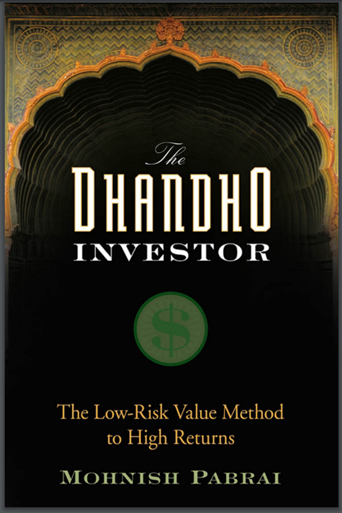
Notes and Quotes from The Dhando Investor – Mohnish Pabrai, published 2007, 209 pages.
There were virtually no Patels in the United States just 35 years ago. Less than one in five hundred Americans is a Patel. Over half of all the motels in the entire country are owned and operated by Patels.
Patels, as a group, today own over $40 billion in motel assets in the United States, pay over $725 million a year in taxes, and employ nearly a million people.
Dhan comes from the Sanskrit root word Dhana meaning wealth. Dhan-dho, literally translated, means “endeavors that create wealth.”
Dhandho is all about the minimization of risk while maximizing the reward.
If an investor can make virtually risk-free bets with outsized rewards, and keep making the bets over and over, the results are stunning.
The first few Patels arrived from Africa in the early 1970s. The reason we end up with concentrations of ethnic groups in certain professions is that role models play a huge role in how humans pick their vocations.
“Few Bets, Big Bets, Infrequent Bets.”
“Heads, I win; tails, I don’t lose much!”
The Dhando approach
- Focus on buying an existing business.
- Buy simple businesses in industries with an ultra-slow rate of change.
- Buy distressed businesses in distressed industries.
- Buy businesses with a durable competitive advantage—the moat
- Bet heavily when the odds are overwhelmingly in your favor.
- Focus on arbitrage.
- Buy businesses at big discounts to their underlying intrinsic value.
- Look for low-risk, high-uncertainty businesses.
- It is better to be a copycat than an innovator.
We see change as the enemy of investments . . . so we look for the absence of change. We don’t like to lose money. Capitalism is brutal. We look for mundane products that everyone needs.1 —Warren Buffett
Never count on making a good sale. Have the purchase price be so attractive that even a mediocre sale gives reliable results. —Warren Buffett
The entrance strategy is more important than the exit strategy. —Eddie Lampert
Arbitrage is as an attempt to profit by exploiting price differences in identical or similar financial instruments.
Minimize downside risk before ever looking at upside potential.
Discover more from Mukund Mohan
Subscribe to get the latest posts sent to your email.
