
How to start building today
Zero experience. One idea. Built with AI.
If you’ve ever had an idea for an app but didn’t know where to start — welcome to vibe coding.
Vibe coding is what happens when AI turns app-building into a conversation. You don’t need to be an engineer. You just need to describe what you want, and your AI co-pilot builds it.
The key is knowing which tools to give your AI so it has the right foundation.
Here’s the exact stack I use (and recommend to every first-time builder) — every tool here has a free tier, is AI-friendly, and scales beautifully from V1 to real users.
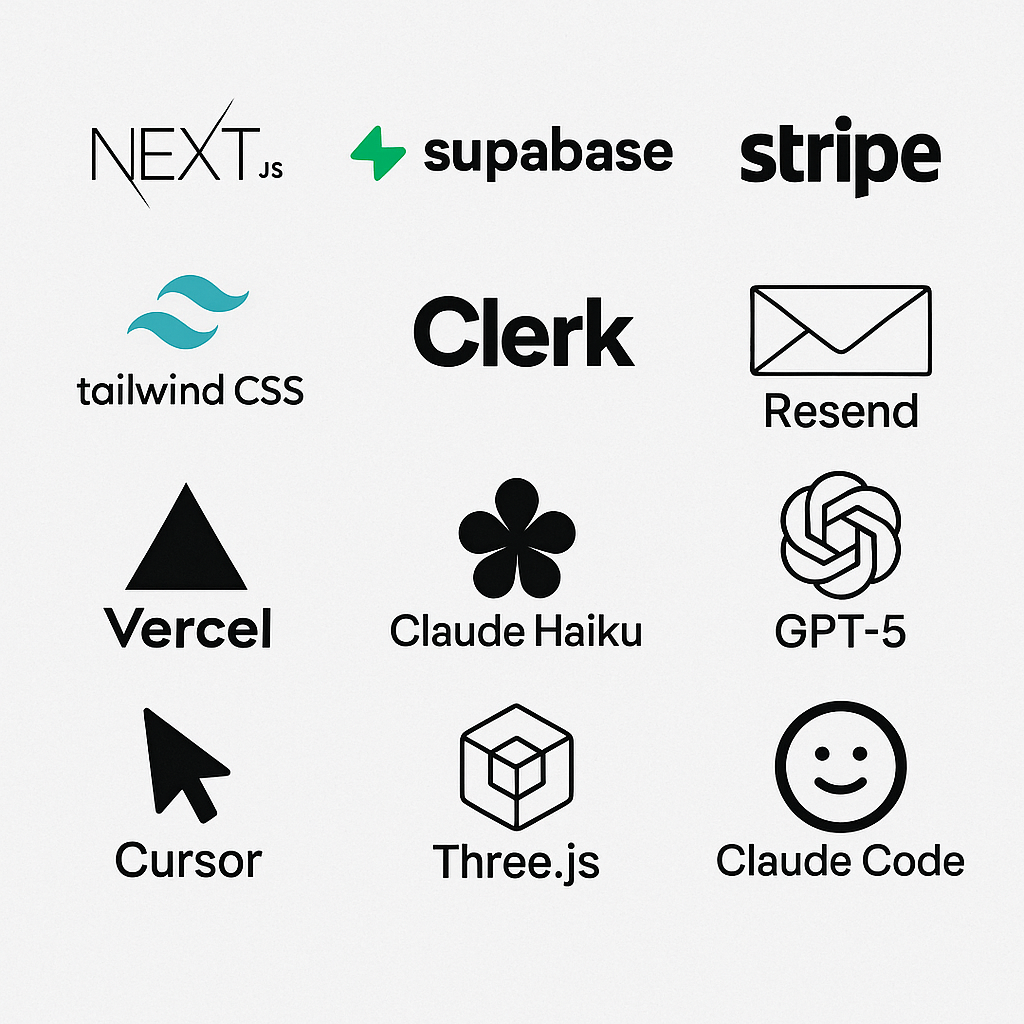
⚡ 1. Web Framework: Next.js
Why it matters:
Next.js is the backbone of modern web development. It’s fast, SEO-friendly, and integrates natively with Vercel (your hosting layer).
Why it works for vibe coding:
AI models like GPT-5 or Claude Code “understand” Next.js exceptionally well — meaning they can scaffold full projects, add routes, and manage components with almost no clarification needed.
In short:
Next.js is the easiest way to go from text prompt → production-ready web app.
🧱 2. Database: Supabase
Why it matters:
Supabase is an open-source alternative to Firebase — with built-in authentication, APIs, and Postgres under the hood.
Why it works for vibe coding:
You can ask your AI to “set up a Supabase table for users, posts, and comments” and it’ll know exactly how to do it. Supabase even generates REST and GraphQL APIs automatically — perfect for AI to plug into.
In short:
It’s the most “AI-friendly” database layer — powerful, flexible, and scalable.
🔐 3. Authentication: Clerk
Why it matters:
User auth is where most first-time builders get stuck — login, signup, forgot password, etc.
Why it works for vibe coding:
Clerk provides pre-built components for user accounts, session management, and multi-provider sign-ins (Google, GitHub, etc.). Your AI can drop them right into your Next.js app without manual configuration.
In short:
Clerk handles the painful part of “who’s allowed in,” so you can focus on building the experience.
💳 4. Payments: Stripe
Why it matters:
If you’re building anything people will pay for — SaaS, memberships, digital goods — Stripe is still the gold standard.
Why it works for vibe coding:
Every major AI model understands Stripe’s API docs inside and out. You can literally say:
“Add monthly billing using Stripe for $20/month per user.”
…and the AI will wire it up end-to-end.
In short:
Stripe gives your app superpowers — and turns your project into a business.
🎨 5. Styling: Tailwind CSS
Why it matters:
Tailwind makes styling fast and consistent — no more wrestling with CSS files.
Why it works for vibe coding:
Tailwind is pattern-based. When your AI writes className=”bg-blue-600 text-white p-4 rounded-lg”, you instantly get a professional-looking UI. It’s predictable, composable, and ideal for AI-generated design.
In short:
It’s the “design language” that AI speaks fluently.
🌍 6. Hosting: Vercel
Why it matters:
You need a place to deploy your app that doesn’t require server configuration, Docker, or DevOps.
Why it works for vibe coding:
Vercel was built by the same team behind Next.js — the integration is seamless. You can deploy your app from GitHub in one click, and your AI can even handle setup through Vercel’s API.
In short:
It’s the smoothest “idea → live app” pipeline on the internet.
✉️ 7. Emails: Resend
Why it matters:
Almost every app needs transactional emails — confirmations, password resets, onboarding messages.
Why it works for vibe coding:
Resend has one of the cleanest APIs out there, and it’s built for developers who want deliverability without complexity. Your AI can easily plug in Resend for all your app’s outbound communication.
In short:
No more debugging SMTP — it just works.
🧠 8. AI Logic Layer: GPT-5 + Claude Haiku
Why it matters:
You’ll often need to add intelligent behavior — summarizing data, generating text, parsing user input, etc.
Why it works for vibe coding:
Use GPT-5 for tough reasoning or complex multi-step builds.
Use Claude Haiku for lightweight tasks — it’s cheaper and faster.
In short:
Think of GPT-5 as your architect, and Haiku as your assistant. Together, they let your app “think.”
🧑💻 9. 3D Assets: Three.js
Why it matters:
If you want to add visual magic — interactive scenes, product demos, or dashboards — Three.js is your toolkit.
Why it works for vibe coding:
AI models can generate scenes, shapes, lighting, and even animations in Three.js with simple descriptions.
In short:
Three.js turns creative ideas into immersive experiences.
🪄 10. The Builder: Claude Code
Why it matters:
Claude Code (by Anthropic) is my go-to AI development companion. It’s context-aware, remembers files, and can reason across entire codebases.
Why it works for vibe coding:
You can feed it your stack, describe what you want, and it handles setup, scaffolding, and iteration — almost like having a calm, senior engineer pair-programming with you.
In short:
Claude Code turns this stack into something living — an AI-native development environment.
🪄 11. The Builder: Claude Code
Why it matters:
Claude Code (by Anthropic) is my go-to AI development companion. It’s context-aware, remembers files, and can reason across entire codebases.
Why it works for vibe coding:
You can feed it your stack, describe what you want, and it handles setup, scaffolding, and iteration — almost like having a calm, senior engineer pair-programming with you.
In short:
Claude Code turns this stack into something living — an AI-native development environment.
🚀 How to Get Started
- Copy this stack.
- Paste it into Claude Code or your AI of choice.
- Give it your app idea (or ask it to brainstorm one).
- Say: “Start building.”
You’ll have a working MVP — database, auth, payments, UI — in hours, not weeks.
No tutorials. No setup hell. Just conversation → creation.
💭 Final Thought
The hardest part of building apps used to be coding.
Now it’s deciding what to build.
We’re no longer learning syntax — we’re learning how to collaborate with intelligence.
Welcome to the new creative frontier:
Vibe Coding.
Discover more from Mukund Mohan
Subscribe to get the latest posts sent to your email.
