All posts by Mukund Mohan

My discipline will beat your intellect

Social Proof and why I am no longer confirming “Angel List” advisory or investments

For the last 3 years, I ran the Microsoft Ventures organization in India and then in the Seattle area. There were about 50 companies that we supported through the program. The program itself did not invest any actual dollars into any company, but provided office space, mentorship and connections.

One of the things I learned quickly and early on was since we did not offer funding, the key “ask” from many of the entrepreneurs was a confirmation of social proof of our commitment. While we did some PR, many were looking for more.

At that point, Angel List was a much smaller, but becoming an important phenomena, and getting listed on angel list with “social proof” about the same was an important signal to many.

Early on we did not “follow” Angel List norms of listing Microsoft Ventures as an entity – either because we were lazy or we did not know the “best practice” or we did not care or something similar.

Following that, many of our companies at the accelerator wanted social proof about our relationship to be reflected on Angel List or LinkedIn, etc, and sent me personal requests to be confirmed either as an investor or an advisor.

Since I had a profile on Angel list, I confirmed many requests to be mentioned as an advisor or investor to many of the Microsoft Ventures companies. Some of the CEO’s don’t even remember, is my guess, judging from 1-2 emails I got from surprised founders, that they were the ones that asked for this in the first place.

I did confirm many of them, which I am now cleaning up from my profile. Now that the social proof is no longer necessary, I think for their sake and for mine, they are no longer needed.

So, I was pretty surprised when folks reached out to me (14 in total, so far) about an online publication calling, emailing and reaching out to all the companies on my Angel List profile to “confirm” my association or the lack thereof.

Added to this, is the one instance when there was a supplier related issue (the name of the company was Engrave.in) where, they were a supplier to an eCommerce company where I was the CEO in 2011 – 2012 when, we as a company did not pay their outstanding balance, since the company was closing down due to our inability to raise a funding round from our existing investors.

The other part is about my investments as an angel investor. Between 2001 and 2008, as a part of Zodiac Investments LLC, based in San Jose, me and a cofounder (he asked to keep his name private, although I listed it before) invested ours and few other’s money in 21 startups in the valley. Many of those companies are no longer in operation. Many cant be named, for a host of reasons including the founders no longer want to be associated etc.

Between 2008 and 2012 I invested in 11 companies and I can name only 8 of them, with the rest of the founders not wishing to be public yet. That’s hard for people to understand, but some failed and some are still going. Plivo (A16Z funded it after our investment), Pricearoo (merged with another company, which I cannot disclose), Kinetic Brains (still going), Jivity (funded then by Argonaut Ventures and Venture East, after my investment, then merged into eYantra), Fresh Month (acquired), Blueberry retail (New Delhi, now shut down) and Azoi (Ahmedabad, still going) are the only ones I can name.

I have 7 advisory positions, some of which are ongoing and others have fiduciary responsibilities as well – so they shall go unnamed except Sign Easy and 9 Mile labs, which are public. Besides these there are 4 others.

So, now they have apparently a “hit” piece on me, in the intent to “expose” the “real” investments or lack thereof in many of these companies.

To be fair and balanced, I made some mistakes – first I should not have confirmed that I was an “investor” or “advisor” when really I was a part of Microsoft Ventures, which was the entity that was related to the startups.

Second, I could have handled the “Engrave” issue with more empathy, given I knew the founder, but at that period I was under a tremendous amount of stress, with 42 employees not being paid for over 2 months, 30+ outstanding balances unpaid to other suppliers and 3-4 of them threatening harm to my family and I over a 3 month period.

In fact, I was asked to come to the police station by one of the suppliers because of an outstanding balance the company owned himnot me personally. Which, surprised me since the company owned him the money, not me as an individual.

There is a lack of separation of personal liability and corporate liability, which I learned in India, is hard for most people to understand.

Anyway, long story short, if you do read a piece about me being a bad person, not a good investor or a “con” man, it is probably true, but now, you know the rest of the story. I am truly a horrible person.

To folks who are regular readers and CEO’s who did reach out to me to give me a heads up, thanks for having my back. I’d love to name you, but obviously I wont since it does not help you. The  Indian startp ecosystem is fairly small, as well, so it makes sense to not burn too many bridges.

Perseverance with the ability to pivot on data: 21 traits we look for in entrepreneurs

There are 5 key inflection points I have noticed which makes founders question their startup, to either make a call to continue working on their startup, pivot to a new problem or quit their startup altogether.

It is at these points that you really get to know the startup founder and their hunger and drive to be successful. I don’t think I can characterize those that choose to quit as “losers” or “quitters” because of many extraneous circumstances, but there is a lot of value that most investors see in entrepreneurs who face an uphill part of their journey to come out on the other side more confident and stronger.

These five inflection points are:

  1. When you have to get the first customers to use and pay for the product you have built after you have “shipped” an alpha / beta / first version. Entrepreneurs quit because they have not found the product-market-fit – because the customer don’t care about the product, there is no market need, or the product is really poorly built, or a host of other reasons.
  2. When you have to start to raise the first external round of financing from people you are not familiar with at all. Entrepreneurs quit because while it is hard to get customers and hire people, it is much more harder to get a smaller set of investors to part with their money, if you do not have “traction”, or “the right management team” or a “killer product”.
  3. When you have to push to break even (financially) and sustain the company to path of being self sufficient. Entrepreneurs quit at this stage because they have now the ability to do multiple things at the same time – grow revenues and manage costs, and many of them like to do one but realize it is hard to do that without affecting the other. So, rather than feel stuck they decide to quit.
  4. When you have to scale and grow faster that the competition – which might mean to hire faster, to get more customers, to drive more sales, or to completely rethink their problem statement and devise new ways to grow faster. Entrepreneurs quit at this point because they are consumed by the magnitude of the problem. They overassess the impact the competition will have on their company, give them too much credit or focus way too much on the competitors, thereby driving their company to the ground.
  5. At any point in the journey, when the founders lose the passion, vision or the drive to succeed. Entrepreneurs quit a these points because they have challenges with their co founder, they don’t agree with the direction they have to take, or encounter the “grass is greener on the other side” syndrome.

While I have observed many entrepreneurs at these stages at  discrete points in time, I have also had the opportunity to observe some entrepreneurs in the continuum, and I am going to give you my observations on 3 of the many folks I have known, who, have quit.

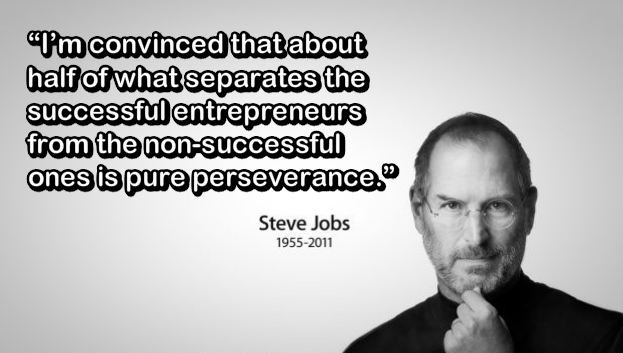
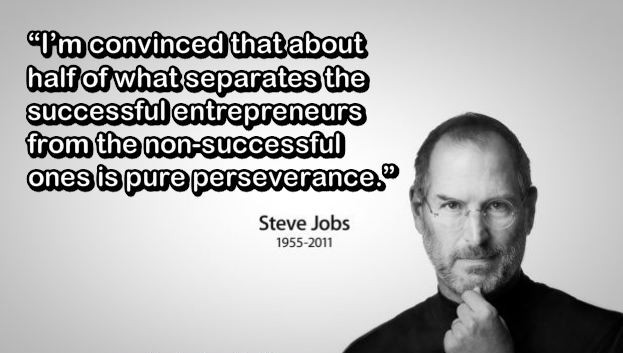
Perseverance separates great entrepreneurs from good ones

One went back to college to finish his MBA after getting a running business to a point of near breakeven, another found the business much harder than he originally thought he would and got a job at a larger company and the third was just unable to have the drive to go past 11 “no’s”‘ from angel investors. Over the last 8 years, if I look at my deeper interactions with over 90 entrepreneurs, who I would have spent at least 100+ hours each, I would say that of the 24 people that are not longer in their startup, the one thing that stands out among the ones that persevere is that it is not “passion” or “vision” at all.

It is the inherent belief that they are solving a problem that they believe is their “calling”. They also don’t believe that there is any other problem that’s worth solving as much, even though there may be easier ways to make money.

So most of my questions of entrepreneurs to test whether they will pivot or quit are around why they want to solve this problem (which I am looking to see if they know enough about in the first place) versus any other one.

The answer to that question is the best indicator I have found to be the difference between the pivots, the leavers and the rest.

Obsessive Attention to Detail: 21 traits we look for in entrepreneurs

Yesterday I was listening to the Corner Office podcast in which Elon Musk was interviewed. There was a part in the episode when he talks for about 7 minutes of the 25 minutes of the podcast about the car door. If you have the time, I’d highly recommend listening to the entire podcast, but the part about the door (15+ min into it) is awesome as well.

In the video showing off his new SUV, he talks about the door, showing how much thought has gone into the creation, design and support of the accessibility to the 3rd row of seats.

Even though Elon Musk is an exception, his trait for being obsessed over the details stands out. One of the things that’s pretty obvious to me is that the best founders obsess over every small detail. Primarily there are 3 areas that I expect founders to pay the most attention to: Product, Customer empathy and Hiring.

These 3 go pretty much hand in glove, so I am not sure if any of them is more important than the other, but it usually starts with customer empathy, then product and finally hiring.

The part I notice about the best entrepreneurs about customer empathy and detail is how some of them (maybe 35%) are their own best customers, who “scratch their own itch”, but the rest of them spend a lot of time with customers understanding, observing and engaging their users. The observations and questions tell you more about the scope and breadth of what they know about their customer.

That’s typically what I look for. How much do you know about the customers’ daily life, their life outside of your product, their schedule, their fears, what motivates them, etc.

While most good entrepreneurs can articulate their customer specific problem set fairly well, which their product solves, the best ones can tell me more about their customer’s overall state of mind and are open to other opportunities that might come up in their ability to expand the footprint of their product with their customers.

Product obsession comes naturally if you are solving a problem you know deeply. That comes from either spending enough time with it for years, or having the problem yourself. The most obvious manifestation of product obsession we see is in the User experience.

The trick I have noticed is that the best founders obsess over documentation, architecture, code coverage, commenting and code reviews as well. If you ask questions about a specific portion of their product – from the logo to the website template and their choice of naming their product plans, they can have detailed discussions on the thought they have put into each of these areas.

Finally when it comes to hiring there are 3 important things I look for – how much time they spend on reference checks, what kinds of questions they ask and how well they put together their job descriptions.

Is starts with a clear understanding of who they are trying to hire, so I ask for their job descriptions first. Not having them gives me indications as well. Some people claim to have “hired” from their network, alone, but if you don’t know who you need to hire, with what particular skills or experiences, then you are “taking” what you get, which is a signal as well. I want to also understand their interview process and steps they have to get candidates through the process. Are they keeping the bar high, or compromising? Are they attracting good talent or picking who comes in? All these give me clues about the entrepreneurs attention to detail.

While it is impossible for an entrepreneur to have attention to detail in every part of their business, their culture usually permeates through the rest of the organization.

Startup Idea: Robo Career Counselor

Every week, I get about 3-4 emails from young people interested in becoming a Venture Capitalist. They want to understand how they can get a job at a good VC firm and would like my advice or connections. Even though I wrote a post about this – How to get a job as a venture capitalist, they are looking for personalized advice.

Which is nearly impossible to give without listening, learning and then processing their background. That takes time, typically 30-45 minutes, which I dont have at all.

This is a real problem not just for Venture Capital job seekers, but also for the millions of people who want help with their career path. They know where they are – their current role, where they want to get to – a specific role (in some cases) or want to understand options (in other cases(, but dont know how to get there or what do to to get there.

For example, an engineer who does not like coding sees a profile of a Group Product Manager and wants to understand how to get there – what opportunities should she be looking for, what courses should she take, what educational background does she still need to fulfill, who should she take on as a mentor, etc.

Most employees at any mid-sized to large company have been told – you have to be in charge of your career, and not expect your manager or the HR team to do that. The problem is most of employees can only do it in hindsight, after 15 years, looking back.

To solve this problem, I think we can borrow a leaf from the “Roboinvesting” startups like Wealth Front or Motif and look at creating Robo Career Counselor service.

Robo Career Counseling

This will be a web service, which a potential user will log into using LinkedIn. Given their background, education and title, etc, it has relevant background about their past and present.

It will then ask a series of questions such as likes and dislikes (professional job specific ones, not the ones that Facebook has) and suggest 10 profiles of other successful role models or people who currently have that role / title. It has to also ask more questions about achievements and metrics which the individual currently has at their job.

Then it can help you connect with those people for a fee. Obviously those people, the mentors or coaches, have opted in, so they can be contacted and are willing to spend the time and energy for a fee.

In some ways this becomes a marketplace for career counseling or “democratizing personalized career advice” if you will.

The service can provide many ancillary services to the mentors or coaches themselves on how to ask questions, train them on available resources and help build frameworks for the user to leverage.

This service I think will be immensely popular and solves a key pain point that many folks (not all, but a large enough market) have.

To be clear, LinkedIn could do this themselves, but I have such a poor and low opinion of the company, that I think even if they wanted to they’d mess it up.They also have the inherent advantage of having a lot of data, so they should be treated as the biggest competition for this service.

On the other hand, I suspect if you do a great job, they’d acquire this service, if they were smart. I believe they are, very smart, so I am willing to fund a company in this space.

What you need to have is 2 full stack developers, with a great background in shipping products at scale, some data related background is ideal, and a person in your startup who has been selling to or understands the career counseling space.

Best way to pitch me is not email, or Facebook or LinkedIn or a Direct Message, but on twitter @mukund.

How to be in the target zone of “fresh opportunity” for new jobs?

Every week I get about 2-3 emails from friends who want to introduce me to good talent that wants to change jobs. They are in a good role; but not quite satisfied. They want to switch. Many because they dont see the growth they desire in their careers, some because their company is not growing as fast, so they are not getting promoted, and still others because they know one or two friends whose career is “taking off” because they are in a hot startup (most likely a Unicorn) and they feel they are just as good as the other person, but in a not so good company.

The surprising aspect of what I learned after talking to about 6-7 of them is something that has made me rethink my previous rule that HR teams drilled into me at larger companies – I was told “Employees dont leave a company, they leave a manager”.

Nope. None of the people I talked to actually disliked their manager. In fact quite the opposite. Most were happy with their manager.

So there is obviously a class of people who dont mind where they work at, like their manager, but still want greener pastures.

My first reaction was “Why”? To which one of the younger and more wiser job seekers said “Why not”?

I started going down the condescending path of “Only the best get into the hot startup”, or “The work-life balance at that hot startup is very poor”. etc.

Turns out none of that matters. Since most of the job seekers have made up their mind to join that startup, nothing I could say or do will change their mind.

I, instead said here are the 3 things you should do to get on the radar of that hot startup. (You can substitute “hot startup” for Google, Microsoft, Facebook, etc.).

First, “Be so good they cant ignore you“. Show off your work on GitHub if you are a developer, Dribble if you are a designer and SlideShare if you are a marketer. The future belongs to “great” talent, not mediocre, average people.

Second, “Make it easy for them to find you“. Participate in forums where your target company employees are – It may be Twitter, or Facebook or LinkedIn or some discussion groups, or offline events. You cannot expect to be an introvert and expect they will find you. You have to make it easy for them to find you.

Third, “Seek to know more about their customers than they do in your area“. If you know their customers well, they believe you must be good. For engineers this does not mean, market research or PowerPoint slides, etc. This might mean, what technologies their customers use, how they use their product, when do they use it, what do they like about it, what they dislike. Keep in mind we dont want opinions, or anecdotes, but facts and data.

Then do your best to network, slowly if you are introvert and dont enjoy networking. Find a way to show that you know more about their customers, and are extremely good at your craft.

The thing that wont help is a general email with your resume to me asking me to introduce you to my friends at a hot company. Not because I am mean or rude.I really want to help. You have to help yourself first.

How often do you ask yourself “Am I working on the right things”?

One of the things I keep asking myself increasingly is “Am I working on the right things”?

Usually these “things: are “goals” which I set for the year, or “initiatives” for the quarter, “projects” for a month or so, “plans” for the week, or “tasks” I do daily.

That’s a framework most people follow: Goals – Initiatives – Projects – Plans – Tasks.

Lately, though, I am asking the “am I working on the right things” when things refers to “goals”.

The first reason is as the world around me has gone more “on demand”, faster and “instant gratification” based, I realize I cannot cling on to the older frameworks I have.

The second reason is that I increasingly am finding many things that I desired to have, once I get them, I realize, are not as important, as fun or as attractive as I thought they would be.

The final reason is there are always more things to do than those that you can do. Which brings me back to “Am I working on the right things”?

So I ask the question – “How did I come up with those things that I wanted in the first place”?

There were 3 ways:

First, I copied them from someone I saw / admire / respect, and say to myself – that would be cool to emulate, not realizing the context for why they chose to get there. For example, I have admired Neil Patel’s ability over the years and the effort and time to build a personal brand and followed that as “something I should do”.

So, like him, I spent more time creating content – not as good, not as effective and not as high quality. The difference in the results is stark – but not only because of the quality of the content.

After having built 1/15 of the brand (or some other smaller fraction) he is, I realized that’s not as important to me as it was to him.

The second way I came up with those “things”, was to think in a vacuum. Long plane rides are usually good for these. When I got on a cross-continental trip I’d always carry a good plain notebook and a book to read. When I was done reading a 10th of the book, I’d get these ideas and goals based on maybe one sentence from the book and run to come up with a manifesto for myself – which I’d keep for a few months or weeks. Until the next long plane ride.

The third way I’d come up with these “goals” was drawing inspiration from other things – a movie, a story I heard, a startup I read about and say that would be good for me to do. My inspiration to “lose weight” was drawn from an arbitrary discussion with a friend, then noticing my sister using MyFitnessPal and finally an annual checkup that revealed nothing but the fact that my BMI was on the “higher side of normal”. Not high, mind you. Just higher side of normal.

If all these 3 are arbitrary and not very well thought out, then welcome to my world. Or as they say in India – “I am like that only”.

I am curious as to how other people come up their list of things to do – not in life or in general terms, but more over 2-3 year. As a goal for example.

What technique am I missing?

3 strategies you can adopt to lose weight – pick one that works for you (or all)

I wrote about how I lost 50 lbs in 25 weeks earlier this year. I went from 174 lbs to 129 actually. I also wrote that the only one thing you need to do to lose weight was to eat less. Although weight loss is a marathon, you want to treat it like a series of small sprints was also something I learned.

Since then I have been asked by over 30-40 people on how exactly I lost weight, what did I eat, when, how much, etc. I did write about what I eat to manage an intake of less than 1500 calories daily. That’s very difficult for most people to follow (and it became for me as well).

I figured out yesterday what people want really is a DIY (Do It Yourself) framework. So, here are 5 strategies you can adopt based on your preference. This is neither comprehensive nor complete, but a useful guide, would be my recommendation.

Vegetarian Food Pyramid

The main point I am trying to make is you need to eat less and make that a lifestyle. How you do it largely up to you based on your own body, your fitness regiment, your other health requirements etc.

  • Portion control: This is the technique I use on holidays and most weekends. Eating everything but in small portions works well. When I was more intense and regimented about my food 6 months ago, I used to drive my wife, kids and friends pretty nuts.I would measure all my food intake, in 1/4 cups, weigh nuts with a machine etc.  This strategy works best when you have a wide spread and you really want to “taste” everything. The technique that goes hand-in-glove with this is that you should not have “seconds”, else it messes up the strategy.
  • Food substitutions: I use this a lot in my salads and you can as well for most other foods. I would recommend before you decide on a substitution, track your food, calories and nutrition for a week using MyFitnessPal to ensure you are substituting good sources of certain nutrients for better nutrients at much lower calorific value. There are certain foods that are “nutrient-dense and calorie-light”. For example I have switched thousand island salad dressing (111 calories per 2 tbsp) with balsamic vinegar (28 calories per 2 tbsp) and now can eat salads with no dressing at all, and found that my palette has gotten used to the taste.
  • Smaller, more frequent meals: I like this approach, but can rarely follow this. There are a set of people who swear by this. Similar to portion control, but slightly different, this strategy means you eat very small “meals” every 2-3 hours, instead of 3 large meals during the day. I only do this if I know I have a busy and packed schedule with many meetings all day.
  • Avoid certain foods: This is the most popular type of diet actually. No carb for example, or high protein, or low fat, paleo diet, Atkins diet, Raw food diet, Juice diet, etc. There are over 30 of these (or more) diet plans. I dont subscribe to this strategy, but I know many people who swear by these
  • Fasting: Once a while, it helps to give the stomach some rest, like the rest of your body. Drinking more water, or drinking hot tea as a substitute for a meal helps. I do this pretty regularly now.
  • Smart snacking rule: I use this technique on most weekday afternoons. Most people can eat healthy during lunch and dinner, but snacks are what kills their diet. So, I have a pre-determined “smart” snack planned instead of having to rush to the vending machine or eat some other junk. I have moved to more nuts (preferably unsalted) and fruits, or just plain soy milk.

At the end of the day, you have to pick a strategy (or many) and stick to what works for you. As I mentioned before, instead of telling people do this, I am now saying follow one of these strategies and see which one works.

The most important part before you do this is to benchmark religiously for 1 week (1 month is the best) using a calories counting app. Then you have your nutrition balance figured out as well.

I do have one caveat – I am not a nutritionist neither am I a doctor. I know these worked for me, so speak to a trained professional instead of using my advice alone.

The other type of entrepreneur – not glamorous, no showboating, but very effective

There are 3 friends and colleagues I want to highlight today, who I have known for a while now. They are the “hardly” know entrepreneurs. They appear rarely on social media touting their company. They rarely talk about how “difficult” their journey was. They dont mention the “challenges” of work-life balance while being an entrepreneur. They never complain about how “hard it is to raise money”.

The thing they do effectively is run businesses that are growing like weeds. All three of them are running startups that are strong, cash flow positive and showing phenomenal growth, and all turning a profit as well.

These are the “other type” of entrepreneur. Effective, workman-like and focused. Ravi runs a deal site – Coupon Rani, Archana runs a media property called Archana’s kitchen and Swapnil runs a University alumni community site called Alma Connect.

I have known these three entrepreneurs for over 3 years now.

Ravi Trivedi Archana Doshi Swapnil Khandewal

I met Ravi first at a Coffee shop when he was looking to leave the cushy world of Venture capital and start his own company. He and I dabbled starting a company together, but things did not quite work out. He then started coupon rani and has built a good team, shown strong revenue growth and has a few investors now chasing him.

Archana and I met on the plane. She is the spouse of one of my good friends and a few years ago, when I was traveling from Mumbai back to Bangalore, she sat in a seat behind me. Surprising that she noticed, but Rutvik (himself a VC) had me on his Facebook profile, so she noticed my photo and the likeness. She was getting started then as a chef and had some early traffic and is now featured on Television frequently and is a celebrity in her own right.

Swapnil and I met 4 years ago at IIM Ahmedabad, at the CIIE, center for entrepreneurship. My wife and I flew in to meet with 9 entrepreneurs for a day to look at interesting companies to invest in and we were greeted by Swapnil that evening. Alma connect was a way to get Alumni from Universities to connect with their colleges and find ways to support and encourage new students and their younger graduates

I am so honored to be friends with all 3 of them, mostly because they are entrepreneurs who have stuck through the tough times that most of us go through.

They are all solo entrepreneurs.

All three of them have bootstrapped their businesses.

All three of them are running profitable, high growth businesses without a plethora of mentors, advisors, investors and the paraphernalia that young entrepreneurs surround themselves with.

All of them are in businesses that are not glamorous, (well Archana is an exception) and still growing like crazy.

None of them are from IIT, IIM or any other “top schools” that most investors seek in entrepreneurs in India.

There is hope in this world after all.

Entrepreneurs investing in other entrepreneurs

A side-effect of product entrepreneurs from 2000’s starting and building a cash-flow business is that many have the money to become “angel” investors.

I wrote about the unique Indian trait of survival because it is hard to shutdown a business. I believe that’s resulting in many new angel investors who understand entrepreneurship and starting up. Which is a good thing, overall, with some caveats.

Most of these business people were still “young” and folks I would consider likely to be founders again, but they are now starting to “invest” in other startups as an investor.

That’s really strange. Or not, I guess. I don’t know.

I mean, the biggest investment you can make is in your own talent, business and capabilities.

Then why would you take your hard earned money and invest in others? That makes no sense, especially given how little you made in revenue or profit.

I asked 2 (not all of them were investing in other companies, only 3 were) of them why they were investing in other businesses instead of putting the money to grow their own business, and their answers ranged from “Saw an opportunity” to “Wanted to help a friend” and “This market is fairly small, and I cant leave it, so I am diversifying”.

I don’t know what to think – whether it is admirable that they were investing in others and “giving back” or lack of imagination for their own venture that they were “unable to direct investment in their own business to channel growth”.

That’s not even the kicker.

Two of them asked if I’d be interested in taking a look at their business to fund growth.

Entrepreneurs Turned Investor (credit Venture Giant)

If your business was not growing fast enough, and was generating “cash flow” to pay the bills but not more, and you were unwilling to fund its growth yourself, why would you assume another investor would?

First, the growth clearly does not exist.

Second, you seem to think the opportunities are elsewhere.

Finally, you are divesting actively from the business yourself to find growth elsewhere.

They did give me some reasons – the money they were generating was not enough to grow and they needed a lot more cash to invest but the opportunity was “super-large” and they were constrained by “running” the business which forced them to not hire people to scale, etc.

I am not sure how to read this.  I am positive that this will result in more “entrepreneur turned business people” investing actively in other startups, but it is a trend for sure.

Uniquely Indian startup trait – Forced to survive because closing a company is painful

For most Indian entrepreneurs, survival is their unique value proposition. The fact that it is impossible – from a legal, financial and procedural standpoint to “close” your company, declare failure (bankruptcy) and move on, creates for more resilient entrepreneurs than in the US.

Last week at NPC, I had a chance to meet 5 entrepreneurs who I have known for 3-5 years now. 3 of them had raised some money (accelerator programs, angel investors, etc.) and 2 were bootstrapped. All of them had approached me a few years ago with the intent of having me fund their company. I passed on them all for a variety of reasons, but largely because I did not think what they were doing was going to be a large enough company to generate big returns.

The most amazing part to me was that they were *all* still in business. They all survived. They had all found a way to generate revenue, and *all* – everyone of them, claimed they were breaking even, or making a profit.

That’s amazing. 100% survival rate from the list of people I thought would have closed and moved on, if they were in the US for sure.

How to survive (Credit- SteamPowered)

To be fair, most of these entrepreneurs would have survived and built a cash-flow business in the US as well, so it is not correct for me to label this as a particularly Indian trait.

Every one of these companies was doing between $150K to $500K in revenue and turning a small profit in some cases after paying for employees & founder’s salary plus expenses.

I am not sure if this is to be filed under “tenacious” entrepreneurs, perseverance, “lost the dream mid-way” or “lost the hunger” founders – which is being very condescending, I know.

I asked why they did not fold, shutdown and start over to find quick growth.

None of them mentioned “difficult to close a company in India” as the reason for not shutting down. All of them were fairly wise in their response – “It takes a long time to build anything meaningful in India, and they got started with revenue development and were now well down the path to give up”.

Now that they had some decent revenues and maybe profit, they were trying to build their base and grow further. Slowly, but surely.

I wonder how many of these will be “cash flow” businesses.

One entrepreneur (a fairly young person at that in his late 20’s) had hired a COO to run the business, while he spent time investing in other companies and try to open new opportunities abroad.

I wonder if this is the new “IT services company” from the 1995-2005 era. They had all built a product or a web service – generated some revenues and were now protecting the cash flow and growing the business at a much more moderate pace.

I wonder though – if shutting down a company in India were much easier, would they have done that mid-way, looked for a new opportunity and moved on?

We will never know, will we?