All posts by Mukund Mohan

My discipline will beat your intellect

Should you build something inconsequential first to make meaning later?

I was at a newspaper and media conference with 20 of the top editors and business people in March this year, when one of the SVP’s of a large publisher expressed dismay at BuzzFeed. “They are trash” she said. “It is not even publishing or journalism, just plain nonsense with a bunch of silly animated gifs”.

She went on to share that the traffic on their own property had dropped 17% year on year, compared to the published metrics from ComScore that stated that BuzzFeed had grown 200% during the same period.

Yesterday, I read an article about one of the presidential candidates complaining that Donald Trump was “muddying” the presidential campaign for other Republicans by saying things that were divisive and catering to the racist crowd.

Regardless of whether BuzzFeed or Donald Trump are right or wrong, the key point that’s important is that they give people what they want. People might “need” serious journalism or a candidate that talks about economic, political, social and cultural “issues”, but the immigration problem is the one that touches the nerve.

That’s not to say that BuzzFeed cant do serious long form journalism or Donald Trump cant talk about any other issue at length.

In fact, going back to the things that are “serious”, most always they apparently start out being fairly silly.

The reason big new things sneak by incumbents is that the next big thing always starts out being dismissed as a “toy.”  Chris Dixon, 2010

One way to be dismissed and not be taken seriously by big large incumbents is for startups to do something fairly inconsequential (what people want) and build enough strength to then take on serious challenges (what people need).
How do you segment startups? Here are 3 models, but we need more

I love the approach, analytics and data associated with segmentation. The act of taking large numbers and breaking them down into manageable smaller parts fascinates me.

Yesterday, I had a chance to talk to a friend about segmenting startups. There were 5 ways we tried to segment them and finally figured out that 3 made sense and the rest were not useful or actionable.

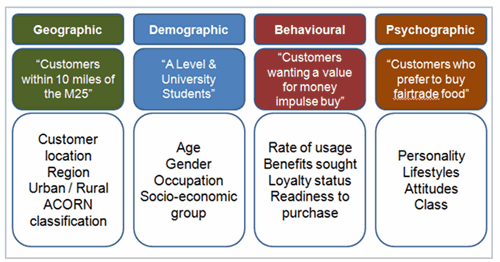
Here are the 3 categories of segmentation we came up with.

  1. Segment by stage of company. (Idea stage, Prototype, stage, Traction, Growing, Scaling)
  2. Segment by growth rate (slow growth, medium growth, fast growth and rapid growth)
  3. Segment by category (eCommerce vs. SaaS vs. Media, etc.)
  4. Segment by location (where they are based)
  5. Segment by type of funding (Bootstrapped, Angel, VC, etc.)
  6. Segmenting by market opportunity (large existing market, vs, disruptive new company)

Segmenting by stage of company: This is the easiest to understand. Most companies call themselves in various stages based on their funding stage as well, so we figured #5 and #1 were fairly close. There were enough differences when a larger company was bootstrapped, so they were “Growing” and “Bootstrapped” but those are fair and few between.

Segmenting by growth rate: We wondered if this was similar to stage of funding as well, but there are enough differences. A slower growth “Startup” would be going through multiple rounds of seed and early stage funding, so we felt this was useful segmentation.

Segmenting by category: This is the one that most startups use as well besides stage. Companies call themselves as an eCommerce company, Consumer Internet, B2B startup, etc. Most startups use this as a way to segment themselves besides stage.

Segmenting by location:Companies tend to email me and segment themselves from “silicon valley” vs. “New York”, vs “Bangalore” for example. Not sure where we could use this, but this is one other way we could segment them. I suspect after you do a first level filter, this might be a follow on segmentation.

Segmenting by type of funding: Compared to 7 years ago, startups are taking longer to get to VC series A for some companies, but others are still taking less time. Some end up bootstrapping for longer, and still others go from accelerator to accelerator, trying to raise seed round, post seed rounds, bridge rounds and still trying to get ready for a series A raise. I dont think this is going to help us action them in a particular way, so this, albeit interesting is not very useful.

Segmenting by market opportunity:

There are other ways to segment startups, including the type of founder (hacker, vs. sales person, etc.) and founders background (serial entrepreneur, first time founder, etc.)

I wonder if there’s anything we missed. I’d love your input.

The difference between metrics-driven and data-driven startups

Data driven means that progress in an activity is compelled by data, rather than by intuition or personal experience. It is what scientists call evidence based decision making.

Metrics driven means that activities are driven towards a deadline and objectives pre-set, rather than organically.

I think of Metrics-driven as inherently proactive and Data-driven as reactive. I dont think being reactive is wrong, especially when you dont know what metrics you should be driving towards.

SaaS metrics drive for success

Here is an example. Most companies start by watching customer behavior and understanding what users are doing on their site. For example what do they do after they sign up, how long do they take to fill out their profile, etc. After watching users for a while, they understand clearly the on-boarding process for users. They can become proactive and set specific metrics – number of users, time for user to get setup and the date by which they want # of users on board.

Which is why it is never either-or. You need to be watchful at times (when you dont know enough) and other times set goals to drive towards them.

Another reason why it helps to be reactive is when you are willing to be open to go in directions that the data takes you. In many cases, in the drive to focus on goals and objectives, many companies miss obvious clues that might give them insights about their customers.

There is a good overview whitepaper by Joel from BlueNose on this for SaaS metrics.

So, if you dont know what to drive towards, I’d say look for clues in the data. If you do, then drive towards predetermined metrics. What do you think?

How long should your customer development interviews be? #napkinStage

Since many accelerators have been asking startup entrepreneurs to “get on the phone” with customers and talk to real users, I have been getting a lot of emails from folks asking me how long their customer interviews should be.

While there is no right answer, there are a few guidelines that you can use, which come from th best User experience designers.

First, it is best to schedule your customer interviews and in step function of availability. Ideally you want 10 time as many surveys, to the number of calls and 3 times as many calls to the number of face to face meetings.

If you want to get feedback from 10 customers / user in a face-to-face setting, then 30 people on a call is ideal and 100 people filling out an online or email survey is the best.

Where did I get these numbers from? Most sample size calculators will give you numbers based on your population (total customers who you expect for your first version of product (segmented), confidence an margin of error.

Second, if it is possible, get users to commit to giving you 30 min of their time, for which you will have to give them something meaningful in return, else they will be unwilling to give you the benefit of doubt.

The best way that I have seen great customer interviews being conducted is to have user empathy sessions.

  1. The first step before your interviews is to prepare and brainstorm questions.
  2. The second step is to identify the focus of what you’d like to learn from your users.
  3. The final step of your preparation is to ensure you have the right questions.

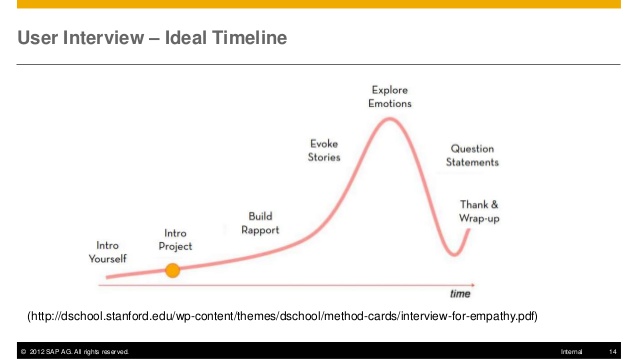
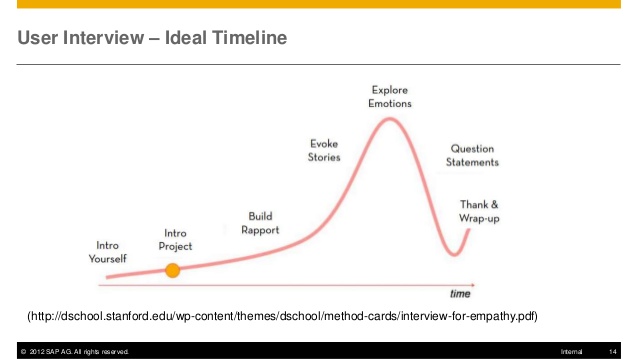
During your interview, I’d recommend you “break up” the allocated time into 7 sections. These are scientifically proven, so you don’t have to take my word for it.

User empathy design thinking

1. Introduce your self – typically this should take less than 10% of the time of the interview. So, if you have 30 min, less than 3 min to introduce the participants.

2. Introduce your problem statement (or project). This should also take less than 10% of the overall time of the interview.

3. Build common ground or rapport – Usually empathy is shown by framing the user problem in their daily scenarios. Typical items to cover include – “Some of our other users have told us …”. Or “the problems our users have encountered so far include…”. Most of this part should take you another 15% of the time.

4. Get them to talk about their problems in the context of the discussion. The best interviews are those when your users are doing most of the talking. The bulk of your interview time should be spent here. Close to 30%.

5. Explore the current solutions and how those solutions are deficient or how they dont empower your user. This part usually takes about another 15%.

6. Ask more questions that help you clarify the statements and positions users take. Most people end up spending 10-15 % of the time here.

7. Thank the user for their time. Typically 5 to 10% of the time is spent on this.

These numbers are purely indicative and will change based on your relationship with the user and their constraints on the ability to express their usage and user behavior.

The pros and cons of accelerated vesting for employees on change of control

Accelerated vesting of stock options is a fairly unusual clause for founders to worry about. It is however, a very important term that I would highly encourage you spend enough time thinking about. Most founders end up doing accelerated vesting for themselves and maybe for the advisors but rarely for the employees.

What is accelerated vesting?

If you are giving 100 stock options to be vested over 4 years for employees, and there is an acquisition event in the 2nd year, then single trigger acceleration means all the remaining shares vest immediately. Your employees now have 100% of the shares they were going to get in 4 years at the close of the acquisition. A double trigger acceleration means if for any reason the acquirer fires your team or your team decides to quit because the acquirer is in Santa Monica and your team is in the Bangalore, they would still vest 100%.

Accelerated vesting is a good clause for employees to have by and large.

The acquirer, however, in many cases, but not all, wont like this, since most acquirers are buying your company, which is worth the software, technology and the services of the people who are in it.

With acceleration, the acquirer has to now budget new stock options to keep the employees for the period of time they think they need to get value from the acquisition.

Accelerated Vesting of Stock Option

The pros of accelerated vesting:

  1. Takes care of employees and gives them confidence that if there is a “change of control” – meaning if you raise money and the VC’s decide to fire the founders, get a new CEO, etc. then they will vest 100% immediately. Or if you get acquired, the employees will hit pay dirt immediately.
  2. Gives you a negotiating chip when potential acquirers want the team to ensure they keep you and the team around.

Cons of accelerated vesting:

  1. Potential acquirers dont like this, since they are not sure how many of the new members will accept new jobs in the acquiring company and they are buying the team and company, not just the software and technology
  2. It might artificially lower the acquisition price since the acquirer might negotiate the new employment contracts with your employees directly and try to pass the costs of the new contracts to your purchase price.

What’ my experience:

Accelerated vesting upon change of control is absolutely important for founders and critical for employees.

I wish I had done it at BuzzGain and lost close to $250K because of it. I would highly recommend you do it for founders, advisors and employees.

Optimizing Mindshare vs. Marketshare vs. Wallet Share

Mind share relates generally to the development of consumer awareness or popularity, and is one of the main objectives of advertising.”

Market share is the percentage of a market (defined in terms of either units or revenue) accounted for by a specific entity.”

“Wallet share is a survey method used in performance management that helps managers understand the amount of business a company gets from specific customers.”

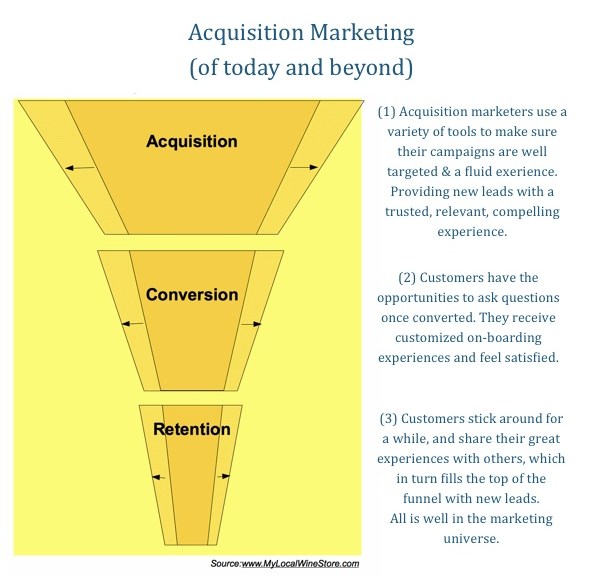
The answer to when do you need to take which approach is via the funnel framework of customer acquisition.

Marketing funnel - mindshare, marketshare and wallet share
Marketing funnel – mindshare, marketshare and wallet share

Most entrepreneurs start to acquire customers via the network they know – either B2B or B2C. Friends and family are the logical first early adopters if it is a consumer product and if they are not the target audience, then sharing via social networks is a logical choice.

Getting “mindshare” is important at the initial stages of customer acquisition. Potential customers need to be aware of your product and know that you exist.

There are 2 parts to this acquisition – the trusted customer acquisition and the unknown.

The trusted is the customers / targets / prospects who know you – they have prior experience or knowledge about you and are willing to make a bet based on their experiences with you.

The unknown is the new fresh leads or prospects who you have to build a relationship with. That’s usually harder for most entrepreneurs. Which is why you want a product that customers really like, which means they will tell other customers about it, reducing the barrier to “building trust”.

When you get “enough” of a pipeline, you tend to focus on marketshare – getting these customers to convert.

Marketshare is a focus if you have enough leads. If you are getting enough leads or “trials” or “free tier” users to convert them. Obviously you cant convert 100% of your free users to paid, but if you get enough data from them to make it worth the while, then the free tier is worth it. In many cases the free tier is also a marketing technique, when you cant afford marketing.

Finally wallet share is when you already have customers and want to get more revenue from existing customers.

So, the easiest way to determine where you need to spend your time and energy is to look at your funnel and determine where the gaps are.

The other way is to look at relative metrics. If the ratio of what’s in your marketshare vs. value of what’s in your mindshare is less than 10%, you need to spend more time on converting existing customers.

If the ratio of wallet share pipeline $ to marketshare pipeline $ is less than 30%, then you need to spend more time converting existing customers to buy more from you.


The long hard road to anything meaningful for #entrepreneurs

3 years ago I was at the Unplugged conference in Bangalore to see about 10 startups presenting. There was one that stood out – Gazemetrix.

I wrote about them and also thought they were the only ones worth funding that day.


That said I also mentioned they were in for a long, tough slog.

I met Deobrat after that event and really liked him. I did not end up funding them though.

Pankaj Jain from 500 Startups did.

They moved to the accelerator program at 500 during the fall of 2012. I met Deobrat again, with the teams from InstaMojo, WalletKit and Tradebriefs. All super great folks.

Sampad from Instamojo was hustling, Sri from Trade Briefs was calm, Kevin from Walletkit was trying to find his groove, and Deobrat was trying to find his mojo but was really struggling.

I dont profess to know what Deobrat and his team went through the last few 3 years. I have an idea though. It would have been a tough, long, hard slog.

They did not get significant funding from the US investors, and they returned to India, to work at the Microsoft Ventures cohort.

They were just acquired by Sysomos.

I am sure the journey was bittersweet, but totally worth it. I am so happy for the team.

That’s the journey an entrepreneur goes through. Ups and downs, sideways and running in place. Some make it, some don’t, but, most would not trade their journey for any other thing.

Is consulting the best way to get started on your product journey?

Yesterday I was judging the #MVLunchbox event at Startup Hall in Univ of Washington. There were 3 companies in the advanced category – Build Pulse, an analytics platform for office buildings, Metric Story, an analytics simplification tool for Websites and GlobAtom, a Import Export Paperwork simplification tool.

There were 5 more companies, in the earlier category, and the winner was Stuff Hopper, which allows you to sell stuff by just taking a picture (similar to what OLX and Quickr do), but they will come by and pick up your stuff as well.

The winner of the advanced category was Metric Story. It allows you ask simple questions and get answers to your Web analytics questions. Currently the web analytics space is largely dominated by Google Analytics, although there are a host (over 50) smaller players such as MixPanel, Kissmetrics, etc.

The interesting part about Metric Story is not that what they are doing is new or innovative. In fact I have seen variations of the same many years ago. I also tried to help build a product in the space a while ago – GitGrow.

The good part of Metric Story is that the founders actually have been consultants in the Web analytics space. This has allowed them to understand and package their expertise into a simple to use product, with very little unique or proprietary technology but more the expertise of working in the space long enough to know what the “just enough” to get paid by the customer requirements are.

Which leads to the question – is the best way to get expertise, knowledge and understanding of a space, by being a consultant and “learn on the customer’s dime” while providing value?

It also helps you make money to bootstrap and at the same time find out the “minimum viable solution” to solve the problem without building a product.

The problem with this approach for most people is that consulting is lucrative enough for many folks, so they don’t ever get to building a product.

Nonetheless, I’d love to hear more about this and if you have been successful going from a consulting gig to being a product startup founder, I’d like to know how you made the transition?

Increasing email open rates – 3 top techniques for newsletters

One of the things I have been very focused on over the last 2 weeks is email “open rates”. Since this blog now has 100K+ subscribers, it is a very important metric to me. I dont get too many metrics beyond the open rate since the WordPress hosting that I use provides only that metric.

Email open rate research suggests that open rates vary from 15% to 25% with the average being 22%. The open rate for this blog had hovered around 17% (that’s low) and now after a few tweaks has inched up to 19%.

Email Subject line length

The best days for open rates for this blog have been Thursday and between the hours of 7 am Pacific (730 pm India time) to 9 am Pacific (10 pm India).

There are 3 changes I made which have progressively yielded better open rates.

  1. Writing more effective headings / Subject lines of the right length. This is the #1 thing I am focusing on. On an ongoing basis, I spend 23-28 minutes a day writing a blog post. In the first few months, I’d spend 95% of that time writing the blog post and less than 2% of the time writing up the heading or Subject line. Now I am spending 15% of the time coming up with the right heading. The other experiment I am conducting is taking my old blog posts and ReTweeting them with new headlines to understand how to write catchy and effective Subject lines.
  2. Moving from inline images to featured images. WordPress has an option called “featured image”. If you choose that, it appears as an image at the top of the post, instead of inline. While most email clients filter images and the use has to explicitly download them, images are very important for people reading blog posts on my site. So the best compromise is to not have inline images but instead have it featured. That way it does not appear on the email body but definitely appears on the blog post. If you can do 2 images, then your open rates increase even further.
  3. Consistent time of publishing.This is pretty obvious, but if you setup a routine to send emails and publish posts, you will get a higher open rate. So, even if you write your blog posts at a time that’s not your usual time, publishing it “later” helps ensure the open rates are higher.

#Complaining is not going to get you anywhere,so entrepreneurs must #TakeAction

I have a friend who I have known for a long time. She constantly complains. In person, social media, everywhere. If it is not the traffic, it is the weather, else it is her manager or the number of people waiting ahead of her in line at a restaurant.

I read Tim Ferri’s article on “I did not complain for 21 days and it changed me“, and forward it to her with a hint – try this.

Late last year she was laid off unfortunately. It was an acquisition by a larger company that made her role redundant and she was let go. She called me up and told me that the first time in many years she was “without a job” and felt scared and slightly unnerved at the same time.

After many days of back and forth, I suggested this was the opportunity for her to be an entrepreneur.

She hemmed and hawed for a few days and told me after a week that she had no ideas to start a company.

So, I asked her to stop complaining on Facebook or telling anyone else about her complaints, and instead asked her to write all the things that bugged her about her life in a notepad. Daily.

Then after a week or so we talked again. She had 11 things. She said she still had “no ideas”. I said she had 11 opportunities.

Everything that you complain about is an opportunity for you to do something about I mentioned.

It took her a while, but the “Few opportunities for women in tech resonated with her the most”.

She’s started a company 4 months ago. I rarely hear from her – either on FB or the phone anymore.

So I called her last week to check in.

I know how to push her buttons, so I mentioned that I was missing all her complaining.

“Who has time to complain”, she said. “If I am not doing something about it, I am likely the cause of the problem”.

Bingo.

Dont complain.

Do something about it.

That’s an entrepreneur.

Everyone else who complains is an opportunity to be solved. Likely someone whose job will get automated by a robot or software or intelligent technology.

Solve problems that you have complaints about.