All posts by Mukund Mohan

My discipline will beat your intellect

How to survive a “funding round that fell through”?

Once a week, I get a panicked email from a founder who wants me to take a look at their startup and invest since they were looking to close a round, but a key investor or two decided to not participate.

Most investors (buyers) don’t like to be rushed. Whether that’s you trying to make a big purchase, or even waiting in line at the McDonald’s trying to decide what to eat for lunch. So, it is not surprising that I have not invested in a single opportunity where the need was to invest within a day or two.

I did get a chance later to talk to a few of the entrepreneurs and of the 5 I have spoken with, 4 shutdown their company because they were unable to raise their round. Most of them decided to move on and join another startup.

Even if you have good traction (growing 10% MoM) and a sense of product market fit, fund raising is very hard. In fact it is likely the hardest thing you will face as an entrepreneur. Some people claim building a product is harder, or getting customers is, but I think fundraising is tougher than either of those two tasks.

The main reason is that there is asymmetry and inefficiency in the market for information and opportunity.

In most cases investors do not know if a startup will make them money and founders do not know if an investor is ready to participate.

The best way to survive the “round did not close” issue is really to keep your burn rate really low or generate enough other income to survive longer. That’s easier said than done.

Keeping your burn rate low is the easier of the two things to do. Don’t hire would be my suggestion to most entrepreneurs. That’s usually the biggest cost in any startup. Payroll. So, if you and your co founder can make by without making the investments in people (or in inventory if you are an eCommerce company) then do it by all means. You might experience pain and longer working hours, but it tends to be worth it. Primarily because the chances of your company doing well after you experience a “almost funded, but did not” is low.

Startup Closed
Startup Closed

Generating enough income to survive is hard as well, but usually if you have specialized talent or skill, then consulting tends to be a necessary but good enough option. If you can get work in the area of your startup and get paid reasonable rates, then you can keep your dream going for that much longer.

If you will want to ensure your funding gets closed, then the first thing I’d advice you to do is to setup enough options with alternate investors (hope to have 10 interested and likely 3-5 might close) or have a way to keep things on simmer until your investors are ready. Since it will be a chicken and egg to get more investors until you get more traction, I’d recommend you focus on selling and getting more customers by focusing all your efforts on sales, instead of adding any more features.


It takes more than ideas to be innovative. Come participate at #Innofest

Ask most people who they think is innovative, they will likely name Apple, Amazon or Google. Some many even mention Facebook.

Innofest
Innofest

True innovations though have been coming from industries outside of technology for years. In the area of healthcare, medicine, drug delivery, education and mining for example, creating great outcomes to help improve the lives of humans.

The credit card for example is one of the innovations I value the most. Not having to carry cash and yet pay for practically anything and “actually” pay for it many days later. What’s not to like? Very innovative.

There are a few observations about innovation that I wanted to put forth.

First, most innovative ideas which have a lot of impact rarely seem to be so early on. I still remember many years ago when a friend, Mike Walsh mentioned Uber to me and I did not think it was very innovative. I actually thought it was an app for taxi drivers to get fares. Turns out it is an innovative way to avoid car ownership.

Second, you need help from many others to bring your innovation to the market. Almost always those people who you need help from are pretty busy or very tied up, so they will likely not have time to give you. Being persistent, taking any chance you get and keeping at it helps.

Finally being disciplined and meeting people from other backgrounds and experiences helps a lot. Getting ideas that worked in other fields and trying to solve problems you have with a different perspective helps make your idea stronger and more innovative.

I heard about Innofest from my friends Sharad and Avinash this week. The 1 day un-conference is an event to be held in 2 weeks (22nd Aug) at IISc Bangalore.

The event is an un-conference so you will have a chance to meet with folks and discuss ideas instead of just listening and leaning back to hear “speakers” talk. Also, the part that’s most useful is that you will get 10 min to talk to the awesome lineup of speakers – people like Alok from Saif partners and Bhavish from Ola Cabs among others. These folks have been through it before and will be there to help guide you through your problems and formulating your idea.

I think if I were in Bangalore, this would be a must attend event. #IndiaCanInnovate

The new age “conglomerate” – Alphabet

The dominant form of corporation in 1980’s was the conglomerate (pdf). By the 1990’s this form had become deinstitutionalized.

Why?

Diversified firms were taken over and the unwanted parts were sold.

The new age takeover firms of the 1980’s are activist shareholders.

Yesterday’s news of the new alphabet is indicative of multiple long running trends:

  1. There was a need for ultra long range investments and Larry Page and Sergey were willing to make those bets.
  2. A cash generating business can help fund many other risky investments over time, which may or may not pay off, but will help move humankind forward.
  3. The limitations of a few activist shareholders need to be put aside for the greater good.
  4. Conglomerates allow for one idea from one portion of the business to help another in a different field innovate.
  5. Different business models in the same “corporation” or entity causes people to get confused.

Welcome to the new age conglomerate.

Google, I believe is the first of maybe 3-4 potential conglomerates, which will emerge over the next few years.

Facebook with Oculus and WhatsApp will likely be another candidate. WhatsApp’s business model is not clear, but Oculus will not likely make money from Ads. So, there’s a need to have a holding company for sure.

Uber (taxi business model, delivery business model, fleet management and ownership) will be possibly another.

Alibaba should be yet another, if already not down that path.

The only thing that’s challenging for these companies is if their structure has not been already setup to support the dual class stock voting structure, etc.

When you have multiple businesses with different models of making money, and you still want to hold them together, this new structure makes a lot of sense.

I only wish more companies in technology would adopt this model. Welcome Alphabet.

Alphabet
Alphabet

The thing I do think that’s going to be a challenge is that there will be less transparency about the “Google” part of the business. I really think that there will be less information shared about how YouTube or other parts of the Google business are performing. I am hoping otherwise, since that was mentioned in the letter, but I doubt it.

What to consider before you start negotiating your stock options package at a startup

After you decide which startup to join if you are considering switching jobs, one of the key questions becomes how to negotiate a package. I get a lot of questions on % of stock ownership, vesting schedule, preferred vs. common stock etc. I am not a qualified lawyer, so take this as pointers and suggestions not as advice.

Depending on the stage of the startup you are considering, the “complete pay package” may be skewed more towards cash or more towards stock. Most startup founders have realized that to hire great talent, there is not just one thing you need any more. There is a need for meaningful work, great pay and benefits and an awesome culture.

I am going to skim over culture, and meaningful work for this post and assume you have figured out a company that offers both, but now need to negotiate your pay package. Most startups are not going to offer great benefits that bigger companies offer, so you are going to work with a fewer set of variables such as pay and stock options.

First, the pay. There are 3 stages that I am going to consider at startups. First, the pre-seed or seed round, second, post some seed round, before the series A and third, post series A.

In almost all of these cases, I have seen that good startups will end up offering a lower base and salary (80% of the chances are it will be much lower than your current pay) but “try to make it up with stock options”.

In many startups, salaries tend to be a fixed range with little room to negotiate. If you are making a lot of money at a larger company, expect to take a cut in pay. If you are working at another startup, expect to be marginally in the same range.

There are exceptions for extremely well funded companies and the post series A stage, but that’s rare. There are fewer than 20 companies in India and about 100 in the Silicon Valley who can offer salaries that match Google or Facebook, Microsoft or Accenture.

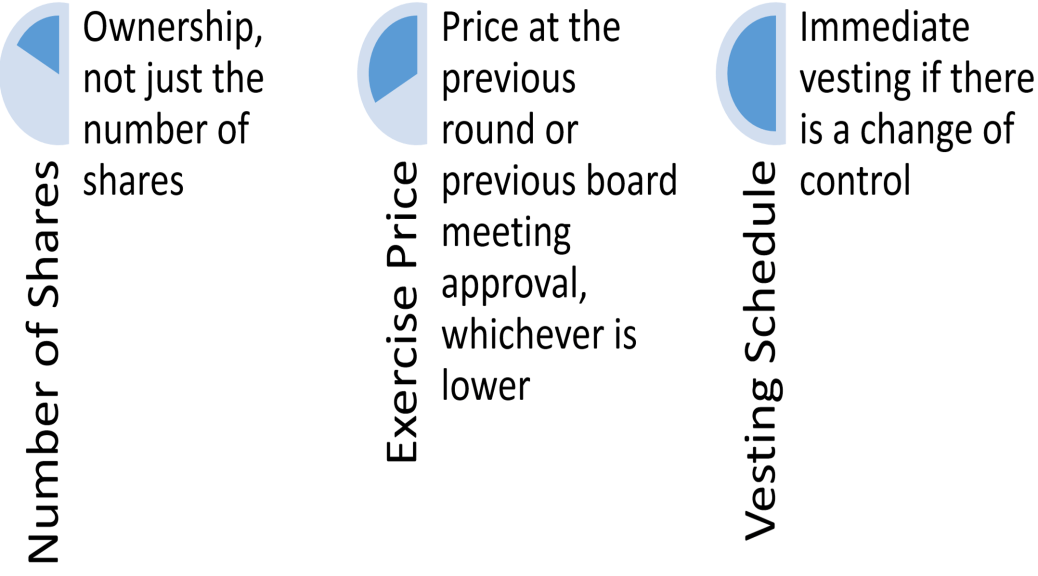
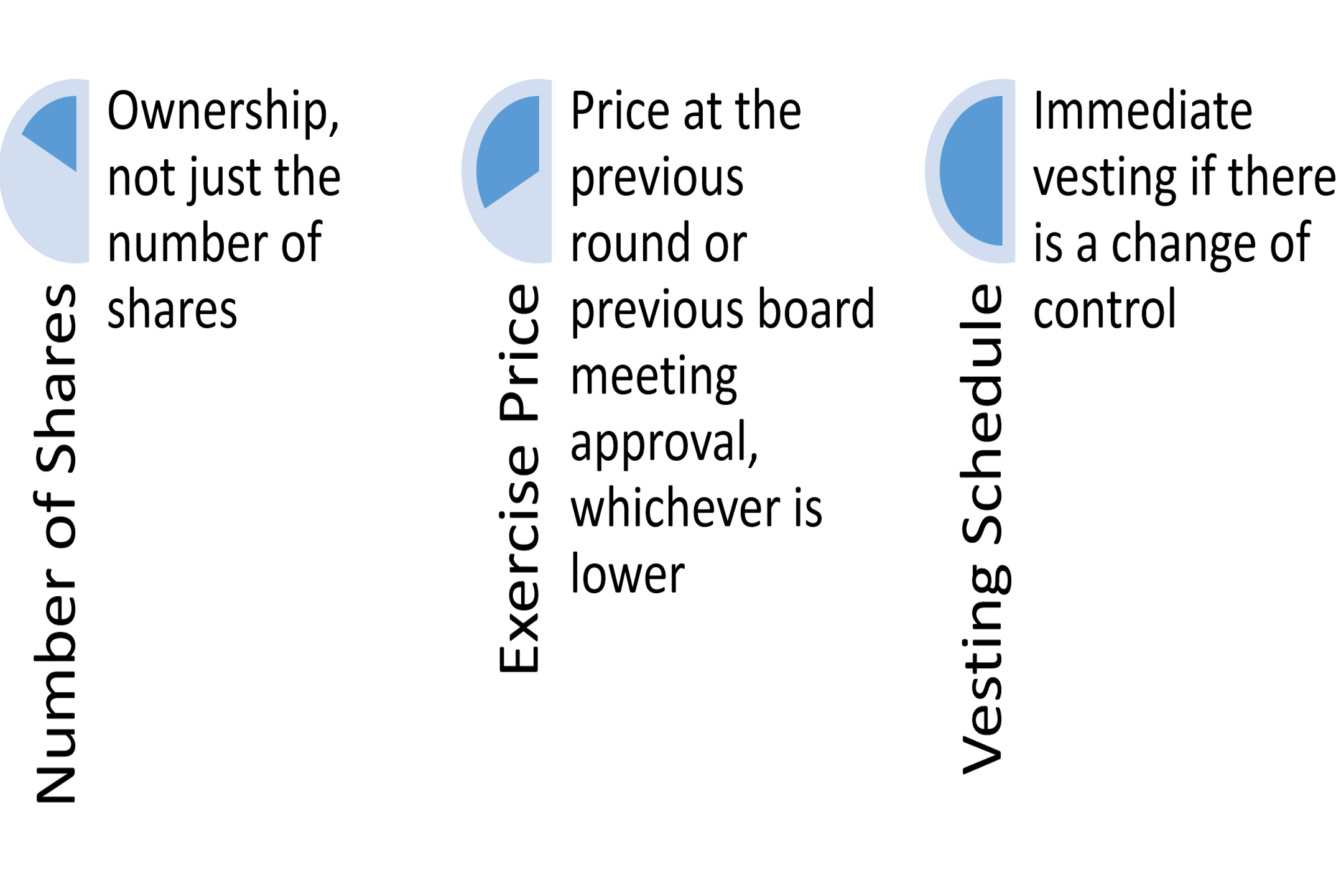
There are 3 important elements to the stock option package – The number of shares, the exercise price and the vesting schedule. The secondary negotiable elements are the type of shares – common vs. preferred, change of control provisions for early vesting and early exercise to save on taxes.

Stock Option Negotiations

If your startup is at the pre-seed / seed stage, and you are fewer than 20 employees, you can ask for the total outstanding shares of the company, so you can determine the % ownership. A senior executive (VP Engineering, VP Marketing) can expect in the 1-7% range and folks more junior can expect 0.1% to 1%. This is likely the only element you can negotiate in most startups. If you are looking for unreasonable percentage ownership relative to contribution, expect to get some push back.

The earlier you are at the startup, expect a larger % relative to later stages.

The price of your stock is determined either at the previous round or in some cases at the board meeting (exceptional cases) when an inside round has been completed. After the backdating stock option scandal of the 2005’s no CEO will help their new employees get stock at a lower price, so there’s not much to negotiate here, other than to know the price.

Finally the vesting schedule tends to follow a pretty standard pattern – usually 4 years, with a 1 year cliff. Meaning, after one year at the company, your shares will vest monthly. What you want to learn about is the option to buy your shares and if there are “claw-back provisions” if you leave before an exit.

Most employees dont stay until the exit of the company (or rarely do) and if there are claw-back provisions, you want to be aware of those.

The secondary considerations are important as well. If your contract can specify that your shares will fully vest in the event of a change of control (meaning your startup gets bought) you should seek that.

If your company offers early exercise I’d ask for that option. You might not want to exercise early (since you cant tell if your company will do well or go bust), but it is a good option to know about and negotiate.

Finally, most employees are usually given common stock. You want to know if the founders have as well, or have they, like other investors for example, been given preferred stock if that exists and what the benefits associated with preferred stock (in terms of what the liquidation preferences are).

How to decide which startup to join if you are considering switching jobs

I get an email or 2 every week from employees at large companies who have interviewed at a startup wondering if “startup X” is good, will do well, or “is a good bet”. Most of the time I dont know about the startup or the founders, so I tend to focus mostly on the market trends and the problem the startup is trying to solve.

Occasionally I will also get folks sharing their salary and ownership details with me (mostly junior folks) who would like some advice on how to negotiate a better salary or more stock options.

I used to be rather dismissive of the negotiators and ask them to focus on the learning and experiences, but that turns off most people I think. They wanted advice on how to negotiate better and here I was telling them what they were getting was good enough.

Instead, I decided to develop a framework to think about the opportunity and the startup role.

The first thing you want to ask yourself is why you want to work at a startup. Or leave your current job and join another startup. If you are at a big company (and have been there for a while) and have made a good salary and are looking for a “big retirement win from 3-4 years of work” at a startup that’s going to go public, then it is very hard to choose the right startup.

If you are however at a big company and looking to learn more and get a different set of experiences, you will likely have expectations that can be met.

Predicting which startups will do well is hard. In fact, over the last 10 years, given that most companies are raising a lot of money in private markets, it is harder to “get an exit” and make it big (financially speaking) in a short period of time.

Lets start with your objective.

If you are looking to make “risk free money in a short period of time” with your talent, you will get a small reward. A role that similar to your big company role and with a pay package that fairly consistent.

If you are seeking to learn how to be an entrepreneur and master how to start a company, you are better off joining an earlier stage startup than one that’s “sure to go public in a year or two”.

If you are looking to make more money than your current role offers and advance your career, it is best you join a later stage startup that’s looking to scale.

Startups that are less than 2 years young are the riskiest, will offer the most in stock and less in pay. Especially if they have only raised a series A.

Startups that are 2-5 years young and have done one or two rounds of institutional funding will likely offer good pay and decent benefits but limited upside in stock options.

Finally, “unicorns” which are over a billion dollars in capitalization will offer compensation that’s commensurate with your current pay and benefits and even more limited upside in terms of stock options.

If you are looking for the “perfect role” with the “most awesome pay”, that’s equivalent to your current pay and “huge upside” in stock options with guaranteed returns, that does not exist.

So, my recommendation is to decide what’s important to you – steady pay with strong benefits, but learning a new technology or being part of a new culture – then join a later stage startup.

If you decide that being a part of a fast growing startup which has some traction but still has potential to scale, where you will learn and grow with the company, is important to you, then join a venture which has been around for about 3-5 years.

Finally if you wish to learn how to start your own company after this one’s done and want to learn the fundraising elements of the startup, understand how to market and scale the business, then join a much earlier stage startup.

New Market analysis – The data center “server” market #napkinStage

Another weekly feature I want to start is an analysis of a new market, so I can understand trends and learn about opportunities.

The hardware market for servers is a fairly large market overall. These are expensive high end systems that have a 7-10 year life-cycles and tend to be shelved and end-of-life-ed after that.

According to IDC and Gartner over $50 Billion dollars is spent on server hardware each year. That constitutes about 8-9 million units each year. So, the average unit price of a server is about $5000.

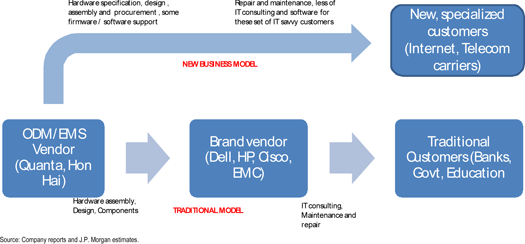
There has been a dramatic shift on both sides of this market – the buyer (service providers and data center owners) and the sellers (OEM’s, ODM’s and Contract Manufacturers).

First the buyers. The biggest tend has been the rise of the cloud. From 70K to 85K buyers and service providers in 2000, there are now only 25K buyers. The rest of the companies have “given up and gone to the cloud”.

Data Center Server Market Distribution of Buyer

The second trend, related and a resulting effect of the first trend, on the buyer side we have gone from a even spread at the top (long head) to a sharp head (consolidated top buyer profile).

What that means is that in 2000, the top 100 buyers accounted for 25% of the server purchases. Now in 2015, the top 10 buyers are accounting for 25% of the purchases. That indicates consolidation in a significant level. Companies like Google, Facebook, Twitter, Baidu, Tencent, Alibaba, Sina, Microsoft, IBM (with acquisitions) and Amazon (AWS) now account for a quarter of all server purchases annually. The next set of buyers – traditional ISP’s such as AT&T, Verizon, GoDaddy and about 1000 others account for 10% of the market.

Finally buyers are now also purchasing more “commodity” servers with cheap hardware components and systems and going away from expensive OEM servers. While HP,Dell, IBM and Lenovo continue to be the market leaders, more ODM’s such as Quanta, Wistron and Invetec.

What this means is that the major OEM vendors are losing market share to ODM’s and contract manufacturers or Electronics Manufacturing services (EMS) such as Foxconn and others.


How accelerators make money to manage operating costs

There are over 500 startup accelerators in the US and over 1000 worldwide. Most accelerators are aligned with Universities (at over 35%), some are government funded (local government mostly) at 29% and some (15%) get grants from rich individuals and institutions such as Kauffman Fund. The remainder (21%) are privately funded accelerators such as 500 startups, Angel Pad, etc.

First, the definition of a seed accelerator, so we can understand the scope of the program:

A fixed-term, cohort-based program, including mentorship and educational components, that culminates in a public pitch event or demo-day.

While there is no reliable data on how many of these accelerators are doing well, graduating great companies and surviving, there is some data on how they are managing to stay afloat and “keep the lights on”.

Most accelerators, raise some money to invest in the startups they fund. Many (over 61%) offer some form of space to their startups to operate in during the cohort. Accelerators also have a staff of 1-5 people (some even more, but the average is 1.8) to manage the program, support the startups and recruit, select and engage the local community and ecosystem of entrepreneurs.

All this costs money. In the US, that’s usually upwards of $400K (that’s the low bar) and in other countries, more than $250K per year.

Typically the cost of the space and maintenance is about 30% to 40% of the budget, the cost of people about 40% – 45% and finally the cost of programs, marketing, etc. tends to be about 20%. This excludes the investment in the startups.

While investors in the accelerator are willing to fund the startups (and take a % stake in them), most are unwilling to pay a “management fee” for running the program.

Having interviewed and talked to many accelerator programs, over the last year, I have a list of 9 different ways programs have tried to raise the operating costs of the accelerator. I thought I’d document these so it would be useful.

  1. Sponsorship: The most frequently used means to raise operating funds, is to have large corporate sponsor. Some local government organizations also sponsor these accelerator as a means to be connected to the community. Many accelerators also raise sponsorship from local legal, accounting and real estate firms who benefit from the startup community or wish to target entrepreneurs and startup talent with their products and services. Nearly 60% of companies and 30% of all operating budget funding is sponsor driven for the 15 accelerators I know.
  2. Events: Many accelerators run events that aid future entrepreneurs, community participants and local businesses. These events are typically networking opportunities and charge attendees a nominal amount of money to cover the costs, enable marketing for the accelerator and pay for the “marketing resource” at the accelerator. Some accelerator programs also put together hackathons and still others run large industry events to generate operating cash. Typically the problems with running these events is that they take up resources and time, but if you can generate enough cash from these events, you can support 1-2 resources who can help with other activities at the accelerator during the non-event days.
  3. Entrepreneur-in-residence programs: A relatively newer program is the EIR, where employees at large companies or those at smaller ones who want to learn how to be more entrepreneurial, end up spending time at the accelerator in exchange for a fee. Typical fees are between $25K to $50K in the US. These EIR programs are full immersion programs and last 6-12 months or 1-2 cohorts. During the program, the EIR is going through the entire process from start to finish and “learning on the job”. Many of the participants end up becoming investors or entrepreneurs at the end of the program and return to their companies, learning about lean methodologies, innovation approaches and how to build on an idea and bring it to market.
  4. Grants: Both government and private donors typically give grants (no strings attached usually) to accelerators to support entrepreneurship, which promotes local jobs, makes a city more attractive to larger companies and also helps the local economy.
  5. Rentals: Many accelerators charge a portion of their investment as a fee for the space during the program per seat. So, if the accelerator invests $100,000, and the startup has 3 founders and employees, then $5000 might be charged per month of the startup for the 3-4 months they are in the accelerator space. This is more of the domain of co-working spaces, but many accelerators are starting to do this as well.
  6. Research Reports: Few accelerators I know write research reports based on their startup data for larger companies. These companies pay for the syndicated research reports so they can use them in their internal presentations. These research reports tend to be focused on a particular area of expertise and also a market domain. It is not unusual to see companies pay $50K for a syndicated report for the year about the startups within a specific area of their interest.
  7. Code Academies and Hacker schools: Many accelerators have also joined with coding schools, which teach programming to new and interested talent. This serves two purposes. First, the accelerator can raise cash by conducting training and second the graduates become good source of talent for the accelerator startups, who pay a fee to recruit the talent.
  8. Innovation scouting for larger companies: Many larger companies are also looking to recruit talent, acquire companies and learn about new disruptions and innovations. These companies are willing to pay a little money to scouts who can help track, recruit and manage a startup pool of entrepreneurial talent. Many accelerators provide this as a service to larger companies.
  9. Distribution, Sales, Design and Marketing consulting: A few early stage accelerator are also providing the equivalent of the “coding” school for non developers by running marketing and sales training programs. The difference is that the graduates are employed by the accelerator program and they end up being consultants to the startups who charge a fee for their services.

These are the various programs I have seen, and I’d love your input on if I have missed any that you have seen.

Sometimes all you need is someone to give you an opportunity @DaveMcClure #IamAnEngineer #MyDaughter

We are a pretty nerdy family and sometimes to a fault. In fact some days we will be at home with the kids and we are texting each other, since we are in different rooms. My older kids do code. Thrisha (13) does mostly front-end – Javascript and HTML/CSS and Rishab (11) does decent SQL. My youngest girls are 9, so I am hoping they will start to code, soon, as well.

I was in San Francisco a few weeks ago talking to Dave McClure during the #preMoney conference, about my daughter, who has been coding for a while, and he suggested she should come and do an internship at 500 Startups. I am was not sure, but I mentioned it to my wife, who was a little worried about where she’d stay, how she’d commute etc.

IAmAnEngineer
IAmAnEngineer

We have a ton of family and friends in the bay area, so one of our good friends, Sachin, offered to host her for the 1 and 1/2 months of the internship. Thrisha was keen to do an internship, and 2 of the startups at our Seattle accelerator offered to have her over during the summer in LA and NYC.

She was constantly talking to these 2 companies and was pushing us to send her to those cities. I was not too keen about LA, because we dont have folks we know there, and so both staying there and commuting were going to be a problem. And she is only 13, so I was a little concerned about she being out on her own.

Over the last 5 weeks, thanks to Dave and #500Strong, my daughter has been in Mountain View, coding and working on a project that they use to monitor their investments. She has been very happy and is learning a ton.

The first day I went to drop her at work, she got on a call with the lead – Santiago, who has been very helpful and supportive. During that call, I was suggesting to Thrisha that she should spend more time brushing up on her Javascript and take 1-2 weeks to do that.

Santigo jumped in and said, “No, just go to github, download the repo and get started”. I was not too sure about Thrisha going in and checking code into production, but I let my fears stay in my own mind.

Turns out Santiago was right. Thrisha got the repo, and picked up the language and the requirements completely by just looking at the code and learning.

I am still amazed that a 13 year old (let me brag for a little bit) is able to understand and work on code that gets used, but that’s I guess the scary part as well. If, a 13 year old, who is heading to 9th grade can do it, what stops my 11 year old or 9 year old?

At what age should we support programming with our kids? Should we just expose them to technology and programming and let them pick up stuff on the go?

Another question is about women in technology. I dont think this problem is going to go away anytime soon and it does require a concentrated effort for a long period of time, but you have to hand it to folks like Dave and others at 500 Startups.

Sometimes, all you need is someone to give a 13 year old, an opportunity. I know Thrisha’s very happy and thankful to the #500Strong team for the chance to work at the fund.

My daughter’s 13. She can code. She is an engineer. #IcantBeMoreHappy #IamAnEngineer

Why some apps and websites have never changed their user interface #DontFixWhatsBroken

The Google search “user interface” has been the same for over 17 years now. The simple text search box with a button for Google search and “I’m feeling lucky”. That’s it. Nothing has changed at all.

Feeling Lucky
Feeling Lucky

Same for iOS and similarly for Instagram, etc.

Media properties go through several changes every 12 to 18 months. Some even undergo changes more frequently than that.

Why do some websites and apps – Facebook, etc. change so often and have the users go through the pain of learning the new experience?

And why do some services NEVER change at all even after user feedback about their experience.

The basic user interface theory suggests that once your user / customer knows how to make something work, they like it and get used to it. After that it is hard for them to change. Many of your users may not even like the change, since it forces them to learn new things and be productive at the same time.

I have a theory of User interfaces, which is just a theory, but I’d love contrasting opinions on this. I believe that most users dont care about the User interface. They care about the experience and want it to be seamless, easy to understand and simple.

Which means, they expect the complexity to be hidden.

As an example the search input for Google has not changed, but the response pages have dramatically changed over the years.

From a simple list of blue links, now, Google provides contextual and relevant information.

That means the search engine has changed a lot (in the back end), but the complexity is largely hidden from the user.

Which is the reason why most apps in the future wont have a User Interface is my belief.

The user interfaces we know of are mostly there or will be there soon. Learning new interfaces will take us a long time.

A combination of micro services and service based apps, will result in the death of mobile apps and pretty much most apps.


The input elements for apps will likely be questions (business apps) or statements (communications) via voice, gestures, etc.

The output elements will have multiple levels of detail (overview, specifics and detail) and while I think they will evolve, they will start to coalesce around the known.

I’d love to know if you think I am wrong.

Granular Pricing and Event based Pricing as a Service – (Praas) #NapkinStage #WillFund

One of the things I’d like to do every week from now is to talk about problems that I know about. I am hoping I can get entrepreneurs interested in working on these problems. Of course, most of these will not be fully vetted or even viable. That’s where customer development comes in. Honing in on the specific problem set will be something that needs work.

The problem I want to talk about today, is pricing. As more software companies offer their products on the cloud, and more companies are becoming “full stack“, there is a big need to help them optimize pricing to capture value instead of usage alone. Pay for performance instead of pay for usage is not a new concept.

Pricing by usage means that as people use more, you will charge them or they will pay more. That’s typical of mobile phone plans for example, the more data you consume, the more you will pay. That’s consumption pricing.

Pricing by value or pricing by outcome are two other means. As companies get more “full stack”, it is becoming more clear that they intend to not price on standard known means. For example Uber’s surge pricing is “value” pricing based on demand. GE has started to price its jet engines on availability and uptime instead of a maintenance fee, which increases its ability to execute differential pricing. If the engine is available more, GE benefits as does the airline, which leads to lesser downtime and hence more profits for the airline. This extra profit is what GE wants a part of.

More specifically, in terms of software defined pricing, it is becoming clear to me that granular pricing, the associated billing is equally important.

The solution is “Pricing as a Service” or PraaS.

I can envision an API driven offering, which is used by the developers of any SaaS company. The offering will manage the pricing pages and the billing for the company (different from recurring billing and transaction that’s done by Recurly, Chargebee, etc.)

The API’s will also be available to customers who want to bill granular components of their product. It should provide the ability to manage pricing tiers or create “packages” and also allow for multiple SKU’s to be created from base offerings by segment of customer.

I think this is a sketch of the idea, and there needs to be a lot of work done to talk to SaaS companies to understand their problems with pricing their products.

The other part of the pricing problem is metering and billing. I know of many SaaS companies who are looking to expand their customer footprint by offering their products via public clouds (AWS, Microsoft Azure) to large customers. For these companies, new metering and billing by components, or value based is a lot more profitable than plain usage or user based pricing.

I think Pricing as a Service is an important solution, so if you have a background (been an entrepreneur – failed or succeeded before) in a SaaS company, and a team of 1 or 2 cofounder who can build large scale API based systems and have the desire to build a company, you should reach out to me. I’d love to learn more and if your team fits the bill, I’d be willing to fund this idea. If you are a solo entrepreneur, I’d not be interested. If you have not been an entrepreneur before, again, it would not fit my criteria.