I am on the advisory board of 2 companies and on the board of directors of 1. One way to think of startups as going through the “forever school of learning”.
Before MVP you have 4 seasons or primary school, then after MVP, before Product Market Fit, 4 seasons of middle school, then after raise your series A or 3 quarters of consistent revenue growth, 4 seasons of high school and finally after series B and beyond, 4 years of graduate school.
As you’d expect, the challenges (or courses) get more difficult as you progress. The early challenges are largely speaking to enough customers to get feedback and nailing the specifics of the problem you are working on with product updates and later on they tend to be about metrics, strategy and managing cash.
Monthly Advisor Update
Here is a template document I have used with my monthly advisor updates. Most of the startup CEO’s create this template on Google Docs. The other advisors update the doc with their comments and since we are all at different locations (and continents) it is easy to review the combined feedback.
There are 5 sections as you can see above. The section I value the most are the what they learned and what they accomplished.
Usually what I have found is that the CEO updates 3 sections – accomplishments, key metrics and areas they need help and the co founder or product person updates the remainder.
Most of the advisor meetings are about an hour a month with many shorter updates and conference calls in between.
Board meeting packages on the other hand tend to be more metrics focused. Here is a sample board deck that I have suggested be used (from IA Ventures) to my startups.
The key part of the advisory monthly update document is that it needs to give your team accountability and ensure the advisor has visibility into the progress so they can help.
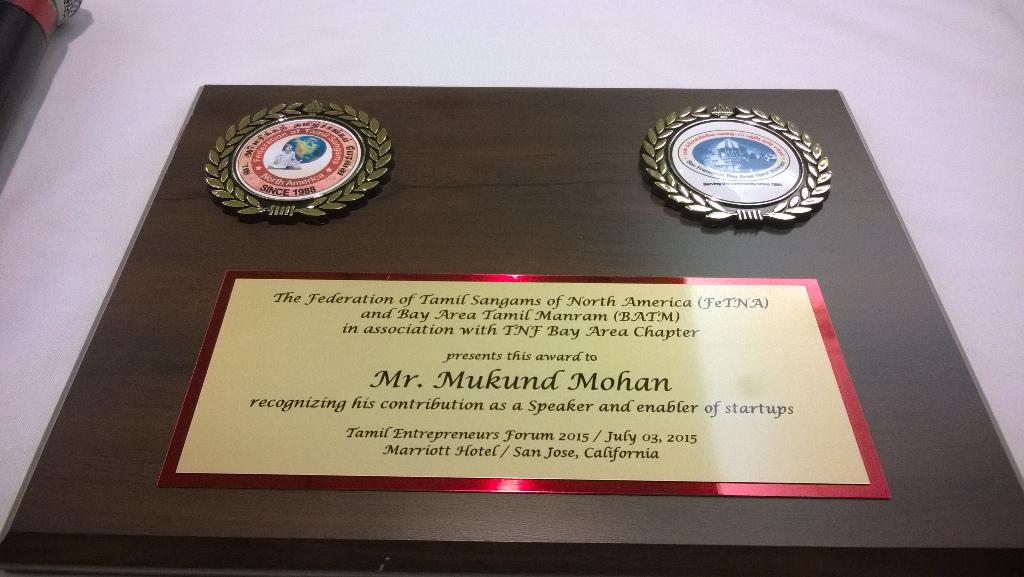
Yesterday I attended and participated on the panel and judged the Tamil Entrepreneur Forum 2015 event. It was a gathering of about 200 folks from the Tamil community all over the US. This was the first time we had a pitch session and Lena Kanappan introduced the format as a way to support early stage entrepreneurs.
Tamil Entrepreneur Forum
There were about 30-50 companies that applied and 8 of them were chosen to present at the forum. Here are their ideas. There were 3 winners, and I’d love your perspective on who you like.
1. ElVitae: A personal branding app and service that’s focused on being the next generation version of About.me. Their goal is to help individuals build their personal brand using the mobile phone alone and help them showcase their portfolio, successes and work beyond LinkedIn and Twitter. ElVitae was “Elevate your curriculum Vitae”
2. FixNix: Already successful in India, FixNix helps smaller businesses manage their Governance and Compliance during audits. Especially useful for regulated industries such as Banking, Healthcare, etc. which have compliance requirements, they have significant customers in large banks and Indian enterprises.
3. IandMyDoc: A ZocDoc clone for primary care physicians, I and My Doc helps you book appointments, schedule visitations, manage your vitals and keep track of your electronic medical records.
4. Indian Moms Connect: An online blog, eCommerce site, Subscription service and community for Indian moms in the US (and looking to expand in India). They problem they were trying to solve is that Indian moms have a lot of questions when they have their babies – and unlike in India where their mom or in-laws provide a lot of that advice, in the US they are unable to get that support. This was an online community to help them.
5. StoryTruck: NetFlix for Indian books and magazines. They want to go beyond just Indian books, but right now they primarily have licensed books and comics for Indian kids. They have over 1000’s of downloads and a working product with 2 book publishers on board. Their focus is on vernacular (native Indian language) content initially.
6. Sway: Mobile phone based budgeting for Millennials. This app is a new generation version of Mint, but with a lot more “fun” elements to help the millennial generation plan, manage and spend money wisely. Initial traction with several 100’s of users.
7. YumPlate: AirBbB for neighborhood food. If your neighbor is cooking something, they can post it on YumPlate and you could buy it from them. We had invested in a company called Imly before in India.
8. Zailoo: A price comparison app for car rides. The app helps you understand the cost of your Uber, Lyft or SideCar (and others) car ride from point A to B, before you get on the car. That way you can know and compare costs before your go on your ride. A month old and already featured on Product Hunt.
The founders were all pretty enthusiastic and had good early traction (most of them) to prove that their idea had merit.
Sway, Indian Moms Connect and FixNix were the 3 winners.
It has become quite fashionable to be an angel investor. The last 5 years has seen an increase in the number of registered angel investors on various platforms – from a mere 3000, we are at over 25K in the US alone. That begs the question – do we have more people who have become angel investors now, or are people richer, or did we always have them and we just found out about them now?
Many high net worth individuals would like to be angel investors, but just don’t have the inclination to do the heavy lifting that it requires to help entrepreneurs, source deals and find follow on investing. Most are also fairly conservative, especially if they have made money at a larger company and not been an entrepreneur before.
Here are key “leading indicator” questions that I ask before I try and syndicate deals with other angel investors, which might be useful for you to consider. YMMV.
Have they invested before in a startup? The best indicator of an investor is if they have invested before. The time to make the first investment for a newly minted rich individual is close to 21 months. So, if in your discussions with a potential investor, they have never invested before, it is highly unlikely they will. Angel list is a good source, but not comprehensive. I would simply ask them this question. Or ask them for their previous investments? What companies have they invested in before?
Do they come referred as an investor? The best network is still word-of-mouth. They best referrals for angel investors is typically not other investors, but entrepreneurs is what I have noticed. Even if an investor “passes” on an entrepreneur’s idea, I have found that if they have been respectful, consistent and fast in their communication, the entrepreneur will refer “relevant” deals to them.
Are they accredited? When an investor has over $1 Million in investment capital (exclude the capital in their primary residence), or if they can show they have over $250K in annual income, they can be accredited. I have found the best way to determine this is ask the investor for who their financial consultant or tax consultant is. People who have that much money have a person for both or either. If they don’t, the signal I get is they are rather unsophisticated in their approach to investing.
Are they involved and connected with the local startup ecosystem? Most interested angel investors are either mentors or advisers at local entrepreneur’s hot spots such as accelerators or co-working spaces. If they are not connected, it is likely they are not going to invest, since they don’t value the experience.
Do they understand key terms and nuances? An experienced or willing angel investor understand convertible notes, equity rounds, key milestones and other “insider” terms well enough to not have you explain it to them. If you are educating the investor about angel investing, you are better of looking for someone else to do that, while you focus on your company.
What other questions would you use to differentiate between a “real” and “wannabe” investor?
I was at the Seattle Founders Institute graduation event last night with 40 others who gathered to see the 3 newly minted entrepreneurs from the program. From the over 100’s of applicants, there were 30+ who signed up for the program, and yesterday 3 folks graduated.
Seattle Founders Institute
TeaBook is a monthly tea subscription. The founder has spent a lot of time in China to source and obtain unique tea’s that will be mailed to your home every day. The tea market is over $25 Billion and growing at 7% annually. They had a great story and compelling market presence. I personally felt the monthly subscription commerce business has many players, and I suspect in the next few years there will be much consolidation. The tea market itself has many competitors as well including TeaLet, teabox, Chahoney and LizzyKate. They have some early indication of traction, with some trials and some passionate customers already willing to sign up for the service.
American Giving – was focused on ending poverty in the US, with a researched philanthropy website. They founder was looking to create a indegogo style site, where philanthropists could research, back and support giving to Americans better. The potential to unlock over a $ Trillion in well researched giving would be large and they were looking to take a 15% admission fee on all giving.
MeltingSpot, has a 2 sided marketplace for helping consumers looking to meet “folks they like” near them. Think of “Tinder meets FourSquare”. They Melting Spot could be a bar, or a restaurant, who wants to “sponsor” a spot where people only interested in “animals” would be able to meet others. There are many dating sites and apps, and many social networks, but their focus was on helping folks in their local region. They would make money by charging bars to sponsor a “melting spot” – initial suggested retail price was $30/month.
All 3 entrepreneurs had great stories and did an excellent job showcasing the market (which was large) and spoke to their personal backgrounds as well. None of them had a working website or prototype (some mockups), but they had financial projections. They were all non developer or technical founders, looking for their CTO, but had the sales and marketing background and expertise.
All of them were looking to raise some money – from early seed (>$100K) to seed ($2 Million – teabook).
As an investor, the biggest challenge I faced was I was not sure how many more pivots were going to happen before they get Product Market fit. I suspect a lot more, because none of them had product shipping yet.
If you have an idea and you want to progress on the journey towards investment, the launch page with social proof, early orders on your crowd funding campaign, product prototype and having a well rounded team are a must have for #napkinStage companies. Those would be the things to focus on, more than distribution channels,
One of the most effective ways to get smart advice early is to get a trusted advisor. Most companies I know get up to3 advisors on board with different competencies, skills and expertise. Typically you’d like oneadvisor who has entrepreneurial backgroundfor customer and investor introductions, one for go to market expertise and one for technology excellence.
Once you have selected and recruited your advisors, I’d highly recommend a scheduled cadence to meet and consult your advisors (early on, once a month is good). Typically, most startups will (if all goes according to plan, which it never does, but nonetheless) need a new set of advisors every 18-24 months. Mostadvisors are paid in equity. Youradvisor’s main role is to give you confidence, but many help with their strategic thinking or insights as well.
In this post I am going to talk about market dynamics using an example to help share a concept that I think you need to get advice from an external person for.
Let’s say you are trying to build a mobile application that replaces Siri or Google Now. This has been attempted before by many folks, so it is not a new idea, but I am taking a crack at shaping and outlining the landscape for discussion.
This will be a “smart assistant” that allowsconsumers to get personalized recommendations for many of their daily questions based on observed patterns on their phone – including usage of other applications.
Mobile Market Dynamics
In this particular case, there are 5 major “interested parties” – the consumer, who wants personalized recommendations, and needs the service, the app developers who have the data, the app store and platform which control the experience, the phone manufacturer, who makes the phone and the mobile carrier who provides the service.
Even though the first pass suggests that you should build the consumer service, focus on acquiring users and then get the app developers on board, it turns out unless you have the data (either from the platform or from the 3rd party app developers) you don’t have a valuable service.
Distribution might be easier for your product via the mobile carrier (if they choose to bundle it with the phones on their network) or even from the phone manufacturer, but unless you have many users, the carriers and the manufacturers don’t want to take a risk.
Consumers find that without their favorite applications (services) integrated into the platform, the assistant is of not much help.
So you realize it has to be the platform (Android, IoS, Windows phone, etc.) or the 3rd party app provider.
Since most consumers are using their favorite apps – such as Yelp, Uber, etc. the data is proprietary to that 3rd party app providers, who have little incentive to give you their “crown jewels”.
The best way to get the 3rd party app developers is to find a way to give them value, so they get consumers more engaged with their app, or acquire new users or monetize better.
While you still have to get consumers after you get the 3rd party app developers on board, that’s the “next problem” – the sequencing matters. Getting app developers quickly and the key (right ones, not anyone that will listen) ones is critical.
This is a good example of a market dynamic that typically you can get from an “insider”. Many of the seasoned investors will help you understand and navigate this landscape as well.
I would highly recommend you talk to potential advisors and help outline the problem statement so they can give you their perspective before you sign them up as an advisor. That way, you are able to gauge their expertise and understanding of strategy as well.
What do you think about this landscape? How would you analyze this better or differently?
“There will be times when you wake up in the middle of the night before a match craving crazy things like hamburgers and pizza. It’s because your body is missing something.”
“One day, everyone will be a nutrition freak. Be ahead of that curve.”
“Play hard, do it on your own terms and stay true to yourself. Do that, and you can’t go wrong.”
“It’s the people in your life — people like Tim — that will shape you. Appreciate them.”
I have been at 3 board meetings this week. It is very apparent to me that we are in an environment where money is easily available to both the best and not so good performers. There are exceptional cases when the awful performer is also getting funded, but I want to avoid judging performance at the earliest stages.
Ben Horowitz popularized the term Peacetime CEO and Wartime CEO’s. We are at a really good peacetime – so the tactics for hiring, fund raising and customer acquisition are different than those when the market will turn – and it will. I cant predict when that will happen, and wont even know when it will start to turn.
I wanted to highlight the change in compensation strategy that’s being used by 3 companies who are preparing for when money gets more constrained, hiring is easier and customers are more cautious about their spending.
Most of the companies I know are moving from 60/20/20 split of base salary, performance bonus (based on individual goals) and stock options to
50/40/10 for marginal performers and
for the superstars, the compensation is 70/10/20.
The superstars have a total compensation that’s greater than the marginal performers.
PeaceTime CEO and WarTime CEO
What is being optimized is the bonus – for the marginal performers a lot more is being paid out on bonus – variable pay based on performance.
The logic behind the thinking is that the key players should not be poached – hence they are given a higher base than they would get outside, and are to be kept for the longer term – hence the incentive on the stock, whereas the marginal performers do not care about options that much.
Who are the marginal employees? Most of them are putting the “6 months, course at a coding academy” folks in the marginal employee pool. Not sure that’s correct, but that’s the approach being taken right now.
The first step to your experiment is usually an idea. Either you or someone at your startup has an idea, which you want to determine is a good one or not. Having tried a framework to experiment your ideas, I’d say the crucial firs step is designing the experiment.
Brainstorming the idea over a casual conversation is usually the first step. The tendency among most startup oriented people is to complicate it and think of all the edge cases and 100% coverage, which is why documenting all the ideas is important.
This documentation need not be long drawn out or format, but needs to be written down.
The best way to do this is to continue using your multi-user messaging solution as before – Slack or HipChat, or Google docs suffices.
To design your experiment, you need to write down the 3 most important aspects of it.
a) Hypothesis b) Outcomes, c) Learning Objectives and d) Time frame
I mention hypothesis vs. assumptions for a reason.
Something that has yet not been proved to classify as a theory but believed to be true is a hypothesis.
An assumption is any statement that is believed to be true.
Until you know your idea will work or not, it is an experiment which has certain items you have to prove.
For example: If one of your customer service people have an idea – they believe as a startup you should send a summary email of the usage of the product every month so the customer understand how valuable your product is to them.
They believe this will reduce churn – the outcome you desire from this experiment.
Your hypothesis may be many all or some of which might be proven, yet others may be false – a) email summary reduces churn b) customers would like the email summary c) your email summary captures key pieces of information about the usage that customers care about and others.
Finally the learning objectives – this is important especially for failed experiments, but it will be useful if it succeeds as well – It helps plan future experiments and creates filters for ideas that come next.
Designing your experiment involves documenting these 3 important items, usually by the person who has the idea. Even an email will suffice, but documenting it is key – even an email will suffice.
Finally in designing the experiment, the time frame how long you are going to run it is important. First so you dont have too many experiments running at the same time, which might skew results, but second so that you can give each experiment the due time to determine if it truly failed or succeeded.
I was thinking of an acronym – HOTEL – Hypothesis, Outcomes, Time Frame, Experiment Design and Learning objectives, but it does not quite fit. I’d love some suggestions on if you can come up with a better acronym of if you believe I have missed documenting anything.
My friends and I have an ongoing debate about programming. They would like their kids to learn programming, but they say their kids dont enjoy it. Regardless of gender, they seem to have an aversion to development.
I am a geek at heart and love programming. I am not good at it, but I enjoy it. I dont get enough time to do it, but it shows on my face when I am developing something or learning a new language.
I have 4 kids, and we are a very geeky family. My daughter, 13, loves mockups, is building apps and is a pretty decent (for a 13 year old) front end dev – She does HTML and CSS with ease and is okay with Javascript. She would ask me to do most of her database development, which I was happy to do.
Kids still love selfies
She recruited my son to learn SQL and he has been tasked to write the DB schema – for someone that does not understand the difference between Integer and Date, much less the phrase datatype, he seems to be struggling through it, but enjoying it.
All 4 of our kids have a laptop and the older ones have their own cell phone – they are all the same, except for my oldest daughter. They all have Surfaces, while my daughter has a MacBook Pro.
This is a point that many of our friends dont get – she’s only 13 or he’s only 11.
They are too young to have a phone and they will be addicted to it all the time is what I hear from them.
That’s a risk for sure. I know that. It is a risk we have chosen to take, since the exposure and benefits far outweigh the negative consequences.
Although my kids are 13, 11, 9 and 9, they seem to enjoy learning to code. They got started without Scratch, I would take 30 min to explain a few concepts, then turn them loose on a bunch of videos.
Then of course there’s Google. When they found out their dad’s limitations – syntax, libraries, etc. – they discovered that Google was their friend. Their first instinct is to Google and cut and paste. Apparently, according to my son, even the best programmers do it – so there.
Many of the basic concepts of computer science are not clear to them. They “kinda” understand that there’s a database and a user interface and a “middle layer”, but that’s as far as it goes.
Their programming skills are very basic (no pun intended), but I enjoy talking to them about programming.
The one thing I have learned is that if you just expose them to various activities and ensure that they are curious enough to learn, they will.
The fact that I dont monitor their PC usage (We do have a basic filter to make it child friendly, but we dont restrict usage) is also a big point of debate among my friends.
I dont, because I believe it does not matter. If you keep talking to them daily about the positives and negatives, they will learn to make choices. Sometimes, they make the wrong choices, for sure, but that’s unavoidable.
The only thing I do to give them the love for programming and coding is to be passionate about it when I explain things to do (since it comes naturally to me that’s easy).
I am sure if I were a finance person on Wall Street, my passion for that would show as well, which means they’d get that instead of programming.
The “problem” is that they have multiple interests – my daughter loves her piano and singing – she’s a good vocalist, my son is really passionate about his cricket. My youngest loves drawing and is a better artist than I am even now and the middle one loves sports of any kind.
I call it a “problem” with air quotes since they dont get enough time to spend on programming. So I make it a point to have them see me do some coding and development once a while. Which gets them excited again to do something new.
I am not sure if exposure, wearing your enjoyment on your sleeve and unrestricted learning models is sufficient, but it seems to work for us.
When you have a great startup culture and hire awesome people at your startup, you will attract a talent pool that has tons of ideas all the time. Many of those ideas may not be relevant to your startup, but I firmly believe that it is not only the product managers, engineers or marketing folks that can have ideas that have an impact on your startup.
If you create an environment that encourages active listening, experimentation and risk taking, you will have a good mix of innovation all around at your startup.
One of the most effective ways to encourage is the impromptu “Lets just chat” weekly sessions that I see at many new startups. These are not larger company-wide all hands sessions, but smaller sessions usually hosted by a very junior, but engaged individual at your startup.
Most times they are held with 5-7 people at your kitchen or during lunch or casual drinks in the evening. The ideal size of the team is less than 10 is what I have found.
Ideas pop into people’s heads at all times. I tend to get most of my ideas when I run. Many people get them when they are stressed, others during vacation, and still others in the shower.
Ideas require a stimulant, and while I have not read the research yet, I believe one of the key ways to stimulate ideas is to exercise or rest your mind.
Capturing these ideas to whoever it occurs is possibly the best start you can have. Many people use idea management software like User Voice or Brain Storm.
I think more people are starting to use Slack for idea capture at their startup. I have seen it with 3 different startups and it is starting to become a thing.
Slack for Ideas
The challenges with Slack are that idea rating, idea management, voting, tracking deployments are pretty challenging.
I would highly recommend you use the one app / messaging platform that EVERYONE in the company uses (possibly email, and if you have Gmail, then use plugins to manage emails to ideas) and put them into a single place.
The best way to review the ones that will have impact is to understand the value of that idea in the context of your key milestones. Some of them will impact your milestones immediately, others will improve aspects of your stated goals. Still others may do neither.
The most important framework I have used is to understand the effort and impact.
Impact versus Effort Matrix
I think putting the ideas generated into the matrix and focusing on the ones with most impact and low effort (has to be delegated) tends to give you the ability to have good value.