There are multiple methods to keep track of your projects and priorities. Here is one technique I used when trying to keep track of customer validation. This approach works best when teams are in one single location since it is visually appealing and easy to update.
It is called the Kanban method of Do, Doing and Done. A visual dashboard, which I used colored post it notes for, comprises of 3 buckets of work:
1. Do – has all the items that need to be still done.
2. Doing – what you are currently working on
3. Done – what’s finished
Typically we update and refresh the items each week – sometimes daily if there are enough changes, but a week is ideal.
Do Doing Done Kanban Method
Some folks have mentioned using Trello or Kanbanize. I have not, so I cant recommend them.
As I mentioned previously, the elapsed time for these 5 steps, in my experience lasts from a 4 weeks to 3 months on average.
The most important item to remember is that the method works best for discrete, defined tasks that take a short period of time. If your item takes many weeks or months, you have to break it down into simpler steps.Customer validation or pricing strategy cant be a step. Pricing strategy has to broken up into price tiers, price testing, pricing validation, pricing research etc.
When validating customer problems, you are trying to understand the following questions:
Is this a real problem? Is is a big enough problem for them to look for a solution?
What will it take for them to adopt a solution? Adopt my solution?
How much will they be willing to pay to adopt?
I have used post-it notes as a great way to segment the steps in the process and use colors to validate different items I need to:
In the customer validation I put forth a process comprised of 5 steps:
1. Secondary research
2. Primary research with insiders
3. Proxy market sizing
4. Online validation
5. Customer interviews
The best way to use color is to put these various “sources” into different colors. So, influencers may be blue, proxy sizing sources may be yellow, etc.
When you get to the customer interview step, you are likely finished with the previous steps, so you can color code segments of your customer with different colors.
So “Segment A” will be yellow and “Segment B” will be green and so on.
The reason for colors is then you can put them all into a board at the end and find a way to look for patterns that correlate.
The big advantage of the visible productivity map is that everyone is motivated to make changes to the charts so you can see progress daily. Try it and let me know if it works for you.
Like most people, some days I have a hundred ideas and other times I go for 100 days without a single idea that I think is worth spending time on.
The difficult part of these ideas is that many most of them are practically useless. They are not grounded in real problems, and are likely a means for the mind to play some games where it feels good to have some exercise for that moment.
Over the years, I have put together many frameworks for thinking about problems and ideas and categorizing them –
a) throw it away (meaning dont think about it any more),
b) file for later (meaning document it on my notepad, to review in a few years or so),
c) do some research (document the market findings) or
d) pursue it for validation (talk to people).
There are 5 steps that I take to understand whether the idea is worth pursuing.
The elapsed time for these 5 steps, in my experience lasts from a 4 weeks to 3 months on average.
Customer validation framework and process
1. The first step almost always is doing secondary research on the web using available resources. I have found that it is fairly easy to get a ton of “expensive paid research reports” by just typing the name of the market, followed by keywords like market, landscape, overview and then filetype:pdf in Google.
There seems to be someone always who has uploaded a recent report from a key investment bank or a analyst report that’s available for free.
During this step I try to document with the intent to publish my learning as a blog post. That’s key, I have found, to ensure that I do as comprehensive a job as possible. It also helps you in steps 2 and 3, as I will share later.
The best way to document is to be honest and write down a bunch of questions you might have about the market, problem etc. Summarize as much as you can, in your own words, instead of cutting and pasting.
2. The second step is actually having a discussion with at least 10+ “industry insiders” to help understand the questions where the data is inconsistent. It is important to have insider discussion before customers only because they will tend to see and know “trends”, whereas customers tend to give you their current problem or their sense of the workarounds, which they seem to think work “fairly well”.
To get to talk to 10+ insiders, you will need to offer them something in exchange for their time. Most insiders are fairly busy and tend to not want to help teach a new person the in’s and out’s of a new market. Here is where you assessment of the market and the 4-5 reports come useful from step 1.
I am consistently surprised at how many insiders have not read (they have head of it, but wont have read) a recent industry report on the space. The fact that I read them in entirety and can provide a Cliff notes summary is very valuable to them.
3. The third step is to get a good sense of the market size. Since most of the research reports will give you a total market estimate, top down, as opposed to an addressable market, bottoms up, number, I find it valuable to do some empirical evidence gathering for the bottoms up analysis.
The best ways I have tried to do this is getting proxies for the market size – Google search volume is a good indicator for certain types of markets, or in other cases, create a series of blog post on LinkedIn and see the traffic volume, try segmentation numbers with Facebook ads etc.
If you are up to spending some money to recruit potential customers and get some email conversations, I’d recommend Google Ads as well.
4. The fourth step in my process is to clarify and crystallize the problem and solution and get primary feedback online – I have found Launch rock for consumer applications work well for this. Create a simple page and drive traffic – either with ads or social and get a sense for interest.
For B2B, just offering your summary of the research on the market as an eBook (from step 1) will suffice to get emails of potential prospects. This also helps you build a target list of customers.
5. The step five is actual customer interviews. This is the most time consuming step and takes a lot of effort, which is why I end up doing it last. I would recommend doing it earlier, if you want to get a quick sense of the market, and maybe you might end up doing it all along, but this is a very intensive process, so I end up breaking it up into chunks and doing it all along while I am going over the steps 1 through 4.
For customer interviews, I try to address the problem question and the adoption question.
Is this a real problem? Is is a big enough problem for them to look for a solution?
What will it take for them to adopt a solution? Adopt my solution?
How much will they be willing to pay to adopt?
These questions help me address both the solution and the go to market problems of marketing and pricing.
There are some caveats to my process and methodology:
1. This does not have to be a waterfall approach. The agile version will ask you to keep doing these 5 steps in parallel and keep doing them consistently. Just because you are following an agile process though, does not mean you dont have a list of steps to follow.
2. These steps work very well for software. What I found for IoT hardware is that a Kickstarter campaign works betterfor a hardware idea to supplement step 4.
3. For consumer facing applications and eCommerce companies, there is no substitute for putting a framework page and putting a buy button (instead of LaunchRock, use Shopify – free version).
4. Document, document, document.The more you write the more your thoughts get clarified and you have new insights. Only listening to customers and insiders is useless. Thoughts come, you process them, and you forget more than 50% of the insights.
5. Be very cautious and deliberate when you go from one step to the next.90% of ideas and problems are really not worth pursuing, unfortunately. You are better off discarding your half baked, insolvent ideas, instead of wasting 6-12 months pursing it, only to realize you dont quite have a real market need.
Customer segmentation for entrepreneurs is a tool to reduce distractions, focus your product roadmap towards your Minimum Viable product and create personas that can help your marketing, sales and development efforts.
I am often asked 3 questions associated with customer segments, which I thought I’d address in this post. I am going to use an example of a company building a new age mobile Patient Records Management solution (or EMR – Electronic Medical Records) for the tablet as an example.
1. What are the steps to a good segmentation strategy?
The first thing you need to do to ensure a good segmentation approach is to write down your ideal customer attributes. You dont need any framework to do this, just a list of attributes will suffice. Your attributes need to be specific, numerical and descriptive.
(I) Specific means, you will have to outline their environment. What are they using currently? How specific is their problem? Do they have alternatives? If your target is doctors in our above example,. that’s too large a segment. Instead there are different types of doctors:
a) Those that practice independently vs. those that are attached to a hospital
b) Those that are general physicians vs. those that are specialists.
c) Those that see < 10 patients a day vs. those that see more, etc.
(II) Numerical means there has to be a set number of customers that fall into this segment. It has to be a number much less than your entire target market, and not more than 2.5% of 2.5% of your target market. Why 2.5% of 2.5%? That’s usually the second question.
(III) Descriptive means, you have to outline their current day-in-the-life scenario without your product. Explain how they are currently solving the problem (if it does exist) and how they are solving it without your product. It cannot be that they are not solving it. They may be used pen and paper to keep medical records, but a system does exist.
2. How many customers is enough to build a segment for? Is there a minimum number?
Innovators – theory of diffusion
According to the theory of diffusion, we have 2.5% of customers who are innovators. These are your earliest of early customers and your initial targets. What I have found with most of the startups I am helping is that 2.5% of those innovators are truly the engaged, early influencers who will be willing to have the discretionary time and budget to try truly innovative products and then be willing to evangelize them to the rest of the innovators.
To be clear, you dont need all of the 312 to be your early customers. These are your early segment of potential customers. Typically 10% of them being early customers tends to show “traction” for an investor.
Lets say the total number of doctors in the US is 500K. Then your Innovators are 12.5K. Of them, 2.5% should be the first segment, which is about 312. That’s the ideal target for you to have as a start.
3. What if most of the target customers dont have the pain point or dont want the product? Does that mean the segment is incorrect or there is no market need for this segment?
If you have targeted 312 doctors who are primary physicians (segment by practice type), in the Texas area (segment by location) who work in a multi-use work location (segment by work area) and are currently using paper based medical records (segment by current product usage) theny you now have a segment of customers who you want to go after.
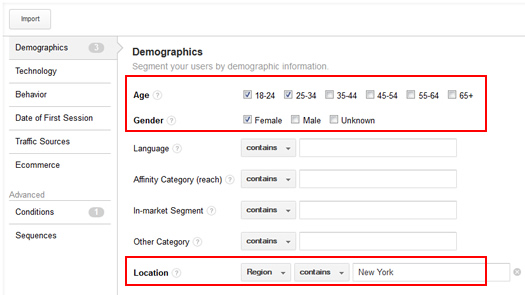
Google Adwords Segments
A trick that I have seen most people use is to segment based on Google Adwords segments (see diagram above) or segment by Facebook targeting options.
Facebook Targeting Options
Once you have your segment at 2.5% of 2.5%, then you are doing a combination of ads, conversions, focus groups and interviews to understand if they have the pain point.
If you end up finding out that customers dont have the pain point or the conversion rates on your ads is low it is indicative of either poor targeting,poor messaging (your message did not resonate), incorrect framing of the problem or lack of the problem in the first place.
What I have found in my experience with over 300 startups is that the number one problem is poor targeting, followed by lack of the problem existing for the prospect in the first place.
One of the first things you will realize as an entrepreneur is that you will need to be absolutely clear about your customer’s problems and envision your product solving their most important pain point. This realization results in an appreciation for the “micro” problem for a “small set of customers” to begin with.
That in essence is customer segmentation.
The discipline of finding the factors that differentiate one set of your potential customers from another based on a set of characteristics.
First, segmentation is a discipline.
The output of that disciplineis a) a way to make it easier to identify your customers via a known name or persona b) a means to target them more effectively and c) a language to explain their problems / pain points and d) an ontology to express your solution to help them solve the problem.
Second, you will have to find factors that help you differentiate customers.
The idea behind the factors it to help you focus on those customers who have the highest pain, and hence the most propensity to buy, or the most desire to solve the pain and eliminate (during that period) than those that dont have the need immediately.
Third is to identify and document the characteristics that help you find the patterns or a set of questions to help guide your segmentation.
The best way I have found you can document the characteristics is to write down a set of interview questions that can help you during a discussion with potential customers. Others have used the buyer persona canvas or a simple tool to document thinking, feeling, seeing into maps.
Buyer Persona CanvasPersona Map VP Sales]
The empathy map is more relevant for design, but it can be made very relevant for you to leverage as a founder to understand the sales cycle, buying process, marketing criteria or service design.
Lets take an example. Assume that you are building a CRM system for SMB, to help them track their sales and allow sales reps to directly provide a quote and contract using just their mobile phone.
Most entrepreneur’s state that all SMB are their customers. This is usually done to prove that the market is very large and hence deserves attention.
The goal of the segmentation exercise is to make the market extremely small (a set of customer you can get in front of, collect feedback and test your hypothesis in as short a time as possible).
In most B2B scenarios there are 3 major and many minor characteristics that define segments of customers.
1. Size of the customer: Some people define size by revenues, others by # of employees, still others by # of sales people within the organization, still others by # of quotes the company delivers in a year, etc.
2. Industry vertical: In industries where speed to quoting and contract delivery makes a difference in the sales process, your solution might be more valuable, (e.g. some insurance verticals) than others were the contract process involves multiple rounds of competitive bids.
3. Title of the buyer: Titles (VP of Sales, Director of sales, Sales Manager, etc.) are usually an indicator of spending authority. In our case the VP of sales at a small company in the insurance brokerage is likely to have the ability to try and purchase the solution to help his sales professionals be more productive, than a Sales manager, who, is likely going to focus on trying the solution to offer feedback, but may not have the authority to buy. They will end up being a user, but not the economic buyer.
It used to be that location was the 4th characteristic, but with the Internet, is highly possible that your customers are in a different location (physically) than you are.
For B2C companies, most segmentation is done by demographics or psychographics. The 3 most frequently used characteristics are age, gender and income. There are many others as well, but these are the primary. I will share the B2C example in the next post.
Short answer – it does a lot, but not as much as you think it does.
There is a never ending debate about how much do ideas matter when you are starting. There are arguments on both sides of this thesis. There are folks that believe ideas are dime a dozen and execution is everything and others who believe that ideas are what differentiate the great entrepreneurs from the mediocre ones.
So this makes me believe the answer is somewhere in the middle. A good idea executed well is obviously better than a good idea executed poorly. Similarly a bad idea executed well is marginally better than a bad idea executed poorly. Either way, execution does matter as does the idea.
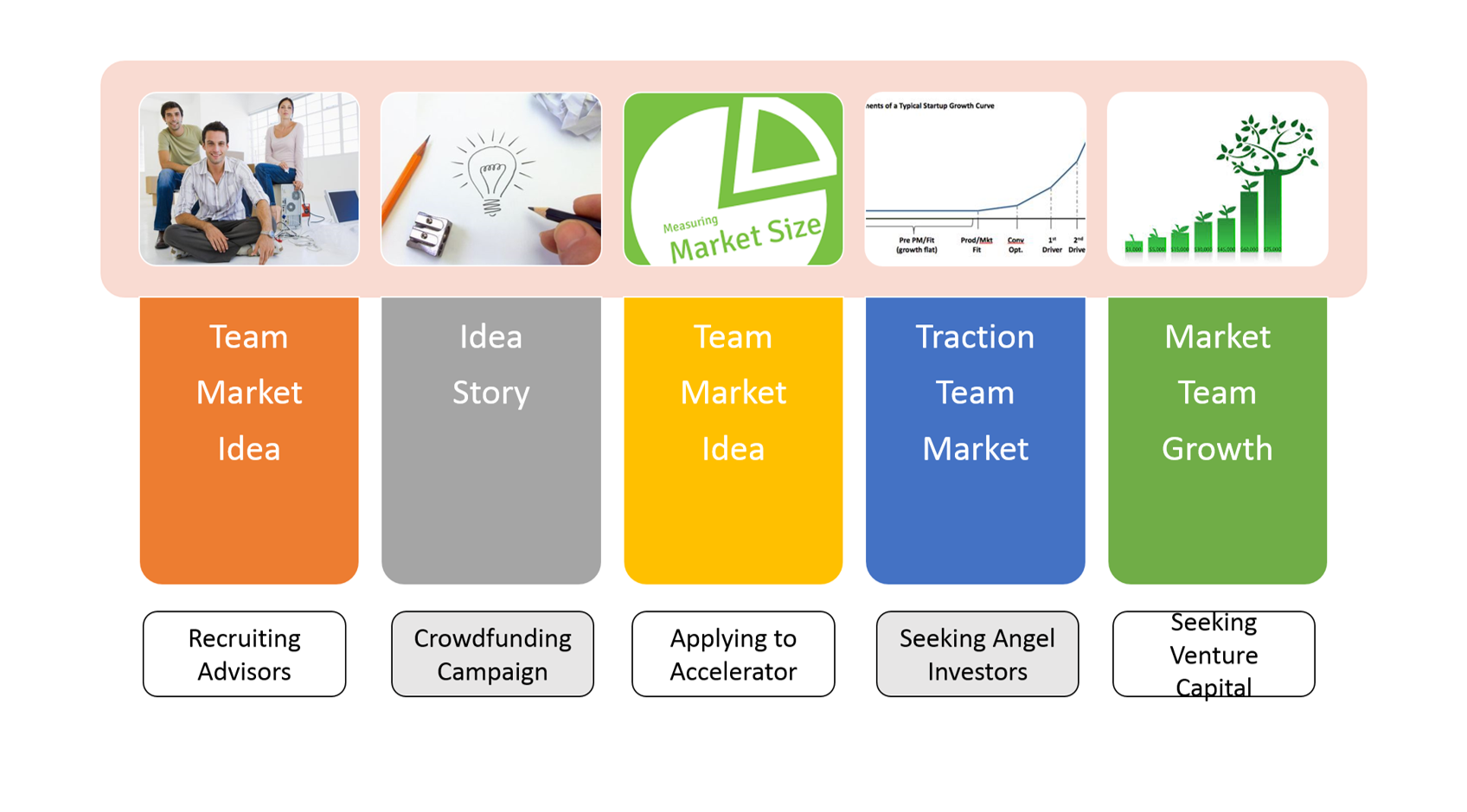
I put a chart together based on my experience of the top 1-3 things that different folks care about the most when you are progressing along stages of your startup.
The first thing to keep in mind is that the idea matters most to your potential customers.
Which is why it matters so much.
Your customers may care about the team, the problem you are trying to solve (it better be important to them) but they certainly dont care as much about your market or your growth.
What Matters When At A Startup
At the napkin stage when you are trying to recruit advisers, and early folks; your team and market matter to them the most, then possibly the idea.
The next stage (if you are going that route) at the crowdfunding stage, the idea and your story matter the most. The market maybe somewhat matters, but the team does not seem to matter as much since they are largely the “people” behind the video.
The stage beyond that (again if it applies), which is the accelerator stage, the team and market matter the most. The assessment of whether the team can pivot plays a lot into this stage.
At angel investor stage the traction seems to matter most, followed by team. Enlightened angel investors care more about the team and the market, but accelerators have trained the startups and angels to write checks based on “traction”.
Finally when you are ready for the venture capital round, lots of things matter, but most VC’s will tell you that the market you operate in and the team matter the most, followed by growth in metrics.
If you look at the chart above, the obvious conclusion you will come to is that idea does not seem to matter to most people.
If, however you expand the “crowdfunding” stage to “recruiting customers“, then at that, stage ideas matters more than everything else.
So the idea does matter, it matters a lot and it matters to a key (if not the most important) constituent of your startup – the customer.
Does it matter as much as you think though?
That answer is also no, because, the other “constituents” including potential employees, care about working on a great problem, getting paid well and being challenged (in that order hopefully).
So, when any of your investors or potential advisors or an accelerator tells you “Ideas dont matter” – you know they are wrong, but not as much wrong as you really think they are.
Put those two numbers together and you it will be likely that you will be introduced to an investor you want to pitch over email, and they will (hopefully) hear about you from someone they know (or trust as well).
The first thing people do when they get an introduction via email is check the person’s LinkedIn profile.
According to the LinkedIn heatmap profile the first thing people look for the photograph followed by the most recent status update – even on LinkedIn.
LinkedIn Heatmap
The next few things people look for are your most recent role, followed by your educational qualifications.
Only after that do people check out your website or mobile app.
I have seen many cases where the investor will push the meeting to later if the LinkedIn profile is “incomplete” or “not very appealing”.
While your app or website might be professionally designed and be very appealing if your LinkedIn profile is not, you will likely not get to the next step very quickly.
Most investors will Google search you as well and click on the first three links – For most people the first two links are LinkedIn profile, AngelList profile (if that exists), followed by the website bio.
So, that makes it all the more important to get your LinkedIn profile more appealing than your website.
The last 10 years have seen a rebirth of startup accelerators, which has resulted in many more startups getting funded by early stage companies who are startups themselves. Startups helping other startups is a very interesting phenomenon, but that is a topic for another post.
I would segment startups into the top 10, the next 25 and the remaining 965. The top 10 take between 1% and 3% of applicants. The next 25 take between 2 to 10% and the last 965 take what they can get. Of course many startups go from one accelerator to another, with some going to 4 accelerators before their seed funding.
Over the last 3 years I have seen our accelerators accept anywhere from 3% to about 8% of applicants depending on location.
Of the over 500 applicants in the most recent cohort at Seattle, we selected 2.6% into the program and interviewed about 8%.
So the question that comes up often is how easy or hard is the selection process.
We (like most others) will read 100% of the applicants, but give a more serious look to those that are recommended by our trusted partners. Getting a introduction from partners ensures that we will not only look at the application, but also shortlist for a second review.
Typically 2-3 folks review the applicants in the first pass and if most applicants get an average of 4 out of 5, then we will interview them.
There are many many criteria our reviewers look for including market, problem and founder’s background.
What I have found is that it is much easier to reject 80% of the applicants than to pick the ones to shortlist.
Looking back at the data to understand the ones we missed, which turned out to be great early successes, in the 8 cohorts I have reviewed, we have missed between 9 and 12.
What are the 3 most mistakes people make in the application process?
1. Estimating a very small or incorrect market. Most accelerator programs are looking to fund companies that will become large. Many entrepreneurs underestimate the market size, which puts them in the “interesting” but not “viable for the accelerator”.
2. Positioning the startup in the summary, especially for consumer startups. Usually we get between 5-10 companies in the same “market” in any given cohort. For example, travel planning was pretty “hot” in 2012, service marketplaces were frequent in 2013, etc. The difference between the startups was marginal in terms of the market, but most of the companies were positioning themselves as a social network first, which by default caused us to weed them out.
3. Not explaining the background and experience of the founders in the way that explains why they are best suited to execute the opportunity. I have seen many young founders look at building an enterprise SaaS product after they found it hard to get traction for their “consumer” app. That usually means a pivot after they got very little traction, so it raises red flags.
The most frequent question I get asked about SaaS companies is how to think about pricing for the product. Here are some constructs to think about and 7 questions to ask before you come up with a pricing model or a price for your product.
1. Understanding your customers current solution and options and their “cost per unit of activity” is the most important thing you should do first. For e.g. if you sell a Sales force automation solution, the customer might be using an Excel spreadsheet to track their sales because they dont have too many opportunities. So in their minds the “cost per unit” is zero, since they have already “paid” for Excel.
2. SaaS pricing is a marketing function not finance or operations. If the team that determines the value of your offering to the customer is another them, then it is their responsibility. The reason for this is that value of your product determines how much you can charge, not what customers are willing to pay. Value cannot be determined as a absolute, only relative. Which is why you have to compare it to their current solution.
3. At the early stages (less than 50-100 customers) optimize for more customers and quicker sales cycles not for profit. To get data and buying patterns you need enough data and a meaningful sample size. When you go beyond the early customers, it is time to optimize for LTV and CAC.
Here are the top 7 questions to ask before you come up with a pricing model for your SaaS product.
1. What are the current options for your customer?
Find out how are they solving the problem your product addresses currently and how much does it cost them to do that.
2. What are the different segments of your customers?
Find out if there are different problems your product can solve and the value associated with those problems. That would be the best indicator of
3. What is your goal from your pricing?
It is not always obvious to say that your goal is to get the “most money” or to be the most expensive product. Some companies want to be the 80% functionality at 20% of the cost option. Determine your pricing goal – profitability (after customer acquisition costs), value creation, marketshare, etc.
4. What is your cost of customer acquisition?
For most parts, your cost of development tends to be fixed (if you hire 3 people, you have to pay their salaries regardless of how many features the ship), but the cost of customer acquisition tends to be a variable. So if your costs dont take CAC into account, you will have a model that wont be profitable.
5. What is your sales model?
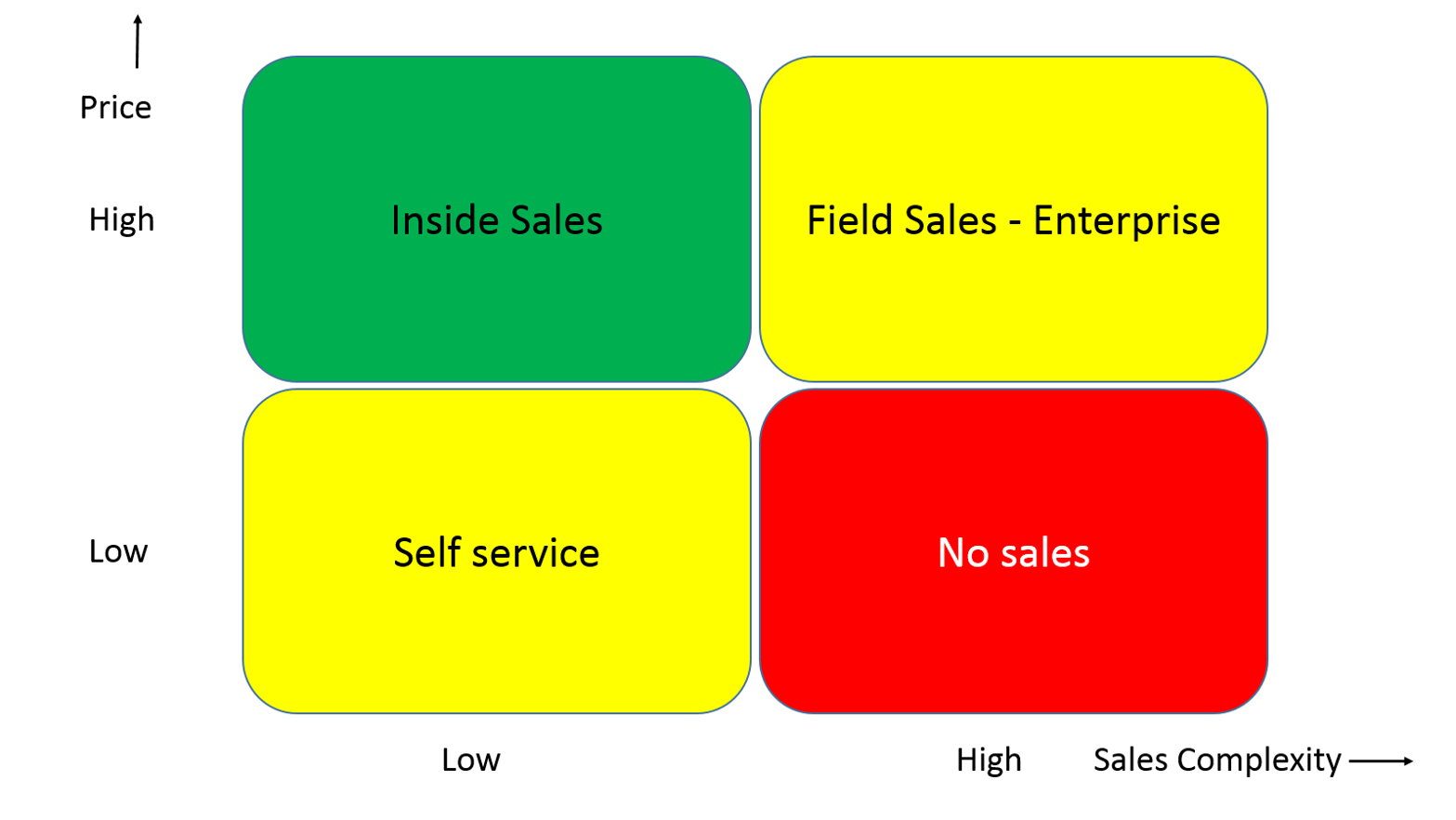
Linking Sales and Pricing for SaaS
I usually use the price and complexity of sales / marketing on two axes to understand the sales strategy for a SaaS company.
If you are a company with a lower price point and low complexity of sales, you will have to rely on customers to try and buy (freemium) the product on their own and work on obtaining customers at a low cost.
If you are a very complex product or have a complex sales process and your product costs a lot, you will have to hire a field sales team to help you sell.
If however, your product is priced high and your complexity is low then you will build an inside (phone) sales team.
If you have a high complexity product and sales model and low price, your company will die.
Use this model to determine where you want to be and price the product appropriately.
I wanted to showcase today the biggest transition pricing plan pages will have over the next decade.
The move primarily affects B2B companies, but is being driven by consumer Internet companies currently such as Uber with their surge pricing.
There are 3 steps towards the maturity of the pricing model that I foresee.
The first step is the transition from perpetual pricing or “pay unfront” pricing to subscription billing or “pay as you go“.
The second step is the transition from subscription billing and “pay as you go” models to utility billing or “pay for usage“.
The third step is the transition from utility billing or “pay for usage” to outcome billing or “pay for performance“.
Why was perpetual pricing or “pay upfront” popular?
Perpetual pricing was easy to understand, for most accounting and finance teams.
Paying for software and amortizing it over a period of time was easy to register on the financial records. The initial assumption was most of this software was going to be in “perpetuity” or forever. It was over 20 years from 1980 to 2000 that most folks realized this was not true. Software changed constantly, had to be upgraded and the 20% annual maintenance did not pay for the new versions.
Why did we transition to pay as you go?
When finance and accounting teams realized that only a fraction of the software that was purchased, is going to be used, and much of it was “shelfware“, they were loathe to pay for “things that were not being used”.
The second problem was the high cost. Perpetual pricing assumes a 4 year fee for the software would be paid “upfront” and so the cost of that software was pretty high. Which meant, most smaller and mid-sized customers were unable to afford it.
Finally, once the sale was done, there was no “skin in the game” for the software provider. The success or lack of the deployment or usage of the software was upto the customer. Obtaining value from the software was also something the customer was on the hook for, not the provider.
Why is there going to be a transition to pay for performance?
While the problems of lack of usage, high upfront cost, and the “skin in the game” can be solved by Software as a Service (SaaS) models, which ensures payment to the software partner once the software is being used and only for the amount it is being used, the problem of “obtaining value from the software” still exists.
The problems with SaaS pricing (usage) are 3 fold:
1. Inability to predict the “constant amount” each month – since it is be based on usage, instead of a fixed amount each month.
2. The need to focus on “success” instead of “best effort” for customers. Instead of the provider saying “this is what we will provide” the provider and consumer jointly will have to agree on the “desired outcomes” and the share of value they will each obtain from the transaction.
3. The need for providers to capture more of the “value” associated with the pricinginstead of the “cost plus profit” model.
Which is why the next transition will be towards subscription billing or variable pricing not on usage but on “outcomes“.
What are outcomes?
Here is an example that most folks can relate to:
Imagine if you had to go from location A to B for a meeting by 6 pm. You are late and leave at 530, and expect it to take you 45 minutes to get there, but you’d really like to get there by 6 pm. You are willing to “pay extra” to get there on time.
Instead of charging you for the distance, which is what the taxi charges you, the cab instead charges you more for the “desired outcome“, being there on time. That means, for someone who left at 5 pm the cost would be less than for you, even though both of you went the same distance.
Here is another example.
If the desired outcome from a startup joining an accelerator is to A) Get a follow on round of funding and B) get some early customers instead of paying (a percentage of your startup, not an actual amount) a fixed %, startups will transition to paying for those outcomes or not paying at all. Or associating a variable payment based on the level of achievement of that outcome.
I believe the biggest transition that pricing pages will have to reflect over the next decade will be the move from “usage based pricing” to “outcome based pricing”.
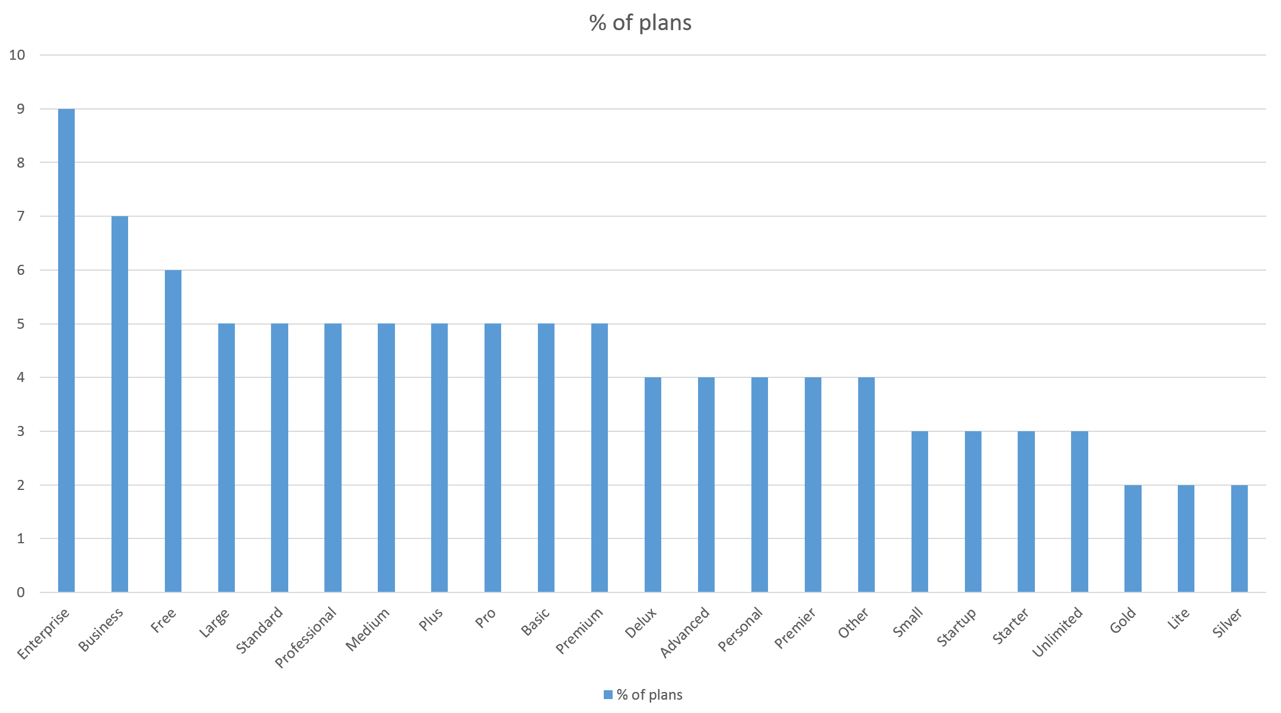
I did notice that of the 89 companies, 82 of them gave their pricing plans “names”. Each plan had a name so their customers could associate the name with the plan. Most (over 80%) used standard and conventional names but it was interesting to see the spread. Here is the data from 89 companies and 251 plans.
Names of SaaS Pricing Plans
The most important points you want to take away are the following:
1. Even though SMB and SOHO (Small Office, Home Office) users are the first few to sign up for a SaaS service, 3 of the top 5 names were named Enterprise and Business and Large. I would imagine this has to do more with the inside out naming (the plan is large or enterprise, not the company buying it).
2. The plans named “Small or equivalent” were largely in the bottom quartile of the distribution. Even though over 70% of companies had 3 plans, only 35% of them named the smallest plan as “Startup”, “Starter” or “Lite”. The most common starting plan was named “Standard”.
3. Of the 20% of companies that used “custom” names like Boutique, Tyrannosaurs, or Garden named all their plans uniquely. The surprising element of the companies that used custom names was that most of them had images to convey the “size” of the plan.
There were some other surprising things I learned as well in my discussions.
1. In naming plans, understanding the end customer’s billing and invoicing was key. Most customers got an email invoice (a few sent PDF invoices) and they would either file them or expense those invoices (if < $50) or would send the invoices to an accounting team.
Ensuring that the “accounting” team did not ask any questions was the consistent mention among 3 of the startups with custom names for plans.
2. Naming the plans to support your payment gateway is also critical. Getting too cute with names means the payment gateway will support a higher refund request that were marginal.
3. Many of the companies had to setup standard names so their marketing and product management teams could do better analytics and research on the backend, consistent with their reporting. Surprisingly, if the names were “standard” the companies found it easier to have a conversation to understand conversion rates, pricing options and changes with their finance teams, design teams and other outsourced companies as well.