Category Archives: Management

Winning by design with Dave Boyce

Alright, so I just finished listening to this fantastic podcast episode with Dave Boyce, and let me tell you—it was like a masterclass in modern go-to-market strategy, systems thinking, and how AI is flipping the game. Imagine sitting with a smart, laid-back friend who’s figured out how to scale SaaS, sell a company to Oracle, and now spends his time thinking deeply about how to make GTM systems work smarter, not just harder. That’s this convo in a nutshell.

So, here’s the vibe: Dave’s hanging out in Provo, Utah, with the mountains behind him and a fresh breeze coming through his office window. And yeah, you can’t help but feel a little jealous. But the real sunshine is in the insights he drops.

We start off with his journey—Dave’s been a founder a few times over, sold his last company, and instead of jumping into another build-from-scratch grind, he wanted to pause. Reflect. You know, zoom out and figure out what worked, what didn’t, and what patterns kept showing up. That led him to Winning by Design (WbD), where he didn’t just join a consulting firm—he joined a team of systems thinkers who speak his language.

Now, if you’ve heard about the “bow tie” model and wondered why everyone’s obsessed with it—Dave breaks it down beautifully. Basically, most companies obsess over the left side of the funnel: acquisition. Pipeline. Bookings. Then they hit the gong and call it a day. But in SaaS, that’s not the win—it’s just the start. The bow tie model maps out the full customer lifecycle—acquisition on one side, but then post-sale? You’ve got onboarding, renewal, expansion, and if you do it right, compound growth. That’s the right side of the bow tie. That’s where the money and retention magic happens.

One thing I loved—Dave draws a clear line between “systems thinking” and “framework thinking.” They’re not that different, really. It’s about poking one part of your GTM system and knowing how it’ll ripple downstream. Lowering price might get you more deals… but what happens to profitability? Widening the top of your funnel might sound sexy, but what happens when your sales team spends their time chasing unqualified leads? Systems thinking helps you see those second- and third-order effects.

Now enter AI.

Dave talks about how AI is just jet fuel for the self-service motion. At WbD, they’re embracing what he calls AssistiveAgentic, and Orchestrative AI. Think of Assistive as your AI-powered intern—summarizing documents, writing drafts, doing research. Agentic AI takes that up a notch—it’s trained to do a job. And Orchestrative? That’s the C-suite bot. It’s making calls, triggering workflows, handling real-deal ops.

They’ve even named their agents—Celeste (internal GTM intelligence) and Jack (inbound SDR)—because we still think in human terms. Celeste attends every call, reads every email, taps into CRM data, and can brief anyone on the full context of an account. Jack qualifies inbound leads right on their site and directs them toward the right path—self-serve or human.

And Dave makes this point that really stuck with me: AI-native companies are just wired differently than SaaS-native ones. In SaaS-native, you sign 12-month contracts, and you get your renewal chat once a year. In AI-native, like with tools we all use now—Replit, Cursor, ChatGPT—you upgrade or downgrade based on value, not contract cycles. If you’re not delivering impact every day, your users are gone. That means the mindset needs to shift from “sell once” to “deliver value continuously.” Renewals are monthly, even daily.

Even the way we think about a “customer” is changing. Dave says: think of a customer as a collection of users, each with their own trust networks. If you deliver impact to one, they’ll recruit others. The virality becomes product-led and AI-assisted.

For marketing agencies—and this part is gold—Dave suggests they’ll need to evolve into GTM agencies. Why? Because recurring revenue depends on recurring impact, and the only way to sustain that is to bake systems thinking into your DNA. Tips and tricks won’t cut it anymore. The agency of the future is empathic, metrics-driven, and deeply attuned to the customer’s business goals.

Oh, and about the naming of AI agents? Dave laughs, but he’s clear—it’s partly because humans need to personify things to build trust. Plus, when you’re onboarding or managing AI agents like team members, giving them a name helps you slot them into your org just like a human hire.

The whole convo wraps with Dave and Mukund reflecting on how the ground has shifted under our feet. Higher cost of capital, AI reshaping user behavior, the rise of DIY SaaS… you can’t just do what worked in 2018 and expect magic. If you’re not re-earning your customers’ trust and business every month, you’re toast.

Anyway, this one was a ride—part therapy session for GTM leaders, part AI strategy briefing, and all heart. Highly recommend.

From Corporate to Full-Funnel: How Tiffany’s Marketing Agency Is Redefining AI-Powered Growth

Okay, so let me tell you about this podcast episode I just listened to—it was with Tiffany, who’s had this amazing 17-year ride through sales and marketing. She’s done the whole big corporate thing, climbed all the way to VP of Marketing, and now she’s running her own agency. But not just any agency—this one’s built for the chaos of modern marketing, where AI is everywhere and everyone wants results yesterday.

She’s based in South Florida (right between Miami and Fort Lauderdale—jealous), and the conversation kicks off super casual. She’s the kind of person who’s clearly walked the walk. At one point, she jokes about being jealous of people posting org charts with “98 AI agents” running their entire marketing department. You know, the ones where someone brags about replacing their entire team with ChatGPT prompts? Yeah, she’s not buying it.

So here’s the deal: Tiffany started her agency originally as a side hustle—just her, trying to help other business owners get to that magical “freedom and flexibility” we all chase. But what kept bugging her, even when she was a corporate exec, was how hard it was to find a good agency partner. Like, even when she was hiring agencies as a client, she was still leading the strategy. And she’d be like, “Why am I paying you if I have to tell you what to do?”

That frustration turned into fuel. She eventually rebranded her firm as Third & Tailor, an end-to-end revenue marketing agency. Not “full-service” (she avoids that term—too “jack-of-all-trades”), but she helps B2B companies and well-funded startups figure out what’s holding them back. Sometimes it’s messaging, sometimes it’s funnel friction, and sometimes it’s paid media that needs a total revamp.

What’s wild is how the work has evolved. Five years ago, people would just say, “Can you run SEO or Google Ads for us?” Now, they’re like, “Something’s off—our funnel feels disjointed, we don’t know what’s working, and we need to hit aggressive targets but don’t have the right team.” That’s where Tiffany comes in with audits, CRO, messaging optimization, and whatever else moves the needle.

And then, of course, the AI convo. It wouldn’t be 2025 if we weren’t all talking about AI agents, right?

So Tiffany’s take on the whole “everyone needs 90 AI agents” trend is refreshingly grounded. Yes, she uses AI every single day. No, she doesn’t trust it to run wild. In fact, she still reviews everything herself before it goes out. She’s got AI helping her synthesize discovery calls, SEO results, brand messaging—you name it—but she’s not handing over full control. She said it best: “Speed to value. Not speed for the sake of it. Not to cheat. But to deliver faster.”

And for outreach? She’s built some pretty slick prospecting systems using AI. Her example: traditional sales reps used to skip LinkedIn touchpoints because it wasn’t automated. So she’s using tools that hit voice, LinkedIn, email—multi-touch, more personal (but not creepy). She called out how even “Hey, I saw you raised funding” messages are still generic if you’re not training your AI properly.

Oh! And this part was so cool: she’s using a tool called TopVoice.com.club (a client of hers, actually) that custom-curates LinkedIn content based on her voice, past writing, and favorite topics. It scours the internet for posts that are actuallyrelevant for her to engage with or respond to. None of that same-old AI-written post garbage. This one keeps her voice consistent and saves her time.

She’s also seeing a huge trend: clients asking for outcome-based or performance-based pricing. Like, 5 out of 10 discovery calls now involve someone saying, “Can we tie this to results?” She’s flexible—some projects get a rev share, others stick with retainers. But she’s very clear: not everything can be performance-based. AI can help, sure, but it doesn’t control the internet’s mood that day.

The future? By 2030, Tiffany thinks the entire agency model will shift. Not necessarily cheaper—because you’re still delivering value, just faster—but definitely different. Expectations will be way higher, timelines way tighter. Agencies that don’t adapt will get replaced—maybe not by AI itself, but by teams who know how to wield it. She’s already thinking ahead, even developing tech to support that shift.

Her advice? Marketers and agency owners need to get off the sidelines and into the AI game. But don’t go full autopilot. Use it to enhance your work. Keep your human edge.

So yeah, this episode was a gem. Tiffany is real, strategic, and future-facing without drinking the full AI Kool-Aid. She’s building a business that’s flexible, fast, and outcome-focused—and not afraid to rethink what it means to be a modern marketing partner in the AI age.

Highly recommend giving this one a listen if you’re in marketing, run an agency, or just wondering how the heck you’re supposed to keep up. Tiffany’s got answers—and probably an audit waiting for you.

Why few developers will make multi-millions but most will see their salaries flatten

This week on the app Blind there were several discussions about salaries. Specifically if technology engineer salaries have peaked.

Blind App

Google, Meta and Microsoft in particular, and some other companies in the valley, were known to pay over $1 Million for senior developers. In 2019, Google had 21 engineers making over a million and that number has most certainly gone up since. Similarly Facebook was known to have over 25 engineers making salaries over a million dollars (outside of stock RSUs and options).

To be fair, in the valley, a million dollars is a lot, but not unusual.

The discussion on Blind, the anonymous networking app, was if mid-level and senior engineers will no longer see $500K – $1M salaries without becoming Directors or VPs.

There are 3 trends to consider before I came to the conclusion that software development salaries will become more like Hollywood or professional sports salaries.

Few people at the top make a lot of money, while most B list actors make decent, but not more than the median income.

  1. With the flattening of the organization, Meta & others are seeking to be more like Amazon where there are certain metrics on span of control and ownership – minimum 6 people reporting to a manager and Directors should have at least 6-8 managers, which means their organization would be 50 – 100 people minimum. This means more developers per manager, and with AI, this will likely go higher, not lower (the number of developers reporting to an engineering manager will increase is my point).

2. The use of Artificial intelligence tools such as CoPilot and Tabnine will reduce the number of developers needed, as AI increasingly does a lot of the basic code output. This means a 10X developer will have to make 10X more than the average. If the average developer makes $150K, it makes sense for the 10X developer to make more than a million dollars.

3. 90% of the skills developers possess will become worth a tenth (e.g. actual writing of code that is reusable), but 10% of their skills (e.g. communicating with users and rapid iteration) will become more 10X more valuable.

Given these 3 trends, I predict that most developers will see their salaries remain same ($150K or so in the US as the median), but there will be far fewer developers in each team & organization.

At the same time a 1or 2 developers in each team or organization will make $1 million or more, even though they are not the manager.

Poll by Zigantic

In the poll yesterday by Zigantic, over 40% of developer (n=1362) expected their salaries to go dramatically lower. Which I dont think will happen.

While I understand the fear developers have, that’s not what I think is the way CEO’s and managers think. To prevent loss of morale, they will just hire fewer developers and make the current developers do more with AI.

How filler jobs infiltrate a startup and why rolling layoffs will become normal

In 2018 I joined an eCommerce company as the CTO. The company had fired its founder and replaced him with a new CEO.

The company has about 250 people, but just before the founder was fired, they had about 400. So they lost over 35% of their staff.

Over the next three years revenue went up and stabilized after a tumultuous period of ups and downs. The company went from 250 to about 90 people during that period.

Revenue was up after 3 years. Website was better performing, conversions were up and staff morale was better. But, the number of employees was down 75% from the peak.

That is when I realized that although well meaning and intended, most companies overhire during their “growth phase”.

The rise of filler jobs

The problem is “filler jobs”. Instead of automating processes or eliminating features, executives add more people to attempt to “move faster”.

These jobs should have never been there in the first place. Instead, taking a little time to remove under-utilized features that don’t deliver for customers is one approach. Or automating a task using a temporary developer or contractor.

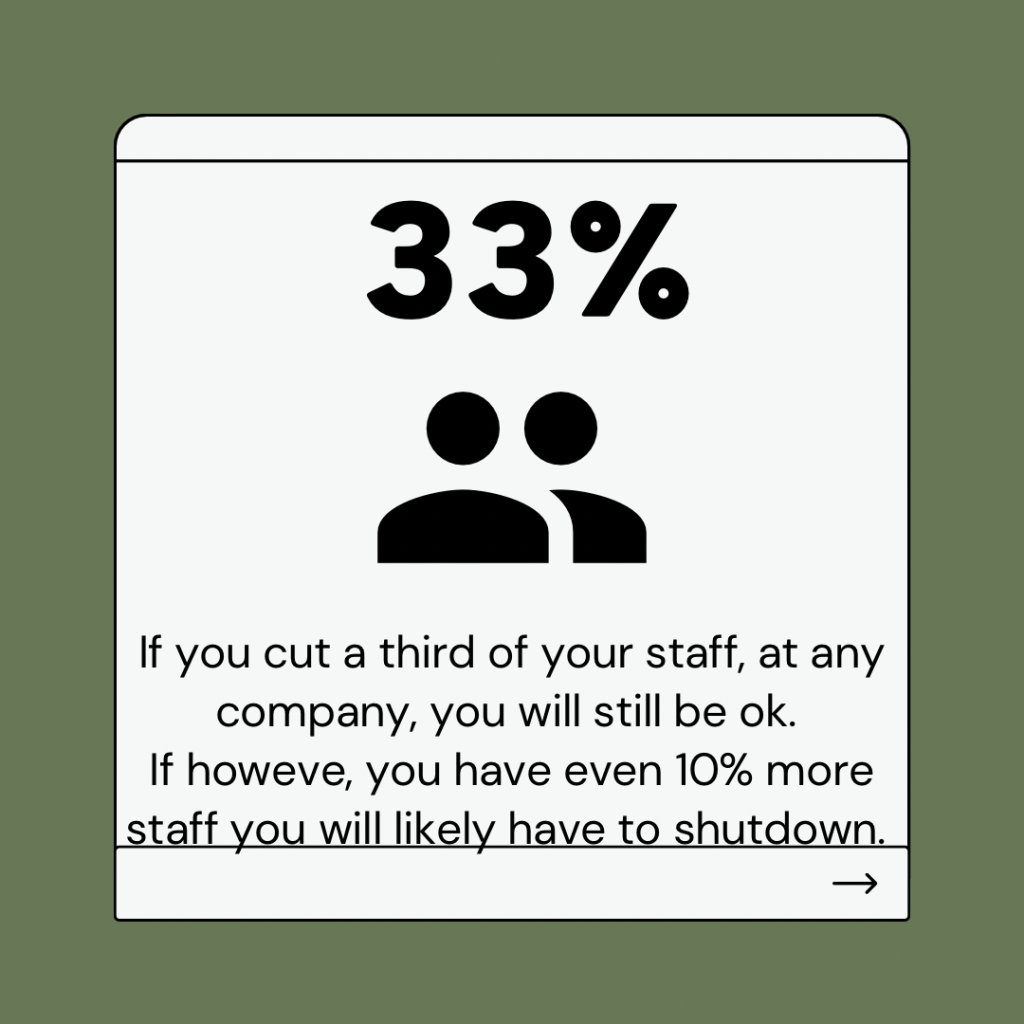
I don’t know the exact number of people companies have in excess, doing “filler jobs”. My estimate is 33%.

Most companies have 33% extra staff

I say 33% since you can safely cut a third of your staff if you are over 50 or so people and the business will still run. You may grow the same or more than you did before. You might have a slight dip in morale but that recovers.

As AI starts to proliferate in the workplace I see companies starting to have rolling layoffs. That will become the norm.

The reason is now CEOs realize many jobs are filler jobs. Second, Elon Musk with Twitter has shown that it’s okay to reduce staff and still have a functioning site. Third, AI will force people to leverage technology to do more in their job or be eliminated.

New YouTube Video – Trading Strategies with Jim Matthews

I returned to doing a YouTube video interview last week with JJMStocks, or Jim Matthews. It was an enlightening conversation for 20 or so minutes.

We covered:

  1. How he go into trading / investing?
  2. Does he day trade, swing trade or invest for the long term?
  3. What are his favorite tools? Which is his go to charting solution?
  4. What is his trading strategy?
  5. How does he manage his emotions?

and more.

Why big technology will not hire as many as people any more

The image above is the TLDR version. Since I got a lot of feedback to extrapolate on the post, I am providing more color commentary and relevant links.

I believe the type and kind of people the big tech will hire when they start to again, will be dramatically different from the ones they let go or have in their organizations now.

To be clear I am not saying they won’t hire again, and neither am I saying they won’t be large, relevant or important employers.

What will happen is that they will hire more younger developers, designers, marketers and sales people and fewer “lateral” hires.

Younger people not only cost much less, they are also more likely to fully expect that AI will aid them be more efficient.

First some context:

  1. Developers are already using GitHub copilot to write 40% of their code, which they do not change at all.
  2. Designers are the early adopters of Generative AI, causing earnings at Fiverr and Upwork for remote designers to drop by 15% especially those who are “inexpensive but average”.
  3. Marketing people are early adopters of ChatGPT for content, reducing their reliance on agencies for content.
  4. Google employees criticize CEO Sundar Pichai for botched layoffs.
  5. Activist investors are taking aim at Salesforce CEO Marc Benioff and others over employee productivity. So, he cut costs by laying off people and impressed on his sales team to increase productivity.
  6. Meta has deemed 2023 as “year of efficiency” while it cuts more costs than it has to, and deprioritizes projects that have longer term impact.
  7. All the big tech companies are facing Government scrutiny – Apple over App store, Microsoft over acquisition of Activision, Facebook over antitrust, Amazon over MGM acquisition and Google over Double Click and display ads.
  8. Elon Musk fired about 61% o the Twitter staff after he purchased the company, raised prices on API access and still managed to introduce new features.

All this leads to what the trend is going forward.

  1. Fewer engineering managers hired. The rule of thumb used to be 5-6 at for junior managers and 8-10 employees per senior manager. I see that changing. The role of the manager will be more of a talent coach – recruit, advocate and cheer their direct reports, leaving the on-job coaching to senior developers, designers and marketers.
  2. Fewer individual contributors hired and most of them younger, less experienced. This will save them money and also allows them to encourage people to be more productive with AI
  3. Smaller, earlier acquisitions (tuck in, within a new product team), instead of the large acquisitions that they were used to.

What salary and equity should a startup CTO expect? #Startup #Equity #CTO

If you have decided that your goal is to become a CTO, then I recommend you direct your career towards that goal. Putting together a working backwards plan to become a CTO and executing to that plan helps. You can network your way to a job or find out about CTO jobs that are open as well. Having a goal and plan is good, but you need to direct your experiences and goals to become a CTO if that is your desire.

Chief Technology Officer Compensation

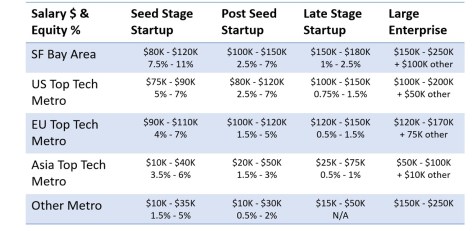
There are 5 variables to consider for the compensation, which might make it complicated, so I will try to simplify for 2 of the variables in this post – size of company and job location. I have collected data from 11 sources – PayScale, Glassdoor, LinkedIn, Salary.COM, Comparably and VC databases such as Pitchbook – sources below.

The variables are:

  1. Size of the company: Impact of the role to the organization is a key determinant. Startups pay less than larger companies, but give more in stock. Seed stage startups will pay less than later stage, but give you more equity (in terms of % ownership).
  2. Location of the role: Roles in the US pay the most, followed by Europe and then in other regions. Indian CTO roles do not pay as much for most startups. Self reported data from 594 CTOs place the salary at INR 2.5 Million to INR 5 Million (25 L to 50 Lakhs)
  3. Industry segment and sector: CTO roles in technology pay a lot more than roles in non technology companies, but that is changing quickly.
  4. Scope of the role: CTOs are expected to be technical leaders, but many organizations also expect them to play the role of VP of Engineering and CIO in certain cases.
  5. Years of experience or CTO background: The rule of thumb is that more experience equals higher pay and equity. Similarly if you have experience building large scale systems at companies such as Amazon, Facebook, Google or Microsoft, you will get paid more than if you are not.

The numbers below assume you are hiring a CTO, as opposed to having a co-founder as a CTO.

CTO Salary and Compensation
CTO Salary Data

Sources: US Salary Data, Bay Area Salary Data, EU Salary Data, India Salary Data and Asia Pacific Salary Data.

The next question is how can I get on the more or show that I deserve more than the guideline range? That question is best answered situationally and if you want to setup time with me for some advice feel free to email me.

The data is above is very subjective and has many nuances. Obviously salaries are very personal and negotiations play a big part in the final salary you get.

Conversations with 21 Chief Strategy Officers: 2020 will be the year of digital transformation acquisitions

Over the last 10 years many in the technology industry have heard of and used the term “digital transformation” to support their case to a) move to the cloud, b) revamp old systems, c) leverage new technologies such as IoT (Internet of Things) or Blockchain or d) replace older internal IT systems to newer “born on the cloud” technologies.

In December 2019, I spent time talking to 21 corporate development leaders in mainline industries such as finance (banks, insurance), healthcare (providers) and manufacturing (automotive) to get a sense for their priorities.

The big takeaway from my discussions is 2020 will be the year that many startups founded between 2011 and 2019 will get acquired by companies in their industry. There are 5 major reasons why they believe this to be true.

  1. The stock market is at all time highs, valuing their stock significantly, which gives them lots of optionality to purchase startups with stock instead of cash. Many anticipate flat to lower gains in the stock market this year.
  2. Board level discussions around moving quickly before high valuations get even more frothy have been asking corporate development teams to come up with options quicker. While there are multiple stories of unicorns with lower valuations in the public markets (e.g. Uber, Lyft, etc.) the private markets are still richly valuing their companies.
  3. Many CEOs fear being disrupted by early stage startups more in “mindshare” and “eyes of the customer” than necessarily in revenue.
  4. Related to stock prices, debt financing is still relatively cheap and widely available, making it an easy option for larger, cash flow rich companies.
  5. Over the last 5 years (2015 – 2019) there has been a rise in corporate development roles within large companies and an increase in product or business line executives taking over the role from a previously “finance” executive. This has led to changes in the way “strategic” acquisitions are considered versus financial transactions.

Ability to sell, but need not be a #salesman 21 traits to look for in entrepreneurs

Most entrepreneurs need to be able to sell. To potential employees, to customers, investors, etc. In fact the most challenging part that most entrepreneurs realize is if they cant sell – their vision, the value proposition or the products – they dont get very far with their startup.

One of the things I always seek to understand is if the founder can sell themselves. While I believe, everyone has some ability to sell, not everyone needs to be a sales person. A sales person falls into multiple categories for me : A hustler, a process jock and a relationship master, a consultative leader or a product expert.

Types of Sales People

Most entrepreneurs who I work with are developers and more technical folks who are largely introverts. They dont enjoy “selling”, which they associate with sleazy, tactics to “con” people.

It does not have to be that way at all. The most important skill I am looking for is if the person can get other people excited and interested in what they are doing and get them to commit to their desired outcome.

Both of these aspects are required – which in sales they call “opening” an opportunity and “closing” the deal.

Some entrepreneurs struggle with “opening” opportunities. I can relate to and understand that. Opening requires you to cold call and in many cases talk to people you dont know. So, what most entrepreneurs do is talk to people they know (get referrals) or avoid it altogether.

Other entrepreneurs may be good at “opening” but have a big challenge at “closing” because they believe most of it is outside their control. They can make the initial pitch, but getting the investor to commit the funding and sign on the term sheet is a problem. Or getting the candidate to interview and be willing to join is easy, but getting them to sign and come on board is the hard part.

One of the first things I look for is how the entrepreneur got to me. If they are referred by a trusted source, I try to find out how my network got to know them. If they cold emailed me, I look and judge the pitch they made via email. Is it genuine, well researched and has a specific outcome or purpose.

Most entrepreneurs dont have the experience going from “opening” an opportunity” to “closing” the deal as well, so they end up spending a lot of time in the middle.

As with any target (potential investors, employees, customers, partners) they goals are different and I first look for clarity of thought. Do they know what they want from this person and the steps the need to get there.

Most entrepreneurs can tell you the goal, but dont understand that you can achieve that in one step. Understanding the layout of steps is critical – which we call the sales process.

Moving from one step – awareness to interest, then consideration, going to intent, and then evaluation and finally purchase, is what I am seeking to see if they have understood. It might take 2 meetings or even 10 or more, but if they know where the “target” is in this process, and how to get a target from one step to another, then you have someone who can sell, not just be a talker. 

The difference between metrics-driven and data-driven startups

Data driven means that progress in an activity is compelled by data, rather than by intuition or personal experience. It is what scientists call evidence based decision making.

Metrics driven means that activities are driven towards a deadline and objectives pre-set, rather than organically.

I think of Metrics-driven as inherently proactive and Data-driven as reactive. I dont think being reactive is wrong, especially when you dont know what metrics you should be driving towards.

SaaS metrics drive for success

Here is an example. Most companies start by watching customer behavior and understanding what users are doing on their site. For example what do they do after they sign up, how long do they take to fill out their profile, etc. After watching users for a while, they understand clearly the on-boarding process for users. They can become proactive and set specific metrics – number of users, time for user to get setup and the date by which they want # of users on board.

Which is why it is never either-or. You need to be watchful at times (when you dont know enough) and other times set goals to drive towards them.

Another reason why it helps to be reactive is when you are willing to be open to go in directions that the data takes you. In many cases, in the drive to focus on goals and objectives, many companies miss obvious clues that might give them insights about their customers.

There is a good overview whitepaper by Joel from BlueNose on this for SaaS metrics.

So, if you dont know what to drive towards, I’d say look for clues in the data. If you do, then drive towards predetermined metrics. What do you think?