How to reduce the number of spam / cold emails you get from AI SDRs and sales people by 50% in 1 hour?


There are over 20 “sales intelligence” tools that farm and collect your email (personal and business) and sell them to AI SDRs and companies.


The top 10 are

ZoomInfo Apollo.io Lusha Cognism Clearbit Seamless AI UpLead LeadIQ Hunter.io Clay and 6sense

The only way you can reduce emails is to “Opt out” of their lists. While they make it hard, I have put together a list of their opt-out pages.

Now, before you tell me “Why can’t you make it so I get a single form?” and I can “make an agent that automates this”.

No. You cannot do it, because the companies have no incentive to help you get it done. So they make it hard. There is one company DeleteMe that helps with this, but many users I have spoken with told me it is a cumbersome process.

Especially because every person has 2-3 emails – personal, work and “private”. They have to delete all 3 emails from those systems.

It would take you about 1-2 hours to do this with each email.

They give you a form with double opt-out.
You have to give them your phone number to confirm.
You have to then click on an email they send to your email address to confirm.


But let’s say you do all that. And you go through the process.

The number of emails I have received in the last 3 months (after going through this process) vs 6 months prior has dropped by over 60%.

https://lnkd.in/gzqRd_8M

https://hunter.io/claim

https://lnkd.in/gCYa2s6H

https://lnkd.in/gja3tXjd

https://lnkd.in/ge26Z4Eq

https://lnkd.in/gvvGvsqr

https://lnkd.in/gT3Y_NEu

https://lnkd.in/gfV7akFn

https://lnkd.in/gUKGX87x

https://lnkd.in/g9XnQzjn

https://lnkd.in/gUuP_Fbw

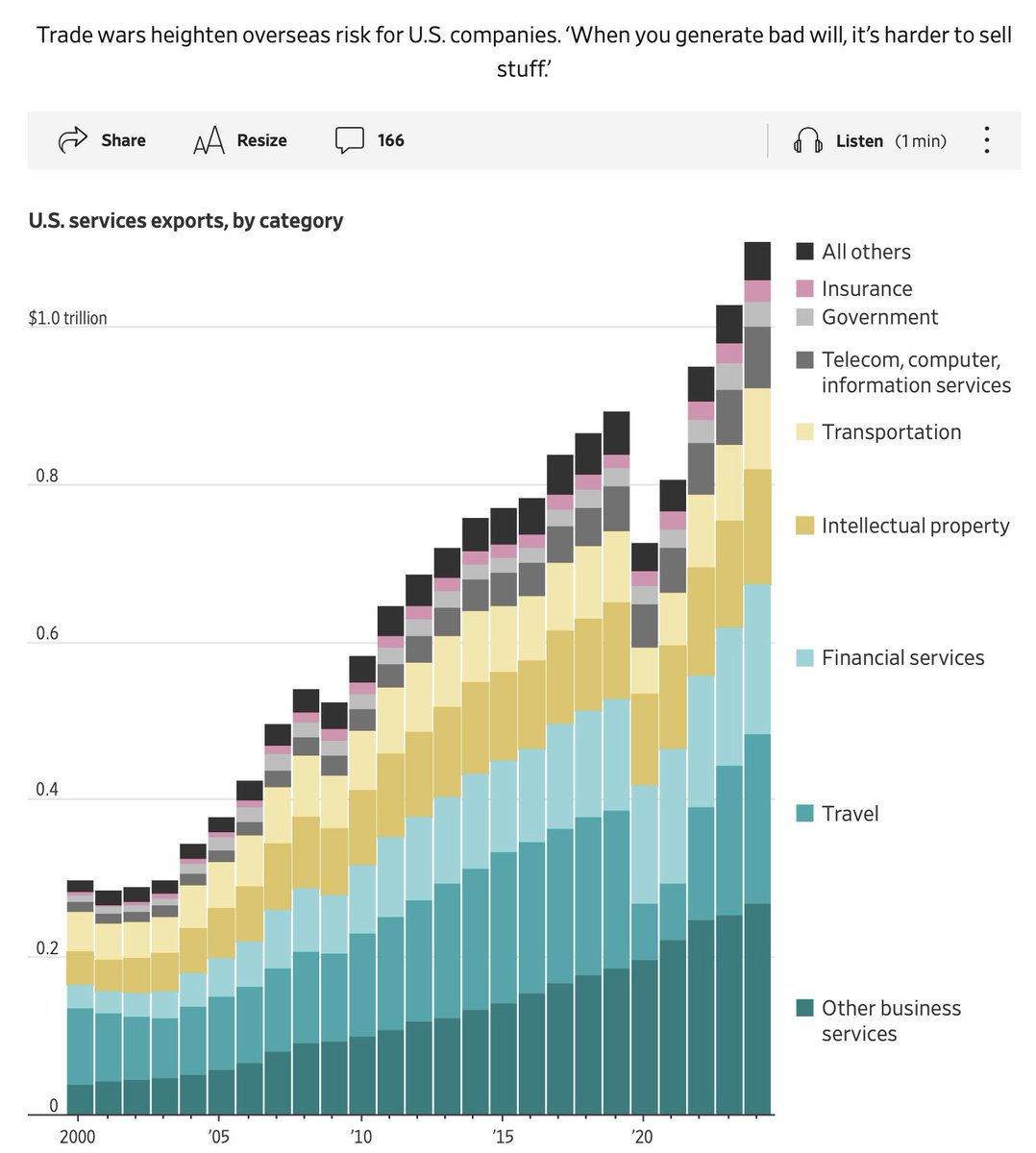
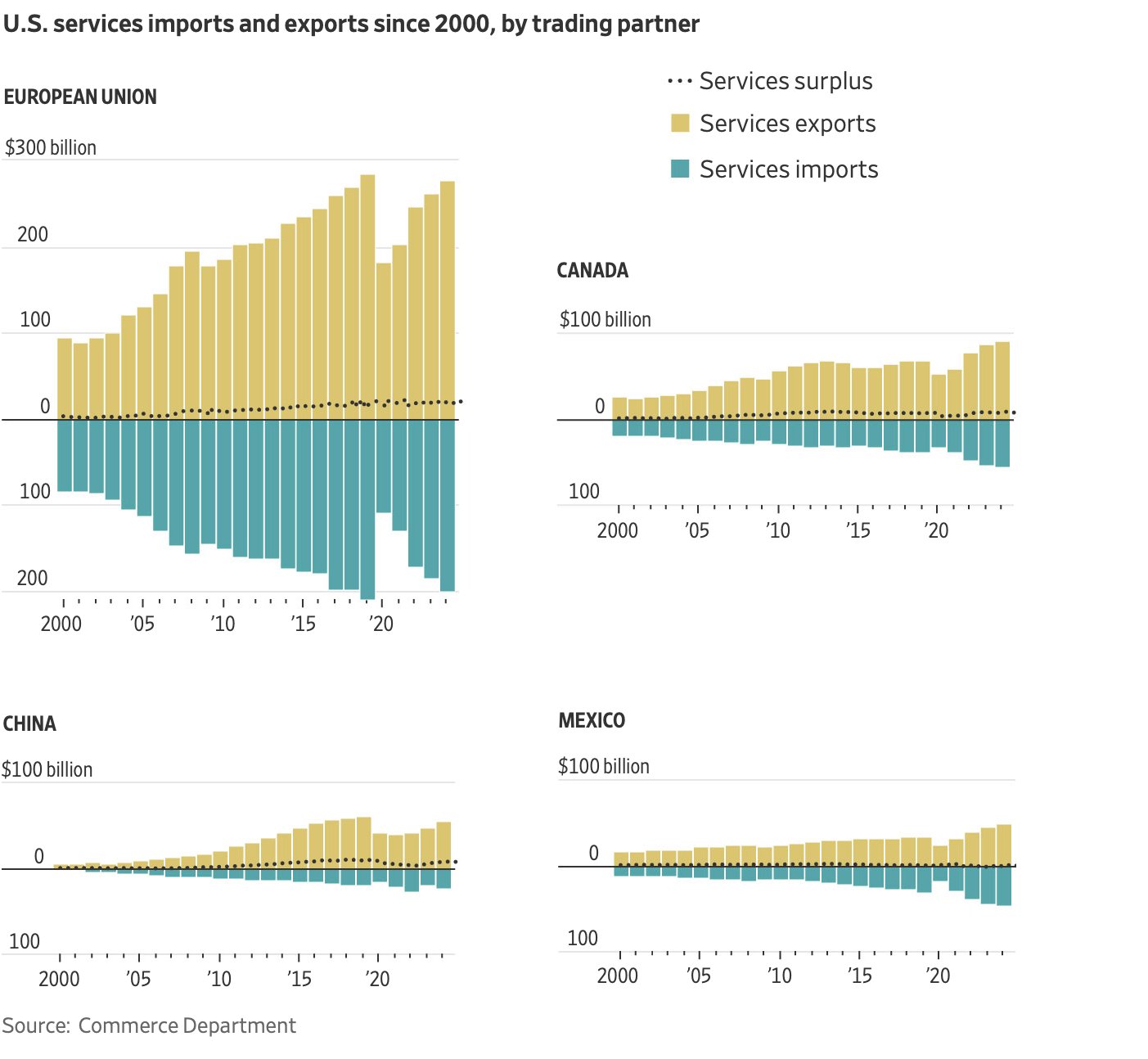
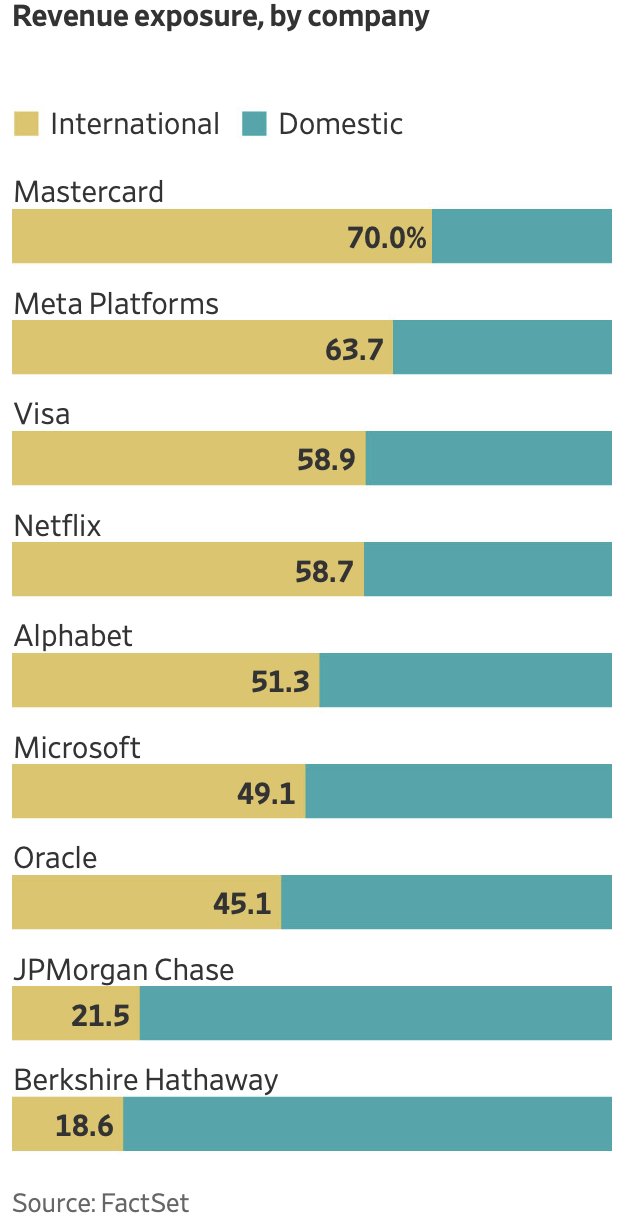
US service exports vs goods and the trade imbalance

The United States tariffs imposed on the rest of the world and China in particular stem from the “trade deficit” that the US runs with the world.

That is part of the story of trade imbalances however.

With the rest of the world and Europe in particular, the United States runs a trade surplus.

The main sectors are financial services, technology and travel (tourism).

Which is not reflected in the administration’s trade deficit.

The services surplus is about $250+ Billion. If you include that in the overall trade imbalance, then the trade deficit drops to about $700 Billion. Still a lot, but less than $1 Trillion.

Book review: The China Business Conundrum: A Comprehensive Analysis of Western Business Challenges in China

The book talks about the disconnect between Western and Chinese ways of doing business

Ken Wilcox’s The China Business Conundrum: Ensure That “Win-Win” Doesn’t Mean Western Companies Lose Twice offers a firsthand account of the complexities and systemic challenges faced by foreign enterprises operating in China. Drawing from his four-year tenure establishing Silicon Valley Bank’s (SVB) joint venture in Shanghai, Wilcox provides a cautionary narrative that blends personal anecdotes, cultural analysis, and strategic insights. This report synthesizes the book’s core themes, including the Chinese Communist Party’s (CCP) influence, cultural mismatches, regulatory labyrinths, and the paradox of “win-win” partnerships.

Strategic Deception and the CCP’s Playbook

The Illusion of Mutual Benefit

At the heart of Wilcox’s account is the concept of One Bed, Two Dreams—a metaphor for the inherent misalignment between Western companies seeking market access and Chinese partners aiming to acquire intellectual property or replicate business models. SVB’s joint venture with Shanghai Pudong Development Bank (SPDB) exemplified this dynamic. Chinese officials initially lauded SVB as more strategically valuable than Goldman Sachs or Morgan Stanley, framing the partnership as critical to China’s innovation ecosystem. However, Wilcox later realized the CCP’s true objective was to dissect SVB’s tech-lending model and transfer its methodologies to state-backed banks.

The CCP’s involvement permeates all business operations. For example, joint ventures must establish Party committees that often function as shadow boards, overriding formal governance structures. Wilcox recounts how SPDB’s chairman—a CCP member—viewed his roles in government, the Party, and the bank as indistinguishable, creating opacity in decision-making. This intertwining of Party and business interests ensures that foreign ventures ultimately serve China’s national objectives, even at the expense of their own profitability.

Cultural and Operational Pitfalls

Misaligned Governance Structures

Cultural misunderstandings frequently derailed SVB’s efforts. A critical misstep arose from SVB’s assumption that corporate titles mirrored Western norms. Wilcox, as president, believed he held operational control, while his Chinese counterpart, the chairman, viewed the role as ceremonial. In reality, the chairman wielded executive authority, leading to clashes over strategic decisions. This disconnect underscores the risks of transplanting Western mental models into China’s distinct hierarchy-driven culture.

Guanxi and Ethical Quandaries

Building guanxi (relationship capital) is essential but fraught with ethical dilemmas. SVB faced pressure to offer “special favors”—such as bribes disguised as commissions—to secure deposits from state-owned enterprises18. While Wilcox resisted, he acknowledges that such practices are normalized in China’s relationship-based economy. Similarly, SVB employees often held side jobs at insurance firms, cross-selling products to banking clients—a conflict of interest unacceptable in Western contexts but tacitly accepted in China.

Regulatory Obstacles and Systemic Delays

The License Quagmire

China’s regulatory environment proved Kafkaesque. SVB’s joint venture required over 20 licenses to replicate its U.S. operations, including separate approvals for deposit accounts, loans, and currency exchanges. Despite years of negotiations, critical licenses—such as renminbi (RMB) clearance—remained elusive, crippling the bank’s ability to operate. Wilcox highlights a paradoxical workaround: renting licenses from other banks, a common but legally dubious practice in China.

Bureaucratic Foot-Dragging

Regulatory delays often served strategic purposes. For three years, Chinese authorities withheld approval for SVB to use RMB, citing nebulous “policy concerns.” Wilcox argues this stalling tactic allowed domestic banks to study SVB’s methods while limiting its competitive reach. Even after securing licenses, daily reporting requirements and sudden regulatory shifts—such as bans on subletting licenses—hamstrung operations.

The Xi Jinping Era: Tightening Party Control

Centralization of Power

Xi Jinping’s ascent in 2012 marked a turning point. His anti-corruption campaign, while popular, intensified Party scrutiny over businesses. SVB’s joint venture faced heightened pressure to align with Xi’s “Chinese Dream” of technological self-reliance. The CCP’s grip extended to staffing: SVB was compelled to hire “sons and daughters of the Party”—relatives of officials—who prioritized political loyalty over merit.

Erosion of Autonomy

Under Xi, foreign firms encountered escalating demands to share proprietary data. SVB’s risk-assessment algorithms, a trade secret, were repeatedly requisitioned under the guise of regulatory compliance. Wilcox warns that such practices are systematic: foreign companies are tolerated until their intellectual property is absorbed, after which domestic competitors receive state support to supplant them.

Lessons for Western Businesses

Realistic Expectations

Wilcox dispels the myth of China as a “market economy.” Success requires accepting that the CCP will always prioritize national interests over partnership equity. Contracts, while necessary, hold limited enforceability; MOUs and guanxi often prove more pivotal.

Mitigation Strategies

  1. Localize Decision-Making: Empower Chinese executives to navigate regulatory and cultural nuances, but maintain oversight to prevent IP leakage.
  2. Diversify Geographically: Avoid over reliance on China. Wilcox notes SVB’s Southeast Asian ventures faced fewer hurdles.
  3. Exit Planning: Establish clear termination clauses. SVB’s joint venture dissolved after U.S.-China tensions escalated, with SPDB absorbing its assets.

Conclusion: Navigating the Conundrum

Wilcox’s narrative is a sobering antidote to the “China dream” rhetoric. The CCP’s playbook—luring foreign firms with market access, extracting knowledge, and sidelining them—remains pervasive under Xi. Yet, China’s market size necessitates engagement. The key lies in tempered pragmatism: leveraging China’s ecosystem while safeguarding core IP and diversifying risk.

For Western executives, The China Business Conundrum is indispensable. It transcends SVB’s story, offering a blueprint for resilience in an era of techno-nationalism and strategic rivalry. As Wilcox concludes, “In China, ‘win-win’ demands recognizing that the Party always wins first—your task is to ensure you don’t lose twice”.

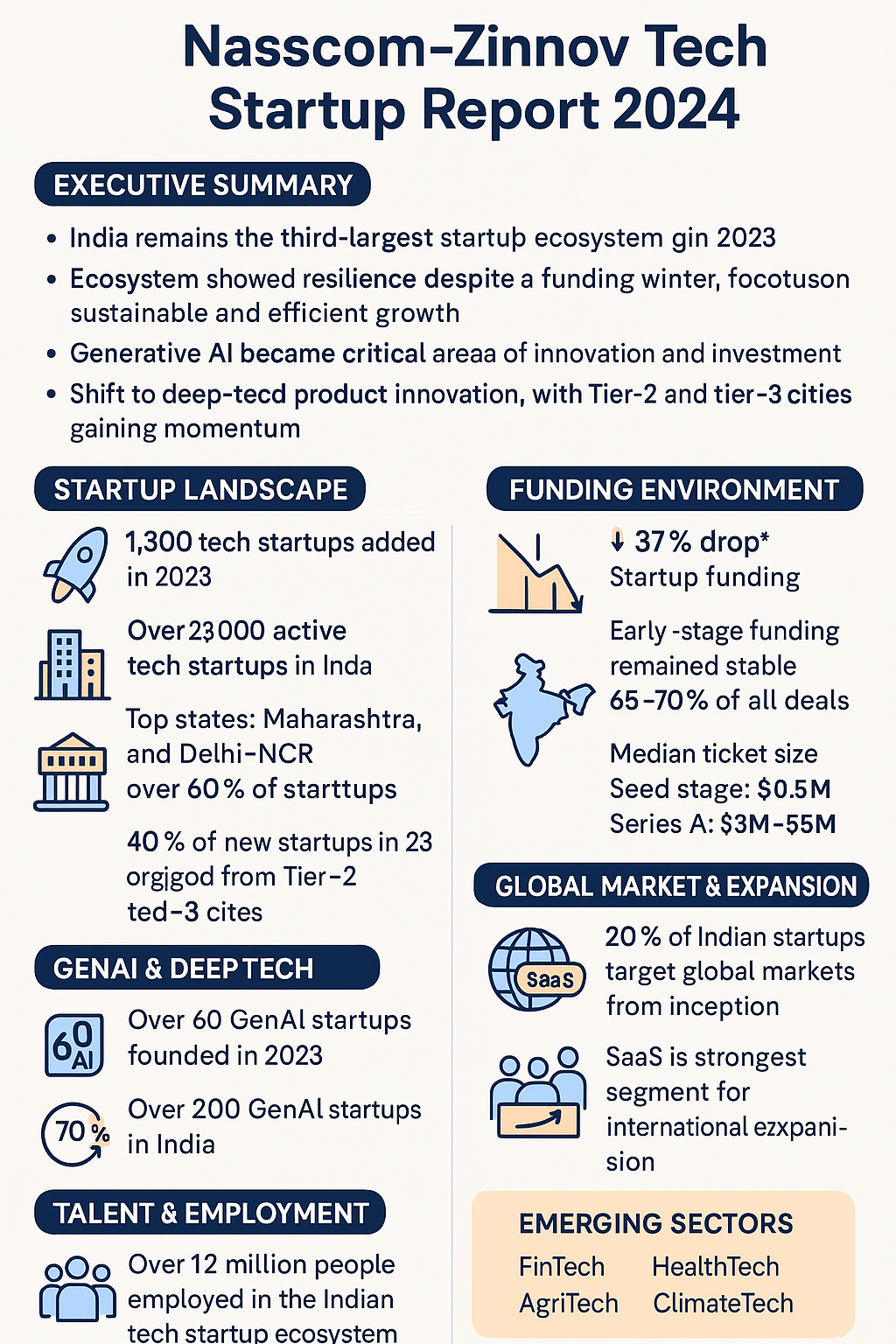
Funding stages

The journey of a startup is marked by distinct stages, each with critical milestones and metrics that measure progress and guide decision-making. These stages—early, growth, and late—are defined by specific goals that reflect the startup’s evolution from an idea to a scalable, sustainable business.

Early Stage: Ideation and Validation

The early stage focuses on transforming an idea into a viable product or service. Key milestones include developing a Minimum Viable Product (MVP), launching it to the market, and achieving proof of concept. Metrics like customer acquisition cost (CAC), activation rate, and initial revenue generation are crucial here. For instance, attracting the first 10, 100, or 1,000 customers validates product-market fit and demonstrates demand[1][2][7].

During this phase, startups must also monitor burn rate to ensure they manage limited resources effectively. Achieving early traction through marketing campaigns and customer feedback is essential for refining the product and building credibility with stakeholders[2][3]. Positive customer feedback, Net Promoter Score (NPS), and low churn rates signal that the product addresses real market needs[7].

Growth Stage: Scaling Operations

Once a startup validates its concept, the focus shifts to scaling operations. This stage involves expanding the customer base, increasing revenue, and optimizing financial health. Key milestones include securing Series A funding, hiring additional team members, and entering new markets[5][6]. Metrics like Monthly Recurring Revenue (MRR), user engagement (e.g., Daily Active Users), and conversion rates become critical indicators of growth[3][7].

Startups at this stage should aim to achieve financial stability by breaking even or exceeding their debt service ratio by at least 20%[4]. Efficiently managing cash flow while maintaining a healthy burn rate ensures sustainability. Additionally, building strong customer retention strategies helps maximize Customer Lifetime Value (CLV) and reduces reliance on constant acquisition efforts[3].

Late Stage: Maturity and Expansion

In the late stage, startups focus on achieving profitability, optimizing operations, and preparing for potential exit strategies like IPOs or acquisitions. Milestones include reaching significant revenue targets (e.g., $1 million annually), expanding into international markets, or launching complementary products[4][5]. Metrics such as profitability ratios, operational efficiency, and market share growth are essential for evaluating success.

At this stage, balancing growth with profitability becomes paramount. Startups must demonstrate consistent revenue streams while maintaining a manageable burn rate to attract investors for late-stage funding rounds or strategic partnerships[3][6]. Additionally, planning for an exit strategy requires aligning operations with long-term goals and ensuring scalability.

Conclusion

Each stage of a startup’s lifecycle is defined by unique milestones and metrics that reflect its progress toward sustainability. From validating an idea in the early stage to scaling in the growth phase and achieving maturity in the late stage, these checkpoints provide a roadmap for success. By tracking key performance indicators at every step, founders can make informed decisions that align with their vision while adapting to market demands.

Sources
[1] Early Stage Startup Revenue Milestones and Metrics – 10k Per Month https://tehcpa.net/early-stage-startup-revenue-milestones-and-metrics-10k-per-month/
[2] Business Milestones that Signify Growth – Mailchimp https://mailchimp.com/resources/business-milestones/
[3] Measuring Progress in Early Stage Startups: Key Metrics for Success https://www.linkedin.com/pulse/measuring-progress-early-stage-startups-key-metrics-success-nqgdf
[4] Financial Milestones That Prepare You for Startup Success https://www.nw.bank/blog-detail/blog/2024/08/13/financial-milestones-that-prepare-you-for-startup-success
[5] What are the three stages of a startup? | Silicon Valley Bank https://www.svb.com/startup-insights/startup-growth/what-are-the-three-stages-of-a-startup/
[6] Beyond Product-Market Fit: The Startup Milestones Every Founder … https://techstartups.com/2024/11/24/beyond-product-market-fit-the-startup-milestones-every-founder-must-know/
[7] Key Performance Indicators (KPIs) Startup Metrics Every Early-Stage … https://www.taxfyle.com/blog/early-stage-startup-metrics
[8] Eight Successful Startup Milestones Every Founder Should … – Forbes https://www.forbes.com/councils/forbesbusinessdevelopmentcouncil/2021/06/25/eight-successful-startup-milestones-every-founder-should-be-striving-toward/

Book summary Chip war. By Chris Miller

Comprehensive Summary of Chip War: The Fight for the World’s Most Critical Technology by Chris Miller| Published October 4, 2022


Chip war policy hurting US firms more than China - Asia TimesIntroduction: The Geopolitical Stakes of Semiconductors

Chris Miller’s Chip War positions semiconductors—tiny silicon chips that power modern electronics—as the linchpin of global economic and military power. The book argues that control over semiconductor technology defines 21st-century geopolitics, akin to oil in the 20th century. Miller traces the industry’s evolution from its origins in Cold War-era innovation to today’s U.S.-China rivalry, emphasizing how these chips underpin everything from consumer gadgets to advanced weaponry .

The narrative opens with a stark illustration of Taiwan’s centrality: Taiwan Semiconductor Manufacturing Company (TSMC) produces 37% of the world’s computing power, making the island a geopolitical flashpoint. China’s dependence on foreign chips (spending more on imports than oil) and U.S. efforts to restrict China’s access to advanced technology frame the book’s central conflict .


Part 1: The Birth of the Semiconductor Industry

From Transistors to Integrated Circuits

  • Transistor Revolution: The invention of the transistor in 1947 by John Bardeen, Walter Brattain, and William Shockley at Bell Labs replaced bulky vacuum tubes, enabling smaller, more reliable electronics. Shockley’s later work on silicon-based transistors laid the groundwork for Silicon Valley .
  • Integrated Circuits: Jack Kilby (Texas Instruments) and Robert Noyce (Fairchild Semiconductor) independently developed the integrated circuit in the late 1950s, consolidating multiple transistors onto a single chip. This breakthrough fueled the space race, with NASA using Fairchild chips for Apollo missions .

Cold War Dynamics

  • Military Demand: Early chip production was driven by U.S. military needs. The Vietnam War highlighted the superiority of semiconductor-guided weapons (e.g., laser-guided bombs) over Soviet vacuum-tube systems, cementing chips as strategic assets .
  • Soviet Failures: The USSR attempted to replicate Silicon Valley through espionage and forced industrialization in Zelenograd. However, their “copycat” strategy failed due to inefficiencies and isolation from global innovation networks .

Part 2: The Rise of Global Competitors

Japan’s Dominance in the 1980s

  • Quality Over Quantity: Japanese firms like Toshiba and NEC surpassed U.S. companies in producing high-quality, low-cost memory chips (DRAM). By 1986, Japan controlled 70% of the global lithography equipment market, prompting U.S. fears of economic and military vulnerability .
  • Trade Wars: The U.S. responded with tariffs, antitrust lawsuits, and the creation of Sematech, a government-industry consortium to revive domestic chip manufacturing. The 1986 U.S.-Japan trade deal aimed to curb Japanese dominance but inadvertently paved the way for South Korea’s rise .

Taiwan’s TSMC and the Fabless Model

  • Morris Chang’s Vision: In 1987, Morris Chang founded TSMC, pioneering the “fabless” model where companies like Apple and NVIDIA design chips while outsourcing production. TSMC’s specialization in advanced fabrication (e.g., 5nm and 3nm chips) made it indispensable to global tech giants .
  • Geopolitical Implications: Taiwan’s dominance (producing 90% of advanced logic chips) has turned it into a strategic asset. China’s threats to invade Taiwan risk disrupting the global supply chain, a scenario Miller likens to “mutually assured destruction” .

Part 3: The U.S.-China Tech Cold War

China’s Ambitions and Challenges

  • Made in China 2025: Beijing’s plan to achieve semiconductor self-sufficiency by 2025 has led to massive investments ($150 billion+), but progress is hampered by reliance on foreign equipment (e.g., ASML’s EUV lithography machines) and U.S. sanctions .
  • Huawei’s Rise and Fall: Huawei’s HiSilicon unit designed cutting-edge smartphone chips, but U.S. export bans crippled its access to TSMC’s fabrication, forcing it to sell its smartphone division. This underscores China’s vulnerability to supply chain disruptions .

U.S. Countermeasures

  • CHIPS Act: Passed in 2022, this $52 billion initiative aims to revive U.S. chip manufacturing, with TSMC and Intel building fabs in Arizona. However, Miller questions whether the U.S. can reclaim leadership given TSMC’s decade-long technological lead .
  • Export Controls: Restrictions on selling advanced chips and equipment to China aim to slow its military modernization. Critics argue this may spur China to accelerate domestic innovation or seize TSMC .

Part 4: Technological and Supply Chain Vulnerabilities

Moore’s Law and Innovation

  • Sustaining Progress: Gordon Moore’s 1965 prediction that transistor density would double every two years drove exponential growth. However, as chips approach atomic scales, breakthroughs like EUV lithography (pioneered by ASML) are required, with each machine costing $200 million and involving 500,000 components .
  • Design Automation: Carver Mead and Lynn Conway’s 1980s “design rules” enabled software-driven chip design, democratizing innovation for firms like Qualcomm and NVIDIA .

Fragile Global Supply Chains

  • COVID-19 Exposures: Pandemic-induced shortages highlighted dependencies on TSMC (advanced chips) and ASML (EUV machines). The automotive industry lost $210 billion in 2021 due to chip shortages .
  • Concentration Risks: Over 90% of advanced chips are made in Taiwan (TSMC) and South Korea (Samsung). Natural disasters, political instability, or conflict could paralyze global production .

Part 5: Historical Case Studies and Lessons

Intel’s Decline and Reinvention

  • Missed Opportunities: Intel dominated the PC era but faltered in mobile devices, rejecting Apple’s 2005 offer to make iPhone chips. Under Andy Grove’s “paranoid” leadership, it pivoted to microprocessors, surviving Japan’s DRAM onslaught but struggling to match TSMC’s fabrication prowess today .

Samsung’s Ascent

  • State-Backed Growth: South Korea’s Samsung leveraged government subsidies and cheap capital to undercut Japanese DRAM producers. By the 1990s, it became a global leader, aided by U.S. support to counter Japan .

ASML’s Monopoly

  • EUV Lithography: ASML’s machines, essential for cutting-edge chips, rely on a global supply chain (German optics, U.S. software). Its monopoly underscores the fragility of hyper-specialization .

Conclusion: The Future of Chip Politics

Miller concludes that semiconductors are both a triumph of globalization and its Achilles’ heel. The U.S.-China rivalry will shape the industry’s future, with Taiwan at the epicenter. Key takeaways:

  1. Supply Chain Resilience: Diversifying production (e.g., U.S. CHIPS Act) is critical but costly and slow .
  2. Innovation vs. Imitation: China’s quest for self-sufficiency faces hurdles without access to global networks, mirroring Soviet failures .
  3. Global Interdependence: No single nation controls the entire supply chain, necessitating cooperation even amid competition .

Chip War serves as a cautionary tale: the tiny silicon chip, once a symbol of progress, now holds the power to destabilize economies and ignite conflicts. As Miller writes, “The world’s dependence on Taiwan only deepens”—a reality demanding urgent geopolitical foresight .


Sahil bloom 5 types of wealth summary

Comprehensive Summary of The 5 Types of Wealth
By Sahil Bloom


Introduction: Rejecting the Default Path

Sahil Bloom’s The 5 Types of Wealth challenges the societal fixation on financial wealth as the sole measure of success. Drawing from interviews with elderly individuals (collectively representing 1,042 years of lived experience), scientific research, and personal anecdotes, Bloom argues that true wealth encompasses five interconnected dimensions: Time, Social, Mental, Physical, and Financial Wealth . The book’s central thesis is: “Your wealthy life may be enabled by money, but in the end, it will be defined by everything else” .

Bloom’s journey began after the birth of his son, which shifted his perspective on time and legacy. He observed that none of the octogenarians he interviewed mentioned money as a source of lasting fulfillment. Instead, they emphasized love, relationships, health, and presence—themes that form the backbone of the book .


The Five Types of Wealth: A Deep Dive

1. Time Wealth

Definition: Control over how you spend your time, prioritizing moments that align with your values.
Key Insights:

  • Finite Family Time: Bloom stresses that time with loved ones is limited. For example, a 92-year-old interviewee shared: “Tell your partner you love them every night before falling asleep; someday you’ll find the other side of the bed empty” .
  • Energy-Creating Tasks: Focus on activities that replenish energy (e.g., hobbies, rest) rather than deplete it (e.g., mindless scrolling) .
  • Actionable Systems: Use time-blocking and delegation to reclaim hours. Bloom’s “25-question assessment tool” helps readers audit their time usage .

Pillars:

  • Prioritization of high-value moments.
  • Elimination of time-wasting habits.
  • Investment in future time freedom (e.g., automation, passive income) .

2. Social Wealth

Definition: Depth and quality of relationships, fostering connections that provide joy and support.
Key Insights:

  • Friendship Atrophy: A 98-year-old Hollywood writer advised: “Never let a good friendship atrophy” .
  • Relationship Maps: Visual tools to identify energy-giving vs. energy-draining relationships .
  • Celebration Rituals: Regularly appreciating loved ones, as emphasized by an 88-year-old soap opera star: “Find dear friends and celebrate them” .

Pillars:

  • Cultivating intentional communities.
  • Repairing minor conflicts before they escalate (analogous to maintaining a house) .
  • Building intergenerational bonds for diverse perspectives .

3. Mental Wealth

Definition: Clarity of purpose, presence, and lifelong learning.
Key Insights:

  • Curiosity Over Consumption: Bloom advocates filtering information with the rule: “If it won’t matter a month from now, it’s not worth your time” .
  • Stress Management: Chronic stress erodes mental acuity; practices like meditation and journaling are recommended .
  • Purpose Alignment: Stories of individuals who pivoted careers to align with their values illustrate the power of mental clarity .

Pillars:

  • Continuous learning and curiosity.
  • Mindfulness practices for presence.
  • Systems to reduce decision fatigue (e.g., routines) .

4. Physical Wealth

Definition: Health and vitality through sustainable habits.
Key Insights:

  • Body as a House: An 80-year-old interviewee advised: “Treat your body like a house you have to live in for another seventy years” .
  • Three Pillars: Nutrition, exercise, and rest—each addressed with non-judgmental, actionable steps (e.g., incremental fitness goals) .
  • Avoiding Extremes: Rejecting fad diets or extreme workouts in favor of balanced, joy-driven practices .

Pillars:

  • Preventive care and minor habit repairs.
  • Joyful movement (e.g., dancing, walking).
  • Sleep hygiene and recovery rituals .

5. Financial Wealth

Definition: Achieving “enough” to enable freedom without sacrificing other wealth types.
Key Insights:

  • The “Enough” Threshold: Research shows happiness plateaus after basic needs are met (~$75,000/year). Bloom critiques the “bigger boat” mentality, where even millionaires crave 2–5x more wealth .
  • Financial Independence Pathways: Practical steps like debt reduction, investing, and defining personal “enough” .
  • Historical Context: Anecdotes about tycoons who sacrificed relationships for money, highlighting the pitfalls of imbalance .

Pillars:

  • Building security through savings.
  • Investing in experiences over possessions.
  • Aligning spending with values .

Structure and Methodology

Each chapter follows a framework designed for introspection and action:

  1. The Big Question: E.g., “What would you regret not doing if today were your last?” .
  2. History & Context: Examines how societies have prioritized each wealth type, from ancient philosophies to modern crises .
  3. Three Pillars: Break down each wealth type into core principles.
  4. Action Guides: Science-backed strategies (e.g., relationship mapping, time audits) .

Bloom integrates real-life stories, such as a tech founder’s post-exit emptiness and a retiree’s rediscovery of purpose through volunteering, to illustrate abstract concepts .


Key Themes

  1. The Treadmill of More: Bloom critiques the societal “glitch” of chasing infinite financial growth, citing Harvard research showing that millionaires still desire 2–3x their wealth for happiness .
  2. Interconnected Wealth: Neglecting one area (e.g., health for career) destabilizes others. The book emphasizes dynamic balance .
  3. Legacy Over Metrics: Elderly interviewees universally valued love and relationships over material success .

Critiques and Limitations

  • Privilege Blind Spots: One reviewer notes the book underaddresses systemic barriers (e.g., single parents working multiple jobs) .
  • Spiritual Omissions: While Bloom touches on mindfulness, he avoids organized religion or spirituality, though readers may draw parallels .

Conclusion: A Blueprint for a Rich Life

The 5 Types of Wealth is not a prescriptive self-help guide but a framework for intentional living. By rejecting society’s narrow definition of wealth, readers are empowered to design lives rich in time, love, health, purpose, and financial freedom. As Bloom writes: “When in doubt, love. The world can always use more love” .

The book’s strength lies in its blend of empathy, research, and practicality, making it a transformative read for anyone seeking holistic fulfillment


5 Ascending Levels of Intellect

According to Einstein

Einstein

Always write your thesis down. If it takes more than a short paragraph, there is a fundamental problem. If it requires me to fire up Excel, it is a big red flag that strongly suggests that I ought to take a pass.

Mohnish Pabrai

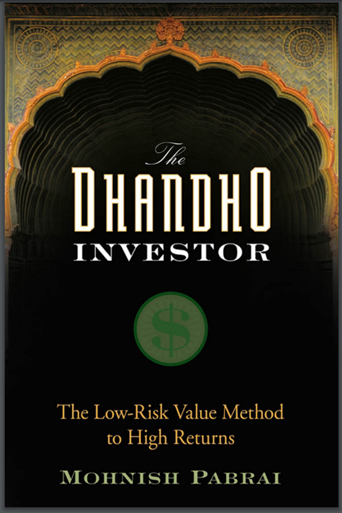
The Dhandho investor: Mohnish Pabrai – Notes and Quotes

Notes and Quotes from The Dhando Investor – Mohnish Pabrai, published 2007, 209 pages.

There were virtually no Patels in the United States just 35 years ago. Less than one in five hundred Americans is a Patel. Over half of all the motels in the entire country are owned and operated by Patels.

Patels, as a group, today own over $40 billion in motel assets in the United States, pay over $725 million a year in taxes, and employ nearly a million people.

Dhan comes from the Sanskrit root word Dhana meaning wealth. Dhan-dho, literally translated, means “endeavors that create wealth.

Dhandho is all about the minimization of risk while maximizing the reward.

If an investor can make virtually risk-free bets with outsized rewards, and keep making the bets over and over, the results are stunning.

The first few Patels arrived from Africa in the early 1970s. The reason we end up with concentrations of ethnic groups in certain professions is that role models play a huge role in how humans pick their vocations.

“Few Bets, Big Bets, Infrequent Bets.”

“Heads, I win; tails, I don’t lose much!”

The Dhando approach

  1. Focus on buying an existing business.
  2. Buy simple businesses in industries with an ultra-slow rate of change.
  3. Buy distressed businesses in distressed industries.
  4. Buy businesses with a durable competitive advantage—the moat
  5. Bet heavily when the odds are overwhelmingly in your favor.
  6. Focus on arbitrage.
  7. Buy businesses at big discounts to their underlying intrinsic value.
  8. Look for low-risk, high-uncertainty businesses.
  9. It is better to be a copycat than an innovator.

We see change as the enemy of investments . . . so we look for the absence of change. We don’t like to lose money. Capitalism is brutal. We look for mundane products that everyone needs.1 —Warren Buffett

Never count on making a good sale. Have the purchase price be so attractive that even a mediocre sale gives reliable results. —Warren Buffett

The entrance strategy is more important than the exit strategy. —Eddie Lampert

Arbitrage is as an attempt to profit by exploiting price differences in identical or similar financial instruments.

Minimize downside risk before ever looking at upside potential.

The psychology of money – notes and quotes

This is not so much a book review as a summary of key quotes and my notes of the book “The psychology of money” by Morgan Housel

Financial outcomes are driven by luck, independent of intelligence and effort. Financial success is not a hard science. It’s a soft skill, where how you behave is more important than what you know. I call this soft skill the psychology of money. The aim of this book is to use short stories to convince you that soft skills are more important than the technical side of money.

To grasp why people bury themselves in debt you don’t need to study interest rates; you need to study the history of greed, insecurity, and optimism. To get why investors sell out at the bottom of a bear market you don’t need to study the math of expected future returns; you need to think about the agony of looking at your family and wondering if your investments are imperiling their future.

Be careful who you praise and admire. Be careful whom you look down upon and wish to avoid becoming.

Therefore, focus less on specific individuals and case studies and more on broad patterns.

You’ll get closer to actionable takeaways by looking for broad patterns of success and failure. The more common the pattern, the more applicable it might be to your life.

Nothing is as good or as bad as it seems.

The hardest financial skill is getting the goalpost to stop moving.

“Enough” is realizing that the opposite—an insatiable appetite for more— will push you to the point of regret.

There are a million ways to get wealthy, and plenty of books on how to do so. But there’s only one way to stay wealthy: some combination of frugality and paranoia.

Getting money requires taking risks, being optimistic, and putting yourself out there. But keeping money requires the opposite of taking risk. It requires humility, and fear that what you’ve made can be taken away from you just as fast. It requires frugality and an acceptance that at least some of what you’ve made is attributable to luck, so past success can’t be relied upon to repeat indefinitely.

More than I want big returns, I want to be financially unbreakable. And if I’m unbreakable I think I’ll get the biggest returns, because I’ll be able to stick around long enough for compounding to work wonders.

Planning is important, but the most important part of every plan is to plan on the plan not going according to plan.

A barbelled personality—optimistic about the future, but paranoid about what will prevent you from getting to the future—is vital.

“I’ve been banging away at this thing for 30 years. I think the simple math is, some projects work and some don’t. There’s no reason to belabor either one. Just get on to the next.” —Brad Pitt accepting a Screen Actors Guild Award

Anything that is huge, profitable, famous, or influential is the result of a tail event—an outlying one-in-thousands or millions event. And most of our attention goes to things that are huge, profitable, famous, or influential. When most of what we pay attention to is the result of a tail, it’s easy to underestimate how rare and powerful they are.

Money’s greatest intrinsic value—and this can’t be overstated—is its ability to give you control over your time. To obtain, bit by bit, a level of independence and autonomy that comes from unspent assets that give you greater control over what you can do and when you can do it.

Controlling your time is the highest dividend money pays.

Wealth is what you don’t see.

The first idea—simple, but easy to overlook—is that building wealth has little to do with your income or investment returns, and lots to do with your savings rate.

Past a certain level of income, what you need is just what sits below your ego.

Sunk costs—anchoring decisions to past efforts that can’t be refunded—are a devil in a world where people change over time.

“Every job looks easy when you’re not the one doing it” Jeff Immelt

Optimism is a belief that the odds of a good outcome are in your favor over time, even when there will be setbacks along the way.

The more you want something to be true, the more likely you are to believe a story that overestimates the odds of it being true.

Everyone has an incomplete view of the world. But we form a complete narrative to fill in the gaps.

The personal blog of Mukund Mohan