If you want work flexibility you can
1. Work for a small company and get paid less. OR
2. Work for a large company and get paid well. But commute 3-4 days a week.


If you want work flexibility you can
1. Work for a small company and get paid less. OR
2. Work for a large company and get paid well. But commute 3-4 days a week.
Notes from my discussions with multiple industry analysts and reading many reports.
There are multiple changes happening with autombiles:
The challenges:
In 2022, electric vehicles (EVs) took 11% global market
share (up from 6.5% in 2021), expecting 20% penetration by 2025
and the most aggressive for 100% by 2030.
Globally, we now expect battery electric vehicles (BEVs) to reach 40% penetration by 2030, and xEVs to reach 80% by 2035.
EV forecast calls for battery capacity to rise from ~600GWh in 2022 to 2,700GWh by end of 2030.
China has seen new energy vehicle (NEV) adoption become increasingly consumer-driven, with the country blowing past NEV penetration targets — the government sought to achieve ~20% penetration by 2025; it saw 23.5% in the first eight months of 2022. Chinese buyers seem to
favor domestic EVs over foreign (German and Japanese) brands though, leaving foreign OEMs potentially playing catch-up with domestic brands.

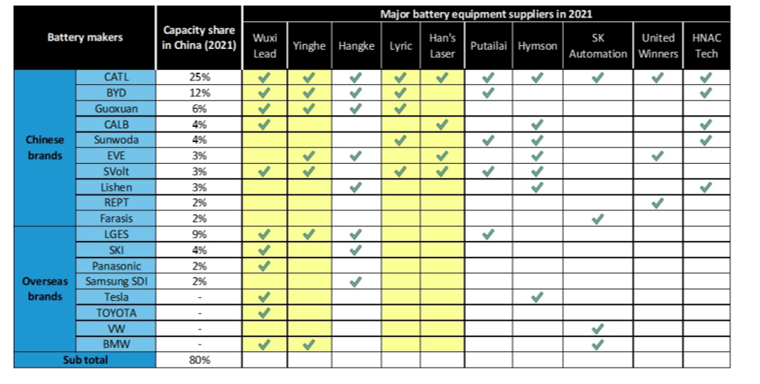
China represented close to 40% of the global battery
equipment market in 2021, up from 10%+ during 2016-19. Explosive growth over the past three years has been driven by sharply increasing investment in new energy industries.
Range anxiety over the switch from ICE to EVs has long been cited as a common impediment to greater EV adoption.

McKinsey says the market is under penetrated among mid-market companies and their research talking to 500 IT executives and 50+ cyber security vendors says this market is going to be large.
Some names of companies

Cloud security is the #1 Area of spend which bodes well for ZScaler, Cloudflare, Palo Alto Networks
Google MusicLM is a large language model to create music with words. It is in beta right now.
Here are the 2 music pieces I created. One for Bollywood and another for dance.

Mid Journey and DALL-E are the most popular of the 50+ Generative AI image products.

The others that are also getting mention are Starry AI and Stable Diffusion.
Each of them have strengths in different areas but all of them get hands wrong.

Have you seen this image where Apple iPhone has replaced so many things we used before?


Here’s the image for what all AI Mid Journey will replace

This week on the app Blind there were several discussions about salaries. Specifically if technology engineer salaries have peaked.

Google, Meta and Microsoft in particular, and some other companies in the valley, were known to pay over $1 Million for senior developers. In 2019, Google had 21 engineers making over a million and that number has most certainly gone up since. Similarly Facebook was known to have over 25 engineers making salaries over a million dollars (outside of stock RSUs and options).
To be fair, in the valley, a million dollars is a lot, but not unusual.
The discussion on Blind, the anonymous networking app, was if mid-level and senior engineers will no longer see $500K – $1M salaries without becoming Directors or VPs.
There are 3 trends to consider before I came to the conclusion that software development salaries will become more like Hollywood or professional sports salaries.
Few people at the top make a lot of money, while most B list actors make decent, but not more than the median income.
2. The use of Artificial intelligence tools such as CoPilot and Tabnine will reduce the number of developers needed, as AI increasingly does a lot of the basic code output. This means a 10X developer will have to make 10X more than the average. If the average developer makes $150K, it makes sense for the 10X developer to make more than a million dollars.
3. 90% of the skills developers possess will become worth a tenth (e.g. actual writing of code that is reusable), but 10% of their skills (e.g. communicating with users and rapid iteration) will become more 10X more valuable.
Given these 3 trends, I predict that most developers will see their salaries remain same ($150K or so in the US as the median), but there will be far fewer developers in each team & organization.
At the same time a 1or 2 developers in each team or organization will make $1 million or more, even though they are not the manager.

In the poll yesterday by Zigantic, over 40% of developer (n=1362) expected their salaries to go dramatically lower. Which I dont think will happen.
While I understand the fear developers have, that’s not what I think is the way CEO’s and managers think. To prevent loss of morale, they will just hire fewer developers and make the current developers do more with AI.
I have a network of about a thousand entrepreneurs, founders, and small business owners who read my blog posts daily of the 114K subscribers to this blog. I get a chance to ask them questions and poll them once a month or sometimes more often.
Over the last few months as part of a project, I have been polling them frequently and asking them about AI and the impact at work. Most of these are software entrepreneurs (a smaller number are eCommerce founders).
The poll I conducted yesterday was:
“Are you reducing the number of people you hire because of ChatGPT, generative AI and other LLM – Large Language Models”?
– generated many emails and a few phone conversations.
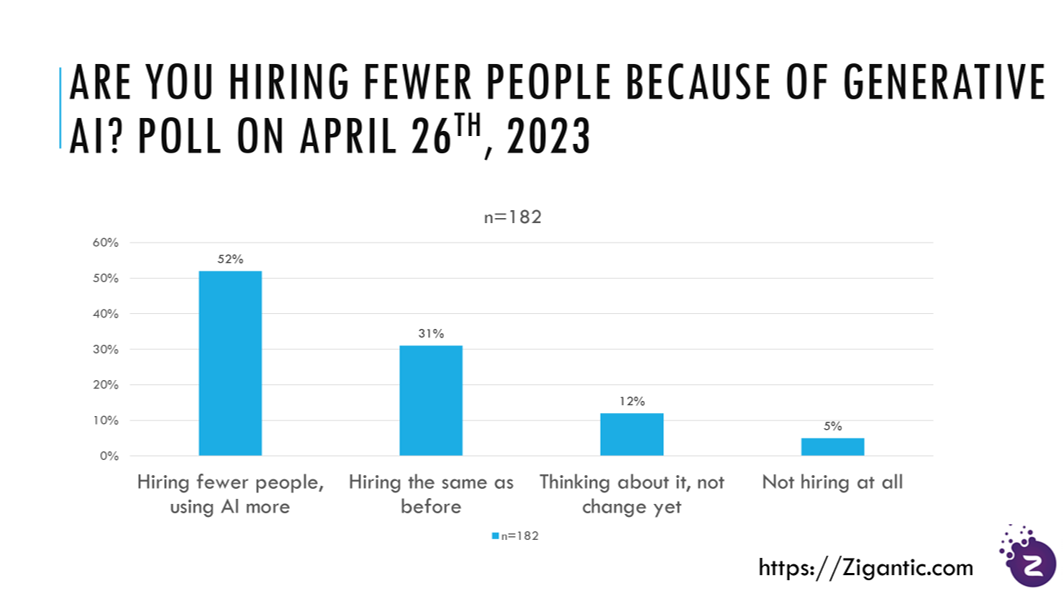
One particular example was telling which a friend related to me yesterday.
The company has 10 people, 8 of them are developers. The CEO of the company provided subscriptions to ChatGPT ($20 / month) and GitHub Copilot ($19 / month) to all the developers and mentioned that he won’t hire for another year and instead the developers could use the AI tools to do their job.
All around goodness.
AI is already starting to reduce the number of jobs. It is just doing it a little slowly.

There are many hustle bros on social media who will tell you that they have the secret “prompts” and that you are doing it all wrong. To get their secret prompts you have to attend their “course” or pay them for their “prompt guidebook”.
I don’t think most people need prompt engineering courses. Yes, it takes time, and may be tricky initially, but it will get easier over time.
The mental model that works for me is to think of using ChatGPT (and other LLM) is to assume you have a new hire, who is very smart, but has only learned “off the books”.

You have to train the new hire over time to understand your questions, the way you work and what you are looking for.
Epilogue: I used Nightcafe studio to create the image above, with the prompt – Smart new hire. I am still figuring out AI bias and don’t know enough. I am a little concerned however and have a few questions.

