🚀 Just had an incredible conversation with Dan Sanchez—a marketer, podcaster, and AI power-user who’s pushing the boundaries of what’s possible with AI in content and marketing.
We started off light—turns out Dan released a full music album on Spotify using AI tools like Suno and ChatGPT, despite not being a musician. That led us into a much deeper discussion about how AI is transforming the way marketers work—especially for those who want to 10x their output without 10x-ing their headcount.
Dan broke down AI in marketing into five distinct use cases:
AI as Co-Pilot – think planning, thinking, troubleshooting, organizing. From writing emails to managing your health goals, AI can be your smartest executive assistant.
AI for Content Creation – yes, blogs and posts, but also infographics, videos, and even music.
Hyper-Personalization – dynamic experiences tailored to individual customers at scale.
Conversational AI – inbound chat, SMS, even phone. It’s replacing SDRs for good reason.
Analytics & Forecasting – still early, but fast-evolving and game-changing.
We talked at length about AI as a co-pilot, not a magic button. The insight? AI is like having 10 subject-matter experts at your side—branding, copywriting, strategy, fitness, relationships—but you have to orchestrate them. Knowing how to prompt well is still useful, but Dan argues we’re evolving from “prompt engineering” to “clear thinking and communication.” And honestly, he’s right.
A few big takeaways for marketers:
Prompting matters less than it used to. You don’t need to be a “prompt wizard”—you just need to be specific and intentional.
Context is everything. Use AI tools that let you organize projects and retain context over time (like ChatGPT folders or custom GPTs).
Video podcasts are a content goldmine. Use AI to repurpose long-form audio/video into high-impact LinkedIn posts, clips, blogs, and newsletters. Start with real insight, let AI scale it.
Avoid “AI slop.” If your content feels like warmed-over blog stew, it probably is. Start with original thought and let AI help with structure, formatting, and tone.
We even dove into the difference between using AI for brainstorming versus automation. Automation (like API workflows) still demands engineered prompts—because consistency matters. But when you’re thinking, learning, or creating? AI thrives in messiness, as long as you guide it.
Dan summed it up best: “AI doesn’t replace marketers. It replaces the marketers who don’t use AI well.”
This episode is for every marketing leader, agency founder, or solo creator trying to scale smarter, not harder. If you’re still on the sidelines with AI, this is your wake-up call.
As SaaS and AI-native companies evolve, so do their monetization needs.
Gone are the days when simple subscription billing could handle the complexities of a modern B2B company. Today’s growth-stage businesses demand flexible usage-based billing, automated revenue workflows, and AI-enhanced pricing logic to remain competitive. A wave of startups—and some mature players—are rising to meet this demand, redefining the core of how software companies generate and optimize revenue.
In this post, we break down the emerging landscape of modern revenue infrastructure by analyzing 9 standout companies: Metronome, Orb, Maxio, Paid.ai, Solvimon, Zenskar, PostHog, Sequence, and Paddle.
The Shift from Legacy Billing to Composable Monetization
Traditional billing platforms like Zuora or Chargebee were built in the era of flat subscriptions and manual workflows. But the modern SaaS business is:
Product-led (PLG), requiring granular metering of user behavior
Global, with currency, tax, and compliance complexity
AI-driven, where dynamic pricing and renewals must be handled in real-time
Enter the new monetization stack—an ecosystem of tools built API-first, designed for developers and RevOps teams alike.
Segmenting the Landscape: Four Clusters
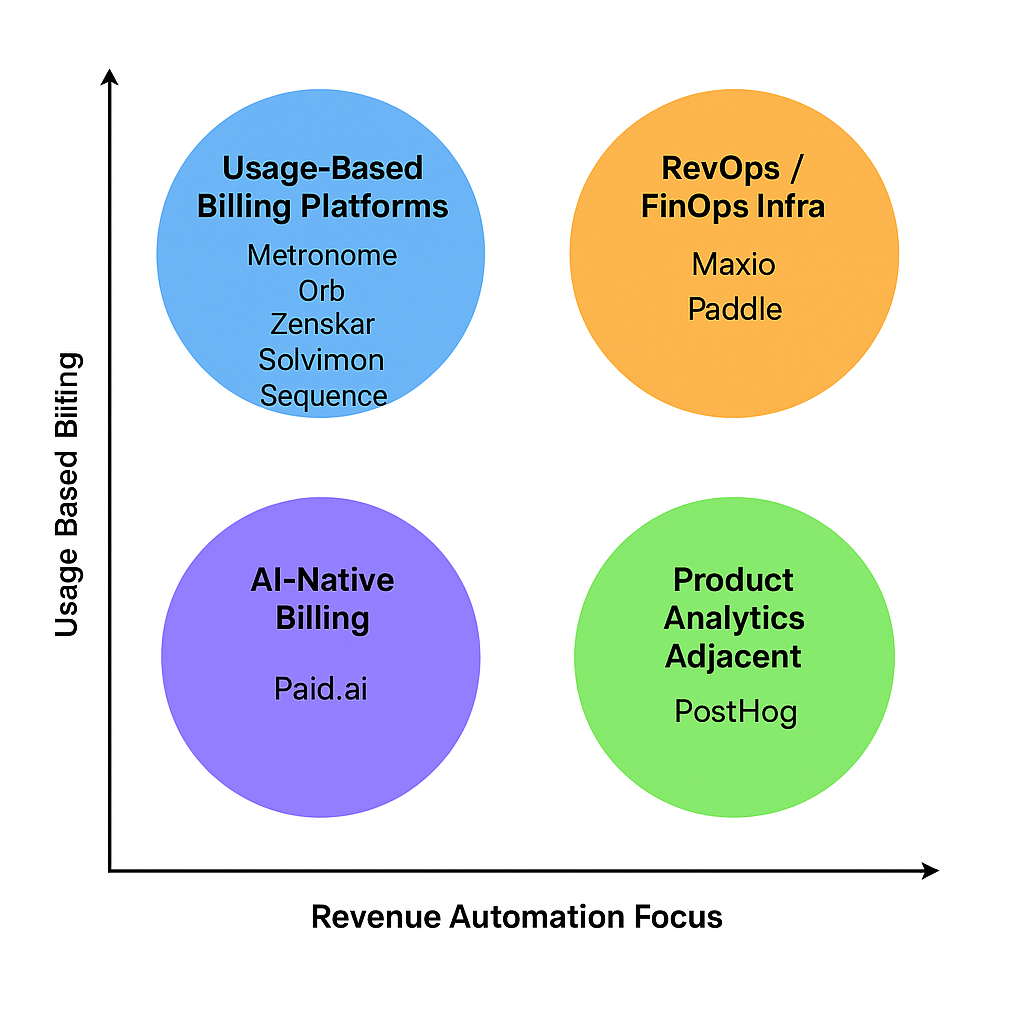
To make sense of this rapidly growing market, we segmented the companies into four distinct clusters:
1. Usage-Based Billing Platforms
These tools provide powerful metering, real-time billing, and pricing flexibility:
Metronome: Built for scale, Metronome is known for its developer-friendly APIs and real-time metering. Used by fast-growing SaaS businesses embracing usage-based pricing.
Orb: A strong choice for AI-native companies needing composable pricing logic and deep integrations.
Zenskar: Focuses on quote-to-cash and supporting hybrid pricing models.
Solvimon: Based in Europe, it supports sophisticated pricing rules for fintech and B2B software businesses.
Sequence: Positioned as a CPQ+Billing hybrid, with strong RevOps and approval workflows.
These platforms are ideal for high-growth SaaS teams that need precise control over how they bill based on real usage.
2. RevOps / FinOps Infrastructure
These platforms extend billing into revenue recognition, SaaS metrics, and compliance:
Maxio: A well-established name for financial operations, including deferred revenue and subscription analytics.
Paddle: Operates as a Merchant of Record, handling tax, fraud, payments, and compliance globally.
They’re especially suited for finance teams looking to unify monetization with compliance and reporting.
3. AI-Native Billing
This emerging category blends dynamic logic with automation:
Paid.ai: A newer player that acts as the brain of the revenue engine—handling renewals, pricing decisions, and billing using AI agents.
Perfect for experimental teams looking to future-proof their revenue stack.
4. Product Analytics Adjacent
These aren’t billing tools per se—but they inform monetization strategy:
PostHog: An open-source product analytics suite that helps companies understand usage patterns, retention, and conversion—crucial for pricing and packaging decisions.
Visualizing the Landscape
In our quadrant view, we plotted these companies along two axes:
X-axis: Revenue Automation Focus (manual vs automated workflows)
Y-axis: Usage-Based Billing Sophistication (flat rate vs dynamic pricing)
Each cluster reflects a different strategy for monetizing software:
Usage-billing companies dominate the top-left, prioritizing granular metering.
RevOps tools cluster top-right, integrating compliance and finance.
AI-native and analytics platforms fill in the bottom quadrants, each pushing innovation.
Who Should Use What?
Company Profile
Ideal Cluster
Early-stage PLG SaaS
PostHog, Metronome
Scaling SaaS with hybrid pricing
Orb, Zenskar, Sequence
Global SaaS needing tax/compliance
Paddle, Maxio
AI-native or dynamic pricing
Paid.ai
Looking Ahead
The lines between billing, finance, and product analytics are blurring. As GTM teams embrace more complex monetization strategies, the most successful platforms will be:
Composable: Integrating across CRM, data warehouse, and product systems
Real-time: Offering instant billing, pricing, and reporting
AI-native: Making predictive decisions on renewals, discounts, and pricing
These 9 companies are at the forefront of this transition. As the market matures, expect convergence—and consolidation—as businesses look for unified monetization platforms.
As B2B software moves from seat based or usage based pricing to outcome based pricing these companies are the new backbone behind many of the new AI startups.
They specialize in recurring revenue models, usage-based billing, or quote-to-cash processes. Their products go beyond billing to include features like revenue recognition, analytics, forecasting, and reporting.
Most platforms provide robust APIs or developer-centric tooling to integrate into existing SaaS stacks. They focus on infrastructure needed after a sale: invoicing, tax compliance, dunning, renewals, etc. These companies are part of an emerging wave disrupting legacy billing systems like Zuora, Aria, or Chargebee.
Company Name
Founding Year
Number of Employees
Key Products
Metronome
2019
130
Usage-based billing platform for SaaS companies.
Orb
2021
72
Modern billing infrastructure for AI and software companies.
Maxio
2009
235
Billing and financial operations platform for B2B SaaS, including subscription management and revenue recognition.
Paid.ai
2024
9
Business engine for AI agents handling pricing, subscriptions, margins, billing, and renewals.
Solvimon
2022
18
Monetization and billing automation platform for global fintech and B2B software businesses.
Zenskar
2022
64
Quote-to-cash platform automating complex subscription and usage-based billing with analytics.
PostHog
2020
85
Open-source product analytics and data toolkit used by over 70,000 teams.
Sequence
2021
30
Modern billing, CPQ, and revenue recognition platform for error-free revenue workflows.
Paddle
2012
360
Merchant of record solution for SaaS businesses, handling payments, tax, and subscription management.
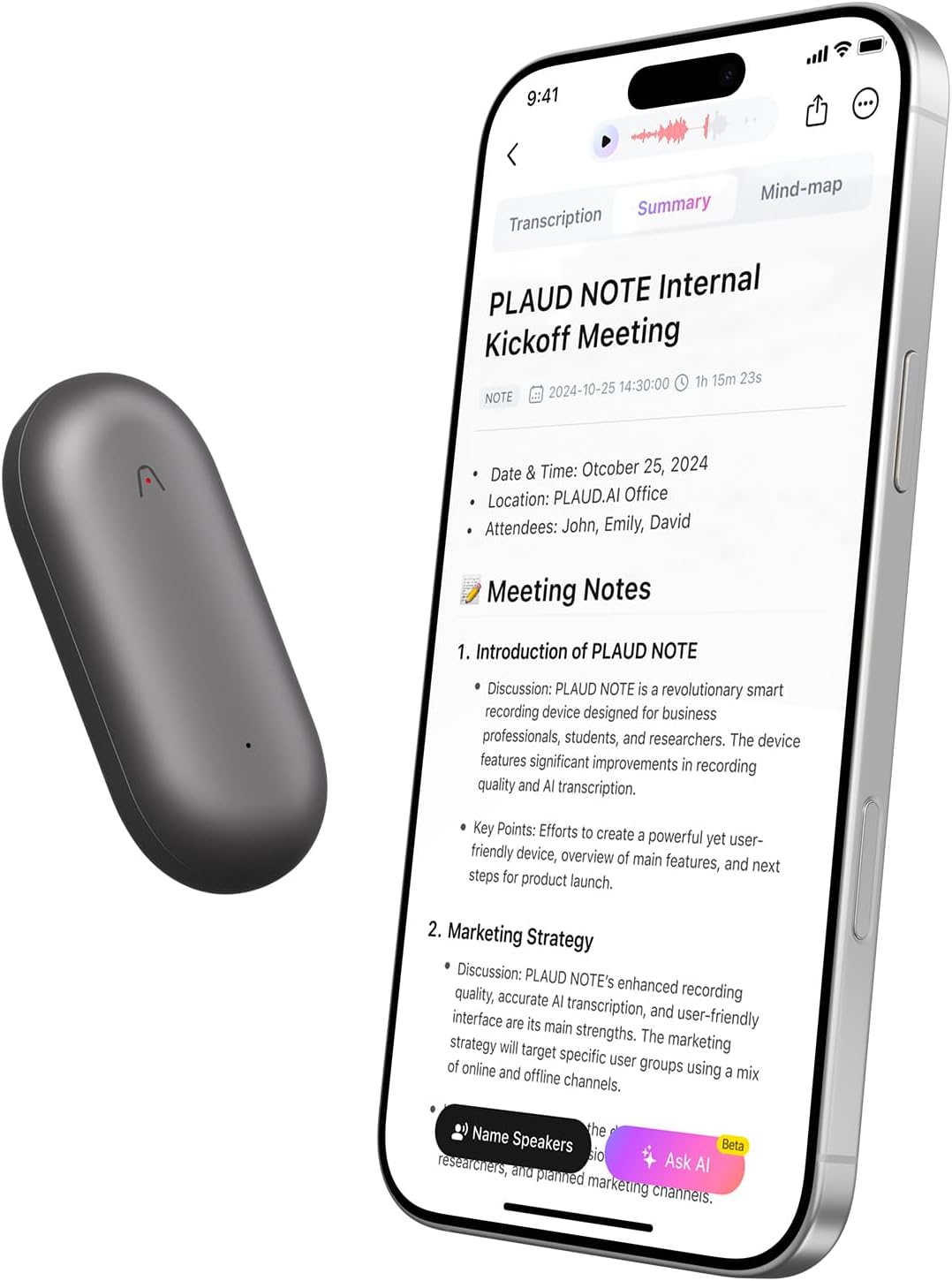
I wanted to compare of AI-powered note-taking solutions Bee, Limitless, and Plaud, highlighting their key features, differences, and best use cases to help you choose the right tool.
In today’s fast-paced digital world, efficient note-taking is more important than ever. AI-powered note-taking solutions like Bee, Limitless, and Plaud are transforming how we capture, organize, and access information. Whether you’re a student, professional, or casual user, understanding the strengths and differences of these tools can help you pick the perfect fit for your needs. This comprehensive comparison dives into their features, usability, and ideal scenarios, so you can make an informed decision and boost your productivity with the right AI note-taking assistant.
Overview of AI-Powered Note-Taking Solutions What are AI-powered note-taking tools?
Imagine having a note-taking buddy who’s always alert, super organized, and ready to help you capture your ideas, meetings, or random thoughts with minimal effort. That’s essentially what AI-powered note-taking tools are all about. These are digital applications infused with artificial intelligence that go beyond simple typing and saving. They analyze, categorize, summarize, and even generate content based on your input, making your note-taking experience smarter and more efficient.
Traditional note apps like Evernote, OneNote, or Notion are great for storing and organizing information, but AI note-taking solutions add a layer of intelligence that can automatically transcribe spoken words, extract key points from lengthy texts, suggest related content, and help you find your notes faster. They leverage machine learning algorithms to understand context, recognize patterns, and adapt to your unique note-taking style, transforming a basic digital notebook into a proactive assistant.
In essence, AI note-taking tools are not just repositories—they’re active partners that enhance productivity, reduce manual effort, and help you focus on what truly matters: your ideas and creativity.
Why choose AI-driven solutions over traditional note apps?
So, why should you consider switching from classic note apps to AI-driven solutions? Well, here are some compelling reasons:
Automation and Efficiency: AI can transcribe meetings, lectures, or voice memos instantly, saving you time. It can also automatically organize notes based on topics, dates, or projects, reducing manual sorting. Smart Summarization: Long notes or articles can be condensed into bite-sized summaries, making it easier to review key points quickly. This is especially handy when revisiting large volumes of information. Enhanced Search Capabilities: Traditional apps rely on keyword searches, but AI can understand context and semantics, helping you find relevant notes even if you don’t remember exact words. Content Generation and Suggestions: Some AI note apps can suggest related notes, generate outlines, or even write drafts based on your input, sparking creativity and reducing writer’s block. Personalization: AI learns your habits, preferred formats, and frequently used tags, tailoring the experience to your workflow and making note management more intuitive.
Compared to note-taking comparison charts like Evernote comparison or Notion Evernote comparison, AI-powered solutions often stand out because they adapt and evolve with your needs, offering a more dynamic and responsive experience. They’re not just static repositories—they’re intelligent assistants designed to make your life easier and more productive.
Brief introduction to Bee, Limitless, and Plaud
Now, let’s get to know some of the exciting players in the AI note-taking solutions arena: Bee, Limitless, and Plaud. These platforms are gaining attention because they combine the power of AI with user-friendly interfaces, aiming to redefine how we take and manage notes.
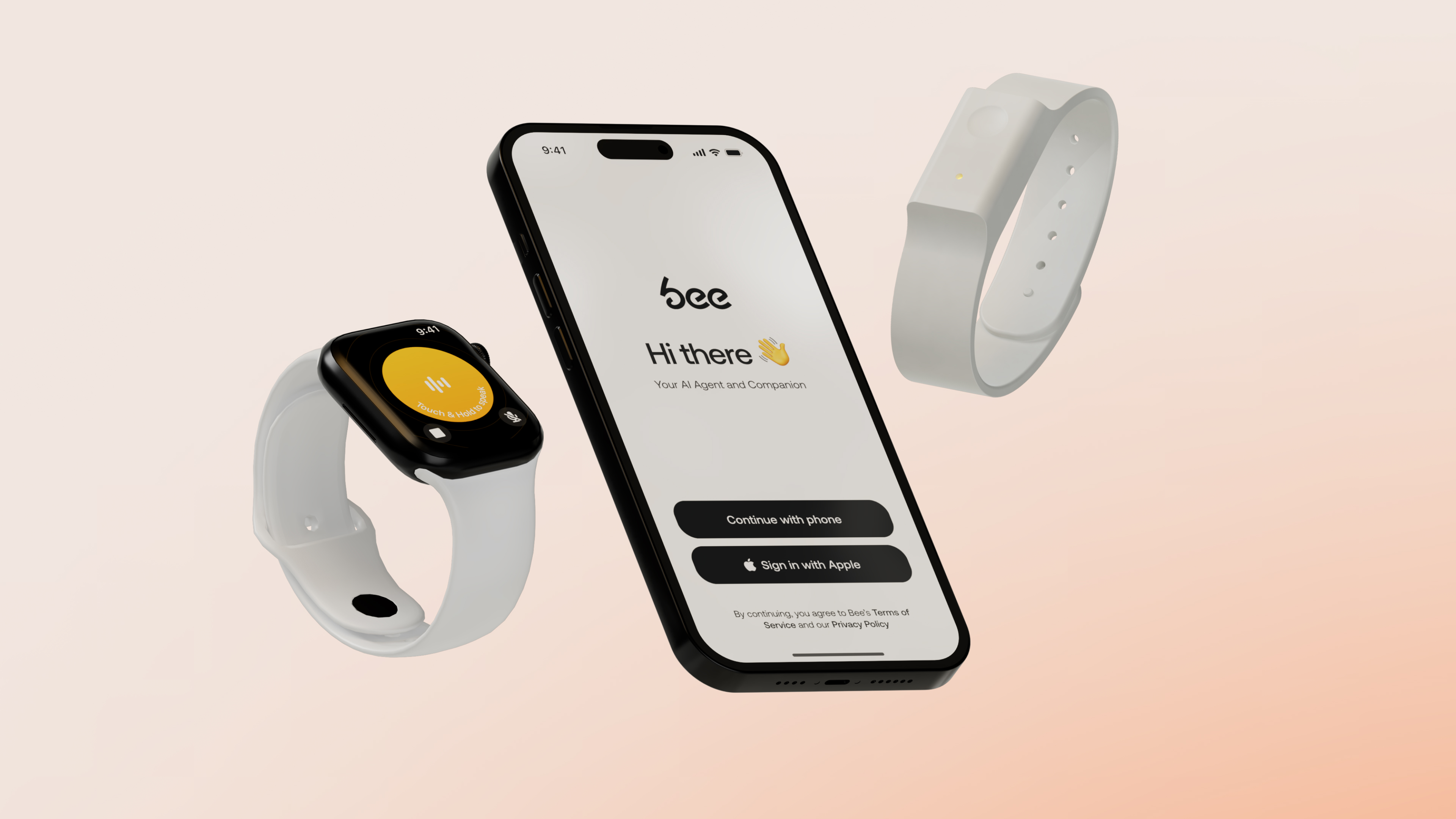
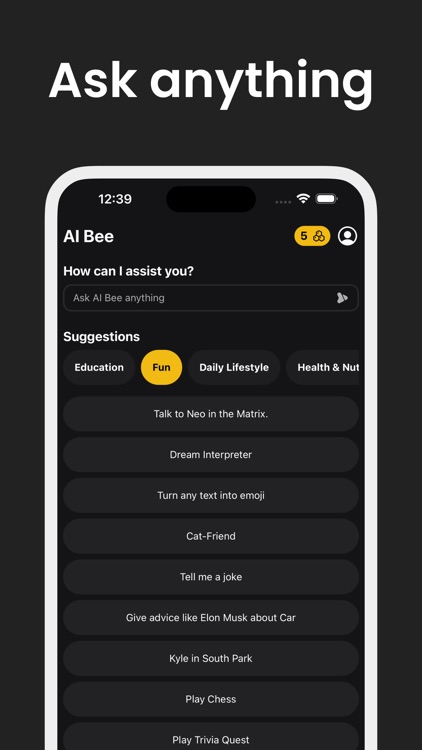
Bee is an innovative AI note app that emphasizes seamless voice-to-text capabilities and intelligent organization. It’s designed for users who want to capture ideas on the fly and have the app automatically categorize and summarize their notes. Bee’s standout feature is its ability to recognize different contexts—whether you’re jotting down a quick reminder or drafting a detailed project plan—and adapt accordingly.
Limitless takes a slightly different approach by focusing on integrating various content types—text, images, audio, and even video—into a unified AI-powered workspace. Its strength lies in its versatility and the way it leverages AI to connect related content, making note-taking not just about writing but about creating a rich, interconnected knowledge base.
Plaud is tailored for collaborative environments, with AI features that facilitate team note sharing, real-time transcription, and automatic task extraction. It’s perfect for teams or study groups who want to keep everyone on the same page and ensure that no important detail slips through the cracks. Plaud’s AI-driven insights help teams prioritize and act on their notes more effectively.
These three platforms exemplify the trend toward smarter, more intuitive note-taking solutions powered by AI. Whether you’re a student, professional, or creative, exploring these options can open up new ways to capture and utilize your ideas with less hassle and more impact.
Key Features of Bee Core functionalities and AI capabilities
When diving into the world of AI note-taking solutions, Bee stands out as a versatile and intelligent tool designed to streamline your note-taking process. Its core functionalities are built around advanced AI capabilities that not only help you jot down ideas but also enhance your productivity through smart suggestions, automatic summarization, and contextual understanding. Unlike traditional note-taking apps, Bee leverages cutting-edge AI to transform the way you capture and organize information, making it one of the best AI note apps available today.
At the heart of Bee’s core functionalities is its ability to recognize and interpret natural language. Whether you’re dictating a quick reminder or drafting a detailed project plan, Bee’s AI can understand context, identify key points, and even suggest relevant tags or categories. This feature is especially useful when performing a note-taking comparison with other popular apps like Evernote or Notion, where AI-driven organization can make a significant difference.
Another standout feature is automatic summarization. If you’re reviewing lengthy meeting notes or research material, Bee can generate concise summaries, saving you time and helping you focus on what’s important. This is a game-changer compared to traditional note-taking apps that require manual highlighting or separate summarization tools. Additionally, Bee’s AI can detect patterns and relationships between notes, enabling smarter linking and cross-referencing, which is invaluable during a note taking app comparison or an Evernote comparison.
Furthermore, Bee incorporates intelligent search capabilities. Instead of sifting through endless notes, you can ask the AI questions or search with natural language queries, and it will retrieve relevant information instantly. This feature aligns with the trend of AI note-taking solutions aiming to make information retrieval more intuitive and efficient, surpassing many standard note-taking apps in speed and accuracy.
User interface and ease of use
One of the key aspects that make Bee appealing in the crowded market of note-taking apps is its user interface. Designed with a casual, user-friendly approach, Bee offers a clean and intuitive layout that minimizes clutter and maximizes usability. Whether you’re a tech novice or a seasoned note-taking pro, you’ll find navigating Bee straightforward and enjoyable.
The onboarding process is smooth, with guided tutorials that help you get started quickly. The interface emphasizes simplicity—think minimal buttons, easy drag-and-drop features, and smart organization options that automatically categorize your notes based on content. This makes Bee one of the best AI note apps for users who want powerful features without a steep learning curve.
For note creation, Bee offers multiple input methods—typing, voice dictation, or even attaching multimedia files. Its AI-powered suggestions appear contextually, helping you expand your notes or refine your ideas without interrupting your workflow. The editing tools are accessible yet unobtrusive, allowing you to focus on content rather than fiddling with complex menus.
Moreover, Bee’s interface adapts seamlessly across devices. Whether you’re on a desktop, tablet, or smartphone, the layout remains consistent, ensuring a smooth experience. This cross-platform compatibility is crucial, especially when performing a note-taking comparison with apps like OneNote or Notion, which also emphasize multi-device synchronization.
Ease of use extends to collaboration features as well. Sharing notes, commenting, and real-time editing are integrated smoothly, making Bee suitable for both personal and team projects. The casual design encourages frequent use, helping you develop a habit of capturing ideas effortlessly—something that sets it apart from more rigid note-taking solutions.
Integration options and compatibility
In today’s interconnected digital landscape, integration options can make or break a note-taking app. Bee recognizes this and offers a wide array of compatibility features to fit into your existing workflow. Whether you’re using productivity suites like Google Workspace, Microsoft Office, or other AI note-taking solutions, Bee plays well with many platforms.
One of the reasons Bee is considered among the best AI note apps is its ability to sync seamlessly with popular cloud storage services such as Google Drive, Dropbox, and OneDrive. This means your notes are accessible across devices and can be easily backed up or shared with collaborators.
Additionally, Bee integrates with calendar apps, email clients, and task management tools, allowing you to embed reminders, attach emails, or link notes to specific projects. This level of integration makes it a versatile tool that can serve as a central hub for your information management, comparable to or even surpassing the note taking app comparison with Notion or Evernote.
For developers and power users, Bee offers API access, enabling custom integrations and automation workflows. This flexibility ensures that Bee can adapt to various workflows, whether you’re automating note organization or connecting with other AI tools for enhanced productivity.
Compatibility with voice assistants and AI platforms is also a highlight. You can dictate notes via Siri, Google Assistant, or Alexa, and Bee will process and organize them accordingly. This feature aligns with the trend of AI note-taking solutions becoming more integrated into daily routines, making note capture effortless and natural.
Overall, Bee’s integration options and compatibility make it a robust choice for users seeking a flexible, interconnected note-taking environment. Whether you’re comparing it to OneNote or exploring AI note-taking solutions, Bee’s compatibility ensures it can be woven into your digital ecosystem seamlessly.
Key Features of Limitless Unique AI features and smart organization
When it comes to AI note-taking solutions, Limitless truly stands out from the crowd. Unlike some of the best AI note apps that rely solely on basic functionalities, Limitless integrates advanced AI capabilities that make note organization feel almost effortless. Imagine having a smart assistant that not only captures your ideas but also intelligently categorizes, tags, and summarizes your notes without you lifting a finger. This is the kind of innovation that sets Limitless apart in the note-taking comparison landscape.
One of the core features is its ability to understand context. Whether you’re jotting down meeting minutes, brainstorming ideas, or compiling research, the AI engine analyzes your input and suggests optimal organization methods. For example, it can automatically create folders or tags based on content themes, making future retrieval a breeze. This smart organization reduces clutter and ensures that your notes are always where you need them, when you need them.
Additionally, Limitless employs natural language processing (NLP) to enhance the note-taking experience. As you type or speak your ideas, the AI can generate summaries, highlight key points, or even suggest related notes. This transforms traditional note-taking into an interactive, dynamic process. Compared to other note-taking apps, where manual tagging and searching can be tedious, Limitless’s AI-driven approach makes finding information faster and more intuitive.
Another standout feature is its ability to learn from your habits. Over time, the AI adapts to your note-taking style, offering personalized suggestions that streamline your workflow. Whether you’re a student, professional, or creative, this adaptive intelligence ensures that Limitless remains a tailored tool that grows with your needs.
Collaboration and sharing features
In today’s interconnected world, collaboration is king. Limitless recognizes this and offers a suite of collaboration and sharing features that rival the best note apps on the market. Unlike some note-taking comparison tools that focus solely on individual use, Limitless makes teamwork seamless and intuitive.
One of its key strengths is real-time editing. Multiple users can work on the same note simultaneously, with changes syncing instantly across devices. This is perfect for team projects, brainstorming sessions, or classroom settings where instant feedback is essential. Plus, the platform supports comments and annotations, allowing collaborators to communicate directly within notes without switching to external apps.
Sharing is also a breeze. You can generate shareable links with customizable permissions—view-only, comment, or edit—giving you control over how your notes are accessed. Whether you want to share a project brief with a colleague or send a summarized report to a client, Limitless simplifies this process with its intuitive sharing options.
Furthermore, the app integrates with popular communication platforms like Slack, email, and even project management tools. This integration ensures that your notes can flow seamlessly into your existing workflow, making collaboration more efficient than ever. For teams that rely on note-taking comparison to decide on the best tools, Limitless’s collaborative features often tip the scales in its favor.
Platform support and accessibility
One of the biggest advantages of Limitless is its platform support and accessibility. Unlike some note-taking apps that are locked into specific ecosystems, Limitless is designed to work across multiple devices and operating systems, ensuring you’re never out of sync.
Whether you prefer Windows, macOS, Android, or iOS, Limitless offers dedicated apps that provide a consistent experience. Its web version is equally robust, allowing you to access your notes from any device with an internet connection. This cross-platform support is a major plus when doing a note-taking comparison, especially against platforms like OneNote compare or Notion Evernote comparison, which may have limitations or less seamless integration across different environments.
Accessibility features are also a priority. The app supports voice input, screen readers, and customizable display options, making it usable for people with diverse needs. For instance, if you’re on the go and can’t type easily, voice notes can be transcribed directly into your workspace, thanks to the AI note-taking solutions integrated into Limitless.
Moreover, the app’s cloud-based architecture ensures your data is synchronized securely and instantly across all your devices. This means you can start a note on your phone during a commute, continue editing on your tablet at home, and review it later on your desktop—all without missing a beat. Such flexibility and accessibility are crucial in today’s fast-paced, mobile-centric world, and they position Limitless as a top contender among note-taking comparison tools.
Key Features of Plaud Specialized AI tools and note enhancement
When it comes to AI note-taking solutions, Plaud stands out by integrating cutting-edge AI tools that truly elevate your note-taking game. Unlike traditional note apps, which often rely solely on manual input and basic organization, Plaud leverages artificial intelligence to make your notes smarter, more organized, and easier to access. Think of it as having a personal assistant that not only records your thoughts but also helps refine, categorize, and enhance them seamlessly.
One of the standout features in the best AI note apps is the ability to automatically summarize lengthy notes, extract key points, and even suggest related content. Plaud’s AI algorithms analyze your notes in real-time, highlighting important information and reducing clutter. This makes reviewing your notes faster and more efficient, especially when you’re juggling multiple projects or studying for exams.
Furthermore, Plaud’s AI tools facilitate note enhancement through smart tagging and contextual understanding. For example, if you jot down a meeting agenda or a lecture topic, the AI can recognize key themes and tag them accordingly, making future searches a breeze. This is a game-changer compared to traditional note-taking apps that require manual tagging or categorization, which can be time-consuming and prone to oversight.
Additionally, Plaud offers intelligent voice-to-text conversion, allowing you to dictate notes on the go. Its AI-driven transcription is highly accurate, capturing nuances and context that many other note-taking solutions struggle with. This feature is especially useful for busy professionals or students who prefer speaking over typing, making Plaud one of the best AI note apps for versatility and speed.
Customization options and user control
One of the reasons Plaud has gained popularity in the note-taking comparison is its extensive customization options. Unlike some note-taking apps that box you into rigid templates or limited layouts, Plaud gives you the freedom to tailor your workspace to suit your style. Whether you’re a visual learner who loves color-coded notes or someone who prefers minimalist design, Plaud accommodates your preferences.
Users can customize the interface, choose from various themes, and even set up personalized shortcuts for frequently used features. This level of control ensures that your note-taking environment feels intuitive and comfortable, encouraging consistent use and productivity.
Moreover, Plaud offers flexible organization tools. You can create nested notebooks, tags, and labels that suit your workflow. Want to organize notes by project, topic, or priority? No problem. The app’s drag-and-drop functionality makes restructuring your notes effortless. Compared to other note-taking apps like Evernote or Notion, which also boast customization, Plaud’s user control is praised for being straightforward yet powerful.
Another aspect worth mentioning is privacy and data control. Plaud allows you to decide how your data is stored and shared. You can opt for local storage, cloud syncing, or a hybrid approach, giving you peace of mind about your sensitive information. This level of user control over privacy settings is often overlooked in note-taking comparison but is vital for professionals handling confidential data.
Device compatibility and syncing
In today’s fast-paced world, seamless device compatibility and syncing are non-negotiable features in the best AI note apps. Plaud shines in this area by supporting a wide range of devices and platforms, including smartphones, tablets, laptops, and desktops. Whether you’re an Android user, an iOS enthusiast, or someone who prefers working on Windows or Mac, Plaud has got you covered.
What sets Plaud apart from other note-taking solutions is its real-time syncing capability. Your notes are automatically updated across all devices, ensuring you always have the latest version at your fingertips. This is particularly useful when comparing it to other note taking app comparisons like Evernote vs. Notion or OneNote compare, where syncing issues can sometimes hinder productivity.
Additionally, Plaud offers offline access, allowing you to view and edit your notes without an internet connection. Once reconnected, all changes are synchronized seamlessly. This feature is essential for users who travel frequently or have unreliable internet access, making Plaud one of the most versatile AI note-taking solutions available.
Furthermore, Plaud’s cloud infrastructure is designed for security and speed. The app employs encryption protocols to protect your data during transfer and storage, giving you confidence that your notes are safe. Its cross-platform compatibility and effortless syncing make it a top contender among note-taking comparison charts, especially for users who need reliable, quick access to their notes from multiple devices.
Comparing User Experience and Interface Design and navigation differences
When diving into the world of note-taking solutions, especially with the rise of AI note-taking solutions and the best AI note apps, the design and navigation aspects become crucial. If you’ve ever used a note-taking app comparison like Evernote comparison or Notion Evernote comparison, you’ll notice that each platform has its unique approach to layout and user flow. Some apps lean towards minimalism, focusing on a clean interface that minimizes distractions, while others pack in features with dense menus and complex hierarchies.
For instance, note taking apps comparison often highlights how Evernote’s interface is more traditional—think sidebar navigation and notebook stacks—making it familiar for long-time users. In contrast, Notion’s design is more modular, allowing users to customize their workspace with drag-and-drop blocks. The difference in design philosophy directly impacts how users navigate through their notes. Evernote’s straightforward notebook and note structure makes it easy to find what you need quickly, whereas Notion’s flexible pages and databases can feel overwhelming at first but offer more customization.
Moreover, AI note-taking solutions are pushing the envelope by integrating smart suggestions and contextual tools directly into the interface. These features can either streamline navigation or complicate it, depending on how well they’re integrated. The key takeaway is that design and navigation are deeply intertwined with user experience—an intuitive layout can make or break your productivity, especially when managing large volumes of notes or complex projects.
Learning curve and onboarding process
When comparing note-taking apps, one of the biggest differences often lies in the learning curve and onboarding process. Take the note taking comparison between Onenote compare and other apps—Onenote’s interface is familiar to many Windows users, which eases onboarding. However, for newcomers, especially those unfamiliar with Microsoft Office ecosystem, it might seem overwhelming at first glance.
On the flip side, apps like Notion or some of the best AI note apps tend to have a steeper initial learning curve. They offer a vast array of features and customization options, which can be intimidating for new users. That said, many of these platforms now include guided tutorials, onboarding checklists, and video walkthroughs to help users get started quickly. The onboarding process for AI note-taking solutions often emphasizes demonstrating how AI features can save time—like automatic note summarization or smart tagging—making the initial learning phase more engaging.
In the note-taking comparison, apps with a simpler, more streamlined onboarding process tend to retain new users better, especially those who just want a quick way to jot down ideas or organize notes without a steep learning curve. Conversely, apps that require more time to master can be more powerful in the long run but might deter casual users or those new to digital note-taking.
Mobile vs desktop usability
1.90.3-R6LBT6MTG6PDGHDGG4FQCS75IQ.0.1-6
When comparing user experience across platforms, mobile vs desktop usability is a hot topic. Many of the best AI note apps are designed to work seamlessly across devices, but their usability can differ significantly. For example, Evernote comparison often highlights how well the app adapts to mobile devices—offering quick note creation, voice memos, and photo attachments on the go. Its desktop version, meanwhile, provides a more comprehensive workspace with advanced formatting options and integrations.
Apps like OneNote excel in this area by providing a consistent experience across platforms. The mobile app is optimized for touch, with swipe gestures and simplified menus, while the desktop version offers more robust features for detailed editing and organization. This consistency is vital for users who rely on their notes throughout the day, switching between devices.
AI note-taking solutions are increasingly focusing on mobile usability, integrating features like voice commands and real-time AI assistance directly into mobile apps. This allows users to capture ideas quickly, no matter where they are, without sacrificing functionality. However, some complex features may still be better suited for desktop environments, where screen real estate and processing power support advanced workflows.
Ultimately, the best note-taking experience balances mobile convenience with desktop power. For users who need quick access and editing capabilities on the go, a mobile-optimized interface with intuitive navigation is essential. Meanwhile, power users working on detailed projects will appreciate a desktop interface that doesn’t compromise on features or usability.
Performance and Accuracy of AI Features Note recognition and transcription quality
When it comes to AI note-taking solutions, one of the biggest deal-breakers is how accurately they can recognize and transcribe your voice or handwritten notes. If you’ve ever tried using the best AI note apps, you know that even the most advanced tools sometimes stumble over accents, background noise, or messy handwriting. This is where the note taking app comparison really shines a light on which solutions excel and which need a bit more work.
In the realm of note recognition, AI-powered note-taking solutions have made huge strides. For example, some apps leverage deep learning models trained on vast datasets, enabling them to distinguish between similar-sounding words or interpret scribbled notes with surprising precision. When you compare Evernote versus Notion or OneNote, you’ll notice differences in how well they handle transcription tasks. Evernote, for instance, has long been praised for its reliable OCR (optical character recognition) capabilities, especially when dealing with scanned documents and images. Meanwhile, Notion’s focus on organization sometimes means its transcription isn’t as refined but still quite effective for digital notes.
Transcription quality isn’t just about getting the words right; it’s also about capturing context, punctuation, and formatting. Some AI note apps now incorporate natural language processing to improve contextual understanding, making the transcribed notes more readable and useful. For example, AI note-taking solutions like Otter.ai or Descript often outperform traditional note apps in this area, offering near-human accuracy, especially in clear audio recordings. However, even top-tier AI note apps can struggle with technical jargon, overlapping voices, or noisy environments, which can lead to errors or missed content.
Ultimately, the best AI note apps are those that strike a balance between high accuracy and ease of use. When doing a note taking app comparison, pay close attention to user reviews and testing results—some solutions might boast great features but falter in transcription accuracy. The key is to find a tool that reliably captures your notes without requiring constant manual correction, saving you time and frustration in your workflow.
AI suggestions and content organization
Another major factor in AI note-taking solutions’ performance is how well they can suggest relevant content and organize your notes. The best AI note apps don’t just transcribe—they actively help you make sense of your information. For instance, AI suggestions can include auto-tagging, smart categorization, or even recommending related notes based on your current content. This is where the note-taking comparison gets really interesting, especially when comparing giants like Evernote, Notion, and newer AI-powered apps.
In a typical note taking app comparison, you’ll find that some solutions excel at content organization thanks to advanced AI algorithms. Notion, for example, offers flexible templates and databases, but its AI features for suggestions are still evolving. Evernote, on the other hand, uses AI to automatically tag and categorize notes, making it easier to retrieve information later. Some of the best AI note apps like Obsidian or Roam Research focus heavily on linking notes contextually, and their AI integrations help surface relevant content based on your note history.
AI-driven content organization isn’t just about sorting; it’s also about enhancing your productivity. Features like intelligent search, automatic summaries, and contextual recommendations help you find what you need faster. For example, if you’re working on a project, these AI suggestions can surface related notes, previous research, or relevant files, turning your scattered notes into a cohesive knowledge base. When doing a note-taking comparison, look for solutions that incorporate these smart features—because they can significantly boost your efficiency and make your notes more valuable over time.
Speed and responsiveness
Last but definitely not least, speed and responsiveness are critical when evaluating AI note-taking solutions. No matter how accurate or feature-rich a tool is, if it lags or responds sluggishly, it can ruin your workflow. In the note taking app comparison, this aspect often tips the scales between good and great solutions.
Modern AI note apps leverage cloud computing and optimized algorithms to deliver near-instant results. For instance, apps like OneNote and Evernote are known for their quick syncing and real-time editing capabilities. When you compare them with newer AI note apps, you’ll notice that some may experience delays during transcription or content suggestions, especially if your internet connection isn’t optimal. The best AI note apps are designed with responsiveness in mind—offering seamless typing, quick search, and instant suggestions without noticeable lag.
Speed also encompasses how efficiently the app handles large volumes of notes. If you’re a power user with hundreds or thousands of notes, responsiveness becomes even more critical. AI features like auto-tagging or content organization should work smoothly without slowing down your device or app. When doing a note-taking comparison, consider not only the raw speed but also how well the app maintains performance as your note library grows. This ensures that your AI-powered note-taking solutions remain reliable and efficient, no matter the scale of your work.
Pricing Models and Subscription Plans Cost comparison of Bee, Limitless, and Plaud
📊 Pricing Comparison Table
Feature
Bee
Limitless
Plaud
Device Price
$49.99
$99 (preorder price)
$169
Free Plan
Yes
Yes (1,200 min/month transcription)
Yes (300 min/month transcription)
Paid Subscription
$12/month
$19/month (annually) or $27/month
$12.99/month or $79/year
Key Benefits
Personalized AI insights
Unlimited AI features and audio storage
Advanced transcription and AI features
When diving into the world of AI note-taking solutions, one of the first things that catches everyone’s eye is the pricing. With so many options out there—each promising to revolutionize your note-taking game—it’s essential to compare their costs and see which one offers the best bang for your buck. Let’s take a closer look at Bee, Limitless, and Plaud, three of the top contenders in the note-taking app comparison space, especially within the realm of best AI note apps.
Starting with Bee, this platform offers a straightforward subscription model. Its pricing tiers are designed to cater to different user needs, from casual note-takers to heavy-duty professionals. The basic plan is quite affordable, making it an attractive choice for students or those just exploring AI note-taking solutions. The premium plans, however, offer additional features like unlimited storage, advanced AI capabilities, and integrations with other productivity tools, which naturally come at a higher price point.
Limitless takes a slightly different approach. Its cost comparison reveals a focus on offering extensive features at a competitive rate. The platform’s entry-level plan is modest, but as you move up to the pro tier, you gain access to features like collaborative editing, enhanced AI note-taking solutions, and priority customer support. Interestingly, Limitless often bundles features that would typically be paid add-ons in other note-taking comparison charts, making it an appealing option for power users.
Finally, Plaud positions itself as a premium AI note app, with a pricing model that reflects its advanced capabilities. Its basic plan is comparable to the other two, but the real value lies in its high-tier subscriptions, which include AI-powered summarization, contextual note linking, and even voice-to-note features. While it might be pricier, many users find that the added value justifies the cost, especially if they rely heavily on AI note-taking solutions for their workflow.
In terms of actual numbers, here’s a rough comparison:
Bee: Starts at around $5/month for basic features, with premium plans ranging from $15 to $30/month. Limitless: Entry-level plans begin at approximately $7/month, with pro options costing between $20 and $40/month. Plaud: Basic plans are roughly $10/month, with premium tiers reaching up to $50/month for full feature access.
Of course, these prices are subject to change and often come with discounts or annual billing options that can significantly reduce the overall cost. When doing a note-taking comparison, it’s vital to consider not just the sticker price but also what features are included at each tier.
Free tiers and trial options
One of the biggest factors influencing the note-taking app comparison is the availability of free tiers and trial options. After all, trying out AI note-taking solutions without committing upfront is crucial for finding the best fit.
Bee offers a free plan that provides limited access to core features. It’s perfect for casual users or those who want to test the waters before diving into a paid subscription. The free tier usually includes a cap on storage, a limited number of notes, or restricted AI functionalities. This way, users can get a feel for the app’s interface and basic capabilities without any financial commitment.
Limitless also provides a free trial, often lasting 7 to 14 days, during which users can explore the full suite of features. This trial period is especially helpful for those doing a detailed note-taking comparison, as it allows hands-on experience with collaborative tools, AI note solutions, and integration options. After the trial, users can decide whether to stick with the free plan or upgrade to a paid tier.
Plaud tends to be a bit more generous with its free offerings. It usually provides a basic free plan with essential AI note-taking features, making it accessible for students or casual note-takers. Additionally, Plaud often offers free trials for its premium tiers, giving users a chance to test advanced features like AI summarization or voice-to-note before committing financially.
Overall, having access to free tiers and trial options is a game-changer in the note-taking app comparison. It allows users to evaluate the best AI note apps based on their workflow, usability, and feature set without risking money. Plus, it helps highlight which platform offers the most value for free, especially when considering the best AI note apps for different user needs.
Value for money and premium features
When comparing note-taking apps, especially in the realm of AI note-taking solutions, the question of value for money is paramount. It’s not just about how much a platform costs but what you get in return. Let’s break down what makes each of these platforms stand out in terms of premium features and overall value.
Bee’s premium plans unlock a suite of advanced AI note-taking solutions, such as contextual understanding, smart tagging, and seamless integration with tools like Notion or Evernote. For users who need a robust, versatile note-taking app comparison, Bee’s value lies in its user-friendly interface combined with powerful AI capabilities. The premium tier is often considered worth the investment for students, researchers, and professionals who want efficient, organized notes that leverage AI to boost productivity.
Limitless shines in its ability to offer extensive collaboration features, AI-powered insights, and customizable workflows. Its value for money is evident in its flexible tier system, which caters to both individual users and teams. For those seeking best AI note apps that support teamwork and real-time editing, Limitless provides a compelling package that balances cost and features effectively.
Plaud, with its focus on premium AI features, justifies its higher price point through capabilities like AI summarization, voice-to-note, and intelligent linking. For power users who rely on AI note apps to manage large volumes of information efficiently, Plaud’s value proposition is clear. Its premium features are designed to save time and enhance productivity, making it a worthwhile investment for those who need the best AI note apps on the market.
In a note-taking comparison, it’s essential to weigh the features against the costs. For instance, if you’re someone who values AI-driven insights and seamless integrations, investing in a premium plan from Plaud or Limitless might be justified. Conversely, if you’re just starting out or have light note-taking needs, a free tier or lower-cost plan from Bee could be more than sufficient.
Ultimately, the best AI note app for you depends on your specific needs, whether that’s simple note organization, collaboration, or advanced AI features. But understanding the value for money—what premium features you get at each tier—helps make an informed decision and ensures you’re investing in a platform that truly enhances your note-taking experience.
Ideal Use Cases for Each Solution Best scenarios for Bee
When it comes to AI note-taking solutions that excel at quick, efficient, and organized note capture, Bee stands out as a top contender. If you’re someone who often juggles multiple projects, attends a flurry of meetings, or needs to jot down ideas on the fly, Bee’s intuitive interface and smart features make it a perfect fit. Think of Bee as your digital sticky note that can grow into a comprehensive knowledge base without the hassle of traditional note apps.
For example, students and academics who need to capture lecture highlights, research snippets, or quick summaries will find Bee invaluable. Its ability to seamlessly organize notes into categories or tags means you can retrieve information effortlessly later. Similarly, professionals in fast-paced environments—like marketing teams brainstorming campaign ideas or software developers jotting down code snippets—will appreciate how Bee keeps their notes accessible and easy to search.
In the note-taking comparison landscape, Bee often shines brighter than some of the best AI note apps because of its focus on speed and simplicity. Unlike more complex tools like Notion or Evernote, Bee doesn’t overwhelm you with options but instead offers a streamlined experience. If your priority is capturing fleeting thoughts and turning them into structured notes with minimal effort, Bee is your go-to AI note-taking solution.
Optimal applications for Limitless
Limitless is designed for users who need a versatile, feature-rich AI note-taking app that adapts to a variety of workflows. If you’re someone who manages multiple projects, collaborates with teams, or requires integration with other productivity tools, Limitless is an ideal choice. Its strength lies in its ability to handle everything from detailed project planning to quick memos, all within a single platform.
Imagine a startup founder juggling product development, investor meetings, and team communications—Limitless can serve as the central hub for all these activities. Its AI capabilities can help generate summaries from lengthy meeting notes, suggest action items, or even draft emails based on your notes. For students, it can organize class notes, research data, and assignment deadlines in one place, making it easier to stay on top of everything.
In the note-taking comparison, Limitless often outperforms basic note apps because of its adaptability and AI-driven features. It’s especially useful for those who want a comprehensive note-taking app that can grow with their needs, rather than switching between multiple tools. Whether you’re using it for personal productivity or team collaboration, Limitless offers the flexibility and power that make it an optimal application for a wide range of users.
Ideal users for Plaud
Plaud is best suited for users who prioritize communication, social interaction, and community engagement within their note-taking environment. If you’re someone who loves sharing notes, collaborating in real-time, or building knowledge bases with others, Plaud’s social and collaborative features make it stand out. Think of it as a hybrid between a note-taking app and a social platform where ideas can flow freely.
Content creators, educators, and community managers will find Plaud particularly useful. For instance, teachers can create shared class notes, students can contribute to group projects, and teams can brainstorm and refine ideas collaboratively. Its AI features can assist in summarizing discussions, highlighting key points, or even suggesting related topics based on the conversation flow.
In the note-taking comparison, Plaud is often compared to platforms like Notion or Evernote but with a stronger emphasis on social interaction and real-time collaboration. If your goal is to foster a community around your notes or to facilitate dynamic discussions, Plaud is the ideal user for this solution. Its design encourages active participation and shared knowledge-building, making it perfect for educational settings, online communities, or any environment where collective input is valued.
Security and Privacy Considerations Data encryption and user privacy policies
When diving into the world of AI note-taking solutions, one of the first things to consider is how your data is protected. With the rise of the best AI note apps, users are increasingly concerned about privacy and security. Many popular note-taking comparison tools, like Evernote comparison and Notion Evernote comparison, emphasize their commitment to safeguarding user data. But what does that really mean in practice?
Data encryption is at the heart of most robust security strategies. In the context of note-taking apps comparison, you’ll find that leading platforms employ end-to-end encryption, which ensures that your notes are encrypted on your device and only decrypted on your authorized device. This means that even if someone intercepts the data during transmission or gains access to the servers, they won’t be able to read your notes without the decryption keys.
Beyond encryption, user privacy policies serve as the blueprint for how your data is handled. The best AI note apps typically have transparent privacy policies that clearly state what data they collect, how they use it, and with whom they share it. For instance, some platforms might collect usage data to improve their AI algorithms but assure users that personal notes are never sold or shared with third parties without explicit consent. When comparing note taking app comparison options, always scrutinize their privacy policies to ensure your data remains yours.
Cloud storage and local data control
One of the key decisions when choosing between note-taking solutions is whether to rely on cloud storage or local data control. Many of the top AI note apps, including those in the note taking apps comparison, leverage cloud storage to sync your notes seamlessly across devices. This convenience is great, but it also raises questions about data security and ownership.
Some users prefer local data control, especially when dealing with sensitive information. Apps like OneNote compare favorably here, offering options to store data locally on your device, giving you full control over your notes. Others, like Evernote comparison, primarily operate via cloud, which simplifies access but requires trust in their security measures.
If you opt for cloud-based solutions, look for platforms that offer encryption both in transit and at rest, along with features like two-factor authentication. Conversely, if local data control is your priority, ensure the app supports encrypted local storage and provides straightforward methods for backing up your notes securely.
Compliance with data protection standards
In the realm of AI note-taking solutions, compliance with data protection standards is more than just a checkbox; it’s a vital aspect of trust and security. Standards such as GDPR (General Data Protection Regulation) in Europe, CCPA (California Consumer Privacy Act) in the US, and others set strict guidelines on how user data should be handled, stored, and processed.
When comparing note taking apps comparison, especially in the context of AI note apps, look for platforms that explicitly state their compliance with these standards. For example, many of the best AI note apps are designed with GDPR compliance in mind, meaning they give users control over their data, including options to delete or export their information at any time.
Additionally, some platforms undergo regular security audits and certifications to demonstrate their commitment to data protection. For users evaluating note-taking comparison options, these certifications serve as a good indicator of a platform’s dedication to maintaining high security and privacy standards.
In the end, choosing an AI note-taking solution that prioritizes security and privacy isn’t just about protecting your notes; it’s about trusting the platform with your personal and professional information. Whether you’re comparing Evernote, Notion, OneNote, or other note taking apps comparison tools, always dig into their security features and privacy policies to find the best fit for your needs.
Customer Support and Community Resources Availability of help and tutorials
When diving into the world of AI note-taking solutions, having accessible and comprehensive support can make all the difference. Whether you’re comparing the best AI note apps or trying to decide between a note-taking comparison like Evernote comparison or Notion Evernote comparison, knowing where to turn for help is crucial. Most top-tier AI note-taking solutions understand this and have invested heavily in creating a robust support ecosystem. From detailed tutorials to quick-start guides, users can find resources tailored to their specific needs.
Many of the best AI note apps offer a variety of help options, including online tutorials, video walkthroughs, and interactive guides. For instance, if you’re exploring a note taking app comparison and want to understand how to maximize features, you might find step-by-step video tutorials that walk you through setting up your workspace, organizing notes efficiently, or integrating with other tools. These tutorials are often updated regularly to reflect the latest features, ensuring users stay current with the evolving landscape of AI note-taking solutions.
Additionally, some platforms provide in-app help features, such as tooltips, contextual help, or chatbots that can answer common questions instantly. This immediate assistance is especially useful for new users who might feel overwhelmed by the array of features available in note-taking apps comparison. The goal is to make onboarding as smooth as possible, reducing the learning curve and encouraging users to explore the full potential of their chosen AI note app.
Community engagement and user feedback
One of the standout aspects of the best AI note apps is their vibrant communities. These communities serve as a goldmine for user feedback, tips, and shared experiences. Whether you’re comparing note-taking apps or trying to decide between a note-taking comparison like OneNote compare or a more niche AI note-taking solution, engaging with other users can provide insights you won’t find in official documentation.
Many platforms host active forums, social media groups, or dedicated community pages where users exchange ideas, troubleshoot issues, and suggest feature improvements. For example, users might share how they optimized their workflow using AI note-taking solutions or discuss the pros and cons of different apps in a note taking app comparison. This peer-to-peer support fosters a sense of belonging and helps users get the most out of their tools.
Moreover, user feedback often influences the development roadmap of these apps. Developers actively monitor community discussions and surveys to identify pain points and feature requests. If a significant number of users express a desire for better integration or enhanced AI capabilities, the development team may prioritize these in future updates. This collaborative approach ensures that the evolution of these tools aligns closely with user needs.
Updates and future development plans
Staying ahead in the competitive world of AI note-taking solutions requires continuous innovation. Leading providers regularly roll out updates that introduce new features, improve existing functionalities, and enhance user experience. For instance, a note taking comparison might reveal that some apps are investing heavily in AI-driven automation, making note organization smarter and more intuitive.
Future development plans are often shared transparently through blogs, newsletters, or community updates. These communications keep users informed about upcoming features, improvements, and even long-term visions for the platform. For example, a company might announce plans to integrate more advanced AI note-taking solutions, such as voice-to-text capabilities or smarter search functions, which could revolutionize how users interact with their notes.
Additionally, many developers seek user input before launching major updates. Surveys and beta testing programs invite users to try out new features and provide feedback, ensuring that the final product truly meets user expectations. This collaborative process fosters trust and loyalty, as users see their suggestions reflected in the evolving ecosystem of note-taking apps.
In the end, the combination of accessible help resources, active community engagement, and transparent future plans creates a supportive environment for users. Whether you’re comparing the best AI note apps or exploring AI note-taking solutions tailored to your workflow, knowing that help is readily available and that the platform is continuously improving can significantly enhance your experience.
Conclusion Choosing the right AI-powered note-taking solution depends on your specific needs, workflow, and preferences. Bee offers a user-friendly interface with strong AI capabilities suitable for quick note organization, while Limitless excels in collaboration and smart content management, making it ideal for team projects. Plaud stands out with its specialized AI tools and customization options, perfect for users seeking tailored note enhancements. By understanding the key features, differences, and ideal use cases of each platform, you can select the tool that best aligns with your productivity goals. Exploring trial versions or free tiers can also help you get a feel for each solution’s workflow before committing. Embracing these advanced note-taking tools can significantly streamline your information management and boost your efficiency in both personal and professional contexts.
Discover how AI tools are transforming B2B intelligence platforms to help businesses maximize sales, improve lead generation, and stay ahead in the competitive market with innovative AI-driven solutions.
In today’s fast-paced business environment, leveraging artificial intelligence has become essential for companies aiming to boost sales and stay competitive. B2B intelligence platforms powered by AI are revolutionizing how businesses gather insights, identify opportunities, and engage with prospects. This article explores the future of B2B sales through AI tools, highlighting their capabilities, benefits, and how they can help your business thrive in a digital-first world.
Understanding AI in B2B Sales and Intelligence Platforms
What are B2B intelligence platforms?
Imagine a super-smart assistant that helps businesses find the right clients, understand market trends, and make smarter decisions—this is essentially what B2B intelligence platforms do. These platforms are sophisticated tools designed to gather, analyze, and present data about other businesses, industries, and market dynamics. They serve as a central hub for B2B sales teams, marketing strategists, and decision-makers to access actionable insights quickly and efficiently.
At their core, B2B intelligence platforms leverage a mix of data sources—public records, social media activity, financial reports, and industry news—to build comprehensive profiles of potential clients and competitors. They help teams identify high-potential leads, understand client needs, and tailor their outreach strategies accordingly. Think of these platforms as a combination of a detective, a market analyst, and a CRM system rolled into one, but with a modern twist powered by AI intelligence platforms.
In recent years, these platforms have evolved from simple data aggregators to intelligent systems capable of predictive analytics, sentiment analysis, and even automating certain outreach activities. This evolution is driven largely by the integration of AI, which makes B2B intelligence platforms more accurate, faster, and capable of handling vast amounts of data that would be impossible for humans to process manually.
Role of AI in transforming B2B sales strategies
AI has become a game-changer in how B2B sales teams operate, shifting the focus from reactive to proactive strategies. Instead of waiting for leads to come in or relying solely on gut feeling, sales teams now harness AI to maximize sales with AI-powered tools that predict customer behavior, identify the best prospects, and personalize outreach efforts.
One of the most significant impacts of AI in B2B sales is its ability to analyze massive datasets quickly and accurately. AI analytics tools can sift through mountains of data—like social media activity, website interactions, and purchasing patterns—to identify buying signals and forecast future needs. This means sales teams can prioritize leads that are most likely to convert, saving time and resources.
Moreover, AI-driven social media AI and social media marketing AI enable businesses to engage prospects more effectively. For example, AI social media content creation tools can generate tailored posts that resonate with target audiences, increasing engagement and brand visibility. AI for social media posts and AI social media analytics help track campaign performance, refine messaging, and optimize timing—all in real time.
Another critical role of AI is in enhancing customer relationship management. AI chat apps, like the best AI chat app, facilitate instant communication, answer queries, and nurture leads around the clock. These tools can also analyze customer interactions to suggest next steps or personalized offers, making the sales process smoother and more personalized.
In the recruitment space, AI tools for recruitment and the best AI recruiting tools are transforming how companies find and hire talent, ensuring they attract the right candidates efficiently. Similarly, AWS intelligent document processing automates the handling of contracts, proposals, and other documents, reducing manual effort and errors.
Overall, AI in B2B sales strategies is about making smarter decisions faster, automating routine tasks, and delivering personalized experiences that build stronger client relationships. This shift not only boosts efficiency but also helps businesses stay ahead of the competition in a rapidly changing marketplace.
Key features of AI-powered B2B platforms
Predictive Analytics: AI analytics tools analyze historical data to forecast future trends, customer behavior, and sales opportunities. This helps sales teams prioritize efforts and allocate resources more effectively.
Data Enrichment: AI intelligence platforms enhance existing customer profiles with additional data points, providing a more comprehensive view of prospects and clients. This is crucial for targeted marketing and personalized outreach.
Lead Scoring and Qualification: Using AI, platforms can score leads based on their likelihood to convert, enabling sales teams to focus on high-value opportunities. This process often involves analyzing social media AI, website activity, and engagement metrics.
Automated Content Creation: AI social media content creation tools generate relevant posts, emails, and outreach messages tailored to specific segments, saving time and ensuring consistency across campaigns.
Social Media AI and Analytics: These features monitor social media channels for brand mentions, sentiment, and engagement levels. AI social media analytics help refine marketing strategies and measure campaign success.
Natural Language Processing (NLP): AI platforms utilize NLP to understand and respond to customer inquiries, extract insights from unstructured data, and improve chatbots or AI chat apps for better customer engagement.
Intelligent Document Processing: AWS intelligent document processing automates the extraction and management of data from contracts, invoices, and other documents, streamlining administrative workflows.
Integration with CRM and Marketing Tools: AI platforms seamlessly connect with existing CRM systems and marketing automation tools, creating a unified ecosystem for sales and marketing activities.
Real-Time Insights and Alerts: AI-powered platforms provide instant notifications about market shifts, competitor activities, or changes in customer behavior, enabling quick strategic adjustments.
AI for Social Media Marketing: These tools optimize social media campaigns by analyzing audience behavior, suggesting the best times to post, and identifying trending topics to boost engagement.
By leveraging these features, B2B companies can not only streamline their sales processes but also gain a competitive edge through smarter, data-driven decision-making. Whether it’s through the use of the latest Gartner AI Magic Quadrant insights or deploying the best AI tools for recruiting, the integration of AI into B2B sales and intelligence platforms is reshaping the landscape in profound ways.
Top AI Tools Revolutionizing B2B Sales
Predictive analytics for sales forecasting
When it comes to maximizing sales with AI, predictive analytics stands out as a game-changer. B2B AI sales tools leverage sophisticated AI intelligence platforms to analyze vast amounts of historical data, market trends, and customer behaviors to forecast future sales with remarkable accuracy. Imagine having a crystal ball that helps you anticipate client needs, identify emerging opportunities, and allocate resources more effectively. This isn’t science fiction; it’s the power of AI data analytics tools integrated into your sales strategy.
Using AI for social media posts and social media AI, companies can also gauge market sentiment and consumer engagement levels, which feed into predictive models. These models can then suggest the best times to reach out, the types of content that resonate, and the potential success of campaigns. For example, AI analytics tools can analyze social media media marketing trends, helping sales teams craft targeted outreach strategies that align with current market dynamics.
Furthermore, AI-driven sales forecasting tools often incorporate external data sources, such as economic indicators or industry reports, enhancing their predictive power. This comprehensive approach ensures that sales teams are not just reacting to past data but proactively planning for future opportunities, ultimately leading to increased revenue and a competitive edge.
AI-driven lead scoring and qualification
One of the most impactful B2B AI sales tools is AI-driven lead scoring and qualification. Instead of relying on gut feelings or basic demographic data, these tools analyze multiple data points—such as website interactions, social media activity, email engagement, and firmographic details—to assign a score to each lead. This score indicates how likely a lead is to convert, allowing sales teams to focus their efforts on the most promising prospects.
Leading AI intelligence platforms integrate seamlessly with CRM systems, providing real-time insights and automating the qualification process. For instance, the best AI tools for recruiting and sales can identify high-value targets by analyzing patterns that humans might overlook. This not only speeds up the sales cycle but also improves conversion rates by ensuring that efforts are concentrated on leads with the highest potential.
Moreover, AI for social media marketing and social media AI can monitor social channels for signals indicating buying intent or pain points. By combining these insights with traditional data, sales teams can personalize their outreach, making interactions more relevant and increasing the likelihood of closing deals. As a result, companies can maximize sales with AI by turning raw data into actionable intelligence that accelerates growth.
Chatbots and virtual assistants for customer engagement
The best ai chat app and virtual assistants have transformed how B2B companies engage with prospects and clients. These AI-powered tools provide instant, 24/7 support, answering questions, scheduling meetings, and guiding potential customers through the sales funnel. They serve as the first touchpoint, creating a seamless experience that keeps prospects engaged and informed.
Chatbots, especially those integrated into social media platforms and websites, can handle multiple conversations simultaneously, freeing up sales reps to focus on complex negotiations. They can also qualify leads by asking targeted questions and collecting relevant information, which can be fed directly into CRM systems for further analysis.
In addition, AI social media content creation tools help craft personalized posts and responses that resonate with target audiences, boosting engagement and visibility. Social media marketing AI tools can analyze interactions to refine messaging strategies continually. This combination of chatbots and AI social media analytics ensures that customer engagement is not only efficient but also highly tailored, fostering trust and loyalty.
Overall, these AI tools for recruitment and customer engagement are redefining the sales landscape, making interactions more intelligent, responsive, and effective. As companies adopt these technologies, they unlock new levels of efficiency and customer satisfaction, ultimately driving growth and competitive advantage in the B2B space.
How AI Enhances Lead Generation and Qualification
Identifying high-potential prospects with AI algorithms
Imagine having a super-smart assistant that can sift through mountains of data to spot the most promising leads—sounds like a dream, right? Well, with AI intelligence platforms and AI data analytics tools, this is now a reality. These AI tools for recruitment and sales are transforming how businesses identify high-potential prospects, especially in the B2B space. By leveraging the power of AI algorithms, companies can analyze vast amounts of data—from social media activity to website interactions—to pinpoint prospects who are most likely to convert.
For example, social media AI and AI social media analytics can track engagement patterns, content preferences, and even sentiment analysis to gauge a prospect’s interest level. AI analytics tools can also analyze historical data to recognize patterns that indicate buying intent. This means that instead of casting a wide net and hoping for the best, sales teams can focus their efforts on leads that show genuine signs of interest, thereby maximizing sales with AI.
Additionally, the Gartner AI Magic Quadrant and Gartner AI Magic Quadrant 2022 reports highlight the rise of AI-powered lead scoring systems that automatically assign scores to prospects based on their likelihood to convert. These systems continuously learn and adapt, ensuring your lead qualification process stays sharp and relevant.
Automating outreach and follow-ups
Once high-potential prospects are identified, the next step is engaging with them effectively. This is where AI truly shines by automating outreach and follow-ups. Best AI chat apps and AI social media marketing tools can craft personalized messages that resonate with each prospect, saving your team countless hours of manual work.
Imagine an AI-powered chatbot that can handle initial inquiries on your website or social media platforms, providing instant responses around the clock. These chatbots, often integrated with AI social media content creation and social media AI, can qualify leads by asking relevant questions and gathering essential information before passing the hot leads to your sales team.
Moreover, AI tools for social media posts and AI social media marketing can schedule and optimize outreach campaigns across multiple channels, ensuring your message reaches the right audience at the right time. Follow-up sequences can be automated based on prospect behavior—if someone clicks a link or spends time on a particular page, the AI system can trigger personalized follow-up messages, increasing the chances of conversion.
Personalizing outreach for better conversion rates
Personalization is the secret sauce for converting prospects into customers. AI enables hyper-personalized outreach by analyzing individual behaviors, preferences, and interactions. AI social media analytics can reveal what type of content resonates most with each prospect, allowing your team to tailor messages that truly speak to their needs.
For instance, AI for social media marketing can generate customized content suggestions or even create tailored social media posts that align with a prospect’s interests. This level of personalization helps build trust and rapport, making prospects more receptive to your offers.
Furthermore, AI-powered email marketing platforms and AI mobile app development tools can craft personalized email sequences that adapt based on user engagement. This dynamic approach ensures your outreach feels genuine rather than generic, significantly improving your chances of closing deals.
In the end, integrating AI into your lead generation and qualification process isn’t just about automation; it’s about smarter, more targeted, and more personalized engagement that drives real results. Whether you’re leveraging AWS intelligent document processing for data extraction or using the best AI recruiting tools to find top talent, AI’s capabilities are reshaping how businesses connect with their prospects—making every interaction count.
Data-Driven Decision Making with AI
Analyzing market trends and customer behavior
In today’s fast-paced business environment, understanding market trends and customer behavior is more critical than ever. AI intelligence platforms have revolutionized how companies approach this task, enabling them to sift through vast amounts of data quickly and accurately. Using ai data analytics tools, businesses can identify emerging patterns, shifts in customer preferences, and competitive dynamics that might otherwise go unnoticed. For example, social media ai and ai social media analytics allow marketers to monitor conversations, sentiment, and engagement levels across multiple platforms, providing real-time insights into what customers are truly thinking and feeling.
Moreover, AI tools for social media posts and social media ai help craft content that resonates with target audiences. By analyzing which types of posts generate the most engagement, companies can optimize their social media marketing ai strategies to maximize reach and impact. This data-driven approach ensures that marketing efforts are not just guesswork but are backed by concrete evidence, leading to more effective campaigns and increased ROI.
Another key aspect is leveraging AI for social media marketing to predict future trends based on historical data. This proactive stance allows businesses to stay ahead of the curve, adapting their offerings and messaging before market shifts become apparent to competitors. When combined with insights from the Gartner AI Magic Quadrant 2022, organizations can choose the best AI tools for recruiting, sales, and marketing that align with their strategic goals, ensuring they are investing in solutions that deliver measurable results.
Real-time insights for strategic adjustments
One of the most powerful benefits of AI in decision making is the ability to access real-time insights. Whether it’s monitoring social media ai or utilizing ai analytics tools, businesses can see what’s happening right now, rather than relying on outdated reports. This immediacy enables rapid strategic adjustments, whether it’s shifting marketing messaging, reallocating resources, or tweaking product features.
For instance, AI social media content creation tools can help generate fresh, engaging posts tailored to current trends, boosting engagement and brand visibility. Similarly, AI social media analytics can identify which campaigns are underperforming or excelling, allowing marketers to pivot quickly and optimize their efforts. This agility is especially vital in competitive markets where timing can make all the difference.
Furthermore, AI-powered dashboards and visualization tools provide executives with a clear picture of ongoing operations, customer sentiment, and sales performance. This transparency helps leadership make informed decisions on the fly, reducing guesswork and enhancing overall agility. By integrating these insights with other data sources, such as AWS intelligent document processing or AI mobile app development metrics, companies can develop a comprehensive view of their business landscape, ensuring they remain adaptable and responsive.
Reducing risks through predictive modeling
Risk management is a crucial component of any successful business strategy, and AI excels at reducing uncertainties through predictive modeling. By analyzing historical data and identifying patterns, AI analytics tools can forecast future outcomes with impressive accuracy. This capability is particularly valuable in areas like sales forecasting, supply chain management, and recruitment.
For example, AI for social media marketing can predict which campaigns are likely to succeed or fail, allowing marketers to allocate budgets more effectively. AI tools for recruitment, including best ai recruiting tools and ai for social media posts, can identify the most promising candidates or talent pools, reducing the risk of bad hires and streamlining the hiring process. Additionally, AI intelligence platforms can assess market risks and flag potential disruptions before they occur, giving companies a competitive edge.
In the realm of AI for social media marketing, predictive analytics can help anticipate customer churn, identify upselling opportunities, and tailor offers to individual preferences. This proactive approach minimizes potential losses and maximizes revenue. Moreover, leveraging the Gartner AI Magic Quadrant 2022 and other industry benchmarks ensures that organizations adopt the most reliable and innovative AI solutions, further mitigating risks associated with technology investments.
Ultimately, integrating AI-driven predictive modeling into decision-making processes transforms risk management from a reactive to a proactive discipline. It empowers businesses to anticipate challenges, seize opportunities, and navigate uncertainties with confidence—making data-driven decision making with AI not just a competitive advantage, but a necessity in today’s digital age.
Integrating AI Tools into Existing Sales Processes
Steps for seamless AI adoption
Bringing AI into your sales workflow isn’t just about flipping a switch; it’s a strategic journey that requires careful planning and execution. To maximize sales with AI, you need to start with a clear understanding of your current processes and identify where AI can add the most value. Think of this as laying a solid foundation before building a skyscraper. Here are the key steps to ensure a smooth integration:
Assess Your Current Sales Processes: Begin by mapping out your existing sales pipeline. Identify bottlenecks, repetitive tasks, and areas where data insights could make a difference. For example, AI analytics tools can help you understand customer behavior patterns or predict sales trends, giving you a competitive edge.
Define Clear Objectives: What do you want to achieve with AI? Whether it’s improving lead qualification with AI for social media posts, enhancing customer engagement through social media AI, or automating outreach with the best AI chat app, setting specific goals will guide your implementation.
Research and Select the Right AI Tools: With a plethora of options like B2B AI sales tools, AI intelligence platforms, and AI social media content creation tools, choosing the right fit is crucial. Consider tools that integrate seamlessly with your existing CRM, marketing automation, or communication platforms.
Develop an Integration Roadmap: Plan how AI tools will connect with your current tech stack. For instance, integrating aws intelligent document processing can streamline your document workflows, while AI data analytics tools can provide real-time insights.
Start Small and Scale: Pilot your AI initiatives on a small scale—perhaps with a specific team or process. Gather feedback, measure outcomes, and refine before a full-scale rollout. This approach minimizes disruption and allows you to learn along the way.
Training sales teams to leverage AI effectively
Even the most sophisticated AI tools are only as good as the people using them. Proper training ensures your sales teams can harness AI to maximize sales with AI and stay ahead of the curve. Here’s how to do it:
Educate on AI Capabilities and Limitations: Start with workshops or seminars explaining what AI can do—like AI social media marketing, AI social media analytics, or AI for recruitment—and what it cannot. Understanding these boundaries helps set realistic expectations.
Hands-On Training: Provide practical sessions where sales reps can experiment with AI tools for social media posts, AI chat apps, or AI analytics tools. For example, showing how to craft engaging social media content using AI social media content creation tools can boost confidence and creativity.
Integrate AI into Daily Routines: Encourage reps to incorporate AI tools into their daily workflows. For instance, using AI social media marketing to schedule posts or AI for social media posts to analyze engagement metrics can become second nature.
Foster a Data-Driven Mindset: Teach your team how to interpret AI-generated insights. Understanding AI analytics tools and AI data analytics tools allows reps to make smarter decisions, from targeting prospects to customizing pitches.
Provide Continuous Support and Updates: AI technology evolves rapidly. Keep your team updated with new features, best practices, and industry trends—like insights from the Gartner AI Magic Quadrant or Gartner AI Magic Quadrant 2022—to ensure ongoing proficiency.
Overcoming common implementation challenges
Integrating AI into sales processes isn’t without hurdles. From technical issues to cultural resistance, challenges can slow down your progress. Here’s how to tackle some of the most common obstacles:
Data Quality and Integration: AI relies heavily on quality data. Investing in aws intelligent document processing or AI data analytics tools can help clean, organize, and unify your data sources. Ensure your data is accurate, complete, and accessible.
Resistance to Change: Sales teams may be hesitant to adopt new technology. Address this by highlighting the benefits—like saving time with AI tools for recruitment or improving social media AI engagement—and involving them early in the process.
Technical Complexity: Implementing AI solutions can be complex. Partnering with vendors who offer user-friendly AI social media marketing platforms or best AI tools for recruiting can ease integration. Consider hiring or consulting with AI specialists if needed.
Cost and ROI Concerns: Justify investment by setting clear KPIs and demonstrating potential ROI. For example, using AI analytics tools to track improvements in lead conversion rates or customer engagement metrics can validate your efforts.
Keeping Up with Rapid AI Evolution: The AI landscape changes quickly, with new tools and updates emerging regularly. Stay informed through industry reports, like the Gartner AI Magic Quadrant, and participate in AI-focused webinars or conferences to keep your strategies current.
Benefits of Using AI in B2B Sales Platforms
Increased sales efficiency and productivity
Imagine having a sales team that’s always a step ahead, working smarter, not harder—that’s exactly what AI tools for sales can do for your B2B business. By integrating AI intelligence platforms into your sales processes, you can automate routine tasks, streamline workflows, and free up your sales reps to focus on what truly matters: building relationships and closing deals. For instance, AI-powered CRM systems can automatically update contact information, schedule follow-ups, and even suggest next best actions based on real-time data. This means less time spent on administrative chores and more on strategic selling.
Moreover, AI for social media marketing and social media AI tools help you identify the most promising leads by analyzing engagement patterns and content interactions. This targeted approach ensures your outreach efforts are laser-focused, boosting your chances of converting prospects into clients. When you maximize sales with AI, you’re leveraging predictive analytics and AI data analytics tools to forecast sales trends, identify potential bottlenecks, and optimize your sales pipeline. The result? Faster deal closures, higher conversion rates, and a more agile sales process that adapts quickly to market changes.
Enhanced customer insights and personalization
One of the biggest game-changers in B2B sales is understanding your customers better than ever before. AI analytics tools and AI social media analytics give you deep insights into your clients’ behaviors, preferences, and pain points. For example, AI social media content creation and social media marketing AI can analyze vast amounts of social media data to uncover what your prospects care about most. This allows you to craft highly personalized messaging that resonates with their specific needs.
Using AI intelligence platforms, you can segment your audience more precisely, tailoring your outreach to different industries, company sizes, or decision-maker roles. This level of personalization not only increases engagement but also builds trust and credibility. Plus, with AI for social media posts, you can automate the creation of relevant content that positions your brand as a thought leader in your niche. When your messaging aligns perfectly with your prospects’ interests, they’re more likely to respond positively, accelerating the sales cycle.
Faster decision-making and shorter sales cycles
In the fast-paced world of B2B sales, speed is often the key to winning deals. AI tools such as AI analytics tools and AWS intelligent document processing enable your team to make data-driven decisions swiftly. For instance, AI-powered dashboards can synthesize complex data sets into clear, actionable insights, helping your sales reps identify the most promising leads and prioritize their efforts accordingly.
Additionally, AI chat apps and the best AI chat app options facilitate real-time communication with prospects, answering questions instantly and providing personalized support throughout the buying journey. This immediacy reduces the waiting time that often stalls negotiations and decision-making. AI for social media marketing and social media AI can also monitor conversations and sentiment analysis, alerting you to emerging opportunities or potential issues before they escalate. All these capabilities combine to shorten the sales cycle, close deals faster, and improve your overall sales velocity.
Future Trends in AI and B2B Sales
Emerging AI technologies to watch
As we look ahead, the landscape of B2B sales is set to be revolutionized by a host of emerging AI technologies. These innovations are not just incremental improvements; they’re game-changers that will redefine how businesses connect, sell, and grow. One of the most exciting developments is the rise of AI intelligence platforms that integrate seamlessly with existing sales workflows, offering real-time insights and predictive analytics. These platforms leverage ai data analytics tools to identify patterns, forecast customer needs, and recommend personalized outreach strategies.
Another key trend is the proliferation of AI tools for recruitment. These tools, including the best ai recruiting tools and best ai tools for recruiting, are transforming how companies find and engage top talent, ensuring that sales teams are staffed with the most capable professionals. Additionally, aws intelligent document processing is gaining traction, automating the extraction and analysis of complex sales documents, contracts, and customer data, thus streamlining workflows and reducing errors.
In the realm of social media AI, tools are becoming more sophisticated at generating ai social media content creation and analyzing ai social media analytics. These enable businesses to craft targeted, engaging ai for social media posts and optimize their social media marketing ai strategies. The gartner ai magic quadrant continues to highlight innovative players in this space, emphasizing the importance of adopting these cutting-edge solutions to stay competitive.
How AI will shape B2B marketing strategies
Looking into the future, AI will be the backbone of highly personalized and efficient B2B marketing strategies. AI social media marketing and social media marketing ai will enable companies to deliver hyper-targeted content, engaging decision-makers at the right moment with the right message. AI for social media posts will become more autonomous, allowing marketers to automate content creation, scheduling, and engagement analysis, freeing up resources for strategic planning.
Furthermore, ai analytics tools will provide deeper insights into customer behavior, enabling businesses to segment their audiences more precisely and tailor their messaging accordingly. This data-driven approach will maximize sales with AI by predicting customer needs before they even articulate them, leading to more proactive and consultative selling methods.
In addition, ai mobile app development will facilitate the creation of more intuitive, personalized mobile experiences for clients and prospects. These apps will incorporate intelligent chatbots, such as the best ai chat app, to handle inquiries, schedule meetings, and provide instant support, all while gathering valuable data to refine marketing strategies.
Another significant shift will be the integration of AI into gartner ai magic quadrant 2022 and other industry benchmarks, guiding companies toward the most effective tools and platforms. This ensures that marketing efforts are aligned with the latest innovations, ultimately leading to better ROI and stronger customer relationships.
Potential challenges and ethical considerations
While the future of AI in B2B sales is promising, it’s not without its challenges. One of the primary concerns is the ethical use of AI, especially regarding data privacy and transparency. As AI tools become more pervasive, companies must navigate complex regulations and ensure that their use of ai data analytics tools and ai social media analytics respects customer privacy and consent.
Another challenge is the risk of over-reliance on automation, which could lead to a loss of the human touch that is often critical in B2B relationships. While best ai chat app and other AI-driven communication tools are improving rapidly, they still may not fully replicate the empathy and nuanced understanding that human sales reps provide.
Additionally, there’s the issue of bias in AI algorithms. If not carefully managed, AI systems can perpetuate existing biases, leading to unfair targeting or exclusion of certain customer segments. This highlights the importance of ongoing monitoring and ethical oversight when deploying AI solutions.
Finally, the rapid pace of AI innovation can pose integration challenges. Companies need to invest in training, infrastructure, and change management to ensure that their teams can effectively leverage new AI tools like ai tools for recruitment and ai social media content creation. Without proper planning, organizations risk falling behind or misusing these powerful technologies.
Case Studies: Success Stories with AI-Driven B2B Platforms
Industry examples of AI boosting sales
When it comes to leveraging AI for B2B sales, different industries have found innovative ways to harness AI intelligence platforms and AI analytics tools to maximize sales with AI. Let’s explore some real-world examples that showcase how AI has transformed traditional sales processes into highly efficient, data-driven engines.
Manufacturing Sector: A leading manufacturing firm integrated AWS intelligent document processing and AI data analytics tools to streamline their procurement and supply chain operations. By deploying AI for social media posts and social media AI, they identified new market segments and tailored their outreach, resulting in a 30% increase in qualified leads and a 20% boost in sales conversions within six months.
Financial Services: A major bank adopted AI social media marketing and AI social media analytics to better understand customer sentiment and engagement. Using the best AI tools for recruiting and AI for social media marketing, they personalized their outreach, improved client retention, and increased cross-selling opportunities, leading to a 15% rise in revenue from existing clients.
Technology and SaaS: A SaaS provider focused on AI mobile app development employed AI tools for recruitment to build a high-performing sales team. They also used AI social media content creation and the best AI chat app to engage prospects more effectively. This approach resulted in a 40% growth in new customer acquisition and a significant reduction in sales cycle time.
Lessons learned from early adopters
Early adopters of AI-driven B2B platforms have uncovered valuable lessons that can guide other organizations looking to maximize sales with AI. Here are some key takeaways:
Start Small, Scale Fast: Many successful companies began with pilot projects focusing on specific pain points, such as AI social media marketing or AI analytics tools, before expanding their AI initiatives. This phased approach minimizes risk and allows teams to learn and adapt.
Data Quality is King: Implementing AI for social media posts or AI social media analytics requires clean, relevant data. Investing in data quality upfront ensures more accurate insights and better decision-making.
Choose the Right AI Tools: Not all AI tools are created equal. Organizations that evaluated the Gartner AI Magic Quadrant 2022 and Gartner AI Magic Quadrant have gained insights into the most reliable and innovative solutions, helping them select best AI tools for recruiting, AI social media content creation, and AI analytics tools that align with their goals.
Integrate AI Seamlessly: Successful companies embed AI into existing workflows rather than treating it as a standalone solution. This integration fosters user adoption and ensures AI insights translate into actionable sales strategies.
Focus on Customer Experience: AI for social media marketing and AI social media analytics can help personalize interactions, but the ultimate success depends on understanding customer needs and delivering value. Companies that prioritize customer-centric AI strategies see higher engagement and loyalty.
Measuring ROI from AI investments
One of the most critical aspects of adopting AI in B2B sales is measuring return on investment (ROI). Here’s how successful organizations evaluate their AI initiatives:
Define Clear KPIs: Before deploying AI tools for recruitment, social media marketing, or sales forecasting, companies establish specific KPIs such as lead conversion rates, sales cycle reduction, customer engagement levels, or revenue growth.
Track Engagement Metrics: Using AI social media analytics, firms monitor engagement metrics like click-through rates, shares, comments, and sentiment analysis to gauge the effectiveness of AI-driven social media campaigns.
Calculate Cost Savings: AI tools like AWS intelligent document processing automate manual tasks, reducing operational costs. Comparing pre- and post-AI implementation expenses helps quantify savings.
Assess Revenue Impact: The ultimate measure is revenue growth attributable to AI initiatives. By correlating sales data with AI-driven campaigns or tools, organizations can attribute increases directly to AI investments.
Continuous Optimization: ROI measurement isn’t a one-time activity. Successful companies continuously analyze AI analytics tools and adjust strategies to improve outcomes, ensuring sustained growth and maximizing sales with AI.
In summary, these success stories and lessons learned underscore that AI is not just a buzzword but a powerful catalyst for B2B sales transformation. Whether through AI social media marketing, AI for recruitment, or AI analytics tools, organizations that approach AI thoughtfully and strategically are reaping impressive results and setting new standards for industry excellence.
Choosing the Right AI Tools for Your Business
Factors to consider when selecting AI platforms
When it comes to integrating AI into your business, there’s a lot to think about. The landscape is flooded with options—from AI intelligence platforms to specialized tools for social media AI and recruitment. To make the right choice, you need to evaluate several key factors that align with your business goals and operational needs.
First, consider the core problem you want AI to solve. Are you aiming to maximize sales with AI? Or perhaps you’re looking to streamline recruitment using the best AI recruiting tools? Knowing your primary objective helps narrow down the options. For instance, if your focus is on social media marketing AI, you’ll want platforms that excel in AI social media content creation and social media AI analytics.
Next, evaluate the features offered by different AI platforms. Do they provide AI data analytics tools that can give you actionable insights? Are they capable of handling AI mobile app development if you’re planning to expand into mobile? The Gartner AI Magic Quadrant is a helpful resource here, offering a comprehensive overview of leading AI providers and their strengths.
Additionally, consider the level of customization and flexibility. Some AI tools are more plug-and-play, suitable for small businesses or those new to AI, while others offer extensive customization for complex enterprise needs. For example, AWS intelligent document processing is a robust option for companies needing advanced document analysis capabilities.
Finally, think about the vendor’s reputation and support. Platforms recognized in the Gartner AI Magic Quadrant 2022, for example, have demonstrated consistent innovation and reliability. Reading reviews and case studies can provide insights into how well an AI platform performs in real-world scenarios, especially in B2B AI sales tools or AI for social media marketing.
Compatibility with existing systems
Integrating new AI tools seamlessly with your existing systems is crucial. No matter how powerful an AI platform is, if it doesn’t play well with your current infrastructure, it can cause more headaches than benefits. Compatibility issues can lead to data silos, inefficiencies, and increased costs.
Start by assessing your current tech stack. Do you already use CRM systems, marketing automation tools, or social media management platforms? If so, look for AI solutions that support integration with these tools. For example, AI social media analytics tools should easily connect with your social media platforms to provide real-time insights and content optimization.
APIs and open standards are vital here. Many of the best AI tools for recruiting, like those that leverage AI for social media posts or AI for social media marketing, offer APIs that facilitate smooth integration. This allows you to automate workflows, synchronize data, and ensure consistency across platforms.
Another consideration is data security and compliance. Ensure that the AI tools you select adhere to industry standards and regulations relevant to your business, such as GDPR or HIPAA. This is especially important if you’re handling sensitive customer or employee data.
Lastly, consider the technical expertise required for integration. Some AI platforms are designed with user-friendly interfaces and minimal setup, making them accessible even for non-technical teams. Others might require specialized knowledge, so plan accordingly—perhaps by involving your IT department or hiring external consultants.
Cost and scalability considerations
Budgeting is a major factor when choosing AI tools. The costs can vary widely—from subscription-based models for AI social media content creation tools to enterprise licenses for comprehensive AI intelligence platforms. It’s essential to understand the total cost of ownership, including licensing, implementation, training, and ongoing maintenance.
Start by defining your budget constraints and then explore options that fit within those limits. For smaller companies or startups, cloud-based AI solutions with pay-as-you-go pricing can be a smart choice. These options allow you to scale up or down based on your needs, avoiding unnecessary expenses.
Scalability is equally important. As your business grows, your AI needs will evolve. You want a platform that can handle increased data volumes, more complex analytics, or additional integrations without requiring a complete overhaul. For example, AI data analytics tools should be capable of scaling to accommodate expanding datasets and user bases.
Consider future use cases as well. If you plan to expand into AI mobile app development or implement AI for social media marketing at a larger scale, ensure the platform can support these initiatives. The Gartner AI Magic Quadrant 2022 highlights vendors that excel in scalability and innovation, making them good candidates for long-term investments.
Finally, evaluate the vendor’s support and upgrade policies. Reliable support ensures that any issues are promptly addressed, minimizing downtime. Regular updates and feature enhancements indicate a vendor’s commitment to staying ahead in the AI space, which is vital for maintaining a competitive edge.
Ethical and Data Privacy Aspects of AI in B2B Sales
Ensuring data security and compliance
When it comes to leveraging B2B AI sales tools and AI intelligence platforms, data security isn’t just a nice-to-have—it’s a must. Companies deploying AI for social media posts, social media AI, or AI tools for recruitment need to ensure that sensitive client and candidate data stay protected. With regulations like GDPR, CCPA, and other regional privacy laws, compliance becomes a critical aspect of ethical AI use.
First off, organizations should implement robust security measures such as encryption, access controls, and regular security audits. These help safeguard data from breaches or unauthorized access. For example, AWS intelligent document processing offers secure cloud infrastructure that complies with many industry standards, making it easier to handle sensitive documents safely.
Next, transparency about data collection and usage is vital. Businesses should clearly communicate what data they collect, how it’s used, and who has access to it. This builds trust and aligns with best practices in AI social media marketing and AI social media content creation, where data is often used to tailor content and campaigns.
Additionally, maintaining detailed audit logs and ensuring data minimization—collecting only what’s necessary—helps meet compliance standards. Regular training for staff on data privacy policies and AI ethics also plays a crucial role in fostering a culture of responsibility.
Addressing biases in AI algorithms
One of the trickiest parts of deploying AI in B2B sales is dealing with biases that can creep into algorithms. Whether it’s in AI analytics tools, AI for social media marketing, or best AI recruiting tools, biases can lead to unfair treatment of certain groups or skewed insights that hurt decision-making.
Biases often originate from the training data—if the data reflects historical prejudices or lacks diversity, the AI will mirror those issues. For instance, an AI social media analytics tool trained on biased data might favor certain demographics, leading to skewed marketing strategies or recruitment decisions.
To combat this, companies should regularly audit their AI algorithms for bias. Techniques like fairness testing, diverse training datasets, and human-in-the-loop approaches help identify and mitigate biases. Incorporating feedback from diverse teams ensures that AI tools for recruitment and social media marketing are fair and inclusive.
Gartner’s AI Magic Quadrant 2022 emphasizes the importance of ethical AI development, urging organizations to prioritize fairness and accountability. This approach not only improves the quality of insights but also aligns with ethical standards and enhances brand reputation.
Building customer trust with transparent AI practices
Trust is the currency of successful B2B relationships, and transparency in AI practices is key to earning and maintaining that trust. When clients and partners understand how AI is used—whether it’s for social media content creation, AI data analytics tools, or AI mobile app development—they’re more likely to feel confident in the process.
Transparency involves clearly explaining AI capabilities and limitations. For example, if an AI social media marketing tool suggests content or targets specific audiences, clients should know how these recommendations are generated. Providing insights into the AI’s decision-making process demystifies the technology and reduces skepticism.
Additionally, openly communicating about data privacy measures, such as how AWS intelligent document processing ensures data security, reassures clients that their information is handled responsibly. Sharing success stories and case studies about ethical AI deployments can also reinforce trust.
Implementing a transparent approach means establishing ethical guidelines for AI use, regularly updating clients on new features or policies, and offering avenues for feedback. When clients see that a business values responsible AI practices—like addressing biases and safeguarding data—they’re more likely to develop long-term loyalty and advocacy.
Conclusion
Embracing AI tools in B2B intelligence platforms is no longer just an option but a necessity for businesses aiming to maximize sales and gain a competitive edge. From predictive analytics and lead qualification to personalized customer engagement, AI offers a multitude of opportunities to streamline sales processes and make smarter decisions. As technology continues to evolve, staying ahead with innovative AI solutions will be crucial for future growth. Businesses that invest in the right AI tools, understand their capabilities, and implement them thoughtfully will be well-positioned to thrive in the dynamic landscape of B2B sales. Now is the time to explore these cutting-edge technologies and harness their potential to transform your sales strategy.
These are semi-autonomous “agents”, which can be given high level goals – “make a website for selling books online”. These agents can figure out the high level tasks, such as front-end HTML site development, payment integration, backend database, etc. and execute each of the tasks and subtasks.
They are all the same (at a high level), using recursive mechanisms to help GPT create prompts for GPT (so meta). Which means the tasks GPT outputs, now become prompts for the next task – in an automated way.
AgentGPT
AgentGPT is a platform that allows you to configure and deploy autonomous AI agents. You can name your own custom AI and have it embark on any goal imaginable. It will attempt to reach the goal by thinking of tasks to do, executing them, and learning from the results.
AgentGPT is on GitHub
AgentGPT is currently in beta, but it has the potential to be a powerful tool for a variety of tasks, such as:
Customer service: AgentGPT can be used to answer customer questions, provide support, and resolve issues.
Sales and marketing: AgentGPT can be used to generate leads, qualify prospects, and close deals.
Content creation: AgentGPT can be used to write articles, blog posts, and other content.
Research and development: AgentGPT can be used to explore new ideas, generate hypotheses, and conduct experiments.
Education: AgentGPT can be used to create personalized learning experiences, provide feedback, and answer student questions.
AgentGPT is still under development, but it has the potential to revolutionize the way we interact with computers. By allowing us to create autonomous AI agents, AgentGPT gives us the power to automate tasks, solve problems, and explore new possibilities.
Here are some of the features of AgentGPT:
Customizable: You can create your own custom AI agents with different skills and capabilities.
Autonomous: AgentGPT agents can think for themselves and learn from their experiences.
Extensible: AgentGPT agents can be extended with new capabilities using plugins and scripts.
Scalable: AgentGPT agents can be scaled to handle large volumes of data and requests.
AutoGPT
AutoGPT is an open-source application that uses OpenAI’s GPT-4 language model to perform autonomous tasks. It was created by Toran Bruce Richards, a game developer and AI researcher.
AutoGPT on GitHub
AutoGPT can be used to automate a wide variety of tasks, including:
Web scraping
Data analysis
Natural language processing
Image recognition
Code generation
AutoGPT is still under development, but it has the potential to be a powerful tool for a variety of applications. For example, it could be used to automate tasks in customer service, sales, marketing, research, and development.
Here are some of the features of AutoGPT:
Autonomous: AutoGPT can think for itself and learn from its experiences.
Extensible: AutoGPT can be extended with new capabilities using plugins and scripts.
Scalable: AutoGPT can be scaled to handle large volumes of data and requests.
BabyAGI
BabyAGI (or BASI) is an autonomous and self-improving agent, built on top of OpenAI’s GPT-3.5 or GPT-4 language model. It is a Python script that takes an objective and a task as input and attempts to complete the task. It can also create new tasks and re-prioritize the task list based on the objective and the results of previous tasks.
Baby AGI
BabyAGI is still in development, but it has the potential to be a powerful tool for automating tasks and solving problems. It is also a good example of how LLMs can be used to create autonomous agents.
Here are some of the things that BabyAGI can do:
It can solve simple math problems.
It can translate languages.
It can write different kinds of creative content.
It can answer your questions in an informative way.
It can generate different creative text formats of text content, like poems, code, scripts, musical pieces, email, letters, etc.
It can follow your instructions and complete your requests thoughtfully.
It can use its knowledge to answer your questions in a comprehensive and informative way, even if they are open ended, challenging, or strange.
BabyAGI is still under development, but it has the potential to be a powerful tool for automating tasks and solving problems. It is also a good example of how LLMs can be used to create autonomous agents.