
Tag Archives: eCommerce

State of Indian Quick Commerce Market 2025 – Blinkit, Zepto, Big Basket, Swiggy and Zomato

India’s delivery ecosystem has transformed dramatically over the past decade. What began as restaurant delivery and scheduled grocery e-commerce has evolved into a competitive, fast-growing landscape encompassing instant commerce, bulk grocery delivery, and B2B supply chain platforms. In 2025, quick commerce and online food delivery have become habitual for urban consumers, while the B2B backend is still stabilizing.

📈 Historical Evolution

Food delivery took off around 2015, with Swiggy and Zomato emerging as the dominant players. Earlier competitors like Foodpanda and Uber Eats exited or were acquired. Grocery delivery experienced early failures in 2016–17 but recovered through companies like BigBasket and Grofers (now Blinkit). The COVID-19 pandemic catalyzed mass adoption across both segments.

Quick commerce (10–30 minute delivery) emerged around 2021–22, led by Blinkit’s rebranding and the arrival of Zepto, sparking a new wave of VC funding and dark store expansion. Meanwhile, the B2B space saw growth through players like Udaan, Jumbotail, and Ninjacart, but has since seen consolidation due to tight margins.


🏢 Major Players

Quick Commerce (B2C):

  • Blinkit (acquired by Zomato): Market leader with ~46% share.
  • Zepto: Startup sensation with ~29% share, focused on metros.
  • Swiggy Instamart: 25% share, integrated with Swiggy app.
  • BigBasket Now, Dunzo: Niche players, limited geography or scale.

Scheduled Grocery (B2C):

  • BigBasket (Tata): Full-stack inventory-led model; strong in staples.
  • JioMart (Reliance): Deep reach, value-driven.
  • Amazon Fresh, Flipkart Supermart: Scheduled slots, limited presence.
  • Milkbasket/BB Daily: Micro-delivery subscription models.

Food Delivery (B2C):

  • Zomato: ~58% market share; dominant in food and quick commerce.
  • Swiggy: ~42% share; broader service portfolio (including Genie, Instamart).
  • Domino’s: Largest single-brand QSR player with own delivery fleet.
  • Others like Uber Eats and Amazon Food have exited the space.

B2B Grocery Supply:

  • Udaan: Wholesale marketplace connecting brands with retailers.
  • Jumbotail: Focus on kirana digitization and supply.
  • Ninjacart: Farm-to-retail fresh produce delivery.
  • Zomato Hyperpure: Restaurant ingredient supplies.

🔁 Business Models

India’s delivery economy spans several models:

  • 10-min Q-commerce (Blinkit, Zepto): Small baskets, dark stores, ultra-speed.
  • Scheduled grocery (BigBasket): Full assortment, planned orders.
  • Hyperlocal marketplace (Dunzo): Store-pick and delivery.
  • Food delivery aggregators (Swiggy, Zomato): Restaurant marketplace + logistics.
  • B2B wholesale (Udaan, Jumbotail): Bulk sales to kiranas, often credit-based.
  • Cloud kitchens & private labels: Vertical integration for better margins.
  • Subscription micro-delivery (BB Daily): Fixed daily essentials delivery.

These are converging – most major players now operate across 2–3 of these models.


🌆 Key Cities and Regional Focus

  • The top 8 metros — Delhi NCR, Mumbai, Bangalore, Hyderabad, Chennai, Pune, Kolkata, Ahmedabad — drive over 60% of order volume.
  • Tier 2 cities are growing fast but have lower frequency and thinner margins.
  • Rural markets remain largely untouched.
  • Companies focus on densifying operations in top metros for profitability (e.g. adding more dark stores in Bengaluru vs. launching in new towns).

👥 Customer Segments

  1. Urban Millennials/Gen Z: Core base. Frequent users of both food and grocery apps. Comfort with impulse buying.
  2. Middle-Class Families: Use scheduled grocery delivery + quick commerce for top-ups. Cost-sensitive but loyal if reliable.
  3. B2B (Kirana stores, Restaurants): Purchase from Udaan, Jumbotail, or Hyperpure. Focus on pricing, reliability, and credit.
  4. Behavioral Trends:
    • High frequency (e.g., Blinkit and Zepto see 3–5 orders/week per user).
    • Gen Z is the fastest-growing segment.
    • Shift toward premium/instant gratification purchases.

⚔️ Competitive Dynamics

  • Zomato–Swiggy duopoly in food delivery; stable but competitive.
  • Blinkit–Zepto–Instamart dominate quick commerce (~95% market).
  • Consolidation: Zomato acquired Blinkit, Reliance invested in Dunzo, Tata owns BigBasket.
  • ONDC, the government-backed open network, is emerging as a wildcard in food/grocery with lower commissions.
  • Companies are shifting from growth-at-any-cost to unit economics and profitability:
    • Blinkit became contribution margin positive in 2024.
    • Swiggy targets profitability for Instamart by 2025.
    • Food delivery profits fund grocery expansion.
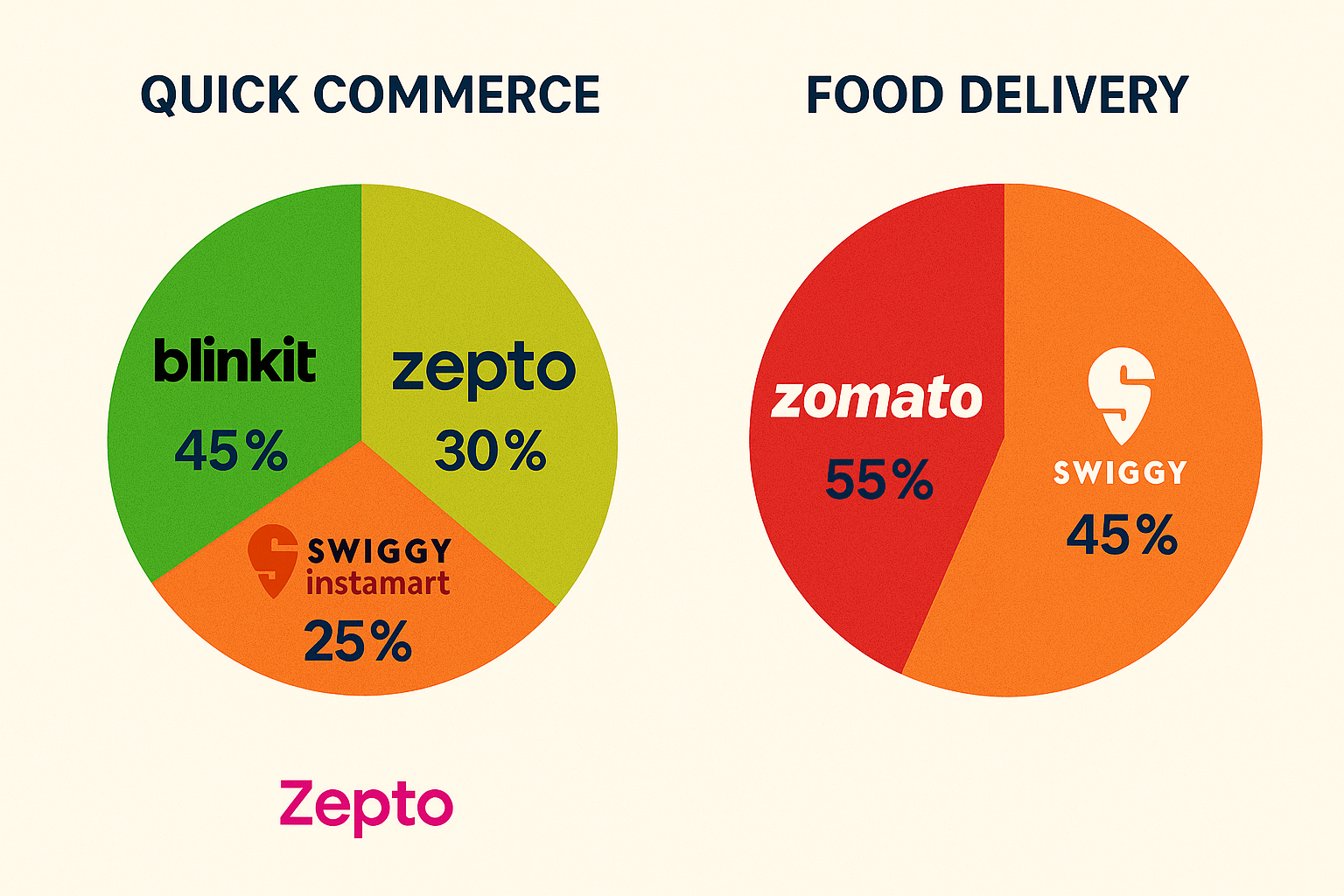
The Indian quick commerce (q-commerce) market, characterized by ultra-fast delivery (typically within 10–30 minutes), is experiencing explosive growth, fundamentally reshaping the country’s retail landscape.


Market Size and Growth
• The sector is currently valued at approximately $3.34 billion (2024) and is projected to reach between $5 billion and $5.38 billion by 2025, with forecasts extending to nearly $10 billion by 2029.
• Annual growth rates are among the highest in retail, with estimates ranging from 40% to 100% year-on-year, far outpacing traditional retail and standard e-commerce channels.
• Quick commerce already accounts for about half of all e-commerce grocery sales and nearly 7% of the total addressable market, indicating significant room for further expansion.

Key Trends
• Urban Focus, Expanding Reach: Initially concentrated in major metros, q-commerce is now rapidly expanding into tier-2 and smaller cities, driven by rising urbanization, smartphone penetration, and a young, tech-savvy consumer base.
• Beyond Groceries: While groceries and daily essentials remain core, platforms are diversifying into electronics, personal care, and premium categories to increase average order values and market share.
• Technology-Driven Efficiency: The sector leverages AI, data analytics, and micro-fulfillment centers (dark stores) to optimize inventory and delivery, enabling the promise of 10–30 minute fulfillment.
• Direct Sourcing and D2C Growth: Platforms increasingly partner directly with manufacturers and feature a growing mix of direct-to-consumer (D2C) and new-age brands, with over 30% of offerings on some platforms now D2C.

Major Players
• The market is dominated by Swiggy Instamart, Blinkit (Zomato), Zepto, BigBasket, and Dunzo, who collectively hold more than 80% market share.
• Traditional e-commerce giants like Amazon and Flipkart are entering the space, intensifying competition.
• User engagement is high: for example, Blinkit reported 8.8 million visits in Q1 2024.
Consumer Behavior
• The core user base consists of urban millennials and Gen Z, who prioritize convenience, speed, and digital payment options.
• The average order value is rising, with platforms pushing into higher-value categories to drive profitability.
• Consumer loyalty is driven by delivery speed, product quality, ease of use, and competitive pricing

Challenges
• Logistics and Infrastructure: India’s diverse geography and urban congestion present delivery challenges, though innovations like dark stores and AI-powered routing are mitigating these issues.
• Profitability and Consolidation: As competition intensifies, differentiation and operational efficiency are critical. The market may see consolidation, with a few dominant players emerging, similar to other Indian digital sectors.
• Consumer Trust: Ensuring product quality, data privacy, and consistent service is essential to maintain and grow the customer base.

Future Outlook
• Quick commerce is expected to continue its rapid expansion, fueled by further penetration into smaller cities, new product categories, and ongoing investment in technology and logistics.
• The sector’s unique strengths-speed, proximity, and convenience-position it to capture a substantial share of India’s $250 billion urban grocery market and beyond.
• By 2029, the user base is expected to nearly triple, reaching over 60 million, with average revenue per user also rising sharply.

Conclusion


Quick commerce is not just a fast-growing retail channel in India-it is redefining how Indian consumers shop, setting new standards for convenience and speed. The next phase will see deeper market penetration, broader product offerings, and likely consolidation as the sector matures and competition intensifies

My thoughts on the Flipkart fund raising

I got 4-5 calls from journalists and reporters wanting my feedback on the Flipkart funding news yesterday. I am biased, and I like the folks in the company a lot.

That said the main questions I got were: (NB: these were actual verbatim questions from reporters).

1. Does this mean game over for other “ecommerce players”?

2. Does this news mean that the “keep inventory model” will work? Is the snapdeal model better? Which one will “win”?

3. Why does this business need so much money?

4. Will eCommerce ever be profitable? Will flipkart ever be profitable?

5. If Amazon decides to come to India, will Flipkart’s first mover advantage still remain?

Rather than answer the questions one by one, I think I will set some context first and address the questions as I see the macro picture emerge.

Indian retail market is a ~$500 Billion market. It is large. Most of this ($350 Billion) is grocery. Unorganized retail (Kirana stores, small shops, etc.) make up 92%-95% of this market.

Besides grocery, the largest number of stores are called “fancy stores” – selling everything from pencils and books to tupperware and brooms. Jewelry stores are next (in terms of revenue they might be larger than fancy stores).

Of the organized offline retailers (totaling about 1500) , fewer than 5 (changed to 5% based on IBG data) are turning profit. Everyone else loses money. Why? High real estate costs and high payroll costs, compared to unorganized retail.

When Amazon started in the US (circa 1994), they were going after a 90% organized retail market. Fewer than 5% of US retail companies were unprofitable.

Amazon was going after big box organized retail in America.

Organized retail in India is a small part of the puzzle.

Flipkart is going after the 90+%, which we know as unorganized retail.

3 major trends that drive retail in India, for the next 10 years will be increasing urbanization, worsening traffic and higher commercial and retail real estate rentals. The fourth (if it ever passes, will be FDI). I am not holding my breath for that one.

The flipkart model will do well is my perspective, given their dense logistics coverage in urban areas and minimal rentals thanks to warehousing.

Amazon surprisingly will do well as well if and when they go direct in India. The market is very large.

I dont think its game over for other eCommerce players, just like many years after Amazon, came Etsy, Zaapos and others. In India, though those markets are currently small and will grow over time, so in a few years or a decade, things will change again.

The inventory model that is flipkart’s strategy seems to be working for them. That’s the reason to raise $200 Million.

The no inventory model for snapdeal seems to be working for them as well. Snapdeal will try to help many of the unorganized retail players compete with the organized players and flipkart.

I am not sure about whether the online players will actually get profitable over the next 5 years since the offline retailers have still not gotten there in 10+ years, but the online players have a better shot at becoming profitable.

Why forced mergers in the eCommerce space is a good thing

Right now there are many distraught entrepreneurs and industry watchers who are either a) saying “I told you so” or b) saying “this is bad for startups”, when they read the latest “forced merger” between several eCommerce companies. While many felt it started with Flipkart and Letsbuy, the most recent BabyOye and Hoopos has more commentary on the negative side.

While we in India, have been witness to these mergers only in the last few years, this has been happening in the valley for eons  The new age name given to some of these funded startup exits is acqui-hire. Somehow acqui-hire in the valley is great and forced mergers in India is not.

There are and were many naysayers when there was a raft of funding in the eCommerce space a few years ago. Many folks were right about unsustainable business models, rampant discounting, unsustainable customer acquisition costs, etc. To them I say:

From Alfred Lord Tennyson’s poem In Memoriam : 27, 1850

“‘Tis better to have loved and lost
Than never to have loved at all.”

The eCommerce bubble in India has created a new set of entrepreneurs. They did it with other people’s money. No one really lost except for the LP’s who I am sure are now once bitten, twice shy about returns from Indian startups.

Honestly though, I have talked to 5 Limited partners at large organizations who are disappointed with returns from Indian Venture capital, but also realize they dont really have much of a choice but to stay invested.

There are some that claim that other deserving entrepreneurs, who were working on non eCommerce startups, were ignored during the eCommerce bubble. That’s absolutely nonsense.

In India over the last 3-5 years, if you were a good entrepreneur with a good business, great team and chasing a large market, you were able to raise money. The ones that did not get funding, either were chasing smaller markets, were going to grow slowly or were not sufficiently good teams.

Now what do I claim that mergers are good for Indian startups?

1. They help companies and their employees consolidate to create one large player in a mid-sized to big market, instead of 10 players chasing the same market and being extremely competitive.

2. They provide a means of employment for the many employees at those companies who were not the founders or the investors.

3. They give hope to the many entrepreneurs in the making that you can have a “failure” and still be considered for another opportunity in a startup.

4. It provides the investors an opportunity to consolidate their portfolio and hence double down on their winners, without spreading themselves too thin. That way the remaining portfolio companies win.

5. It frees up time from several investors having to spend time on middle-of-the-road companies, and gives them more time to spend chasing new opportunities.

6. It is easier to merge a company in India than it is to shutdown. The process to shutdown a company is also a lot more expensive.

Anything I missed on the other goodness from the eCommerce forced mergers?

The “two speed” state of Indian market adoption

I have been watching / following 7 startups (3 in eCommerce, 2 in SaaS and 2 in consumer Internet) that target the Indian market over the last 14-18 months. All the entrepreneurs approached me with an intent to get seed funding so I had a chance to go over their traction, progress and future projections.

I have formulated a theory of market adoption of products / high technology products in India which I have tested with these and other companies and also with several venture investors.

For background please read “Diffusion of innovations” by Everett Rogers and Crossing the chasm by Geoffrey Moore. Don’t worry, I have only linked to their Wikipedia page, so it wont cost you anything.

Diffusion of innovations

At the top of the consumption (and monthly income) pyramid in India are what economists and marketing people call the SEC A and B class who have enough disposable income to spend on innovative new products. For the purposes of this blog post I am going to use 10 Mill (SEC A) + 20 Million (SEC B) households as the target.

The Innovators (less than 1 % of the population or 12 Million individuals) in India (entrepreneurs mostly) who conceive and develop these products for the Indian market and the early adopters (less than 5% of population or approx 60 Million individuals) together make up the entire “early adopter” category. Unfortunately less than 30% of them have both the interest, and the desire to be early adopters of technology.

Indian markets do not follow traditional diffusion characteristics when first innovators buy, then early adopters, then the early majority, and then the late majority and finally the laggards.

My theory on how diffusion of innovations works in the Indian context is as follows.

In India there are only 2 market adopters – those that are early and those that are not.

Abhijeet calls it the “low hanging fruit” and then everyone else.

So lets look at the implications of this observation / theory.

So what does that mean for entrepreneurs?

You will see a “headfake” of adoption and then a taper off.

E.g. The B2B SaaS company will quickly (within 3-6 months) get 10+ customers and over 30 in the pipeline, only to find the next 50 and the next 100 or the next 1000 are either non-existent or will come in 3-6 years.

E.g. The eCommerce company will see 1 -3 Million “registered” users and 1000’s of transactions within 12 months and find that the next 1000, 5000 and 10,000 transactions take 4-5 times as long.

E.g. You will see an initial 20,000 users for your mobile application for social TV extremely quick (within 3-6 months) and the next 50,000 or 100,000 take you the next 3-6 years.

I have seen these numbers play out again and again to know there are exceptions but those are rare.

These numbers are also dramatically different than those of companies targeting US or other markets.

When should you (as the entrepreneur) raise money?

You should raise it at the peak of inflated expectations. I.e. After you have some traction, which the investors think will be long lasting, steady and rapid. You will get the best valuation for the company at that time. Once your investor has some “skin in the game”, they are in to get their money back and then some, so they will do all it takes to make you successful.


Trough of disillusionment

What does this mean for investors?

The best time to invest is either very early (starting to build a company, idea and team stage) OR at the trough of disillusionment stage.

If they are early, you will get the bump from the initial adoption, so the value of the company increases many fold before the next round (which you should help the company raise at the peak of inflated expectations.

If you are post the trough, then you benefit from a growth stage.

What makes you go over the trough to the slope of enlightenment?

In my experience:

TIME

Nothing else.

You may think I am being facetious, but I am serious.

This may be a cultural thing, but in India, over time if you have the ability, patience and willingness to survive, you will reach the plateau of productivity.

Anecdotal evidence over several sales transactions also suggests to me that once people in India see you around for 2-3 years, they think “Okay, this company / person is for real. We should give her / the product a shot”.

Big thanks to Abhijeet and Shekhar for helping me with their data points to reinforce my theory.