
Everyone thinks the AI race is about models.
It is not.
Models are already becoming interchangeable. OpenAI, Anthropic, Google, DeepSeek, Meta, Mistral — the gap narrows every quarter. Intelligence itself is rapidly commoditizing.
The real battle is moving one layer higher.
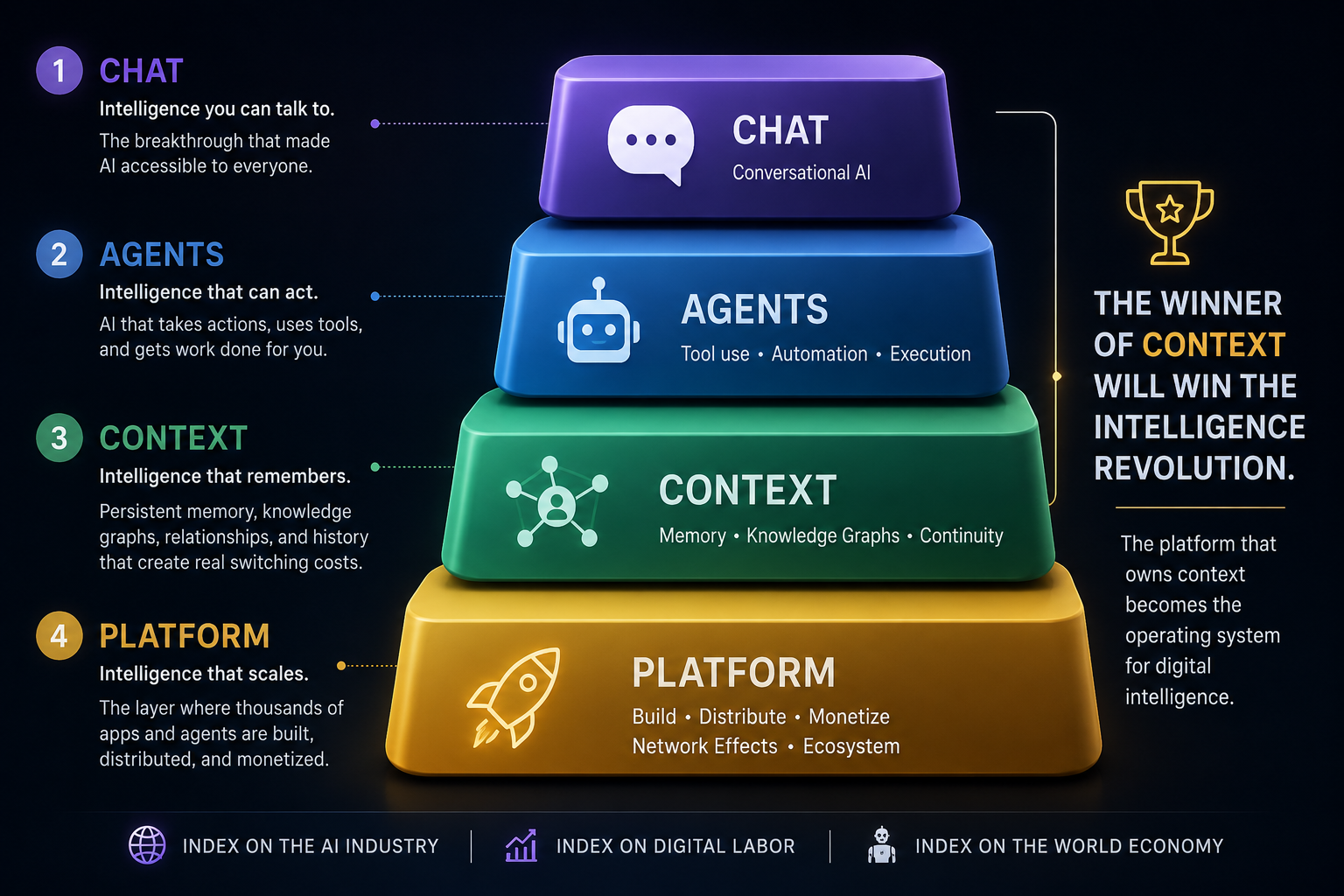
We are not living through one AI revolution. We are living through four overlapping micro-revolutions:
- Chat.
- Agents.
- Context.
- Platform.
And the company that wins the Context Revolution will likely become the most valuable company in history. Not because it builds the smartest model. Because it becomes the operating system for digital intelligence itself.
The mistake people make during every technological revolution is assuming the first winners remain the final winners. History says otherwise. The companies that dominate one phase of a revolution are often structurally incapable of dominating the next.
- IBM did not win the PC revolution.
- Yahoo did not win search.
- BlackBerry did not win mobile.
- MySpace did not win social.
- VMware did not win cloud.
The current AI cycle will follow the same pattern.
Every Revolution Follows the Same Structure
Technology revolutions always feel chaotic from the inside. But viewed historically, they are surprisingly predictable.
First, fringe technologists experiment for years while nobody pays attention. Then a breakthrough suddenly reduces the cost of creating something valuable. Entrepreneurs rush in. Capital floods the market. Startups multiply. Hype explodes.
Then comes saturation.
The weak die. The winners consolidate. Infrastructure forms. Platforms emerge. The Industrial Revolution followed this pattern. So did the internet, cloud computing, mobile, crypto, and social media.
AI is no different.
What makes this cycle unusual is the scale of what is being automated. Previous revolutions automated transportation, manufacturing, publishing, communication, or commerce. This one automates intelligence itself. That changes everything.
Revolution 1: Chat
The first phase of AI was conversational intelligence.
ChatGPT was the iPhone moment. For the first time, hundreds of millions of people could directly interact with a machine that felt intelligent. That alone created massive companies.
Entire industries emerged around AI-generated text, therapy, tutoring, coding assistance, roleplay, search augmentation, and content production.
This phase belonged overwhelmingly to OpenAI. They won distribution.
ChatGPT became the default interface for consumer AI in the same way Google became the default interface for the web. But chat alone was never the final form. Conversation is useful. Action is more valuable. Which led directly to the second revolution.
Revolution 2: Agents
Once models became reliable enough to produce structured outputs and invoke tools, AI stopped being conversational software. It became executable software.
Agents could suddenly interact with APIs, write code, search databases, send emails, book meetings, analyze files, and manipulate software systems.
This unlocked the agentic explosion.
- AI SDRs.
- AI customer support.
- AI coding agents.
- AI researchers.
- AI workflow automation.
- AI employees.
The entire market shifted from “AI that talks” to “AI that does.” This is where Anthropic built enormous momentum. Claude Code and agent-native workflows pushed the industry toward persistent execution rather than isolated prompts. But we are now clearly in frenzy territory.
Half of YC is building agent startups. Every SaaS product suddenly claims to have “agents.” Launch videos look like crypto commercials from 2021. People are spending more time branding agents than building moats.
That usually means a layer is approaching commoditization. And agents have a serious problem. They are only as good as the context they operate inside.
The Real Bottleneck Is Context
Most AI systems today are stateless. They forget everything. Every prompt starts from near-zero.
Even sophisticated agents still operate with fragmented memory, incomplete understanding, weak personalization, and shallow continuity.
That is the next great infrastructure problem in AI. Context. Not context windows. Context itself. Persistent organizational memory.
The living graph of people, meetings, documents, workflows, decisions, preferences, relationships, histories, and intent.
The companies solving this are not building “better prompts.” They are trying to build intelligence substrates. A durable memory layer for humans and organizations.
This is where the real switching costs emerge. Models are replaceable. Context is not.
A company can switch from GPT to Claude.
It is much harder to switch away from years of accumulated organizational memory, workflows, embeddings, permissions, histories, and relationships.
That is why the Context Revolution matters more than the Chat or Agent revolutions.
Chat created users. Agents created utility. Context creates lock-in.
And whoever owns context becomes the default environment where intelligence operates.
Why Incumbents May Lose
One of the strangest things happening right now is how absent the major model labs appear in the context discussion.
OpenAI and Anthropic pioneered the Chat and Agent revolutions.
But much of the experimentation around context graphs, memory systems, second brains, organizational knowledge layers, and persistent AI identity is happening in open source and startups.
That is historically consistent. Incumbents are often trapped by the architecture and incentives of the previous revolution.
- Microsoft missed mobile.
- Google struggled with social.
- Meta struggled with search.
- Amazon struggled with consumer social products.
Winning one layer often blinds companies to the next layer. Especially when the next layer threatens their current product structure. The Context Revolution requires fundamentally different thinking.
Not “better models.” Better continuity. Better memory architectures. Better identity systems. Better organizational knowledge graphs.
The winners here may look nothing like today’s AI leaders.
Revolution 4: Platforms
Every major technology wave eventually consolidates into a platform.
- The PC revolution produced Windows.
- Mobile produced the App Store.
- Social produced creator platforms.
- E-commerce produced Amazon marketplaces.
AI will do the same. But AI platforms failed early because they lacked the one thing platforms require: differentiated supply. Custom GPTs were not enough. Agent marketplaces were not enough.
Most agents today are disposable because they lack persistent context. But once context becomes standardized and deeply integrated, something changes. Users stop interacting with isolated apps.
Instead, they interact with intelligence built directly on top of their memory layer.
Their meetings. Their documents. Their workflows. Their relationships. Their company history. Their personal behavior.
That creates dramatically higher quality agents and generative applications. And whoever owns that substrate gains an extraordinary advantage. Because they automatically become the best place to build AI products. Then naturally, they become the best place to distribute them. Then they become the best place to monetize them.
That is how platforms form.
Why This Winner Could Become the Largest Company Ever
The final implication is the one most people still underestimate.
The winning AI platform may not simply become another software company. It may become an index on digital labor itself. Previous technology giants indexed industries.
- Apple indexed mobile software.
- Amazon indexed e-commerce.
- Google indexed information retrieval.
But an AI platform built on persistent context and agentic execution indexes something much larger:
Human work. Agents replace increasing amounts of digital labor. Generative systems replace increasing amounts of software. As robotics matures, the physical economy increasingly becomes programmable too.
That means the ultimate AI platform is not indexing one market. It is indexing every market touched by intelligence. Which is nearly all of them. That is why this cycle is different. This is not another SaaS wave.
It is not another cloud cycle. It is an Intelligence Revolution. And the most important company of the next decade may not be the one with the best model. It may be the one that remembers you best.
Discover more from Mukund Mohan
Subscribe to get the latest posts sent to your email.
