
AWS Partners, ISV and Solution Consultants
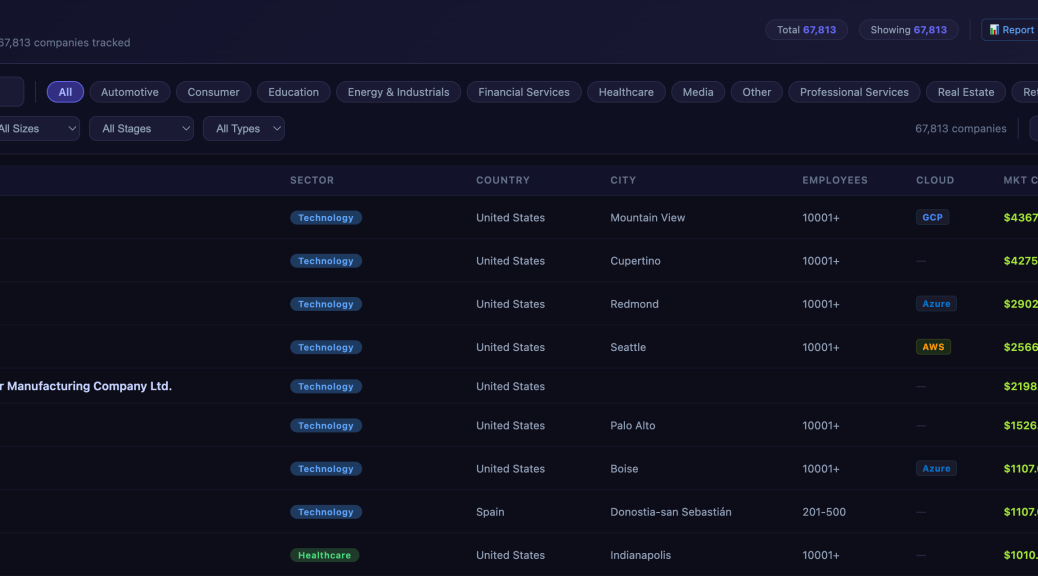
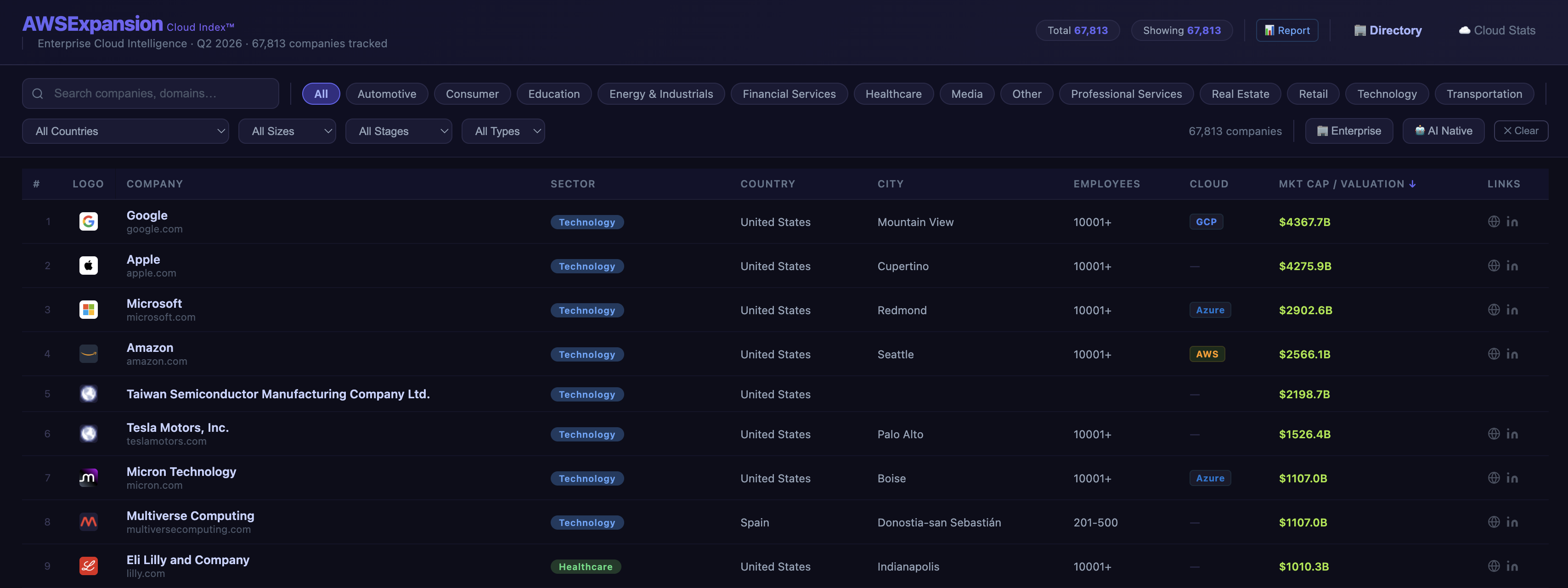
📐 TAM inputs: 67,813 companies with cloud platform, sector, headcount, and geography — a searchable bottoms-up TAM dataset, free to filter.
Most startup TAM slides are wrong. Not because the founders are dishonest — because the data they’re drawing from is either self-reported survey data from vendors with a stake in the number, or analyst firm estimates that bundle adjacent markets and call it addressable.
If you’re building for cloud-infrastructure-adjacent markets, there’s a better way to size your real opportunity — using actual detected infrastructure data rather than analyst projections.
The Problem With Traditional Cloud TAM Slides
The “cloud market is worth $X trillion by 2030” format of market sizing has a fundamental problem: it describes spending on cloud, not the number of companies that are your actual potential customers.
For most B2B software companies, what matters is: 1. How many companies are in my ICP? 2. Of those, how many are on the cloud platform my product requires or integrates with? 3. What’s the realistic ACV I can charge each of them?
Steps 1 and 3 are problems you know how to work on. Step 2 is where founders typically guess — or cite AWS’s “millions of customers” figure, which includes individuals, academic projects, and hobby accounts alongside your real targets.
Using Infrastructure Detection Data for Bottoms-Up TAM
The AWSExpansion Cloud Index (cloud.awsexpansion.com) gives you a starting point for step 2 that doesn’t exist anywhere else: detected cloud provider usage across 67,813 commercial companies, built from DNS and HTTP infrastructure analysis rather than self-reported surveys.
The high-level numbers (Q2 2026): – 9,522 confirmed AWS companies – 2,292 confirmed Azure companies – 1,125 confirmed GCP companies
These are your cloud-specific denominator for TAM, before you’ve applied any other ICP filter.
Building a Real TAM Model
Here’s a worked example for a security company building an AWS-native CSPM (Cloud Security Posture Management) tool targeting mid-market tech companies:
Step 1: Define the ICP intersection. From AWSExpansion: filter to AWS + Technology sector + 201–5,000 employees. This gives you the confirmed AWS, mid-market tech company universe — your actual addressable set.
Step 2: Apply a conversion assumption. Not every company in that set will buy your category in the next 3 years. Apply a realistic penetration estimate (10-20% for a fast-growing category) to get your serviceable obtainable market.
Step 3: Multiply by realistic ACV. $15K/year for a 500-person tech company on AWS is defensible. $150K/year is probably not unless you have enterprise-specific features.
The resulting model is much smaller than “$5 billion cloud security market” — but it’s a number you can actually defend in a board conversation, a fundraise, or a hire.
The Undetected 80% Is Also Useful
One often-overlooked part of the AWSExpansion data: 80.4% of tracked companies (54,520) have undetected cloud infrastructure. This isn’t a gap in the data — it reflects companies where public signals are obscured (often by Cloudflare), companies still on-premises, or companies on smaller hosting providers.
For founders building migration-related products, compliance tooling for pre-cloud organizations, or infrastructure products that work across environments, this undetected segment is your TAM. The detected 13,293 are the most obvious customers; the undetected 54,520 are the expansion opportunity.
What This Approach Does and Doesn’t Tell You
It tells you: How many of the commercial companies you care about have confirmed footprints on which cloud platforms. This is the most reliable denominator for cloud-specific TAM work available publicly.
It doesn’t tell you: How much those companies are spending on cloud, their actual cloud architecture complexity, whether they have budget approved for your category, or whether they have a current pain point.
You still need primary research for those questions. But starting with an accurate denominator makes every subsequent research conversation more focused — you’re talking to confirmed AWS customers in your segment, not guessing at cloud platform distribution.
The data is at cloud.awsexpansion.com. Free to use, no signup.
Data: AWSExpansion Cloud Index Q2 2026. Infrastructure detected via DNS CNAME, HTTP headers, and IP ASN lookup. 67,813 companies tracked. cloud.awsexpansion.com/report.html
Discover more from Mukund Mohan
Subscribe to get the latest posts sent to your email.
