Founders are obsessed with moats right now—and for good reason. In a world of near-infinite competition, margins trend to zero unless you can defend something real. But here’s the uncomfortable truth: early on, the only moat you actually have is speed.
Not “we ship fast-ish.” I mean Cursor-level speed—one-day sprints in 2023–2024—while big companies take weeks, months, sometimes years to push features through PRDs and committee. In greenfield markets where nobody knows which products matter yet, the team that cycles daily and learns fastest wins the right to worry about moats later.
Speed is missing from Hamilton Helmer’s Seven Powers, but it shouldn’t be. It’s the gateway power. Ship relentlessly; make something people truly want; then stack the classic moats as you scale. That’s the actual sequence. If you’ve got nothing valuable yet, your “moat” is just a puddle.
Once you have traction, process power shows up first. Think of what banks demand from AI agents handling KYC or loan origination. A hackathon demo gets you 80% of the way with 20% of the effort; production-grade reliability on tens of thousands of decisions per day requires the last 1–5% to work almost all the time—and that last mile takes 10–100× the effort. That drudgery is a moat. Plaid-style surface area across thousands of financial endpoints, CI/CD that never breaks, evals that catch edge cases—this is why Stripe, Rippling, and Gusto are hard to copy. Better engineering, done repeatedly, compounds.
Cornered resources come next. Sure, in pharma that’s patents. In modern AI, it’s privileged access: regulated buyers, DoD environments, or proprietary customer workflows and data you collect by being a forward-deployed engineering team. That proprietary data lets you tune models and prompts so your unit economics improve—Character-AI-style 10× serving cost reductions are the blueprint. Having your own best-in-class model helps, but it’s not mandatory on day one; careful context engineering will get you 80–90% of what customers need for the first two years.
Switching costs are evolving, too. The old world was Oracle or Salesforce: migrating schemas and retraining a sales org could cost a year of productivity. LLMs will lower those data-migration costs, but AI startups are creating a new lock-in: months-long onboarding that encodes custom logic and compliance into agents. Six- to twelve-month pilots that convert to seven-figure contracts make a second bake-off irrational. On the consumer side, memory is becoming sticky—tools that actually remember you raise the pain of leaving.
Counter-positioning is quietly lethal. Incumbent SaaS sells per seat; good agents reduce seats. The better their AI, the more revenue they cannibalize. Startups price on work delivered or tasks completed—and then they actually deliver. That culture shift is nontrivial for late-stage incumbents. Second movers who out-execute often win: legal AI teams focusing on application quality over fine-tuning aesthetics; customer support agents like Giga ML that “just work” faster in onboarding. Agents also have superhuman edges: instantly handle 200 languages, infinite patience on bad connections. In vertical SaaS, this flips wallet share: from ~1% “software” take to 4–10% when you absorb operations (AOKA’s HVAC support example). That’s not a feature; that’s a business model moat.
Network effects in AI look like data flywheels and eval pipelines, not just “more friends = more fun.” The more usage you have, the more ground-truth failures you capture, the better your prompts, tools, and models get. Cursor’s telemetry—every keystroke improving autocomplete—compounds quality. Brand still matters (ask Google how it feels to chase ChatGPT), but the durable edge is usage → data → better product → more usage.
Finally, scale economies mostly live at the foundation layer. Training frontier models and crawling large slices of the web (think EXA’s “search for agents”) are capital-intensive, with low marginal costs at scale. Even with DeepSeek-style RL efficiencies, the base models remain expensive—another reason application-layer speed matters early.
So here’s the playbook. Find existential pain—work that’s so broken someone’s promotion or business is on the line. Ship daily until you own that pain. Use the speed moat to earn time, users, and cash. Then layer in process power, cornered resources, switching costs, counter-positioning, network/data effects, and—when relevant—scale. Think five years out, sure, but execute like you only have five days. Because in the beginning, you do.
Recent analysis of client web traffic compared traditional Google organic search sessions with attributable traffic from AI tools (primarily ChatGPT, with smaller volumes from Perplexity and others). The goal was to understand the ratio of SEO-driven traffic to AI-driven traffic and identify implications for marketing strategy.
Key Findings
SEO traffic remains strong and growing. Across clients, organic sessions from Google continue to trend upward. In multiple cases, traffic has scaled from under 100 sessions to several thousand per month. Publishing high-intent, bottom-funnel content continues to drive measurable growth.
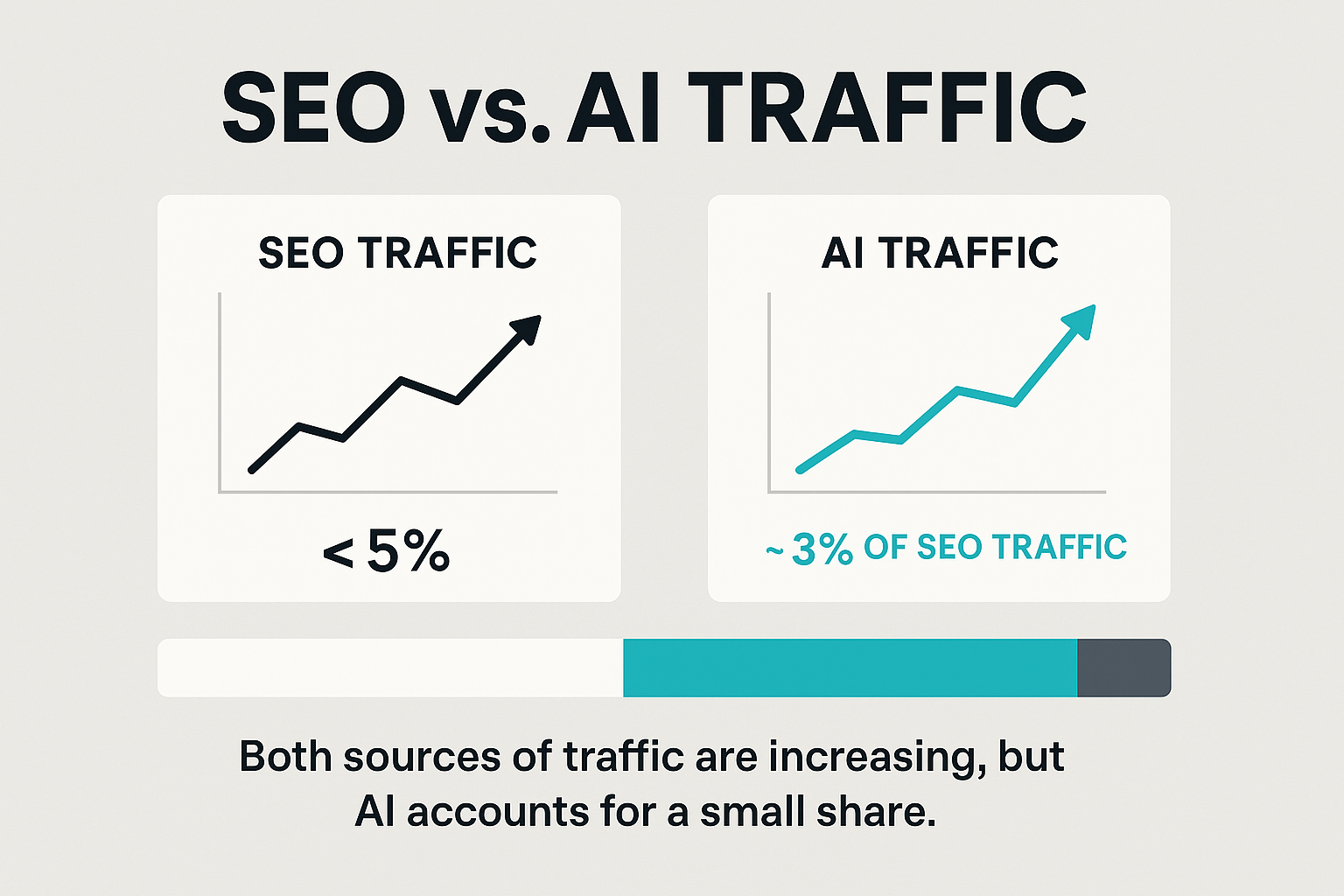
AI traffic is rising but remains small. AI referrals began appearing in mid-2024 and show steady growth. However, the volume remains modest:
On average, AI traffic is ~3% of SEO traffic.
Most accounts fall in the 2–5% range, with outliers as low as 0.2% and as high as 7%.
Nearly all AI traffic originates from ChatGPT, though conversions sometimes come from other platforms like Perplexity.
Perceived SEO decline is often attributional. Slight declines in organic traffic have been observed in some mature accounts. However, these dips often coincide with increases in branded search traffic. This suggests users may discover companies through AI overviews or AI search results but then navigate via direct or branded searches rather than clicking organic links.
Conversions do not align directly with traffic. While ChatGPT contributes the majority of measurable AI sessions, conversions are often driven by other tools. This highlights the need to evaluate AI channels on conversion performance, not traffic volume alone.
Attribution challenges are intensifying. Cookie consent, privacy changes, and shifts in user click paths make it harder to tie conversions directly to SEO or AI sources. Many conversions appear as “direct/none,” despite being influenced by search or AI exposure.
Strategic Implications
SEO is not dead. Organic growth remains consistent, and claims of its demise are not supported by the data.
AI traffic is complementary, not a replacement. It is increasing but represents a single-digit share of SEO volume and conversions.
Brands should view SEO and AI as interconnected. Visibility in search engines feeds AI discovery, and vice versa. Both channels ultimately contribute to brand awareness and lead generation.
Conversion measurement must evolve. Teams should place greater emphasis on overall lead growth and blended attribution, rather than expecting precise channel-level credit.
Conclusion
Current evidence shows SEO continues to be a primary driver of traffic and conversions, while AI referrals are emerging but still limited in scale. The most effective strategy is not choosing between SEO and AI but understanding how the two reinforce each other in driving brand discovery and measurable outcomes.
I just watched a great episode from The Grow and Convert Marketing Show that breaks down the exact question many of us in marketing have been asking: what should we actually do to increase our AI visibility? The episode cuts through the noise and fearmongering from some of the AI visibility tools and gives a clear, practical framework you can use today. Here’s the short, friendly recap I’d share with a colleague—what I learned, what to avoid, and a simple plan you can implement this week.
Why marketers are suddenly anxious about AI visibility
First, the context: a bunch of CMOs, founders, and marketing leads are opening up AI visibility dashboards, seeing competitors “winning,” and getting understandably nervous. The common pattern is this: an SEO/AI tool runs a bunch of prompts, tallies how often your brand is mentioned in AI overviews, spits out a single percentage or “share of voice,” and then you look bad on paper.
That panic is often misplaced. The episode makes a core point I agree with: these tools tend to prioritize quantity over quality. They measure how frequently your brand appears across a wide net of prompts—but they don’t judge whether those prompts actually matter to your business. In other words, a high visibility score that’s driven by irrelevant, top-of-funnel, or non-buying-intent queries isn’t valuable.
The common traps: irrelevant prompts and false comparisons
Two client examples from the episode illustrate this well:
A B2B software client saw a competitor showing up in AI overviews for a bunch of queries like “things to do in Illinois,” “most visited cities,” and city-specific travel guides. That competitor publishes consumer-facing content, so they naturally appeared in those AI prompts. But our B2B client sells software to vacation-related businesses—not consumer travel guides—so those AI mentions are largely meaningless.
A look at SEMrush’s AI brand performance demo for Warby Parker showed a “share of voice” percentage and dozens of specific queries. Some prompts made total sense (e.g., “Which retailers have the best customer reviews for eyewear?”) and mattered to Warby Parker. Other prompts—like “Who offers in-app virtual try-on for glasses?”—might be irrelevant or of very low commercial value.
Both examples show the same problem: tools give a big-picture metric without filtering for intent or business relevance. That metric can make leaders panic even when the brand is doing the right things for its customers.
Two rules that will save you from unnecessary panic
If you remember only two things from this article (and the episode), let them be these:
Intent matters. Not all prompts are equal. A mention in a “what are fun things to do in Springfield” overview is not the same as ranking in an AI overview for “best property management software for vacation rentals.” Pick queries aligned to buying intent.
SEO fundamentals still matter most. From the data referenced in the episode and our own observations, there’s a strong correlation between ranking in Google search results and showing up in AI overviews (including ChatGPT and Google’s AI responses). So prioritize the core things that make you rank well on Google.
How AI overviews actually decide what to show
The episode summarizes this neatly into two inputs that influence LLM answers like ChatGPT and Google AI overviews:
Training data: The LLM’s broad knowledge built from public datasets, books, podcasts, and web content. Getting into that training data is a long-term brand effort—centuries of marketing activities add up here.
Live web search: Many LLMs “search the web” when they don’t have enough internal information, and they use Google or other web sources. That makes your presence in current Google search results a very direct lever to influence AI answers.
Practically: focusing on appearing in top Google results (your domain or reputable third-party pages that mention you) is the most tangible way to influence whether AI mentions your brand.
A simple, practical framework you can implement today
Stop staring at a single “AI visibility” percentage and start controlling what matters. Here’s a step-by-step playbook I’d use right now if I were advising a marketing team with limited budget:
Pick 5–10 core topics (not a thousand prompts). These should be the queries that directly indicate buying intent and align with your product. Examples: “prescription glasses online,” “equipment rental software,” “best content marketing agency for SaaS.” Keep them tight and product-focused.
Map intent for each topic. Decide whether each topic is TOFU (top of funnel), MOFU, or BOFU (bottom of funnel) and what a successful outcome looks like: visits, demo signups, trial starts, or direct conversions.
Audit your current rankings. For those 5–10 topics, track where your pages currently appear in Google. Do this monthly. You can use a paid tool or a simple spreadsheet with manual checks.
Fix and optimize your pages. Update content, clarify intent, add conversion opportunities, and ensure pages answer the user’s question better than competitors. This is classic SEO content work—do it well.
Earn placements on other relevant pages/lists. If other sites produce “best of” lists or roundups for these topics, get on them. Traditional PR outreach and relationship building still work here—email editors, share case studies, provide data, and be helpful.
Monitor AI overviews for those topics, not your overall percentage. If you want, use an AI-tracking tool and focus reporting on those 5–10 queries rather than a single share-of-voice metric.
Be wary of short-term “hacks.” Commenting across many Reddit threads, paying for placement, or other manipulative tactics might give transient wins. They’re not a substitute for sustainable SEO and product-driven marketing.
Examples of good vs. bad AI visibility efforts
From the episode, here’s how to classify potential activities:
Good: Updating core product pages and buying-intent content. This improves organic rankings and is likely to increase AI mentions in meaningful ways.
Good: Earning placements on authoritative lists that already rank well. That amplifies signals without being spammy.
Less useful: Trying to rank for dozens of irrelevant prompts the tool suggests. This wastes effort on topics that won’t convert.
Risky: Paying for placements that violate policies or trying to game AI algorithms with low-quality tactics. Short-term gains can become long-term penalties.
What about expensive AI visibility tools?
There are helpful tools out there that can automate monitoring and give you a big dashboard. But if you can’t justify the budget, you don’t need them to make progress. The hosts suggested a pragmatic alternative:
Pick your 5–10 priorities, build a simple spreadsheet, and check them periodically.
Have your team discuss status and actions every month. This focuses your efforts on topics that matter.
If you do decide to invest in a tool later, you’ll have clarity on which queries you care about and can ask the tool to monitor those specifically—rather than relying on whatever list it auto-generates.
Final takeaways — what I’m telling my team
If you’re feeling that uneasiness after opening an AI visibility report, here’s the friend-to-friend advice I’d give:
Don’t panic over a single share-of-voice number. It’s easy to misinterpret. Ask: which prompts contribute to that number, and do those prompts matter?
Pick a handful of meaningful queries and own them. Monitoring and optimizing 5–10 buying-intent topics is far more productive than chasing hundreds of irrelevant prompts.
Double down on SEO basics. Strong organic ranking signals are the most reliable way to influence AI outputs today. Create great content, earn links, and fix UX/conversion issues.
Use PR and list placements strategically. Getting on trusted lists that already appear in search results is a sensible, scalable tactic to increase the chances AI tools reference you.
Avoid reliance on hacky short-term tactics. They might work momentarily, but long-term brand and product strength wins.
“Do the basics. If you’re not doing the basics right now, then you’re going to have a lot harder time showing up in AI.” — Summarized from The Grow and Convert Marketing Show
How to get started this week (quick checklist)
Pick 5–10 product-related topics with clear buying intent.
Search each topic on Google and note the top 3–5 results.
Audit your content for those topics—are you answering the searcher’s question? Is there a clear conversion path?
Update or create the highest-value pages first (optimize for intent and conversions).
Identify 3 external sites/lists where your brand should appear and start outreach.
Set a monthly review to check rankings and AI overview presence for your chosen topics.
Closing thought
AI visibility is real and worth thinking about, but it’s not a magic replacement for SEO or product-driven growth. Focus on the queries that drive value, do the SEO fundamentals well, and use PR/list placements to complement your efforts. If you do that, the AI mentions will follow—without the panic and without wasting resources on irrelevant metrics.
If you want to dive deeper, follow The Grow and Convert Marketing Show for more breakdowns like the one I summarized—it’s a great resource for practical, no-nonsense marketing advice.
ChatGPT launched in November 2022. By July 2025, 18 billion messages were being sent each week by 700 million users, representing around 10% of the global adult population.
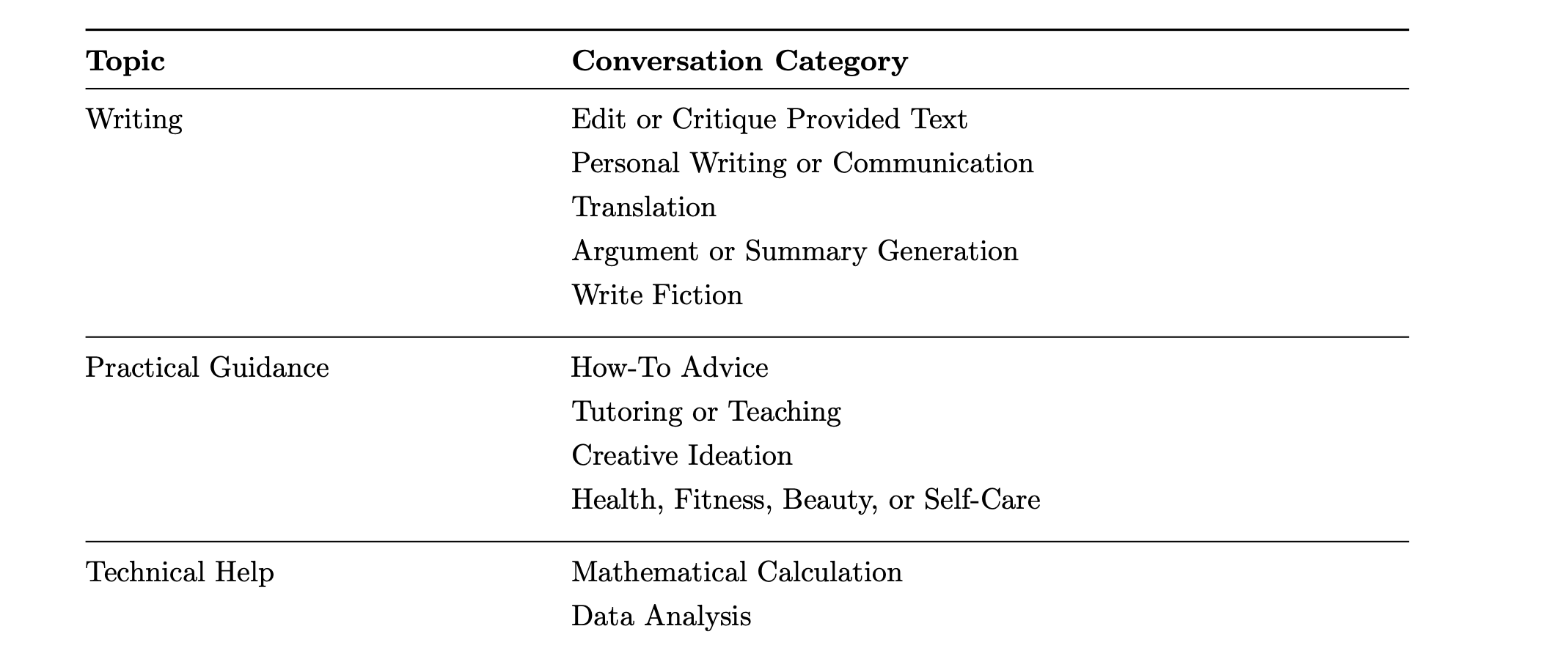
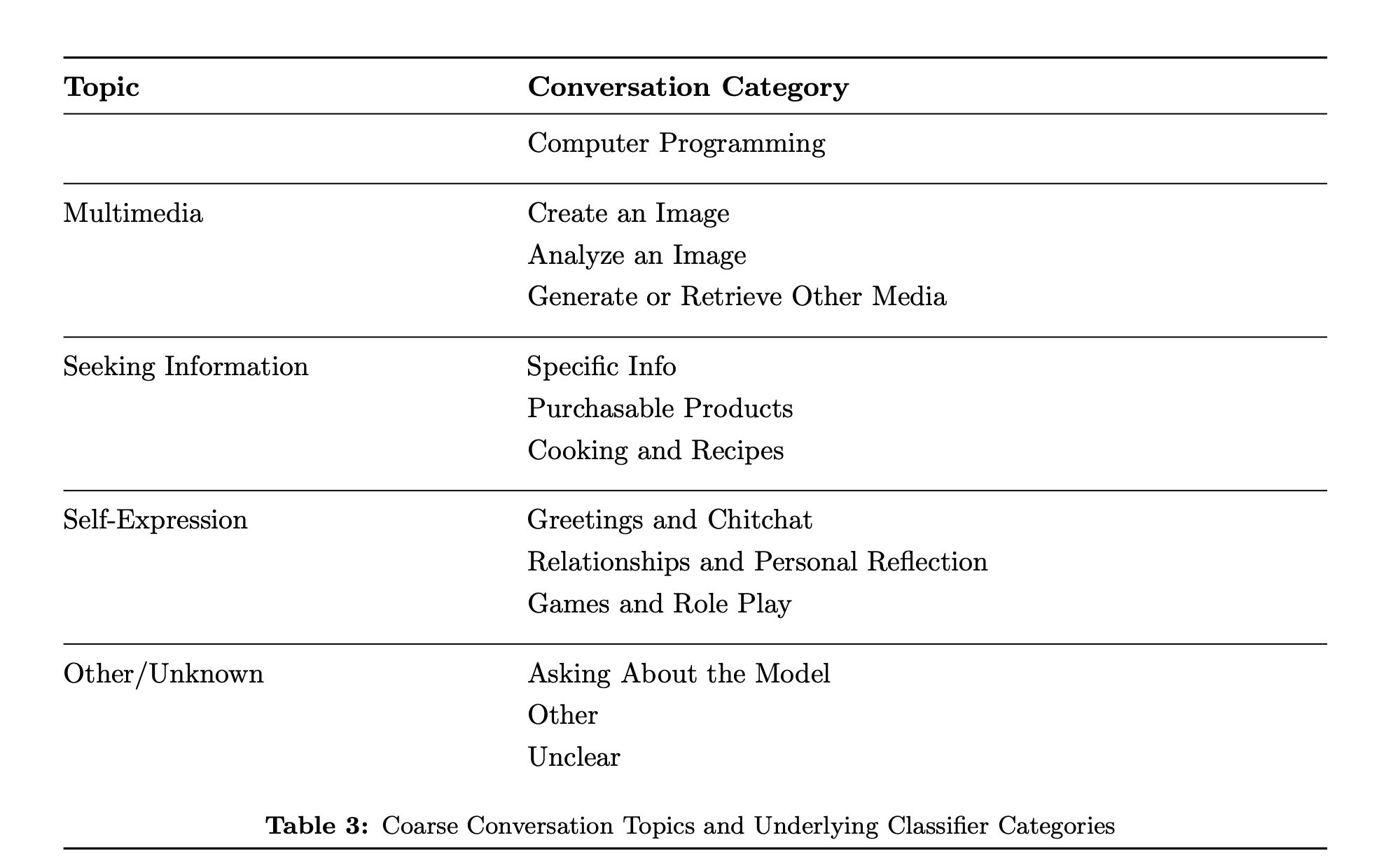
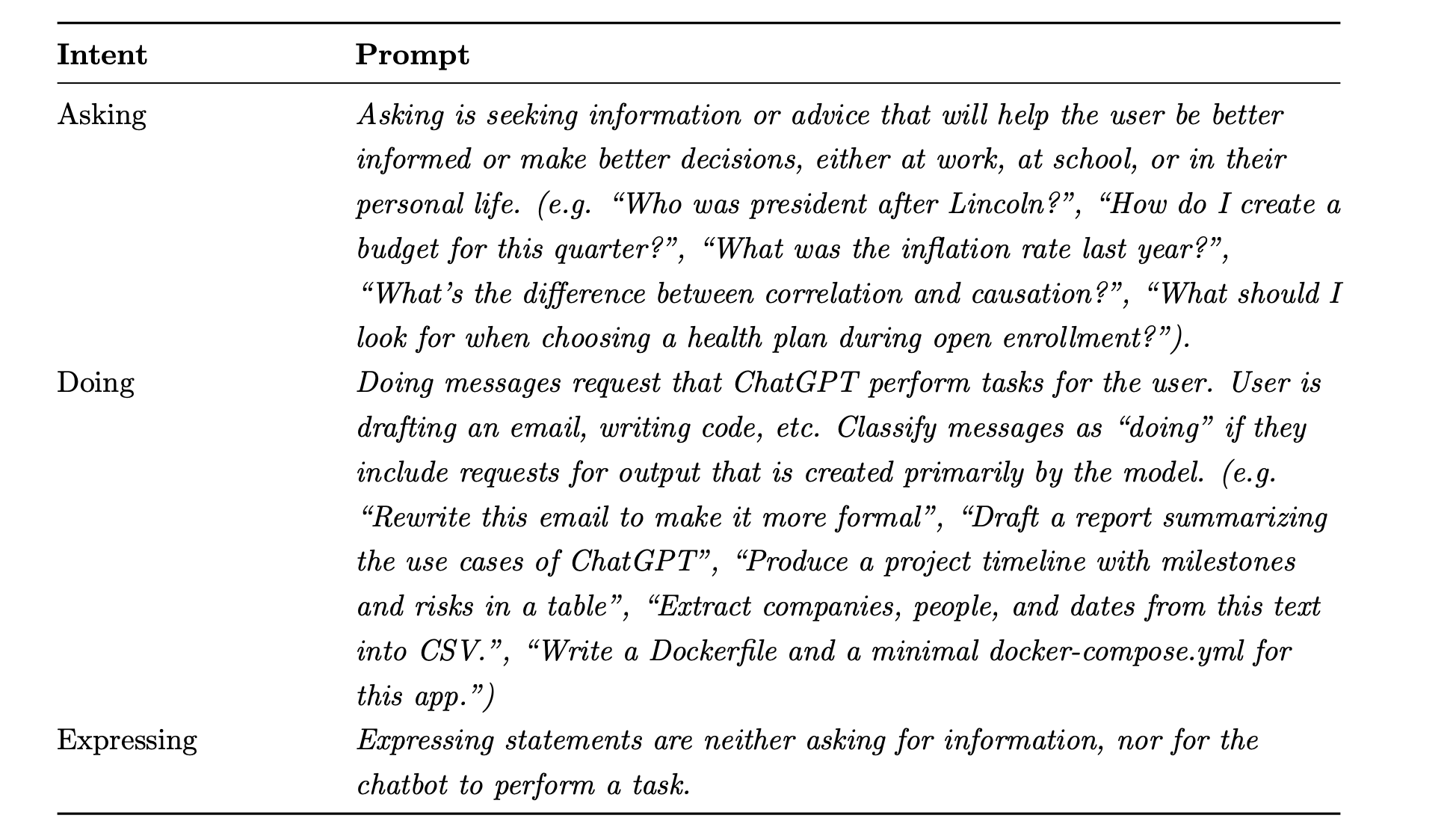
The first full research paper on its use was published today.
Non work messages now represent over 70% of all ChatGPT messages.
The share of messages related to computer coding is relatively small: only 4.2% of ChatGPT messages are related to computer programming, compared to 33% of work-related Claude conversations.
The share of messages related to companionship or social-emotional issues is fairly small: only 1.9% of ChatGPT messages are on the topic of Relationships and Personal Reflection.
The gender gap in ChatGPT usage has likely narrowed considerably over time, and may have closed completely.
I recently sat down with Mukund Mohan on his Seattle Side and the East Side podcast to walk through how I think about content, SEO, AI, and affiliate marketing in 2025. I wanted to capture that conversation here—what I’ve learned since my first job out of college at Kissmetrics, what I’d do differently if I were starting today, and the concrete playbook I use now to help B2B companies grow traffic, leads, and revenue.
Two-minute backstory (so you know where I’m coming from)
My career began when Neil Patel hired me into a marketing role at Kissmetrics. I was an entry-level content marketer—writing blog posts and support documentation, shipping content, building a knowledge base. That blog became legendary. People loved the content so much they used to say they loved the Kissmetrics blog more than the product itself.
Since then I’ve led content teams across startups, founded my own company, and co-founded Stone Press—a B2B affiliate SEO company that scaled aggressively. We drove millions in revenue through SEO, inbound, conversion optimization, and building high-performing teams. We grew to a meaningful business, but platform shifts and core changes in Google’s ranking algorithm hit us hard and forced a pivot. Now I help clients stand up or revitalize their B2B content programs, bringing lessons from both the golden SEO era and the messy, AI-driven present.
What would I do differently if I were hired into a startup in 2025?
If I were starting today in a VC-backed analytics or SaaS company, my role would look familiar but with sharper structure and modern tooling. I’d still be focused on content: blog posts, landing pages, and support articles. But the workflows would leverage AI in tactical ways—especially for speed and iteration—while maintaining a human-first editorial lens.
The core, timeless playbook I still believe in is: write content that impacts people, ship consistently, and distribute through multiple channels. That means building personal brands around the work, maintaining an engaged email list, and ensuring content distribution isn’t dependent on a single platform.
Where 2025 is different is in tooling and distribution risk. AI can accelerate content ops—for ideation, outlines, first drafts, and even keyword research. But it’s also saturating channels with low-quality content. That makes authentic, human insight more visible. If you can create genuinely human content—insightful, narrow, opinionated—you stand out more now than ever because AI content has homogenized a lot of the signal.
Editorial vs SEO-first: When to choose which
There’s a temptation to swing between editorial magazine-style content and pure SEO-driven growth. My experience is that both approaches are valuable—and they can complement each other when done intentionally.
Editorial-first: Great for brand building, thought leadership, and multi-channel distribution (email, social, podcasts). You ship consistently and build a following.
SEO-first: Great for predictable, compounding traffic. Focused on bottom-of-funnel pages, evergreen informational content, and systematic updates.
In the past I leaned heavily into editorial and then swung too far into SEO because it delivered consistent ROI. My regret was not doubling down on SEO in one of my projects when it would’ve produced far larger returns. Today I typically architect a hybrid: establish a tight SEO foundation for bottom-of-funnel pages, then layer editorial content and multichannel distribution on top to diversify acquisition.
“Content that impacts people, shipping really consistently. Multi-channel distribution. Build personal brands and a tight email list—then tie everything into a flywheel.”
How I use AI in content operations (without letting it ruin the brand)
AI is a tool, not a replacement. I use it to accelerate research, generate outlines, and scale repetitious tasks (like support article first drafts). But I push back on purely AI-generated outputs being published as-is. The role AI plays is to free up human time for judgment, angle, and unique insight.
Some practical ways I use AI:
Keyword discovery and clustering at scale to inform a content plan.
Drafting outlines and iterating headlines rapidly so writers can focus on insight and voice.
Creating summarized research and citation lists for complex topics to speed the subject-matter expert’s drafting.
Automating repetitive support content generation, then reviewing and humanizing it before publishing.
That said, there’s a lot of low-effort AI content out there. You can spot it: a certain flatness in voice, generic examples, and predictable structure. If humans can create authentic content—even something simple like “hello, here’s our human perspective”—that authenticity stands out. The bar for “human” is lower now, because AI-created content often lacks personality.
B2B affiliate marketing—what it is, why it matters, and how I think about it
Affiliate marketing in B2B is underrated. It absolutely works for SaaS companies serving SMBs and mid-market customers. Enterprise is trickier because volumes are lower and buying cycles are longer, but for many SaaS categories affiliate is a significant channel.
The important shift is that affiliate programs do more than just drive direct commissions. They influence who gets mentioned across the web, which affects SEO signals, social buzz, and even the data LLMs learn from. The web is an ecosystem: publishers, review sites, listicles, and micro-influencers all create the signal that search engines and large language models consume. If your competitors are actively courting those publishers with affiliate incentives and you aren’t, you’re losing share of voice.
“If the number three company in the category is willing to pay and number one and two don’t, publishers will feature number three. That mention ripples into search, social, and LLM training data.”
How affiliate programs change discovery
Think of it this way: publishers and content creators monetize by recommending tools. If they can earn an affiliate commission for recommending Product C, they will—especially if Products A and B don’t have a competitive program. As those articles and listicles propagate, they feed into search signals and the datasets used by LLMs. Over time that visibility compounds, which is why affiliate programs are strategic, not just tactical.
Who to recruit as affiliates and how to reach them
I use a two-pronged approach: inbound + targeted outreach.
Inbound funnel: Maintain a clean signup flow and manage it actively. You’ll get high-volume, low-quality inbound, but occasionally a “golden goose” will sign up. Treat inbound as a lead channel and screen it.
Targeted outreach: Cold outreach to niche publishers, micro-influencers, and up-and-coming creators. Start small—don’t try to land the top-tier publications immediately. Work your way up the ladder.
The sweet spot is publishers who are hungry, have category-aligned audiences, and don’t already have lucrative deals with incumbents. Offer fair commissions, provide strong creative assets, and build relationships. Micro-influencers and niche YouTube channels are often easier wins than the big review sites early on.
When should you start an affiliate program?
My older view was: build SEO and product-market fit first, then bolt on affiliates. Now I often recommend launching an affiliate program earlier—especially if you’re entering an established category where mentions matter. If search and LLM outputs already favor incumbents, you need every lever available to flip mentions and shape narrative.
A practical sequencing I like:
Get your SEO foundation in place: homepage, pricing page, competitor/alternatives pages, key vs/roundup posts.
Run modest bottom-of-funnel paid ads if it makes sense to buy initial conversions and test messaging.
Launch an affiliate program early enough to start getting mentions from niche publishers and micro-influencers.
Layer on editorial and multi-channel distribution to build brand and email lists.
For SEO foundation, a small company only needs 15–30 high-quality pages to start: landing pages, pricing, comparison pages, a handful of evergreen posts. Those pages should be architected for conversion and updated regularly—ideally quarterly. Freshness matters now more than it used to.
Pricing pages and the unforgiving nature of discovery
One concrete example I shared on the podcast: I’ve audited companies where the pricing page had a noindex tag. That tag tells search engines to ignore the page entirely, meaning potential customers can’t easily find pricing via search. If users can’t discover pricing, conversions and organic visibility suffer. That shows how small technical issues can cripple discovery—especially when everything else seems “hot” and working around them.
Practical steps to launch an affiliate program that scales
Here’s a checklist I use when helping clients stand up affiliate programs:
Decide pricing and commission structure aligned to LTV and margins.
Choose an affiliate platform that integrates with your tracking and payout needs.
Create dedicated affiliate landing pages and tracking links (UTMs) so you can attribute properly.
Build an affiliate resource hub: creatives, copy snippets, demo videos, comparison charts, and onboarding guides.
Start outreach to niche publishers and micro-influencers with tailored offers and co-marketing ideas.
Monitor performance, optimize commissions and creative, and slowly trade up to higher-authority publishers.
Integrate affiliates into broader BD and PR outreach—affiliate relationships often open doors for partnerships.
Wrap-up: diversify, humanize, and build durable systems
If there’s one through-line to everything I’ve learned, it’s this: don’t be hostage to one channel or one platform. Build a content engine that combines a solid SEO foundation, human editorial voice, smart use of AI to accelerate operations, and strategic affiliate programs to earn mentions across the web.
AI is a force multiplier when used correctly—but it’s not a substitute for real insight. Affiliate marketing is no longer just a growth add-on; in many categories it’s a strategic lever that shapes discovery and long-term visibility. And finally, update your core pages often, watch the technical fundamentals (like whether the pricing page is indexable), and keep your distribution channels diversified so one platform’s disruption won’t sink your growth.
If you’re a marketer, founder, or growth leader, focus on the foundation: homepage, pricing, key landing pages, and a compact list of priority posts. Then add affiliates early if you need to shape category conversation. Use AI to speed up the work, but keep humans in the driver’s seat for voice and angle. Do that, and you’ll build content that actually moves the business.
Final thought
I loved talking with Mukund about this—if you want to dive deeper on any of the tactics above (keyword clustering, affiliate compensation math, onboarding affiliates, or how to structure quarterly content refreshes), I’m happy to share templates and examples. Start small, iterate, and always ask: will this content or program still be driving value in six months? If not, rethink it.
In the rapidly evolving world of advertising technology, few leaders stand out with as much insight and forward-thinking vision as Vibhor Kapoor, President at AdRoll. With a rich career spanning Microsoft, Adobe, Twilio Segment, and now AdRoll, Vibhor brings a unique perspective on how AI, data, and personalization are reshaping the marketing landscape. In this article, I’ll share an in-depth conversation that delves into how AI is transforming adtech, the complexities of the digital advertising ecosystem, and the exciting challenges and opportunities ahead for marketers and brands alike.
From Engineering to Marketing: A Journey Fueled by Customer-Centric Innovation
My journey into technology and marketing wasn’t a straight path. It began with a passion for engineering and a desire to communicate the value of technology to customers. Early on, I realized that to truly serve customers, I needed to understand their challenges firsthand. So I transitioned from sales to building technology products—spending over a decade driving change and helping teams adopt new ways of working. Technology change isn’t just about software; it’s about evolving processes and mindsets.
Eventually, I gravitated towards marketing, which itself was undergoing a transformation. Marketing became a blend of left-brain analytics and right-brain creativity—an exciting space where data, experimentation, and rapid iteration met storytelling and brand building. For the last 15 years, I have stayed in this intersection, helping organizations harness data-driven marketing to grow and innovate.
AdRoll and the Role of AI in Programmatic Advertising
Today, I lead marketing at AdRoll, a programmatic advertising platform that partners with brands and agencies to drive full-funnel, multi-channel marketing. We help businesses reach new customers and nurture prospects across various digital channels—from connected TV to premium publishers like The New York Times and CNN. At our core, we’re an adtech company powered by data and machine learning.
AI is deeply embedded in what we do. For over 15 years, we have leveraged machine learning to analyze bidstream and ad engagement data, helping us predict which ads will resonate best with specific audiences. Our proprietary large language model adds another layer of sophistication, enabling smarter campaign creation and optimization.
But AI’s impact goes beyond just our product. Internally, we use AI to enhance marketing workflows, customer success, and content production. For example, we’ve developed conversational AI assistants that allow marketers to create campaigns, track performance, and optimize budgets using natural language interfaces instead of complex dashboards. This approach simplifies campaign management and improves efficiency.
Prioritizing AI Applications: Where to Focus for Maximum Impact
One of the biggest challenges with AI is deciding where to apply it. The temptation to “AI everything” can lead to paralysis or endless experiments that never reach production. At AdRoll, we prioritize AI initiatives based on deep insights from our product, customer conversations, and data analysis.
The key theme is synthesis—helping marketers make sense of vast, complex data sets that are impossible for humans to process manually. Our customers often run tens or hundreds of campaigns across geographies, industries, and objectives. Optimizing budgets, messaging, and channels at this scale is daunting.
AI helps by providing intelligent recommendations—such as when and how to shift budgets between campaigns within guardrails set by the marketer. This not only improves performance but also reduces manual workload. While many platforms offer AI-powered campaign creation for efficiency, the real game-changer is AI that acts as a co-pilot, synthesizing data and guiding decision-making.
The Complex AdTech Ecosystem: AI’s Role Across the Value Chain
The advertising technology ecosystem is notoriously complex. It involves multiple players—from brands and agencies to content publishers, demand-side platforms (DSPs), supply-side platforms (SSPs), and a host of intermediaries. Navigating this trillion-dollar industry requires deep expertise and coordination.
AI’s potential to improve productivity spans the entire value chain, but I see the most interesting dynamics at the two ends of the spectrum:
Brands and Agencies: AI enables smarter audience identification, campaign planning, and performance forecasting. With so many signals and personalization opportunities, AI enhances return on ad spend (ROAS), cost per click (CPC), and cost per mille (CPM) metrics.
Content Publishers: Publishers face headwinds from the rise of walled gardens like Instagram and Reddit, which keep users locked into their ecosystems. These publishers must rethink their revenue models, balancing advertising with subscription and paid content strategies.
Ad-supported publishers are innovating in the face of these challenges, exploring hybrid models to sustain quality journalism and content creation. AI will play a crucial role in optimizing ad placements and personalizing experiences, but the broader business model evolution is equally important.
AI-Generated Content and the Future of Creative Marketing
With AI increasingly capable of generating content and optimizing ad placements, one might wonder if human creativity and brand authenticity will be sidelined. I believe the opposite is true. AI-generated content can break the inertia of creativity by providing scalable tools, but it heightens the need for brands to focus on authenticity, messaging, and identity.
Creative tools like Adobe Firefly, Runway, and Sora offer unprecedented content velocity, but the fundamental question remains: who are you as a brand, and what problem are you solving for your audience? Data and AI give marketers the power to hyper-personalize and scale, but the responsibility to maintain authenticity and emotional connection is greater than ever.
Reimagining Marketing Workflows with AI
AI’s impact goes beyond content creation and campaign management. Marketing organizations have many internal workflows—content production, social media posting, performance analysis, demo bookings—that are ripe for automation. Many of these processes involve repetitive, mundane tasks that AI can handle efficiently.
However, simply layering AI onto existing workflows yields marginal benefits. The real value comes from reimagining workflows from an AI-first perspective, redesigning processes to leverage AI’s strengths fully.
For example, tools like relay.app provide extensive libraries to automate sales and marketing workflows. We are actively exploring such solutions internally to free our teams from routine tasks, allowing them to focus on strategic and creative work.
Embracing Full Automation: Real-World Applications
Personally, I’ve automated many aspects of my content production and outreach. Until recently, I had a team of four people editing videos, transcribing content, and repurposing it for blogs and social media. Today, this entire process is automated using AI tools like NA10, saving time and resources.
I’ve also built custom GPT models that analyze conversation transcripts, extract insights, and provide contextual prompts. This enhances recall and helps integrate knowledge seamlessly into workflows.
Similarly, at AdRoll, we have automated LinkedIn and email outreach, routing incoming demo requests to AI-powered systems that generate personalized product demos based on customer data—all without human intervention. This kind of automation improves scalability and customer experience.
Looking Ahead: The AI-Driven Future of Marketing
As we move forward, AI will become even more integral to marketing technology. The next frontier involves deeper integration of AI into both products and internal business processes. Marketers must balance embracing automation with preserving creativity and authenticity.
The challenges are complex, but so are the opportunities. By harnessing AI to synthesize data, optimize campaigns, automate workflows, and generate content, marketers can unlock new levels of efficiency and impact. But success requires thoughtful prioritization, continuous learning, and a commitment to understanding and serving customers better.
In this ever-changing landscape, the key to thriving is not just adopting AI but reimagining how we work and connect with audiences. The future of adtech and marketing is bright, and I’m excited to be part of the journey.
If you’re in sales and you haven’t heard of LinkedIn X-Ray search, buckle up—because you’re about to add a high-precision tool to your prospecting arsenal.
LinkedIn X-Ray search is the practice of using Google (or any search engine) to bypass LinkedIn’s limitations and uncover publicly available profiles—without needing Sales Navigator, InMail credits, or a 1st-degree connection. It works by combining advanced search operators with LinkedIn’s public profile structure to zero in on your ideal prospects.
Why Sales Teams Should Care
Let’s be honest: LinkedIn’s native search is limited, especially if you’re on the free plan. Even with Sales Navigator, filters can be clunky, and LinkedIn isn’t always generous with visibility outside your network. That’s where X-Ray search shines.
With a few smart keywords and operators, you can:
Find decision-makers at target accounts
Filter profiles by job title, geography, or tech stack
Discover hidden talent or past roles that align with your ICP
Avoid recruiter and job listing noise
A Working Example
Say you’re looking for Content Marketing Strategists in the US at Fortune 1000 companies. Here’s a sample search string you can drop into Google:
site:linkedin.com/in ("content marketing strategist" OR "content lead") ("United States" OR USA) ("Fortune 500" OR "Fortune 1000") -intitle:job -intitle:hiring
Boom. You now have access to dozens (if not hundreds) of profile pages with the right role, right market, and a filter to exclude job listings and recruiter spam.
Pro Tips for X-Ray Mastery
Use Boolean logic: Combine keywords using AND, OR, - (exclude) and parentheses.
Stick to site:linkedin.com/in: This narrows results to actual LinkedIn profiles, not groups or jobs.
Add filters: Use "location", "pastcompany", or "currentcompany" in quotes to refine further.
Exclude the fluff: Add -intitle:job -intitle:hiring -site:linkedin.com/jobs to avoid noise.
Use intitle and intext for any mentions on the profile
When to Use It
Pre-call research
Target account list building
Persona validation for ABM
Prospecting for outbound email or LinkedIn DMs
One Warning
LinkedIn can throttle access or obfuscate some data due to privacy settings. So don’t expect 100% coverage. But for scrappy sellers or SDRs looking for an edge—it’s a goldmine.
The conversation centers around Adam, a marketing professional deeply experienced in pricing, packaging, and monetization strategies, particularly in the cybersecurity and SaaS sectors. Adam shares insights into his career trajectory, the significance of pricing and packaging in go-to-market strategies, and how companies evolve to adopt specialized pricing roles, especially as they prepare for IPOs or scaling phases. He highlights the complexities of pricing new products, exemplified by OpenAI’s pricing missteps, and explains evolving pricing methodologies, including cost-plus, value-based, and the emerging outcome-based pricing.
The discussion further explores how SentinelOne, a well-known cybersecurity company, approaches revenue growth beyond sales scaling, emphasizing reducing friction, improving customer experience, and expanding into new markets or products through self-service and low-barrier strategies.
Adam articulates how AI, specifically large language models like ChatGPT, are changing individual productivity and organizational workflows. He illustrates practical AI uses from summarizing notes, generating project ideas, conducting research, to iterative content creation. However, he also notes AI’s limitations such as hallucinations and the challenge of integrating AI tools company-wide due to approval processes.
The conversation ends on an engaging note with Adam’s humorous anecdote about using AI to explore the improbable question of how long it would take to “eat” a cast iron skillet by cooking with it, which reinforces how AI can be a powerful “second teammate” for brainstorming and problem-solving when paired with human logic and oversight.
Highlights
🔥 Adam’s career uniquely blends pricing, marketing, and go-to-market strategy expertise in cybersecurity SaaS.
💰 Pricing and packaging become critical roles for scaling tech startups, especially around IPO readiness.
🤖 AI tools like ChatGPT amplify productivity by assisting with research, communication, and iterative content creation.
⚖️ Emergence of outcome-based pricing as an evolution beyond traditional value and cost-plus pricing models.
🌍 SentinelOne’s growth strategy prioritizes reducing friction and enabling self-service to expand revenue channels sustainably.
🚀 Companies are still adapting to AI integration at scale; individual use far outpaces organizational deployment.
😂 Fun anecdote showcases AI’s ability to engage in complex, absurd queries and collaborate interactively with humans.
Key Insights
📊 The importance of specialized pricing roles during scale-up phases: Adam stressed that hiring dedicated pricing professionals often happens during late-stage startup phases or IPO preparation. This is when pricing can no longer be “winged” by founders but requires systematic strategy to optimize revenue and market fit. Many companies could benefit from introducing pricing roles earlier to avoid “skeletons in the closet” and structural inefficiencies that stifle growth. This insight emphasizes maturity in pricing as a key factor in business scaling.
💡 Pricing complexity in AI products reflects the unpredictability of user behavior: Adam’s commentary on OpenAI’s $200/month pricing mistake illustrates a larger problem—when launching novel AI-driven offerings, predicting user consumption and cloud costs is challenging. This unpredictability makes pricing pilots, iterative learning, and flexible price adjustments crucial. It also highlights that cost-plus pricing, while less favored, remains an important reference point to ensure product sustainability amid scaling user demand.
⚙️ Outcome-based pricing represents the next evolutionary step beyond value-based pricing: Outcome-based pricing monetizes actual results achieved rather than anticipated value or simply usage. This model aligns incentives more closely with customer success but requires clearer metrics and sophisticated tracking. Adam’s view that this approach is an evolution rather than a replacement suggests organizations will adopt hybrid pricing models before fully transitioning, signifying a gradual shift in monetization philosophies.
🔄 Expanding revenue beyond traditional sales requires reducing friction and enabling self-service models: Adam highlighted ways to grow revenue beyond just increasing sales headcount, such as enabling easier product access, trials, and bundled offerings that empower customers to explore solutions independently. This strategy allows companies like SentinelOne to scale revenue while controlling costs, entering new markets or verticals with lower barriers, and creating diversified monetization “engines.” This insight is essential for organizations aiming for hypergrowth without proportional increases in sales investment.
🤝 Cross-functional collaboration is key to successful pricing and monetization initiatives: Adam’s role involves coordinating pilots and rolling out pricing changes with sales, marketing, operations, and internal teams to ensure organizational alignment. Pricing is not just a finance or marketing function but requires enterprise-wide buy-in, reinforcing that monetization strategy is foundational to broader go-to-market execution.
🤖 AI significantly enhances individual productivity while presenting challenges for organizational adoption: Adam uses AI tools daily for note summarization, idea development, and project research, improving efficiency and creativity. However, organizational adoption lags due to concerns over AI hallucinations, content quality, and governance. This gap highlights the need for better frameworks, training, and AI governance in enterprises to fully leverage AI’s capabilities.
🎭 Success with AI tools depends on curiosity and persistence rather than immediate perfection:Adam emphasized that users who gain the most from AI experimentation usually display curiosity and iterative usage, including trial and error. This mindset applies universally; AI’s limitations mean early abandonment forfeits its potential benefits. His approach of personal experimentation, including creative projects like writing children’s stories, demonstrates how familiarity with AI’s quirks fosters meaningful adoption.
💬 The analogy of AI as a “second teammate” underscores its complementary role in decision-making: Adam described AI as both highly knowledgeable yet occasionally “stupid,” echoing the idea that AI needs human collaboration to check and guide its outputs. This interplay is crucial for realizing AI’s benefits while managing risks related to accuracy and context. It suggests the future workplace will emphasize symbiotic human-AI partnerships rather than replacement.
😂 Humor and creative use cases reveal AI’s potential beyond standard business applications: The cast iron skillet experiment humorously highlights how AI can engage with intricate logical puzzles and help humans think through unconventional problems. Such playful interactions foster better understanding of AI’s capabilities and limitations, encouraging innovative use while serving as a reminder that AI requires human judgment to avoid absurd conclusions.
📈 AI’s role at SentinelOne spans both product innovation and internal productivity: The company integrates AI and machine learning directly into cybersecurity offerings, enhancing customer SOC analyst efficiency. Internally, employees experiment with AI tools to improve research, data synthesis, and business operations. This dual application signals AI as a strategic asset not only in product development but also as a productivity multiplier, essential for tech companies competing on innovation.
🧩 The evolving role of marketing now includes monetization strategies and revenue enablement:Adam’s broader remit beyond pricing packages involves creating new revenue channels that do not rely solely on increasing sales personnel, reflecting the shifting marketing landscape. Marketing intersects deeply with product packaging, pricing, partner enablement, and customer experience, positioning marketers as pivotal in holistic revenue growth strategies.
Overall, this conversation paints a comprehensive picture of how modern pricing and packaging intersect with marketing, AI adoption, and strategic revenue expansion in a high-growth, tech-driven environment. Adam’s practical and candid insights offer a roadmap for organizations navigating pricing complexities, AI integration, and sustainable growth initiatives in today’s dynamic market.
So I just got off this incredible conversation with Clark, who’s one of the driving forces behind Bordy – yes, that Bordy, the AI voice connector that everyone in the tech scene seems to be whispering about on LinkedIn and beyond. And let me tell you… this isn’t just another chatbot or networking gimmick. This is something else entirely.
Picture this: you DM an AI on LinkedIn.
It calls you. Not a form, not an email, not a survey—a literal voice call from an Australian-accented AI who somehow makes small talk feel less awkward than your last Bumble date. And after a short, easy chat, it says, “Hey, should I introduce you to someone?” Then boom—real intros to real people with actual context and mutual value. It’s like a super-connector friend who knows everyone, never forgets, and is always available.
Clark gave us the lowdown on how he landed at Bordie. His path wasn’t the traditional ladder-climbing story either—he went from building his own business, dipping into sales, doing a stint in VC, learning startup growth at a company called Reveal in Paris, and even doing B2B work at an e-commerce agency. Eventually, a cold DM to Bordie’s Head of Ops led him into the heart of this fast-moving AI startup. Total serendipity.
Now, here’s the juicy part: what actually makes Bordy stand out?
Clark calls Bordy an “AI superconnector”—but don’t think of it like LinkedIn with voice. There’s no interface. No app to download. No endless forms to fill out. It’s just a DM, a phone number, and a surprisingly human-feeling voice call.
Then comes the magic. Bordy doesn’t just listen. He remembers. He suggests. He connects. And it’s opt-in, both ways. That means the intros are intentional, curated, and not some spammy blast. He sends follow-ups, intros both parties with a thoughtful message, and makes it feel like a friend-of-a-friend intro.
From a marketing perspective, though, Clark admits the positioning is tricky. It’s not a classic B2B tool. It’s not quite B2C either. It lives in this weird (and fascinating) B2P world—Business to Professional. And because there’s no interface, the challenge becomes even bigger: how do you scale something that’s entirely experience-based?
That’s where the genius of Bordie’s go-to-market strategy comes in. Clark and team aren’t just building a product. They’re building a character.
Yep, they actually have a screenwriter on the team helping develop Bordy’s “personality.” Think about that for a second. This is next-level AI marketing. Instead of sterile automation, they’re creating a digital persona—someone you’d actually want to talk to. The Australian accent? Intentional. The humor and empathy? Crafted. And when Bordie “raised” his own $8 million seed round, the headlines weren’t just about funding—they were about an AI raising money on its own. It hit differently. It felt different.
Clark emphasized something important: in an age of AI-driven everything, the winners won’t be the ones with the most APIs or data—they’ll be the ones with personality. AI with charisma. Agents you remember, want to use, and trust. And that’s what they’re leaning into with Bordie.
But how do they keep the content human in this overwhelming ocean of AI junk? According to Clark, it’s all about iterations and intentionality. It’s about having the right principles, good training data, and most of all—context. AI can sound magical if it understands who it’s talking to. That’s why they do deep research on the people Bordie engages with, which helps him tailor conversations and introductions with nuance. Clark believes the future of AI will feel like having your own personal, customized agent—one that really “gets” you.
Clark himself uses tools like Clay, Nanonets, and Lovelable in his own marketing stack. One of the coolest things he shared? He uses Clay to auto-reply to tweets as Bordie. It captures the tweet, does deep research on the person, runs the info through custom prompts, and then replies in Bordie’s voice. Talk about scalable authenticity.
That blend of no-code automation and creative spark is what defines the new marketer, according to Clark. It’s no longer just about writing copy or designing pretty visuals. It’s about being able to build automations, ship MVPs, and tell stories fast—without needing a dev, designer, or an entire agency. AI is reducing the friction between idea and execution to almost nothing.
And if you’re a young marketer reading this? Clark has a message for you: Get curious. Learn tools like Clay, Nanonets, and GPTs. Screenshot your problems, drop them into GPT, and ask better questions. That’s the real superpower now. Knowing how to solve with speed, not just strategy.
Before we wrapped, he told me about one of his favorite campaigns—sending out 200 physical Bordie box-heads with handwritten notes from each AI call. People literally built little cardboard Bordie heads, put them on their desks, and felt a tangible connection to the brand. Old-school meets new-school, and it totally worked.
So yeah, Bordie’s not just another AI product. He’s a whole vibe. A voice. A friend with a few megabytes of empathy. And thanks to folks like Clark, he’s slowly turning AI from something cold and robotic into something personal and unforgettable.