
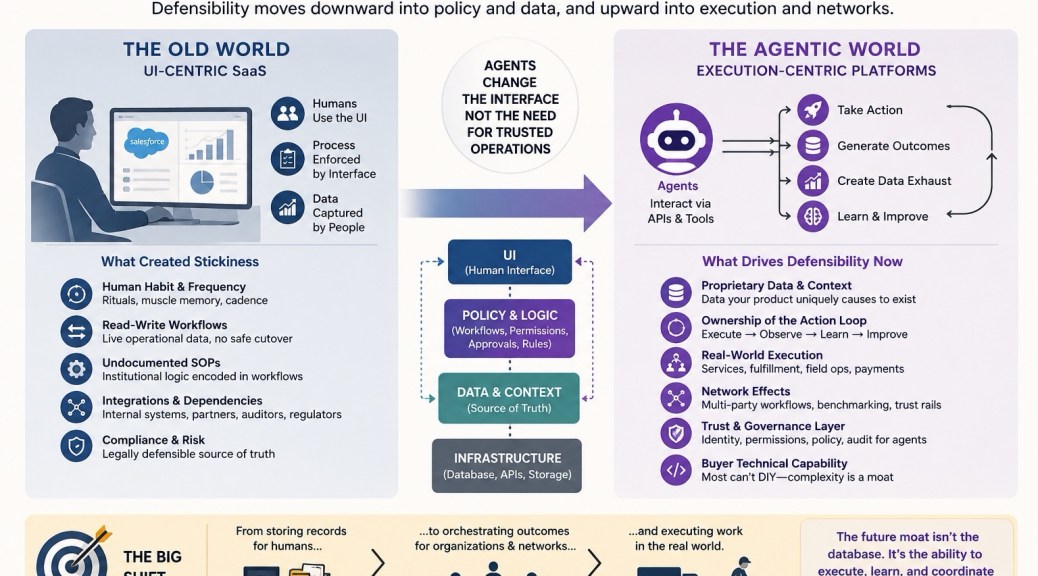
AI and LLMS won’t kill Salesforce or most other SaaS.
First: Salesforce was never “just” the UI. The UI was the enforcement mechanism for structured data capture. That is different. The real moat was always organizational standardization. Salesforce won because entire GTM organizations reorganized themselves around its ontology: Accounts, Opportunities, Stages, Forecasts, Territories, Approvals. The UI enforced compliance with that ontology. Agents weaken the interface advantage, but they do not automatically weaken the organizational ontology advantage. That distinction matters.
Second: “headless” is being overstated across the industry. Most enterprise software already exposed APIs years ago. What is changing is not technical architecture. What is changing is who the primary consumer of the software is. Historically: humans. Increasingly: agents. That is a distribution and interaction shift more than a pure infrastructure shift. Salesforce is effectively repositioning itself from “application employees log into” toward “operational substrate agents execute against.” That is a very different narrative than “Salesforce became headless.”
Third: the deepest moat may not actually be the database layer. It may be the policy layer.
That is the missing insight in most “Postgres + APIs replaces SaaS” arguments.
A surprising amount of SaaS value is not CRUD operations. It is encoded institutional policy:
- who can approve what
- escalation trees
- exception handling
- rollback rules
- auditability
- compliance workflows
- reconciliation logic
- permissions
- temporal sequencing
- coordination between departments
The database is easy. The operational state machine is not.
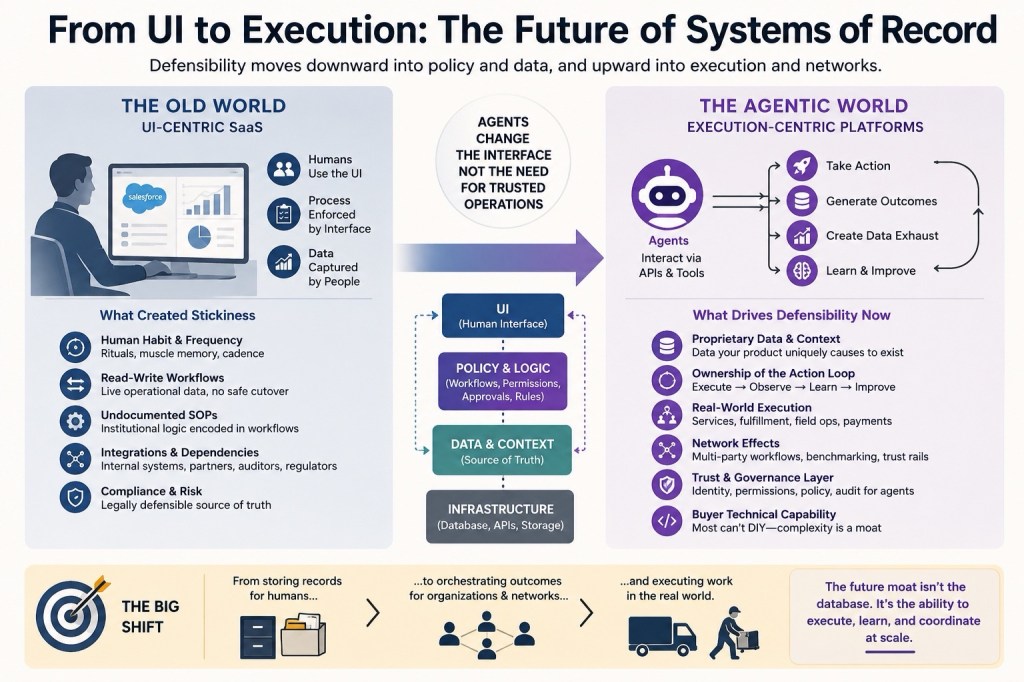
AI lowers the cost of recreating the first 80% of a system of record. The remaining 20% is the moat.
The first 80% is schema generation and workflow reconstruction. The final 20% is operational entropy accumulated over 15 years of edge cases.
That is where incumbents still retain leverage.
The agentic world may compress the distinction between system of record and system of execution.
Historically:
- CRM stored intent
- ERP stored transactions
- Ticketing stored requests
- Humans executed work
In the agentic stack:
- the system stores context
- agents execute
- outcomes become new training/context
- execution exhaust becomes proprietary data
That closed-loop matters enormously.
The future moat is not:
“Who stores the record?”
The future moat is:
“Who observes the action loop?”
That changes everything.
A vertical AI-native field-service platform that:
- dispatches technicians
- observes outcomes
- tracks timing
- handles exceptions
- coordinates payments
- monitors resolution quality
- captures edge-case execution traces
…is building a fundamentally stronger moat than a passive CRM.
Because it generates new proprietary operational data every day.
That is the key transition:
Static data → Dynamic execution exhaust.
Another strong insight: network effects historically being weak in SoRs.
Most enterprise SaaS never achieved true network effects. It achieved switching-cost lock-in masquerading as network effects.
Salesforce did not become more valuable because more companies used Salesforce.
It became harder to leave because:
- integrations accumulated
- process accumulated
- training accumulated
- reporting accumulated
- management rituals accumulated
That is not a network effect.
That is organizational sediment.
Agentic systems may genuinely create network effects for the first time because agents transact across organizational boundaries.
That is a major conceptual shift.
For example:
- procurement agents
- logistics agents
- insurer/provider agents
- auditor/accounting agents
- supplier/manufacturer agents
Once multiple counterparties coordinate through the same execution rails, the software stops being a database and starts becoming market infrastructure.
That is closer to Stripe, Visa, Flexport, DoorDash, or even Bloomberg than traditional SaaS.
DoorDash is actually more profound than it initially appears.
DoorDash’s moat is not “restaurant data.”
It is coordinated operational execution:
- drivers
- routing
- logistics
- dispatch
- fulfillment timing
- marketplace balancing
- payments
- exception recovery
The future durable enterprise platforms likely look more like operational coordination networks than dashboards.
Another thing:
The SaaS seat-license model structurally weakens in an agentic world.
If:
- one agent replaces 20 UI users
- workflows become automated
- human interaction frequency declines
…then charging “per employee seat” becomes increasingly artificial.
This is existential for large enterprise SaaS vendors.
The pricing model likely shifts toward:
- workflow volume
- execution outcomes
- API consumption
- agent transactions
- orchestration complexity
- governance/compliance layers
- coordination rails
That transition is potentially more dangerous to incumbents than the technical transition itself.
Because their valuation multiples were built on predictable seat expansion economics.
The most important sentence in the entire piece may actually be this:
“The data is the context now.”
Yes. But even that understates it.
In agentic systems:
context is memory,
memory drives action,
action generates exhaust,
exhaust becomes proprietary context.
This creates recursive compounding loops.
The strongest AI-native systems will not merely store records.
They will:
- observe workflows
- model workflows
- predict workflows
- execute workflows
- optimize workflows
- benchmark workflows
That is qualitatively different from SaaS.
One final pushback.
You slightly overestimate the speed at which enterprises will abandon incumbents.
Theoretically:
“Postgres + APIs + agents” sounds compelling.
Operationally:
most enterprises cannot even maintain clean Salesforce objects consistently.
The average enterprise is nowhere near capable of safely operating:
- custom ontologies
- agent orchestration
- policy engines
- exception handling systems
- governance layers
- evaluation pipelines
- permission frameworks
- audit systems
Especially outside elite tech companies.
So the near-term likely looks less like:
“Incumbents disappear.”
And more like:
“Incumbents become increasingly infrastructural.”
Salesforce may become:
- the policy layer
- the permission layer
- the audit layer
- the canonical customer graph
…while newer AI-native systems increasingly own execution and workflow intelligence above it.
Which means the interesting startups may not fully replace incumbents initially.
They may parasitize them first.
That is historically how platform transitions usually happen.
Overall, the core thesis is strong:
defensibility moves away from UI habit and toward:
- execution loops
- operational context
- policy orchestration
- proprietary exhaust
- multi-party coordination
- real-world execution
- trust infrastructure
That is the real shift.
And the most important hidden implication is this:
The winners of the agentic era may look less like SaaS companies and more like operational networks.
Discover more from Mukund Mohan
Subscribe to get the latest posts sent to your email.

One thought on “Why SAP and Salesforce won’t die because of AI”
Comments are closed.